Episode 934: Some plans we could spoil

Last Experience

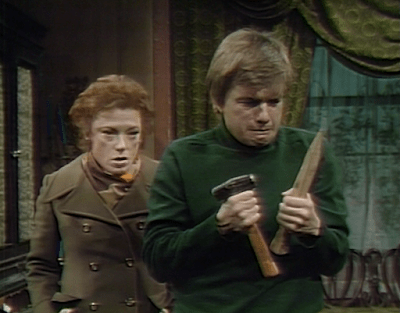
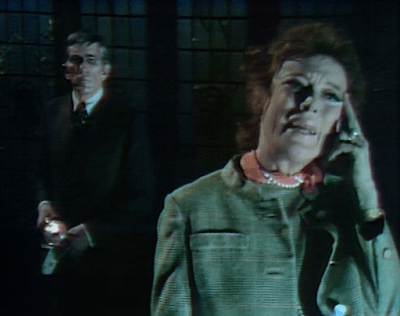
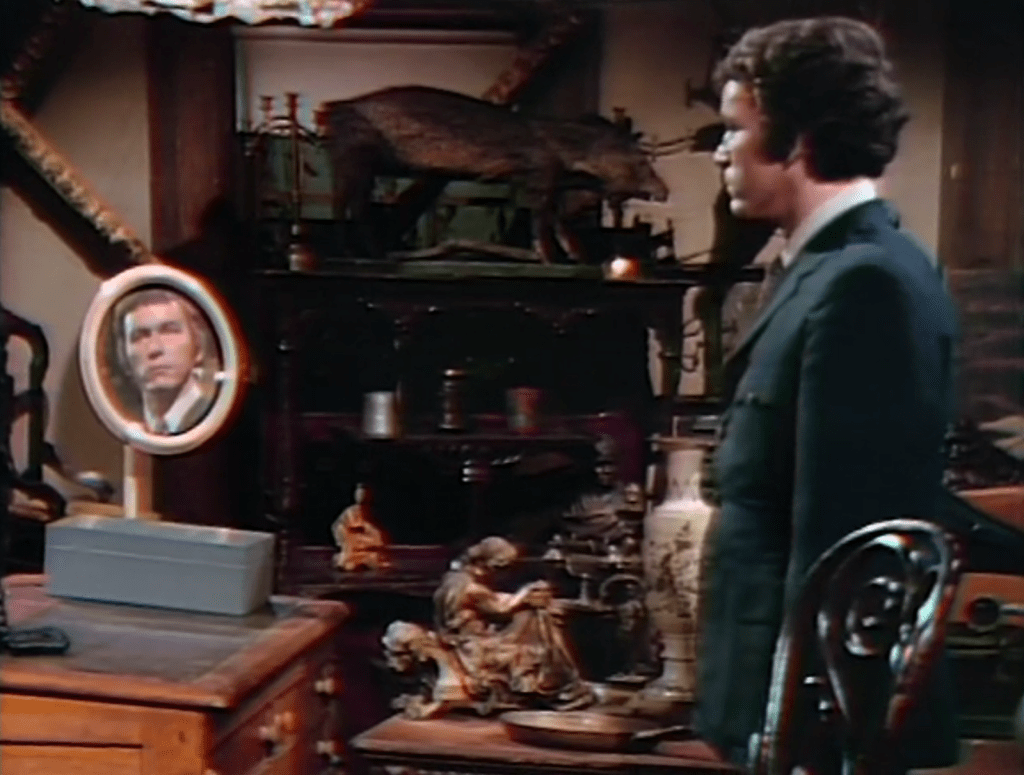
We open with a reprise of the end of yesterday’s episode. Quentin Collins and Amanda Harris are reenacting the myth of Orpheus and Eurydice. As in the ancient Greek story, they will live together if they can escape all the perils on the road from the realm of the dead to that of the living. Unlike that story, they are allowed to look at each other along the way, but they are not allowed to touch.

The teaser ends where Wednesday’s episode ended, with Amanda falling through a gap in a footbridge and Quentin crying out in anguish. After the opening title, we are surprised to find ourselves at the same scene. Amanda is not yet lost. Quentin pulls her up from the ravine she fell into. But that involves touch, so the ceiling of the cavern collapses and buries her. Suddenly, Quentin finds himself lying on the ground, in the upper world, with no sign of any way back to the place from which he just came.

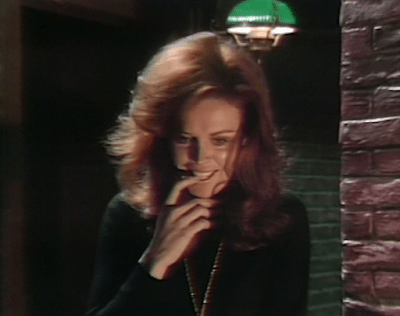
Amanda’s demise marks Donna McKechnie’s final appearance on Dark Shadows. Miss McKechnie left to be in the original cast of Stephen Sondheim’s Company, paving the way for her enormous success on Broadway in the 1970s. Much later, Miss McKechnie would reprise the role of Amanda in a couple of Big Finish Productions’ Dark Shadows audio dramas, and nowadays she appears at the Dark Shadows conventions.

Any account of Donna McKechnie’s last day at 433 West 53rd Street would be incomplete without this story from Hamrick and Jamison’s book Barnabas and Company:

In rehearsal, we went through the scene with a few Styrofoam boulders and a little peat moss, no big deal. Nobody told me there was going to be ten times as much dropped during the taping. So, when it was time to tape the scene, I was looking up, and I just got buried. I got peat moss in my eyes and in my mouth and ears and nose… and I was covered in rocks. The way things worked at the studio, at the end of that scene, the lights went out, and the camera and crew and actors all moved on to the next scene, in another part of the studio. So there I was, laying under all those Styrofoam rocks and peat moss, and nobody helped me get out. I had to dig myself out, and that was my last experience on Dark Shadows.

Craig Hamrick and R. J. Jamison, BARNABAS AND COMPANY: THE CAST OF THE TV CLASSIC DARK SHADOWS (2nd edition, 2012) page 245.

They’ve been doing a bit of videotape editing recently, as several awkward cuts have made clear. One might think that the whole Underworld sequence, pre- and post-title, was edited in from tape left over from yesterday’s shoot. But Miss McKechnie’s story proves that is not so. The episodes were done in sequence, so if the last bit of tape they shot yesterday had been the crushing of Amanda there wouldn’t have been any next scene to run off to and Miss McKechnie would have had plenty of help digging herself out from under.

Some Sort of Monster was After Him

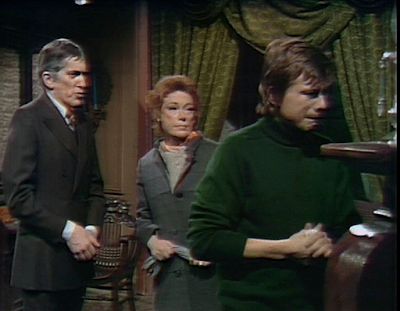
Meanwhile, the sheriff is at the home of occult expert Timothy Eliot Stokes. Stokes and his friend, mad scientist Julia Hoffman, have called him in because a monster wrecked Stokes’ bedroom, in the process killing a man named Paul Stoddard.

No law enforcement officer on Dark Shadows has yet solved a case, and Sheriff Davenport seems likely to prove the most useless member of the fraternity yet. At no point does he interrogate Stokes and Julia, or even show much interest in what they were doing while Paul was being killed. He refuses to believe Julia when she says that he should be looking for a monster, even though Collinsport has been overrun with monsters for years now and he has acknowledged that the wreckage at Stokes’ is like nothing he has ever seen. Julia tells him that the monster lives in the room at the top of the stairs in the antique shop operated by Megan and Philip Todd. In response, he flatly states that “They wouldn’t have anything to do with his death.” He finally agrees to get a search warrant for the Todds’ place, but when he presents it to Philip he says that he will execute it “unless of course, you don’t want me to?”

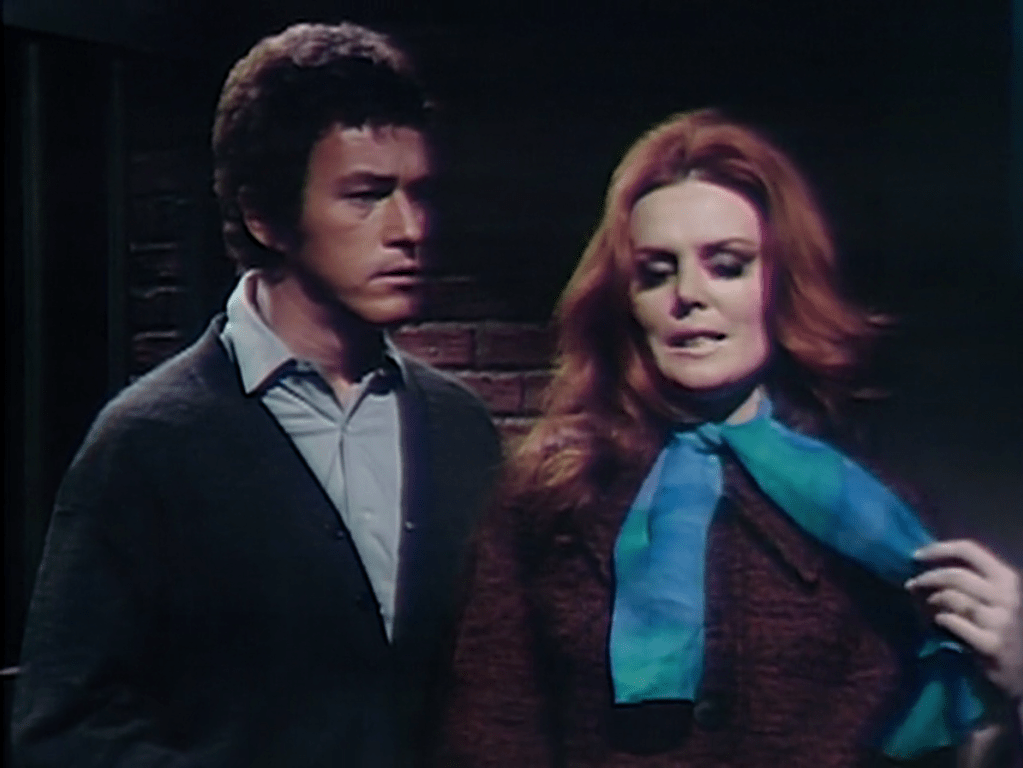
The meatiest part of the episode is a long scene between Megan and Philip. She is exultant that the monster has killed Paul and certain that it will go on to do other, even more wonderful things. He’s scared to death of what the monster will do to them if it is not defeated and of the retribution that will come to them if it is. She sneers at him as a coward. He admits that he is a coward, but insists that they run away and count themselves fortunate if they can escape with their lives.

In her first role on Dark Shadows, as Eve, The Fiancée of Frankenstein, Marie Wallace was called upon to show an unbending, unvarying contempt for Adam, the patchwork man she was supposed to marry. Since that was the only feeling Eve had ever shown for Adam, it wasn’t very interesting. But Megan loved Philip when we first met them. The other day, when she told the monster that she had loved Philip for a long time, we could believe her. So her scorn today does carry some force, and no one knows better how to play scorn and play it to the hilt than does Miss Wallace.

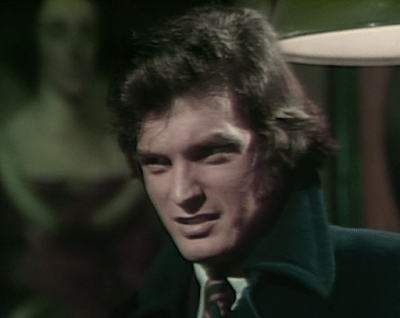
The part of Philip has not been a particularly congenial one for Christopher Bernau up to this point, but he too excels in the scene. He has lots of lines you would expect a man to find it hard to say, calling himself a coward and so on, but he speaks them smoothly and fluently. He shows his hesitancy and anguish not in his delivery of the lines, but in his facial expressions and movements while Megan is speaking. You can see him deciding to put aside all male ego and say something that might get through to Megan, no matter how humiliating it is for him to say it. With lines proclaiming his cowardice, Bernau creates the image of a remarkably brave Philip.

Philip divided. Screenshot by Dark Shadows Before I Die.

That in turn makes it possible for the episode to end on a suspenseful note. The closing cliffhanger has Sheriff Davenport turning the doorknob to the monster’s room, while Philip is frenziedly trying to come up with a way to talk him out of entering it. When we watched that, my wife, Mrs Acilius, said to the screen “If you don’t tell him what’s in there, it’s murder,” in a tone that suggested she thought Philip actually might tell the sheriff the truth. That such an idea could even form is a testament to Bernau’s outstanding performance in this episode.

Episode 931: Into strange rooms

Some invisible Elder Gods known as the Leviathans have taken control of a group of individuals in and around the area of Collinsport, Maine and formed them into a cult serving their plan to reclaim the Earth. Confusingly enough, the cultists are also known as Leviathans.

In 1949, deadbeat dad Paul Stoddard was leaving his family. On his way out of town, he stopped in a bar, where he ran into a Leviathan (whether one of the mortal or supernatural variety is never explained.) This being tricked Paul into selling his infant daughter Carolyn to the Leviathans. Late in 1969, Paul came back to town, where the leader of the new cult, old world gentleman Barnabas Collins, explained to him what he had done that night twenty years before. Since the deal was already made, it is unclear why Paul had to come back to Collinsport, why he had to be told what he had done, and why Barnabas had to be a big jerk to him about it.

Paul has been trying to warn people that something terrible is happening, and Barnabas has become disaffected from the cult. The Leviathans are based on concepts H. P. Lovecraft developed in his tales of cosmic horror, and the specific Lovecraft story from which they have been drawing most heavily is The Dunwich Horror. In that one, what appeared to be a rapidly-growing, unaccountably precocious boy named Wilbur Whateley turned out to be one half of an unearthly creature of vast destructive power. Their Wilbur analogue has been a series of children who live in the antique shop that cultists Megan and Philip Todd own. There is a room above the shop where the creature takes its true, invisible form. Yesterday Barnabas helped Paul escape from captivity, and Paul went directly to the shop where he let himself into the upstairs room. Barnabas and the Todds got Paul out of the room and locked him in the prison cell in the antique shop’s basement.* The episode ended with the creature approaching the door of the cell and Paul holding a chair to use as a weapon against it.

Today we open with the creature entering the cell. The metal door jumps off its hinges and disappears; the chair flies from Paul’s hands; and Megan looks down from the top of the stairs, a gleeful look on her face as she anticipates Paul’s grisly end.

Megan is thrilled to see what her baby boy can do. Screenshot by Dark Shadows Before I Die.

Danny Horn devotes his post about the episode at his great blog Dark Shadows Every Day to a series of complaints about the invisibility of the creature, claiming that it is unsuitable to have something important on a television show that does not come with striking visuals, but I can’t believe that any monster effect would be as impressive as this sequence. Director Lela Swift really delivers with it.

Barnabas shows up in the nick of time and orders the creature to leave Paul alone. He wrangles it back to its room, then scolds Megan for letting it out. While this is going on, Paul staggers out of the shop.

In the street, Paul meets mad scientist Julia Hoffman. Julia knows that Barnabas is involved in an evil scheme. It is very unlike him to leave her out of those, so she is alarmed. She takes Paul to the apartment of her non-evil friend, occult expert Timothy Eliot Stokes.

Stokes and Julia comment on Paul’s appearance. His clothes are rotting away, as if they had been dipped in acid, and something is on him that emits a strong odor. This is a nod to The Dunwich Horror, in which the Elder Gods cannot be seen, but boy oh boy can they be smelled. “As a foulness you shall know them,” goes the refrain. Paul is in terrible shape and can’t talk. Julia vetoes Stokes’ suggestion that they call the police, and even after she notices Paul’s blood pressure dropping she does not suggest taking him to the hospital.

Stokes then shifts Julia’s attention to the B-story. He tells her that a friend of his is just about finished removing an overpainting from the portrait of Quentin Collins. Julia knows that this portrait, painted in 1897, freed Quentin of the effects both of the werewolf curse and of aging. Like the picture of Dorian Gray, it changes while Quentin himself remains the same. Quentin is back in town now, but he has amnesia. Julia believes that showing the portrait to him will jolt his memory back into place.

Julia lives as a permanent houseguest on the estate of Collinwood. We cut there, and see a woman named Amanda Harris pacing nervously in the foyer of the great house. Amanda was Quentin’s girlfriend in 1897, and was in that year granted more than 70 years of youth by a supernatural being named Mr Best. Mr Best said she could go on living even beyond that time if she could reunite with Quentin and get him to tell her her loved her. She has reconnected with Quentin, but since he doesn’t remember their past he doesn’t know he is in love with her. For some reason they don’t reveal to the audience she can’t tell him the truth. She has told Julia everything, and they have joined forces. We can assume Amanda is at Collinwood waiting for Julia to come back.

The telephone rings and Amanda answers it. It is Megan asking to speak with Elizabeth Collins Stoddard, owner of Collinwood and a member of the Leviathan cult. Amanda tells her no one is home. Megan asks who she is, and Amanda gives her current alias, Olivia Corey. As Olivia, she is a big star on Broadway, a fact which will be mentioned later today. There is quite a bit of overlap between antique dealers and Broadway fans, especially in the northeastern USA, and Amanda/ Olivia has been in Collinsport long enough that everyone must know she is in town. I try to imagine an antique shop owner in Bar Harbor or Kennebunkport asking a person on the telephone who they were, hearing “I’m Donna McKechnie,” and not getting excited. I suppose Megan’s continued focus on her own problem shows just how profoundly she is committed to the Leviathan cause.

Julia enters, and Amanda tells her that Mr Best will be coming for her in two hours. Julia replies that they must get Quentin to the portrait within that time.

They manage it. Quentin is noisily skeptical about the whole thing. He is frustrated that Julia keeps telling him he’s a hundred years old when he doesn’t look like he’s quite 29 yet, and even more frustrated that Amanda (who introduced herself to him as Olivia, and only today admits that isn’t her original name) won’t tell him when they met before and why she is so interested in him. Several times he threatens to leave the room before Julia can unveil the portrait. When she finally does, Amanda screams and runs out. Quentin reacts with fascinated horror.

Quentin can’t take his eyes off the painting. Screenshot by Dark Shadows Before I Die.

Regular viewers, remembering the Dorian Gray bit, would have expected these reactions. If the moon is full enough, it will be the portrait of a wolf wearing an adorable little suit. Otherwise, it will show all the effects of 73 years of dissolute living. In neither case will it look much like the Quentin we know.

*That’s how people tell you they aren’t from Collinsport without saying they aren’t from Collinsport, they get all surprised when basements have prison cells.

Episode 929: The convergence

For the first 55 weeks of Dark Shadows, matriarch Elizabeth Collins Stoddard was under the impression that she had killed her husband Paul and that Paul’s associate Jason McGuire had buried his corpse in the basement of the great house on the estate of Collinwood. She spent nineteen years at home, terrified that if she left the estate someone might find Paul’s grave and hold her to account for his killing. Finally it turned out that she had only stunned Paul. He and Jason had faked his death to trick Liz into giving them a lot of money. Soon, Liz was no longer a recluse and that whole story was forgotten.

Now, Paul has returned. He denies knowing anything about his fake death, claiming that Jason acted alone. Longtime viewers will be skeptical of this claim, and Liz certainly is. But she doesn’t care about it as much as you might expect. She is now part of a secret cult that serves mysterious supernatural forces known as the Leviathan People, who plan to take over the earth, supplanting the human race. Paul has learned that he inadvertently sold Carolyn Collins Stoddard, his daughter with Liz, to the Leviathans, and he has been trying to sound the alarm about them. As a serenely happy devotee of the Leviathan cult, Liz has agreed to keep Paul at Collinwood where she can drug him into immobility.

The power of the Leviathans has taken bodily form in a succession of children who live in an antique shop in the village of Collinsport. The shop’s owners, Megan and Philip Todd, were the first people inducted into the cult by Liz’ distant cousin, old world gentleman Barnabas Collins. The latest manifestation of this being, an apparently thirteen year old boy known as Michael, had been attracting attention that threatened to blow the cult’s cover, so Philip and Megan faked his death. They held a funeral this morning.

Michael is supposed to retire into his room above the antique shop and stay there until he has graduated to his next form. He comes out and tells Megan and Philip that he has decided not to go through with this plan. Philip picks him up and carries him there, putting a new lock on the outside of the door to keep him in until he has gone through another transformation.

Carolyn calls the Todds and extends her mother’s invitation to an evening at Collinwood. They accept.

Unknown to Liz or the Todds, Barnabas has become disaffected from the cult. He visits Paul in his room. He gives Paul clothes and a lot of money and urges him to go far away. Paul doesn’t trust Barnabas, and holds him at gunpoint throughout their entire conversation.

When the Leviathan cult first emerged, its members were siloed off from each other. Barnabas gave Philip and Megan their instructions in dream visitations. When they were awake, they would not recognize him as their leader. They and Liz were not aware of each other’s connection to the cult, though Liz did know that Barnabas was her leader and her nephew David Collins was a fellow cultist. It reminded us of secret operations in the real world, where only people who work with each other directly are allowed to know of their shared allegiance.

Now, all that security is out the window. Liz and the Todds stand around the drawing room at Collinwood having drinks and talking about what Barnabas has and has not told them about the Leviathans and their goals. They do still keep some secrets, however. Liz says that she can’t help but wonder what Carolyn’s role will be in the time to come. Barnabas and the Todds know that she is fated to be the bride of the force currently incarnated as Michael, but they are not allowed to tell Liz this. They look at each other with alarm, and Barnabas gives her some vague and hasty assurances.

There is an unintentionally hilarious moment during the cocktail party scene. Megan is seized by enthusiasm for the Leviathan project, and starts babbling all sorts of portentous phrases about the new world that is taking shape through their efforts. Marie Wallace was one of the most committed exponents of the Dark Shadows house style of acting, which consists largely of delivering your lines so vehemently that you are in constant danger of spraining your back. For her part, while Joan Bennett sometimes played to the balcony as Liz and her other characters, she never really let go of the urbane and relatively understated approach that made her one of the biggest movie stars of the late 1930s. When Liz responds to Megan with the amiable smile and subtly musical voice of a sophisticated society hostess, it all of a sudden strikes regular viewers who have got used to the show’s peculiarities just how incredibly bombastic Miss Wallace was.

Meanwhile, Paul goes through a lot of business with Barnabas and Carolyn in which he is told to wait an hour, no half an hour, no ten minutes, before leaving the house. He steals the keys from Megan’s purse and sneaks off to the antique shop. He has decided he must figure out what exactly is going on there. He lets himself into the room where the Leviathan force is kept when it is not embodied as a child. He hears a heavy breathing. The camera zooms in on his shocked face. With that, the episode closes. Paul’s future would appear to be extremely brief. On the day of Michael’s phony funeral, he seems likely to bring the show’s first fake death firmly into the realm of the actual.

Paul gets more than he bargained for. Screenshot by Dark Shadows Before I Die.

Today marks Michael Maitland’s last appearance as Michael. He did a lot of acting as a child, including major roles on Broadway both before and after his run on Dark Shadows. Playing Michael didn’t give him much chance to show what he could do. His resume suggests that is a shame- he must have had a lot to offer to get all those big parts. And by all accounts, he was a very nice guy.

Michael Maitland died of cancer in 2014, at the age of 57. That means that three of the five child actors who appeared on Dark Shadows during the Leviathan segment have died. Denise Nickerson, who played Amy Jennings, was 62 when she died in 2019; Alyssa Mary Ross Eppich, who under the name Lisa Ross played the Leviathan child in the guise of an eight year old version of Carolyn in #909, was 60 when she died in 2020. David Henesy, who played David Collins, and David Jay, who played the Leviathan child as an eight year boy called Alexander, are still going strong. So too is Sharon Smyth Lentz, who played the ghost of nine year old Sarah Collins in 31 episodes in 1967 and the living Sarah in six episodes in 1967 and early 1968.

Episode 927: Reasons don’t matter

Permanent houseguest Julia Hoffman, MD, is in the drawing room of the great house of Collinwood when a secret panel opens and a boy known as Michael comes strolling out. She asks him how he knew about the panel and the passages behind it; he says that thirteen year old David Collins told him. Julia asks if Michael knows what has become of David’s governess, the missing Maggie Evans. Michael tries to dodge her questions. When Maggie comes running into the room, screaming that she has been living a nightmare, Michael takes the opportunity to flee.

Michael emerges from the secret passage.

Returning viewers know that Michael is not really human, but is the latest in a series of manifestations of a monstrous force that has enlisted the support of several characters for its plan to supplant the human race. We also know that Michael trapped Maggie in the long-disused west wing of the house and tormented her there. She had been sure that Michael was her tormentor, but when Michael’s foster father, antique dealer Philip Todd, came to her rescue, Maggie beaned him with a small candlestick and jumped to the conclusion that he was to blame. She tells Julia that Michael is innocent and Philip is dead.

Maggie’s captivity is a remake of a story that ran from #84 to #87. In those days, the show’s liveliest villains were David and his father, high-born ne’er-do-well Roger. David locked Maggie’s predecessor Victoria Winters up in a room in the west wing, where he hoped she would die. Eventually Roger used the secret panel from which Michael emerges today to go to the west wing and investigate. He went straight to the room where Vicki was trapped. Roger shared David’s ill-will towards Vicki, and had in #68 encouraged him to harm her. In the corridor outside her prison, he took advantage of the situation to terrorize her further, disguising his voice and pretending to be a ghost taunting her with her doom. When he finally opened the door, she flung herself into his arms and declared that he was right and David really was a monster.

That story dragged out for so long that we couldn’t help noticing several steps Vicki might have taken to get herself free. Her failure to try any of them was a major step towards the creation of the “Dumb Vicki” image that would in time destroy the character completely. Maggie doesn’t outdo Vicki in engineering ability, but at least part of her helplessness can be explained by a taunting voice that she hears, on and off, from the beginning of her captivity. This one really is supernatural in its origin, projected by Michael. Her misunderstanding of Philip’s motives and condition is as total as was Vicki’s of Roger’s, but she corrects it by the end of the episode, when she realizes that Philip was coming to rescue her from Michael, and that he is fine now. She goes to his shop to apologize for accusing him.

The contrast between the two stories sheds light on the strengths and weaknesses of the show in the days when they were made. In the first months, individual episodes might have so little action that there was nowhere to hide a logical problem like Vicki’s immediate resignation when she realized that the window in the room was slightly out of her reach, even though the room was full of materials she could stack up and stand on. Still, Vicki’s reaction when Roger enters was electrifying, one of the best moments of acting in the entire series, and the change in her relationship with David in the weeks after her release is pivotal to everything that happens from that point on.

The relative busyness of the stories now allow us to overlook Maggie’s absurd helplessness while she is in the room, and her quick reconciliation with Philip papers over her inexplicable failure to remember that she heard Michael’s voice taunting her. But as Philip points out, Maggie doesn’t really know him. Nor will her experience shape her future attitude to Michael in any interesting way- as a creature who rapidly changes his form, he comes with a built-in expiration date. The whole story vanishes without a trace once Maggie leaves the antique shop. The individual episodes may not seem as slow now as they did at first, but when we find ourselves weeks or months into a storyline and find that very little has happened that we have any need to remember, we are left with a sense of motionlessness.

Roger’s use of the secret panel in #87 was the first time we learned it existed, and we didn’t see or hear of it again for two years, when both David and the ghost of Quentin Collins used it during the “Haunting of Collinwood” segment. David ushered visiting psychic Madame Janet Findley through the panel, directly to her death; Quentin came out of it and killed elderly silversmith Ezra Braithwaite. So to longtime viewers, the panel represents both murderous intentions and an intimate knowledge of the layout of the house. When Michael comes sashaying out of it today, we are meant to be a deeply unsettled.

Philip is disaffected from the project Michael represents; his wife Megan is still all in, and she combines her fanaticism with a desperate love for Michael. She talks with Michael privately, and tells him that he has been making himself so conspicuous that he has raised suspicions in the minds of many people. They will have to take steps to quell these suspicions, steps which neither she nor Michael will like at all.

Michael becomes very ill, and Megan calls Julia to come to the shop to treat him. She finds that his heartbeat is irregular and his vital signs are fading. She is calling the hospital when he goes into some kind of crisis; she leaves the telephone and injects him with a stimulant to jolt him back into stability.

Recently, we have heard several references to “Dr Reeves,” a character who was on the show a couple of times in 1966. Dr Reeves did not appear on screen, much to the relief of longtime viewers who remember how annoying he was, but the sheer fact that his name came up sufficed to assure us that Julia is not the only doctor in Collinsport. Since the group around Michael has been unable to absorb Julia and sees her as a potential enemy, Megan must have chosen her for some reason to do with the plan she was telling Michael about.

Episode 926: I don’t want to know who you are

This episode has the same story as Friday’s.

The current A-story is about the coming of the Leviathans, mysterious beings who act through a cult that has absorbed several people in the village of Collinsport and on the estate of Collinwood. Antique shop owners Megan and Philip Todd have been entrusted with the care of a creature that has assumed the forms of several human children in succession. This creature, currently presenting itself as a thirteen year old boy named Michael, is extremely obnoxious to everyone for no apparent reason, prompting them all to reconsider their commitment to the program. Philip is ready to turn against the Leviathans; Megan from time to time admits that he is onto something, but by the end of yesterday’s episode was back under Michael’s control. She had said Philip needed to be got out of the way and picked up a gun.

Old world gentleman Barnabas Collins goes to the Todds’ shop in the village. He finds Megan pointing her gun at Philip and orders her to cut it out. Barnabas had been the leader who initiated the Todds into the cult and as we hear his thoughts in internal monologues today we hear that he still has some loyalty to it, but Michael has been too much for him. When he tells Megan to listen to him instead of Michael, she is shocked at his sacrilegious words. He hastily claims that he was only testing her.

Barnabas and Philip have a staff conference. Screenshot by Dark Shadows Every Day.

For his part, Michael is at the great house of Collinwood. Last night he was there as the guest of strange and troubled boy David Collins, who has shared supervision of the Todds with his distant cousin Barnabas. David’s governess, Maggie Evans, is not a member of the cult, and she had done something that bothered Michael. So he trapped her in the house’s long-disused west wing. She is still trapped there, and he has returned to use his powers to torment her further. David is anguished about this, but does not feel he can oppose Michael.

Maggie’s captivity prompts us to ask just why it is so frustrating that this episode is essentially a duplicate of Friday’s. In May and June of 1967, Barnabas was a vampire, he was holding Maggie prisoner in his basement, and there were a number of duplicated episodes. It was during that period that the show first became a hit, and it is that story that every revival of the show, from the 1970 film House of Dark Shadows on, goes out of its way to incorporate.

I think what kept people coming back to watch Barnabas’ imprisonment of Maggie was not so much what he was doing to her, but his relationship with his blood thrall Willie. In the course of Barnabas’ abuse of Maggie, Willie went through all of the psychological phases that Megan, Philip, David, and Barnabas exhibit today. I think the actors playing all four of those characters live up to John Karlen’s performance as Willie; even those who disagree with me on that will have to concede that some of them do good work. So the problem is not with the performances.

Rather, these episodes fall short because the character of Michael does not have the depth Barnabas had in the spring and summer of 1967. We kept wondering what Barnabas was thinking, and the more we learned about him the more puzzled we became, since all his ideas were so crazy. In his role as Barnabas’ external conscience, Willie gave us grounds to hope that we would eventually reach a layer of his mind where the nonsense would give way to something intelligible. But we don’t wonder what Michael is thinking, because there’s no evidence Michael is thinking at all. He demands submission from all and sundry and flies into a rage the instant he encounters resistance. He is just a spoiled brat.

Moreover, as a vampire Barnabas needed people to protect him during the day and to surrender their blood to him at night. When David is slow to submit today, Michael tells him he doesn’t need him or anyone else. This seems to be all too true- nothing is at stake for Michael in any interaction. No matter what Michael Maitland brings to the part, no matter how well his four Willies play their roles, the character is a dead end.

One viewer who seems to have been carried away with his frustration with this one is Danny Horn, author of the great blog Dark Shadows Every Day. His post about it includes some rather obtuse remarks about the performances, some of which fit with his usual shortcomings (e.g., his habitual underestimate of David Henesy’s acting.) But in other comments he loses track of his own analysis. For example, time and again throughout the blog he stressed that the show was made for an audience that saw each episode only once, and that their memories of the images that had appeared on their television screens would drift over time. When a particular moment makes a big enough impact that it is frequently referred to in later episodes and is a topic of discussion among fans, the images of that moment that appeared on screen during the original broadcast are at most a starting point, something that the viewers build on in their imaginations, so that the pictures that memory supplies soon enough have little or nothing in common with what was actually produced.

Danny makes all of these points over and over. Yet his post on #926 ends with this objection to the invisible form Michael and the other Leviathan boys assume when they are supposed to be mighty:

Dark Shadows actually has a great track record at creating scary things out of not that much money. The legendary hand of Count Petofi was incredibly cool and memorable — a Halloween decoration that they invested with real power. The scariest thing about the legendary hand was that it wasn’t under anybody’s control, even Petofi’s; it would fly around on its own, doing unexpected things. Not an expensive or difficult effect, just good writing, using what they have to tell an interesting story.

Television is a visual medium; we need to see the thing that the story is about. “It’s better in your imagination” is just a way to weasel out of coming up with a compelling visual. If you can’t actually show us the monster, then maybe you should consider a non-visual medium like print, or radio. Or not doing it at all.

Danny Horn, “Episode 926: The Shark, and How to Jump It,” posted on Dark Shadows Every Day, 15 September 2016.

I reached that point in Danny’s blog more than four years after the post went up, but even so I felt compelled to join those who piled on him for those two paragraphs. Here’s what I wrote:

I don’t think there would be a point in showing the monster. If the monster had done anything really scary, our imaginations would be working overtime to frighten us. Any image they put on screen would let the steam out of our anxieties. And since it hasn’t done anything scary, we won’t be worked up when we see it. Looking at it calmly, we’ll just be examining a costume or a prop or a visual effect or whatever.

Now, you can show the audience a thing or a person that looks harmless, and then build up fear around it. That’s what they did with The Hand of Count Petofi, which Barnabas observes with utter contempt when Magda first shows it to him, but which then wreaks havoc. Or you can build up a fear, introduce a person, and suddenly connect the person with the fear in an unexpected way. That’s how they gave us Barnabas- Willie opens the box, there are vampire attacks, a pleasant man shows up wearing a hat and speaking with a mid-Atlantic accent, and then we see that man without his hat, waiting for Maggie in the cemetery. There are lots of ways to scare an audience, but showing a picture of something that’s supposed to be scary isn’t one of them.

Comment posted 17 December 2020 by “Acilius” on Danny Horn, “Episode 926: The Shark, and How to Jump It,” posted on Dark Shadows Every Day, 15 September 2016.

I still agree with that, more or less, though I suppose it makes the creative process sound a lot tidier than it ever is. I do wish I’d thought of the comparison I make above between the four disaffected cultists and Willie. Danny’s blog was still drawing comments in those days, and I think that would have attracted some responses.

Episode 925: Not like other boys

In #891, old world gentleman Barnabas Collins gave a present to antique shop owners Megan and Philip Todd. It was a wooden box. When the Todds opened the box, it made a whistling sound. By #893, the whistling sound had taken the form of a newborn baby whom Megan introduced to heiress Carolyn Collins Stoddard under the name “Joseph.” In #905, Joseph had taken the shape of an eight year old boy, and was going by “Alexander.” In #909, Alexander briefly shape-shifted. He kept his apparent age and mass, but his body became that of a girl. In particular, s/he was for an hour or two a perfect double of Carolyn as she was at eight. In that shape, s/he tormented Carolyn’s father Paul, who had been absent throughout Carolyn’s childhood. In #913/914, Alexander gave way to a thirteen year old who insisted on being called “Michael.”

Clearly, none of these children is really human. They are manifestations of a supernatural force known as “the Leviathans.” The Leviathans operate through a secret cult that is gradually taking over people in and around the estate of Collinwood and the nearby village of Collinsport. Barnabas, the Todds, Carolyn’s mother Liz, and her cousin, strange and troubled boy David Collins, are among the members of the cult. Paul is one of its enemies, and others are coming into their sights.

As he was when he was Alexander, Michael is a bully, monotonous in his hostility and demands for obedience. Philip has had about enough of this. He spanks Michael today, and tells Megan that it is time they think about quitting the Leviathan cult. Megan is appalled by Philip’s apostasy. She and Michael talk alone. He caresses her face, exciting a physical response from her. She then agrees that Philip should be got rid of, and picks up a gun.

Michael caresses Megan’s face. Screenshot by Dark Shadows Before I Die.

We have seen Barnabas caress the faces of people whom he wanted to bring under the control of the Leviathans, so the makers of the show could tell the ABC network’s Standards and Practices Office that Michael was doing a magic trick when he did that to Megan. But in a period when Sigmund Freud was the among most cited nonfiction authors in the English-speaking world, few adults in the audience could have failed to notice the erotic charge in the contact between Michael and his (foster) mother as they plot the murder of his (foster) father.

Freud has turned up on the show before. In September 1968, Carolyn hid Frankenstein’s monster Adam in a room in the dusty and long-disused west wing of the great house of Collinwood. Adam spent most of his time alone, with little to do but read. When Carolyn brought him a meal there in #577, Adam was disappointed she was not prepared to discuss Freud’s works with him. She mentioned that she was dealing with some family troubles, at which Adam invited her to sit down and to “Tell me about your mother.”

Adam is long gone, but we see today that the west wing is still dusty. Maggie, David’s governess, fell afoul of Michael yesterday and is wandering around there, hopelessly lost. For some time, Adam held Maggie’s predecessor Vicki prisoner in his room; evidently writers Sam Hall and Gordon Russell see some kind of connection between Freudian psychoanalysis and governesses stuck in the west wing.

Like Adam, Michael came into being otherwise than by sexual reproduction, and the arrangement of his anatomy is the result of a series of conscious acts of will. Also like Adam, he has an intense crush on Carolyn, one which does not exclude violence. In #549, Adam attempted to rape Carolyn. In #919/920/921, Michael introduced himself to Carolyn by creeping up behind her and putting his hands over her eyes; moments later, he was yelling at her and demanding “How dare you” when she would not go along with an idea of his. Since Carolyn is virtually the same height as Michael, his disregard of her personal space and his unrestrained bullying come off not only as bratty, but as rape-adjacent.

Furthermore, Marie Wallace, who plays Megan, first joined the show as patchwork woman Eve, Adam’s intended spouse. Megan’s desperate indulgence towards Michael puts her at the opposite extreme from Eve’s total rejection of Adam, but it is equally inflexible, and when she takes up her gun today it seems likely to lead to an equally disastrous ending. Whatever point Hall and Russell were making by associating Adam with Freud is apparently in their minds again when Michael and Megan play out their little Oedipal dance.

Closing Miscellany

When Maggie is first trapped in the west wing, she reaches up to bang on the closed panel. When her shoulders rise, the high hem of the outfit Junior Sophisticates provided Kathryn Leigh Scott exposes parts of her that performers on daytime television in the USA in 1970 did not customarily display.

Yesterday and today, David and Michael play a game they call “Wall Street.” They use Monopoly money and a playing surface which, when Michael overturns it today, proves to be a checkerboard with a backgammon board on the reverse. A board game called The World of Wall Street really was around in those days; it was produced in 1969 by Hasbro and NBC. The dialogue David and Michael exchange during the game sounds like things you might say while playing it. Perhaps the script called for the boys to play that game, but ABC vetoed it since the rival NBC network’s logo appeared prominently on the box.

Episode 915: Emergency Leviathan Broadcast

In #701, old world gentleman Barnabas Collins traveled in time from 1969 to 1897. For the next eight months, ending in #884, Dark Shadows was a costume drama set in that year. On his way back to a contemporary setting, Barnabas took a detour to the 1790s, when he was a vampire. Before he left the 1790s, he was abducted by and absorbed into a cult that serves supernatural beings known as the Leviathans. At their behest, he took a small wooden box with him to November, 1969, and functioned as one of the leaders of the Leviathan cult in that period.

The first six weeks of the Leviathan story has had its strengths. Ever since Barnabas was first cured of vampirism in March 1969, he has been under the impression that he was a good guy and has been doing battle with various supernatural menaces. He was hopelessly inept at this, and created as much work for the other characters by his attempts at virtue as he formerly did in his unyielding evil. That has made him a tremendously productive member of the cast, but it does leave him with a tendency to seem harmless, even when he is trying to murder his way out of a problem. But Barnabas the Leviathan chief has been ice-cold and formidably efficient. Even though not much has yet been done to hurt anyone, seeing him in this mode adds a note of terror to the proceedings.

Moreover, the Leviathans have voided Barnabas’ friendship with mad scientist Julia Hoffman. Since the relationship between the two of them has been the heart of the show for over two years now, from the hostility of their early days to the close bond they formed in the summer of 1968, this reinvigorates the action. It is as interesting to see them fight with each other as it is to see them collaborate against a common foe, and their hate scenes gain an extra depth because we keep wondering about their eventual reconciliation. If they play their cards right, they should be able to keep this up for months.

Today, it all falls apart. Barnabas has drawn a huge following of very young fans who run home from elementary school to watch the show. The 1897 segment was a triumph in large part because it had a core of stories that could hold the attention of adults while also appealing to the preteen demographic. But the Leviathan arc has so far had little to offer anyone but grownups. Apparently the kids were writing angry letters, because this episode, rushed into production at the last minute and bearing signs of haste in every shot, turns Barnabas back into the would-be hero who was such a klutz that he couldn’t even stay in the right century.

The creature who emerged from the box Barnabas brought from the past now appears to be a 13 year old boy and answers to the name Michael. In the opening scene, Michael orders Barnabas to kill Julia. Barnabas declares that he will not, and goes home. There, he tells his troubles to the box, then falls asleep in his chair.

A hooded figure appears to him. This hooded figure says that he is a Leviathan, and tells Barnabas he must comply with Michael’s commands. The Leviathan is not named in the dialogue and there are no actors’ credits at the end, but reference works based on the original paperwork call him Adlar.

Adlar sets out to explain Barnabas’ position, much as Marley’s ghost did to Scrooge in Dickens’ A Christmas Carol. The shortened production schedule shows in inconsistencies that litter Adlar’s speeches. At one point he says that the Leviathans needed Barnabas to transport the box from the eighteenth century to the twentieth; at another, he claims that they are holding his lost love Josette prisoner in the eighteenth century and will inflict a new, far more horrible death on her than the one she died the last time Barnabas was in the 1790s, a threat they will be able to carry out only if they have their own means of traveling back and forth through the years. Barnabas doesn’t pick up on this or any of Adlar’s other inconsistencies; perhaps he is too distracted by the many jump cuts that make this episode look like the videotape was edited with a rusty butter knife.

Adlar threatens to make Barnabas a vampire again, then disappears. He does not tell him that he will be visited by three spirits, one representing his past, another his present, and the third the future he is risking by his present course of action, but this is in fact what happens. Barnabas goes outside, and sees a bat. It was a bat whom he first saw on this very spot who initially made him a vampire. Barnabas rushes inside, looks in the mirror, and does not see a reflection. He thinks of his mouth, and feels fangs growing there.

Next comes Megan Todd, a Leviathan cultist who with her husband Philip is fostering Michael in their home. Barnabas cannot take his eyes off Megan’s long white neck. Megan keeps telling Barnabas that he is the only one she can confide in about her concerns with the progress of the Leviathan plan; he keeps demanding ever more stridently that she leave at once. His bloodlust may explain why he doesn’t notice the continuity problem in the scene. They’ve made the point time and again that it is only while Barnabas is giving orders to her and Philip that Megan remembers that he is their leader. At other times, she thinks he is an outsider. But Megan is the only one who can tell Barnabas a story of family life in any way paralleling that which the Ghost of Christmas Present brings to Scrooge’s attention at the Cratchit house. Continuity has to go if the episode is going to fit into the form of A Christmas Carol.

Suddenly, Barnabas finds himself in an alley by the waterfront. A sign behind him says that he is next to the Greenfield Inn; we saw this sign in #439, set in the year 1796. Evidently the Greenfield Inn is a long-established, though not very reputable, place of lodging.

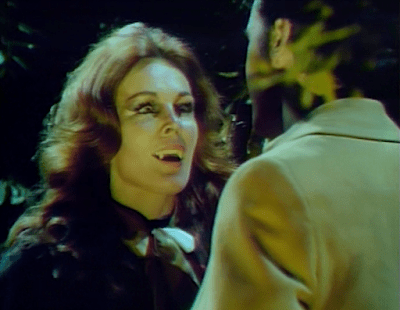
A woman approaches him. She is very aggressive about insisting he take her with him wherever he is going. He is reluctant at first, urging her to seek friends at the Blue Whale tavern, but she won’t take no for an answer. All of a sudden, he brightens and looks at her with desire. She says she is afraid of him. He asks if she wants to go, and she screws up her courage to declare that she will stay with him. He bares his fangs and attacks. The rough videotape editing adds to the violence of the scene. There is no sensuous bite, only a flash as he lunges at her and then is standing up again, protesting that he didn’t want to do it. When the camera zooms in on the bleeding marks on her neck, it is surprising to see that he didn’t rip her throat out altogether.

We cut back to Barnabas’ house. He is dozing in his chair, and the woman, displaying vampire fangs of her own, walks in through the front door. She approaches Barnabas. He awakens, and is horrified. Adlar tells Barnabas that “she is not up to your usual standards.” She’s standing right there, that’s pretty tactless. Also, she is future four-time Academy Award nominee Marsha Mason. The only other Oscar nominee Barnabas bit was Grayson Hall as Josette’s aunt, the Countess DuPrés, in #886. Hall was only nominated once, so if anything this woman is a step up for him.

Four time Academy Award Nominee Marsha Mason. Screenshot by Dark Shadows Before I Die.

Adlar makes the woman disappear, and shows Barnabas that he is not really a vampire again. With that, we see that she is a shade of a future that may come to be, not one that is already ordained. Adlar also tells Barnabas that it is not now necessary to kill Julia. But he does say that Barnabas will have to do something to ensure Julia’s silence, or else Josette will suffer. Barnabas hangs his head and says to the mirror that he has no choice to obey.

Episode 902: I heard breathing

Heiress Carolyn Stoddard is working for her friends, Megan and Philip Todd, in their antique shop. She goes upstairs to tell Megan that Philip has telephoned. Carolyn hears heavy breathing coming from the room where a baby the Todds are taking care of sleeps. Megan comes out of the room and in a most imperious tone demands to know what Carolyn is doing there. She tells her Philip called, and asks about the breathing sounds. Megan sweetens up and says “It’s the radiator!” She says she’ll have to call the plumber about it. Carolyn is unconvinced.

Downstairs in the shop, Carolyn and Megan notice someone looking in the window. The shop is open for business and there is merchandise displayed in the window, but for some reason it unnerves them that they have attracted the notice of a potential customer. All we can see of the man is his clean-shaven upper lip. When Carolyn approaches the window, he runs away. The only sneaky man we have met so far in the current phase of the show is Carolyn’s long-absent and recently returned father Paul. Since Paul wears a mustache, the upper lip is enough to show us that this is a new character, at least new to the ongoing stories.

No mustache. Screenshot by Dark Shadows Before I Die.

Carolyn and her mother Liz live in the great house on the estate of Collinwood. Also among the residents of the great house are Liz’ brother Roger Collins and Roger’s son, strange and troubled boy David. We cut to David’s bedroom, where a book opens by itself. We have seen books do this before on Dark Shadows, but I believe this is the first time I couldn’t see a cord being pulled. They really have come a long way with practical effects.

David reads aloud from the book, something about a child being cloaked in radiant garments. He is interrupted by his Aunt Liz. She asks him to notice that she knocked on the door, and tells him that she is learning to respect his privacy. She says she heard him reading aloud, and asks what it was. He says it was a school book. She starts talking about how terribly cold it is in his room. He brings up her ex-husband, Paul. Liz hadn’t known David was aware of Paul’s return, and gets very uncomfortable. She says he needs friends his own age, and hurries out of the room. Once she is gone, he goes through the room and gathers a lot of cash. Evidently David raised the subject of Paul to get the room to himself.

David does have one friend his own age, Amy Jennings. Amy lives in the great house, down the hall. We just saw Amy in #893 and #896, but she tends to be unmentioned in between appearances. Amy is a favorite of mine, and when they don’t use her name for long stretches I worry they are about to drop her from the show. It would have reassured me if Liz had named Amy as someone David ought to spend more time with.

Joan Bennett tends to do a lot of acting with her eyes when she plays a two-scene with David Henesy, and this is a good example. When Liz is pointing out her own good manners in knocking, it is her eyes that convey her mild amusement at the situation; when she is offering to help David with his schoolwork, her eyes follow him so closely that we notice all of the little movements he makes as he tries to get out of a tutoring session; when she talks about the coldness in the room, she looks from side to side, searching for the open window with increasing consternation; when he asks about Paul, her eyes bulge in their sockets, showing deep alarm. When she tells him he needs friends his own age, she raises her eyebrows, making it sound like a threat. Bennett had been so famous for so long that many of her scene partners would not react to what she was actually doing, but to what they expected her to do, forcing her to add Joan Bennett-isms to her performances. With Mr Henesy, she was free to work simply, and the result was consistently very effective.

Downstairs, Liz answers the telephone. To her disgust, Paul is calling. He tells her that if she doesn’t meet with him for a talk, she is in danger of losing Carolyn. She agrees to go to his hotel. Carolyn enters in time to catch the end of the conversation. Liz doesn’t want to talk about Paul with her any more than she did with David, and she exits.

Carolyn and David have a scene in the drawing room. She tells him he should go to bed; he says he wants to read the newspaper. He asks her if she hasn’t noticed that he has grown. Since the thirteen year old David Henesy was about the same height as Nancy Barrett, this question is worth a chuckle. David gets excited when he sees that Brewster’s Department Store in the village of Collinsport is going to be open nights until Christmas. He tears the Brewster’s ad out of the paper while Carolyn reminds him he can’t leave the house tonight. He says that of course he can’t, it’s late.

In his post about the episode on his great Dark Shadows Every Day, Danny Horn asked if David’s reaction to the Brewster’s ad is the only reference to Christmas in the whole series. His commenters responded that Christmas is also mentioned in #92, #123, #257, #810 (twice,) #887, and #1050. It’s hilarious to read through the thread and see the citations mount up. I sympathize with Danny, though- I tagged my posts about the first couple of episodes on that list with “Christmas,” because I, too, was sure that the holiday was only named once or twice in Dark Shadows.

Carolyn exits, and David sneaks out the front door. As he does, a man in a belted overcoat walks into the house. We see him only from the midsection down. He straightens the portrait of the Collinses’ distant cousin Barnabas that hangs in the foyer of the great house. This suggests that whoever he is, he has some connection with Barnabas. Carolyn comes back, and the man hides behind the curtains in the drawing room. This has been a favored hiding place for the last several months, suggesting that the man knows the house. Carolyn leaves, and the man goes out. If all he wanted to do was straighten that portrait, he could count his journey a success. Otherwise, it’s hard to see what the point of it was.

At the hotel, Paul struggles to explain his concerns to Liz. He is hampered by his own ignorance- he does not know exactly who is after him or what they want to do, but he knows they have some kind of sinister plan for Carolyn. Paul admits that Liz has no reason to believe anything he says, after his total failure as a husband, but he keeps urging her to take Carolyn and go far away, not telling anyone that they are going. She is exasperated with what she takes to be yet another of his scams, and tells him that “I’ll never figure out this latest plot of yours.” Indeed, the story is taking shape slowly enough that some viewers will have been saying the same thing.

Bennett and Dennis Patrick had many scenes together from March to July 1967, when he played seagoing con man Jason McGuire. Liz’ relationship with Jason was one-dimensional, consisting of nothing but a series of blackmail threats from him followed by capitulations from her. As her ex-husband, Paul offers far more for Liz to react against, and this scene is far richer and more satisfying than was anything we saw in the dreary Liz/ Jason story.

Liz goes out of the Collinsport Inn and sees David entering the antique shop across the street. The Inn has been part of the show from episode #1, but this is the first time we see a set representing its outside. Cutting between that set and the set representing the exterior of the antique shop, they make an attempt to create a sense of Collinsport as a place. When the show was in black and white, they would occasionally insert video they had taken at various locations in upstate New York and southern New England to achieve that effect, but they haven’t left 433 West 53rd Street since they went to color in August 1967. This quick cut between minimally decorated parts of the studio doesn’t work as well as that footage did, but it is a valiant effort in its own way.

Liz goes into the antique shop and insists Megan let her search the place for David. Since Liz essentially owns the town, Megan can’t say no. We conclude with Liz outside the door of the room upstairs from which Carolyn heard the breathing when we began. We hear the breathing again. David is inside the room, telling some unseen presence that it will like what he bought for it at Brewster’s. Perhaps he found it in the Unseen Presences section of the store. It’s in Collinsport, after all. David stops talking when he hears Liz’ voice; the breathing cuts out at the same time.

Episode 901: In Collinsport, where your only hope lies

Heiress Carolyn Collins Stoddard thinks that her recently returned father, Paul Stoddard, is mentally ill. She knows that her mother Liz and Liz’ brother Roger are deeply hostile to Paul, and thinks that her distant cousin Barnabas is friendly to him.

We open in the Blue Whale tavern, where Carolyn has been pleased to discover Paul and Barnabas sitting together at a table. Barnabas says that Carolyn is her father’s most precious possession, and she happily agrees. Paul angrily denies that this is the case, and jumps up. He asks Carolyn to go away with him, and leaves the tavern.

Carolyn is bewildered by this reaction, and annoyed when Roger enters. She exits to follow Paul, and Roger goes to the table to warn Barnabas that friendship with Paul would mean trouble with Liz. Barnabas assures him they are not friends.

In Paul’s hotel room, Carolyn tells her father that his troubles are all in his head. She says that she will try to help him, and mentions Julia Hoffman, a psychiatrist who is permanently in residence at the great house of Collinwood. Paul insists that he really does have enemies, and pleads with Carolyn to join him in running far away. She refuses, and insists that he must solve his problems where he is.

Carolyn goes home to the great house. She and Roger have a confrontation. He gives her a check for $5000, payable to Paul. He tells her that the only reason Paul has come back is that he wants to get money out of the Collinses, and that if she gives him that check, he will leave again.

Carolyn goes to the antique shop where she has been working for her friends Megan and Philip Todd. Megan is holding a baby, whom she identified to Carolyn as her nephew Joseph, her sister’s son. Barnabas is with Megan and the baby. Carolyn apologizes to Megan for being late to work, and tells Barnabas she has been late many times. Megan says that it isn’t a problem, that she couldn’t have got away from the shop any earlier even if Carolyn had been there. Barnabas exits.

Carolyn tells Megan that is strange to be reunited with a father who left when she was a newborn. Megan says that she was close to her own father growing up, and that she was an only child. Carolyn furrows her brow, looks at the baby, and asks if he isn’t her sister’s son. Megan scrambles for a second, then claims that Joseph’s mother is her stepsister, one of two daughters of the widow her father married.

Megan takes the baby to his bedroom upstairs. Carolyn answers the telephone, and tells Philip that she will have Megan call him right back. She waits a moment, then goes upstairs. She hears a loud breathing sound coming from the baby’s room, as if a gigantic obscene telephone call were in progress.

Unknown to Carolyn, her father’s troubles are not imaginary, and Barnabas is not his friend. Between her two scenes in the antique shop, we saw Paul in his room. A true Collinsporter, he was in bed fully clothed, wearing even his tie and his shoes, but still he had difficulty sleeping. Barnabas entered the room and told him it was odd to sleep on such a sunny day. To demonstrate the day’s sunniness, he turns a light on. He also ruffles the window-shades, but does not open them. Evidently that would be a little too on-the-nose.

Paul aims a revolver at Barnabas and says that he will kill him if he doesn’t leave him alone. Barnabas says that if he kills him, someone else will be sent in his place. Paul says that he will also kill that person, and he squeezes the trigger several times. That only makes a clicking sound. Barnabas tells him that “we” knew about the gun, as “we” know about everything Paul might do before he does it, and that the ammunition was therefore removed. He also tells Paul that if he leaves Collinsport without permission from whomever it is Barnabas represents, Carolyn will suffer.

The telephone rings, and Barnabas orders Paul to answer it. It is Carolyn. He tells her that he is feeling better, and that he does not want to go away. Barnabas praises him for beginning to see things “our way.”

Paul telling Carolyn that everything is just great with him. Screenshot by Dark Shadows Before I Die.

Today’s closing credits are the first headed by “Starring Jonathan Frid as Barnabas Collins.” From now on, Frid will get the “Starring” designation unless Joan Bennett is in the day’s cast, in which case she gets “Starring” and he follows with “Also Starring.”

Episode 898: The keeper of the book

A cult devoted to the service of supernatural beings known as “the Leviathan people” is secretly establishing itself in and around Collinsport, Maine. Antique shop owners Megan and Philip Todd are members of the cult. Its acting leader, old world gentleman Barnabas Collins, has entrusted them with several items sacred to the cult. The Todds are responsible for a scroll, a box, a book, and a baby. Now the book has gone missing, and the baby is sick. Yesterday, Barnabas responded to this situation by brainwashing Philip into killing Megan. Today, we open with Philip entering the antique shop and choking Megan.

Megan is Marie Wallace’s third character on Dark Shadows. Her first, fiancée of Frankenstein Eve, was strangled by her intended spouse Adam in #626. Her second, madwoman Jenny Collins, was strangled by her estranged husband Quentin in #748. The murder of Eve came at the end of the Monster Mash period of the show that stretched throughout most of 1968, while the murder of Jenny marked a turning point in the eight-month costume drama segment set in the year 1897. The Leviathan arc is just beginning, and Miss Wallace’s character is already being strangled by her husband. If we were hoping for fresh new story ideas, we couldn’t be more disappointed.

Until, that is, the strangulation is called off. Philip is holding Megan by the neck, reiterating that “There is no margin for error! Punishment is necessary!,” when strange and troubled boy David Collins appears on the staircase and announces “punishment is no longer necessary.” Philip releases Megan, and David informs them that he is now “the keeper of the book, and the protector of the baby.” He gives Megan and Philip medicine that will cure the baby of his illness. He tells them that if they need him, he will know and will appear.

Barnabas was a vampire when he joined the cast of characters in April 1967. As a villain he was unrivaled at giving everyone else things to do, whether as his victims, his accomplices, or his would-be destroyers. In March 1968, his curse was put into abeyance and he became human. He set out to be the good guy, but still had the personality of a metaphor for extreme selfishness. As a result, Barnabas the would-be hero created at least as many disasters as Barnabas the monster ever did. He thus remained the driving force of the show, as well as its star attraction.

While Barnabas can keep things going from day to day, Philip’s attack on Megan suggests that he cannot take the story in new directions. From episode #1, that has been David’s forte. The series began when well-meaning governess Vicki was called to Collinwood to take charge of David’s education, took its first turn towards grisly tales when David tried to murder his father, became a supernatural thriller when David’s mother the undead blonde fire witch came back for him, began its first time travel story when Barnabas was planning to kill David in November 1967, and was launched into both the “Haunting of Collinwood” that dominated the show from December 1968 through February 1969 and the 1897 segment that followed it by David’s involvement with the ghost of Quentin Collins. David was not always a highly active participant in the stories that began with him; indeed, he sometimes disappeared altogether for months at a time. But even from the outside, he is the instrument by which the basic architecture of the show is reshaped. Now that he is, apparently, the leader of the Leviathans, we can renew our hopes that something we haven’t seen before is still in store for us.

David is still in the shop when a gray-haired man enters. David greets him as “Mr Prescott,” the name by which he heard his cousin Carolyn address the man when he met her in the shop the other day. David has a smug look on his face that suggests he knows this is an alias. Indeed, we already know that the man is connected with the Leviathan cult, so the leader of the cult may well recognize him as Paul Stoddard, Carolyn’s long-missing father.

Paul asks the Todds to give a note to Carolyn. David says that he will be going home to the great house of Collinwood in a few minutes, and volunteers to take the note to her there. Paul gladly hands it to him.

At Collinwood, permanent houseguest Julia Hoffman is conferring with mysterious drifter Chris Jennings. Yesterday, Jenny’s ghost appeared to Chris and told him that Quentin could help him with his big problem, which is that he is a werewolf. Jenny did not identify herself, and Chris had no clue who she was.

Julia shows him a Collins family photo album. She shows him a picture of maidservant Beth Chavez and asks if that is who he saw. He says it wasn’t, and they keep turning pages. It is interesting for regular viewers that they take a moment to put Beth’s picture on the screen and to make some remarks about her. Beth appeared several times during the “Haunting of Collinwood” segment, and was a major character during the 1897 flashback. The sight of her picture is the first reason we have had to suspect that either she or actress Terrayne Crawford will be back.

Chris and Julia look through a Collins family photo album. Screenshot by Dark Shadows Before I Die.

When Chris recognizes Jenny’s picture, Julia breaks the news to him that Jenny and Quentin were his great-grandparents, and that Quentin was the first to be afflicted with the werewolf curse. We know that Quentin and Jenny’s daughter was named Lenore, and that she was raised by a Mrs Fillmore. Chris confirms that his grandmother’s maiden name was Lenore Fillmore. Wondering how Quentin could help Chris, Julia decides they will hold a séance and contact Quentin’s spirit.

David enters, looking for Carolyn. Julia asks him to participate in the séance. He agrees, with the blandness appropriate in a house where séances have become almost routine. When Julia tells him that the spirit they are trying to reach is that of Quentin Collins, David becomes alarmed. As well he might- we left 1969 at the beginning of March, but in #839, broadcast and set in September, we saw that the haunting continued in the absence of the audience, and that Quentin’s ghost had killed David. That episode took place on the anniversary of an event in 1897 that was changed by time travelers from the 1960s, and so David came back to life and the haunting ended. But everyone at Collinwood still remembers the ten months that Quentin exercised his reign of terror, and David does not want to return to it.

Julia assures David he has nothing to be afraid of. She says that the past was changed as of September 1897/ September 1969, and that Quentin’s ghost was laid to rest forever. This doesn’t fit very well with her plan to disturb that rest, but David is still ready to go along with the plan.

When they have the séance, David goes into the trance. He speaks, not with Quentin’s voice, but with that of Jamison Collins, his own grandfather and Quentin’s favorite nephew. Jamison says that Quentin’s spirit is no longer available for personal appearances. He doesn’t know more than that, and excuses himself. When David comes to and asks what happened, Julia says she will tell him later and sends him to bed. Once he is gone, she tells Chris that she thinks Quentin may still be alive.

Quentin was a big hit when he was on the show as an unspeaking ghost during the “Haunting of Collinwood,” and became a breakout star to rival Barnabas when he was a living being during the 1897 segment. So the audience is not at all surprised that he will be coming back. But David’s behavior before, during, and after the séance is quite intriguing. He is not simply possessed by some spirit that is part of whatever it is the Leviathan cult serves. He is still David, is still afraid of Quentin’s ghost, and is still fascinated by séances. During the 1897 segment, Jamison was a living being; like David Collins, he was played by David Henesy. That Jamison can speak through his grandson and not express discomfort at the unfamiliarity of the atmosphere suggests that there are sizable expanses inside David which are still recognizably him.

There is a similar moment between Philip and Megan. She smiles at him and in a relaxed voice says she understands why he had to do what he did. Philip has no idea what she is talking about. She reminds him that he tried to strangle her earlier in the evening, and he suddenly becomes highly apologetic. She tells him he has nothing to apologize for, that it was his duty as a servant of their cause. He is still anguished about it. They share a tender embrace. Again, while the force that animates the Leviathan cult may have the final say over what Megan and Philip do, their personalities are still there, and the loving couple we met a not so long ago still exists. There is still something for us to care about concerning them.*

Paul also has a lot of activity today. He goes to the cairn in the woods that is the ceremonial center of the Leviathan cult and that only people associated with it can see. He wonders why he keeps being drawn to it. When he first returned to Collinwood in #887, he was watching when the cairn materialized in its place out of thin air. He didn’t react at all, but merely turned and continued on his stroll. That led us to believe he knew a great deal about the cult, enough that he not only expected to see this extraordinary sight, but knew he need take no action regarding it. But evidently his connection is more subtle, and he does not understand it himself.

In his hotel room, Paul goes into a trance and circles the date 4 December 1969 on his calendar. That was when the episode was first broadcast, so the original audience would have assumed he was merely circling the current date. But when it was taped, the makers of Dark Shadows had expected the episode to be shown on 3 December. In between, there had been a pre-emption when the ABC television network gave its news department the 4:00 PM timeslot to cover the end of the Apollo 12 lunar landing mission. So the intention had been that we would share Paul’s puzzlement as to what was so special about the next day.

Paul is already worked up because some unknown person left him a note at the antique shop reading “Payment Due, 4 December 1969.” By the end of the episode, he notices that a tattoo has appeared on his wrist. It is a symbol that the show refers to simply as “the Naga,” a group of intertwined snakes that represent the Leviathan cult. All of this combines to get him into quite a state.

* I should mention that Danny Horn made the same point in his post about the episode on his great Dark Shadows Every Day: “And then they kiss, and the creepy thing is that I think they’re actually in there… So far, I’ve been critical of Chris Bernau, but he’s the one who pulls this moment together. As far as he’s concerned, the unpleasant incident is entirely forgotten — but when Megan brings up the fact that he was seconds away from killing her, his apology is entirely sincere.” Danny Horn, “Episode 989: Executive Child,” on Dark Shadows Every Day, 12 July 2016.