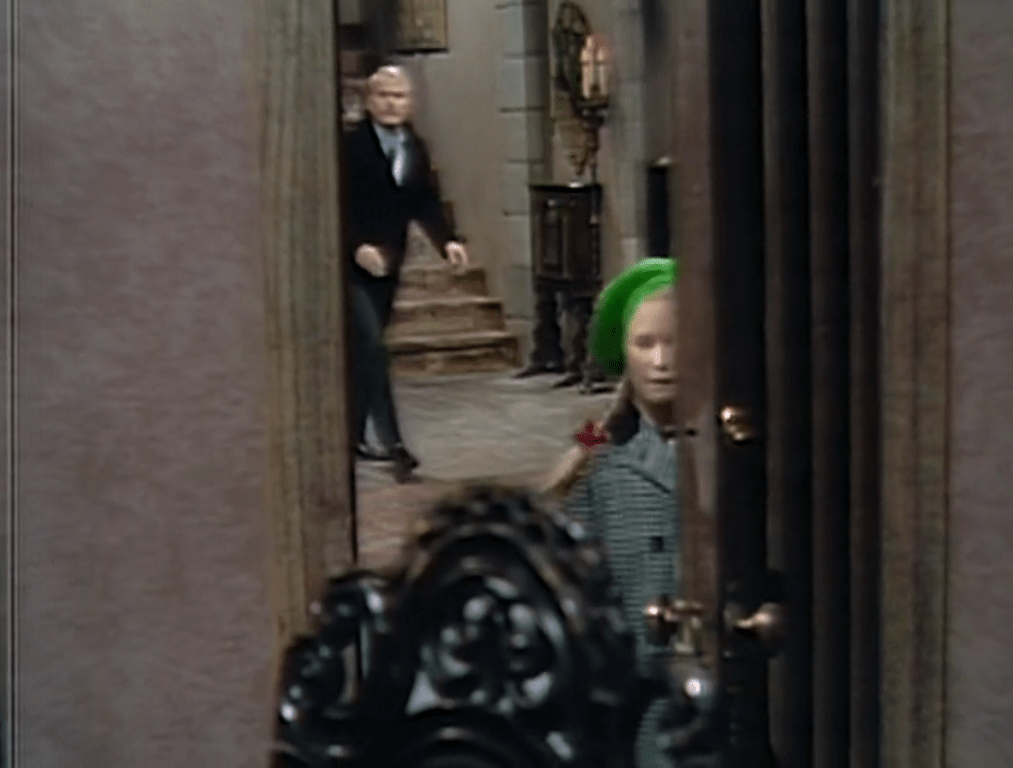
Paul Stoddard (Dennis Patrick) has been staying in his ex-wife’s home, the great house on the estate of Collinwood. At the end of yesterday’s episode, he found a boy known as Alexander hiding in his room. He chased Alexander out of the room. We saw Alexander go behind some curtains. In today’s opening reprise of that scene, Paul looks behind the curtain and sees, not Alexander, but a girl. The girl calls him “Daddy” and runs off. He looks at a photo album and recognizes her as his daughter Carolyn as she was at the age of eight. Since Carolyn is alive and well, the girl cannot be her ghost. He concludes that she must be something that the mysterious enemies whom he knows to be persecuting him have conjured her up.
Paul sees this pseudo-Carolyn a few more times, but no one else does. The last time he sees her, he chases her into a closed room.
Paul chases the pseudo-Carolyn into a closed room.
When Paul opens the door to the room and invites permanent houseguest Julia Hoffman to look inside, no one who could be mistaken for Carolyn is there. Alexander is, and he has the same book with him that the pseudo-Carolyn took into the room with her.
The foyer from a new angle.
Alexander is not the eight year old boy he appears to be. He is both a borrowing from H. P. Lovecraft’s The Dunwich Horror and a meta-fictional comment on Soap Opera Rapid Aging Syndrome. He began life a couple of weeks ago as a whistling sound coming out of a wooden box, spent a week as a newborn baby, then emerged in his current form. When he masquerades as the very young Carolyn, he doesn’t get any bigger or smaller, but he does shift his shape between male and female. Which, good for him (them?,) I suppose.
Many longtime viewers will be even more intrigued by another metamorphosis that we see today. The foyer set has always stopped a little bit downstage from the front door. The room into which Paul chases Carolyn/ Alexander lies beyond this line. Previously, when characters had entered that space they simply exited and were picked up elsewhere later. The only time the camera followed actors beyond the line was in #664, when time-traveling vampire Barnabas Collins and indentured servant Ben Stokes walked from the foyer to the study by way of an undecorated area of the studio. That area is decorated now.
New set.
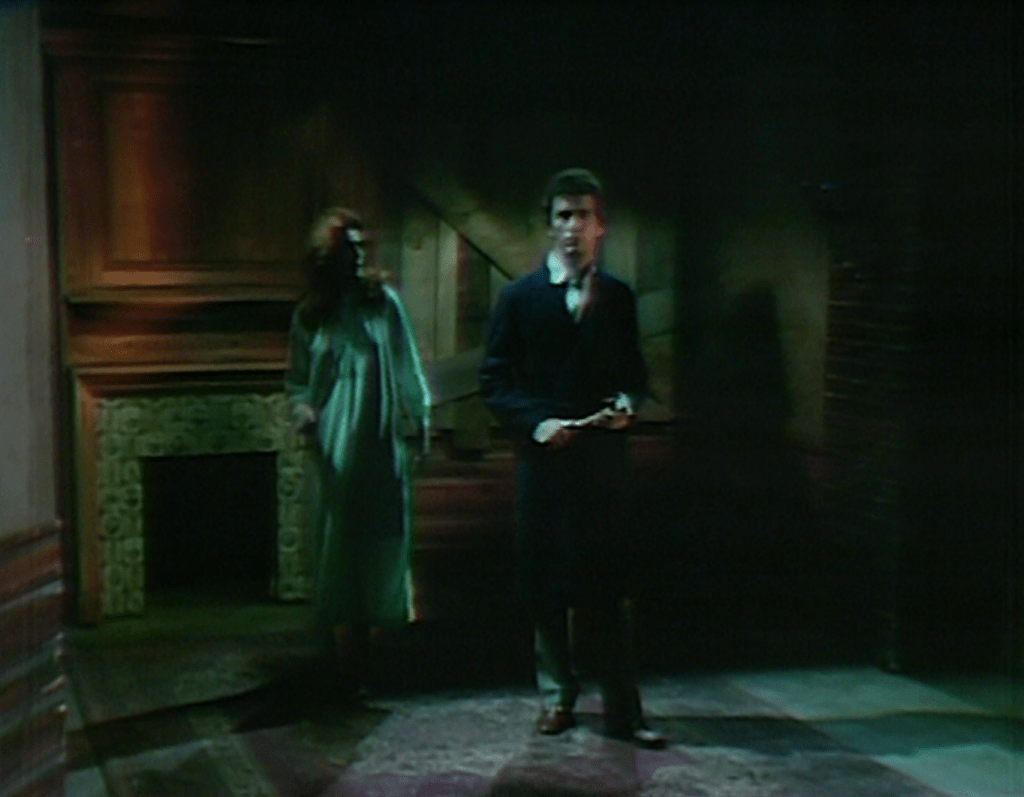
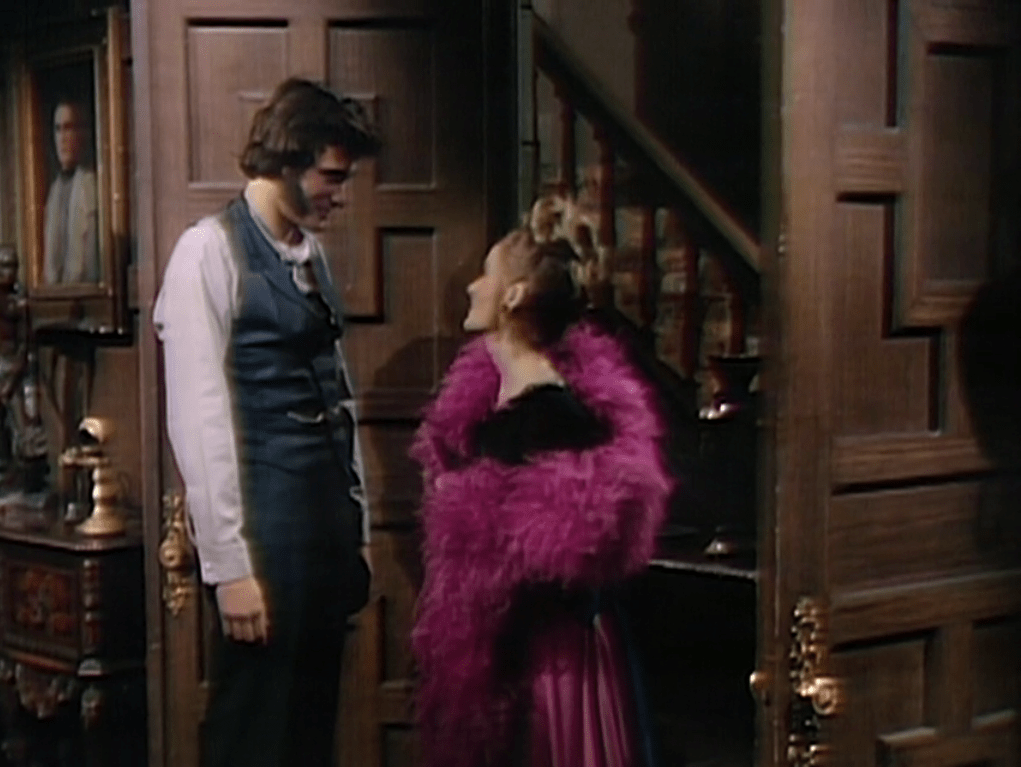
In the picture of Julia, Paul, and Alexander above, we see a portrait in the foyer behind Paul’s left shoulder. That depicts Barnabas as he was in the 1790s, before he became a vampire. It first appeared in #204, when Dennis Patrick was on the show as Paul’s sometime friend, seagoing con man Jason McGuire. It was still being painted when Patrick joined the cast a few weeks before. When he first entered the great house in #195, there was a mirror on that spot. The mirror had been trading places with a metal doodad that was shaped like a coat of arms. At the moment Jason entered, the mirror caught a portrait on the opposite wall, making it look like there was a portrait there. On repeat viewings, that effect makes it clear that Jason’s purpose is to clear the decks of leftover story elements that will not be needed in the show’s future as a supernatural thriller.
When Jason first came to the house and insisted on staying, he and Liz stood in the foyer. She looked into a space beyond the camera, to the viewer’s left (=stage right,) and said that she supposed she could find a room for him there. Jason identified the imaginary part of the house Liz was facing as the servants’ quarters, and when in later episodes we saw servants going to their rooms that was indeed the direction they exited. So when they have Patrick on screen when they enlarge the performing space available in the foyer to include an area to the viewer’s right (=stage left,) they are picking up on that aspect of his iconography.
The Carolyn side of Carolyn/ Alexander is played by Lisa Ross, whose given name was Alyssa Mary Ross. In later years, she took her husband’s name and was known as Mrs Eppich. She was born in 1959 and died in 2020; her family put a very nice tribute page to her online, you should look at it.
Lisa Ross had brown eyes; Nancy Barrett, who plays the adult Carolyn, has brilliantly blue eyes. Since half the episodes of Dark Shadows in this period were directed by Henry Kaplan, a specialist in extreme closeup shots, no regular viewers can be unaware of this. For a single episode, #578, Miss Barrett was replaced as Carolyn by Diana Walker. That one was directed by Sean Dhu Sullivan, who was adept at a wider variety of setups than Kaplan and therefore did not shove the camera into the actors’ faces over and over. Miss Walker’s eyes might be brown, I can’t tell. If so, maybe it was her Carolyn whose juvenile form Alexander assumed.
Heiress Carolyn Stoddard is working for her friends, Megan and Philip Todd, in their antique shop. She goes upstairs to tell Megan that Philip has telephoned. Carolyn hears heavy breathing coming from the room where a baby the Todds are taking care of sleeps. Megan comes out of the room and in a most imperious tone demands to know what Carolyn is doing there. She tells her Philip called, and asks about the breathing sounds. Megan sweetens up and says “It’s the radiator!” She says she’ll have to call the plumber about it. Carolyn is unconvinced.
Downstairs in the shop, Carolyn and Megan notice someone looking in the window. The shop is open for business and there is merchandise displayed in the window, but for some reason it unnerves them that they have attracted the notice of a potential customer. All we can see of the man is his clean-shaven upper lip. When Carolyn approaches the window, he runs away. The only sneaky man we have met so far in the current phase of the show is Carolyn’s long-absent and recently returned father Paul. Since Paul wears a mustache, the upper lip is enough to show us that this is a new character, at least new to the ongoing stories.
Carolyn and her mother Liz live in the great house on the estate of Collinwood. Also among the residents of the great house are Liz’ brother Roger Collins and Roger’s son, strange and troubled boy David. We cut to David’s bedroom, where a book opens by itself. We have seen books do this before on Dark Shadows, but I believe this is the first time I couldn’t see a cord being pulled. They really have come a long way with practical effects.
David reads aloud from the book, something about a child being cloaked in radiant garments. He is interrupted by his Aunt Liz. She asks him to notice that she knocked on the door, and tells him that she is learning to respect his privacy. She says she heard him reading aloud, and asks what it was. He says it was a school book. She starts talking about how terribly cold it is in his room. He brings up her ex-husband, Paul. Liz hadn’t known David was aware of Paul’s return, and gets very uncomfortable. She says he needs friends his own age, and hurries out of the room. Once she is gone, he goes through the room and gathers a lot of cash. Evidently David raised the subject of Paul to get the room to himself.
David does have one friend his own age, Amy Jennings. Amy lives in the great house, down the hall. We just saw Amy in #893 and #896, but she tends to be unmentioned in between appearances. Amy is a favorite of mine, and when they don’t use her name for long stretches I worry they are about to drop her from the show. It would have reassured me if Liz had named Amy as someone David ought to spend more time with.
Joan Bennett tends to do a lot of acting with her eyes when she plays a two-scene with David Henesy, and this is a good example. When Liz is pointing out her own good manners in knocking, it is her eyes that convey her mild amusement at the situation; when she is offering to help David with his schoolwork, her eyes follow him so closely that we notice all of the little movements he makes as he tries to get out of a tutoring session; when she talks about the coldness in the room, she looks from side to side, searching for the open window with increasing consternation; when he asks about Paul, her eyes bulge in their sockets, showing deep alarm. When she tells him he needs friends his own age, she raises her eyebrows, making it sound like a threat. Bennett had been so famous for so long that many of her scene partners would not react to what she was actually doing, but to what they expected her to do, forcing her to add Joan Bennett-isms to her performances. With Mr Henesy, she was free to work simply, and the result was consistently very effective.
Downstairs, Liz answers the telephone. To her disgust, Paul is calling. He tells her that if she doesn’t meet with him for a talk, she is in danger of losing Carolyn. She agrees to go to his hotel. Carolyn enters in time to catch the end of the conversation. Liz doesn’t want to talk about Paul with her any more than she did with David, and she exits.
Carolyn and David have a scene in the drawing room. She tells him he should go to bed; he says he wants to read the newspaper. He asks her if she hasn’t noticed that he has grown. Since the thirteen year old David Henesy was about the same height as Nancy Barrett, this question is worth a chuckle. David gets excited when he sees that Brewster’s Department Store in the village of Collinsport is going to be open nights until Christmas. He tears the Brewster’s ad out of the paper while Carolyn reminds him he can’t leave the house tonight. He says that of course he can’t, it’s late.
In his post about the episode on his great Dark Shadows Every Day, Danny Horn asked if David’s reaction to the Brewster’s ad is the only reference to Christmas in the whole series. His commenters responded that Christmas is also mentioned in #92, #123, #257, #810 (twice,) #887, and #1050. It’s hilarious to read through the thread and see the citations mount up. I sympathize with Danny, though- I tagged my posts about the first couple of episodes on that list with “Christmas,” because I, too, was sure that the holiday was only named once or twice in Dark Shadows.
Carolyn exits, and David sneaks out the front door. As he does, a man in a belted overcoat walks into the house. We see him only from the midsection down. He straightens the portrait of the Collinses’ distant cousin Barnabas that hangs in the foyer of the great house. This suggests that whoever he is, he has some connection with Barnabas. Carolyn comes back, and the man hides behind the curtains in the drawing room. This has been a favored hiding place for the last several months, suggesting that the man knows the house. Carolyn leaves, and the man goes out. If all he wanted to do was straighten that portrait, he could count his journey a success. Otherwise, it’s hard to see what the point of it was.
At the hotel, Paul struggles to explain his concerns to Liz. He is hampered by his own ignorance- he does not know exactly who is after him or what they want to do, but he knows they have some kind of sinister plan for Carolyn. Paul admits that Liz has no reason to believe anything he says, after his total failure as a husband, but he keeps urging her to take Carolyn and go far away, not telling anyone that they are going. She is exasperated with what she takes to be yet another of his scams, and tells him that “I’ll never figure out this latest plot of yours.” Indeed, the story is taking shape slowly enough that some viewers will have been saying the same thing.
Bennett and Dennis Patrick had many scenes together from March to July 1967, when he played seagoing con man Jason McGuire. Liz’ relationship with Jason was one-dimensional, consisting of nothing but a series of blackmail threats from him followed by capitulations from her. As her ex-husband, Paul offers far more for Liz to react against, and this scene is far richer and more satisfying than was anything we saw in the dreary Liz/ Jason story.
Liz goes out of the Collinsport Inn and sees David entering the antique shop across the street. The Inn has been part of the show from episode #1, but this is the first time we see a set representing its outside. Cutting between that set and the set representing the exterior of the antique shop, they make an attempt to create a sense of Collinsport as a place. When the show was in black and white, they would occasionally insert video they had taken at various locations in upstate New York and southern New England to achieve that effect, but they haven’t left 433 West 53rd Street since they went to color in August 1967. This quick cut between minimally decorated parts of the studio doesn’t work as well as that footage did, but it is a valiant effort in its own way.
Liz goes into the antique shop and insists Megan let her search the place for David. Since Liz essentially owns the town, Megan can’t say no. We conclude with Liz outside the door of the room upstairs from which Carolyn heard the breathing when we began. We hear the breathing again. David is inside the room, telling some unseen presence that it will like what he bought for it at Brewster’s. Perhaps he found it in the Unseen Presences section of the store. It’s in Collinsport, after all. David stops talking when he hears Liz’ voice; the breathing cuts out at the same time.
Old world gentleman Barnabas Collins has given a present to antique shop owners Megan and Philip Todd. It is a wooden box. This box has a strange effect on the Todds, filling them with a mixture of irresistible fascination and nameless dread.
When the Todds go to open the box, it makes a whistling noise. They find a book inside it. The book is noticeably larger than the box. It is written in a script they do not recognize. There is also a scroll. That is in English, but may as well not be- neither Philip nor Megan can understand it, though Megan does say that she feels as if she almost can.
Later, Megan has a dream. It is the sort of dream people had in the first year of the show, before there were special effects. Like the dreams in ancient Greek literature, it takes the form of someone standing by the bed and making a speech. The speaker is Barnabas, and he tells Megan to empty the bedroom of furniture, board up its windows, and let no outsiders enter it. She calls him “master,” and he tells her she will not recognize him as such when she is awake. When she does wake up, she finds that Philip is already following the instructions, and realizes they had the same dream.
Downstairs, heiress Carolyn Collins Stoddard is minding the antique shop. She receives a telephone call from someone wanting to buy a cradle that is on the shop floor. At the end of the call, we hear Carolyn’s thoughts as she congratulates herself on making a sale. She is shocked when Megan comes down and tells her the cradle is not for sale. Philip comes afterward, and with a blank expression on his face carries the cradle upstairs. Carolyn is left to call the buyer back and apologize.
Philip and Megan set the cradle in the special room. They are apparently in awe. They look like any new parents stunned by the fact that they have brought a new life into the world, but the cradle is empty. After they leave the room, it starts rocking by itself.
The cradle is an interesting choice of prop. It was important early in 1969 in the “Haunting of Collinwood” story, when it was associated with the ghosts and rocked by itself. We then saw it a couple of months later in the 1897 flashback, when we learned why it was haunted. Those stories have been resolved in such a way that it won’t occur to us that the consequences of the same tragic events are animating it this time. The cradle seems to have become a generic symbol of spookiness. Considering that its back is coffin-shaped, that’s an understandable association.
Meanwhile, Maggie Evans, The Nicest Girl in Town, has come into the shop. Maggie is the governess in Carolyn’s home, the great house on the estate of Collinwood, and they are friends. Maggie notices the sacred book on a table and asks Carolyn what it is. Carolyn doesn’t know anything about it. Why the Todds would leave such a thing on a table in their shop, a placement that implies it is for sale, is not explained.
Maggie tries on a feather boa. Like the cradle, this prop was significant in the 1897 segment. In that part of the show, Nancy Barrett, who plays Carolyn, was introduced as a woman named Charity Trask. Charity’s body was eventually taken over by late Cockney showgirl/ mentalist Pansy Faye. She wore the boa to indicate that she was Pansy. We last saw Charity/ Pansy, boa and all, in #883, and heard her voice in #887, so when we see it in the shop regular viewers will have fresh memories of her. We may well hope Carolyn will put it on and start singing Pansy’s song. But Maggie is the only one who is interested in the boa, and she doesn’t seem possessed at all. She wants to buy it, but Megan comes in and prevents her doing even that. She declares she is going to be closing the shop early.
Maggie leans very heavily on Carolyn to join her for a drink at the local tavern, The Blue Whale. Even after she drags Carolyn there, Maggie keeps pressuring her to stay for another drink. This is not at all typical of Maggie. When we find out her reason, it turns out to be even less characteristic. A mysterious gray-haired man who has been lurking around Collinwood lately wants to sit with Carolyn. When he comes to the table, Maggie gets up and leaves Carolyn alone with him. She has a self-satisfied smirk on her face as she does so, not a look we have ever seen her give before.
The man introduces himself to Carolyn as Paul Stoddard, her father. Paul abandoned the family when Carolyn was an infant, in the process faking his own death and prompting Carolyn’s mother Liz to believe that she had killed him. That belief led Liz to confine herself in her home for nineteen years, terrified that she would be caught. So it is simply inexplicable that Maggie would think Carolyn would be happy about having this bomb dropped on her.
Paul’s introduction of himself to Carolyn is the first time he is identified in a scene, but it is not the first time viewers have been told who he is. His name appeared in the closing credits for #887 and #891, ruining the surprise that is supposed to give a punch to the ending of today’s episode.
Yesterday, we spent a lot of time watching an unidentifiable man wandering around the estate of Collinwood. We only saw him from the back; he was wearing a dark coat and hat, and had silver-gray hair. Evidently we were supposed to expect his face would mean something to us when it was finally revealed.
At the end of yesterday’s episode, permanent houseguest Julia Hoffman caught the prowler coming out of the Old House on the grounds of the estate, home of her friend, missing person Barnabas Collins. She did not recognize the man, and he refused to identify himself. We see him in today’s opening reprise. His face would not be familiar to her, but it is instantly recognizable to longtime viewers. It is that of actor Dennis Patrick, who from March to July 1967 played seagoing con man Jason McGuire. Jason blackmailed reclusive matriarch Elizabeth Collins Stoddard to the point of marriage. When Liz finally stood up to Jason, his scheme collapsed. On his way out of town, Jason went to the Old House hoping to steal jewels from Barnabas. That attempt also failed, and Barnabas strangled Jason.
We spend most of the episode wondering how Jason managed to rise from the dead. Near the end, Liz’ daughter Carolyn runs into the prowler. She gets a good look at him and talks to him for a few minutes, but does not recognize him. Carolyn would certainly recognize Jason, whom she was ready to shoot if Liz had gone through with the wedding. So Patrick must be playing another character. He does not give Carolyn his name, but his strong emotional reaction when she gives hers tells us that he has some kind of connection to her. We are again supposed to leave the episode wondering who he might be.
Unfortunately, word of that did not get to the people who make up the closing credits. Patrick is billed today as “Paul Stoddard.” Paul is Carolyn’s long-missing father, Liz’ ex-husband, and a close friend and partner in crime of the late Jason McGuire. This is not the first time on Dark Shadows the closing credits have identified a character whose identity was supposed to keep us guessing. For example, at the end of #124 we are supposed to be in suspense as to which of a few people a mysterious woman is, but the closing credits identify her as “Laura Collins,” a name which blows the secret completely for attentive longtime viewers. A mysterious little girl turns up in #255 and for a few episodes we are supposed to be in the dark as to who she is. But at her first appearance the character was billed as “Sarah Collins.”
It’s interesting to cast Patrick as Paul. Jason’s scheme was based on Liz’ belief that she had killed Paul, when in fact Paul and Jason had worked together to fake his death and swindle her of some money. Since Paul and Jason committed the two halves of the same crime, they merge together in the disastrous effects they have had on Liz’ life. So they may as well look and sound exactly alike.
Waiting for Barnabas
Barnabas vanished from his basement some time ago while he was involved with some supernatural doings. Julia has been hanging around the house for over a month, waiting for him to rematerialize. She explains to Carolyn that because he disappeared from the basement, it is the only place where he can reappear. They go into the house and Julia almost immediately suggests they leave. She is sure he isn’t there, because she locked the basement door. Evidently Julia has spent all this time waiting to hear Barnabas banging on that door demanding to be let out.
Carolyn points out that Barnabas might be unconscious, and if he is he would not be banging on the door even if he has come back. Julia exclaims “I hadn’t even thought of that! He- he could be down there now!” At this, my wife, Mrs Acilius, laughed and said “He could have been down there for a month!” By profession, Julia is a mad scientist. She knows how to cure vampirism, bring Frankenstein’s monsters to life, rewrite people’s memories at will, and travel back in time, but she has her blind spots.
Be that as it may, Julia checks the basement and finds Barnabas is not there.
The Antique Shop
Carolyn takes Julia to an antique shop that has just opened in the village of Colllinsport. Carolyn called the shop “divine” yesterday, and is still thrilled about it today. I suppose it reminds her of home- like all the unoccupied spaces in the great house of Collinwood, it is crammed with a lot of miscellaneous junk.
Carolyn may have a soft spot for the place, but she hasn’t lost all capacity for judgment. The proprietors, a young couple named Philip and Megan Todd, have just unpacked a painting they bought that morning. Philip says that when it came up for auction he couldn’t resist it. Carolyn widens her eyes, tilts her head back, and says in an incredulous voice, “Hmm, your taste must be quite different from mine, Philip. I could have resisted that.”
The painting Philip couldn’t resist.
Philip mentions that the artist’s name is Charles Delaware Tate. At that, Julia perks up. She asks Philip if he is certain that it is an authentic Tate; he assures her that he is. He astonishes her by saying that it was painted only about twenty years ago. Julia says that Tate would have been in his 80s then. Seeing that the painting is about as good as anything Tate ever did, she says that he was still at the height of his powers despite his advanced age. She wonders if, having been in such good shape so recently, he could still be alive. Philip doesn’t know about that.
Julia asks for the price. When Philip says he will part with the painting for $300, Julia takes out her checkbook. Carolyn looks on, amazed to see her shell out so much money so quickly for a mediocre picture. When it is time to go, Julia asks her if she is ready. Still agape, Carolyn replies “Yes.. for practically anything!”
For eight months, from #701 at the beginning of March to #884 last week, Dark Shadows was a costume drama set in the year 1897. In the second half of that segment, Tate was one of the minor villains. He had made a bargain with evil sorcerer Count Petofi. Petofi made him a nationally famous painter whose works were very much in demand. Many of his paintings also had magical powers. The magical powers were the result of Petofi’s spell, but it was never made entirely clear whether Tate’s fame was the result of a talent Petofi gave him to paint well or if Petofi’s intervention was more direct and he simply bewitched people into admiring Tate’s paintings and wanting to buy them. Indeed, if we had to classify the works of Tate that we saw, the most secure categorization would be “Nothing Special.” They certainly do not stand comparison to the best of the portraits that the ABC Network’s Art Department prepared for the Collinwood sets. Carolyn’s reaction today clearly suggests that once Petofi’s influence receded, the paintings lost their charm.
Julia’s interest in Tate is not aesthetic. Julia traveled back in time for a couple of weeks in September. She knows that Tate’s portrait of Quentin Collins prevented Quentin from turning into a werewolf. The prospect that Tate might still be alive leads her to hope that her friend Chris Jennings, a great-grandson of Quentin’s, might also be cured of lycanthropy.
The audience is unlikely to find much ground for optimism in the thought of more Tate. As is usual for characters played by Roger Davis, Tate is hard to watch. He delivers most of his lines in a shout, and he amplifies his voice by clenching his rectal sphincter muscles. The result is what Pauline Kael used to call an “anal screech.” He also has what we might tactfully call a poor sense of personal space; indeed, two of the tags that most often appear together on posts on this blog are “Roger Davis” and “Abusive Behavior on Camera.” So I would just as soon Julia give up her search for Tate.
The Todds
Megan and Philip exult over Julia’s purchase. They are in the middle of talking about how it is a good sign for their new business, when Megan is suddenly seized with a fit of foreboding. She wants to close the shop early; Philip protests that they still have time to make a few more sales. Megan then says she has a premonition that if they stay in Collinsport something terrible will happen to them. She says she wants to sell the shop and move away. Philip tries to soothe her. He puts his head against hers and kisses her. She just looks straight on, her eyes full of dread.
Philip working his way to Megan’s neck while it dawns on her that they are now characters on Dark Shadows.
Megan is the third role Marie Wallace played on Dark Shadows. Her first two were Eve, the Fiancée of Frankenstein, and Crazy Jenny Collins, Quentin’s estranged and deranged wife. Miss Wallace had a lot of fun with those parts, but neither of them gave her much opportunity to interact meaningfully with her scene partners. Eve was unyieldingly nasty to everyone, whatever they might say or do, and Jenny was just one long mad scene. As Megan, she gets to listen to Philip and react to what he says. That ends when she ignores his kissing her neck, but while it lasts it’s good to see.
Philip is played by Christopher Bernau. Some fans say that Bernau and Miss Wallace lacked “chemistry,” but their last shot today shows how misguided that criticism is. The key to chemistry is for one character to initiate a kiss and the other to kiss back. Megan is supposed to be too preoccupied with her premonition to notice anything in her environment, even her beloved husband kissing her. If she had responded to him at all, the whole point of the scene would have been lost.
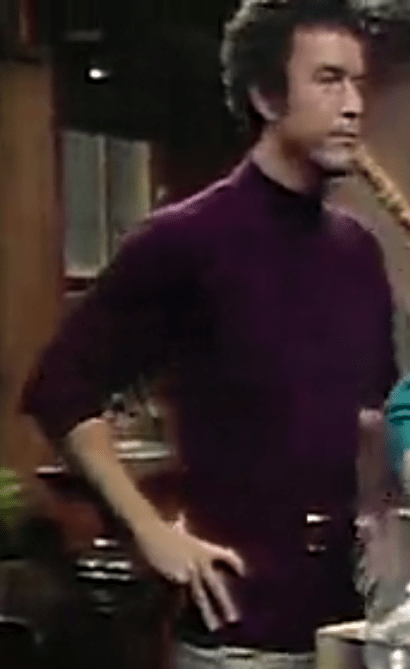
It is true that Bernau does not perfectly embody a romantic lead in Philip’s scenes with Megan. As a happy couple, Philip and Megan constantly make little jokes with each other. The jokes in the script aren’t very good, and Bernau tries to put some life into them by imitating Jack Benny. In the 1920s and 1930s, Benny’s persona struck people as a spoiled rich kid, and in later years he was so famous that it just meant Jack Benny. But by the 1960s, any man other than Jack Benny would send a very different message if he were to speak with that drawl and walk with that mincing gait. When the man in question is an antique dealer wearing a belted sweater that looks suspiciously like a dress, it does not seem especially likely that he will passionately in love with his wife.
I think Philip borrowed this from Maggie Evans…
Several times in his career Bernau proved he could be effective in love scenes with women, most famously as ladies’ man Alan Spaulding on The Guiding Light. I mentioned that role in a comment on Danny Horn’s post about this episode on his great Dark Shadows Every Day:
I was a kid when Bernau joined GUIDING LIGHT. My mother watched that show, and I had several times attempted to watch it with her, but it always defeated me after 5 or 10 minutes. It just seemed like a window into the deepest level of Hell, the frozen cavern where absolutely nothing happens. But Bernau caught my imagination. I could watch entire episodes if he was in them.
Years later, when I watched DARK SHADOWS on the Sci-Fi Channel, I realized what made Bernau so compelling on GUIDING LIGHT. He was doing a Jonathan Frid imitation. Within moments of first seeing Barnabas, I exclaimed “Alan Spaulding!” It was only years later that I learned Bernau had been on DARK SHADOWS.
Comment left 10 December 2020 by Acilius, on Danny Horn, “Episode 888: Little Shop,” 26 June 2016, Dark Shadows Every Day.
I’m very fond of John Gielgud’s story that from the time he first saw Claude Rains give a performance, his acting style consisted of imitating Claude Rains. Gielgud went on to say that this represented a great improvement over his previous style, which consisted of imitating Noël Coward. I doubt Bernau’s style ever depended entirely on either Jack Benny or Jonathan Frid, but he certainly learned a great deal by watching each of them.
The dramatic date is November 1897. We open in an abandoned mill on the old North Road in Collinsport, Maine. The late Garth Blackwood, once the keeper of Britain’s Dartmoor Prison, is about to avenge his own murder. Blackwood was raised from the dead by sorcerer Count Petofi and Petofi’s stooge, artist Charles Delaware Tate. Petofi wants to be rid of his unreliable servant Aristide, and decided that Blackwood, whom Aristide killed while escaping from Dartmoor and has feared ever since, will be the one to slay him.
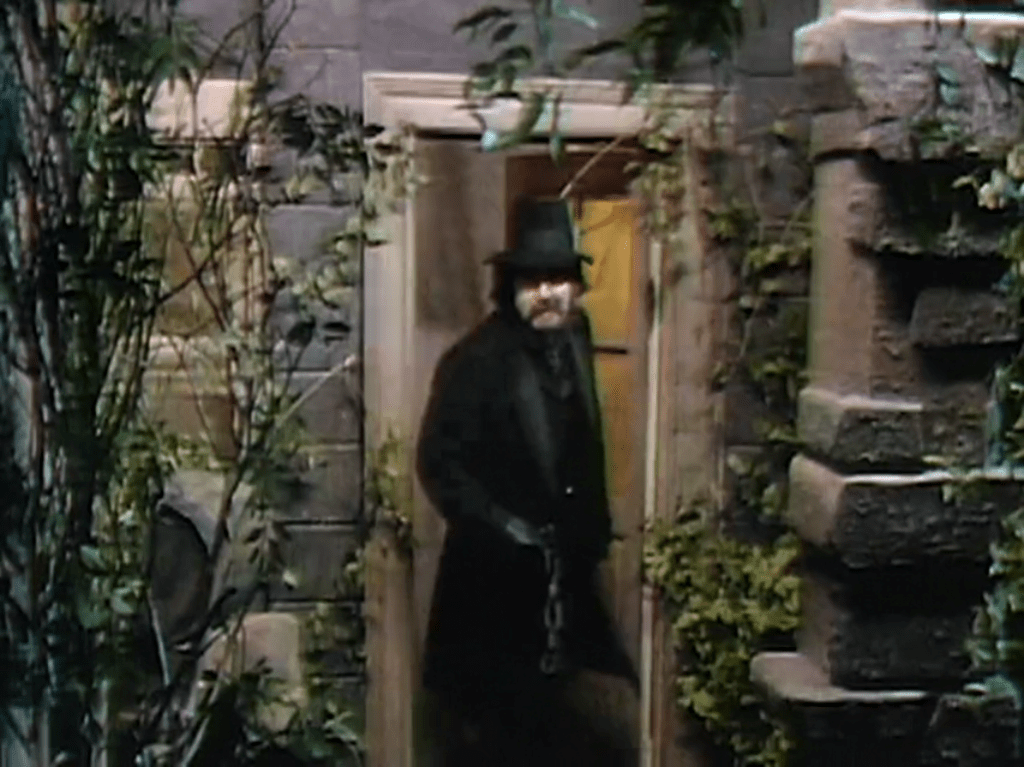
Blackwood is ready to strangle Aristide, who takes a moment to tell him that if he does so he will be endangering his own existence. He explains that there are others who conjured him up to perform the very task he is about to undertake, and that once he has completed it they will not need him anymore. Blackwood says that this is no problem. Once he has killed Aristide, he will kill them too. He pulls a chain tight around Aristide’s neck.
Tate is outside while this is happening. The set represents the exterior of the mill. The set is alternately in deep shadow and illuminated by lightning flashes. We haven’t seen it before, it is rather nice.
Tate hides while Blackwood leaves, then goes into the old mill and confirms that Aristide is dead. Aristide was a nasty and inept fellow, but Michael Stroka found so many ways to make him fun to watch that he will be missed.
Back in his studio, Tate tells Petofi what he saw. He also reminds Petofi that Blackwood has killed two other people, and that he will in all likelihood go on killing everyone he meets. Petofi doesn’t care about any of that. All that interests him is his plan to forcibly swap bodies with handsome young Quentin Collins and, as Quentin, to travel to the year 1969.
Blackwood storms in, declares that Petofi and Tate are his prisoners, and says that they are under sentence of death. Petofi tries to cast a spell to make Blackwood go away; he finds that there is more to Blackwood than his magic can control. He can only hold him at bay, and that only for a moment. Tate shoots Blackwood. The bullet wounds cause him to fall and briefly lose consciousness, but he is soon back on his feet. He leaves, and vows that he will return to finish what he started.
At the great house of Collinwood, Quentin is going through his belongings. Cockney showgirl/ mentalist Pansy Faye enters. Quentin explains that he will be leaving on the early morning train to get away from Petofi. Pansy is sad to see him go, but she well knows how dangerous Petofi is. Quentin further explains that he has been looking through all his old stuff to see if any of it is worth keeping. He doesn’t think any of it is, but she thinks a photograph of him at the age of ten is adorable, and is glad when he makes a gift of it to her. They share a really lovely moment, as she says that she still wishes they could have become lovers and he plays along. She says that if he’d married her, she’d even have given up her career for him. He says gravely that he never would have asked her to do that. Quentin never asked Pansy for any of what she wanted to give him, and her reaction to this line shows that it has reminded her of that fact. But she still cares about him, and it is still a sweet little exchange. They smile their unforgettable movie-star smiles at each other when they part.
Later, Pansy has a dream in which Quentin falls asleep and Petofi seizes his body the instant his guard is down. She awakes, and realizes she must rush downstairs to prevent this dream coming true.
Most of the episode revolves around the fact that Julia Hoffman cannot speak. Grayson Hall uses a whole new set of acting techniques playing a mute character than we had seen in her appearances as the most talkative human beings imaginable, and the result is absolutely fascinating. I’d have been glad to watch the episode again as soon as it ended.
We open in the basement of the Old House on the estate of Collinwood. Julia is sitting at a table in front of a set of I Ching wands. These wands are still in the pattern recovering vampire Barnabas Collins cast several months ago, when he was trying to contact the malign ghost of Quentin Collins. Barnabas meditated on them, and his “astral body” went back in time to 1897. Since his physical body was also in 1897, confined to the coffin in which he was at that time trapped, he became a resident of that year, and met the living Quentin.
Julia has decided that she, too, must travel to 1897. So she meditates on the wands. She tells herself that she must visualize them on a door, and she tells herself to “Empty your mind of everything else.”
She follows this injunction only too well. After passing through a series of doors, she collapses outside the great house at Collinwood in 1897. When stuffy Edward Collins takes her into the drawing room and questions her, she can respond only with a blank stare. Quentin comes in and finds a letter from Barnabas in Julia’s pocket. He asks her if she is the Julia addressed in the letter and why she has a letter from Barnabas. She does not recognize her own name or Barnabas’.
Quentin has become Barnabas’ friend, and his brother Edward has become his enemy. When he reads the letter Julia brought, Quentin realizes that Edward has locked Barnabas in the prison cell in the basement of the Old House. When dawn comes, Barnabas will not be able to get back to his coffin. Since he is a full-fledged vampire in 1897, that means he will disintegrate into dust.
Quentin leaves Edward with Julia and goes to Barnabas’ rescue. Quentin knows that Barnabas is a vampire and that he is trying to help him, and he knows that if things keep on as they are going he might become a family-annihilating ghost at Collinwood in 1969. But it is only while talking to Barnabas about the letter that he learns that he has come to 1897 from that year. The pieces start falling into place in Quentin’s mind as he absorbs this information.
Barnabas goes to hide in “the old rectory on Pine Road.” Quentin takes Julia there. Barnabas can’t get any information out of her, but he is sure that she knows how to save Quentin’s life. He is also sure that if they don’t find out what she knows, Quentin will be killed on this night, 10 September 1897.
The basis of Barnabas’ certainty regarding this latter point is a vision that a woman had. This woman used to be the repressed Charity Trask, but has now by supernatural means been transformed into the late Cockney showgirl/ psychic Pansy Faye. Pansy’s psychic act was fake until she came to Collinwood in #771. In the spirit-laden atmosphere of the estate, even her phony mumbo-jumbo called up real voices from the great beyond. Pansy’s stunned reaction when she actually contacted a ghost reminded longtime viewers of #400, when Charity’s ancestor, the fanatical witchfinder the Rev’d Mr Trask, conducted an exorcism to drive a witch out of the Old House and showed delight and not a little astonishment when the person he believed to be the witch came running out at the climax of the ceremony. Perhaps Pansy reminded the writers of Trask as well, and that was where they got the idea of having her spirit take possession of Charity.
Charity/ Pansy is in today’s episode. She’s the one who finds Julia, and she tells Edward that Julia “has death written all over her face!” She also says that she has a job. She is working at the tavern in the village of Collinsport, the Blue Whale. Presumably she is doing Pansy Faye’s old act there, singing, dancing, and doing psychic readings. We can imagine what Charity’s father, the hypocritical Rev’d Gregory Trask, must think of that.
Charity Trask is in the drawing room of the great house on the estate of Collinwood trying to call the police when her abusive step-uncle, Quentin Collins, comes out of a secret panel and takes the telephone from her. He tells her that there is no longer any point in telling the police about Tessie, the injured woman upstairs. Tessie won’t be telling them anything. She has died. Apparently the sheriff of Collinsport is the same in 1897 as are his counterparts in other periods when Dark Shadows has been set- if you’re already dead, it’s too late for them to take an interest in you.
Charity says that Quentin killed Tessie. Charity knows that Quentin is a werewolf. He locks the door to the room and asks “Are you afraid to be locked in alone with a beast, a murderer, a creature of the supernatural?” This would seem to be rather an odd question, especially since he spent yesterday’s whole episode threatening to kill her.
Charity says that her father, Gregory Trask, will see to it that Quentin is brought to justice. Quentin takes a paper from his pocket and shows it to Charity. It is a confession to the murder of Charity’s mother, signed by her father. Charity claims that it was fabricated by Satan, which is what her father told her when she first saw it, and that Trask repeatedly tried to destroy it. This only convinces Quentin that the confession is true. He says that if either Charity or her father tells the police about him, he will hand over the paper. He adds “Now, Charity, I may hang for murder, but your father will be dancing at the end of a rope, too.”
Dark Shadows is set in the state of Maine, which in our universe abolished capital punishment in 1887. That used to be true in the show’s universe, as well. In #101, broadcast and set in November 1966, high-born ne’er-do-well Roger Collins told his son, strange and troubled boy David, that “They don’t hang people anymore. Not in this state, anyway.” But by the time the show left the 1960s for its first costume drama segment a year later, characters were already afraid of being sentenced to death. The morbid fascination of the gallows is so much of a piece with the show’s exaggerated melodrama that there must be a death penalty, no matter when or where the action is supposed to be taking place.
Quentin tells Charity that there is a chance- a small chance, he concedes- that he will be cured of lycanthropy before the next full Moon, so that she need not feel that she is an accessory to murder if she doesn’t turn him in right away. Miserable, frightened, and confused, she takes this seriously enough that she remains quiet at least through this episode.
We cut to a hiding place where a man known as Aristide is looking at himself in a mirror and primping his hair, moving his fingers through it with an exaggerated daintiness. We pan to broad ethnic stereotype Magda Rákóczi , who impatiently asks “Did you send for me so there would be two of us to admire you?” Aristide has some business to discuss relating to plot points not directly involved in this episode, and he and Magda trade menacing insinuations about the danger each faces from the various supernatural forces at work in the area. Magda says that what the ziganophobic Aristide calls her “Gypsy cunning” will protect her, and Aristide says that an amulet he wears around his neck will protect him.
Magda replies “All right, we’ve both got something to protect us. I go now,” and starts to leave. Aristide stops her, and says that she must recover the severed hand of Count Petofi. She says that a man named Tim Shaw stole the hand and ran off with it, and she has no way of knowing where Tim is. Aristide says she must find out and bring it soon, “before time runs out.” She asks “Before time runs out for who? You mean when Petofi comes back!” In fact, Aristide means more than that- his master, 150 year old sorcerer Count Petofi, will die in a matter of days unless he is reunited with the hand that was cut from his right arm a century before, in 1797. If he does recover the hand in time, he will become immortal. Magda fears Petofi and hates him, and would doubtless make any sacrifice to keep the hand away from him if she knew these were the stakes. So Aristide is mortified that he let slip the phrase “before time runs out,” and is anxious to avoid saying anything else.
Back at Collinwood, Quentin confers with a Mrs Fillmore. Mrs Fillmore has been looking after the twin children Quentin’s wife Jenny bore him after he left her and before he murdered her. This is the first time we have seen Mrs Fillmore. It is also the first confirmation we have had that Quentin has seen Mrs Fillmore. He didn’t know about the twins until #798, when the boy twin was already dead as the result of a curse that a woman named Julianka placed on Magda, who is Jenny’s sister. Now Mrs Fillmore tells Quentin that the girl is suffering the same symptoms the boy showed before he died, and that the doctor is at a loss what to do for her. Quentin says he will look for someone who might be able to help, and they both exit.
Charity is alone in the drawing room, making an earnest effort to get drunk. Magda enters and expresses surprise that the unbendingly prudish Charity has been drinking. Charity replies that she merely ate some chocolates that were filled with brandy. At the sight of an empty snifter, she says that after eating the chocolates she poured herself a small brandy. She then picks up and drinks another, regular-sized brandy. Charity starts talking about how terrible life at Collinwood is. Magda mentions Tim Shaw, who was once Charity’s fiancé and who was framed for her mother’s murder. Charity wonders if Magda can use the Tarot cards to find Tim and bring him back. She asks if Tim will have to tell the truth if he comes back, and Magda assures her that he will. Magda may assume that the truth Charity wants is about the end of her relationship with Tim; she does not know that Charity is desperate to revert to believing that Tim, not her father, murdered her mother.
Magda asks Charity to tell her as much as she can about Tim. Charity says that when Tim was a boy, his closest friend was named Stephen Simmons, and that “He and Stephen Simmons used to always say they would go to San Francisco when they grew up.” Magda asks where Stephen Simmons is now, and Charity says she thinks he lives in Worcester, Massachusetts. She goes to her bedroom to look for a Christmas card Stephen sent her last year, hoping it may have his current address.
Quentin returns and finds Magda. He asks Magda how she knew about his daughter. She asks what he means. When Quentin tells her that the girl is suffering the same symptoms that her brother showed immediately before his death, they rack their brains to come up with a potential defense against Julianka’s curse. Magda remembers Aristide’s amulet. It is capable of warding off vampires and witches- perhaps it will defend against Julianka as well. Magda tells Quentin where Aristide is hiding, and he decides to go to Aristide and rob him of the amulet.
Aristide is asleep when Quentin arrives. He awakens before Quentin can take the amulet, and declares “This pendant protects me from witches, warlocks, and unnatural spirits.” Quentin asks “How does it do against flesh and blood, Aristide?” Aristide draws a curvy piece of wood with no sharp edges and replies “For flesh and blood, I have The Dancing Lady.” The piece of wood is supposed to be a knife. When Aristide first displayed it in #792, he called it “The Dancing Girl.” Perhaps this is a case of Soap Opera Rapid Aging Syndrome, and in a couple of weeks it will be The Dancing Dowager, then The Dancing Crone. At any rate, Quentin replies “Then let her dance, Aristide, let her dance.” Quentin wins the subsequent fistfight. He knocks Aristide senseless, then takes the amulet from him.
Quentin and Magda go to Mrs Fillmore’s house, the first time we have seen this set. Appropriately for a member of the Collins family, the baby sleeps in a cradle shaped like a coffin.
Quentin talks with Mrs Fillmore about little “Lenore,” a name we have not heard before today. The only other girl of Lenore’s generation in the Collins family is the daughter of Quentin’s brother Edward, and she is named Nora. Since the name “Lenore” became popular outside Greece because speakers of English and French thought it was an alternative form of “Nora,” that would suggest rather a limited imagination regarding girl’s names on the part of whoever chose them.
But it is appropriate that Quentin and Edward have children with similar names. They are two variations on Dark Shadows’ first archvillain, Roger, whose evil largely expressed itself in his amazingly bad parenting of David. Edward’s attentive and caring interactions with Nora and her brother Jamison show that he is a less villainous Roger, while Quentin’s frequent assaults on his adult family members are among the evidence that he is an even worse version of the same character. Jamison is the only child we have seen Quentin interact with, and he is fond of him. But while we were still in the 1960s, Quentin’s ghost was possessing and killing the children at Collinwood, and in #710, only two weeks into the 1897 flashback, he and his fellow Satanist Evan Hanley used Jamison as a “sacrificial lamb” in a ritual meant to exploit his innocence for their own sinister purposes. Clearly, Quentin is no more to be trusted with the care of a child than was the early Roger.
Quentin asks Mrs Fillmore to leave him and Magda alone with Lenore. They apply the amulet, and it does not seem to work. Magda tries to raise the spirit of Julianka. After some pleadings and whatnot, there is thunder, wind, and other signs of ghostly presence. Magda cries out in hope that Julianka has come with pity. A figure materializes and says “Not with pity, Magda.” But the figure is not Julianka. It is Jenny.
In #804, we saw a photograph of Jenny in Quentin’s room. It was a full length picture in a period-appropriate costume, not just Marie Wallace’s professional headshot, raising a hope that we would see Miss Wallace again before too long. But after a week and a half, those hopes had begun to fade. Perhaps they took the picture months ago and never got around to using it when Jenny was on the show. If they had done that, they wouldn’t be above sticking in a scene of Quentin looking at the picture and discussing it with his distant cousin Barnabas the vampire so that they could get their money’s worth out of it. When Miss Wallace does in fact return, the show sends us out on a high note.
Charity Trask finds Quentin Collins unconscious and disheveled in the woods. She kneels beside him in a show of concern, then notices a woman on the ground near him. The woman’s face is covered with what on a black and white television look like slash marks and her clothing is badly torn. She regains consciousness just long enough to say Quentin’s name. Charity notices that Quentin is holding a scrap of cloth that matches the woman’s dress, and realizes that he is the werewolf who has been terrorizing the area.
Quentin comes to, and Charity tells him they must get help for the injured woman. Quentin’s response is to threaten to kill Charity if she says anything to anyone about what she has seen. He says that he will look after the woman, and repeats his death threats to Charity.
Charity goes home to the great house of Collinwood, where her father, the overbearingly evil Gregory Trask, orders her to marry Quentin by the end of the week. She is horrified and tells him she will not. She cannot explain why. Before Gregory can corner Charity and force her to give him information, twelve year old Jamison Collins enters. Jamison reports seeing the injured woman in the woods, and says that Gregory must go to her at once if she is to survive. Gregory dismisses this as a “tall tale” and says he will not be distracted from punishing Jamison for his long unexplained absence from the house. Charity, on the point of sobbing, urges Trask to take Jamison seriously, and he reluctantly goes to see if there really is a woman in the woods.
We know more than do Charity or Trask. We saw Jamison meet Quentin in the woods next to the woman’s body, and talk to him in an amiable and condescending tone about the possibility of turning this unfortunate incident to their mutual advantage. He also makes it clear that, despite his appearance, he is not simply Jamison. He is a sorcerer named Count Petofi, in possession of Jamison and acting through his body. When Charity asks Jamison/ Petofi if the woman was alone when he found her, he replies that of course she was. Smiling, he asks who she thought he might have seen. Terribly agitated, she soon excuses herself and goes into the foyer. Jamison/ Petofi looks directly into the camera and smiles. David Henesy was the first actor on Dark Shadows to use this technique, back in 1966 when he was playing strange and troubled boy David Collins. He’s been doing it a lot lately, and is still very good at using it to unsettle the audience.
He looks young for 150, but he’s grown quite a bit since 1966. Screenshot by Dark Shadows Before I Die.
Quentin comes down the staircase, wearing a tidy new suit. Charity is shocked that he did nothing to help the injured woman; he resumes his menacing tone and demands to know whether she kept her side of the bargain. He eventually deduces that she did not tell what she saw, and allows her to go upstairs to her bedroom. Quentin is usually charming, often funny, and occasionally aligned with good against evil, but even before he became a monster he was established as a homicidal maniac. When we first met Quentin, he was a ghost haunting Collinwood in the late 1960s and he kept killing people there. The first week of our trip back in time to 1897, we saw him trying to strangle his grandmother in her bed. And his sister-in-law turned him into a werewolf as revenge after he murdered his wife Jenny. Since we are focused on the horror of Charity’s situation as her father is pressuring her to marry Quentin, of course his bloodthirstiness is the aspect of his personality we see most clearly today.
Trask returns, carrying the injured woman. Quentin asks if she was conscious. Trask says she is not conscious. Quentin specifies that he wants to know if she has been conscious at any point while with Trask. This arouses Trask’s suspicions; Quentin protests that it is information he will need when he telephones the doctor. Trask says that she was not, and carries her upstairs.
Quentin goes to the drawing room. Jamison/ Petofi is there, and has some business to discuss. Quentin is too unsettled by the fact of the possession to talk candidly. Jamison/ Petofi decides to humor him. “I’ll become that beautiful child you so want to see… Can we play a game, Uncle Quentin?” Quentin is stunned by Jamison/ Petofi’s sudden change of tone and bearing. It is indeed impressive to see David Henesy drop his mimicry of Thayer David as Petofi and resume his usual approach to the role of Jamison. We’d forgotten just how deeply he had come to inhabit that imitation.
Jamison/ Petofi declares that they will have a treasure hunt. He gives Quentin a series of clues in the form of cryptic rhymes. Quentin is completely stumped by all of them. Finally Jamison/ Petofi just points at the desk drawer he wants Quentin to open and tells him there is a document in it that he can use against Trask. Quentin opens the drawer and pulls out heap after heap of paper, then declares “There’s no paper here!”
Quentin is not especially brainy; much of his appeal comes from the joy David Selby, Ph.D., took in playing a character who at no point says or does anything to demonstrate intellectual prowess. But we are not supposed to believe that he is stupid, at least not so stupid that it is plausible that “There’s no paper here!” was the scripted line. Maybe it was a blooper for “There’s no paper like that here!” or “There’s no paper here I haven’t seen before!” or something like that.
A document bearing a wax seal and a couple of signatures materializes on top of the papers Quentin has pulled out of the desk. He reads it, and sees that it is a full confession to the murder of Trask’s first wife, signed by Trask and lawyer Evan Hanley. All Jamison/ Petofi has to say is “It can be very useful, can’t it? Especially since it’s true… Aren’t games fun, Uncle Quentin?” and Quentin catches on that the document gives him power he can use against Trask.
Meanwhile, the injured woman has briefly regained consciousness in the upstairs bedroom where Trask and Charity are attending her. She spoke Quentin’s name, and Trask sent Charity to fetch him. Trask confronts Quentin about this. Quentin says that the woman’s name is Tessie, that he talked to her a couple of times when they ran into each other at the Blue Whale tavern, and that he knows nothing more about her. He admits he didn’t call the police after he called the doctor; he claims he simply forgot, in the confusion of the moment. Trask says that he will go and make the call. In an accusing tone, he asks “Most unfortunate, isn’t it, that you were the one who forgot?” He leaves Quentin alone with Tessie.
Tessie regains consciousness, looks at Quentin, and reacts with dismay. He tells her he didn’t mean to do it. She moans and dies. As she flops over, her right breast comes perilously close to springing out of her décolletage. When he realizes she has died, Quentin says “Tessie!” with a note of exasperation, as if she’s always doing inconvenient things like that. Mrs Acilius and I laughed out loud.
Downstairs, we see that Trask did not call the police after all. Charity is doing it from the telephone in the drawing room. Quentin enters through the secret panel behind her. We first saw him use this panel in #685, when it was 1969 and he was a silent but peculiarly corporeal ghost. He let himself into the drawing room and strangled silversmith Ezra Braithwaite, played by Abe Vigoda. A bit of an eldritch moment that the killer of Tessie is also the killer of a character played by the actor who would go on to play Tessio in the 1972 film The Godfather.
In Vigoda’s last scene in that movie, Tessio and Corleone Family consigliere Tom Hagen are at pains to assure each other that Tessio’s impending murder and the events that led up to it were strictly business, and that Tessio and his murderers still have the warmest regards for each other. Quentin’s attempt to deny his guilt to Tessie is of that same sort- he didn’t have any hostility towards her, his nature as a werewolf simply required that he kill the nearest person.
By contrast, Quentin’s interaction with Charity is intensely personal and intensely unpleasant. He takes the telephone out of her hand, something that men often do to women on Dark Shadows when they are trapping them, and moves deep into her personal space as he demands to know why she would want to call the police. She tells him her father ordered her to make the call; he says that Tessie will tell the police nothing now, because she is dead. Charity shouts that he killed Tessie, and that she will tell everything.
Danny Horn devotes much of his post about the episode at his great blog Dark Shadows Every Day to the absurdity of Quentin making a date with Tessie on a night when the Moon was full. In a comment, I pointed out that we have no reason to think he did make a date with her:
I don’t think it’s so hard to explain why Tessie was in the woods at dawn, though it does require a little fanfic.
Charity was in Quentin’s room in 806, inviting him to go for a walk on the beach when he’s busy getting drunk and listening to the same dreary little waltz over and over. To get Tessie into the woods, all we have to do is assume that shortly after that scene Quentin ran out of booze before he was drunk enough to stop caring about the upcoming full moon. Not wanting to deal with the Trasks, he didn’t go to the mansion’s liquor pantry, but staggered down to the Blue Whale.
There, Quentin met Tessie. She was upset with him for missing several dates in the last few days. He can’t very well explain what he’s been doing lately, and his refusal to answer Tessie’s questions angers her. She’s about to give Quentin a piece of her mind when he realizes that it will be dark soon, and rushes from the bar.
Now Tessie is really furious. She follows Quentin to the estate. Once there, she sees him change into the werewolf, and hides in terror for most of the night. Shortly before dawn, she thinks he is gone and leaves her hiding place. The werewolf appears and slashes away at her for a few minutes before changing back into human form and collapsing beside her.
And that’s when Charity finally takes her walk, and finds out.
Comment left 17 November 2020 by “Acilius” on Danny Horn, “Episode 808: Twice Burned,” Dark Shadows Every Day, 18 January 2016
Tessie is played by Deborah Loomis, and is the earliest screen credit on her IMDb page. Her next role listed there was in Hercules in New York, a 1970 film which also featured fellow Dark Shadows day player Erica Fitz Mears, who appeared in #594 and #595 as Leona Eltridge. Neither Miss Loomis nor Mrs Mears stuck with acting after the middle of the 1970s, but the two top billed members of the cast worked steadily for some years after. The first name in the credits was comedian Arnold Stang, who was best known at the time for a series of TV commercials for window screens ending with the tag “Arnold Stang says don’t get stung!” Second billed was Arnold Strong, a bodybuilder from Austria making his acting debut. Under his birth name of Arnold Schwarzenegger, Arnold Strong would go on to roles in several later films. I know of no evidence he ever auditioned for a part on Dark Shadows.
Nine year old Nora Collins walks in on her teacher, Charity Trask, being bitten by vampire Barnabas Collins. Barnabas tells Nora to “Look into my eyes!” He hypnotizes Nora and mind-wipes away her memory of him. Barnabas has been on Dark Shadows for more than two years now, and this is only the second time he has pulled the “Look into my eyes!” move with someone whose blood he has not been drinking. The previous occasion was also with Nora, in #756. In the parts of Dark Shadows set in the 1960s, Barnabas is usually paired with mad scientist Julia Hoffman, who is the master of a magical form of hypnosis that allows her to rewrite people’s memories at will. So if Barnabas exercised this traditional vampire power in those segments of the show, he’d be stepping on Julia’s territory. But this episode is part of a time-travel story set in 1897, and Julia is not here.
Barnabas has been exposed and is being hunted by a number of people. His current hiding place is inside a cave. He confers there with his reluctant sidekick, broad ethnic stereotype Magda Rákóczi. Today the show is being taped on new cameras, and the image is crisper and more nuanced than we have seen since it went to color in August of 1967. The cave would barely have shown up through yesterday’s cameras, but it looks nifty today.
Magda is Barnabas’ sidekick, she is quick with lies, and she is played by Grayson Hall, but she does not do hypnosis. Screenshot by Dark Shadows Before I Die.
Magda has stolen a severed hand that a crime boss was keeping in a box, and believes that she can use it to undo a curse she placed on the rakish Quentin Collins. Barnabas is worried that they will not use the hand correctly when the time comes to release Quentin. Since there is no way to test the procedure they plan to use on Quentin, he asks if it will be able to help someone else. Magda says that it should. He has the bright idea to summon Charity. He evidently overate, and she is in danger of dying from loss of blood.
Vampires are metaphors for extreme selfishness, and with this suggestion Barnabas is a case in point. If the hand can lift curses from the people it touches, why does Barnabas not have Magda place it on him? If it freed him of vampirism, that would heal Charity and his other victims, and would allow him to stroll up to the vampire hunters on some sunny day and watch their suspicions of him collapse. But that is out of the question, because he does not know how to control the hand. He is simply using Charity as a laboratory animal.
Barnabas telepathically summons Charity. As it happens, lawyer/ Satanist Evan Hanley is at her bedside. Evan is among the vampire hunters, and knows Charity is under Barnabas’ power. He physically restrains her from leaving her room. Barnabas and Magda despair of bringing Charity and the hand together. The hand then disappears from its box. Magda thinks the hand is simply lost and is terrified that she will not be able to return it to its owner, but Barnabas is serenely convinced that it has gone to Charity under its own power.
This turns out to be true. The hand materializes in Charity’s room. Evan sees it, and, expert that he is in occult lore, exclaims “The hand of Ojden!” It settles on Charity’s face, and when it vanishes the bite marks are gone from her neck and she is once again her brisk, authoritative, and intensely priggish self, no longer a thrall of Barnabas. The hand reappears in the cave next to the box, and Barnabas smugly announces to Magda that it completed its mission.
For some reason, Barnabas’ self-satisfied certitude crumbles and he feels compelled to check on Charity to see that she has indeed been healed. He materializes in her room, but she is not there and the cock is already crowing. When he returns to the cave, Evan meets him, holding up a cross and keeping him from getting back into his coffin.
We open with governess Maggie Evans entering the bedroom of strange and troubled boy David Collins. She had heard David’s screams and a man’s laughter coming from the room; the man is gone, and David is unconscious on the floor. He has a nasty burn on his arm, and as he is coming to he pleads with “Quentin” not to hurt him.
Once David is fully awake, Maggie asks who Quentin is. David frantically denies that there is any such person, and claims that the laughter she heard was his own voice as he was playing a make-believe game. She says that she knows he couldn’t have made those sounds. He points out that they are the only people in the room. Maggie does not even try to explain how anyone could have left the room unseen; she seems already to have concluded that Quentin is a supernatural being. Maggie identifies Quentin with a strange and frightening man she and housekeeper Mrs Johnson have both seen. David keeps trying to deny everything, and Maggie keeps telling him she wants to help. David sobs, and Maggie holds him.
Maggie holds David.
Quentin is indeed a ghost who is taking possession both of David and of Maggie’s other charge, nine year old Amy Jennings. With their help, Quentin has so far killed two people, tried to kill two others, and set about trying to drive everyone off the estate of Collinwood. Up to this point, Maggie has failed completely to represent any sort of obstacle to Quentin. She is a poor disciplinarian who lets the children run rings around her even when they are themselves, and is altogether at sea when they are doing Quentin’s bidding. This scene promises a breakthrough. Maggie is the first of the adult characters to learn Quentin’s name, she does not flinch from the evidence of his uncanny nature, she vows to fight him, and David finds comfort in her arms.
The breakthrough does not come today, however. After a moment, David declares that no one can help him, and he rushes out of the room. He goes downstairs to the foyer and hears a knocking at the door. He opens it and sees notoriously abusive actor Roger Davis standing there. He reacts to that sight as anyone might, running away without a backward glance.
Maggie follows David downstairs. There is again some question as to how much of the body language in the next scene is the blocking the director gave as an interpretation of Maggie’s response to the character Ned Stuart and how much is Kathryn Leigh Scott’s reaction to Mr Davis. Maggie tells Ned she can’t talk because she must go out in search of David; as she prepares to exit, she circles around with as much space as possible between her and him, never quite making eye contact but glancing back every time he moves towards her. This is not a pattern of movement we have seen before on the show, even when a character was dealing with a vampire or some other murderous foe. Miss Scott looks very much like a woman alone with a man whom she does not trust not to assault her. If he had, it wouldn’t be the first time he has physically abused a castmate on camera.
She keeps her eyes on his hands
A child’s voice is heard, singing the song “Inchworm.” It is Amy, and she is working a jigsaw puzzle in the drawing room. The drawing room brings out Amy’s musical side. She played “London Bridge” on the piano there in #656 and tapped a few random keys on the same instrument in #676. She is quite a good singer, perhaps not surprising since actress Denise Nickerson had been in the cast of the short-lived James Lipton/ Laurence Rosenthal Broadway musical Sherry! in 1967.
Ned enters and introduces himself to Amy. His lines are all perfectly polite and friendly. Amy is supposed to gradually sense that Ned is hostile to her big brother Chris and to become uncomfortable around him, but that is supposed to come at the end of their time together. As it plays out, she already seems uncomfortable when he first enters. A minute or so into the scene, Amy smiles at Ned. Nickerson was remarkably good at flashing quick smiles, but it doesn’t work this time. She looks like she is displaying her teeth to the dentist. When Amy is supposed to start edging away from him, Nickerson turns around and proceeds to her next mark at full speed. The camera pans back, but does not capture her movement- she has gone clean out of the shot, leaving Mr Davis alone in the frame.
She goes as far as she can as fast as she can.
Ned approaches Amy; he grabs her by the shoulders and pulls her back into the shot. Chris enters. Amy starts to warn him against Ned, and he tells her not to be afraid for his sake. Indeed, Chris is safe. It is only women and children who have to be afraid of Roger Davis.
Ned confronts Chris. Evidently something bad happened to Ned’s sister Sabrina. She can’t tell Ned what it was, but he thinks Chris is responsible and wants him to go with him to the Collinsport Inn to see her. Returning viewers know that Chris is a werewolf and that Sabrina saw him transform. He assumed that he had killed her while in his beastly form, and he is surprised to learn from Ned that she is still alive. Chris is a character we are supposed to sympathize with, so it is a bit disturbing that he does not seem particularly relieved to find that he did not kill Sabrina.
In the woods, Amy finds David. She learned some days ago that Quentin wants to hurt Chris, and she has been resisting Quentin’s influence ever since. She and David talk about ways they can work together to fight him. David says that he has decided to tell Maggie what has been happening; Amy objects that this is too dangerous. They seem to be getting somewhere when Quentin appears to them. They are terrified, and then resign themselves to their fate.
Later, the children are in the drawing room with Maggie. Amy is still working her jigsaw puzzle, and David is staring into the fireplace. Longtime viewers will remember that this is something his mother used to do. She was the show’s first supernatural menace and tried to lure David to his doom. Maggie’s predecessor, well-meaning governess Vicki, led the other characters in the campaign that saved David then. We wonder if Maggie will be able to match her success.
Maggie admires the puzzle and calls David over to look at it. David makes a show of being bored, leading Amy to remark airily that boys don’t like jigsaw puzzles. David complains that there is nothing to do. Maggie suggests the three of them sit down together for a heart-to-heart talk, an idea the children reject. They suggest a variety of games they might play. Maggie notices that their manner is quite different than it was earlier in the day. David is more assertive, Amy supercilious. She finally agrees to let them play dress-up.
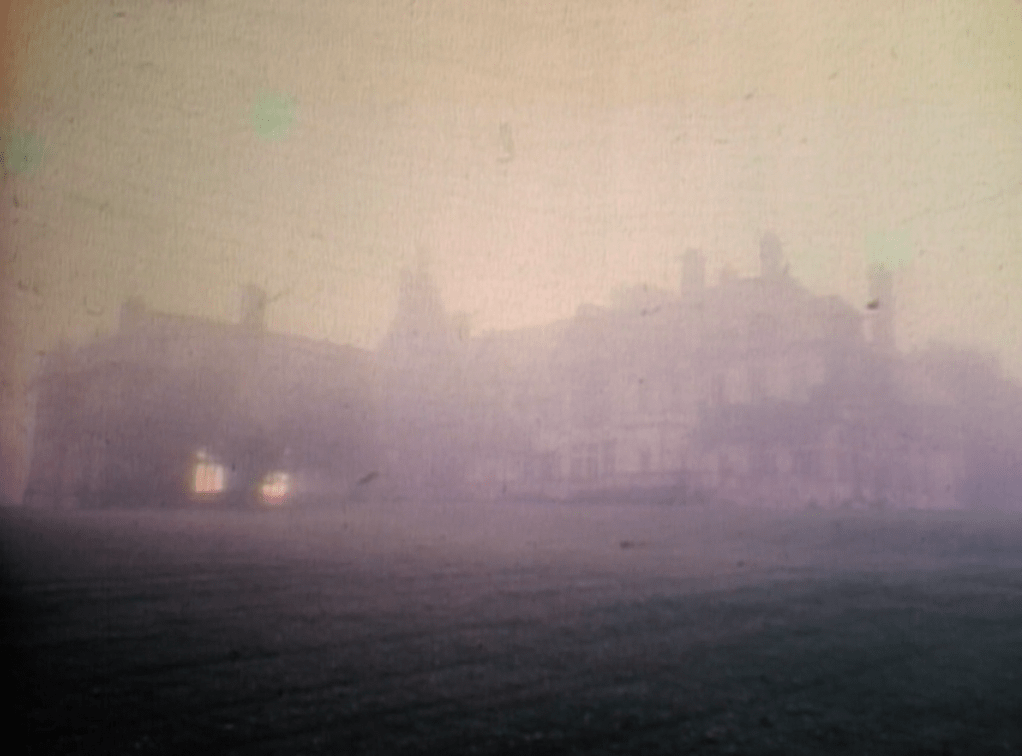
In the first year of the show, the opening voiceovers often involved a weather report. “A cold wind blows from the sea to the great house of Collinwood, but the fog still hangs heavy on its vast lawns” that sort of thing. They stopped doing that some time ago, but today they slip in an almost comically detailed bit about atmospheric conditions- “Soon dark, threatening clouds will gather over Collinwood, and long, ever-lengthening shadows will creep menacingly toward the great house. By late afternoon, rain will come, a rain that will begin slowly but steadily increase into a raging storm.” You expect them to go on with “Expect cooler temperatures and clear skies after 8 PM, with a chance of frost in the morning.” But the rain, at least, plays a part in the story. It explains why David and Amy have to stay indoors, and a roar of thunder gives Amy a chance to sneeringly ask Maggie if she is frightened. It also occasions the use of this still of the exterior of the house, one which I do not believe we have seen before:
We don’t usually see that much of the lawn.
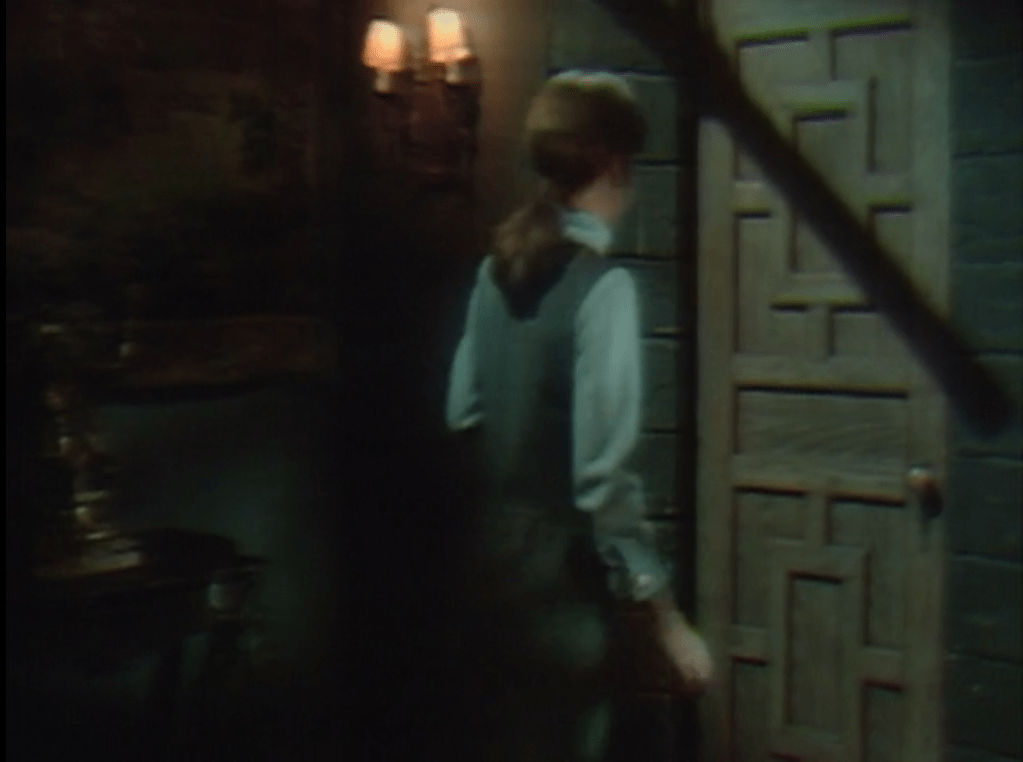
Later, Maggie goes to look for the children. She enters the study. This set has been familiar since early 1967, but today is the first time we see the outside of its door. Lately we have been seeing more of the little spaces that are supposed to join one room to another, part of a strategy to make the house seem like a bigger place.
The sequence before this suggests Maggie is heading into the long-deserted west wing, but once she goes through the door it is clearly the study.
Once in the study, Maggie hears Amy and David calling to her from no particular direction while Quentin laughs. She is bewildered, then the children join Quentin in laughing. His laughter is hearty, theirs is maniacal. Maggie goes out into the corridor, sees something frightening, and retreats into the study. She is only there for a moment when the doorknob starts turning. We end with Maggie staring directly into the camera, its lens representing the point of view of whatever it is that is terrifying her.
Maggie terrified.
This is the first of only two episodes credited to writer Ralph Ellis. Dark Shadows never had more than three writers on staff at any time. I often wish they had had many more. Ellis is one of those whom I would have liked to see as a senior writer on the show right the way through. The episode is well-paced, the characters are clearly defined, and the dialogue is smooth with just a touch of wit. If he had been in charge of, let’s say, every Monday’s script, the whole series would have been a cut above what it actually was. Since he only contributed two scripts, it is especially sad that Roger Davis had to crap on one of them, but even when Mr Davis is on camera you can still tell that Ellis did his job well.










 Dark Shadows Commentary