Episode 402: Name the witch

Well-meaning governess Vicki is in jail, about to be tried on a capital charge of witchcraft. That couldn’t happen in the New England that existed in 1795 in our timeband, but many things were possible in the world of Dark Shadows that we don’t see in ours.

Gallant gentleman Barnabas Collins has figured out that Vicki is innocent and that the real witch is his new wife, Angelique. Rather than go to the authorities with his evidence, he decides to take a more direct approach and murder Angelique. That won’t be much use to Vicki, but Barnabas can’t be bothered with details.

The longest sequence of the episode is a farce in which Barnabas pours two glasses of sherry, puts poison in the one he then gives Angelique, and tries to get her to drink. They don’t do “the old switcheroo” and mix up the glasses, but instead go with an equally hoary device of having Barnabas’ mother show up and take Angelique’s glass. Barnabas has to claim the glass is cracked and knock it from her hand.

After the failure of his attempt to poison Angelique, Barnabas opens a hidden compartment of his desk and takes out a dagger. If it weren’t for Robert Cobert’s solemn musical score, the effect would be that of seeing Wile E. Coyote open yet another crate from the Acme Corporation. He goes up to Angelique’s bedroom and lifts the dagger. Since there has been no indication that she has got into her bed, and all we see on it are a lump of covers, the audience has no reason to suppose she is in there. We end with the distinct impression that Barnabas, having barely avoided matricide, is stabbing a mattress.

We first knew Barnabas in the year 1967, when he will be a vampire and will develop from a profoundly bleak presence and an urgent threat to our favorite characters into a comic villain for whom we can’t help but feel a kind of affection as we watch him fail again and again in his elaborate schemes. In that way, his maladroit attempts on Angelique’s life today are entirely typical of the Barnabas we had met before Vicki traveled back in time in November.

In another way, this episode represents one of the biggest retcons in the whole series. Throughout his first eight months on the show, Barnabas nursed a bitter hatred for his uncle Jeremiah Collins. In the first weeks of the 1795 segment, we saw that Jeremiah eloped with Barnabas’ beloved fiancée, the gracious Josette, and that Barnabas responded to this betrayal by killing Jeremiah in a duel. When Barnabas is talking today about Angelique’s black magic, he realizes that Jeremiah and Josette ran off together only because they were under a spell, and that neither was responsible for betraying him. He has no hostility left for Jeremiah.

In the various accounts the vampire Barnabas gave in 1967 of his last years as a living being, he never mentioned Angelique. Nor did he ever say that he, Josette, or Jeremiah had been the victim of witchcraft. Instead, he had indicated that he himself had gotten involved in black magic. In #345, he told his sometime friend, mad scientist Julia Hoffman, that he became a vampire after trying to gain eternal youth, and that Josette killed herself when he offered her that eternal youth. In #358, he uses “the secret magic number of the universe,” which he had learned while studying witchcraft under a warlock on Barbados, to torment Julia. The Barnabas we met when we came to 1795 hadn’t done any of that. Until he learned the truth about Angelique, Barnabas was a man of the Enlightenment and didn’t believe that witches even existed.

Perhaps this is a change Vicki’s arrival and her bizarre behavior have wrought. The stories Barnabas tells in #345 and #358 both took place years after Josette and Jeremiah were married. So perhaps in the original timeline, with no one around yammering about what the first 73 weeks of the show were like, events moved much more slowly. The change of loves took place gradually enough that Barnabas did not feel he had to challenge Jeremiah to a duel, but he was still full of hatred and resentment. Angelique was able to cover her tracks so that no one suspected witchcraft was underway. She gradually lured Barnabas into the occult arts, perhaps giving up the idea of marrying him at some point, certainly losing his attention. By the time he brought the vampire curse on himself, the version of Barnabas in that timeline would have forgotten Angelique and would have come to be consumed by his grievance against Jeremiah. That fits far better with the April-November 1967 Barnabas than does the character we have seen so far in 1795.

Barnabas asks a key question in this episode. When Angelique says that she will always love him, he asks her what she thinks love is. She answers “Why of course I do!,” which probably means that the script called for him to ask if she knew what love was, but “What do you think love is, Angelique?” is a better question. She’s been destroying every relationship that makes him the man he is in order to have him all to herself, suggesting that if Barnabas pressed Angelique to explain what love is, she would wind up saying that it means having total control over someone. As a vampire, that’s going to be Barnabas’ working definition too, suggesting that he will be more like Angelique then than he already is now.

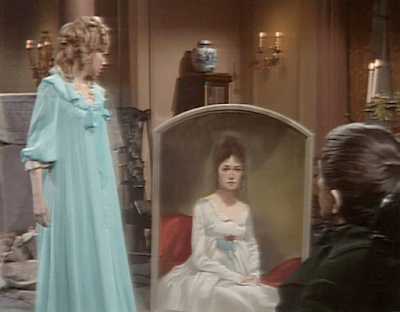
In this episode, the portrait of Josette is delivered to Barnabas’ home, the Old House on the estate of Collinwood. This portrait, haunted by Josette’s ghost, was the dominant presence in the Old House from its first appearance in #70 until Barnabas moved back in there in #221, and was important as a symbol of Barnabas’ obsession with Josette thereafter. The makers of the show left it on the wall of Josette’s bedroom at the beginning of the 1795 segment; we see it there in #374, but they replace it with a different portrait in #377. It’s hard to understand why it would already have been there before Josette formally became a member of the family- perhaps it was just a slip-up that it was there in #374, and they’d always planned to show its arrival at Collinwood.

The portrait of Josette arrives at the Old House. Screenshot by Dark Shadows Before I Die.

Episode 384: What is the truth, Barnabas?

It is 1795, and we are on the great estate of Collinwood. Under the influence of wicked witch Angelique, the kindly Jeremiah and the gracious Josette have eloped, breaking the heart of Josette’s fiancé, Jeremiah’s nephew and best friend Barnabas Collins. Barnabas, up to that point an idealistic man of the Enlightenment, responded by going against his beliefs and challenging Jeremiah to a duel.

Angelique is a lady’s maid. She was introduced as maid to Josette’s aunt, the Countess DuPrés, but today it seems she is Josette’s maid. She comes to Barnabas’ room. He demands to know why her mistress has sent her, meaning Josette, to which she replies she has come on her own account.

Angelique asks Barnabas why he has challenged Jeremiah to a duel, since he has never fought a duel or even seen one before. He explains that he could not stand being an object of pity- “I couldn’t be poor Barnabas.” In 1967, Barnabas will be a vampire. We saw him in that year, in #345, telling his sometime associate mad scientist Julia Hoffman the story of his relationship with Josette. The story he told was different from other versions he had told previously, for example in #233 and #236, and radically different from what we have seen play out in this extended flashback. In the story he told Julia, as in all other versions we had heard before coming to 1795, Josette was originally Jeremiah’s fiancée. One theme developed that resonates here was that all he could be to Josette was a faithful friend, and that he found that role humiliating. He was “poor Barnabas” in that version of the story, and he implies that it was to escape from that identity that he did whatever it was that made him the undead monster he became.

Angelique cast her spell on Josette and Jeremiah because she wanted Barnabas for herself. Now that she sees that he is likely to get himself killed before she can make her play for him, she asks him to wear a medallion of hers, one which she says will bring good luck. In the 1960s, a portrait of Barnabas hangs in the foyer of the great house of Collinwood. He is wearing a medallion in that portrait. Is Angelique’s medallion the one in the portrait? We can’t be sure.

Josette and Jeremiah have a conversation. They try to figure out what came over them. They don’t love each other, and regret hurting Barnabas. As their conversation goes on, Josette realizes that Jeremiah regrets it so deeply that he is planning to let Barnabas kill him in the upcoming duel. She is horrified by this. She doesn’t want anyone to die, and has accepted the fact that Jeremiah is the only husband she’s got. Nevertheless, she cannot dissuade him.

Josette’s father arranges for Jeremiah to have a final talk with Barnabas. Barnabas accuses Jeremiah of lusting for Josette all along, saying that “you wanted her the moment you saw her.” This is not true of Jeremiah, but in #345 it is exactly what Barnabas tells Julia he himself did. In that version, he conceived a wild passion for Jeremiah’s bride-to-be the moment he first saw her.

Barnabas tells Jeremiah “You must have hated me all your life.” As we have seen over these last few weeks, Jeremiah and Barnabas have been dear friends all their lives. But from his early days on the show in the spring of 1967 until we left for our voyage to the past in #365, Barnabas consistently said that he hated Jeremiah from his earliest days. The overall effect of comparing Barnabas’ various accounts of the past with each other and with what we are seeing in this flashback is something like reading the accounts of the patient’s memories in a case study by Freud. Not only does the order of the events jumble as retcon follows retcon, but guilt floats from one person to another and back again.

When Jeremiah tries to explain how he and Josette found themselves stricken with intermittent attacks of intense desire for each other and how they struggled against those attacks during the intervals between them, Barnabas asks “Why didn’t you come to me then?” That’s a good question, and it suggests another, equally good question. Angelique is casting spells because she and Barnabas had a brief affair before he became engaged to Josette. Why hasn’t he come clean to Josette about his past? If he had, Josette would not have put herself so completely in Angelique’s hands that she could bind her with her spells at leisure.

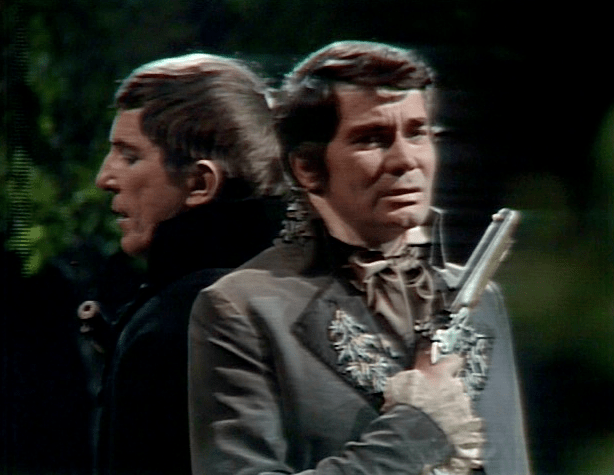
Jeremiah and Barnabas have their duel. We see them back to back, getting ready to pace off the prescribed distance. On Jeremiah’s face, we see his resolution to let Barnabas kill him.

Resigned to his fate. Screenshot by Dark Shadows Before I Die.

The men are in place when Josette comes running up, pleading with them to stop. She arrives just in time to see Barnabas shoot Jeremiah. Some say they hear only one shot, but I hear two. I think Jeremiah deloped.

Josette goes to Jeremiah’s crumpled body and shouts at Barnabas. “You monster! You madman! You killed the only man I ever loved!” She claims that she and Jeremiah were happy together, and that in his pride Barnabas could not let them be happy. She refuses Barnabas’ offer to help move Jeremiah and get a doctor for him.

Angelique had rubbed Josette’s forehead with some of the rose water in which she had put her love potion not long before this, so Josette’s declarations that Jeremiah is “the only man [she] ever loved” and that they were happy together could be a sign of that influence. It could also be rooted in Josette’s realistic assessment of her situation. Earlier, she had told Jeremiah that she would never again allow herself to say that she loved Barnabas, and when Jeremiah said that his own death would make her a free woman she rejected the idea. Whatever the circumstances that led to the marriage, she is Jeremiah’s wife, and if she becomes his widow she will have an obligation to keep up certain appearances.

This was Anthony George’s last episode. George was woefully miscast when he first joined the show in #262 as the second actor to play Burke Devlin. Writers Ron Sproat and Malcolm Marmorstein kept writing Burke as if he were still being played by the explosively exuberant Mitch Ryan. George’s style was the exact opposite of Ryan’s. He was a cold actor whose characters keep us guessing as to their motives and intentions. He was utterly lost as the hot-headed Burke.

When Gordon Russell joined the writing staff in #292, things looked up for George. Russell understood what actors could do, and gave George some scenes he played very well indeed. In Jeremiah Collins, Russell and Sam Hall created a character who was perfect for George. It’s fascinating to watch Josette scrutinize Jeremiah until she gradually realizes that he has decided to throw his life away to do penance for the offense he and she have committed against Barnabas. It is also credible that, while we can see what Jeremiah is doing, Barnabas, who has known him all his life, would not catch on. George was so bad as Burke in the Sproat/ Marmorstein era that it seemed anything that got him off the show would be welcome. But Russell and Hall know so well how to take advantage of his strengths that it is sad to see him go.

All of the actors have trouble with their dialogue today, even the usually reliable Kathryn Leigh Scott and Lara Parker. Jonathan Frid always struggles, but is especially rough this time, and as for David Ford, what can we say. He mangles virtually every line. His character is supposed to be French; he doesn’t sound French, but doesn’t exactly speak English, either. Danny Horn transcribes many of Ford’s flubs in his post about the episode on Dark Shadows Before I Die, but you really have to hear it for yourself to absorb the sheer bizarreness of the speechlike sounds that come out of Ford’s mouth. I always enjoy watching Ford, and I think he made a major contribution to Dark Shadows‘ acting style when he first came on the show, but when he is off he is way, way off.

Episode 383: Between men now

In 1966 and the early weeks of 1967, the Collinsport Inn was an important place on Dark Shadows. The restaurant there, presided over by Maggie Evans (Kathryn Leigh Scott,) The Nicest Girl in Town, was a place where people could meet each other unexpectedly and characters new to town could be introduced. Dashing action hero Burke Devlin (Mitch Ryan) lived in a suite at the inn, and the place often represented his territory, the base from which he conducted his war against the ancient and esteemed Collins family.

The sign. Screenshot by Dark Shadows Before I Die.

We haven’t seen Burke’s room since #206, at which point he had given up his vendetta against the Collinses and proceeded far down the road to irrelevance. We haven’t seen the restaurant since vampire Barnabas Collins (Jonathan Frid) met Maggie there in #221. By the time Anthony George took over the part of Burke in #262, Burke seemed to live in the Blue Whale tavern. He made business calls from the pay phone there, and in one episode apparently stayed behind when the bartender locked the place up for the night.

The inn makes a return appearance at the top of today’s episode. It is 1795, and Jeremiah Collins (Anthony George) is sharing a suite with Josette DuPrés (Kathryn Leigh Scott.) They are on their honeymoon.

Jeremiah and Josette eloped from the estate of Collinwood on the night when Josette was supposed to marry Jeremiah’s nephew, kindly gentleman Barnabas Collins (Jonathan Frid.) Josette truly loved Barnabas and Jeremiah was his dearest friend, but they were under a spell cast by wicked witch Angelique, who wanted Josette out of the way so she could have Barnabas for herself. The power of the spell waxes and wanes. When Josette and Jeremiah are in the grip of it, a trident shaped mark appears on their hands; when they return to their senses, the mark disappears.

Tridents showing. Screenshot by Dark Shadows Before I Die.

When the episode begins, the tridents are showing, and the newlyweds are inflamed with passion. Shortly after, Josette’s mark is gone, Jeremiah’s still showing. She is filled with regret, he is still ardent.

Back in the manor house of Collinwood, Barnabas has a conversation with Josette’s father André and his own father Joshua. He resists André’s suggestion that Josette and Jeremiah must have left together, and resists even more strenuously Joshua’s declaration that they did so because they are the victims of witchcraft. Joshua says that his sister Abigail and André’s sister, the Countess DuPrés, found a blasphemous trinket in the quarters of governess Victoria Winters, and that a witch-hunting divine, the Reverend Trask, is coming to investigate the matter. Barnabas is appalled at the notion of an inquiry into witchcraft, and vows to defend Victoria if Trask comes. Joshua forbids him to do so.

Barnabas’ reaction to the idea of a witchcraft trial, coupled with what we have seen of him so far in the 1795 segment, looks like a retcon. In #358, only a week and a half before we began this uncertain and frightening journey to the past, vampire Barnabas told a story about studying witchcraft under a warlock on Barbados who taught him “the secret magic number of the universe.” Events are moving so fast that it doesn’t look like Barnabas will have time to sail to the Caribbean before he becomes a vampire, and he won’t be crossing any waters after that. But now he is a man of the Enlightenment, who scoffs at the idea of witchcraft today as he scoffed at the tarot when the countess introduced him to it in #368/369.

Jeremiah returns to the house. There is an exquisite little scene with a servant, Riggs, who is uncomfortable at the sight of the disgraced Mr Jeremiah. Riggs stands in for the establishment of Collinwood and the whole working class of the town of Collinsport, and in his reaction we see the disquiet that bad news from the big house on the hill would spread among the people whose livelihoods are at stake when trouble comes to the family there. Riggs makes haste when Jeremiah tells him to go out and fetch Joshua.

When Riggs is gone, Josette enters. The audience sees that the mark is gone from Jeremiah’s hand, and Josette can tell that his passion for her is gone. She tells him that he no more loves her than she loves him. He begins with a protest against this remark, but ends by saying that they must be kind to each other.

Joshua and André enter. André embraces his daughter and tells her everything will be all right; Joshua looks at his brother with distaste and demands an explanation.

Jeremiah says that he and Josette are married. He further says he realizes they are not welcome, and that they will return to the inn. This raises the prospect of a recreation of the early days, with the inn as a territory separate from and opposed to Collinwood. Joshua rejects the idea at once. He will not have the scandal of Jeremiah and his new wife living in town because they have been estranged from the rest of the Collinses. He decrees that they will live at Collinwood and put on a happy face for the townsfolk.

Barnabas enters. Joshua tells him that Jeremiah and Josette are married. He refuses to believe it until Josette confirms it herself. He takes the glove from Jeremiah’s hand and slaps him in the face. He gives him a choice of weapons.

Dueling may have been as alien to the ideals of the Enlightenment as were Barbadian warlocks, but so too is Joshua’s plan of forcing the whole family to commit itself to a massive lie in order to preserve its hereditary privileges. Joshua, the proud apostle of Jeffersonian republicanism, is simply being a hypocrite, but Barnabas is a more complicated figure. Seeing his every hope turned to dust before him, his ideals have become useless. He has only a moment to choose among the evils the Enlightenment had promised to stamp out, and he chooses the most macho one available.

Joshua forbids the duel, but Barnabas disregards his father’s authority and insists on it. In 1795 and for some time after, dueling was widely practiced in much of the United States, and particularly in the South and West a gentleman lost face if he refused a challenge. No such stigma attached in New England, where dueling was condemned by law and religion. Had Joshua or Jeremiah gone to the police, Barnabas would have been arrested. In 1719, Massachusetts, of which Maine was a part until 1821, passed a law making it an offense punishable by a fine of £100 (equivalent to about $7000 today) to challenge someone to a duel. Massachusetts law already considered it murder to kill someone in a duel, and prescribed death by hanging as punishment. Of course, Joshua’s declaration that Jeremiah and Josette will live in the house and the family will present a “united front” to deter scandal makes it clear he will never turn his son over to the police, and the pattern of cover-up with the support of law enforcement we saw among the Collinses in 1966 and 1967 leads us to doubt that anything a member of the family does will ever be a matter for the courts to judge.

There is a missed opportunity in the show’s lack of interest in Massachusetts’ actual laws about dueling. The 1719 law was amended to be even stricter in 1730. Among the provisions added to the law at that time was a requirement that anyone who had either been killed in a duel or been put to death for winning a duel would “be given an unchristian burial at a gallows or crossroads, with a stake driven through their body.” Since the audience knows that Barnabas is fated to become a vampire, there is a chilling irony in seeing him volunteer for a staked burial.

Episode 379: Governesses are supposed to be trusting

Dark Shadows became a hit after vampire Barnabas Collins joined the cast in April of 1967. Displaced from a previous era, Barnabas spent most of his time trying to con people into believing that he was a native of the twentieth century. The difficulties Barnabas encountered in his performance in the role of modern man dovetailed so neatly with those actor Jonathan Frid encountered in his characterization of a vampire that his every scene was fascinating to watch.

The audience’s main point-of-view character for the first year of the show or more was well-meaning governess Vicki. Now Vicki finds herself in a situation like that which made Barnabas a pop culture phenomenon. The ghost of Barnabas’ ten year old sister Sarah has sent Vicki back in time to 1795, when Barnabas and Sarah are both living beings and the vampire curse has not yet manifested on the estate of Collinwood. Vicki and Barnabas have traded places- she is now the time-traveler who must trick everyone into thinking she belongs in their period, while he is her warm-hearted, if uncomprehending, friend.

Unfortunately, the show has not chosen to write 1795 Vicki as a fast-thinking con artist. By the time the Collins family of 1967 met Barnabas, he was wearing contemporary clothing and telling them a story about being their cousin from England. Vicki shows up in her 1967 clothes and carrying a copy of a Collins family history printed in the 1950s. She goes around blurting out information she learned from reading that book and introduces herself to each character by telling them that they are played by actors who had other parts in the first 73 weeks of the show. Vicki’s natterings have convinced two ladies in the manor house, repressed spinster Abigail Collins and visiting aristocrat Countess DuPrés, that she is a witch.

Today, we open with the countess setting a trap to expose Vicki. Haughty overlord Joshua Collins vanished from the front parlor yesterday, in the middle of an argument with his brother Jeremiah. Jeremiah looked away from Joshua for a moment, and when he looked back his brother was gone and there was a small house cat in his place. The countess insists Vicki come into the parlor and reenact Joshua and Jeremiah’s argument. Vicki keeps protesting that the whole idea is silly, but the countess will not be stopped.

The countess imitates Joshua. This is the first time we have seen Grayson Hall play one character mimicking another, and it is hilarious. I suppose it would have ruined the laugh if Vicki had shown that she was in on the joke, but at least it would have provided evidence that Vicki hasn’t left her entire brain in 1967.

The countess tries to get Vicki to speculate on what goes on behind closed doors between Joshua and his wife Naomi. Vicki says that “It’s not my place to judge their marriage,” managing to sound like a dutiful servant, if not like an eighteenth century English speaker. The countess goes on testing Vicki with provocations that seem unconnected with each other, and she tries not to say anything wrong. That goes on until the cat reappears.

Barnabas is Joshua’s son. He enters and sees the cat. Vicki leaves, and Barnabas tells the countess he doesn’t think he has ever seen the cat before. Caddish naval officer Nathan Forbes enters to confer with Barnabas about the search for Joshua. Nathan overhears the countess suggesting to Barnabas that Vicki is a witch and is responsible for making his father disappear.

Nathan finds Vicki. He tries to warn her that the countess suspects her of being a witch. This is the second time we have seen someone explicitly tell Vicki that she will have to do a better job of faking her way through her current situation, after a scene in #367 where the kindly Jeremiah told her in so many words that she would have to make up a better story to tell people about herself. No one had needed to do that for Barnabas when he was lying his way through 1967, and if they had he would have had a stake in his heart before he’d been on the show a week.

Nathan tries to talk sense into Vicki’s head. Screenshot by Dark Shadows Before I Die.

At least Vicki tried to absorb what Jeremiah told her in #367. When Nathan tells her today how bad she has made things for herself, she just gets uptight. There have always been times when the writers solved plotting problems by having Vicki do something inexplicable, but now it seems Dumb Vicki is the only side of the character we will be allowed to see.

The countess confronts Vicki again, inviting her to take a lesson in tarot card reading. As the countess probes Vicki for information, we hear Vicki’s voice in a recorded monologue, wondering if she could tell the countess the truth. She may as well- she has pretty well blown any chance she ever had at establishing a false identity for herself.

Vicki in over her head. Screenshot by Dark Shadows Before I Die.

When the countess asks Vicki where she was trained to be a governess, she says that she was raised in a foundling home in Boston and was trained there. The only false part of this account is that the foundling home was in New York. Changing the location to Boston only makes it that much easier for people based in Maine to check her story and prove it false. When the countess asks when she was born, she says “March 4, 19-” and catches herself. The countess remarks on the strangeness of the slip, and Vicki is conscious enough not to fall into her trap when she invites her to put the wrong digits after “17.”

By the end of their encounter, it should be obvious even to Vicki that the countess suspects her of witchcraft. The countess presses Vicki about her knowledge of the supernatural, telling her that Barnabas regards her as clairvoyant. Vicki tries to dismiss that as “his joke.” When Vicki protests that she does not know why the countess keeps asking her questions about the supernatural, the countess impatiently tells her that she certainly does know. She declares that something terrible is happening in the house, and that she is determined to find out what it is.

Having made it clear that she thinks Vicki is a witch, the countess leaves her alone in the room with the layout of tarot cards she had been studying. Vicki decides to rearrange the cards. She thinks to herself that she will thereby warn the countess of the upcoming tragedies. But the countess will know that the cards are not where she dealt them, and it will be obvious that it was Vicki who moved them. She will know that she is receiving a message, not from whatever realm tarot cards are supposed to access, but from Vicki. If that message foretells disasters that in fact occur, she will only be confirmed in her suspicions. It is difficult to imagine a stupider act Vicki could have committed.

Difficult, but for a writer as imaginative as Sam Hall it is not impossible. In the next scene, Vicki is talking to Barnabas while the countess stands nearby. Vicki tells Barnabas that Joshua will return. She speaks with such assurance that Barnabas takes it as another sign of her clairvoyance, and the countess reacts with horror, hearing the witch declare that she is about to lift her spell.

The moment when Mrs Acilius shouted at the screen, “Vicki, SHUT! UP!” Screenshot by Dark Shadows Before I Die.

Alone with the countess, Barnabas admits that he is starting to think that she may have a point about witchcraft. The countess answers that he is becoming wise.

Closing Miscellany

The asthmatic Grayson Hall has a coughing fit during her scene with Vicki and the tarot cards. It is one of the less amusing bloopers, she really sounds like she’s suffering.

I chuckled a little when Vicki stops at “19-” in giving her birthdate. Alexandra Moltke Isles’ year of birth is given on various websites as early as 1943 and as late as 1949. I think it is only fitting that someone so central to a show like Dark Shadows should be a little mysterious, so I’m glad that all we really know about Mrs Isles’ birth is that it took place on 11 February 194-.

Episode 373: Not a lady yet

Angelique, lady’s maid/ wicked witch, has cast a spell over kindly indentured servant Ben Stokes, making him her slave in an even deeper sense than he was already Joshua Collins’ slave. She gives Ben various tasks in support of her current project, black magic that will make the lovely Josette forget her fiancé Barnabas and conceive a mad passion for Barnabas’ uncle and dear friend Jeremiah. Most notably, she needs an unbroken spider web from an oak tree, and Ben brings her one.

Unbroken web. Screenshot by Dark Shadows Before I Die.

Meanwhile, cousin Millicent Collins has come to the estate of Collinwood. Millicent is giggly, afraid of germs, and very, very rich. Joshua means for his bachelor brother Jeremiah to marry Millicent, a prospect that repels Jeremiah.

Joshua suggests Jeremiah show Millicent upstairs. Screenshot by Dark Shadows Before I Die.

Time-traveling governess Vicki enters. When she sees Millicent, Vicki calls her “Carolyn,” because she is played by Nancy Barrett, who plays a character named Carolyn in the parts of Dark Shadows set in the twentieth century. The makers of the show wanted Vicki to keep the audience up to date on the cast members’ resumés, even though it makes all the other characters think she is a lunatic.

Alone with Vicki, Jeremiah confides that he does not want to marry Millicent. Vicki had studied Collins family history when she was living in the 1960s and has an idiotic compulsion to verbalize her every thought, so she declares that Millicent will never marry. Jeremiah remarks that she says the strangest things.

This scene is more tolerable than the others in which Vicki blurts out information she wouldn’t know if she belonged in 1795 because of the casting of Anthony George as Jeremiah. George was a cold actor who kept the audience guessing what was going on inside his characters’ heads. That made him a disaster as the second to play the hot-blooded Burke Devlin, but when we see him as Jeremiah we take his ready acceptance of Vicki’s bizarre behavior as a sign that he has something up his sleeve. If they can stop giving Vicki such tiresome lines, Jeremiah might be a promising love interest for her.

Episode 367: Good and evil vibrations

Episode #359 included a recreation of a shot from #69, harking back to a long-forgotten storyline in which housekeeper Mrs Johnson was a secret agent spying on the ancient and esteemed Collins family for their arch-nemesis, Burke Devlin. In #69, Mrs Johnson followed Burke’s orders and eavesdropped on a conversation between him and blonde heiress Carolyn Collins Stoddard. In #359, Carolyn herself is a secret agent, spying on the household for vampire Barnabas Collins. She follows Barnabas’ orders to eavesdrop on a conversation between him and mad scientist Julia Hoffman. The reference showed just how drastically both Carolyn and the show itself had changed from week fourteen to week seventy-two.

The puzzle is why writer Sam Hall watched #69. He wasn’t connected to Dark Shadows in those days, and it would be very far down the list of episodes you would watch in an attempt to get up to speed on what was happening when he came aboard. That puzzle is solved today.

As Mrs Johnson, Clarice Blackburn had a big turn in #69. Angrily denouncing the Collinses, she twisted up her face in a lunatic expression and loudly declared “I believe in signs and omens!” She appeared as the sworn enemy of the people we have been following all along, and as someone who is superstitious even by the standards of the haunted house where most of the action takes place.

Today, we and well-meaning governess Victoria Winters have been transported back in time to 1795. Blackburn reappears in the role she will be playing in the segment of the show set in that year- Abigail Collins, unmarried sister of haughty overlord Joshua. Abigail is a Puritan busybody out of Nathaniel Hawthorne by way of The Crucible. She renews the promise of all the mischief we had hoped Mrs Johnson would make when we first met her, long ago.

Vicki wakes up in the manor house and sees Abigail. She thinks Abigail is Mrs Johnson and is relieved that she has awakened from a nightmare. Abigail quickly makes it clear that the year is still 1795, that she is not “the friendly housekeeper,” and that she finds everything about Vicki to be appalling. She loses no time in declaring that Vicki is possessed by the Devil. Vicki denies this, but does not convince Abigail.

Abigail confronts Vicki. Screenshot by Dark Shadows Before I Die.

When Abigail leaves Vicki’s room, she locks the door from the outside. The rooms in the servants’ quarters are surprisingly large and well-appointed for the 1790s, but when we see that they can double as jail cells it offsets the apparent luxury. Vicki escapes through the window.

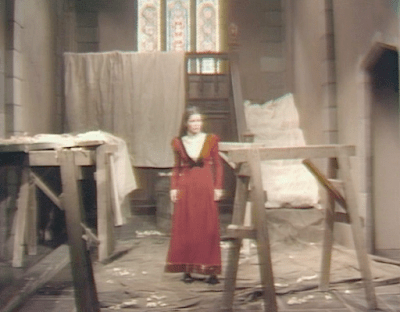
The great house of Collinwood, where Vicki lives in 1967, is under construction, and she goes there. Danny Horn, on his Dark Shadows Every Day, often said that the real subject of the series was the house. This scene corroborates his interpretation. When the ghost of little Sarah Collins said she would tell “the story from the beginning,” she sent Vicki back to the time when the great house was being built.

Construction site. Screenshot by Dark Shadows Before I Die.

Vicki finds a man in the foyer played by Anthony George. George had been the second actor to play the part of Burke. You might think her experience with Abigail would break Vicki of her habit of telling her cast-mates what characters they played in the 1960s part of the show, but no such luck. She reacts to George’s new character as if he were Burke. After a moment, she tells him that she can see he isn’t the same man. This is a riddle- if the characters played by the same actor look so much alike that it makes sense for Vicki to keep mistaking them for each other, what does she see in this Anthony George character that sets him apart from the other?

As it happens, George is playing Jeremiah Collins, builder of the great house and brother of Joshua. In #280, Barnabas had given a costume party and George’s Burke had attended it dressed as Jeremiah. Barnabas, a native of the late eighteenth century, had been thunderstruck by the sight of Burke in that costume, unable to do anything but say “Jeremiah!” and glare at him. So there is a strong resemblance, perhaps suggestive of some spiritual linkage between the two men. Vicki’s constant confusion of the actors with their roles indicates that such linkages are to be found throughout the cast. Having her babble about the resemblances out loud so frequently is the most annoying possible way to make this point. If Barnabas had kept mistaking the 1960s characters for their 1790s counterparts, it’s hard to imagine that they would have accepted him and certain that the audience would not have.

Vicki tells Jeremiah that Abigail thinks she is a witch. Jeremiah makes it clear that he finds Abigail’s hostility to be a strong recommendation, and the fact that Sarah is a fan of Vicki’s clinches the deal. He takes her back to the main house.

Once Vicki is back in her room, Jeremiah brings her 1967 clothes. He asks her why she wants them so much, telling her that they will bring nothing but trouble if they are found. She tells him that she will need them when she gets home. Combined with her habit of blurting out remarks that could only strike people in the 1790s as bizarre, Vicki’s attachment to her belongings from her own time suggests that she will very soon find herself in huge trouble. That’s unwelcome- this voyage to the past is shaping up to be interesting, and it would be nice to stay here long enough to get to know all of the characters. If Vicki keeps acting like this, she’ll get herself kicked out of 1795 and drag us back to the 1960s before Dark Shadows has had a chance to show us what they can do with a period piece.

Vicki tells Jeremiah that she has amnesia about her life until her arrival at Collinwood the day before. He tells her that she will have to make up a better story than that. She is shocked that he is telling her to lie, and he says that she will never find a place in the world if she doesn’t.

When Barnabas left 1795 and showed up in 1967, we didn’t see anyone patiently explaining to him that he would have to conceal his true identity and maintain a convincing cover story. He had figured that out by the time we met him. Most of the time he was on screen in those first months, he was trying to play the role of a modern man, a distant cousin from England whom the Collinses had forgotten about. It was fascinating to watch him essay that part. Occasionally he would stumble and blurt out information only someone from an earlier century would know; Vicki caught him doing that more than once, most notably in #233, when it seems for a moment that he might be thinking of killing her to cover his indiscretion. Other times he would face questions he couldn’t answer, and we would wonder what he would set in motion with his attempts to evade them. Quite frequently actor Jonathan Frid would have trouble with Barnabas’ lines, and it would seem that Barnabas, not he, was the one groping for words. When we first realized yesterday that Vicki was taking Barnabas’ journey in reverse, we might have hoped that it would be as interesting to watch her trying to pass as a native of the eighteenth century as it was watching Barnabas trying to pass as a native of the twentieth. That hope took a beating before the day was done, and her conversation with Jeremiah reduces it to a still lower order of probability.

Downstairs, Abigail is telling Joshua and his wife Naomi that they ought to turn Vicki over to “the authorities.” Jeremiah opposes this plan. Naomi makes a great show of screwing up her courage and “for the first time” speaks out against Abigail’s ideas.

This is quite a reversal from what we saw in the part of the show set in the 1960s. Joan Bennett plays Naomi here and matriarch Elizabeth Collins Stoddard there; Louis Edmonds plays Joshua here and Liz’ brother Roger there. But where Joshua is an iron-willed, self-assured tyrant and Naomi his cowed and isolated dependent, Liz is the mistress of Collinwood and Roger a shameless, sybaritic wastrel who lives as a guest in her house and collects a salary from her business. We saw yesterday that Naomi is entirely illiterate; we see today that this inability, though it is an anachronism in a wealthy New England lady of the 1790s, is of a piece with her cramped position in the world. Not only is she supposed to obey her husband; she is supposed to defer to his sister, and is sidelined even in the management of her own household.

The show has been hinting heavily from the first episode that Vicki, played by Joan Bennett lookalike Alexandra Moltke Isles, is Liz’ unacknowledged daughter. It’s certainly no surprise when Liz goes out of her way to stick up for Vicki. Regular viewers, connecting Bennett’s two characters, may not be surprised that Naomi also takes Vicki’s side, but she doesn’t really have much reason within the story to do so. It might have been better if they had given the two of them more time together before this scene, and shown us why Naomi would be especially well-disposed towards Vicki.

Naomi carries her point, and Joshua offers Vicki a position as Sarah’s governess. Vicki is surprised when he asks if she can read; he says that “Many people can’t, these days,” a reference to yesterday’s demonstration of Naomi’s illiteracy. She is startled by his offer of four dollars a week; he angrily asserts he could get someone else for less, and she remembers herself sufficiently to agree that the pay is ample. Joshua is very much the haughty overlord, but he does have some closeups in which we see him looking vulnerable as he tries to figure out who Vicki is and why his wife and brother have taken her side against Abigail. It is a strong scene, and it raises our hopes that Joshua will make exciting things happen.

Episode 357: Hit the blood

Mad scientist Julia Hoffman must hide her notebook from vampire Barnabas Collins and Barnabas’ blood thrall, his distant cousin Carolyn. The notebook documents Barnabas’ vampirism, and he does not want it to fall into the hands of the authorities. Once he gets hold of it, he plans to kill Julia.

The last time Dark Shadows devoted as much story time to attempts to hide and find an object as they have to this notebook was when high-born ne’er-do-well Roger Collins was frantically trying to hide local man Burke Devlin’s filigreed fountain pen, a story that dragged on from August to November of 1966. Few remember that storyline fondly, but at least the pen was a unique piece of evidence that might connect Roger to a homicide. The notebook is less satisfactory as a focus of attention, since there is nothing unique about it- Julia could easily have written a hundred documents detailing Barnabas’ secret and stashed them all over the world, and for all Barnabas knows she may have done. There are several strong episodes during this period, but the inadequacy of the notebook as a MacGuffin, combined with the fact that Julia could at any moment hop in her car and drive someplace where Barnabas wouldn’t be able to hurt her, prevents any momentum carrying over from day to day.

There are two important things about this installment. It is the first episode written chiefly by Sam Hall,* who will become far and away the most important member of Dark Shadows‘ writing staff. Hall would write hundreds of episodes, right up to the final one, would write the two theatrical features based on the show that were produced in the early 1970s, and would stick with producer Dan Curtis for years afterward, even contributing a script to the ill-fated 1991 primetime reboot of Dark Shadows. The husband of Grayson Hall, who played Julia, he would develop the show into something as different from its November 1967 incarnation as that version is from the show that premiered in June 1966.

On his blog Dark Shadows Every Day, Danny Horn argued that Hall’s contribution was to see Dark Shadows as, first and foremost, a “mashup” of various stories. The example he gives in his post about this episode are the scenes in the office of Tony Peterson, a local attorney whom Julia has hired to keep the notebook locked up in his safe. Tony is played by Jerry Lacy, who in the 1960s and 1970s was chiefly known for his Humphrey Bogart imitation. He would do that imitation on Broadway in 1969 in Woody Allen’s Play It Again, Sam and again in the 1972 film version of that play; here he is doing it in a 1980 commercial for the Long Beach California Press-Telegram.

In the scenes Danny focuses on, Mr Lacy imitates Bogart as Sam Spade or Philip Marlowe meeting a succession of mysterious women in his office. Grayson Hall plays Julia as a frightened and barely coherent client and Nancy Barrett plays Carolyn as the blonde you’d be a fool to trust, even if she does have a pair of gams that won’t quit. They’re all having a great time with their pastiche of The Maltese Falcon, The Big Sleep, and other staples of the Late Late Show.

Carolyn fingers the notebook. Screenshot by Dark Shadows Before I Die.

I do have to demur from Danny’s claim that Hall pioneered Dark Shadows as a mashup. It was that from #1, when Jane Eyre met the Count of Monte Cristo and they both found Art Wallace trying to remake a script he’d already sold to television twice. Nor is he the first to mash up disparate genres. The story of Burke’s fountain pen led into a police procedural that merged with a ghost story; Burke’s typically soapy conflict with Roger dissolved into the story of Roger’s ex-wife, undead fire witch Laura Murdoch Collins, a story which was Dark Shadows’ first and most detailed adaptation of Dracula. The difference in Hall’s approach to mashups is that always before, one of the genres was Gothic melodrama. Today, a vampire story is meeting a film noir, and there are some elements of conventional daytime soap opera in the margins. Hall is letting go of Dan Curtis’ original idea of chasing viewers who read Gothic romances.

We get a clue as to what that might mean for the existing characters when Tony asks Julia if she is afraid of Roger Collins. Julia laughs loud and long at the idea that Roger is any kind of danger. For the first 25 weeks, Roger was indeed a deadly menace, but ever since Laura came through he has been reduced to occasional comic relief. Viewers who find a reminder of Burke’s fountain pen in the business with the notebook will see that even the villainous early Roger is a minor threat compared to the supernatural force Barnabas represents. So we are not to assume that any character or theme surviving from the show’s original conception is safe.

*The credits on screen say Gordon Russell wrote it, but evidently the paperwork from the show demonstrates that Hall did. Also, some of last week’s episodes sounded and felt as much like Hall’s work as this one does, but none of the experts tries to credit him with those, so I’ll defer to the consensus and say that while his influence may have been visible some days ago, this one marks his debut on Dark Shadows as the principal author of a teleplay.