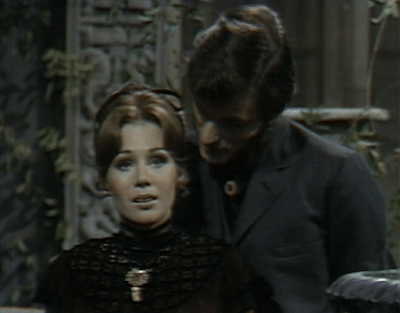
Episode 717: I know what color a lie is

A showcase for the actors today. We begin in the room on top of the tower at the great house on the estate of Collinwood. Madwoman Jenny Collins, who has been locked up in that room for some time, is threatening to stab her sister-in-law Judith with a large pair of scissors. Judith and her brother Edward have been hiding Jenny and trying to keep the rest of the family in the dark about her presence in the house. For services to this secret, they have been paying maidservant Beth Chavez and, we heard in #707, someone named Mrs Fillmore. Beth comes in just in time to distract Jenny with talk about her “babies,” and thereby to prevent her from killing Judith. Jenny turns to some baby dolls, and cuddles them happily.

Judith goes downstairs and encounters newly hired governess Rachel Drummond. Rachel has caught on the someone is living in the tower room, and the other day sneaked up there and let Jenny out. Judith reprimands Rachel for seeing and hearing things that don’t exist. Rachel is a neurotic intellectual. Her insecurities compelled her to investigate the question of the tower room, and also make it plausible that she might eventually cave in to Judith’s attempt to gaslight her into believing that she didn’t really see what she saw.

Rachel goes out, and Beth enters. Judith shows how frustrated she is with the whole situation. This scene is a bit of a letdown. As Judith, Joan Bennett was brilliant opposite Marie Wallace’s Jenny, and brilliant again opposite Kathryn Leigh Scott’s Rachel. But she falls to pieces alone with Terrayne Crawford as Beth. So many of the fansites feature so much grousing about Miss Crawford’s literalist style of acting that I hate to pile on, but it is true that she did not give Bennett anything to play off of. When Miss Crawford delivers a line, its meaning is the dictionary meaning of the words that compose it, no more and no less. She never leaves you wondering what else is going on in Beth’s mind. Sharing a scene with her would be like sharing a scene with a sign labeled “No Right on Red.” Later, Miss Wallace will have a two-scene with Miss Crawford, but as a character in a psychotic state she doesn’t need support. Her lines in that scene are flowery gibberish that don’t work at all, but neither actress is to blame for that.

The master class in acting resumes as we cut to the Old House on the estate. The mysterious Barnabas Collins has recently arrived at Collinwood and is staying in the Old House as the guest of his distant cousins in the great house. Rachel and Barnabas are attracted to each other, and she tells him what has happened. He says that he believes her, and goes on to say that no one at Collinwood is what they seem. She pleasantly replies “Except for you!” He hesitates before agreeing.

More than meets the eye.

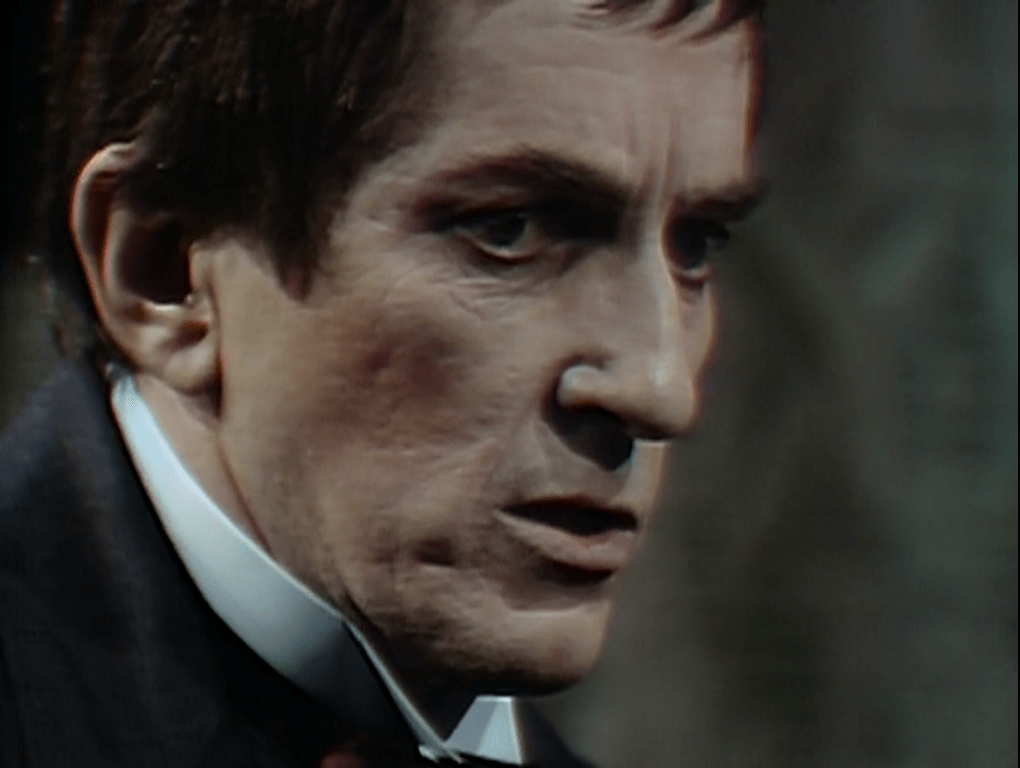
In fact, Barnabas has more than five hundred episodes of secrets he is keeping from Rachel and everyone else. Jonathan Frid’s work prior to Dark Shadows was almost entirely on stage, but he used his face like a movie actor, keeping every part of it but his eyes virtually immobile. With that, he can isolate emotions, playing just one feeling at a time. All anyone can see by looking at him in his scenes with Rachel today is that he is anguished. Rachel interprets that anguish as a sign that he cares about her, and she is delighted to think that she has such a straightforward and reliable friend.

Returning viewers know that Barnabas is in fact the most dangerous person Rachel has ever met. That knowledge on our part frees Miss Scott to play Rachel’s relief at Barnabas’ friendliness as broadly as she likes. Her unrestrained display of good cheer brightens the episode’s otherwise somber emotional palette, but the irony the audience finds in a woman having this reaction to Barnabas keeps the dramatic tension high.

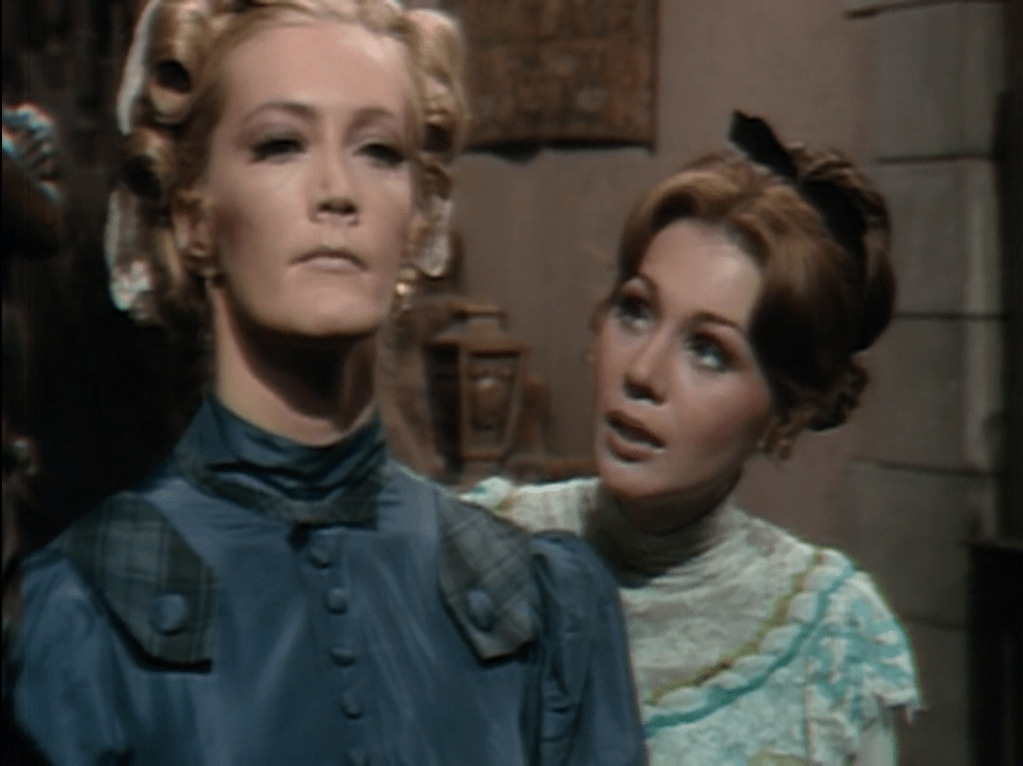
Barnabas walks Rachel back to the great house. They have made a plan that she will bring him the key to the tower room and he will go up there to investigate. She impulsively kisses him on the cheek. Rachel goes in the house and finds to her surprise that Judith is still awake. Judith detains Rachel in the drawing room with a glass of sherry and a lot of disconnected talk. Judith doesn’t make eye contact with Rachel during this scene; she doesn’t want a conversation. She is simply enjoying her new position as head of the household. Rachel cannot get away until Beth enters and Judith abruptly dismisses her.

Barnabas has been watching the windows of the tower room and has seen lights go on and off. Nervous, he considers letting himself into the room without a key; he has the means to do that, but he would like to keep Rachel from knowing about his abilities, and so he resolves to wait for her.

After Rachel brings Barnabas the key, he goes to the tower room and uses it to let himself in. No one is there. He picks up the damaged, severed head of a doll, one of Jenny’s “babies.” Suddenly, he hears someone enter. He turns, and reacts with shock.

Episode 716: Someone who is not going to come

Governess Rachel Drummond has figured out that her employers, the Collins family of Collinwood, are keeping someone locked in the room atop the tower in the great house on the estate. Rachel has seemed frightened ever since we first saw her, in #705, and this information has added to her fear considerably. Rachel recently came to the conclusion that some unknown person was trying to harm her. She then let Romani stereotype Magda Rákóczi talk her into believing that the prisoner in the tower room was that person, and that her only hope was to choose the time of their confrontation.

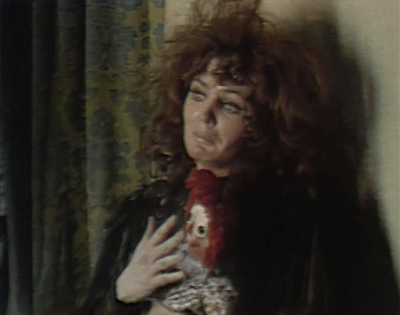
Today, Rachel opens the door to the room and goes in. We know that the enemy Rachel ought to fear is wicked witch Angelique, and we can tell that the person in the room is not her. Instead, she is a madwoman named Jenny, and she is tall with red hair. Jenny attacks Rachel, pushes her back in the room, and flees, locking the door behind her and trapping Rachel.

The show has been dropping broad hints that Jenny is the estranged wife of stuffy Edward Collins and the mother of Edward’s children, Rachel’s charges Jamison and Nora. Once she is on the loose, Jenny slips into Nora’s room and looks at a framed picture of Edward there, expressing her hatred for him. Nora has been outside; she had a dream that her missing mother came home, and she went out to look for her. When Nora comes back into the room, Jenny dares not show herself, but stays in the shadows and longingly caresses a doll.

Jenny, in 1897, with a Raggedy Ann doll, first made in 1918. Screenshot by Dark Shadows Before I Die.

A servant named Dirk Wilkins figures in the episode a couple of times. He finds Nora outside, picks her up, and with considerable roughness carries her into the house. Perhaps this roughness is only apparent, but actor Roger Davis was notorious for physically abusing his scene-mates on camera, especially women and children. He may well have been even harder on Denise Nickerson than Dirk is on Nora.

One of my ways of making the show tolerable to watch when Mr Davis is on camera is to imagine someone else playing his part. Dirk is supposed to be unlikable; he sneers at everyone, even his employers. In the part of Dark Shadows set in 1968, a character named Harry Johnson had a similar manner, and even wore a costume like Dirk’s. The first actor to play Harry was Craig Slocum, who was pretty bad, but the second, Edward Marshall, took the same personality and made it quite amusing to watch. Mr Marshall might have made a fine Dirk. Other accomplished performers had small turns as background players on Dark Shadows and surely would have been glad to accept speaking roles. Among these, Harvey Keitel (Dancer at Blue Whale in #33) and David Groh (Ghost of One-Armed Man in #544 and Hangman’s Assistant in #664) went on to do outstanding work playing ill-tempered men, so in either of their hands Dirk might have become a breakout star.

Episode 714: The available ladies in the house

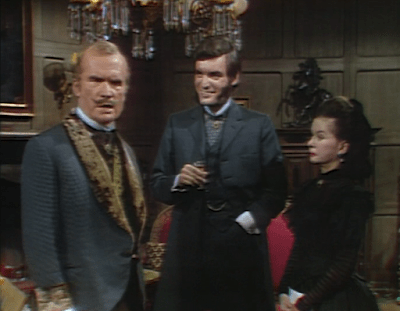
One day in the year 1897, Edward, Carl, and Quentin Collins hear their sister Judith read their grandmother’s will. Stuffy Edward and childlike Carl are shocked to find that Judith is the sole heir of their family’s vast holdings. Quentin stole the will and tried to forge a new one, so he is not shocked, but he is weirdly gleeful about the paragraph relating to him. He will receive no property and no income, but will be guaranteed a place to live in the great house of Collinwood forever. This enshrines his relationship with Judith as one of the clearest examples of Dark Shadows’ signature dynamic of Bossy Big Sister and Bratty Little Brother. No matter how atrociously Quentin may behave, no matter how loudly Judith may disapprove of him, she has no authority to punish him and her concern for the family’s good name will compel her to cover up his misdeeds and shelter him from their natural consequences.

Edward flummoxed, Quentin delighted, Judith in charge. Screenshot by Dark Shadows Before I Die.

Meanwhile, governess Rachel Drummond and ladies’ maid Beth Chavez are busy with a mystery concerning the room on top of the tower that stands in the middle of the great house. Rachel has seen lights in the room and suspects someone is being held prisoner there; contrary to the direct orders of Judith and Edward, and against Beth’s very strongly worded advice, Rachel is investigating this matter aggressively. She sneaks up the stairs to the top of the tower, listens at the door to the room, and sees Beth coming out of it with a tray.* She then goes to Beth’s room, where she interrupts Quentin sexually harassing Beth. When she tells Beth what she saw in the tower and asks about it, Beth is shocked that Rachel went into the tower. She denies everything.

Later, Rachel goes back to the top of the tower and again listens at the door. She hears a cradle rocking. We saw that cradle in #645, when Dark Shadows was set in contemporary times and Quentin and Beth were ghosts haunting children David Collins and Amy Jennings. They sent Amy and David to fetch the cradle from the attic of the Old House on the estate and to bring it to Quentin’s old room in the west wing of the great house. This is one of the first times in the 1897 segment when we explicitly close a loop opened during the “Haunting of Collinwood” story.

*At the beginning of the episode, we saw Beth approach the room with the tray and a baby doll. During that scene, we hear what I believe is new music. It has been quite some time since we have heard any new cues, so this stands out.

Episode 713: The heart of the room

Vampire Barnabas Collins returns to his coffin at dawn to find it already occupied. Governess Rachel Drummond is resting there, and is under the impression that she is Barnabas’ lost love Josette. He exclaims that only his old enemy, wicked witch Angelique, could be “monstrous enough” to put Rachel in this position.

Longtime viewers remember that in #248 Barnabas forced Maggie Evans, who like Rachel is played by Kathryn Leigh Scott, into this coffin because she refused to submit to his attempt to brainwash her into thinking she was Josette. So we know that Angelique is not all alone in the ranks of the sufficiently monstrous. On the other hand, we also know that it was Angelique who made Barnabas a vampire in the first place, and that like others who labor under Angelique’s curses he is in many ways a reflection of her. So perhaps his remark is not so preposterous an example of lack of self-awareness as it initially seems.

Shortly after, Rachel comes to in the front parlor of Barnabas’ home, the Old House on the estate of Collinwood, and is puzzled to find herself there with him. She has no idea how she got to the Old House, and certainly has no memory of the coffin in its basement. Barnabas tells Rachel he found her wandering in the woods. She goes to pieces, overwhelmed that she is not in control of her actions. He talks soothingly to her. Rachel collects herself, but is still struggling not to let Barnabas see her cry. He offers to walk her home to the great house on the estate. This offer is sheer bravado on his part- the sun has been up for some time, and he cannot possibly expect to survive outdoors all the way to the great house. Luckily for Barnabas, Rachel declines his offer. Unable to keep her emotions in check any longer, she hurries out the front door, walking herself home.

At the great house, Rachel sees maidservant Beth enter the foyer carrying a baby doll. Rachel says that her charge Nora will like the doll very much. Beth sputters at this remark, and spinster Judith Collins summons Beth to the drawing room. Rachel eavesdrops while Judith scolds Beth for her carelessness. Returning viewers know that Beth is helping Judith and Judith’s brother Edward keep someone prisoner in the room atop the tower of the great house, and that it is hugely important to Judith and Edward that no one knows about this. Beth’s sputtering response to Rachel told us also that the doll is not for Nora, but for this mysterious prisoner. Rachel does not have all the information about the matter that we do, but she has enough to suspect something very much like the truth, so we wonder what she gets out of the conversation she overhears.

Later, Rachel meets Beth in the foyer and urgently pleads with her for information about Edward’s wife, the mother of Nora and of her other charge, Jamison. Beth tells her what Edward has already made abundantly clear, that the topic is utterly forbidden. Rachel sidles up to Beth, bends her head at an angle, and speaks in an urgent whisper, something we have not seen from either Maggie or Miss Scott’s other role, Josette. Indeed, Rachel is quite a fresh character, impressively so from an actress whom longtime viewers already seen for so many hours.

Rachel pleads with Beth for more information.

Judith overhears Rachel’s questioning of Beth and Beth’s response that Rachel should leave the matter alone. Judith dismisses Beth and talks to Rachel, telling her that Beth has given her very good advice. Judith has figured so far as a stern and menacing figure; it is something of a surprise that she does not fire Rachel on the spot, and even more of a surprise that she indicates she will not report the conversation to Edward.

The opening voiceover will tell us in a couple of days that Rachel’s reckless curiosity is “spurred on by her own fears.” Miss Scott has been playing this motivation all along. When we first saw Rachel, she and Edward were in a train station. He was being courteous to her, but she was stiff and awkward, clearly very much afraid of something. She is often seen reading, and her dialogue is both filled with signs of intellectual ambition and delivered with a frantic edge, suggesting that her studiousness has its roots in her attempt to defend herself against some danger. We have no idea as yet what that danger was or how it formed Rachel before we met her, but we know that her reaction to the evidence that she has found that someone is being held prisoner in the tower room at Collinwood is a deepening of her long-established fears, not the sudden appearance of new fear.

For her part, Judith’s main concern is finding her late grandmother’s missing will. The late Mrs Collins kept the provisions of her will secret, and it was stolen shortly after her death by some people who wanted to forge a new will and get the estate for themselves.

A woman named Magda Rákóczi shows up at the house, claiming to be able to help Judith find the will. Judith is violently prejudiced against Magda for her Romani ethnicity, and dismisses her offer of help out of hand. But Magda persists. Knowing that her grandmother had a fondness for Magda, Judith lets her into the drawing room and sits behind her while she reads the tarot. Judith keeps protesting that the previous cases Magda cites as evidence that the tarot can tell the future prove nothing, and that in her interpretations of them she is “making no sense whatsoever.”

Magda then says that the arrangement of the cards means that the will is hidden in the room where Judith’s grandmother died, in “the heart of the room.” In an entirely different voice than she has been using so far, Judith asks “What is meant by the heart of the room?” With that, Magda knows that she has Judith in the palm of her hand, and she starts to ham it up. “The hearrrt of the roooom… is a booook! A book that was very important to your grandmother! A very, very oooolld booook!” Judith decides this must be the family history, and she tells Magda that she will look through it at once.

Magda goes over the top. Screenshot by Dark Shadows Before I Die.

In fact, Barnabas found the will and hid it in the family history. He has sent Magda to tell Judith where to find it. It comes as no surprise to us when Judith comes downstairs with the will and is jubilant to find that she is the sole heir of her grandmother’s vast holdings. After all, Barnabas wants the original provisions of the will to be enacted, and the only way to ensure that result is to see that it comes to the hand of the person who is its chief beneficiary.

We end with Beth standing at the door to the tower room, holding the doll and addressing the person inside as “Jenny.” We learned in #701 that Beth was originally maid to a lady named Jenny, that everyone thinks Jenny has gone away, and that it is surprising Beth has stayed on at the house in Jenny’s absence. Now it is confirmed that Jenny is the prisoner in the tower room. The obvious inference is that Jenny is Edward’s estranged wife, and that she has become the sort of crazy lady who appreciates baby dolls.

Episode 707: Dark for over a hundred years

One day in 1897, Edward Collins convenes his siblings Judith, Carl, and Quentin for a family meeting in the drawing room of the great house of Collinwood. Their grandmother Edith died the night before. She was supposed to tell Edward a celebrated family secret, but did not do so. Edward is convinced she must have told one of the others, and declares that no one will leave the room until he finds out which.

Returning viewers know that Edith did not tell any of them, and we can imagine a half hour of nothing but the four Collinses of Collinwood sitting around staring at each other. Fortunately, Quentin points out that Edith was briefly alone with their recently arrived and thoroughly mysterious cousin, Barnabas Collins, and she might possibly have told him. Edward orders Carl to go to the Old House on the estate, where Barnabas is staying. Carl asks why it’s always him who has to do these things, and Edward angrily shoos him away. Louis Edmonds and John Karlen were both talented comic actors, and this little exchange is very funny.

In the Old House, Carl finds Sandor Rákóczi coming up from the cellar. He asks Sandor what he is doing there. Sandor says he lives there. Carl says that he’d heard Barnabas was living in the house now. Sandor says that Barnabas hired him and his wife Magda as servants. Carl laughs at that and says of Barnabas “He is an odd one, isn’t he?” Sandor gives him a fierce look, offended. Carl apologizes.

Carl explains that he has come to fetch Barnabas. Sandor says Barnabas won’t be back until after dark. Carl explains why they need him at the great house, and Sandor laughs. “You must have Gypsy blood! Nobody in the family trusts nobody else!” Carl laughs, too.

This scene may remind longtime viewers of the first time we saw Thayer David on this set, when he was playing crazed handyman Matthew Morgan. The dramatic date and the date of production were both 1966 then. Strange and troubled boy David Collins found Matthew hiding in the Old House, and agreed to help him avoid the police. Carl is a grown man, but he is as eager to please and uninterested in asserting dominance for any length of time as was the nine year old David. Further, he is so naive that he reacts with bewilderment to the idea that lust for money might be a motive for murder. Carl may not be less prejudiced against Romani people than are the rest of the Collinses, but his childlike qualities allow him to laugh at a joke that would have drawn a violent response from any of his siblings.

Carl insists that Sandor go home with him and tell Edward that Barnabas is away. Again, this shows Carl’s childishness. He wants to prove to Edward that he did as he was told and went to the Old House. In fact, Edward is appalled to see Sandor in the great house, and can barely stand listening to him.

While Sandor is leaving, Judith stops him. Sandor is astounded that she is speaking to him at all. She tells him that her grandmother may have tolerated his presence in the Old House, but that she and her brothers will not. Sandor and his wife Magda are to leave the property within twenty four hours. Judith does not give Sandor a chance to tell her that Barnabas has hired them as servants.

On the terrace, Quentin finds Rachel Drummond, the new governess. The two of them look very good together. In fact, Quentin’s seductive manner and Rachel’s response to it make them the most attractive couple we have seen on the show, by a long way.

Chemistry lesson. Screenshot by Dark Shadows Before I Die.

They talk about the house. Quentin mentions that no one has been in the room on top of the tower since 1796, 101 years ago. Later that night, Rachel will see a light burning in the room, and she will rush into the drawing room to tell Edward about it.

She comes in after a meeting between Edward and Judith. Judith came to tell her brother about something entirely new to the audience. She says that the matter relating to the tower room is going well. Maidservant Beth goes to the room three times a day, and Beth also goes into town regularly to take money to a Mrs Fillmore.

This will interest returning viewers. The other day, Quentin found Beth going into town with a parcel and an envelope containing $300 in cash. Beth said Judith gave her permission to go to town to conduct personal errands, and claimed, absurdly, that she had saved the money from her salary. We now know that she was taking the money to this Mrs Fillmore for some purpose of Edward and Judith’s. Later, Quentin found Beth taking a tray of food upstairs. He asked who was supposed to eat it; she said it was for Edith. When he pointed out that it was more than Edith could eat, she said Judith would be eating with her. In Edith’s room, Beth told Judith about this. She said they would have to be more careful now that Quentin was back home, and dismissed her to take the rest of the food “upstairs.” We now know that this “upstairs” is the tower room, and that Beth is helping Judith and Edward to hide someone there of whose presence in the house Quentin is unaware.

However much this may interest us, it does not interest Edward at all. He is outraged that Judith so much as mentioned the matter to him, saying that he wants her to handle it without notifying him in any way. She objects that they will have to talk about it sometimes; he does not agree.

When Rachel enters and tells them about the light, Edward detains her with a disquisition about the impossibility of the tower room being lighted while Judith scurries off and goes upstairs. After a while, Edward takes Rachel back to the terrace and shows her that the room is dark. He asserts that it was also dark when she looked at it earlier, and it has been dark for over a hundred years.

Longtime viewers will recognize this scene. In March 1968, Dark Shadows was set in 1796, and Barnabas had just become what he is again now, a vampire. Barnabas’ father, haughty overlord Joshua, confined him to the tower room while he tried to find a way to free his son of his curse. Barnabas’ mother Naomi saw lights in the tower room, as did his second cousin Millicent. When Naomi told Joshua about the lights, he pretended not to see them, and when Millicent told her husband Nathan she had seen the lights, he, for his own reasons, also pretended not to see them. Those pretenses led each woman to go to the room, resulting in madness for Millicent and suicide for Naomi. Quentin tells Rachel that the tower room has been closed since 1796 because “a woman killed herself” there; that is an explicit reference to Naomi.

Like Edward and Judith, Joshua and Naomi were played by Louis Edmonds and Joan Bennett. It is a sign of how much more dynamic the 1897 section is than the 1790s section that Judith is an active participant in whatever scheme is going on, not simply a helpless person who stumbles upon a terrible secret and promptly kills herself.

Episode 447: Dear son

Yesterday, haughty tyrant Joshua Collins found out that his son Barnabas is a vampire. Today, he shoots Barnabas in the chest and learns that vampires can’t be killed by gunshots. So Joshua insists that Barnabas come with him to a place where he can be kept until they figure out a way to lift his curse.

Barnabas is always making plans that fail spectacularly the moment they come into contact with reality. Today, Joshua shows that Barnabas inherited his planning abilities from him. The hiding place Joshua chooses for Barnabas is not one of the underground prison cells on the estate or a cabin off in the woods somewhere, but the many-windowed room on top of the tower in the center of the great house. No one in the house can avoid seeing the light of the candle Joshua carries up there.

The tower at Collinwood.

The tower room has been vacant up to this point, so when Joshua returns to the drawing room his wife Naomi meets him with questions about why there was a light there. He is reduced to insisting that she didn’t see what she clearly knows she saw.

Joshua realizes Naomi saw the light.

There are a couple of interesting visual echoes today. Naomi and Joshua are played by Joan Bennett and Louis Edmonds, who in the parts of Dark Shadows set in the 1960s play reclusive matriarch Liz and her brother, high-born ne’er-do-well Roger. Liz was standing at this window when we first saw her in episode #1. Roger approached her there and whined to her about her decision to hire well-meaning governess Vicki. The selfish, cowardly, weak-willed Roger represents the ultimate destination of the path on which Joshua’s habit of denial and concealment has set the family. Joshua’s absurd insistence that Naomi did not see a light in the tower puts him in a position as ridiculous and contemptible as any that Roger brings upon himself.

From episode #1.

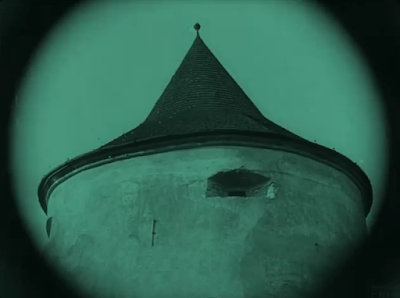
In their post about this episode on Dark Shadows Before I Die, John and Christine Scoleri point out that the tower looks very much like the one in F. W. Murnau’s Nosferatu. That movie was not widely available in the 1960s, but books about film history were finding a mass audience in those days, and some of them would have had stills from it.

The tower in Nosferatu. Screenshot by Dark Shadows Before I Die.