When Dark Shadows premiered in June 1966, it was supposed to bring the sensibility of the then-fashionable “Gothic romances” to the small screen. That did not prove to be much of a ratings draw, so six months later they introduced undead blonde fire witch Laura Murdoch Collins, who was at the center of a story that by March 1967 had swallowed up all of the major loose ends and committed the show to becoming a supernatural thriller.
Now, vampire Barnabas Collins has crossed over to an alternate universe. We have seen enough of “Parallel Time” over the last several episodes to know that it will feature a story derived from Daphne Du Maurier’s Rebecca, one of the foundational works of the “Gothic romance” genre. Viewers who have been with the show from the beginning will be intrigued at this return to its starting point.
The first person Barnabas meets is the counterpart of his distant cousin and onetime blood thrall, heiress Carolyn Collins Stoddard. This Carolyn finds him in a room deep in the great house of Collinwood and demands to know who he is and what he is doing there. He starts in on the “cousin from England” jazz that won him his place at Collinwood in the continuity we have been following so far. He cites the portrait of him that hangs in the foyer in the familiar timeline, only to be told that there is no such portrait in this house and that his story does not add up. Carolyn marches off to blow the whistle on the intruder, and Barnabas bites her. We can see that Parallel Time is going to move fast- it took Barnabas 28 weeks to attack Carolyn in the other universe.
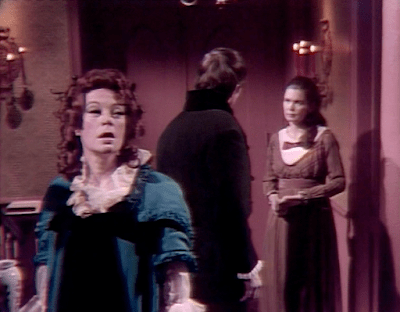
This Carolyn is married to the counterpart of Barnabas’ servant Willie Loomis. While Willie is an uneducated ruffian, Will Loomis is the author of several books, including three bestselling novels and a biography of Barnabas’ late counterpart, who died a natural death in 1830. Will and Carolyn live in the Old House, which corresponds to Barnabas’ own house in the main continuity. Quentin Collins, another distant cousin, is the master of Collinwood here, and widower of Angelique, who corresponds to the wicked witch who made Barnabas a vampire in 1796 but was apparently a mortal woman and a native of the twentieth century here. Other characters we see today include: Julia Hoffman, in the other universe, a mad scientist and Barnabas’ best friend, but here a uniformed domestic and Angelique’s fanatical devotee, Mrs Danvers to her Rebecca; Carolyn’s mother Elizabeth Collins Stoddard, who is not the owner of Collinwood and the Collins family businesses but a guest in Quentin’s house; and Quentin’s new wife, Maggie Evans Collins. We also hear that Angelique’s father is “Tim Stokes,” the counterpart of Barnabas’ sometime ally, occult expert Timothy Eliot Stokes.
What we had seen of “Parallel Time” before Barnabas arrived let us know that Quentin was bringing a new bride home, much to the displeasure of Hoffman and Angelique’s other acolytes. We also knew about the Loomises. So that left us with two candidates to play the part of the intimidated, anxiety ridden “second Mrs de Winter.” Those were Kathryn Leigh Scott, who has been Maggie in the main continuity since episode #1 and has played other parts in time travel segments and as a ghost, and Lisa Blake Richards, who plays Sabrina Stuart, girlfriend of werewolf Chris Jennings.
I love Miss Scott, but I was hoping Miss Richards would be the overpowered new wife. Miss Scott has one of the deepest iconographies of any cast member. No matter how far Miss Scott dials down the big brassy Dark Shadows style of acting, regular viewers simply will not believe that she, answering to the name of Maggie, is going to be reduced to the position that the second Mrs de Winter finds herself in, where she is grateful to her own servants for allowing her a piece of bread and butter when she hasn’t eaten all day. It took all the abuse Barnabas could heap on her, supported by Julia’s magical powers of hypnosis, to break Maggie in 1967. Miss Scott was successful as neurotic intellectual Rachel Drummond when the show was set in 1897, but they went out of their way to show that Rachel was not Maggie. The second Mrs Quentin Collins not only has the same name as the wised-up representative of Collinsport’s working class whom we met long ago, we even hear today that her father was an artist who lived in the village, as our Maggie’s was.
Miss Richards, by contrast, would come in clean. Sabrina, stuck in a dead-end story where her character was a mute for a long time, has made relatively little impression. Miss Richards specialized in a very precise, understated approach. She would be the perfect choice to tackle the job Alfred Hitchcock gave Joan Fontaine in his 1940 feature adaptation of Rebecca and depict a character succumbing to obscure anxieties.
We hear today that this Maggie has a sister, which ours never did. Perhaps Miss Richards will appear as that character. We do not hear whether Sam Evans is still alive. He is dead in the main continuity, but that was the result of an attack by a monster who would not have existed in this one. Longtime fans might get their hopes up that we will see David Ford again as Sam’s counterpart. Carolyn Loomis tells Barnabas today that the idea of widowhood is not as unattractive to her as he seems to imagine; since Nancy Barrett had divorced Ford a few months before this episode was taped, bringing him back into the cast might have helped her add some zest to this aspect of her character.
The blocking does not always take into account the dimensions of the brief outfits Junior Sophisticates provided Miss Scott. So when Quentin carries Maggie into the great house today, the camera looks right up her miniskirt. The ratings were still high during this period, but you can tell no one was watching who worked for either ABC’s Standards and Practices Office or the Federal Communications Commission.
The reigning chief villain on Dark Shadows is a shape-shifting monster from beyond space and time. He refuses to shift his shape, since he likes being a tall young man. He isn’t interested in any part of space or time not connected with heiress Carolyn Collins Stoddard, with whom he has fallen in love. He can’t persuade anyone to call him by his preferred name, “Jabe,” so has resigned himself to going by “Jeb.”
As we open, Jabe is raising four men from the dead. That he can do such a thing might suggest that he is a formidable menace, but the introductory voiceover explains that he has no choice about it, since he is “unable to trust one living human being.” Whatever powers he may have, Jabe is surrounded by enemies whom he can battle only by resorting to the most desperate means. We are left wondering how much longer the show can keep the storyline going if it depends on such a feeble menace.
Jabe and one of the zombies are peeking through the window of the Old House on the estate of Collinwood, home to vampire Barnabas Collins, a distant cousin of Carolyn’s. Jabe sees Barnabas’ best friend, mad scientist Julia Hoffman, giving him an injection. He realizes that Julia is trying to treat Barnabas’ vampirism.
Jabe goes to the great house on the estate and orders Carolyn’s mother, matriarch Elizabeth Collins Stoddard, to keep watch over Barnabas’ blood thrall Megan Todd. Liz is one of Jabe’s few remaining followers. He is crude and abusive towards her; she protests that they are in her house, and when he responds to this with a sneer she gives him a look of disbelief. First-time viewers can understand how Jabe came to be so isolated.
When Barnabas was first on the show, from April 1967 to March 1968, Liz never figured out that he was a vampire. The show depended on keeping Liz in the dark about Barnabas’ curse, because she was too civic-minded to let him stay in a house on her estate if she had known that he was an abomination risen from the depths of Hell to prey upon the living, even if he was her cousin. In those days, the show seemed determined to keep Liz on the shelf lest she be stained by contact with the main story, and so they took care to give Barnabas’ adversaries reasons to keep from telling Liz about him.
Now, Liz is under the control of the forces Jabe represents. She is already hostile to Barnabas, and has told Jabe she would try to evict him from Collinwood if that is what he wants her to do. Jabe does not have any reason to withhold from her the fact that his enemy is a vampire.
Moreover, Liz is no longer the symbol of lawful goodness she was two years ago. In #956, she told eleven year old Amy Jennings that she hoped Jabe wouldn’t murder Maggie Evans, The Nicest Girl in Town. Her first reason for not wanting this to happen was that it would remind people of the other murders Jabe has committed. The second, and more important, was that it would tend to exonerate the person they have framed to keep the heat off Jabe. It seems likely that Jabe will soon defeated and Liz will be released from the spell under which she has been laboring, but if she comes out of that remembering what Barnabas is she will also remember that she herself is complicit in some pretty serious felonies, all of them well-known to Barnabas. Since Liz knows that Barnabas is invested in her position in the community and puts a high priority on protecting it, the show wouldn’t have a hard time explaining why she keeps him around, and she would be available to take part in whatever stories they might have going.
Liz is sitting with Megan. She can see that Megan is ill and goes to fetch her a glass of water. When she returns, Megan has gone. We see Megan at Barnabas’ house. Barnabas is intensely hungry. But he does not want to bite her. He knows that if he does so, she will die. She insists, and he gives in.
Julia enters and pronounces Megan dead. Barnabas is in a panic; he had earlier lied when Julia asked him if he had bitten anyone, and he flies directly into hysteria, accusing Julia of implying that he acted deliberately. She keeps her cool and assures him she does not see it that way. Usually Julia’s quickness to make excuses for Barnabas’ murders is an opportunity for Grayson Hall to amaze us with the spectacle of a brilliant woman rationalizing the behavior of a hopelessly evil man, but this scene is a showcase for Jonathan Frid. So they have taken care to establish that Barnabas was overpowered by the need for blood and have shown him taking steps to avoid biting Megan, allowing us to take Julia’s behavior more seriously and focus on Barnabas’ panic.
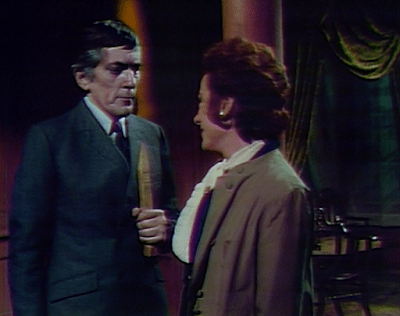
Barnabas tells Julia that to prevent Megan rising as a vampire they will have to drive a wooden stake through her heart. Previously Barnabas has simply strangled his victims or broken their necks after they died, and that has kept them from coming back. He did this as recently as #951, when he fed on Jabe’s would-be devotee Nelle Gunston. Regular viewers will know that the trip he and Julia make to the basement to fetch a stake is just a setup for them to return and find Megan already gone. Before that happens, there is a strange moment when Barnabas and Julia have the stake and are talking about driving it through Megan’s heart. Barnabas wants to spare Julia that horror, but she smiles warmly as if assuring him that it is her pleasure to join in the act.
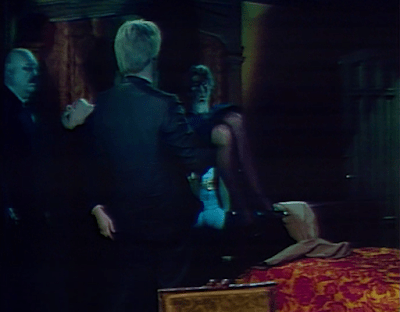
Jabe dispatches his four zombie henchmen into the great house, saying that he has given them their orders and now it is time to “Carry them out!” Julia lives in the great house, and is working with some test tubes in her bedroom. It’s the first time we’ve seen Julia’s room in years, and the first time we have seen scientific apparatus of any kind there. One of the zombies knocks on her door, another emerges from behind the curtains, and a third comes up and slaps her in the face. Perhaps remembering Jabe’s words as he sent them into the house, they carry her out.
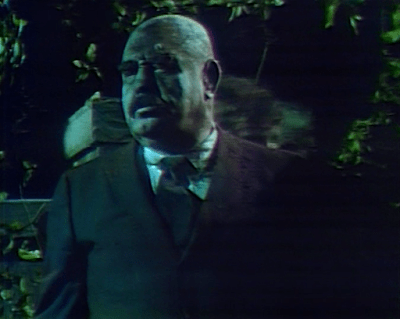
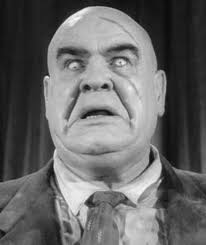
One of the zombies is named Thomas Findley. Longtime viewers will remember Madame Janet Findley, a psychic who made a big impression in three episodes in December 1968, and Margaret Findley, who was one of the ghostly Widows who were prominent in the show’s supernatural back-world in its first 26 weeks. Another zombie is a large bald man who will remind many viewers of Tor Johnson in Plan 9 from Outer Space.
Danny Horn’s post about this one at his great Dark Shadows Every Day is a fascinating comparison of the episode with four issues of Gold Key’s Dark Shadows comic book. Other commentators have mentioned that the graveyard scenes often evoke the sensibility of EC Comics, particularly in the character of The Caretaker, but Danny’s in-depth discussion of what this episode has in common with those four issues is far and away the most substantive analysis I have seen of the overlap between the visual grammar of Dark Shadows and that of comic books.
Episode 361 was virtually a one-woman show, featuring Grayson Hall as Julia Hoffman, MD. Julia was being tormented by haunted house-style effects resulting from her involvement with a supernatural entity. The script, by Ron Sproat, was largely a recycling of an episode Sproat had written for Never Too Young, the soap opera that ran on ABC at 4 PM before Dark Shadows premiered.
Episode 658 consisted largely of a one-man show, featuring Joel Crothers as fisherman Joe Haskell. Joe was being tormented by haunted house-style effects resulting from his involvement with a supernatural entity. The script, by Gordon Russell, owed a good deal to Sproat’s work on #361.
Episode 897 ended with a long scene that amounted to a one-woman show, featuring Marie Wallace as antique shop owner Megan Todd. Megan was being tormented by haunted house-style effects resulting from her involvement with a supernatural entity. The script, by Violet Welles, drew from both #361 and #658.
Many fans consider #361 to be The Worst Episode of Dark Shadows, and many consider Megan’s turn at the end of #897 to be The Worst Scene on Dark Shadows. To the extent that #658 is remembered at all, it is because it is one of Crothers’ last appearances on the show. The memory of this fine and well-loved actor makes the fans so weepy that no one can be very harsh about his final star turn.
Today, the second half of the episode is virtually a one-woman show featuring Nancy Barrett as heiress Carolyn Collins Stoddard. Carolyn is being tormented by haunted house-style effects resulting from her involvement with a supernatural entity. The script, by Gordon Russell, recycles elements of #361, #658, and #897.
Russell was usually one of the most careful writers on Dark Shadows, but this one is remarkably shoddy. Carolyn and her mother, matriarch Liz, are staying at the home of a woman named Angelique. Angelique tells them that she has to drive to the airport to pick up her husband, and that she will be away for “several hours.” A couple of minutes later, Liz is also called away, and she tells Carolyn that she is sure “Angelique will only be gone an hour or so.”
Worse, all the action of the episode is completely, flagrantly unnecessary. The calls that leave Carolyn alone in the house are part of a monster’s scheme to get at Carolyn. But Liz is the monster’s loyal servant- if he had told her to bring Carolyn to him, she would gladly have done so.
Carolyn’s torments aren’t quite a monodrama, since they are interrupted by a couple of brief scenes with other actors. But one of those is a dream sequence in which she talks to the monster while we see him silhouetted in darkness. The interaction between them is so limited he may as well be a recorded voice. She also has a few interactions with Angelique’s husband. Since he is played by Geoffrey Scott, he may as well be a cardboard standee.
One advantage this episode has over #361 is that Nancy Barrett was excellent at screaming, second only to Clarice Blackburn in her ability to produce a true blood-curdler. Grayson Hall, accomplished as she was, had asthma and was physically incapable of controlling the timbre of her voice when she raised its volume above a certain level. Sproat’s script for #361 required Julia to scream several times, and every time she tried it Hall emitted a croaking sound that raised a bad laugh. Miss Barrett’s closing scream today, by contrast, really puts the “opera” in “soap opera,” it sounds great.
This is one of the few episodes with no scenes on the estate of Collinwood, and one of very few to take place primarily in a location many miles from the village of Collinsport.
There’s also an interesting moment when Angelique claims to have met Liz and Carolyn’s distant cousin Barnabas while they were both living in England. Barnabas never lived in England, that’s a lie he has been telling his relatives to conceal the fact that he is a recovering vampire who hasn’t left Maine since George Washington was president. Liz is part of the current supernatural storyline and Carolyn has at various times known all about Barnabas, so we don’t expect to be reminded that he’s still peddling the “cousin from England” bit.
In October 1897, sorcerer Count Petofi has used his powers to steal the body of handsome young Quentin Collins and to trap Quentin in his own aging form. I refer to the villainous Petofi who looks like Quentin as Q-Petofi, and to the forlorn Quentin who looks like Petofi as P-Quentin.
Q-Petofi
We open outside a cave near the estate of Collinwood, where Q-Petofi’s henchman Aristide is on the ground, gradually coming back to consciousness. Q-Petofi had ordered Aristide to hold wicked witch Angelique prisoner in the cave. Shortly after Q-Petofi left, Angelique slipped out of the cave and ran past him. Aristide followed her, and she bashed him on the head with a rock.
Aristide’s eyes focus, and he sees time-traveling vampire Barnabas Collins standing over him. The last time he saw Barnabas was in #842. Barnabas threatened to kill Aristide then, and he was so terrified that he ran away and didn’t come back until he heard that Barnabas had been staked in his coffin. The coffin is in the cave, and Aristide just saw Barnabas in it, the stake still in his heart, so he is shocked to see him up and about.
We cut to the great house of Collinwood, where Q-Petofi and Quentin’s stuffy but lovable brother Edward are recapping another storyline. Edward exits, and a telephone call comes from Ian Reade, MD. Dr Reade says that a strange man is in his office, asking for Edward. When he describes the man, Q-Petofi recognizes him as Barnabas. He takes a gun and goes to Dr Reade’s.
Q-Petofi finds Barnabas lying on Dr Reade’s exam table. He orders Dr Reade to leave. Dr Reade reminds Q-Petofi that they are in his office and refuses to comply with his commands. He does leave for a moment to call Edward again; when he comes back, he finds Q-Petofi holding Barnabas at gunpoint. He bravely tells Q-Petofi that if he wants to kill Barnabas, he will have to shoot him first.
Edward comes. Dr Reade trusts Edward and agrees to leave the room while he is there. After dawn breaks, Edward is astonished to see that Barnabas is still alive. Barnabas tells his old story that he is their cousin from England come to pay his respects. He says that when he first arrived, a man approached him in the dark woods, a man who, when he emerged from the shadows, proved to be his exact double. Until, that is, he opened his mouth and showed two long fangs. Barnabas says that he does not know what happened next or how much time has passed. All he knows is that this strange man kept him captive and dominated his will, from time to time appearing to him and repeating his original assault.
Edward is inclined to believe this story, Q-Petofi to shoot Barnabas on the spot. They compromise, and agree to take him to the cave. If Barnabas’ coffin is empty, they will shoot him. Dr Reade sees Edward and Q-Petofi carrying Barnabas out of his office, and objects that in his condition Barnabas may die if he is subjected to any exertion. When the question is asked if he is willing to go, Barnabas weakly croaks out a “yes.” At that, Dr Reade is willing to wash his hands of the whole thing. For someone who was willing to be shot a few minutes before, it’s quite a startling capitulation.
Q-Petofi does not know that Angelique and Aristide are no longer in the cave, so he insists on leading the way in. He finds that they are gone and the chains around Barnabas’ coffin have been broken. He invites Edward and Barnabas in. He takes it as obvious that the broken chains prove that the coffin is empty, but Edward, with his sense of fair play, insists on opening the coffin before they shoot Barnabas. The body is still there, the stake still in the chest. Barnabas reacts with horror, the others with amazement.
Doppelgänger time.
In #758, Angelique created a Doppelgänger of herself to trick an enemy into thinking that she had killed her, and in #842 she agreed to help Barnabas’ friend Julia Hoffman, MD in a plan to allow him to reestablish himself as a member of the Collins family. Julia was working on a medical intervention to free him of the effects of vampirism, and now we can see that Angelique contributed the grounds for the Collinses to believe that their cousin never labored under that curse.
When Dark Shadows was in production in the 1960s, the legends of King Arthur, the Knights of the Round Table, and the Holy Grail had been fashionable topics in English departments for decades. That vogue was reflected not only in the coursework the writing staff likely did when they were in college, but also in the popularity of novels like The Once and Future King and the Broadway show based on it, Camelot. When I was hanging out in used book stores in the 1980s and 1990s, mass market paperbacks printed in that era collecting the Grail sagas were still a staple.
The coffin in the cave recalls a prominent figure in one of those sagas, a king named Amfortas. In Heinrich of Turlin’s The Crown, Amfortas did not requite the love the mighty sorceress Orgeluse had for him. The humiliated Orgeluse inflicted a wound that both paralyzed Amfortas and made him immortal. In that state, Amfortas was confined to a coffin that was hidden in a cave. Sir Gawain found the coffin and freed Amfortas both of his paralysis and of his immortality.*
Longtime viewers of Dark Shadows will see many parallels to the story of Barnabas and Angelique in Heinrich’s story of Amfortas and Orgeluse. During the part of the show made and set in 1968, two mad scientists played the role of Sir Gawain in returning Barnabas to humanity. The first was a man named Eric Lang, the second was Julia. Now, Angelique herself, who was the original source of the curse that made Barnabas a vampire, combines the functions of Orgeluse and of Gawain. She not only frees Barnabas, but also redeems herself. The Grail legends also abound in other elements that figure prominently in this part of the show. For example, Count Petofi was originally on the show as a severed hand with magical powers, later to be reunited with the rest of its body. Gawain’s most famous story is of his battle with the Green Knight, who starts off as a severed head. Doppelgänger abound in the Grail legends, especially the so-called Vulgate Lancelot where a double of Queen Guinevere sets off a whole arc.
Dr Reade is played by Alfred Hinckley. Hinckley was in plays on and off Broadway, and when the networks ran a lot of programming produced in New York, his was a frequent face on American television. He was in Dark Shadows episode #1 as the conductor of the train that brought well-meaning governess Vicki Winters and dashing action hero Burke Devlin to Collinsport. Longtime viewers were reminded of that train in #850; maybe the production staff was reminded of it too, and that was why they called Hinckley to make his second appearance on the series today. It’s also his final appearance.
Dr Reade, unintimidated by Q-PetofiThe conductor, unintimidated by Burke
*Richard Wagner’s opera Parsifal features another version of the Amfortas legend, calling the sorceress by a different name, omitting Amfortas’ paralysis, leaving out the coffin in the cave, and giving the honor of healing Amfortas and succeeding him as king of the Grail to Percival rather than Gawain.
Vampire Barnabas Collins has traveled back in time to the year 1796, where he plans to change what happened on one crucial night.
Yesterday’s episode was a clip show excerpted from #456-#460, the last full week of a period when Dark Shadows was a costume drama set in the 1790s. Today’s consists largely of reenactments of those scenes. It all pays off in the last minute, when a confrontation between Barnabas and roguish naval officer Nathan Forbes ends differently than it had the first time round. As before, Nathan loads a crossbow with a wooden bolt and waits for Barnabas to come to him, hoping that he will shoot the bolt through Barnabas’ heart and thereby achieve the same effect as a wooden stake. The first time, Nathan missed Barnabas’ heart and Barnabas killed him. Unlike the first time, Barnabas knows what Nathan is planning. So he opens the door, but does not enter the room. Nathan can hear Barnabas’ voice, but cannot see him. Finally Barnabas jumps Nathan from behind, evidently biting him.
Barnabas originally killed Nathan as revenge for Nathan’s role in his mother’s death. This time he is willing to let Nathan live. He wants to take control of him and force him to tell the authorities that he lied when he testified against governess Victoria Winters and her boyfriend, an unpleasant man named Peter. Victoria is herself a time-traveler, and Barnabas got to be quite fond of her in her original period, the 1960s. She is scheduled to be hanged tonight for her many crimes, and Peter is also condemned to the gallows. Barnabas has come to rescue them.
During the opening title sequence, Thayer David announces that “Today the part of Victoria Winters will be played by Carolyn Groves.” When we first see her, Victoria is asleep in her cell at the Collinsport gaol, and her face looks very much like that of Alexandra Moltke Isles, the original Victoria.
Barnabas wakes Victoria. She is puzzled to see him. He has never told her that he was a vampire; even when he was biting her on the neck and sucking her blood for a week in March 1968, she didn’t seem to catch on. She just seemed to think he had a particularly aggressive make-out technique. She thinks that the Barnabas she knew in the 1960s was a descendant of the one she knew in the 1790s, and that the one from the 1790s is dead. Barnabas would rather not get into the weeds about his personal history, such as the countless murders he has committed, and gives Victoria a truncated account of how he, the man from the 1790s, is laboring under a curse that made it seem that he was dead. He doesn’t explain how he got into her cell, how he knows who Peter is, or how he plans to free the two of them from their death sentences. He asks her to take all of that on faith.
Miss Groves plays Victoria as so happy to see Barnabas she smiles all through her account of her imminent and, she believes, inevitable execution. That’s odd to see, but it fits so perfectly with the delight Victoria always took in Barnabas’ company that it shouldn’t bother longtime viewers.
Mrs Isles was cast as the original Victoria in large part because she looked so much like Joan Bennett that Bennett famously mistook her for her daughter when she first saw her. In the Collinsport Historical Society’s 30 December 2017 post for this episode, Patrick McCray not only tells us that Miss Groves appeared in a play with Joan Bennett in 1960, but provides a still of the cast in which the two women look like they could be mother and daughter:
The show spent much of its first year hinting heavily that Victoria was the unacknowledged daughter of Bennett’s character, matriarch Elizabeth Collins Stoddard. They never collected those hints and built them into a story, and the question of Victoria’s parentage was left as one of Dark Shadows’ most annoying loose ends. Perhaps Miss Groves’ casting is a sign that the failure to resolve that question bothered the makers of the show as much as it did the audience.
The only story that consistently worked in the first year of Dark Shadows was well-meaning governess Victoria Winters’ quest to befriend her charge, strange and troubled boy David Collins. In #191, David’s mother, blonde fire witch Laura Murdoch Collins, was trying to immolate him and herself. At the climactic moment, David ran from the flames into Vicki’s arms. When David chose Vicki and life over Laura and death, their story was concluded, and Dark Shadows 1.0 came to an end.
Vampire Barnabas Collins would first appear on Dark Shadows in #211 and quickly become its main source of interest. The show never made up its mind how Vicki would relate to Barnabas’ story. The obvious move would have been to follow Bram Stoker’s Dracula and make Vicki the vampire’s first victim, rising from the dead like Lucy Westenra as “The Bloofer Lady,” a friend to children in life who in her undead afterlife feeds on the blood of children. In that case, Vicki would be destroyed as she was about to kill David. But Vicki had been an effective protagonist throughout the Laura story, which was itself in large part an adaptation of Dracula, and if as seemed likely the show was going to be cancelled with #265 they would have wanted Vicki to stake Barnabas at the end of that episode. So she was spared his bite, and instead he turned his fell gaze upon Maggie Evans, The Nicest Girl in Town.
With Vicki walled off from the vampire story, David’s contact with it was initially limited to the inconvenience he could make for Barnabas by sneaking into his house during the day. When Barnabas was keeping Maggie in his basement, a new character was introduced who would meet David and relate to him in a way that would bring him to the center of Barnabas’ concerns. This was the ghost of Barnabas’ little sister Sarah, a girl about David’s age.
David Henesy had been the only child actor on Dark Shadows until Sharon Smyth joined the cast as Sarah in #255. Miss Smyth had very little of the training and experience Mr Henesy brought to the show, but playing a ghost she didn’t really need them. Our main reaction to Sarah is puzzlement, puzzlement as to what she wants, what she can do, and whether she knows anything at all about herself and the world she finds herself in. Miss Smyth was just as puzzled as the audience about all of these questions, and that works to her advantage. In Sarah’s scenes with David Collins, Sharon Smyth’s feelings about David Henesy- a precocious crush mixed with fear of his propensity for playing rather nasty practical jokes on her- added a touch of urgency without erasing any of the character’s mystery. At the same time, Mr Henesy’s acting skills made it possible for us to believe that David Collins had gone a tremendously long time without catching on that Sarah was a ghost. Once David Collins finally did figure it out, David Henesy made the most both of scenes where he coolly presented skeptical adults with irrefutable evidence of Sarah’s true nature and of scenes where he became overwrought at his inability to convince them of the truth.
Sarah’s ghost hasn’t appeared since #364. A couple of weeks ago Alexandra Moltke Isles left the show and the part of Vicki was recast; Mr Henesy hasn’t shared a scene with the new actress, but he had barely shared a scene with Mrs Isles for a year. Throughout 1968, his appearances on the show have been few and far between. Today, for example, he makes his first appearance since #609, which was in turn only his second appearance since #541. That changes when he meets a new co-star who will change the trajectory of his character and of the show.
Amy Jennings is played by Denise Nickerson, whose preparation was fully equal to Mr Henesy’s. Her style was quite different from his- while he, like Mrs Isles, tended to play his characters from the inside out, figuring out what is in their minds and then using the dialogue and action to project that understanding, she tended to start with the action and find the character in the middle of it. Today she shows up on the grounds of the estate of Collinwood just as David’s aunt, matriarch Elizabeth Collins Stoddard, comes face to face with a werewolf. The werewolf was about to attack Liz, but he runs off at the sight of Amy. Liz takes her unlikely rescuer home with her to the great house on the estate.
There, Amy meets permanent houseguest Julia Hoffman, MD. Julia is the nominal head of Windcliff, a sanitarium from which Amy recently escaped. Liz describes the encounter with the werewolf, and Amy explains that she is looking for her brother Chris. Returning viewers know that Chris is the werewolf, but none of the characters knows this yet. The adults are mystified by Chris’ wandering ways and his refusal to take responsibility for his little sister, while Amy is convinced that he is ready to give that up and settle with her in the village of Collinsport.
Julia wants to ship Amy back to Windcliff at once, but Liz talks her into letting Amy stay the night. David strolls in; he meets Amy, and Liz sends the two of them to get housekeeper Mrs Johnson.
We see David and Amy looking out the window of a guest room during a storm. David is disappointed to hear that Amy won’t be staying through the next day, and talks about what they will do the next time she visits. He asks if the thunder and lightning frightens her, she says no, “It can’t hurt you.” To this he replies, “Sure can! Lightning can strike you dead.” After a brief pause, he adds “Well, if you’re not afraid, I guess you don’t need me.” That sequence of lines is so funny the humor must have been intentional.
Amy asks David to stay. They sit on the floor in front of the fireplace in her room, and at her suggestion they decide to explore the long-deserted west wing of the house. They go straight to a room in which they find an antique telephone. They decide to play a game in which they pretend to talk to the ghosts of the people who used to live in the house using the telephone. Amy actually gets through to one of them. David thinks she’s kidding him, and takes the phone. To his amazement, he hears breathing on the other end, even though the telephone’s line is cut.
David only heard the breathing, no words. Amy tells him that the voice identified itself as that of Quentin Collins. David, whose avid interest in Collins family history made it logical that he, in #205, would be the first character to mention the name “Barnabas Collins,” says he has never heard of Quentin.
Later, they return to Amy’s room and find Quentin’s picture in a family album. Liz comes in, and when David asks her about Quentin she tells him that he was her great-uncle, that he left for Europe when he was young, and that he died in Paris. Regular viewers will remember that when Barnabas became a vampire, the Collinses put about the story that he had gone to London, and when he came back in 1967 he introduced himself to Liz as a cousin from England. Thus the show suggests that Quentin may be its next attempt to match Barnabas’ breakout success.
Amy has taken the telephone to her room, and at the end of the episode she talks to Quentin again. He beckons her to return to the room in the west wing, and she goes. If Quentin is indeed going to succeed Barnabas as Dark Shadows‘ great supernatural menace, evidently it is Amy who is in danger of becoming his first victim.
In #636, occult expert Timothy Eliot Stokes remarked that he had never heard of a ghost communicating by telephone. During this period, the show was going through a lot of last minute rewrites; the Dark Shadows wiki reports on several flimsies and drafts that were cast aside and replaced with new scripts. So I can imagine that Stokes’ line may have inspired the idea of using the telephone to introduce Quentin, though perhaps it is likelier that they already had the prop and Stokes’ line was a private joke among the writers.
Mad scientists Julia Hoffman (Grayson Hall) and Eric Lang (Addison Powell) are conferring in Lang’s lab. Lang is putting the finishing touches on a Frankenstein’s monster into which he plans to transfer the “life force” of recovering vampire Barnabas Collins. Julia, Barnabas’ best friend, has been opposed to this experiment, but now has accepted that she can’t stop Barnabas and Lang from going through with it. She volunteers to assist.
Lang is having trouble concentrating because of a nightmare he had last night. Unknown to him, the nightmare was part of the Dream Curse, a dead end storyline about wicked witch Angelique sending a dream that each of a series of people will have. When the last person has the dream, Barnabas is supposed to revert to full-on vampirism.
Lang tells Julia about his nightmare. He says that she was in it. When he tells her that she did not speak, she smiles comfortably and says that that was proof that it was a dream. This is not only a genuinely funny line as Grayson Hall delivers it, but it is an extraordinary moment of self-awareness from Julia, a character who usually exists at the outer edge of heightened melodrama. It’s a shame that Addison Powell doesn’t know how to get out of Hall’s way for the half second it would take for it really to land with the audience.
Barnabas and his ex-blood thrall Willie are at home in the Old House on the great estate of Collinwood. Willie is smirking and Barnabas is rigid with embarrassment while the dogs howl outdoors. Willie laughs a little as he makes a remark about how Barnabas hasn’t changed as much as he thought he had. This exchange reminds us of the moment in #346 when Julia and well-meaning governess Vicki noticed that some fresh flowers Barnabas touched had died and shriveled up. Like the howling of the dogs when Barnabas feels bloodlust, the shriveling of the flowers was a consequence of his vampirism, effectively a bodily function that he cannot control. He squirmed when Julia and Vicki looked at him then, and he is stiff and flustered when Willie laughs at him now.
Barnabas orders Willie to take a letter to matriarch Liz at the great house on the estate. It will explain that he is going away on a long trip, and that Adam Collins, a young cousin from England, will be coming to stay in the Old House. Willie is alarmed by this.
Willie asks what Barnabas will do if Liz won’t let him stay in the Old House when he is in the form of Adam. Barnabas is sure she will, and dismisses Willie’s doubts. This is an interesting sequence to regular viewers. The show has never made it clear whether Liz still owns the house or has signed it over to Barnabas. A whole year ago, in #223, Liz was talking to strange and troubled boy David as if the Old House and its contents were Barnabas’ legal property. Since then, there have been moments that tend to confirm that impression, as when Barnabas takes Liz’ keys to the house away from David and does not give them back to her, and other moments that conflict with it. Willie’s question and Barnabas’ response would seem to prove that the house still belongs to Liz.
Another question we might ask is why Barnabas doesn’t go to Liz himself. Certainly she will be unhappy that he went away without saying goodbye to her. Moreover, when he showed up at the great house in April 1967, Barnabas told Liz that he was the only survivor of the English branch of the family. Liz will be skeptical if another member of this imaginary branch presents himself and expects to take possession of a big mansion on her property. She has had unpleasant experiences with Willie, so much so that a letter he delivers seems unlikely to allay that skepticism.
When Willie gets to the great house, Angelique herself opens the door. She is living there under the name Cassandra. She has cast a spell on Liz’ brother, sarcastic dandy Roger, and married him so that she will have a residence at Collinwood while she works to restore Barnabas’ curse to its full potency. Showing his typical degree of strategic ability, Barnabas has not bothered to tell Willie about any of this.
Angelique/ Cassandra ushers Willie into the drawing room, sits him down, and chats with him. Willie answers her questions about Barnabas, not realizing that he has any more reason to be discreet with her than with anyone else. He tells her that Barnabas has been spending his days with Lang. Angelique/ Cassandra already knows that it was Lang who gave Barnabas the treatments that put his vampirism into remission and that Lang is preparing further treatments for him. Barnabas should know that she knows this, since she went to Lang’s house and tried to kill him. Willie also tells her that sometimes Barnabas doesn’t seem to have changed as much as you might expect. Angelique/ Cassandra’s reaction makes it clear this is new information to her, and that it might help her in her efforts.
The scene raises yet another question. Barnabas had expressed the hope that once the experiment was complete, Angelique would see that his old body was dead, would assume that meant that he no longer existed in any form, and that she would then go away and leave him alone. But he knows that she knows about Lang, and now he is planning to come back to Collinwood, where she lives, as another “cousin from England.” The question is this- how dumb does Barnabas think Angelique is?
Back in the lab, Lang and Julia are preparing for the experiment. Barnabas shows up. When he talks with the doctors, his face is reflected in the mirror above Lang’s creature. Not only does this suggest the idea of his personality moving into the creature’s body, it also reminds us that until Lang gave him his first course of treatment, Barnabas did not cast a reflection. The whole idea of Barnabas’ reflection will remind longtime viewers of #288, when Julia first confirmed her suspicion that Barnabas was a vampire by peeking at the mirror in her compact and not seeing him. That draws a contrast between Lang, whose initial success with Barnabas appears to be leading to disaster because his impersonal, hyper-masculine approach leaves him unable to recognize the threat Angelique poses, and Julia, whose own attempts to cure Barnabas of vampirism did not match Lang’s spectacular results, but whose femininity, as symbolized by the compact, represents a fighting chance against the forces that really govern this universe.
Barnabas takes his place on a bed. He tells Julia he is glad she is with him, and she smiles at him with the sad tenderness of someone saying a final farewell to a loved one. As with her self-deprecating joke in the opening part of the episode, this smile shows a new side of Julia. For a time in October 1967 she tried to launch a romance with Barnabas, and he rejected her. Hall played Julia’s unrequited love in the same larger-than-life style that the rest of her action called for. Her feelings seemed to be an outgrowth of despair- she was by that point so deeply entangled with Barnabas that there was little hope she could ever make a life with anyone else, so even though he was an active vampire, she had little to lose by committing herself to him. But this sweet little exchange is played so gently that it opens a window on a more complex inner life for Julia.
As Lang starts the experiment, we cut to Angelique in the drawing room at Collinwood. She is talking to a clay figure, calling it “Dr Lang,” and saying that it cannot overcome her powers, for they were a gift to her from the Devil himself. She jabs at the clay figure. In the lab, Lang writhes in pain, interrupting the experiment.
It was not until #450 that Dark Shadows let on that there might be anything to Christianity. In that episode, good witch Bathia Mapes held Barnabas at bay by showing him a cross. Up to that point, Barnabas had many times strolled comfortably through the old cemetery north of town, where half the grave markers are in the shape of the cross, and they hadn’t bothered him a bit. The only representatives of the faith who figured in the story were repressed spinster Abigail Collins and fanatical witchfinder the Rev’d Mr Trask, both of whom were fools whom Angelique easily twisted to her own purposes. Now we have a character named Adam, a New Adam through whom a resurrection is supposed to take place, and he is wearing a headpiece that is photographed to look like a crown of thorns. Angelique’s reference to the Devil suggests that she can be defeated only through the aid of a being more powerful than the Devil, and since we haven’t heard about Ahura-Mazda or any other non-Christian deities who represented a supreme principle of good pitted against an otherwise irresistible evil, it looks like we’re drifting Jesus-ward.
It is daring to take that direction, even if it is only for a little bit. Vampire legends are pretty obviously an inversion of the Christian story, in which a man comes back from the dead, not having destroyed the power of death once and for all, but only to die again every time the sun rises. While Jesus feeds us with his body and blood in the Eucharist and thereby invites us to share in his eternal life, the vampire feeds himself on our blood and thereby subjects us to his endlessly repeated death. That’s why Bram Stoker’s Dracula has all those crosses and communion wafers, because it is a religious story of the triumph of the promise of resurrection in Christ over the parody of that resurrection that the vampire has settled for. It also explains why Dark Shadows so studiously avoided Christian imagery for so long. Christianity is such a powerful part of the culture that once you let any of it in, it tends to take over the whole story.
There are many reasons the makers of the show would want to avoid that fate. Not least is the tendency of religions to fracture and stories based on their teachings to become sectarian. Dracula itself is an example of that; the vampire is a Hungarian nobleman from Transylvania, connected with the Szekely clan. There really was such a clan, and like other Hungarian nobles in Transylvania its members were Calvinists, supporters of the same version of Christianity that Abigail and Trask represented. Stoker was a Roman Catholic from Ireland, a country where most Protestants are Presbyterians, a tradition that grew out of Calvinism, and so his depiction of the vampire is clearly driven by sectarian animus. The Collinses have an Irish surname, settled in New England when that region was officially Calvinist, and did very well there. So it would be easy to present their troubles as a cautionary tale about Calvinism. That would seem to be a surefire way to shrink the audience drastically. Not only are there millions of Calvinists whom it would offend, there are billions of people to whom Calvinism means nothing at all, and they would be utterly bored by a denunciation of it.
The episode is daring in several other ways as well. When Barnabas and Willie were first on the show, ABC-TV’s office of Standards and Practices kept worrying that viewers might interpret their relationship, which was founded on Barnabas’ habit of sucking on Willie and swallowing his bodily fluids, as somehow homosexual. Not only is the scene between them at the Old House reminiscent of the scenes that attracted memos from that office in the spring and summer of 1967, but the whole idea of Barnabas draining his “life force” into the body of Adam would seem to invite the same concerns.
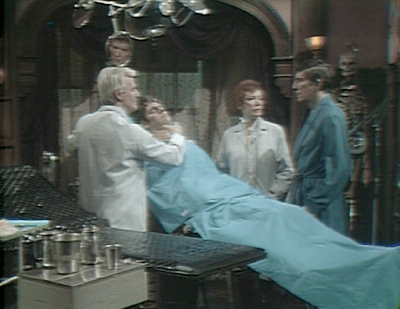
The experiment scene would only intensify such concerns. The experiment is a medical procedure that is supposed to bring a new life into the world, which by 1968 was how Americans usually thought of the process of birth. Barnabas is the patient, he is lying down, and the doctors sedate him. Thus he takes on all the medicalized marks of a mother-to-be. Julia asked Lang if the process would be painful for Barnabas; he does not disappoint, but ends the episode screaming in response to labor pains. Not only does turning Barnabas into Adam’s mother invert the expected gender performance, but it also introduces a homosexual side to Barnabas’ relationship with Lang, who is Adam’s other parent.
Somebody ought to be there telling Barnabas he’s doing great and urging him to push. Screenshot by Dark Shadows Before I Die.
Christian imagery and gender-nonconformity would have been rather a queasy combination for most Americans in 1968. That’s unusual, in historical terms. Before modern times, Christians didn’t hesitate to discuss ways that familiar gender roles break down in the relationship of humans to Christ. The “Fathers of the Church,” the prominent Christian intellectuals of the fourth and fifth centuries, talked about that all the time, going into depth not just with the image of the Church as the Bride of Christ but of each human soul, whether male or female, as one of Jesus’ wives, and of the physical contact between humans and Jesus in the Eucharist as a consummation of their marriage.
For their part, Calvinists tended to be skeptical of the physical aspect of the sacraments, but that didn’t mean that they shied away from conjugal metaphors to describe the relationship between the soul and Jesus. John Donne, like most priests in the Church of England in the 16th and early 17th centuries, was basically a Calvinist, yet his sonnet “Batter my heart, three-person’d God” is one of the most vivid and uncompromising statements of the ancient idea of an erotic dimension to Christian life that transcends the binaries between masculine and feminine, male and female. That tradition makes today’s conjunction of Christian and homoerotic themes all the bolder- imagine if Dark Shadows wrote itself into a corner where they had no choice but to explain nuptial imagery and mystical eroticism in the writings of Saint Ambrose. The whole audience could fit into a seminar room.
Closing Miscellany
Lang and Julia wear white lab coats. This is the first time Julia has worn a white coat. Her previous lab coat was light blue, which looks white on the black and white TV sets most households had in 1968, but now that the show is being produced in color they are buying costumes and props for color televisions.
The idea of a machine that would cause a person to go to sleep in one body and wake up in another was a big deal on TV in the 1960s. Just today I saw this screenshot from The Avengers on Tumblr:
This episode marks the first appearance of Robert Rodan. When Adam was a nameless heap of flesh under a blanket, he was played by a stand-in named Duane Morris. Rodan had a few small parts on TV shows in 1963 and 1964 and was in a couple of commercials between 1964 and 1968. Adam was his first, and last, recurring role on a series. In 1969, he appeared in a little-seen feature film called The Minx, then spent the rest of his life selling real estate in Southern California.
Dark Shadows became a hit after vampire Barnabas Collins joined the cast in April of 1967. Displaced from a previous era, Barnabas spent most of his time trying to con people into believing that he was a native of the twentieth century. The difficulties Barnabas encountered in his performance in the role of modern man dovetailed so neatly with those actor Jonathan Frid encountered in his characterization of a vampire that his every scene was fascinating to watch.
The audience’s main point-of-view character for the first year of the show or more was well-meaning governess Vicki. Now Vicki finds herself in a situation like that which made Barnabas a pop culture phenomenon. The ghost of Barnabas’ ten year old sister Sarah has sent Vicki back in time to 1795, when Barnabas and Sarah are both living beings and the vampire curse has not yet manifested on the estate of Collinwood. Vicki and Barnabas have traded places- she is now the time-traveler who must trick everyone into thinking she belongs in their period, while he is her warm-hearted, if uncomprehending, friend.
Unfortunately, the show has not chosen to write 1795 Vicki as a fast-thinking con artist. By the time the Collins family of 1967 met Barnabas, he was wearing contemporary clothing and telling them a story about being their cousin from England. Vicki shows up in her 1967 clothes and carrying a copy of a Collins family history printed in the 1950s. She goes around blurting out information she learned from reading that book and introduces herself to each character by telling them that they are played by actors who had other parts in the first 73 weeks of the show. Vicki’s natterings have convinced two ladies in the manor house, repressed spinster Abigail Collins and visiting aristocrat Countess DuPrés, that she is a witch.
Today, we open with the countess setting a trap to expose Vicki. Haughty overlord Joshua Collins vanished from the front parlor yesterday, in the middle of an argument with his brother Jeremiah. Jeremiah looked away from Joshua for a moment, and when he looked back his brother was gone and there was a small house cat in his place. The countess insists Vicki come into the parlor and reenact Joshua and Jeremiah’s argument. Vicki keeps protesting that the whole idea is silly, but the countess will not be stopped.
The countess imitates Joshua. This is the first time we have seen Grayson Hall play one character mimicking another, and it is hilarious. I suppose it would have ruined the laugh if Vicki had shown that she was in on the joke, but at least it would have provided evidence that Vicki hasn’t left her entire brain in 1967.
The countess tries to get Vicki to speculate on what goes on behind closed doors between Joshua and his wife Naomi. Vicki says that “It’s not my place to judge their marriage,” managing to sound like a dutiful servant, if not like an eighteenth century English speaker. The countess goes on testing Vicki with provocations that seem unconnected with each other, and she tries not to say anything wrong. That goes on until the cat reappears.
Barnabas is Joshua’s son. He enters and sees the cat. Vicki leaves, and Barnabas tells the countess he doesn’t think he has ever seen the cat before. Caddish naval officer Nathan Forbes enters to confer with Barnabas about the search for Joshua. Nathan overhears the countess suggesting to Barnabas that Vicki is a witch and is responsible for making his father disappear.
Nathan finds Vicki. He tries to warn her that the countess suspects her of being a witch. This is the second time we have seen someone explicitly tell Vicki that she will have to do a better job of faking her way through her current situation, after a scene in #367 where the kindly Jeremiah told her in so many words that she would have to make up a better story to tell people about herself. No one had needed to do that for Barnabas when he was lying his way through 1967, and if they had he would have had a stake in his heart before he’d been on the show a week.
At least Vicki tried to absorb what Jeremiah told her in #367. When Nathan tells her today how bad she has made things for herself, she just gets uptight. There have always been times when the writers solved plotting problems by having Vicki do something inexplicable, but now it seems Dumb Vicki is the only side of the character we will be allowed to see.
The countess confronts Vicki again, inviting her to take a lesson in tarot card reading. As the countess probes Vicki for information, we hear Vicki’s voice in a recorded monologue, wondering if she could tell the countess the truth. She may as well- she has pretty well blown any chance she ever had at establishing a false identity for herself.
When the countess asks Vicki where she was trained to be a governess, she says that she was raised in a foundling home in Boston and was trained there. The only false part of this account is that the foundling home was in New York. Changing the location to Boston only makes it that much easier for people based in Maine to check her story and prove it false. When the countess asks when she was born, she says “March 4, 19-” and catches herself. The countess remarks on the strangeness of the slip, and Vicki is conscious enough not to fall into her trap when she invites her to put the wrong digits after “17.”
By the end of their encounter, it should be obvious even to Vicki that the countess suspects her of witchcraft. The countess presses Vicki about her knowledge of the supernatural, telling her that Barnabas regards her as clairvoyant. Vicki tries to dismiss that as “his joke.” When Vicki protests that she does not know why the countess keeps asking her questions about the supernatural, the countess impatiently tells her that she certainly does know. She declares that something terrible is happening in the house, and that she is determined to find out what it is.
Having made it clear that she thinks Vicki is a witch, the countess leaves her alone in the room with the layout of tarot cards she had been studying. Vicki decides to rearrange the cards. She thinks to herself that she will thereby warn the countess of the upcoming tragedies. But the countess will know that the cards are not where she dealt them, and it will be obvious that it was Vicki who moved them. She will know that she is receiving a message, not from whatever realm tarot cards are supposed to access, but from Vicki. If that message foretells disasters that in fact occur, she will only be confirmed in her suspicions. It is difficult to imagine a stupider act Vicki could have committed.
Difficult, but for a writer as imaginative as Sam Hall it is not impossible. In the next scene, Vicki is talking to Barnabas while the countess stands nearby. Vicki tells Barnabas that Joshua will return. She speaks with such assurance that Barnabas takes it as another sign of her clairvoyance, and the countess reacts with horror, hearing the witch declare that she is about to lift her spell.
The moment when Mrs Acilius shouted at the screen, “Vicki, SHUT! UP!” Screenshot by Dark Shadows Before I Die.
Alone with the countess, Barnabas admits that he is starting to think that she may have a point about witchcraft. The countess answers that he is becoming wise.
Closing Miscellany
The asthmatic Grayson Hall has a coughing fit during her scene with Vicki and the tarot cards. It is one of the less amusing bloopers, she really sounds like she’s suffering.
I chuckled a little when Vicki stops at “19-” in giving her birthdate. Alexandra Moltke Isles’ year of birth is given on various websites as early as 1943 and as late as 1949. I think it is only fitting that someone so central to a show like Dark Shadows should be a little mysterious, so I’m glad that all we really know about Mrs Isles’ birth is that it took place on 11 February 194-.
Yesterday, fake Shemp Burke Devlin tested his hypothesis that old world gentleman Barnabas Collins abducted Maggie Evens, The Nicest Girl in Town, and held her prisoner during the period covered by her current amnesia. On the one hand, he found that Maggie was perfectly relaxed when Barnabas visited her recently, and that she regards him only as a mildly pleasant acquaintance. There would seem to be no way she could have this reaction to someone who had subjected her to such an ordeal. On the other hand, he found that a melody she seems to remember hearing during her captivity might have come from a music box that was in Barnabas’ possession at the time. Since he has also found that the only person Barnabas will admit to having known before his arrival in the town of Collinsport lived over 130 years ago, he seems to be willing to consider that the resolution to this paradox might require a supernatural element.
Since we know that Barnabas is a vampire and have been frustrated with Burke’s recent angry denials of the existence of supernatural phenomena he previously knew all about, that episode felt like a breakthrough. Lately Barnabas has been harmless and all the non-villain characters have been clueless, leaving the show adrift. Maybe Burke will restart the vampire story. Maybe he will again become the dashing action hero he was when the charismatic Mitch Ryan played him in the first year of Dark Shadows, and maybe his investigation will precipitate a crisis that will bring the Barnabas arc to an exciting climax.
That hope shrivels to nothing in the first minutes of today’s outing. We begin with Burke knocking on the door of Barnabas’ house. When sorely bedraggled blood thrall Willie Loomis tells Burke that Barnabas isn’t in, Burke says that he knows he is. Willie asks why he thinks he knows this, and Burke says that he’s been hiding behind a tree for hours staring at the front door. Burke is supposed to be a rich guy- it would be one thing if he’d hired private detectives to hide behind trees, but that he chose to spend his time doing that himself makes him look ridiculous. He pushes past Willie and declares that he won’t let Willie keep him out of the house. So before the opening titles roll, we’ve seen Burke as an unstable man who alternately cowers in the dark and perpetrates home invasions.
After Burke shouts Barnabas’ name a couple of times, he tells Willie he knows Barnabas is there because he never saw him come out of the front door. Willie says he might have gone out the back door. Burke’s response to that is “Maybe.” With that, Burke blows his last shred of credibility as an action hero. He presses Willie with some questions about Barnabas’ business interests; usually when characters ask about that, I think a suitable send-off for Burke would be a story where Barnabas bites him, enslaves him, and uses his money and connections to put some substance behind his pretense to be an independently wealthy cousin from the Collins family’s long-lost English branch. But when we see Burke being such a total schmuck as he is in this sequence, it’s hard to imagine he could be of any use to anyone, or to care very much how they go about writing him off the show.
That “Maybe” is such a preposterous anticlimax that I wonder if it is a sign of some politics behind the scenes. Long after the show was made, writer Malcolm Marmorstein remembered executive producer Dan Curtis wanting to end the vampire storyline around this time and to give the show over to an arc about Burke and well-meaning governess Vicki getting married and moving into a long-vacant “house by the sea.” There have been a few vague stabs at getting such a story off the ground- Burke and Vicki are engaged now, and he is in the process of buying such a house. But the vampire story was so much the biggest ratings draw the show has had that it is hard to imagine Curtis really wanted to scrap it- more likely he wanted to have more than one story going at a time, as soap operas usually do. In any case, the “house by the sea” bits have been so dull that it feels like the writers are simply refusing to develop the theme, and Ron Sproat’s script today could hardly fail to do lasting damage to Burke. So perhaps there is a sneaky kind of revolt in progress.
Meanwhile, visiting mad scientist Julia Hoffman and strange and troubled boy David Collins have left the great house of Collinwood to take a walk in the woods. They are looking for David’s friend, the ghost of nine year old Sarah Collins. Sarah leaves belongings of hers as tokens of her presence; these objects linger in physical existence until she reclaims them, after which they vanish when she vanishes. Some Dark Shadows fans put a lot of energy into saying that this aspect of Sarah “doesn’t make any sense!” To which I reply, she’s a ghost. All you can expect is that the story will tell you what the rules are and will follow them consistently. Not only does Sarah follow this rule consistently, but the ghosts of Bill Malloy and of Josette Collins had both previously left things lying around the house for people to find. Most recently, Sarah left her bonnet in the house, and now David and Julia are on a quest to return it to her.
David takes Julia to a clearing in the woods where he has encountered Sarah before. We hear “London Bridge” on the soundtrack, the musical cue telling us that Sarah is present, but she does not appear. David and Julia look around and don’t see her. David thinks he hears someone nearby to their left. They look that way, but don’t see anyone. They turn back, and find that the bonnet is gone.
This little scene captures some of the feeling of live theater that gave the early episodes of Dark Shadows such a special quality. I particularly like the low camera angle on David and Julia, as if we are looking up at a stage.
Later, Julia goes to Barnabas’ house. She and Willie talk about Burke’s visit. Julia muses about the need to provide Barnabas a more complete cover story to keep Burke at bay. This is the first staff meeting we see between Julia and Willie. Until this scene, the only conversations we’ve seen between two people who knew that Barnabas was a vampire were between Willie and Maggie during her captivity, and only a sharply limited number of things could happen during those conversations. Willie would tell Maggie to submit to Barnabas, either sorrowfully or angrily. Maggie would either express defiance openly, pretend to be cooperative, or give nonresponsive answers that suggested she was losing her mind. Combine those attitudes, and you have six possible interactions. Sometimes the characters would change attitudes in mid-scene, multiplying the number of possible interactions, but no matter how you mix and match you still end with Maggie in the same fix she was in at the beginning. But when both characters have some measure of personal autonomy and both are invested in helping Barnabas keep his secret, the number of possible interactions is very large and the number of possible outcomes is infinite. So this is an exciting scene.
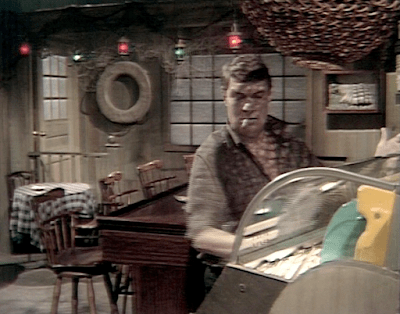
We end in The Blue Whale tavern, where Burke asks Vicki to stay away from Barnabas for reasons he refuses to explain. The only interesting thing about this scene is that Bob O’Connell does not appear in the background as Bob the Bartender. Some other uncredited extra is pouring today.
Fake Shemp Burke Devlin is starting to suspect that there is something odd about old world gentleman Barnabas Collins. He suspects that Barnabas is not from England as he claims to be. More darkly, he is considering the possibility that Barnabas might be the one who abducted Maggie Evans, The Nicest Girl in Town, and held her prisoner. As it happens, the audience knows that he is correct in both of these suspicions. We also know more- that Barnabas is a vampire.
Burke has hired investigators to probe into Barnabas’ past. Barnabas told him he lived near London with a cousin named Niall Bradford. Burke’s investigators have found that the last time a man of that name lived in London was 130 years previously. Dark Shadows has been going back and forth for months on whether Barnabas lived in the 1830s or in the eighteenth century. Yesterday they seemed to commit themselves to the earlier date, but now we’re back with the 1830s.
Burke asks Maggie’s doctor, addled quack Dave Woodard, to show him all of her medical records. Woodard protests that medical records are confidential. He then tells Burke everything he knows about Maggie’s case.
Burke calls on Maggie. She is back home, apparently well, but suffering from amnesia covering the entire period of her captivity. Unknown to any of the characters we see today, Maggie’s psychiatrist Julia Hoffman is a mad scientist in league with Barnabas, and she has wiped Maggie’s memory clean of any information that might threaten to expose him. Burke talks with Maggie and her boyfriend, hardworking young fisherman Joe, repeating everything Woodard told him a few minutes before.
Maggie and Joe tell Burke that she has had a few visitors since she came home. Maggie blithely mentions that Barnabas was one of those visitors. Burke is startled to hear this, and Maggie repeats that Barnabas dropped in to pay his respects.
During the fourteen weeks when Dark Shadows was driven by undead fire witch Laura Murdoch Collins, Burke saw extensive evidence of supernatural doings. But he lately he has decided that he lives in the kind of world where the show took place in its first few months, where there might be hints of ghosts in the background, but all the action came from flesh and blood humans subject to the usual laws of nature. Since it doesn’t occur to him that a person might have powers like Julia’s, Maggie’s calmness when talking about a visit from Barnabas seems to prove that Barnabas is innocent.
Burke learns that Barnabas has been to see Maggie.
Maggie does say that there is just one memory she has that seems to be connected with her time in captivity. It is a bit of music- “a light, playful tune. A soft, tinkling sound.” She freely admits that it seems unlikely that this would have any connection with such an experience, and speculates that it may have been something she remembered from childhood.
In the great house of Collinwood, well-meaning governess Vicki is listening to the enchanted music box Barnabas gave her. Burke and Vicki are now engaged to be married. He comes to see her, and remarks on the music box. She accuses him of being jealous of Barnabas, and he keeps coming back to the music box. When she opens it for him, he remarks that it makes “a light, playful tune… a soft, tinkling sound.”
The episode ends with Burke listening to the music box and staring off into space. Barnabas gave the music box first to Maggie, then to Vicki, in each case hoping that she would listen to it until its magical quality caused her to believe that she was his lost love Josette. Seeing the look on Burke’s face as he listened, my wife, Mrs Acilius, said “Maybe Burke will start to think that he’s Josette.” Who knows, maybe he and Barnabas could be very happy together.






 Dark Shadows Commentary