Mrs Acilius and I did our first watch-through of Dark Shadows on streaming starting in the spring of 2020, when there was no live theater to attend. When we got to the episodes introducing Barnabas Collins the vampire, I found Danny Horn’s Dark Shadows Every Day, which picks up with those and follows the series to its conclusion. I enjoyed Danny’s blog very much, and soon became one of his regular commenters. When we started this watch-through to coincide with the 56th anniversary, I looked for someplace to leave my comments on the episodes Danny didn’t cover, and found that all I could do was to start this blog of my own.
In his post about #412, Danny wrote: “This actor, Roger Davis, plays five roles on Dark Shadows, and they just get more and more angry. By the time we get to Harrison Monroe in late 1969, his character is literally an automaton sitting behind a desk, who yells at people nonstop until his head falls off. That is actually true.” I remember reading that in 2020 and doubting that it was actually true, but by the time we got to this episode and saw it happen, we had learned not to underestimate Dark Shadows. It is far and away the best Roger Davis moment on Dark Shadows. In fairness to Mr Davis, he is a highly trained actor who can do good work, but he chose to do so only a handful of times on the show. When we see that the writers are as sick of his obnoxiousness as we are, it’s an occasion to stand up and cheer.
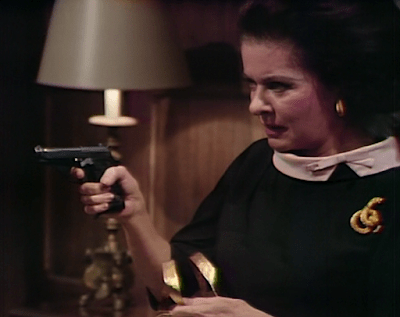
Much of the episode is taken up with some business about whether matriarch Elizabeth Collins Stoddard and her thirteen year old nephew David Collins are going to murder permanent houseguest Julia Hoffman. Liz and David have been absorbed into a secret cult devoted to unseen supernatural beings called the Leviathans, and Julia, who cannot be absorbed into the cult, is on track to uncover its existence. Liz takes a pistol and aims it at Julia’s back. Julia is absorbed in another crisis, and by the time she notices that someone else is in the room, Liz has put the pistol down.
Liz tells David she can’t bring herself to kill Julia, who has been very helpful to the family in the past. David sternly tells her that they must put aside all such considerations and think only of their duty to the Leviathans. They consult a sacred book the Leviathans have entrusted to them, and read that they must not kill anyone, since the ghosts of their victims are more formidable to them than are living people. Since most of the principal characters on the show, including Julia, Liz, and David, have committed or at least attempted homicide, this prohibition would seem to imply that the Leviathans are the good guys.
There is also a story about Quentin Collins and his great-grandson Chris Jennings. Quentin was a werewolf in the nineteenth century and Chris has inherited that curse. In 1897, a repellent little man named Charles Delaware Tate painted Quentin’s portrait. The portrait had magical powers, relieving Quentin of the effects both of lycanthropy and of aging. Quentin recently came back to town, suffering from amnesia and refusing to listen to Julia or Chris when they try to tell him he is 99 years old. Julia and Chris hope that Tate will be able to do for Chris what he did for Quentin, and they have figured out that he is still alive and using the name Harrison Monroe.
The moon was full enough last night to trigger the werewolf transformation, and will be again tonight. Chris turns up. She had taken him to a mental hospital she controls, to be locked up securely while he is in his lupine form; he checked himself out, and says he can’t stand being caged. Since the alternative is killing at least one person at random, it is rather difficult to sympathize with Chris’ insistence on letting himself out.
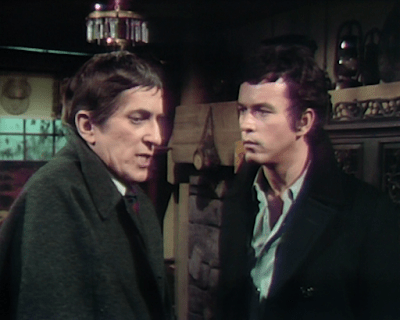
For her part, Julia was already afraid that a werewolf was on the loose before she knew Chris had left the hospital. She suspects Quentin may have reverted to lycanthropy. She goes to the apartment of the woman who has been keeping Quentin and finds him there, his face soiled and his clothing tattered as it might be the morning after a fit of werewolfery. It turns out that he did not transform- he simply got into a bar fight. When she tells Chris about this, he goes to his great-granddad and demands he accompany him to Tate/ Monroe’s house. Quentin isn’t interested in Chris or his problem or Tate/ Monroe, but he is too drunk to hold his ground for long.
Tate/ Monroe doesn’t want to let anyone in, but when Quentin announces himself he opens the door. Chris and Quentin see a young man sitting at a desk in a darkened room. The young man sees Quentin’s apparent youth and yells “Liar!,” shouting that he is too young to be Quentin. Quentin points out that Tate/ Monroe looks just as young as he does, and Tate/ Monroe responds by shouting something about being a genius. Within seconds, he is shouting that of course he recognizes him as Quentin. Confusing as this transition is, I don’t think it is a flaw in the writing, but in the acting. I suspect Mr Davis was supposed to put some sort of inflection on the lines in between to show that Tate has figured something out, but doing that would not be compatible with his technique of delivering all of his lines in an unvarying petulant shout.
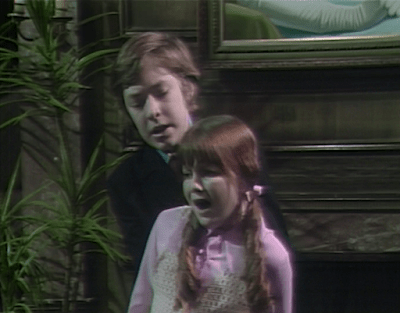
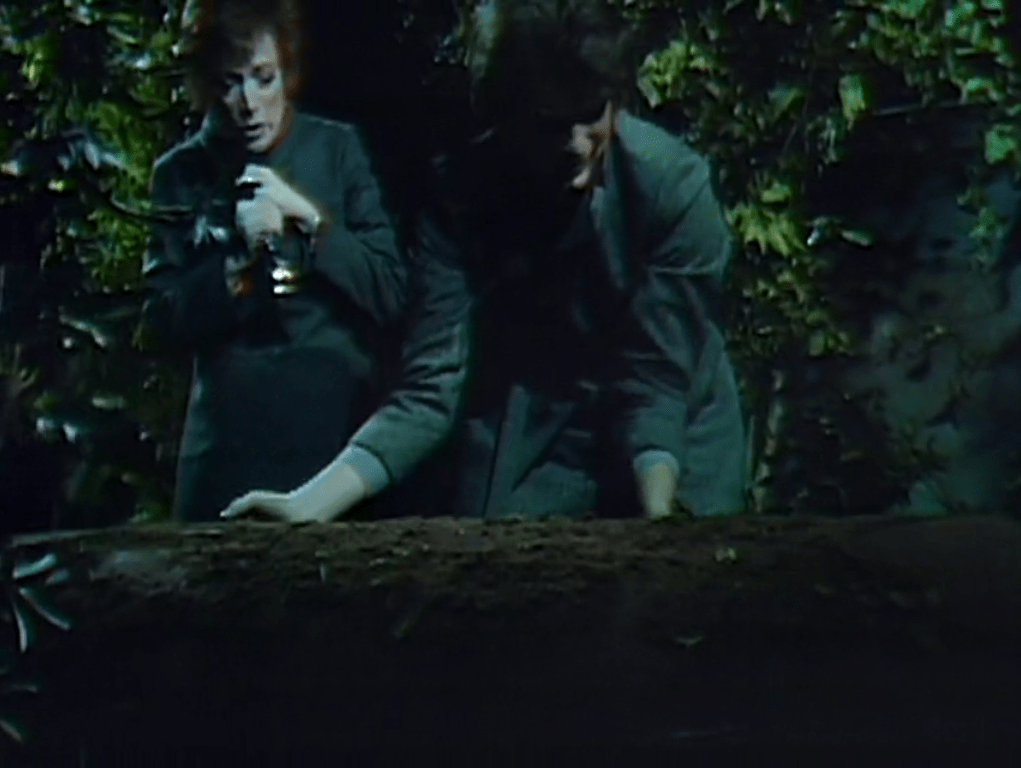
Quentin can’t take Tate’s personality any more than the audience can. He throws a vase at him and runs out of the room. It’s when the vase hits the automaton that the head falls off.
The Leviathan story is based on some of H. P. Lovecraft’s stories. Chris and Quentin do not appear to have a direct connection to the Leviathans, but Harrison Monroe, and today’s closing revelation that he is a pile of junk arranged to look like a person, are taken from Lovecraft’s novella The Whisperer in Darkness. So perhaps werewolves and Leviathans have something to do with each other after all.
In December 1968, children David Collins and Amy Jennings explored the long-deserted west wing of their home, the great house on the estate of Collinwood. They stirred up the ghost of Quentin Collins, who turned out to be David’s great-great uncle and Amy’s great-grandfather. For the next several weeks, Quentin steadily gained power and wrought ever graver havoc, until by the end of February the great house had become uninhabitable and David was hovering between life and death. At that point, David and Amy’s distant cousin Barnabas Collins did some mumbo-jumbo to try to contact Quentin’s ghost, only to come unstuck in time and find himself in the year 1897, when Quentin was a living being.
For the next eight months, Dark Shadows was primarily a costume drama set in 1897. Occasional glimpses of 1969 showed us that the haunting was continuing. In #839, we saw David lying dead before his father Roger, finally having succumbed to the effects of the haunting. But while Roger was lamenting him, David came back to life. The events in the part of the episode set in 1897 had changed the future, so that the ghost of Quentin found peace and Collinwood returned to its usual condition. But that took effect as of the anniversary of the change. Everyone’s memories of the ten months of Quentin’s haunting and of the eight months of Barnabas’ absence in the past are intact.
Not only is Quentin no longer a ghost, he isn’t even dead. In the altered version of 1897 that we saw, an artist named Charles Delaware Tate painted a portrait of Quentin that had the same magical effects on him that Dorian Gray’s portrait had in Oscar Wilde’s novel. Quentin looks, moves, and sounds exactly like he did when he was 28 years old. He has recently returned to Collinsport, and has amnesia. He was found carrying identity papers in the name of Grant Douglas. He’s open to the possibility that that may not be his right name, but when he finds Dr Julia Hoffman, MD trying to convince him he is the 99 year old Quentin, he is incredulous.
At Collinwood
We open today in Quentin’s old room in the west wing. Julia has persuaded Quentin to sit there and listen to his record player. In the unaltered timeline, he was obsessed with a sickly little waltz, listening to it over and over in 1897 and inflicting it on Collinwood when he was a ghost. Julia plays the record, and it doesn’t mean a thing to him. She becomes frustrated and accuses him of lying when he says that he doesn’t remember that he is Quentin.
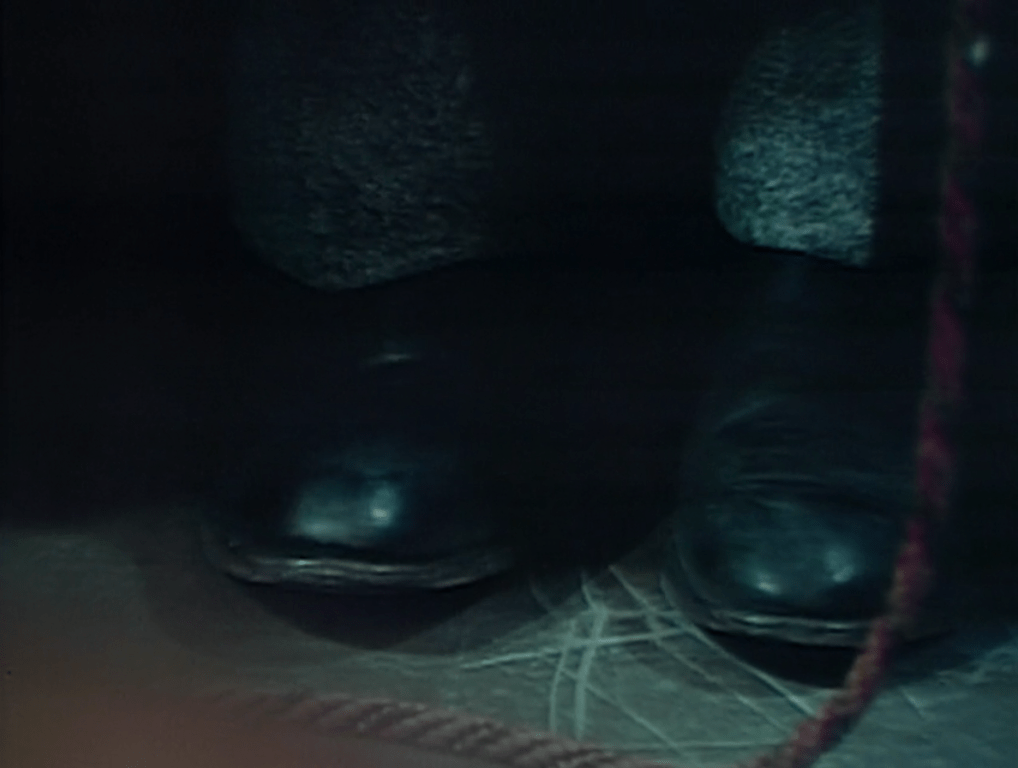
The music does ring a bell for someone else in the house. The sound of it reaches David and wakes him. Alarmed, he makes his way to Quentin’s room. By the time he gets there, Quentin is hiding behind a curtain. Julia tells David she went in to look for a painting, and that she thoughtlessly started the record player. He accuses her of hiding Quentin. While she is denying it, he sees Quentin’s shoes sticking out from under the curtain.
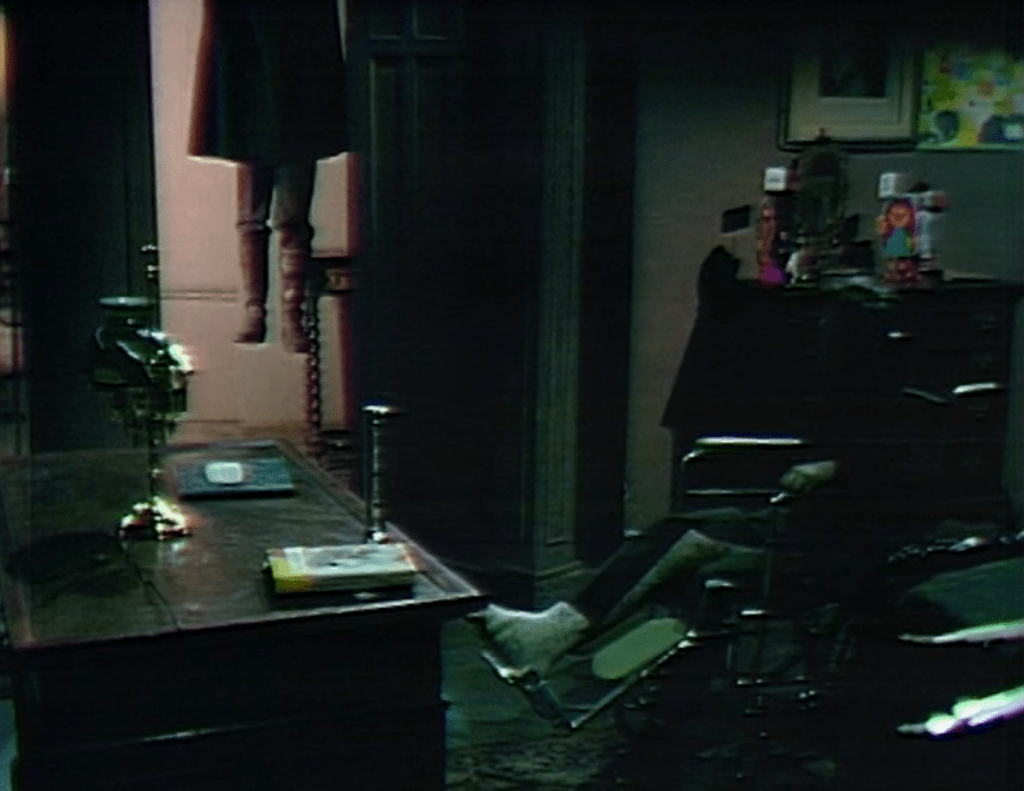
Quentin’s shoes, as seen by David.
In 1963, philosopher Edmund Gettier published a little paper about the traditional definition of knowledge as “justified true belief.” He gave several examples of justified true beliefs that most people would not regard as knowledge. His examples were kind of far-fetched, but it is easy to come up with more plausible instances. For example, I first read Gettier’s paper when I was in college, and at the same time I was reading Anthony Trollope’s novel The Eustace Diamonds. The main point of that novel is that everyone believes that Lizzie Greystock has stolen some diamonds from her late husband’s estate. She has in fact done so, and they have good reason for believing that she did so, but those reasons are so mixed up with misunderstandings of Lizzie’s motives and other circumstances that we wouldn’t say any of them really knows anything about her. My epistemology professor was excited when I told her about the novel, since the example she gave to our class to show that Gettier’s contrivances were not the only cases illustrating his point was something overly elaborate about believing that you have recognized someone whom you have partially seen while he is hiding most of himself behind a curtain.
David’s claim that Julia is hiding Quentin is another Gettier case. He believes it, the sight of Quentin’s shoes in Quentin’s room provides compelling justification for believing it, and it is true. Yet the Quentin whom Julia is hiding does not have any of the characteristics that give David’s belief the significance that he draws from it. His presence is not a sign that the haunting has resumed and that David is back in mortal danger. He is not a ghost at all and is not a threat to David or anyone else in the house. So while David has a justified true belief that Julia is hiding Quentin, that belief is so deeply entangled with a severe misunderstanding of the situation that we wouldn’t count it as knowledge.
Once David is gone, Quentin emerges and demands answers from Julia. She tells him something about Quentin’s ghost; he already finds her insistence that he is 99 years old to be so preposterous that the additional detail that he used to be dead prompts a merry laugh. By the time he is at the front door ready to leave, he is stern and telling Julia that he expects a “full explanation” tomorrow. Lotsa luck on that- ghosts, time travel, magical portraits, and a universe where the present is a stew made up of the consequences of several mutually incompatible pasts? And those are just the elements you can’t avoid in the executive summary of the situation. A “full explanation” involves werewolves, vampires, a humanoid Phoenix bent on incinerating her children, demons conjured from the depths of Hell, a sorcerer who still misses his pet unicorn, and about a thousand other fantastical topics.
David eavesdrops on Quentin and Julia’s parting conversation. When he was a ghost, we never heard Quentin speak- he communicated telepathically with David and Amy, and they could apparently hear his voice on a particular telephone, but he never stood around and talked with anyone like this. So the mere fact of the conversation undermines David’s belief that the man he is looking at is Quentin’s ghost. When David hears Julia call Quentin “Mr Douglas,” he can see that whoever this person may be, he is not exactly Quentin, not as he knew him. He does recognize the name “Mr Douglas” as that of a man his cousin Carolyn Stoddard met at the antique shop in the village where she works and whom she visited in the hospital when he first had amnesia, so his attitude towards him changes.
In the Antique Store
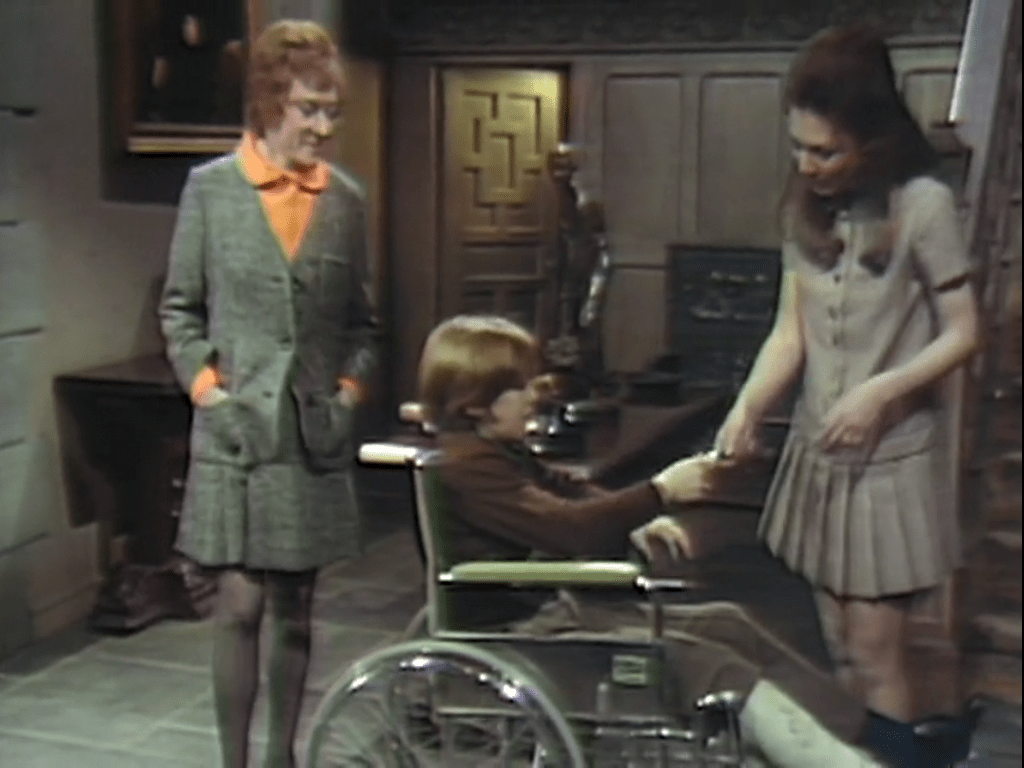
Unknown to Julia or Carolyn, David has been assimilated to a cult that serves unseen supernatural beings known as the Leviathans. Carolyn’s mother, Elizabeth Collins Stoddard, has also been absorbed into the cult, as has Barnabas. Megan and Philip Todd, the owners of the antique store, are members too, and they are fostering a mysterious creature who currently appears to be an eight year old boy and answers to the name Alexander. Liz takes David and Amy to the antique store, where they interrupt an uncomfortable conversation between Alexander and Julia.
Liz suggests to Julia that they should leave Amy and David in the store to play with Alexander. Julia doesn’t think this is such a hot idea, but Liz insists.
We then have the first scene on Dark Shadows populated by three child actors. It was a breakthrough when the ten year old David played with the ghost of nine year old Sarah Collins in the spring and summer of 1967; their scenes, the first interaction between children on Dark Shadows, advanced it towards becoming a kids’ show. David had up to that point been the only child on the show. He was first a homicidal monster who threatened the adults, then a figure threatened by his mother Laura and in need of rescue. When we saw him with Sarah, the two of them built a relationship that was of importance in itself and that had consequences which grew to dominate the story, leading directly to the show’s first time travel segment in November 1967. In David and Sarah, the fans running home from elementary school to watch the show could see characters their own age driving the action.
The current phase has been very heavy in adult interest. This first three-scene among children might be expected to take us back to territory Sarah and David did so much to open, but it does nothing of the kind. The three children do not really interact with each other at all. David is under the control of the Leviathans, Alexander is a manifestation of their power, and Amy is at a loss to figure out what’s going on. The forces motivating the action are not on screen, any more than they would be if the boys’ parts were played by marionettes.
David, Amy, and Alexander
Amy finds that Alexander has a photograph of Carolyn as she was when she was eight. She realizes that he stole it from a photo album at Collinwood. She declares that she will take it back to the house. Alexander forbids her to do so, and David takes his side. Amy is puzzled by David’s attitude. David threatens to sic Quentin on her. That shakes her up, but she says that Quentin is gone. David says he isn’t, and he and Alexander force her to play hide and seek. Once she is out of the room, David tells Alexander to keep her away for a couple of minutes. He telephones “Grant Douglas” and asks him to come to the shop to pick up a book he left there.
Amy comes back just in time to see and recognize Quentin. She runs upstairs and goes into the room which belongs to Alexander. She hears a heavy breathing there and sees something that terrifies her. Returning viewers know that what she saw was some inhuman thing that is of the Leviathans.
For his part, David is quite calm with “Grant.” Though we saw at the beginning that his connection to the Leviathans has not removed his fear of Quentin, he has reached the conclusion that he doesn’t need to be afraid of “Grant Douglas.” Maybe he thinks that someone using the names of two such prominentCanadians can’t be all bad. He gives Quentin the book and assures him Amy will be all right.
Quentin accepts David’s assurance, but we cannot. Amy is absent from the cast for long periods, and is usually unmentioned during those intervals. The same was true of Nora Collins, the character Denise Nickerson played in the 1897 segment. The show seems to be deliberately telling us not to get used to having this fine young actress in the cast. And the Leviathans haven’t done anything truly horrible yet- they are due to murder a character we really like. So it is quite possible we will tune in tomorrow and find that Amy is dead. Again, the contrast with the David and Sarah story is telling. David Henesy was a core member of the cast from the first week of the show, and the ghost of Sarah was a key part of the show for months. Dark Shadows was as much their show as it was that of any of the adults on screen. Keeping both Amy and Denise Nickerson at the margins, they make it clear that the kids are going to be taking a back seat.
David Henesy and Denise Nickerson were both highly capable performers, but eight year old David Jay just stands on his mark and shouts his lines. That need not have been a problem. Alexander has only been in human form for a week or two, so we don’t expect subtlety from him, and to the extent that he sounds like a real child he is supposed to be a vicious little bully trying to figure out what he can get away with. Such children often do put on acts and sound awkward, so Mr Jay’s professional ineptitude dovetails with the requirements of his part. That’s similar to the way Sharon Smyth’s limitations fit with the part of Sarah. We were supposed to be unsure whether Sarah knew that she was a ghost, whether she knew what year it was, and what if anything she remembered from one appearance to the next. Since Miss Smyth* was, as she says now, “clueless” about the craft of acting, she did a great job keeping us guessing. Later we saw Sarah as a living being, and Miss Smyth’s performance was less satisfactory. We know that Alexander is likely to transform into a shape that is not compatible with David Jay soon, so his shortcomings aren’t a particular concern. But again, the fact that Alexander comes with an expiration date keeps us from regarding him as one of the main characters.
The Store Room
While the kids were alone in the antique shop, Liz took Julia to a store room in the west wing of Collinwood to show her some photographs she had been asking about. While there, they come upon a painting. Liz says that she bought it about a year before at a charity auction, and that when her brother Roger saw how lousy it was he said he hoped that it was a worthy cause. She took it directly to the store room. It is signed “Harrison Monroe” and dated 1968. We will learn tomorrow that it depicts a place called Indian Hill. Julia recognizes the painting as extremely similar to an equally undistinguished landscape she bought a few weeks ago.
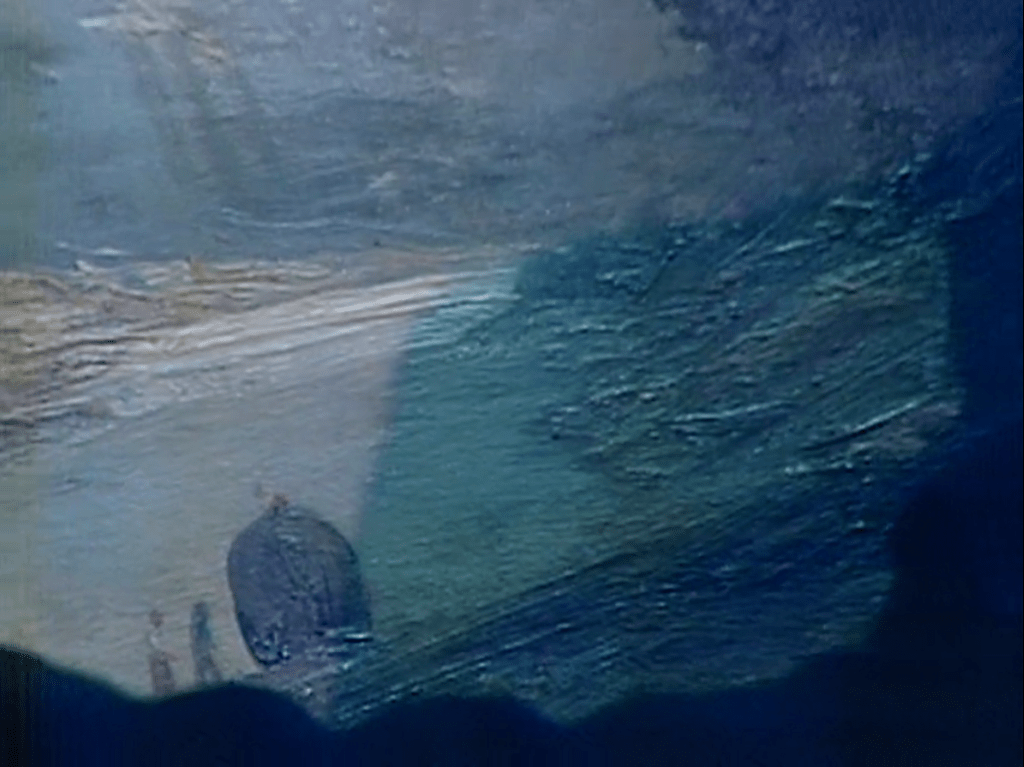
Detail from “A View of Indian Hill,” Harrison Monroe, 1968.
That painting was the work of Charles Delaware Tate, executed about 20 years previously. That Tate had been alive and working as recently as that gave Julia the hope that he might still be around and able to help a friend of hers who has problems. Yesterday, an expert called on to remove the landscape and reveal the portrait underneath it said that Tate died in 1959. But this painting is apparently the product of the same hand. Julia hopes that “Harrison Monroe” is a pseudonym of Tate’s.
It has been clear to the audience ever since Julia found the first painting that Tate would be back. That can’t be welcome news to many people. Like all characters played by Roger Davis, Tate is a loathsome man who shouts his lines and assaults his scene partners. So this pseudonym, as strongly redolent of oldVirginia as “Grant Douglas” is of twentieth century Canada, will bring a sinking feeling to much of the audience. Our reprieve that began when we left Tate in the nineteenth century five weeks ago cannot last much longer.
*Her name is Mrs Lentz nowadays, but that’s an odd title to give a nine year old. So I refer to her as Miss Smyth.
The current phase of Dark Shadows is focused on the threat to the human race posed by the Leviathans, unseen supernatural beings who have taken control of several characters on the show. Among their devoted servants are matriarch Elizabeth Collins Stoddard and her nephew, strange and troubled boy David Collins. Today, Liz and David welcome a boy known as Alexander to the great house of Collinwood. Alexander appears to be an eight year old boy, but is in fact an extreme case of Soap Opera Rapid Aging Syndrome. Last week he was an infant, and a few days before a whistling sound coming from a wooden box. Whatever Alexander may really be, he holds a key position in the Leviathans’ plan.
At times, Dark Shadows becomes so much a kids’ show that it loses much of its adult audience. The Leviathan story so far has gone to the opposite extreme. A scene in which Alexander orders the thirteen year old David to give up the transistor radio he had long wanted and that his father just gave him will probably get similar reactions from viewers of all ages, but when Alexander scolds Liz for asking questions and she apologizes, only those who remember Joan Bennett as the great star she was in the late 1930s and early 1940s will get the full force of the moment. In general, adults will probably feel the distress Alexander’s tyranny is supposed to induce, while the fans who are running home from elementary school to watch the show will likely be either annoyed with the kid or amused to see the grownups getting theirs.
Liz’ ex-husband Paul is being persecuted by the Leviathans and their human agents. Paul is staying at Collinwood, and he is outraged to find Alexander in the house. Paul carries on like a crazy man, prompting Liz to tell him that if he doesn’t compose himself he will end up in a mental hospital. He tells Maggie Evans, David’s governess, about his suspicions; she listens sympathetically until he catches Alexander eavesdropping and roughs the boy up. Maggie then freezes in horror, and Paul goes on shaking Alexander and yelling at him until Liz enters and puts a stop to it. While Liz and Maggie stand in the corridor and talk about Paul’s lunatic behavior, he paces in the drawing room, telling himself that he mustn’t “fly off the handle” again.
David enters and hands Paul a small photo album. He says that it has pictures of Paul and Liz’ daughter Carolyn when she was a child. Since Paul wasn’t around when Carolyn was growing up, David says it occurred to him that Paul might want to look through it. Paul thanks David for his thoughtfulness.
As Paul leafs through the album, we get a look at a picture depicting Carolyn as she was when she was about ten. We haven’t seen the model before. Dark Shadows had such a tight budget that regular viewers will be fairly sure they wouldn’t have brought a girl in only to pose for a single photograph, so we might start wondering when we will meet the ten year old Carolyn.
We may also be wondering when we will see another girl of about the same age. Denise Nickerson, twelve years old in December 1969, has been in the cast for a year at this point, and has made major contributions every time we’ve seen her. We saw in #893 and #896 that her character Amy Jennings is still living at Collinwood and is still David’s chief playmate. But as is usual in episodes where she does not appear, Amy is unmentioned today. Liz tells Paul that David spends entirely too much time surrounded by adults, as if Amy does not exist. They followed the same pattern during the eight months of 1969 when Dark Shadows was set in 1897 and Nickerson played nine year old Nora Collins. When Nora was in the episode, she was often its brightest spot, but when she wasn’t her name never came up. It’s unnerving that the show does so little to reassure us that it will continue to make use of such a talented and appealing young actress.
Alexander sits on the bench that has been in the foyer at Collinwood throughout the whole series. The Dark Shadows wiki says this is only the second time the bench has been used. I want to say it is the third- I remember David sitting there in #176, when Maggie’s predecessor Vicki told him he could have two desserts, cake and ice cream, but I seem to recall either him or someone else sitting there at some point around that time. I’m not going to go back through those episodes to check, but if you’ve been watching them I’d appreciate it if you’d leave a note in the comments.
Matriarch Elizabeth Collins Stoddard (Joan Bennett) was usually a blocking figure in the first 73 weeks of Dark Shadows, and when the pace of the stories picked up sufficiently that they didn’t need to slam on the brakes so often she drifted far to the margins. When she does show up, she is usually a talk-to for characters who might actually do something. The few times she has been the center of attention have been when she was so crushingly depressed she was a suicide risk. At one point she went beyond that, succumbing to a boredom so extreme that she lapsed into a catatonic state and was mistaken for dead.
Today, Liz is being atypically dynamic. She is trying to figure out what her nephew, strange and troubled boy David Collins, has been up to. Her investigations have shown her that David stole an old book from an antique shop and bought some clothes at a department store. These aren’t exactly the most thrilling discoveries of the age, especially when it appears that David has already returned the book to its rightful owners, but it represents a big step up from her usual activity level.
Liz walks in on David in his room, and finds him reading from a book. He denies that it is the book from the antique shop, but she doesn’t believe him. Later, Liz is poring over the book in her drawing room when her distant cousin Barnabas comes in. She tells him she doesn’t recognize the language or the script in which it is written, but that she has found certain blocks of text that are repeated throughout, in the manner of ritual language. She thinks it must be a religious book of some kind. Barnabas recognizes this as a remarkably intelligent observation. He offers to take the book to the antique shop himself. Liz happily accepts his offer, and goes upstairs to bed.
Liz has a dream. In the dream, David is wearing a fat suit. He takes her to a funhouse. At first the mirrors merely add to her chronic depression, but she brightens when she sees Barnabas in one of the mirrors. And when David recites a bit of doggerel- “Fat and Skinny had a race, all around the steeplechase./ Fat fell down and broke his face./ Skinny said, I won the race!” she laughs heartily. She wakes up. In her bed, she is staring into space, all jollity gone.
Most of the dream is shot in a kaleidoscopic style, splitting the screen into many copies of the same image. Regular viewers know that Dark Shadows puts kaleidoscopic patterns on the screen when it is showing people submitting to one or another form of mind control. For example, when mad scientist Julia Hoffman hypnotizes people, we often see pictures that seem to come from inside a kaleidoscope. Liz herself asks David at the beginning of the dream if the mirrors will show her “all the people I could have been”; he says that no, “They’ll show you all the people you really are.” Since the dream is full of odd looking dolls and puppets, that suggests all the people she really is are controlled by someone other than herself. The cut from her laughing face at the end of the dream sequence to her blank expression when she wakes up would also suggest a discontinuity between the Liz who had the dream and the Liz who will rise from bed.
Over the last few weeks, the show has been developing a story about a cult devoted to mysterious supernatural beings known as the Leviathan people. The cult is secretly absorbing one person after another, enabling the Leviathans to act through them. Barnabas and David have taken turns leading the cult, and the owners of the antique shop are members of it. If Liz is no longer herself, we must conclude that she has now been coopted into the cult as well.
Liz’ daughter Carolyn works at the antique shop. Early in the episode, she met a man whom we could see only from the chest down. He was wearing a belted overcoat. In #902, we had the same view of a man wearing the same overcoat as he wandered into Liz’ house, straightened a portrait of Barnabas, hid from Carolyn, and wandered out again. Evidently this is the same man. Later, Barnabas went to the shop, and Carolyn told him she was smitten by the man and that he would be coming back when the shop closed, after 10 pm.
The man does come back as promised, but doesn’t quite make it into the shop. He is between the streetlight and the door, in a space which we must interpret as representing a sidewalk, when Barnabas runs him down with his car. Carolyn comes out of the shop and Barnabas claims that the man just darted out of nowhere, giving him no chance to stop. It is unclear when Barnabas learned to drive. When he was first on the show in April 1967, he was a vampire who had been sealed in a coffin since the 1790s. He was cured of the effects of vampirism in March 1968, and in #687 we heard about him driving. Perhaps his training in the rules of the road was irregular. Still, you would think he would have a better excuse for driving into a pedestrian than failing to expect him to be on the sidewalk.
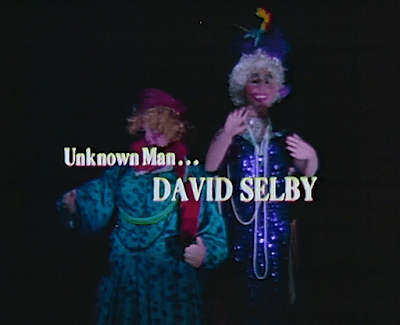
The camera zooms in on the injured man’s face. We don’t see enough of it to be sure who it is. The closing credits tell us that “Unknown Man” is played by David Selby. It must be a goof that we don’t see much of Mr Selby’s face. Over the year he has been playing the rakish Quentin Collins, Mr Selby has become a huge breakout star, rivaling the fame Jonathan Frid has gained as Barnabas. Surely they wouldn’t put him on unless they wanted us to recognize him.
Quentin first came on the show as a ghost at the end of 1968, and found his greatest success from March to November 1969, when the show was set in the year 1897. Since the show returned to a contemporary setting, we have been sure that Quentin will be back, but we haven’t had any reason to expect him to return at any particular time. In #887, the first episode set in November 1969, we saw the back of a man prowling about the estate of Collinwood; we might have suspected he was Quentin. But he turned out to be Liz’ ex-husband Paul Stoddard, who had never before been a real character on the show and who has been unmentioned for more than two years. So when we are kept from seeing the face of another prowler, he could be anyone at all. Perhaps Frank Garner is training to be a ninja, or Ezra Hearne is having a personal crisis.
The closing credits run over this image from Liz’ dream. The dolls move while the credits are scrolling over them, the effect is hilarious. I didn’t think the dream sequence was particularly effective, but I wish every episode ended with these two figures doing their little act.
Heiress Carolyn Stoddard is working for her friends, Megan and Philip Todd, in their antique shop. She goes upstairs to tell Megan that Philip has telephoned. Carolyn hears heavy breathing coming from the room where a baby the Todds are taking care of sleeps. Megan comes out of the room and in a most imperious tone demands to know what Carolyn is doing there. She tells her Philip called, and asks about the breathing sounds. Megan sweetens up and says “It’s the radiator!” She says she’ll have to call the plumber about it. Carolyn is unconvinced.
Downstairs in the shop, Carolyn and Megan notice someone looking in the window. The shop is open for business and there is merchandise displayed in the window, but for some reason it unnerves them that they have attracted the notice of a potential customer. All we can see of the man is his clean-shaven upper lip. When Carolyn approaches the window, he runs away. The only sneaky man we have met so far in the current phase of the show is Carolyn’s long-absent and recently returned father Paul. Since Paul wears a mustache, the upper lip is enough to show us that this is a new character, at least new to the ongoing stories.
Carolyn and her mother Liz live in the great house on the estate of Collinwood. Also among the residents of the great house are Liz’ brother Roger Collins and Roger’s son, strange and troubled boy David. We cut to David’s bedroom, where a book opens by itself. We have seen books do this before on Dark Shadows, but I believe this is the first time I couldn’t see a cord being pulled. They really have come a long way with practical effects.
David reads aloud from the book, something about a child being cloaked in radiant garments. He is interrupted by his Aunt Liz. She asks him to notice that she knocked on the door, and tells him that she is learning to respect his privacy. She says she heard him reading aloud, and asks what it was. He says it was a school book. She starts talking about how terribly cold it is in his room. He brings up her ex-husband, Paul. Liz hadn’t known David was aware of Paul’s return, and gets very uncomfortable. She says he needs friends his own age, and hurries out of the room. Once she is gone, he goes through the room and gathers a lot of cash. Evidently David raised the subject of Paul to get the room to himself.
David does have one friend his own age, Amy Jennings. Amy lives in the great house, down the hall. We just saw Amy in #893 and #896, but she tends to be unmentioned in between appearances. Amy is a favorite of mine, and when they don’t use her name for long stretches I worry they are about to drop her from the show. It would have reassured me if Liz had named Amy as someone David ought to spend more time with.
Joan Bennett tends to do a lot of acting with her eyes when she plays a two-scene with David Henesy, and this is a good example. When Liz is pointing out her own good manners in knocking, it is her eyes that convey her mild amusement at the situation; when she is offering to help David with his schoolwork, her eyes follow him so closely that we notice all of the little movements he makes as he tries to get out of a tutoring session; when she talks about the coldness in the room, she looks from side to side, searching for the open window with increasing consternation; when he asks about Paul, her eyes bulge in their sockets, showing deep alarm. When she tells him he needs friends his own age, she raises her eyebrows, making it sound like a threat. Bennett had been so famous for so long that many of her scene partners would not react to what she was actually doing, but to what they expected her to do, forcing her to add Joan Bennett-isms to her performances. With Mr Henesy, she was free to work simply, and the result was consistently very effective.
Downstairs, Liz answers the telephone. To her disgust, Paul is calling. He tells her that if she doesn’t meet with him for a talk, she is in danger of losing Carolyn. She agrees to go to his hotel. Carolyn enters in time to catch the end of the conversation. Liz doesn’t want to talk about Paul with her any more than she did with David, and she exits.
Carolyn and David have a scene in the drawing room. She tells him he should go to bed; he says he wants to read the newspaper. He asks her if she hasn’t noticed that he has grown. Since the thirteen year old David Henesy was about the same height as Nancy Barrett, this question is worth a chuckle. David gets excited when he sees that Brewster’s Department Store in the village of Collinsport is going to be open nights until Christmas. He tears the Brewster’s ad out of the paper while Carolyn reminds him he can’t leave the house tonight. He says that of course he can’t, it’s late.
In his post about the episode on his great Dark Shadows Every Day, Danny Horn asked if David’s reaction to the Brewster’s ad is the only reference to Christmas in the whole series. His commenters responded that Christmas is also mentioned in #92, #123, #257, #810 (twice,) #887, and #1050. It’s hilarious to read through the thread and see the citations mount up. I sympathize with Danny, though- I tagged my posts about the first couple of episodes on that list with “Christmas,” because I, too, was sure that the holiday was only named once or twice in Dark Shadows.
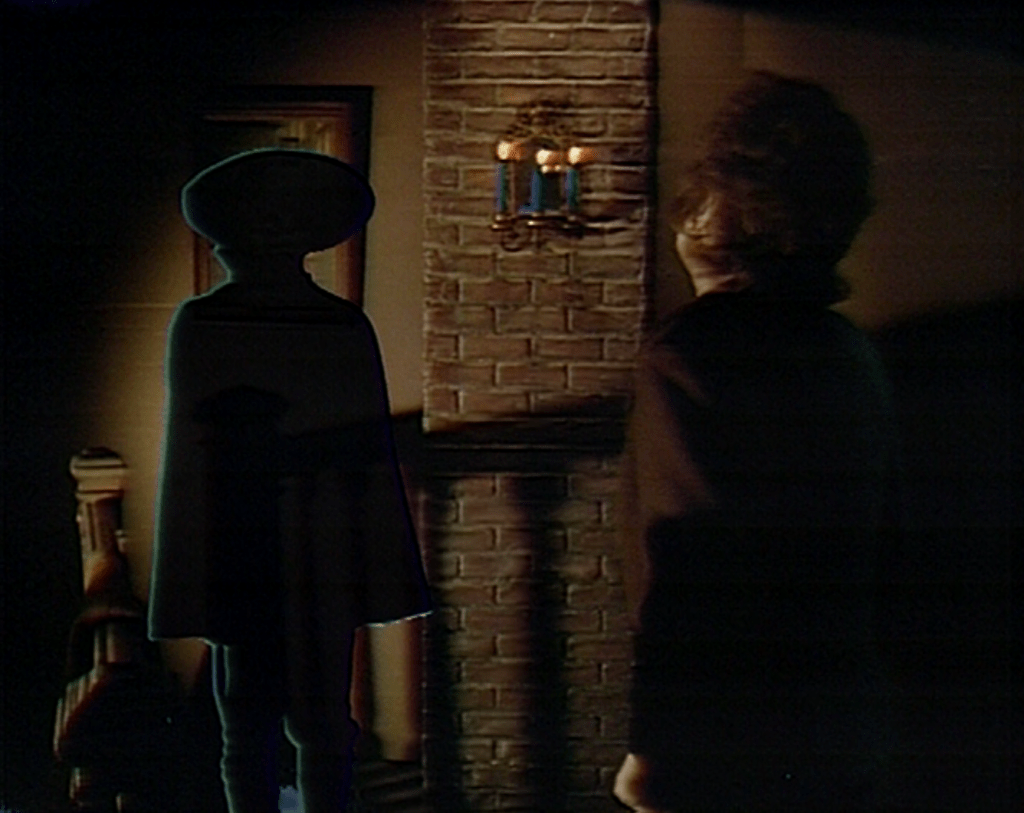
Carolyn exits, and David sneaks out the front door. As he does, a man in a belted overcoat walks into the house. We see him only from the midsection down. He straightens the portrait of the Collinses’ distant cousin Barnabas that hangs in the foyer of the great house. This suggests that whoever he is, he has some connection with Barnabas. Carolyn comes back, and the man hides behind the curtains in the drawing room. This has been a favored hiding place for the last several months, suggesting that the man knows the house. Carolyn leaves, and the man goes out. If all he wanted to do was straighten that portrait, he could count his journey a success. Otherwise, it’s hard to see what the point of it was.
At the hotel, Paul struggles to explain his concerns to Liz. He is hampered by his own ignorance- he does not know exactly who is after him or what they want to do, but he knows they have some kind of sinister plan for Carolyn. Paul admits that Liz has no reason to believe anything he says, after his total failure as a husband, but he keeps urging her to take Carolyn and go far away, not telling anyone that they are going. She is exasperated with what she takes to be yet another of his scams, and tells him that “I’ll never figure out this latest plot of yours.” Indeed, the story is taking shape slowly enough that some viewers will have been saying the same thing.
Bennett and Dennis Patrick had many scenes together from March to July 1967, when he played seagoing con man Jason McGuire. Liz’ relationship with Jason was one-dimensional, consisting of nothing but a series of blackmail threats from him followed by capitulations from her. As her ex-husband, Paul offers far more for Liz to react against, and this scene is far richer and more satisfying than was anything we saw in the dreary Liz/ Jason story.
Liz goes out of the Collinsport Inn and sees David entering the antique shop across the street. The Inn has been part of the show from episode #1, but this is the first time we see a set representing its outside. Cutting between that set and the set representing the exterior of the antique shop, they make an attempt to create a sense of Collinsport as a place. When the show was in black and white, they would occasionally insert video they had taken at various locations in upstate New York and southern New England to achieve that effect, but they haven’t left 433 West 53rd Street since they went to color in August 1967. This quick cut between minimally decorated parts of the studio doesn’t work as well as that footage did, but it is a valiant effort in its own way.
Liz goes into the antique shop and insists Megan let her search the place for David. Since Liz essentially owns the town, Megan can’t say no. We conclude with Liz outside the door of the room upstairs from which Carolyn heard the breathing when we began. We hear the breathing again. David is inside the room, telling some unseen presence that it will like what he bought for it at Brewster’s. Perhaps he found it in the Unseen Presences section of the store. It’s in Collinsport, after all. David stops talking when he hears Liz’ voice; the breathing cuts out at the same time.
A cult devoted to the service of supernatural beings known as “the Leviathan people” is secretly establishing itself in and around Collinsport, Maine. Antique shop owners Megan and Philip Todd are members of the cult. Its acting leader, old world gentleman Barnabas Collins, has entrusted them with several items sacred to the cult. The Todds are responsible for a scroll, a box, a book, and a baby. Now the book has gone missing, and the baby is sick. Yesterday, Barnabas responded to this situation by brainwashing Philip into killing Megan. Today, we open with Philip entering the antique shop and choking Megan.
Megan is Marie Wallace’s third character on Dark Shadows. Her first, fiancée of Frankenstein Eve, was strangled by her intended spouse Adam in #626. Her second, madwoman Jenny Collins, was strangled by her estranged husband Quentin in #748. The murder of Eve came at the end of the Monster Mash period of the show that stretched throughout most of 1968, while the murder of Jenny marked a turning point in the eight-month costume drama segment set in the year 1897. The Leviathan arc is just beginning, and Miss Wallace’s character is already being strangled by her husband. If we were hoping for fresh new story ideas, we couldn’t be more disappointed.
Until, that is, the strangulation is called off. Philip is holding Megan by the neck, reiterating that “There is no margin for error! Punishment is necessary!,” when strange and troubled boy David Collins appears on the staircase and announces “punishment is no longer necessary.” Philip releases Megan, and David informs them that he is now “the keeper of the book, and the protector of the baby.” He gives Megan and Philip medicine that will cure the baby of his illness. He tells them that if they need him, he will know and will appear.
Barnabas was a vampire when he joined the cast of characters in April 1967. As a villain he was unrivaled at giving everyone else things to do, whether as his victims, his accomplices, or his would-be destroyers. In March 1968, his curse was put into abeyance and he became human. He set out to be the good guy, but still had the personality of a metaphor for extreme selfishness. As a result, Barnabas the would-be hero created at least as many disasters as Barnabas the monster ever did. He thus remained the driving force of the show, as well as its star attraction.
While Barnabas can keep things going from day to day, Philip’s attack on Megan suggests that he cannot take the story in new directions. From episode #1, that has been David’s forte. The series began when well-meaning governess Vicki was called to Collinwood to take charge of David’s education, took its first turn towards grisly tales when David tried to murder his father, became a supernatural thriller when David’s mother the undead blonde fire witch came back for him, began its first time travel story when Barnabas was planning to kill David in November 1967, and was launched into both the “Haunting of Collinwood” that dominated the show from December 1968 through February 1969 and the 1897 segment that followed it by David’s involvement with the ghost of Quentin Collins. David was not always a highly active participant in the stories that began with him; indeed, he sometimes disappeared altogether for months at a time. But even from the outside, he is the instrument by which the basic architecture of the show is reshaped. Now that he is, apparently, the leader of the Leviathans, we can renew our hopes that something we haven’t seen before is still in store for us.
David is still in the shop when a gray-haired man enters. David greets him as “Mr Prescott,” the name by which he heard his cousin Carolyn address the man when he met her in the shop the other day. David has a smug look on his face that suggests he knows this is an alias. Indeed, we already know that the man is connected with the Leviathan cult, so the leader of the cult may well recognize him as Paul Stoddard, Carolyn’s long-missing father.
Paul asks the Todds to give a note to Carolyn. David says that he will be going home to the great house of Collinwood in a few minutes, and volunteers to take the note to her there. Paul gladly hands it to him.
At Collinwood, permanent houseguest Julia Hoffman is conferring with mysterious drifter Chris Jennings. Yesterday, Jenny’s ghost appeared to Chris and told him that Quentin could help him with his big problem, which is that he is a werewolf. Jenny did not identify herself, and Chris had no clue who she was.
Julia shows him a Collins family photo album. She shows him a picture of maidservant Beth Chavez and asks if that is who he saw. He says it wasn’t, and they keep turning pages. It is interesting for regular viewers that they take a moment to put Beth’s picture on the screen and to make some remarks about her. Beth appeared several times during the “Haunting of Collinwood” segment, and was a major character during the 1897 flashback. The sight of her picture is the first reason we have had to suspect that either she or actress Terrayne Crawford will be back.
Chris and Julia look through a Collins family photo album. Screenshot by Dark Shadows Before I Die.
When Chris recognizes Jenny’s picture, Julia breaks the news to him that Jenny and Quentin were his great-grandparents, and that Quentin was the first to be afflicted with the werewolf curse. We know that Quentin and Jenny’s daughter was named Lenore, and that she was raised by a Mrs Fillmore. Chris confirms that his grandmother’s maiden name was Lenore Fillmore. Wondering how Quentin could help Chris, Julia decides they will hold a séance and contact Quentin’s spirit.
David enters, looking for Carolyn. Julia asks him to participate in the séance. He agrees, with the blandness appropriate in a house where séances have become almost routine. When Julia tells him that the spirit they are trying to reach is that of Quentin Collins, David becomes alarmed. As well he might- we left 1969 at the beginning of March, but in #839, broadcast and set in September, we saw that the haunting continued in the absence of the audience, and that Quentin’s ghost had killed David. That episode took place on the anniversary of an event in 1897 that was changed by time travelers from the 1960s, and so David came back to life and the haunting ended. But everyone at Collinwood still remembers the ten months that Quentin exercised his reign of terror, and David does not want to return to it.
Julia assures David he has nothing to be afraid of. She says that the past was changed as of September 1897/ September 1969, and that Quentin’s ghost was laid to rest forever. This doesn’t fit very well with her plan to disturb that rest, but David is still ready to go along with the plan.
When they have the séance, David goes into the trance. He speaks, not with Quentin’s voice, but with that of Jamison Collins, his own grandfather and Quentin’s favorite nephew. Jamison says that Quentin’s spirit is no longer available for personal appearances. He doesn’t know more than that, and excuses himself. When David comes to and asks what happened, Julia says she will tell him later and sends him to bed. Once he is gone, she tells Chris that she thinks Quentin may still be alive.
Quentin was a big hit when he was on the show as an unspeaking ghost during the “Haunting of Collinwood,” and became a breakout star to rival Barnabas when he was a living being during the 1897 segment. So the audience is not at all surprised that he will be coming back. But David’s behavior before, during, and after the séance is quite intriguing. He is not simply possessed by some spirit that is part of whatever it is the Leviathan cult serves. He is still David, is still afraid of Quentin’s ghost, and is still fascinated by séances. During the 1897 segment, Jamison was a living being; like David Collins, he was played by David Henesy. That Jamison can speak through his grandson and not express discomfort at the unfamiliarity of the atmosphere suggests that there are sizable expanses inside David which are still recognizably him.
There is a similar moment between Philip and Megan. She smiles at him and in a relaxed voice says she understands why he had to do what he did. Philip has no idea what she is talking about. She reminds him that he tried to strangle her earlier in the evening, and he suddenly becomes highly apologetic. She tells him he has nothing to apologize for, that it was his duty as a servant of their cause. He is still anguished about it. They share a tender embrace. Again, while the force that animates the Leviathan cult may have the final say over what Megan and Philip do, their personalities are still there, and the loving couple we met a not so long ago still exists. There is still something for us to care about concerning them.*
Paul also has a lot of activity today. He goes to the cairn in the woods that is the ceremonial center of the Leviathan cult and that only people associated with it can see. He wonders why he keeps being drawn to it. When he first returned to Collinwood in #887, he was watching when the cairn materialized in its place out of thin air. He didn’t react at all, but merely turned and continued on his stroll. That led us to believe he knew a great deal about the cult, enough that he not only expected to see this extraordinary sight, but knew he need take no action regarding it. But evidently his connection is more subtle, and he does not understand it himself.
In his hotel room, Paul goes into a trance and circles the date 4 December 1969 on his calendar. That was when the episode was first broadcast, so the original audience would have assumed he was merely circling the current date. But when it was taped, the makers of Dark Shadows had expected the episode to be shown on 3 December. In between, there had been a pre-emption when the ABC television network gave its news department the 4:00 PM timeslot to cover the end of the Apollo 12 lunar landing mission. So the intention had been that we would share Paul’s puzzlement as to what was so special about the next day.
Paul is already worked up because some unknown person left him a note at the antique shop reading “Payment Due, 4 December 1969.” By the end of the episode, he notices that a tattoo has appeared on his wrist. It is a symbol that the show refers to simply as “the Naga,” a group of intertwined snakes that represent the Leviathan cult. All of this combines to get him into quite a state.
* I should mention that Danny Horn made the same point in his post about the episode on his great Dark Shadows Every Day: “And then they kiss, and the creepy thing is that I think they’re actually in there… So far, I’ve been critical of Chris Bernau, but he’s the one who pulls this moment together. As far as he’s concerned, the unpleasant incident is entirely forgotten — but when Megan brings up the fact that he was seconds away from killing her, his apology is entirely sincere.” Danny Horn, “Episode 989: Executive Child,” on Dark Shadows Every Day, 12 July 2016.
Strange and troubled boy David Collins has stolen an old book from an antique shop. He didn’t want the book, but had damaged it slightly and was terrified that he would be punished if this was discovered and his father had to pay for the rare volume.
David’s friend and fellow resident of the great house of Collinwood, Amy Jennings, catches him with the book in the drawing room. He tells her he is going to burn it in order to conceal his crime. She points out that this will make a bad situation much worse. As a creature of Soap Opera Land, David can have no higher calling than to make bad situations worse, so this does not deter him.
While Amy offers to take the book to the nearest grownup and to claim that she was the one who stole it, David opens it to a page depicting a group of intertwined snakes, a symbol the show refers to simply as “the Naga.” He is transfixed by the symbol. His whole manner changes. His posture becomes more rigid, his voice grave and authoritative. He tells Amy he no longer wants to burn the book. Instead, he will read it. Since the book is written in a script neither of them has seen before, Amy tells David he cannot read it, but he assures her he can. She asks him to read it to her, and he says that it is forbidden for her to hear any of it. She says that she doesn’t like the game David is playing and would rather turn to another; he says it is no game. She leaves him alone with the book.
The book was not in fact part of the antique shop’s merchandise, though it was on a display table there. The owners of the shop, Megan and Philip Todd, have been inducted into a mysterious cult led by David’s distant cousin, old world gentleman Barnabas Collins, and the book is one of that cult’s most sacred objects. The Todds flew into a panic when they realized the book was missing, and Barnabas told Philip that he faced a severe penalty for losing it. Those reactions make it hard to understand why Philip and Megan left the book on the table in the first place.
Longtime viewers know that many of the major plot-lines on Dark Shadows start with David. So we may suspect that the supernatural forces behind the cult, unknown to Barnabas or the Todds, caused the book to be left on the table and led David to take it so that he could become part of the story. Indeed, once he is alone with the book David intones a statement from it: “And then those who have been hidden so long shall rise and show themselves, and the others will know their time is ended and the time of the people of the Leviathan will begin.” Later, he goes to the mysterious cairn in the woods that is the center of the Leviathan cult’s ceremonial activity, and announces that he is one of them now. The stones at the bottom of the cairn part, revealing a small opening. David crawls into it. The words are solemn, the music melodramatic, the action of the boy stuffing himself into the little hole preposterous. It is the perfect Dark Shadows sequence.
David Henesy was nine years old when the show started, and was thirteen by this time. It would seem no one told the carpenters he had grown in the interval. That gap is such a tight fit for him that he has to wiggle his rear end at the camera for quite a while as he tries to wedge himself into it. Screenshot by Dark Shadows Before I Die.
We Actresses are Vain
As David is leaving to go to the cairn, he has to refuse a request from permanent houseguest Julia Hoffman. Julia wants him to go to the Old House on the estate and give a note to Barnabas. She keeps telling him that it is urgent, but he tells her he is already on his way to do something urgent.
Julia does not know about the Leviathan cult, much less about Barnabas’ connection with it. All she knows is that Barnabas has been her best friend for a year and a half, and when last they had a chance to spend time together they were concerned with the rakish Quentin Collins, whose whereabouts they do not know. Now it is 4:45 PM, and Julia is expecting a Mr Corey to come to the house at 5:00 and look at a painting she bought from the Todds a little while ago. She thinks this Mr Corey might be Quentin, and is keen for Barnabas to meet him.
When David cannot help her, Julia decides to take the note to the Old House herself. The show is usually fairly vague and inconsistent about the geography of Collinwood, but several times they have said that it takes about fifteen minutes to walk between the great house and the Old House. They stick with this today. Julia leaves at 4:45, and returns as the clock is striking 5:15. Barnabas was not at home, so she just turned right around.
Julia hears voices in the drawing room. They are heiress Carolyn Collins Stoddard and another woman. Julia gathers that Mr Corey is actually Ms Olivia Corey. When she enters the room, she sees that Olivia is a dead ringer for Amanda Harris, a woman who lived in 1897. Julia became aware of Amanda in September, when she and Barnabas were traveling in time and met each other in that year. Julia did not meet Amanda, but evidently must have seen at least one of the many portraits of her that magical artist/ dreary goon Charles Delaware Tate painted. She mentions these portraits to Olivia, who claims that Amanda was her grandmother. Amanda was in love with Quentin, and Julia takes an excited breath when she asks Olivia who her grandfather was. Olivia gives his name as Langley. Quentin may well have used an alias, so that doesn’t rule out the possibility that Olivia may be his granddaughter, though Dark Shadows fans looking back in these later days will think of another member of the Collins family when they hear that name.
Olivia is a famous New York actress. Julia tells her that she has seen her on stage and has seen her photograph in the newspapers, but that she never noticed her resemblance to Amanda. Olivia asks where Julia heard about Amanda; she says that she must have read about her somewhere in connection with one of the portraits. She also tells Olivia that she isn’t likely to want the painting, since it is not a portrait. Olivia says that she wants any painting of Tate’s she can get. Julia tells her there is no portrait of Quentin Collins in the house; Olivia pauses for a fraction of a second, then blandly asks if she is supposed to know who that is.
Some of Tate’s paintings had supernatural effects. When Tate painted pictures of his ideal woman, Amanda came into being as their embodiment, like Galatea emerging from Pygmalion’s statue. And when he painted Quentin’s portrait, Quentin was freed of the effects of the werewolf curse. Like a Halloween version of The Picture of Dorian Gray, the portrait turned into a wolf on the nights of the full moon, while Quentin remained human.
As long as the portraits of Amanda and Quentin are intact, they themselves will remain alive and well and youthful. So Julia’s hope that Quentin might still be traveling the world and using false names 72 years after the period when she and Barnabas knew him is not ill-founded, and her surmise that Olivia might be, not Amanda’s granddaughter, but Amanda herself, is also plausible.
Old world gentleman Barnabas Collins has become the leader of a mysterious cult. Antique shop owners Megan and Philip Todd are members of the cult, and they have a magical baby who materialized after Barnabas gave them a sacred box. Inside the box was a book that is also of tremendous importance to the cult. Philip and Megan left the book on a table in their shop, so that it appeared to be for sale. Yesterday strange and troubled boy David Collins stole the book. In its absence, the baby has developed a high fever. When Megan and Philip found that the book was gone, they flew into a panic and declared that they would have to kill the person who took it.
Many stories on Dark Shadows start with David, so it could be that the uncanny and sinister forces behind the cult want him to have the book. If so, Barnabas doesn’t know any more about it than do Philip and Megan. He finds out today that the book is missing, and takes Philip to a cairn in the woods. He tells him he will have to be punished for losing it.
When Philip first saw the cairn, he remarked that he had been that way before, but never noticed it. Barnabas explains that only people connected with the Leviathan cult can see it. This casts the minds of returning viewers to heiress Carolyn Collins Stoddard, Barnabas’ distant cousin. In #888, Carolyn saw the cairn and ran into a prowler there. The prowler refused to identify himself to her; the closing credits told us he was Paul Stoddard, Carolyn’s long missing father. We had seen him from behind the day before, when he saw the cairn materialize, then simply walked off. His blasé response told us that he expected to see what he saw, which can only mean he was connected with the cult. Carolyn doesn’t know anything about the Leviathans, but what Barnabas says to Philip today confirms that she is nonetheless associated with them in some sense. Indeed, Barnabas has been very solicitous of Carolyn’s well-being ever since he joined up with the Leviathans and keeps telling her that she has an extraordinary future.
There is also some business going on between Paul and Carolyn. On the surface it would seem to be a typical soap opera story, in which the daughter is trying to reintroduce her errant father into the family circle and has to keep secrets from her mother and young cousin to pull it off. Given what we know about Paul’s awareness of the Leviathans and their interest in Carolyn, we can see that it is in fact part of the supernatural A story.
There are no closing credits today, only the logo of Dan Curtis Productions. The Dark Shadows wiki says that this one was directed by Henry Kaplan. I am certain this is false. Kaplan was very clumsy with the camera, resorting to closeup after closeup and then to ever-more extreme closeups until you have scenes played by one actor’s left ear opposite another’s right nostril. Today, there is a scene between Carolyn, David, and Barnabas in the drawing room of the great house at Collinwood, a scene in which Carolyn presses David with questions about the book, that is so expertly choreographed that only Lela Swift could have blocked it. My wife, Mrs Acilius, marveled at the dance that Nancy Barrett, David Henesy, and Jonathan Frid execute so flawlessly.
This episode is double numbered to make up for a planned pre-emption, when the ABC television network showed football at 4 PM on the afternoon of Thanksgiving Day. Every Friday’s episode was supposed to have a number that ended with a five or zero, so that all you had to do was divide by five and you would get the number of weeks the show had been on. That didn’t work this time, because there was also an unplanned pre-emption when the network’s nes division took the 4 PM slot to cover the return of the Apollo 12 mission. They are producing episodes well ahead of their airdates at this point, in a couple of cases over five weeks ahead, so it will be a long while before they can get back in sync.
Heiress Carolyn Collins Stoddard is sitting at a table in the Blue Whale, a tavern. A man who refused to give his name when she caught him trespassing on her property invites himself to sit down with her. She objects to this. He identifies himself as her father, the long-missing Paul Stoddard. She objects far more strenuously to that. Not only did Paul leave the family when Carolyn was an infant, he and his friend Jason McGuire faked his death. Jason convinced Carolyn’s mother, Liz, that she had killed Paul and he had buried the corpse in the basement. In response, Liz immured herself in the house for nineteen years. Only after Jason came back and was blackmailing Liz into marrying him did the truth come out and Liz break free of her reclusive ways.
Paul tells Carolyn that he didn’t know Jason told Liz that she had killed him. Longtime viewers may suspect this is a lie, not least because Paul and Jason are both played by Dennis Patrick. Nonetheless, Carolyn falls for it. Soon she is agreeing to sound Liz out to see how she might react were she to hear that Paul had returned. He walks her home to the great house on the estate of Collinwood. He can’t go in, but gives her a goodnight kiss on the forehead.
Carolyn’s young cousin, strange and troubled boy David Collins, sees Paul kissing her. When she goes inside, he asks who her new boyfriend is. Carolyn is vexed. She refuses to tell David anything, and sends him to bed.
Carolyn’s friend Philip Todd comes to the door. He tells her that he and his wife Megan want Carolyn to work at their antique shop in the village. It may seem rather odd for the keeper of a little shop to go to a vast mansion and ask the daughter of its proprietor to take a job as his assistant, but Carolyn loves the shop and was volunteering there yesterday. She agrees happily, and mentions that a man might be leaving messages for her there.
In the shop the next morning, Carolyn sees that Megan has a baby. Megan says it is her sister’s son. Carolyn asks his name. Megan thinks for quite a while before coming up with “Joseph!”
Carolyn is alone in the shop when David comes in with his friend and fellow resident of Collinwood, Amy Jennings. We haven’t seen Amy since #835; that in turn was her first appearance since #700. For eight months, from #701 to #884, Dark Shadows was set in the year 1897, with only a few brief glimpses of the 1960s. In the 1897 segment, Denise Nickerson played Nora Collins, whose own final appearance was in #859. Both Nora and Amy had long absences from the cast, and were usually unmentioned while they were away. So we’ve been afraid that we wouldn’t see Amy or any other Nickerson character again. It’s good to have her back. She even pulls her signature move and gives a meaningful look directly into the camera at one point.
A Nickerson special.
Amy and David see a doll that longtime viewers will recognize as Samantha, favorite plaything of the late Sarah Collins both when we saw her as a living being in the 1790s from November 1967 to March 1968 and before that, when she was a ghost haunting Collinwood and its environs in 1967. There are also a couple of toy soldiers from “The Regiment,” which Sarah’s brother Barnabas played with when he was a young boy and which Sarah gave to people in 1967 as protection against Barnabas, who was at that time a vampire. Barnabas did sell a bunch of things to Megan and Philip the other day, but neither Samantha nor the members of The Regiment were in Barnabas’ possession when last we saw them. Presumably the camera lingers on the toys, not because we are supposed to know how Philip and Megan got them, but because we are supposed to be pleased with ourselves for recognizing them.
Paul comes into the shop. David recognizes him as the man he saw kissing Carolyn. Carolyn addresses Paul as “Mr Prescott,” sends him into a back room, and hustles the children out of the shop. She tells Paul who David is, and explains that he saw them together, complicating their plans.
When Carolyn was minding the shop yesterday, her friend Maggie noticed an old book on a table. Neither of them knew what it was, but viewers knew it was an object of great importance to a cult into which Philip and Megan have been inducted. It seemed inexplicable that they would leave it on a table in their shop, as if it were for sale. We get a hint today as to what they may have been thinking. In his room at Collinwood, David shows Amy that he has stolen the book. She asks why he would want it. He explains that Carolyn said that if they damaged anything in the shop, his father, Roger, would have to pay for it, and he creased a page in the book. David’s fear that his father would punish him drove several stories in the early months of the show. Roger has mellowed enormously since then, but evidently David is still so afraid of him that he will make a bad situation worse rather than face his wrath.
Indeed, many major storylines have begun with David. The 1897 flashback started because Barnabas was trying to keep a ghost from killing David, as the 1790s segment started when David’s governess Vicki participated in a séance meant to solve a mystery concerning him. For that matter, the whole show started when Vicki was summoned to Collinwood to take charge of David’s education. David doesn’t always have a lot to do in the stories, and when they are over it is often as not forgotten that he was in peril when they began. But he is so often the catalyst that we can suppose that David was supposed to find the book so that the current story could move into its major phase.
If that was the intention, Megan and Philip didn’t know about it. When they discover that the book is gone from the shop, they fly into a panic and declare that whoever took it must be killed. It may turn out that the mysterious forces behind the cult want David to become involved and that they created a situation in which he would find the book and take it with him, but if so, those forces are operating outside the cognizance of anyone in today’s episode.
Twenty-eight weeks ago, the ghost of Quentin Collins had made life intolerable on the great estate of Collinwood. Recovering vampire Barnabas Collins, in an attempt to contact Quentin and persuade him to make peace before his haunting killed his twelve year old great-great-nephew David Collins, accidentally traveled back in time to 1897, where he met and befriended the living Quentin.
In that time, he learned that Quentin was a werewolf. In 1969, Barnabas and his friend Julia Hoffman, MD, had been trying to cure a man named Chris Jennings of lycanthropy. Now, Barnabas has figured out that Chris inherited his curse from Quentin, whose infant daughter Lenore will grow up to be Chris’ grandmother.
Julia herself has now traveled back in time. The journey left her dazed and, astonishing to behold, unable to speak. Today, Barnabas and Quentin at her bedside in the hiding place Barnabas has found, and she started talking. She has a vision of 1969. She sees David lying dead and his father Roger mourning him. Suddenly David comes back to life and announces that Quentin’s ghost and that of maidservant Beth are no longer haunting the house. When Julia regains her senses, she tells Barnabas that this means that they should both go back to 1969- their mission in the past is complete.
Barnabas declares that they cannot leave, because Chris is still a werewolf. He doesn’t actually know this. Chris wasn’t in Julia’s vision. His transformations became more frequent and longer lasting as Quentin’s ghost gained power; when Quentin achieved total control over the great house at Collinwood, Chris took on wolf form permanently. For all Barnabas knows, the end of Quentin’s obsession of Collinwood might mean Chris’ return to normal. He also knows that Quentin himself remained human the last time the Moon was full, suggesting that something has happened to the curse. Perhaps if they return to their own time, he and Julia will find that Chris is not a werewolf and never was one.
Barnabas tells Julia that, while she and a fellow mad scientist had managed to free him of the effects of vampirism in the 1960s, he is fully subject to them in 1897. Moreover, everyone knows that he is a vampire, and he is being hunted. And there is an evil sorcerer in the area, Count Petofi, who is closely connected with Quentin and who has malign intentions towards Barnabas. Julia points out that all of these are reasons to return to 1969 at once.
Barnabas demands that Julia develop a treatment that will once more put his vampirism into remission. Julia calls this impossible. The drugs and devices she used to accomplish this in the 1960s have not yet been invented, and even in that time she was just barely able to make the treatments work. In the story we actually saw in 1968, treatments of the kind Julia is talking about worked only for a little while, and the lasting cure came only when Barnabas was hooked up to a Frankenstein’s monster. There clearly is no time to create an abomination of that kind.
But there is no reasoning with Barnabas. Julia concedes this- “I always lose with you, don’t I?” She agrees to stay and to do her best.
Barnabas suspects that Quentin is working for Petofi. This is true. Not only did Petofi save Quentin’s life yesterday, but he also arranged the painting of a portrait which, like the one in Oscar Wilde’s Picture of Dorian Gray, changes while Quentin remains the same. When Quentin realizes that Petofi has the power to make him human or return him to lycanthropy, he caves in to his demand that he act as his spy in his dealings with Barnabas.
Julia has managed to concoct an injection for Barnabas and is planning to give him another when he insists on rushing out. She says this will ruin the treatment; he says he will be back before dawn.
Barnabas goes to see Quentin. He finds the portrait, puts two and two together, and confronts Quentin about his relationship with Petofi. Quentin lies, and Barnabas goes back to the hiding place. It has been ransacked, and Julia is gone.