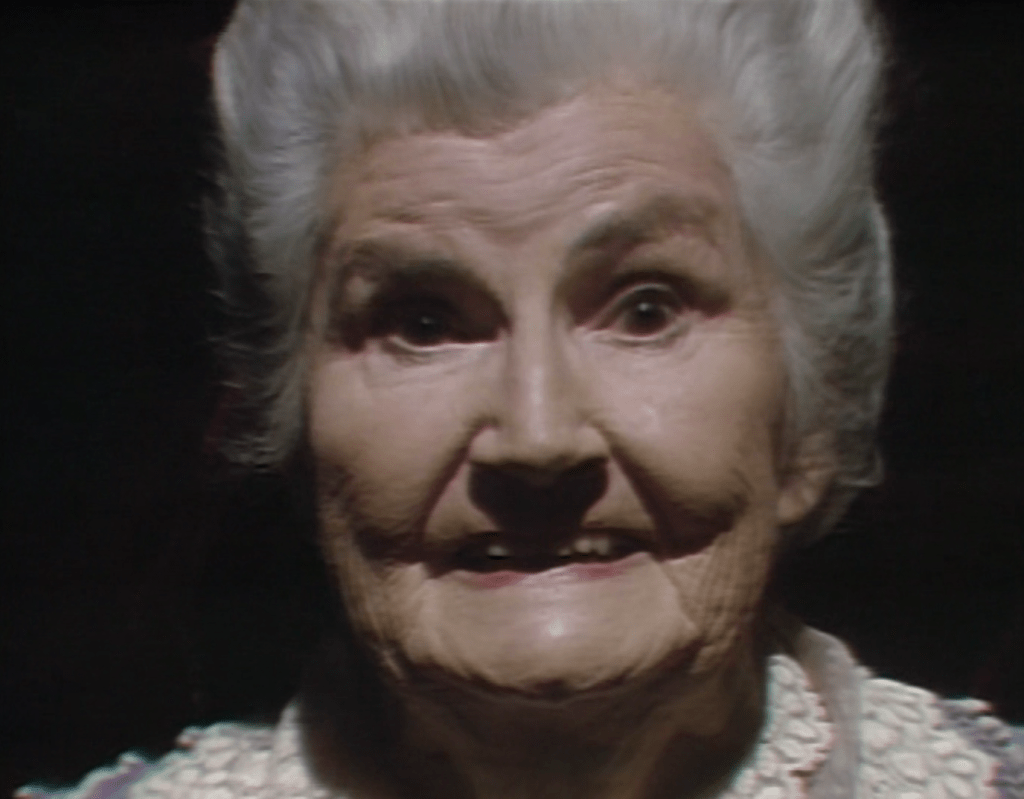
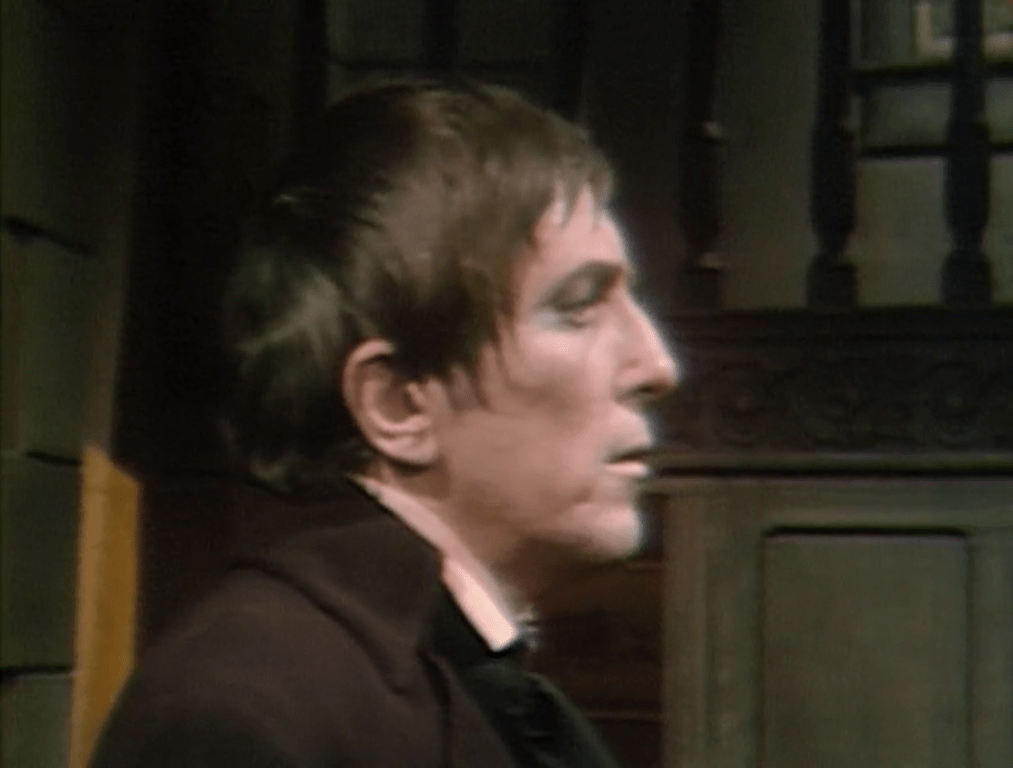
Episode 633/634: Now was the moment, or never at all

Suave warlock Nicholas has had bad news. His boss, Satan, will be recalling him to Hell, and does not plan to send him out to the world of the living again. Satan gave Nicholas two tasks to complete before his time runs out. He is to perform a Black Mass during which he will sacrifice Maggie, The Nicest Girl in Town, and afterward take her to Hell with him as his bride. He is also to complete the project he has been working on, forcing mad scientist Julia and old world gentleman Barnabas to resurrect Eve, the mate of Frankenstein’s monster Adam. Yesterday, we saw that Nicholas plans to make Barnabas and Julia use Maggie as the donor of the “life force” that will bring the mate back to life. It was entirely unclear how Maggie could both be sacrificed on Nicholas’ altar and used as the “life force.”

We open today with a reprise of yesterday’s closing sequence, showing Nicholas performing a rite while Maggie lies on his altar. We then cut to the basement of Barnabas’ house, where Eve’s body lies on a bed in a laboratory full of mad science equipment. Barnabas vows to Julia that this is the last time they will ever go through the vivification procedure; she asks “What’s the point of saying that? We’re at Nicholas’ mercy.” The other day, Barnabas confronted Nicholas with some demands, threatening to stop cooperating with his project unless he complied. Nicholas gave some ground in response, suggesting there might yet be some dramatic tension left in his relationship with Barnabas and Julia. But when Julia sounds this note of total defeat she is telling us that their conflict with Nicholas is exhausted, that the Frankenstein story has nowhere to go, and that Barnabas is therefore right and this is the last time we will see them run the experiment.

Julia looks at the body and expresses sympathy for “poor motherless Eve.” “There’s a poem about that,” she says. Indeed there is, and it is an apt reference here. Nicholas’ attachment to the ingenuous Maggie has always been jarringly out of character for him; Ralph Hodgson’s 1913 poem “Eve,” with its juxtaposition of the innocent Eve with the crafty serpent, not only tells a story that is as broadly melodramatic as any episode of Dark Shadows, but also dwells on the incongruity of Eve and the serpent, the sheer strangeness of the fact that they coexist at all. “Here was the strangest pair/ In the world anywhere.”

Yesterday we caught our first glimpse in a long time of a character who, like Maggie, was introduced in the first episode. He was Mr Wells, the innkeeper. Maggie has been with us through all of the show’s transformations, but we hadn’t seen Mr Wells since #61, when Dark Shadows was all about what went on among people while they were drinking coffee together. Seeing him again puts that 1966 show side by side with this dramatization of “The Monster Mash,” and that contrast is as jolting as anything Hodgson manages.

Visitors let themselves into the lab. First comes Nicholas. He is trying to seem cheerful. He comes down the stairs with a bounce in his step and greets Julia and Barnabas with a jokey “Why are my conspirators so reluctant?” He might be trying to evoke the same unholy jollity that we see at the end of Hodgson’s poem, “Picture the lewd delight/ Under the hill tonight/ ‘Eva!’- the toast goes round-/ ‘Eva’ again.” But the imminent prospect of his return to Hell has Nicholas in no jolly mood, and his mask of good cheer falls away the moment Barnabas complains of his untrustworthiness.

It is true that Barnabas’ complaint strikes Nicholas at a most sensitive spot. He tells him that “You seem to specialize in second chances” and gripes that he revived vampire Tom Jennings and left him to do the dirty work of ensuring Tom would never rise again. Giving second chances was the very habit for which Satan reproved Nicholas in #629 when he told him he would soon be returning to Hell. Stung by the echo of his master’s words in Barnabas’ mouth, Nicholas retorts that destroying a vampire must have been “traumatic” for Barnabas, who was until recently a vampire himself. Because of some magical business, Barnabas will revert to that condition if Adam dies, and it is Nicholas’ threat to kill Adam that has compelled him and Julia to assist in his diabolical plan. Having reminded Barnabas and Julia of the source of his power over them, Nicholas composes himself, agrees with Julia that there is no time for quarrels, and leaves the room.

A moment later, Adam enters. Adam hates Barnabas and Julia, believes that Nicholas is his friend, and looks forward to Eve’s resurrection. Barnabas tells Adam he doesn’t want him there, but Nicholas enters with the command “He stays, Mr Collins.” A third visitor follows and shocks Julia and Barnabas even more deeply. It is Maggie.

The rite on the altar dedicated Maggie to Satan, but it did not involve her death. When Julia and Barnabas see that Nicholas has brought Maggie, they declare that they will not go ahead with the procedure. But Maggie declares that she is there of her own free will. Quite calmly, she looks around the laboratory in Barnabas’ basement, and says “I’ve been here so often.” Indeed she has- in May and June of 1967, Barnabas was still a vampire, Maggie was his victim, and he kept her imprisoned in a cell here. Julia used her extraordinary hypnotic abilities to make Maggie forget her ordeal, but this line suggests that she now remembers what Barnabas did to her, and that she is, terrifyingly enough, happy about it.

When Maggie was Barnabas’ prisoner, he was trying to erase her personality and replace it with that of his lost love Josette. Later, the show took us back in time to the year 1795, where we saw Josette when she was alive and realized that she wasn’t on board with Barnabas’ plans then any more than Maggie was in 1967. But it looks like Nicholas has succeeded where Barnabas failed and remade Maggie as a companion fit for a demon. Barnabas is already miserable at being forced to toil in Satan’s cause, and now he goes nuts with jealousy.

Barnabas loudly protests that he will not be a party to the experiment. Nicholas silences him by causing Adam’s heart to beat dangerously fast. Their magic bond gives Adam and Barnabas the connection Alexandre Dumas’ Corsican Brothers had, so that Barnabas also suffers the pain. Julia was originally introduced as Maggie’s doctor, but she long ago betrayed her patient for Barnabas’ sake. She pleads with Maggie to stop Nicholas, but Maggie just smiles and asks “Why should I?” Julia tells her that otherwise Nicholas will kill both Adam and Barnabas. Perfectly relaxed, Maggie responds “Then you stop him. Do what he wants.” Julia capitulates, saying “We’ll use her.”

This glimpse of Evil Maggie is breathtaking for longtime viewers. In #1, Maggie premiered as a wisecracking waitress who was, in the words of the original series bible, “everybody’s pal and nobody’s friend.” Soon, we saw her with her father Sam, the town drunk, and she emerged very clearly as a classic Adult Child of an Alcoholic (ACoA.) In #20, Maggie left behind the short blonde wig she had worn in her first appearances, and from then on she was The Nicest Girl in Town.

When Barnabas first bit Maggie, she went through the phases the vampire’s victim usually experiences, including snappishness towards her loved ones when they try to get between her and the ghoul on whom she is becoming dependent. During her time in Barnabas’ house, her level-headedness and warm-heartedness reasserted themselves, and even when she was in the mental hospital as a psychological wreck after escaping from him she was never far from a display of kindliness. In the eighteenth century flashback, Kathryn Leigh Scott took on the part of Josette. Josette was so unfailingly virtuous that not even Miss Scott could find a way to make her interesting. This brief moment of a Maggie utterly indifferent to the value of human life, even her own, is such an extreme departure that we can immediately see a world of possibilities opening up for her as a character and for Miss Scott as a performer.

Maggie is strapped to a table and Julia and Barnabas get to work. We have seen the procedure often enough that it is far from fresh, but in-universe it is still highly experimental. The equipment doesn’t work as Julia and Barnabas expected; gauges indicate higher readings than they want, and the adjustments that are supposed to bring them down just make them go even higher.

Maggie cries out that she is dying; Eve barely moves. The readings get even worse; Barnabas shuts the apparatus down. Nicholas tries to cast a spell to immobilize Barnabas; he struggles against Nicholas’ power at first, but still smashes the equipment, and soon is free of the spell altogether. Nicholas calls out to his master and pleads “Don’t desert me now!” His powers gone, he runs to Adam and starts trying to choke him, but Adam brushes him aside easily. Nicholas runs away; Barnabas runs after him, saying that he will take the opportunity to kill Nicholas.

Adam is shocked that Nicholas attacked him. He and Julia find that nothing is left of Eve’s body but a skeleton with a wig. Adam sobs, declaring that now he has no one. Adam decides that Barnabas is to blame for Eve’s destruction. He goes upstairs, tells himself that Barnabas “doesn’t deserve to love,” then leaves the house. Later, we see him in the great house of Collinwood. Regular viewers know that Adam has in the past thought of punishing Barnabas by murdering well-meaning governess Vicki, in whom Barnabas does not actually take much interest but whom he frequently claims to love. So we can expect that Friday’s episode will involve some apparent danger to Vicki.

Julia is too busy with Maggie to take any notice of Adam’s doings. The last time Julia ran the experiment, the “life force” donor died. Julia is frightened when she cannot get Maggie to respond to any stimulus. She gives her a shot, and Maggie opens her eyes.

Longtime viewers wonder what Maggie will be like now. If Satan has lost interest in Nicholas, it seems unlikely that the heartless Maggie of a moment ago will stick around. If she returns to her usual sensibilities with her memories of Barnabas’ crimes restored, the show will no longer be able to use the sets representing the houses at Collinwood since Dark Shadows will become a prison drama about the activities of Barnabas and Julia on their respective cell blocks. If she just snaps back to the way she was before she got involved with Nicholas, it will feel like a cheat.

What they actually choose to do is to give Maggie total amnesia. She does not recognize her own name or Nicholas’, refuses to believe she has ever met Julia, and has no idea where she is. Julia tries desperately to reactivate Maggie’s memory. She takes her up to Barnabas’ living room. In a moment longtime viewers will find impossible to believe, Julia takes a music box and plays it for Maggie. She tells her that it once belonged to Josette and that Maggie has heard it many times. Indeed she has- Barnabas forced her to listen to it incessantly during the weeks when he was trying to Josettify her. Julia, who has gone to such great lengths to bury Maggie’s memory of what Barnabas did to her, is now trying to dislodge her recollection of his very worst crimes. When Maggie does not remember the music box, Julia takes her up to Josette’s bedroom, where Barnabas kept her for much of her time as his prisoner. It is simply impossible to imagine what Julia could be thinking at this point.

Meanwhile, Barnabas is skulking in the foliage near the peak of Widow’s Hill. He is eavesdropping on Nicholas, who is pleading with Satan to give him another week to get the Frankenstein project back on track. He dissolves into a process shot depicting flames, and Barnabas smiles the most evil grin anyone has ever managed.

Mr Warmth. Screenshot by Dark Shadows Before I Die.

Even though poor motherless Eve is on screen for only a minute or two, doesn’t open her eyes, has no lines, and moves only a couple of fingers and those just barely, they brought Marie Wallace back to play her. That was $333 well spent. Miss Wallace’s presence on screen convinces us that Eve is really dead and that she will not be back. Combined with Maggie’s amnesia, that leaves Nicholas without any connection to an unresolved storyline. The only former underling of his still at large is witch-turned-vampire Angelique, and she had broken from him decisively a couple of weeks ago. When he vanishes, we can accept it as a line drawn under the part of the show in which he was the principal villain.

Eve’s decomposition and Nicholas’ damnation are not the only departures today. This was the final episode directed by John Walter Sullivan. As “Jack Sullivan,” he was credited as an associate director on a great many episodes, from #15 to #549. When John Sedwick left the show in the summer of 1968, Sullivan took over his share of the directing duties, alternating with Lela Swift. He directed a dozen episodes as “Jack Sullivan,” from #504 to #580. He then took the name “Sean Dhu Sullivan,” and directed 50 more. Sullivan was not as accomplished a visual artist as either Swift or Sedwick, and the camera operators had more trouble keeping his episodes in focus than they did either Swift’s or Sedwick’s. But his scenes were never any more confusing than you would have expected, considering the ridiculously convoluted stories the scripts gave him to work with, and he seems to have been as good a director of actors as either of them. The period when he was helming segments happened to be the one when the show had its most explicitly Christian elements, which you might say made him a Sean Dhu for the Goyim,* but I doubt he had anything to do with that.

*This is my only chance to make this joke, please just let me have it.

Episode 632: A new mate

Two arcs overlap today. Suave warlock Nicholas Blair is in one that is coming to its end, while mysterious drifter Chris Jennings is in one that is beginning.

The fansites I consult when I write these posts vary in how much detail they give about what happens in the episodes. At one pole is John and Christine Scoleri’s Dark Shadows Before I Die, which gives detailed summaries of every plot point, usually illustrating each with at least one screenshot. Their post about this one is no exception.

At the other pole is Patrick McCray and Wallace McBride’s Dark Shadows Daybook. They typically present a brief essay about one key point in an episode. Halfway between the two is Danny Horn’s Dark Shadows Every Day, which occasionally drifts towards one or the other of those extremes and occasionally disregards the episode altogether to focus on some other Dark Shadows related topic, but which as a rule focuses on two or three points and weaves them together as it runs through an overview of the day’s narrative outline. It’s a sign of the thickness of today’s story that not only Danny’s post, but even Patrick’s, approaches a Scoleri-esque level of retelling.

Nicholas is under orders from his boss, Satan, to do two things in a very short time. He must sacrifice Maggie Evans, The Nicest Girl in Town, in a Black Mass. For this, he will be rewarded with Maggie’s eternal companionship in Hell. He doesn’t exactly seem happy about this, but he does drug Maggie, dress her up, and put her on an altar, so it seems like he’s going to comply.

Nicholas’ other task is to create a humanoid species entirely subject to the spiritual forces of darkness. This would seem like a big project, but he already has a start on it. A male Frankenstein’s monster known as Adam lives in his house, and at Nichol;as’ bidding Adam has coerced mad scientist Julia Hoffman and her friend, old world gentleman Barnabas Collins, to revive a female of the same breed known as Eve. As their names suggest, Adam and Eve are to be the parents of this new race of people.

Nicholas finds that Adam has grown reluctant. Eve needs reviving because Adam killed her the first time she was brought to life. She hated Adam and rebelled against Nicholas’ command that she mate with him, and at the end the big guy murdered her. Adam says that if Eve comes back to life with the same personality, he will kill her again. Nicholas tells Adam that the reason Eve was so hard to live with was that the woman who donated the “life force” Julia used to animate her was evil, and that the woman who takes that role when Eve is brought back to life will be very sweet and loving. When Adam is skeptical, Nicholas tells him that Maggie will donate the “life force.” Knowing Maggie, Adam finds this acceptable.

Nicholas doesn’t have time to recruit any other woman, since the experiment must take place tonight. It seems he must be telling Adam the truth about Maggie. Perhaps he will take her to Barnabas’ basement and tell Julia to hook her up to the machinery. But even before the end of the episode, when we see her on the altar, her throat apparently about to be cut, it puzzles returning viewers how this can be. Yesterday Barnabas forced Nicholas to promise he would not harm Maggie in any way, and said that he and Julia would not continue working to revive Eve unless he honored that promise. So it is a mystery how he can expect them to cooperate if he shows up with Maggie and tells them to subject her to a procedure that is more likely than not to kill her.

Meanwhile, Chris is visiting his little sister in the hospital. The hospital is Windcliff, a sanitarium about a hundred miles north of Collinsport; Julia is its nominal head. The sister was first mentioned in #627; her name was “Molly” then. It’s “Amy” now. There’s good precedent for such an identity change. When Julia was first mentioned in #242, she was simply “Dr Hoffman,” and she was “one of the best men in the field” of rare blood diseases. A change from “Molly” to “Amy” isn’t so drastic as that.

Amy reacts blankly to Chris. He offers her a box of paints. He tries to get her to say something in response; at length, she replies “Why didn’t you come before?” He doesn’t have a satisfactory answer to that, and she says “You did what you had to do. You brought me the present. You can go now.” He looks for words to express his wish that he could be with her, and all she hears is that he is about to go away again. He breaks down and promises to stay “right here in Collinsport.” Regular viewers will recognize that as a continuity error, but if we imagine it to be a slip on Chris’ part it is intriguing- he has been so far away for so long that any location in Maine seems like Collinsport. He repeats his promise, and finally she throws her arms around him, bursts into tears, and pleads with him to stay.

This is our introduction to Denise Nickerson. In the hands of another actress, Amy’s transition from suspecting Chris to embracing him could have seemed very pat indeed, but she is so utterly cold to him in the first part of the scene, so subtle in showing signs of hope in the middle of it, and so abrupt when time comes to warm up, that the whole thing plays as a real surprise. When we see that she has those skills, we can be confident that the show will be in good hands as long as Nickerson is part of the cast.

Nickerson and Don Briscoe play part of their scene behind an aquarium. We last saw that aquarium in #276. In that one, we were supposed to be uneasy about Windcliff and about Julia as its director. When we saw her feed the fish, it was a metaphor for her role as the mistress of a strange, self-contained little world whose inhabitants were at her mercy. Julia has been living on the estate of Collinwood for well over a year now, and the only member of Windcliff’s staff whom we see today is a nurse whose bit part was a prize given to beauty contest winner Bobbi Ann Woronko. So our attention is directed not to whoever is in charge of the place, but to Nickerson and Briscoe’s faces distorted in the water as the goldfish pass in front of them. This is rather a heavy-handed way of telling the audience that they are, each in their own way, as much prisoners as are the fish.

In the tank. Screenshot by Dark Shadows Before I Die.

Chris has seen the weather report in the newspaper and realized that the moon will be full tonight. This alarms him. Back at the Collinsport Inn, he asks the innkeeper, whom longtime viewers met in #1 and know as Mr Wells, if he can change his room. He wants the most isolated room in the place. He also wants Mr Wells to lock the door from the outside and to leave the door closed no matter what he hears inside. Mr Wells is reluctant, but agrees to all of these conditions.

Even viewers who stumbled onto Dark Shadows never having heard of it would know from what we have seen between Maggie and Nicholas that it is a horror story. Those who have been to the movies will add Chris’ status as a mysterious drifter to his alarm at the full moon and his request to be locked up and left alone no matter what Mr Wells may hear and will come up with the irresistible conclusion that he is a werewolf. They will also be sure that Mr Wells will eventually decide the sounds coming from behind the door are so terrible he cannot leave Chris alone, and that when he unlocks it Chris will kill him. Of course this is exactly what does happen. Our last shot of Mr Wells shows his face streaked with red and blue markings. The red ones presumably signify blood, and the others signify that most TV sets in the USA in 1968 received only in black and white, so blue lines would look like bruises.

Blue and red. Screenshot by Dark Shadows Before I Die.
The same shot in black and white.

Mr Wells, played by veteran character actor and future TV star Conrad Bain, had last appeared in #61. That was one of the longest gaps between appearances by a cast member, though the record belongs to Albert Hinckley, who like Bain appeared in #1. Hinckley, a train conductor in that one, will return playing a doctor in #868. That’s quite an extended absence from the show, but a remarkably short period to make it all the way through medical school, he must have been very bright.

Also in #1 was Alexandra Moltke Isles as well-meaning governess Victoria Winters; Mrs Isles left the show three days before this episode was taped. Victoria was Dark Shadows’ chief protagonist for its first year, and Mrs Isles’ presence in the cast was a powerful reminder of the show’s history even after the character was relegated to the sidelines of the action. Combining her departure with Mr Wells’ on-screen death, it might seem plausible that Maggie, another survivor from the first episode, might really die on Nicholas’ altar.

Episode 627: Her name is Victoria. I cannot take care of her.

Dan Curtis often said that the idea for Dark Shadows came to him in a dream about a girl with long black hair taking a journey by train. When he persuaded ABC-TV to let him make a pilot for a series, the most difficult part of the casting process was finding the actress who would embody that girl, whose name came to be Victoria Winters. Alexandra Isles, then still known as Alexandra Moltke, finally emerged as the one person who combined the right physical appearance with a mysterious, otherworldly quality that suggests a figure from a dream.

From Episode 1: The girl on the train. Reflected in the window behind her is Burke Devlin, her original love interest.

Mrs Isles’ casting had an immediate effect on the underlying story in Art Wallace’s original series bible, Shadows on the Wall. Wallace projected a puzzle about Vicki’s origins that would be resolved when it was revealed that she was the child of an extramarital liaison between Paul Stoddard, the long-missing husband of matriarch Elizabeth Collins Stoddard, and some unknown woman. Liz’ guilty feelings about Paul would explain her concern for Vicki and her decision to bring her to the great house of Collinwood as governess for her nephew, strange and troubled boy David Collins. Since Vicki would not be a blood relative of the Collins family, it would also leave an option for Vicki to develop a romance with David’s father, Liz’ brother Roger.

From Episode 1: The front doors of Collinwood open for the first time. Liz and Vicki come face to face, and each sees her own reflection in the other.

Wallace did include a note saying that if it was more story-productive, it could turn out that Liz was Vicki’s mother. Liz was played by Joan Bennett, whom Mrs Isles strongly resembled. When Bennett first saw Mrs Isles, she famously mistook her for her own daughter. From the first episode on, the show heavily signaled that Vicki was Liz’ daughter by a man other than Paul. Liz soon treats Vicki so much like a daughter that the only events that would follow from confirming the relationship would be to make some changes to Liz’ will. Since the business aspects of the characters’ lives ceased to generate action after the first few months, that would have been a severe anti-climax. So they wound up dropping the question altogether.

For the first 39 weeks of Dark Shadows, Vicki was its main protagonist. Not many of the storylines worked in those days; the only scenes that reliably clicked were those between Vicki and David. Even though their dialogue was as dreary as anything else in those early scripts, Mrs Isles and David Henesy managed to use their physical movements and the spaces they occupied to tell the story of a young woman persuading a boy to trust her. That version of the show ended with #191, when David ran from the mother who was trying to lure him to his death and flung himself into Vicki’s arms. That completed their story, and left neither character with a clear path forward.

From Episode 191: David turns from his mother and death, embracing Vicki and life.

After #191, the show was on course for the introduction of vampire Barnabas Collins. Vicki kept trying to get close to Barnabas; she even invited herself to spend the night at his house in #285 and #286. But he wouldn’t bite her, and she couldn’t get a foothold in the A-story otherwise. There was an odd meta-fictional side to Vicki in this phase. In-universe, she didn’t know that Barnabas was a vampire, and she certainly didn’t know that she was a character on a soap opera that was coming to be all about him. But her behavior made sense only if she did know those things and was making an effort to reestablish herself as a central figure in the action. I don’t know whether Mrs Isles or any other particular person was lobbying the writers to present her that way, or if it was a response to fan mail. It happened so often and led to so little that it did seem to be coming from somewhere outside the usual creative process behind the scripts.

In November 1967, Vicki came unstuck in time and found herself in the year 1795. She took the audience with her, and for several months the show was a costume drama set in the late eighteenth century. On balance, the result was a triumph. By the time Vicki and the show came back to contemporary dress in March 1968, Dark Shadows had become a real hit, and Barnabas had become one of the major pop culture phenomena of the 1960s. But Vicki did not benefit from that success. When the costume drama insert started, fans had every reason to expect it would revive her character. Barnabas spent most of his time in 1967 scrambling to impersonate a native of the twentieth century; Jonathan Frid would always say that it was in that scramble that he found Barnabas, and that he thought of him first and foremost as a liar. When Vicki turns up in Barnabas’ original period, we look forward to seeing her doing what he did, and trying to pass as his little sister’s governess. Remembering how well Mrs Isles did during the 39 weeks she carried the show on her shoulders, we look forward to her showing us what Vicki can do when she has to think fast.

But that was not to be. Instead, Curtis and his staff chose to write Vicki as an intolerable moron. She introduced herself to every new person by telling them that they are being played by actors who had other parts in the first 73 weeks of the show. Tedious as that habit was, it was compounded when she made one inexplicably idiotic decision after another as she failed utterly to adapt to her new surroundings. That would have been a difficult role to make appealing even if she had shared her screen time with a partner as capable as David Henesy. It became utterly impossible when Vicki made the least intelligible move of all and fell in love with her jailer/ lawyer/ boyfriend/ accomplice Peter Bradford, played by the abusive and shouty Roger Davis. Marooned in scene after scene with Mr Davis, Mrs Isles withered and Vicki became a cipher. By the time the court sentenced Vicki to be put to death for her many crimes, half the audience was on their side.

Shortly after Vicki returned to the 1960s, Barnabas finally bit her. Each of Barnabas’ victims reacted to his bite differently; Vicki’s reaction was perhaps the most unexpected, and certainly the funniest. She was just sort of chill about the whole thing. She showed up when Barnabas summoned her and didn’t object when he told he her she would become his vampire bride for all eternity, but first she had some errands to run, and she was irritated with him when he tried to get her to skip them. When a doctor saw the bite marks on her neck, she did not react with the fear or defensiveness of other victims, but innocently asked “Why are they bad?” She seemed to regard them as just another hickey, the result of Barnabas’ peculiar make-out technique.

Unfortunately, Peter came back to life and ruined Vicki’s relationship with Barnabas. He jumped out in the road in front of her car while she was driving off with Barnabas, causing her to crash. Vicki and Barnabas were taken to the hospital. There, one of the doctors turned out to be a mad scientist who cured Barnabas of vampirism. Once the cure took hold, Vicki forgot all about her time as Barnabas’ victim, and she sunk into a relationship with the irredeemably repellent Peter. Every time we’ve seen her in recent months, she has dragged Peter back to our attention. Mrs Isles has found ways to liven up Vicki’s scenes; she always projected a forceful personality when she was standing near the clock in the foyer of the great house of Collinwood, and she has even managed to coax Roger Davis into playing a couple of scenes competently. Mr Davis never had quite as much to offer as did the clock, but when Mrs Isles could raise her voice and fix him with a steely stare it does seem to have come back to him that he had had a lot of acting lessons and could deliver dialogue interestingly.

Today is Mrs Isles’ last day on the job. We open with a reprise of the end of yesterday’s episode, when Vicki finds the corpse of a strangled woman in the closet in Peter’s room. Peter assures her he doesn’t know how the corpse got there. She tells him they have to call the police. He says he needs time to figure out what happened before they can involve the police; she points out that delaying will only make him look guiltier in their eyes. He tells her that she should leave so that her name won’t be connected with the case; she tells him it is too late for that. We can see why Vicki has faded- she is thinking like a rational person from our world, not like anyone you would meet in Soap Opera Land.

Vicki goes home to Collinwood and tells permanent houseguest Julia Hoffman that Peter is in jail, suspected of murder. She explains that the dead person is a woman Peter knew only as Eve. Julia reacts with shock to the name; Vicki asks if she knew Eve. Julia says of course not, and Vicki tells her she will go wake Roger and ask him to help arrange bail for Peter. She goes into the door leading to the bedrooms, never to be seen again.

In her final appearance, Vicki talks with Julia, her successor as the principal audience-identification character.

Viewers who have been with the show from the beginning will see a loop closing in the idea of Vicki going to Roger’s bedroom while he sleeps. In #4, Roger had tried to let himself into Vicki’s bedroom at night, only to be caught with his hand on the doorknob by Liz. In response to Liz’ threats, Roger told her not to bother him about his “morals,” a choice of words that made it clear that his intentions with regard to Vicki were of a sexual nature. Later in the episode, he and Vicki bantered flirtatiously after he offered her a snifter of brandy; for the first and last time, Vicki sounded like what she was supposed to have been, a street kid from NYC. Roger has long since been stripped of all his villainous qualities; in #585, he and Vicki even shared a scene in her bedroom while she was in her nightgown, and it was all perfectly innocent. In that scene, we not only saw that the old menacing Roger was gone forever, but that Vicki was also reduced to such a humdrum status that a man can enter her bedroom at night without raising an eyebrow. Now that Julia sees nothing out of the ordinary in Vicki dropping in on Roger while he sleeps, that humdrum status is reinforced.

When Vicki first arrived in the village of Collinsport in #1, she met her original love interest, dashing action hero Burke Devlin. Burke told her she had found her way to “the beginning and the end of the world.” We are reminded of the beginning of the world since we know that the man who killed Eve was named Adam. This Adam and Eve are no one’s parents; they share nothing but hostility and death. The episode ends with the wicked Angelique trying to summon up the Devil, a symbol of the end of the world. She herself disappears, apparently destroyed. Burke’s description is finally fulfilled.

The part of Vicki will be recast twice in the months ahead, but those actresses never had a chance to breathe any life into her. The character had lost any reason to be on the show long before Mrs Isles’ departure. In #87, David had trapped Vicki and left her to die; wondering where she was, Roger said, “She came to us from nowhere, and now it seems she has disappeared into nowhere.” And so, at last, it has come to be. The long-haired girl from Dan Curtis’ dream, the image that started it all, has vanished, never to be seen again.

Episode 626: The sad case of Victoria Winters and Peter Bradford

From November 1967 to March 1968, Dark Shadows was a costume drama set in the years 1795 and 1796. Well-meaning governess Vicki had come unstuck in time, found herself in that period, and failed utterly to adjust to her new surroundings. While she was in gaol charged with witchcraft, she befriended an unpleasant man named Peter, who served as her defense attorney. Peter handled the case so badly that he and Vicki were both sentenced to hang, but they nonetheless fell in love with each other.

Shortly after Vicki was whisked back to the 1960s, she found that Peter had also come back to life. Unfortunately, he had total amnesia covering everything prior to his arrival in the twentieth century, and he became belligerent every time Vicki tried to tell him about himself. These traits did nothing to improve Peter’s already repellent personality, but having fallen in love with him once Vicki remained grimly determined to make a life with him.

The other day, Peter and Vicki were about to get married when a mysterious woman known as Eve presented Peter with evidence that what Vicki has been telling him is true. He ran off to exhume the grave marked with his name and found that the coffin was empty. For some reason he took this to mean that he shouldn’t marry Vicki after all. He has gone back to his room, where he is packing his bags and looking at a train schedule.

Unknown to Peter, there have been two visitors in his room while he was away. Eve came in and called for him, saying aloud that she would “make it all right” for him. A man known as Adam followed her in and overheard this. Adam thus learned that, despite their names, he and Eve would never be a couple. He asked if, when “yesterday, you made me happy- that was a lie, wasn’t it?” She confirmed that it was, that she would never love him, that she had always hated him, and that she found him ugly. That last apparently struck a nerve, because Adam responded with great rage. He choked Eve, and she collapsed.

Vicki drops in on Peter while he is getting ready to leave town. He tells her they cannot be together, and she insists on giving their relationship a second chance. Peter opens his closet to get some more clothes to pack, only to close it quickly. Vicki opens it, and finds Eve’s strangled corpse crumpled on the floor.

There is a genuinely horrifying moment in this episode. Vicki thinks back to the night in the 1790s when she was taken to the gallows, and we see events from her point of view. At one point we see Peter’s face looming towards the camera with his lips puckered. We’ve seen how Roger Davis manhandles his female scene partners, and in particular how miserable Alexandra Moltke Isles is when he kisses her. The sight of him coming at us for a kiss is enough to make even the most seasoned horror viewer flinch.

Get away from me. Screenshot by Dark Shadows Before I Die.

Mrs Isles read the opening narration of episodes 1-274 in character as Vicki. After she lost her monopoly on the opening narrations, she read more than 100 others, no longer as part of that role. This is the final time she takes on that task. It is also the first time “and Alexandra Moltke as Victoria Winters” is followed on screen by other acting credits.

Episode 623: Her name was Gloria Winters!

An eighteenth century homicidal maniac named Danielle Roget was raised from the dead in 1968 to serve a warlock’s evil scheme. Today, she is taking a break. Another witch has sent her back to her original era for a short visit.

Danielle wants to see a man named Peter Bradford, who has also been raised from the dead and whom she has seen several times in 1968. Peter has a collection of intensely annoying habits which serve as a substitute for a personality. Among these is a tendency to fly into a rage whenever anyone calls him by his right name, and to insist that he be called “Jeff Clark” instead. Danielle has traveled back to the 1790s in search of some evidence that will convince him to desist from this tedious practice.

Today we open at the Collinsport gaol. Peter is in a cell, the gaoler and his assistant are reading Peter’s death warrant, and a gallows is under construction outside. Danielle materializes behind the gaolers, and talks with them for a while. They tell her that a woman named “Gloria Winters” was recently hanged for witchcraft. Danielle realizes that they are actually talking about Victoria Winters, who was the chief protagonist of Dark Shadows for about a year. In November 1967, Victoria came unstuck in time and found herself in the year 1795. She was trapped there until March 1968. Victoria’s utter failure to adapt to her new surroundings led to her condemnation as a witch. At the last second she was whisked from the gallows and returned to her own time. The luckless person whose place she had taken when she arrived from the 1960s appeared at the end of the rope and died in her place.

Danielle asks to see Peter. The gaolers escort her into his cell, lock her in with him, and leave them alone together for several minutes. Peter is unhappy to see Danielle, to whom he was once engaged but whose murderous ways have alienated him. He tells her it saddens him that she is free while he, an innocent person, is about to be executed. Indeed, it was Victoria who killed the man Peter was convicted of murdering, and she did it only to prevent that man killing a child. She tried to tell the court what had happened, but since she was already sentenced to hang and was in love with Peter, her testimony did not persuade the judges.

Danielle offers to break Peter out of gaol. He agrees. She tells him she will go to the great house of Collinwood to enlist much-put-upon indentured servant Ben Stokes in her scheme. Ben, she says, could refuse her nothing.

During the flashback that lasted from November 1967 to March 1968, Ben was ensorcelled by wicked witch Angelique. Now we learn that before Angelique came along, he had been under the influence of Danielle, another beautiful woman with an evil heart and a greatly heightened acting style. Perhaps Ben would do better if he looked for a homely, soft-spoken woman.

We cut to Collinwood, where haughty patriarch Joshua Collins is summoning Ben. They discuss Peter’s upcoming hanging and Victoria’s recent one, and lament the injustice of it all. Joshua calls Ben’s attention to a book Victoria brought with her from the twentieth century. It is a highly inaccurate history of the Collins family up to that time. Joshua says that he believes the book is an evil thing and that getting rid of it is the only hope of ending the cascade of horrors that have befallen the family and everyone they know since Victoria first arrived. Joshua orders Ben to take the book deep into the woods and burn it. He tells him something else- he has read the book thoroughly, and will see to it that posterity accepts all of its false reports as true. Rather than risk the world finding out that his son became a vampire, his wife committed suicide, and his cousin married a bounder, he will see that it is published that the son moved to England, the wife died of natural causes, and the cousin was a spinster all her life. Thus we learn how the events we saw during the 1795 segment were kept out of the historical record.

Ben is barely out the front door when Danielle stops him. He is dismayed to see her. He tells her she wasn’t supposed to come back, and refuses to look at her. She says she has a plan to spare Peter. Ben says that her plans always involve hurting someone, and she says that this time it is different. Ben asks if she intends to poison the gaoler. She tosses her head, laughs at the thought, and assures Ben all she will put in the gaoler’s drink is a “harmless drug.” Ben asks if she is sure the man won’t be hurt, and she assures him she has no grievance against him, only a desire for him to sleep long enough to get Peter to safety. At length, Ben agrees to take two horses to the gaol. There won’t be time for him to burn the book first; Danielle takes it from him for safekeeping.

We cut to the office of the gaol, where Danielle has been reading the book. She tells herself that Victoria must have brought it from the 1960s, and that it might be very valuable to her. The gaoler enters, and Danielle tells him she wants to see him after the hanging. He doesn’t understand why; she clarifies that she is making a pass at him. They are an unlikely couple, and he seems dubious of her interest in him. He tells her Peter is writing a note, probably for her, and sends her back to see him.

The gaoler has the look of a man who believes that if a thing seems too good to be true, it probably is. Screenshot by Dark Shadows Before I Die.

Peter tells Danielle he has decided not to escape. He hands her a note which he predicts she will have trouble understanding. Delivered by another actor, this might have sounded like an apology for an unsuccessful effort to express a complicated idea, but Roger Davis has a way of spitting out his lines that makes it sound very much like he is telling Danielle she is stupid. The gaoler and his assistant come to take Peter off to be hanged, not a moment too soon.

In the office, Danielle reads the note and is pleased with it. She closes it in the book. Apparently she expects to be able to use both of those items to get Peter to stop boring everyone with his nonsense about being named “Jeff Clark.” The gaoler stands behind her and watches as she fades away, taking the book with her.

The gaoler is played by Tom Gorman. Gorman was on Dark Shadows at least 14 times, until now always as an uncredited background player. His first part was in November 1966, when each episode began with the words “My name is Victoria Winters.” So it really is remarkable when he proclaims “Her name was Gloria Winters!” Despite that spectacular blooper, he does a nifty job playing the gaoler’s confusion and skepticism about Danielle, and it is too bad this is his final appearance.

Episode 578: The misplaced

Nancy Barrett was taken ill not long before shooting began for this episode, and she was replaced in the role of Carolyn Stoddard by Diana Walker. Miss Walker had her sides letter perfect; her only flub comes when she delivers a line in a level conversational tone, and a moment later has to apologize for shouting. She doesn’t seem to have much idea of what was going on in the story, though. Her Carolyn is a calm, practical-minded homemaker of the sort you might find on another daytime soap of the period, not someone who is keeping a stray Frankenstein’s monster in the spare room. Besides, Miss Barrett is probably Dark Shadows’ most reliably entertaining performer, an impossible act for anyone to follow.

Diana Walker wonders where she is. Screenshot by Dark Shadows Before I Die.

Aside from the two actors who at various times filled in for Vince O’Brien in the famously disposable role of Sheriff Patterson, I believe Miss Walker is the only person to have served as a substitute for a temporarily unavailable cast member. Many times, the makers of the show went out of their way to rearrange the shooting schedule or rewrite scripts to avoid substitutions. Many of the show’s fans were extremely young and extremely intense, so I suspect Miss Walker’s mail after this appearance would have included some ugly items that would have confirmed the producers in their reluctance to call up the reserves.

Today is the last time we see Jerry Lacy as lawyer Tony Peterson. Mr Lacy will be back in other roles. In 1969 and 1970, he and Diana Walker were reunited in the original Broadway cast of Play It Again, Sam, in which Mr Lacy scored a triumph with the same Humphrey Bogart imitation that is the basis of Tony’s character, while Miss Walker played Sharon and understudied Nancy.

Episode 546: A woman, born on Martinique in 1774

Suave warlock Nicholas has expressly forbidden his subordinate, the wicked witch known variously as Angelique and Cassandra, from killing Frankenstein’s monster Adam. But now he has twice caught her trying to do just that. He punishes her by stripping her of her powers. He tells her that she is now a human being, and that she will die soon.

Nicholas de-witches Angelique/ Cassandra, while also trying to hold her wig in place. Screenshot by Dark Shadows Before I Die.

Angelique/ Cassandra’s husband, sarcastic dandy Roger, comes downstairs and confronts her about her indifference to him. She responds that there never was anything between them and never will be, and rushes out of the house. My wife, Mrs Acilius, is a soap opera fan from way back, and she says that as far as she is concerned this archetypal soap moment makes for a “Genuinely Good Episode.”

Angelique/ Cassandra goes to see recovering vampire Barnabas. He opens the door and asks what she wants. She says that she was once the mistress of the house and that as such she has a right to enter.

Ever since she showed up in the year 1968, Angelique/ Cassandra has been trying Barnabas’ patience and the audience’s by pretending that she was not the witch he married in the 1790s. He asks her why she has dropped that pretense now, and she says that she, like he, has become human. She also says that she will die at dawn. It is unclear why she thinks this- all Nicholas told her was that her life expectancy was to be measured in “minutes.” She declares her intention to kill Barnabas, and is pointing a gun at him when the episode ends.

If it does not lead to her immediate demise, depriving Angelique/ Cassandra of her powers would be an intriguing way of making her a more flexible character. In the costume drama segment set in the late eighteenth century, she was so powerful that she painted herself into a corner, facing no real opposition. The only suspense she could generate came when she was indecisive or distracted and got in her own way. In 1968, her subordination to Nicholas has pushed her to the opposite extreme. She has been very busy, but hasn’t done much. If she survives without her powers, it might be interesting to see her learn how to live as a human after all this time.

Angelique/ Cassandra’s appearance reflects the end of her dual identity perhaps more clearly than was intended. When she answered to the name Angelique in the 1790s, she had blonde hair; when she turned up in 1968 calling herself Cassandra, she wore a black wig. Throughout this episode, the wig keeps sliding around on her head.

This episode includes another of the innumerable replays of an audiotape message about Barnabas and Adam. The other day, it seemed that Nicholas and Cassandra had taped over the message, as undead fire witch Laura Murdoch Collins taped over a recording she didn’t want parapsychologist Peter Guthrie to hear in #172. But Friday they played it for us yet again. When Nicholas threatens Angelique/ Cassandra with death if she keeps disobeying him, Mrs Acilius said to the screen “I’ll kill you myself if you play that tape again!” I am glad to report that this is the last time we will hear the thing.

Danny Horn’s Dark Shadows Every Day post about this episode juxtaposes screenshots and dialogue from the scene in which Nicholas strips Angelique/ Cassandra of her powers with screenshots and dialogue from a contemporary episode of General Hospital. The contrast is hilarious. It also shows why even the conventionally soapy scenes with Roger and Barnabas stand out from the other daytime dramas of the period. Director Lela Swift’s use of the camera was incomparably more dynamic and ambitious than anything General Hospital was doing, Robert Cobert’s original orchestral score is comprehensible to a modern audience in a way that an organ playing in the background would never be, and the action is paced so that it takes less time for Angelique/ Cassandra to lose her supernatural powers, end her marriage to Roger, and pull a gun on Barnabas than it took Lucille to explain to Audrey that she had an idea about how she could learn to play bridge.

Episode 530: A fine line between love and hate

In the eighteenth century, wicked witch Angelique loved scion Barnabas Collins. He betrayed her in those days, rejecting her in favor of the gracious Josette, and ever since she has been casting deadly spells on him and everyone close to him. Today she encounters him in the woods. After a brief confrontation, she is left thinking about the feelings of love for him that still linger in her and undermine her killing power.

A few months ago, Frankenstein’s monster Adam imprinted on Barnabas when he saw him at the moment he came to life. Barnabas betrayed Adam’s filial love time and again, chaining him to a wall in a windowless basement cell, leaving him alone for all but a few minutes a day, and entrusting his care to his abusive servant Willie. When Barnabas beat Adam with his cane to stop him retaliating against Willie, Adam’s love turned to hate and he adopted “Kill Barnabas!” as his motto.

Today, well-meaning governess Vicki stops by Barnabas’ house to update him on the progress of Angelique’s latest attempt to destroy him. Vicki is to be the next to have a nightmare that Angelique has sent to a series of people, and after she has it she will pass it to Barnabas. Vicki doesn’t know that Barnabas was a vampire from the 1790s until 1968, much less that Angelique is trying to turn him back into one, but she does know that if Barnabas has the nightmare he is supposed to die as a result.

While Barnabas and Vicki confer, Angelique raises the ghost of Sam Evans from his grave. Sam was supposed to tell Vicki the nightmare, causing her to have it, but died before he could do so. Sam resists Angelique’s commands, but finds that Angelique can prevent him from returning to his grave. His soul needs rest, so he complies.

Back at Barnabas’ house, the sound of a gunshot interrupts the conversation. Barnabas goes out to investigate while Vicki waits in the parlor. Sam materializes there. Evidently his need to rest is quite urgent, since he sits down in an armchair while he talks to Vicki. The dead must rest! Or at least take a load off, it’s very tiring being dead apparently.

Vicki pleads with Sam not to tell her the dream, since she does not want to bring death to Barnabas. Sam says that in Barnabas’ case, death might come as a welcome relief. He declines to explain to Vicki what he means, but longtime viewers will be intrigued. Sam now knows about Angelique, so presumably he knows about Barnabas’ vampirism as well. Sam was the father of Maggie, The Nicest Girl in Town, whom Barnabas attacked, imprisoned, tried to brainwash into thinking she was Josette, and set out to kill when his brainwashing plan failed. If Sam knows about that part of Barnabas’ career, you’d think he would be a bit more peeved with him than he seems to be. At any rate, Vicki can’t stop Sam telling her the dream. When Barnabas comes back, she tells him what happened, and tells him she is already tempted to tell him the dream. She must go far away for his sake.

Many people have already had the dream, and none of them had the compulsion to tell it until they awoke from it. Vicki’s relationship to Barnabas is an odd one; shortly after his attempt to Josettify Maggie failed, he decided to repeat the experiment with her. Yet he never made much of an effort to get close to her, even though she time and again went out of her way to present him with opportunities to have his way with her. She even invited herself to his house for a sleepover in #285, only to have him back off the opportunity to suck her blood. He finally bit her in #462, only for his vampirism to be put into remission less than a week later. In this scene, Vicki keeps looking at Barnabas with wide, longing eyes, while he reacts coolly. So perhaps Vicki’s compulsion suggests that her attachment to Barnabas causes the Dream Curse to affect her differently.

Back at the grave, Angelique asks Sam’s ghost whether he told Vicki the dream. He said he did. She heaves a sigh of relief and exclaims “Excellent!,” and lets him go back to his grave. She doesn’t ask any follow-up questions or require any evidence. Clearly she couldn’t read Sam’s mind, or she wouldn’t have had to ask the question in the first place. So he could just as easily have gone off to haunt someone else, then lie to her.

We cut back to Barnabas’ house. Evidently he went somewhere after Vicki left, because he is walking in the front door. He looks around, apparently sensing a presence. He calls for Willie and gets no response. He opens a closet door, and hardworking young fisherman Joe falls out, unconscious. He hears a loud dirty laugh and sees Adam at the window, jeering at him.

This episode marks the final appearance of Sam Evans and of actor David Ford. Ford brought a fresh energy to the show when he took over the part of Sam from the execrable Mark Allen in #35, prompting blogger Marc Masse to discern what he called “The David Ford Effect” in the brightened performances of all the cast in the weeks that followed. But ever since the major storyline he was part of fizzled out in #201, Sam has been at the outer fringes of the plotlines, and Ford has been coasting. He inhabits his characters comfortably enough that he is always pleasant to watch, but it’s easy to forget the verve he originally brought to the show.

A few months after leaving Dark Shadows, Ford would join many other Dark Shadows alumni in the original Broadway cast of the musical 1776. He played John Hancock on Broadway and in the 1972 movie, and John Dickinson in the national touring company. I’ve been in the habit of watching the movie every year on or around the Fourth of July since the 1980s, and so it’s oddly fitting that Ford should depart Dark Shadows early in July. Fitting too that Sam Evans’ grave should be decorated with what looks to be a red, white, and blue floral wreath.

Screenshot by Dark Shadows Before I Die.

Episode 330: bat by Bil Baird

Dangerously unstable ruffian Willie Loomis spent a week staring at the eighteenth century portrait of Barnabas Collins in the foyer of the great house of Collinwood back in April, then tried to rob Barnabas’ grave. That turned out to be an awkward situation when Willie found that Barnabas wasn’t entirely dead. Barnabas was a vampire who bit Willie, turned him into his sorely bedraggled blood thrall, and had lots of conversations with him. Yesterday, Willie was written out of the show.

Today we open with strange and troubled boy David Collins staring at the same portrait. As Willie was obsessed with the idea that there were jewels hidden in the Collins mausoleum in the old cemetery north of town, where in fact Barnabas’ coffin was hidden, so David is preoccupied with the idea that Barnabas has something terrible stashed in the basement of the Old House on the estate, where in fact his new coffin is hidden. As Willie sneaked off to the cemetery on his ill-starred expedition, David will sneak off to the Old House today and try to search Barnabas’ basement.

Unlike Willie, David is not driven by greed. He is afraid of Barnabas, and his friend, the ten year old ghost of Barnabas’ sister Sarah, has told him that he must not go to the Old House. But his aunt Liz and his father Roger dismiss his attempts to warn them about Barnabas, and he thinks it is his duty to provide them with evidence. So he screws up his courage and makes his way across the property.

David lets himself into the Old House by opening the parlor window. Not only have we seen David do this before, but Willie’s sometime friend, seagoing con man Jason McGuire, got into the house the same way in #274. Barnabas would kill Jason when he reached the basement in #275, so you might think he’d have put a lock on that window by now.

Jason’s fate is certainly on the minds of returning viewers when David tries to open the basement door. It comes as a relief when he finds the door locked. Barnabas’ co-conspirator, mad scientist Julia Hoffman, catches him there.

Julia demands to know what David is doing in the house, and he tries to brazen it out. He claims that he has a right to be there, since it belongs to his Aunt Liz. This is a bit of a murky point- we never see Liz transfer title to Barnabas, but she and others act as if he owns the place and its contents. Julia doesn’t clarify it when she responds that Liz gave the house to Barnabas- she doesn’t deny that it still belongs to Liz, only says that it also belongs to Barnabas.

Back in the great house, Roger is banging away at the piano. We saw Liz play the piano in #47 and #91, a reference to the conception of her character writer Art Wallace developed in his original story bible, titled Shadows on the Wall, in which she, like similar characters in a couple of TV plays he wrote in the 1950s under the title “The House,” gave piano lessons. Since then, Liz’ daughter Carolyn tried her hand at “Chopsticks” in #119 and used the piano as a prop in a teen rebel scene in #258, and Jason poked at a few keys in #198. Roger isn’t exactly Vladimir Horowitz, but he’s the first one we’ve seen who actually achieves a melody.

Liz comes in and tells Roger that David isn’t in his room. They fret over David’s attitude towards Barnabas. Julia brings David home and tells Liz and Roger where she found him. After an angry scene between father and son, David goes upstairs, and Liz scolds Roger for his inept parenting. In these as in all of Liz and Roger’s scenes together, we see a bossy big sister who tries to govern her bratty little brother, but who ultimately abets all of his worst behavior.

In the Old House, Barnabas notices that Julia is troubled. He keeps asking what’s on her mind, and she has difficulty deflecting his questions. This is odd- Julia has been established as a master of deception, and Barnabas is the most selfish creature in the universe. All she has to do is start talking about something that does not affect him directly, and he will lose interest at once. Rather than talk about her personal finances, or the job from which she is apparently on an indefinite leave of absence, or some ache or pain she might have, or how sad she is to miss her Aunt Zelda’s birthday, she brings up Willie. That does get Barnabas’ mind off her tension, but it also reminds him of David. He thinks David knows too much about him, and is thinking of murdering him. Julia assures him that the boy doesn’t know so very much, that whatever he does know he hasn’t told anyone, and that if he does say something his reputation as an overly imaginative child will lead the adults to ignore him.

From the beginning of the series, we’ve heard people say that David is “imaginative.” The audience finds an irony in this, since we have never seen David show any imagination whatsoever. All his stories of ghosts are strictly literal accounts of apparitions he has seen. We’ve seen some drawings he has done and heard quotes from some essays he has written. Some of these are technically accomplished for a person his age, but they are just as literal as his ghost stories. And when he tells lies to cover his various misdeeds, he tells simple little tales that fall apart at once.

In #327, well-meaning governess Vicki became the first character to dissent from the “David is a highly imaginative child” orthodoxy. Liz and local man Burke Devlin were dismissing David’s laboriously accurate account of his latest encounter with Sarah as a sign of his “imagination,” and Vicki interrupted with “I don’t think it has anything to do with his imagination.” Now, Barnabas goes a step further. After pronouncing the word “imaginative” in a truly marvelous way that makes it sound like something I’ve never heard before, he tells Julia that she has given him an idea. Frightened, she asks what he means. All he will say is “You’ll see.”

Roger goes to David’s room and has a friendly talk with his son. Throughout the conversation and afterward, David is thinking intensely, trying hard to figure out what his next step should be.

Once he is alone in the room, the window blows open and a bat enters. More precisely, a bat-shaped marionette is brought in on clearly visible strings by a pole that casts a shadow we can see the entire time, but no one who has been watching the show up to this point will doubt for a second that David’s fear, as depicted by David Henesy, is fully justified. David tries to flee from the bat, but he cannot open the door to escape from his room. His back against the door, David slides onto the floor and screams as the bat comes near him.

David finds that he cannot escape. Screenshot by Dark Shadows Before I Die.
David helpless before the bat. Screenshot by Dark Shadows Before I Die.

When Barnabas is about to attack someone, dogs start howling. Sometimes this works to his advantage, but it so often puts his intended victims on their guard that it doesn’t really seem to be something he is doing on purpose. So this bat represents something new. Perhaps Barnabas is using magic to control a bat- if so, it marks the first time we have seen Barnabas use magic to project influence over something other than a human mind. Or perhaps he himself has assumed the form of a bat. If so, that is the first indication we’ve had that he has shape shifting powers. In either case, Barnabas’ powers have just gone up a level.

Closing Miscellany

The bat was created by famed puppeteer Bil Baird. Most famous today for the puppets he created for “The Lonely Goatherd” sequence in The Sound of Music, Baird was a frequent guest on television programs like The Ed Sullivan Show, and Jim Henson cited Baird’s own TV series, the short lived Life with Snarky Parker, as a major influence on the Muppets. In December 1966, Baird opened a marionette theater in New York City, at 59 Barrow Street in Greenwich Village; it operated until 1978, and many leading puppeteers, including dozens who would go on to work with Henson, were members of its company in those years.

Bil Baird’s bat-credit. Screenshot by Dark Shadows Before I Die.
The original string wasn’t quite so conspicuous. Screenshot by Dark Shadows Before I Die.

This is the last episode to end with ABC staff announcer Bob Lloyd saying “Dark Shadows is a Dan Curtis production.” We do hear the announcement again in February of 1969, but that won’t be because Lloyd has returned- they used an old recording for the music under the closing credits that day, and they picked one with him on it.

Fans of Dark Shadows will often talk about “the early episodes” which ended with Lloyd making that announcement. So I suppose #330 is the last of “the early episodes.”

Danny Horn’s post about this one on Dark Shadows Every Day includes a morphology of episode endings. He divides them into five categories, Haiku,* Restatement of Threat, ** New Information,*** Crisis Point,**** and Spectacle.***** It’s an intriguing scheme, and he makes a good case for it.

*Danny explains that “Haiku” “aren’t necessarily recognizable as endings in the traditional sense, because nothing is resolved and no progress is made. It’s just a little moment when a character pauses, and possibly has a feeling about something… In some extreme cases, the audience may not realize that the episode is over until halfway through The Dating Game.”

**Restatement of Threat, at this period of Dark Shadows, usually means Barnabas looking at us through his window and saying that someone or other “must die!” Which of course means that you can safely sell a million dollar life insurance policy to that character.

***”A New Information ending provides an actual plot point, which either advances the story another step, or tells us something that we didn’t know.”

****”The Crisis Point cliffhanger is the big game-changer, and for best effect, it should come at the end of a sequence that’s been building up for a while. This is a big turn in the story, and it should feel satisfying and thrilling… The defining feature of a Crisis Point ending is that the resolution marks a change in the status quo, ending one chapter and setting up the next.”

***** “Obviously, plot advancement is always welcome, but every once in a while the show needs to set its sights a little higher. These are the moments when the show goes above and beyond, in order to surprise and dazzle you… The point of a Spectacle is: You can’t take your eyes off the screen. Housewives in the audience have put down the iron, and switched off the vacuum. Teenagers have stopped swatting at their siblings… A Crisis Point cliffhanger will bring you back for the next episode, because you want to see what happens next. But a Spectacle cliffhanger is bigger than that — you’ll be coming back for the next episode, but it’s because you can’t believe what you’re seeing, and maybe tomorrow they’ll do it again.”

Episode 329: The truth about Willie

We open in the Old House on the great estate of Collinwood, home to courtly gentleman Barnabas Collins. In a bedroom there occupied by Barnabas’ servant Willie, Sheriff George Patterson and artist Sam Evans have found evidence that convinces them they have solved the case of the abduction of Sam’s daughter Maggie. They found Maggie’s ring hidden in a candlestick. The room is in Barnabas’ house and he has unlimited access to it. Further, the house is the only place Willie could possibly have kept Maggie if he had held her prisoner. But for some unexplained reason, they are sure that the ring proves that Willie and only Willie abducted Maggie. When Barnabas says that he feels somehow responsible, Sam rushes to tell him that he mustn’t blame himself.

The sheriff says that he will be going to the hospital, where Willie is recovering from gunshot wounds the sheriff’s deputies inflicted on him when they were looking for a suspect. Barnabas hitches a ride with him.

At the hospital, Willie’s doctor, addled quack Dave Woodard, is conferring with his medical colleague Julia Hoffman. When he steps out of the room for a moment, we hear Julia’s thoughts in voiceover. She is thinking about killing Willie before he can regain consciousness and tell a story that will make it impossible for her ever to practice medicine again. She thinks of Barnabas’ voice demanding that she kill Willie. She is reaching for the catheter through which Willie is receiving fluids when Woodard comes back in. She tells him she was checking it, and he is glad when she confirms it is working correctly.

Returning viewers know that Barnabas is the one who abducted Maggie and committed the other crimes of which Willie is suspected, that he is a vampire, that Julia is a mad scientist trying to cure him of vampirism, and that in pursuing her project she has become deeply complicit in Barnabas’ wrongdoing. We also know that she has several times told him that she will draw the line at killing anyone herself, but that she has involved herself in so many other evil deeds that it was just a matter of time before she found herself on the point of crossing that line.

Barnabas and the sheriff arrive at the hospital. In the corridor, Barnabas is bewildered to find that the sheriff will not allow him to be present while he questions Willie. The sheriff has been so careless about treating miscellaneous people as if they were his deputies- for example, enlisting Sam yesterday to help him search Willie’s room- that Barnabas’ puzzlement is understandable. The conversation goes on for quite a while.

Note the poster that reads “Give Blood.” That’s a message Barnabas could endorse. Screenshot by Dark Shadows Before I Die.

The sheriff enters Willie’s room, and greets Julia as “Dr Hoffman.” Woodard thinks Julia has come to Collinsport to investigate Maggie’s abduction, and so he has agreed to keep her professional identity secret from most people in town, including the sheriff for some reason. Therefore, she is startled at this form of address. Woodard explains that now that Maggie’s abductor has been identified, he doesn’t see a point in keeping law enforcement in the dark.

Julia meets Barnabas in the corridor. When she tells him that she didn’t kill Willie, he fumes and calls her a “bungling fool.” He says he will do the job himself, but Julia points out that Woodard and the sheriff are in the room with Willie now. They wind up staring at the clock for hours.

Willie regains consciousness. He doesn’t recognize Woodard. When the sheriff shows him Maggie’s ring, his eyes gleam and he claims that it is his. Returning viewers will remember that before Willie ever met Barnabas, he was obsessed with jewelry. He is terrified when he learns that it is night-time, and says that he knows why he is afraid.

The sheriff and Woodard go out into the corridor to talk with Julia and Barnabas. Woodard tells Julia that she was right- Willie is hopelessly insane. Apparently when they asked him what he was afraid of, he mentioned “a voice from a grave. Nothing else made more sense than that.”

Julia and Barnabas go into Willie’s room. He looks at Barnabas and asks “Who are you?” Barnabas shows surprise that Willie doesn’t know him. Willie asks if he is a doctor. “Yes,” replies Barnabas. “I am a doctor.”

Sheriff Patterson is played by Dana Elcar today. It is Elcar’s 35th and final appearance on Dark Shadows. He would go on to become one of the busiest and most distinguished character actors of his generation.

Elcar had his work cut out for him with the part of Sheriff Patterson. If a police officer on the show ever solved a case, or followed any kind of rational investigative procedure, or interpreted a clue correctly, the story would end immediately. So all the sheriffs and constables and detectives have to be imbeciles. Elcar reached into his actorly bag of tricks almost three dozen times, and always came out with some way to make it seem as if something more was going on in Sheriff Patterson’s mind than we could tell.

My wife, Mrs Acilius, exclaimed “I’m so glad Dana Elcar is playing this scene!” when Barnabas and the sheriff had their long conversation in the hospital corridor. This week’s episodes were shot out of sequence, so yesterday’s was made after Elcar had left. It featured Vince O’Brien as Sheriff Patterson. O’Brien was by no means a bad actor, but he didn’t make the character seem any smarter than the script did. Elcar seems so much like he has something up his sleeve that Jonathan Frid’s insistent pleading makes sense as a cover for a mounting panic. Without Elcar to play against, it might just have come off as whining.

With the conclusion of Willie’s story, this is John Karlen’s last appearance for a long while. Beginning shortly after Barnabas’ introduction to the show in April, his conversations with Willie have been the main way we find out what he is thinking and feeling. More recently, Willie and Julia have been having staff conferences in which they come up with new ideas and add a new kind of flexibility and dynamism to the vampire storyline. From time to time, Willie’s conscience gets the better of him, and he adds an unpredictable element to the story as he tries to thwart one of Barnabas’ evil plans. For all these reasons, removing Willie from the show drastically reduces the number of possible outcomes in any situation they might set up involving Barnabas. His departure, therefore, seems to signal that some sort of crisis is at hand.

In fact, Karlen wanted to leave Dark Shadows because he had a better offer from a soap called Love is a Many Splendored Thing. But the producers knew that no one else could play Willie after the audience had got used to Karlen, and so they wrote the character out until they could get him back. Still, losing Willie puts Barnabas’ story on a much narrower track. So far, each development has led us to speculate about an ever-growing list of directions the story might possibly take. From now on, we are entering a phase where we will often be stumped as to what might be coming next.