Episode 728: Mother is coming home

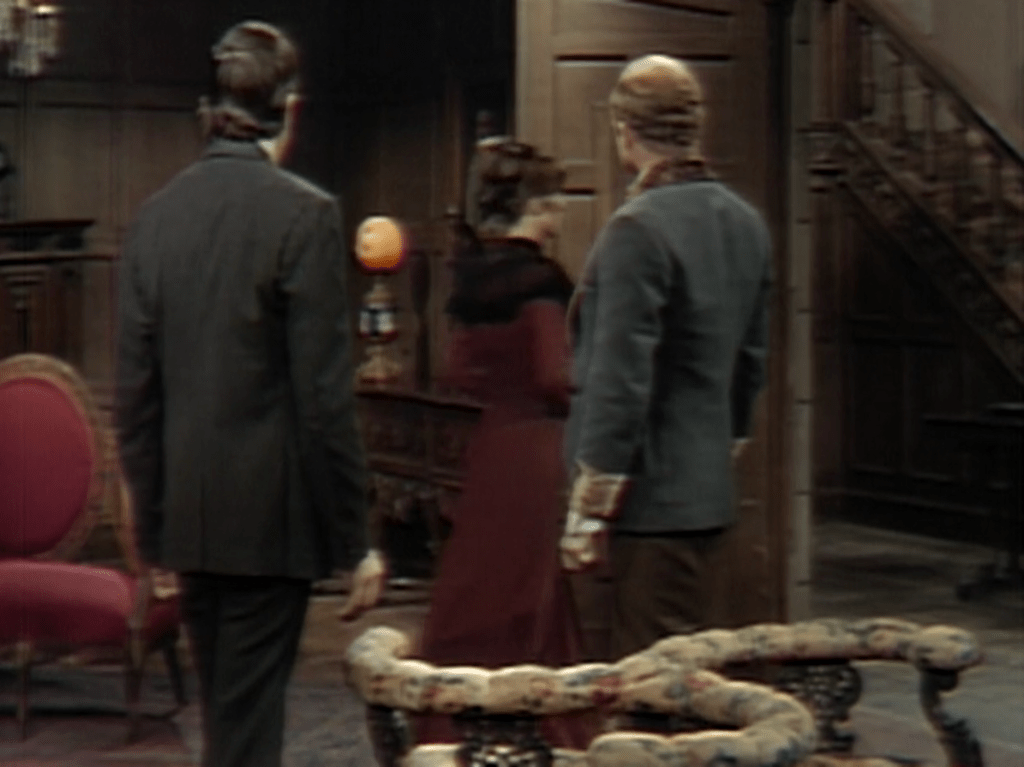
Repressed patrician Edward Collins enters his study in the great house on the estate of Collinwood and finds his brother, libertine Quentin, riffling through his desk. Quentin does not feel an obligation to apologize for going through Edward’s things since Edward is among the conspirators holding Quentin’s estranged wife, madwoman Jenny, prisoner somewhere in the house. Quentin learned that Jenny was around only when she escaped from her cell and stabbed him. He is looking for information about where she is now so that she will not get another chance at him. Edward says that Quentin does not need to know where Jenny is, since he is confident she will not escape again.

Quentin is not at all reassured by Edward’s promise. He brings up another topic, Edward’s own estranged wife. For the first several weeks of the portion of Dark Shadows set in the year 1897, the audience was led to believe that Jenny was Edward’s wife, and the mother of his children, twelve year old Jamison and nine year old Nora. When we found out that Jenny was Quentin’s wife, we wondered not only who Edward was married to, but also whether Jenny had borne children by Quentin. After all, she is obsessed with her “babies,” and in #707 we learned that the enterprise of concealing Jenny’s presence in the house involved taking substantial sums of money into the village of Collinsport and giving them to a Mrs Fillmore. Perhaps Mrs Fillmore is taking care of Jenny and Quentin’s children.

Today, Quentin mentions that Edward’s wife, whom Edward said in #705 and says again today “no longer exists” as far as he is concerned, is named Laura. This rings a very loud bell for longtime viewers. The first supernatural menace to dominate the plot of Dark Shadows was Laura Murdoch Collins, estranged wife of high-born ne’er-do-well Roger Collins. That Laura was on the show from December 1966 to March 1967. In the first week of the show, newly hired governess Vicki was surprised to learn that Roger’s wife was still alive, and was told in no uncertain terms that she was not to be discussed. In #705, during the first week of the 1897 portion, newly hired governess Rachel Drummond was surprised to learn that Edward’s wife was still alive, and was told in no uncertain terms that she was not to be discussed. Like Roger, Edward is played by Louis Edmonds. When we learn that Edward’s wife, too, is named Laura, we can only assume that she, too will prove to be an undead fire witch out to incinerate her children for the sake of her own immortality.

Quentin reminds Edward that Laura followed him the year before when he was banished from Collinwood. Indeed, Laura followed Quentin all the way to Alexandria, Egypt. The other day, Quentin admitted to Jamison that he had been a police spy in that city. Edward does not want to hear about any of it.

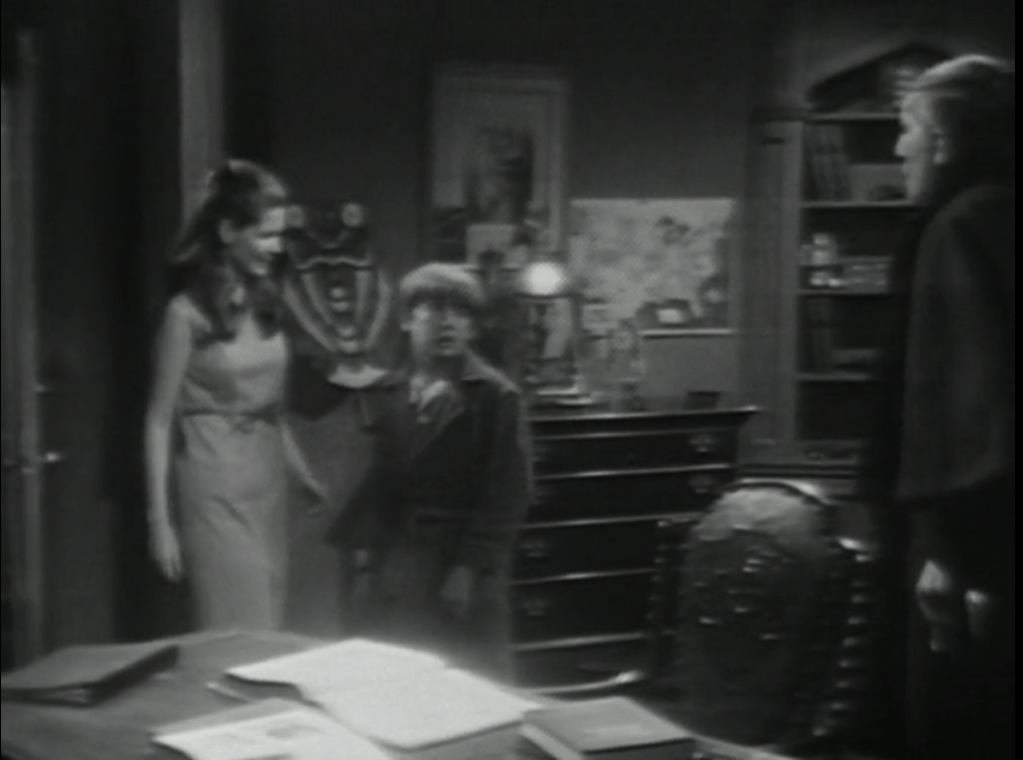
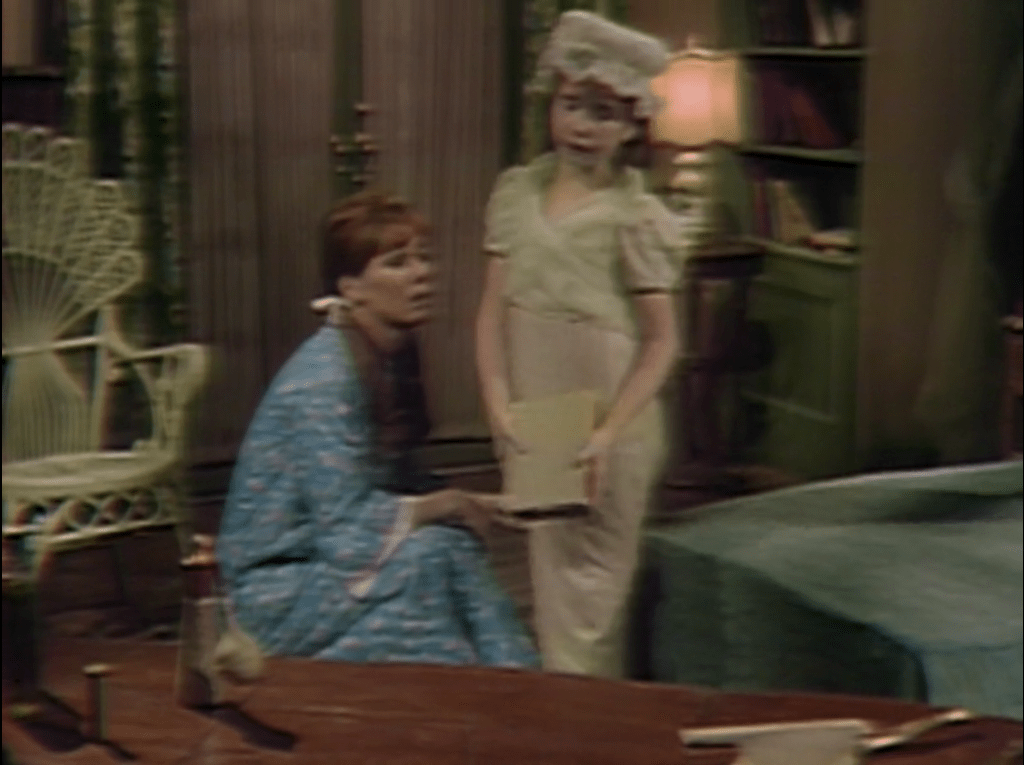
Nora enters. She asks Edward if she can use his desk to draw with crayons. Edward says that he was just leaving, and she can do what she wants. Quentin stays behind with her for a moment. Nora asks her uncle if he thinks her mother will come back. He looks uncomfortable, says he doesn’t know, and exits.

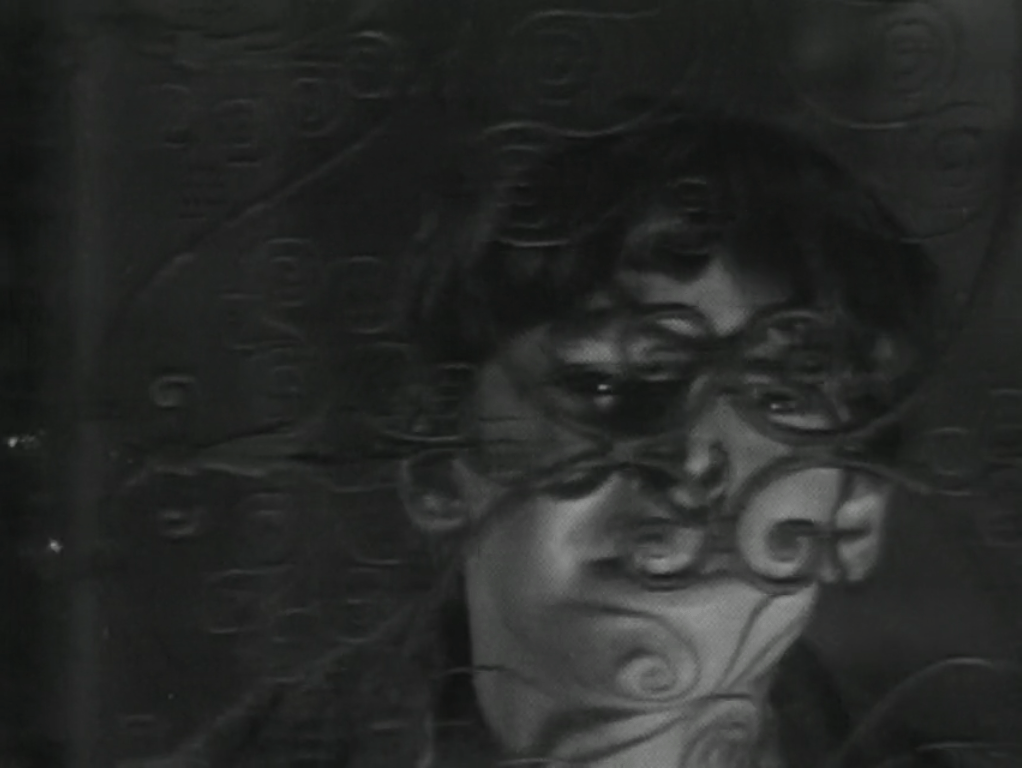
Barnabas Collins, a distant cousin recently arrived from someplace far away, enters. He looks at what Nora has drawn and recognizes Egyptian hieroglyphics. He asks if she copied them out of a book; she says that they just popped into her head. He says he wonders what they mean; she looks directly into the camera and tells the audience she knows exactly what they mean. They say that her mother is coming home soon. And indeed, they do include actual hieroglyphic symbols for “Mother,” “Come,” and “Home.”
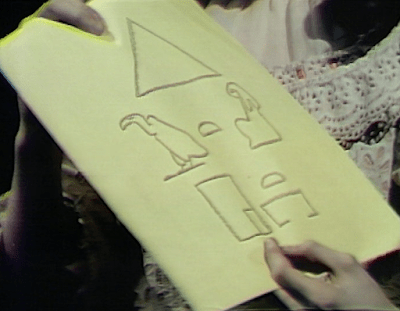
Nora is quite the scribe. Screenshot by Dark Shadows Before I Die.

Nora starts talking about her mother. Barnabas encourages her to continue with the topic, and Edward enters. Edward is quite stern with Barnabas; he had made it clear that his wife was not to be discussed with anyone in the house, least of all with his children. Barnabas explains that Nora brought her mother up. He goes on to show Edward the drawing and tell him that he finds it profoundly disturbing. Edward accepts that as a sufficient excuse for going along with Nora while she talks about her mother, but he attributes the drawing to Quentin’s influence.

Whenever we saw Laura alone indoors during the “Phoenix” storyline, she was staring blankly into a fire burning in a hearth. She kept urging her son, strange and troubled boy David, to join her in this pastime, and every time he did we were led to believe that she had taken a sizable step towards her terrible goal. Now we see Nora in the drawing room, staring into the fire that always burns in its hearth.

Nora hears gurgling noises, like indistinct voices rising from below or behind the fire. Frightened, she runs into the foyer, into her father’s arms. She tries to explain to Edward what she heard, and he insists there is nothing to be afraid of. He carries her into the drawing room, where he declares they will look into the fire together and will both realize that nothing out of the ordinary is going on. His plan fails when Nora sees a face wearing a blonde wig starting to take shape in the flames. Nora cries out that it is her mother’s face. We pan to Edward. He is also looking into the fire, and he looks shocked. We wonder whether he is shocked because he can also see the face, or if he is merely alarmed by Nora’s reaction.

Roger and his sister Liz, the adults in the generation of Collinses who live at Collinwood in the 1960s, are Jamison’s children. So Edward and Laura are their grandparents. If this Laura is indeed the same immortal humanoid Phoenix who was David’s mother, Roger therefore married his own grandmother. In #313, Roger had a line about his “ancestors,” which Louis Edmonds bobbled. When he said “incestors,” he giggled, repeated the misspoken word, then corrected himself, calling the maximum possible attention to his error. Many fans bring that rather bizarre blooper up when we come to this story. The writing staff picked up ideas wherever they could, and I suppose the cast’s line difficulties might have been as good a source as any.
Episode 724: There has to be truth to make a story

Ethnic stereotype Magda Rákóczi is at home in the Old House on the great estate of Collinwood when Rachel Drummond, governess to the children in the great house on the same estate, comes to the door. Rachel says that the late Quentin Collins has risen from the dead and attacked her. Quentin was about to bury Rachel in his own disused grave when Magda’s husband Sandor showed up. Sandor fought Quentin, enabling Rachel to escape. Rachel cannot satisfactorily answer Magda’s questions about whether Sandor survived the fight, and Magda will not honestly answer Rachel’s questions about how Sandor knew to come to her aid.

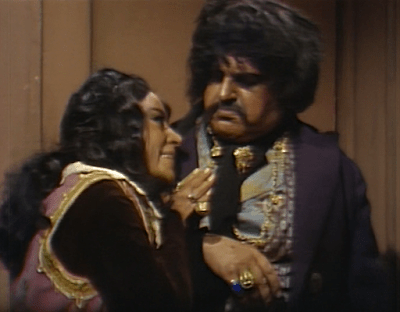
Sandor makes his way back. Magda is overjoyed to see him and throws herself at him with undisguised affection. He responds with his usual grumpiness. At the end, she remembers that they are not alone, and she reverts to their usual form of pretend-quarreling. Their dialogue is great fun, and Grayson Hall and Thayer David make the most of every laugh line:

Magda overjoyed to be reunited with Sandor. Screenshot by Dark Shadows Before I Die.

Magda: Oh, the hero!

Sandor: I am all right.

Magda: Oh, my big, bad, bold hero.

Sandor: Oh, shut up. I cannot hit you. My arm is too sore.

Magda: Oh, what a brave man you are.

Sandor: Yes.

Magda: What a brave man to fight a zombie, a brave, foolish man.

Rachel: He is a brave man. Thank you, Sandor.

Sandor: I don’t like to see a beautiful lady getting buried before her time.

Magda: But you could have been killed.

Sandor: Yes, that at least would have made you cry. Get me some hot water. My wrist is beginning to swell.

Magda: Oh, so now, I have to nurse you. It is better he should have finished you!

Sandor and Magda are the first happily married couple we have seen on Dark Shadows, and this scene shows them at their very happiest. It is not only a good bit of comedy, it is quite lovely.

Rachel is bookish and intellectually ambitious, very much the sort of young lady you might expect to find in charge of the education of the children in a wealthy family in the late Victorian age. She tells Sandor that she cannot accept that Quentin has risen from the dead and is roaming about as a zombie, even though she has encountered as much evidence of the fact as anyone could want. When Sandor urges Rachel to believe what she has seen, she asks what she will have to believe in next- “Ghosts? Witches? Werewolves?” Sandor affirms that he believes in all of those things, and Rachel replies that she cannot.

Well might Sandor believe in such beings. He is under the power of the new master of the Old House, Barnabas Collins, a vampire. Barnabas rises from his coffin in the basement at dusk, when Rachel is upstairs sleeping. Barnabas knows that Angelique, the same witch who made him into a vampire in the 1790s, is controlling Quentin and persecuting Rachel. When Quentin turns up in the basement, Barnabas remembers a ceremony he saw on Angelique’s home island of Martinique that reunited a zombie’s soul with his body and made him once more a living man. He sends Sandor to the attic to retrieve a packet of letters he wrote to his uncle Jeremiah in those days, describing the ceremony.

Jeremiah’s name will jolt longtime viewers. Angelique raised Jeremiah from his grave as a zombie in #393. Over the next five episodes he initially did Angelique’s bidding, then turned on her. They never did tell us that Jeremiah had returned to his grave, in spite of Angelique’s phenomenally vehement exhortations to him to do so. It’s too bad Barnabas didn’t remember these letters then, he might have been able to un-kill Jeremiah.

Or perhaps not. The ceremony is a total failure today, so maybe Barnabas just doesn’t have what it takes to reunite a soul with a body.

When Sandor and Quentin are fighting in the graveyard, we see a tombstone labeled “Laura Murdoch Radcliffe, born 1840.” The Oxford English Dictionary doesn’t have any examples of the phrase “Easter Egg” meaning hidden content of special interest to devotees until 1986, and for that matter this episode aired a few days before Easter began in 1969. So it is doubly premature to call this an Easter Egg. We learned in #181 that a woman named Laura Murdoch Radcliffe died (by fire!) in 1867, with her young son David in her arms; other Laura Murdochs have died that way in other years, and in #187 the residents of the great house decide that Laura Murdoch Collins is likely to take her own young son David to the same fate. The show has been dropping reminders of the Laura story lately, and any longtime viewers who can read this tombstone will appreciate the reference.

I suspect that the original audience for this particular Easter Egg was pretty nearly limited to the set decorators. The inscription is on screen for less than a second, and it is as clear as it is in the capture above for only a small fraction of that time. It’s hard to see even on a modern television; on a 1960s-vintage TV set tuned to an ABC affiliate, many of which had the worst reception in their markets, it must have been totally illegible to something like 99% of the audience. Moreover, it comes at the end of the fight scene, when most eyes were focused on Sandor’s falling figure. Not very many of the few thousand people who might have had a good enough picture to read the inscription would have been looking at it. And most of the audience who were tuning in at this point had joined the show after Barnabas was introduced, the month after Laura went up in smoke, her name unmentioned since. But in the age of streaming and DVDs, we can all appreciate the reference.

Episode 712: A pawn in this cruel game

Dark Shadows first developed its conception of the supernatural in depth when undead blonde fire witch Laura Murdoch Collins was on the show from December 1966 to March 1967. Laura was not so much one person as she was a complex of at least three distinct beings. There was a charred corpse in the morgue in Maricopa County, Arizona; a phantom that Laura’s son, strange and troubled boy David Collins, can sometimes see through his window as she flickers above the lawns of the estate of Collinwood; and a living woman who carries on conversations with people but is never seen eating or drinking. People who encounter Laura also experience dream visitations that resemble her and unaccountable compulsions to do things relating to her, but it is never clear which of those psychic phenomena come from Laura and which from her arch-nemesis, the ghost of the gracious Josette. It is clear that the various parts that make up Laura are not always aware of each other, and sometimes work at cross-purposes with each other.

Laura’s successor as Dark Shadows‘ chief supernatural menace was vampire Barnabas Collins, who joined the show in April 1967. Like Laura, Barnabas comes in several parts, not all of them working together harmoniously. For example, sometimes doors slam shut when he is in a house, and only he can open them. This is never shown as something he deliberately makes happen, and it does not always serve any intelligible purpose of his. Also, when he is active dogs start howling. Sometimes that immobilizes his targets with fear and confusion, but just as often it costs him the element of surprise and foils his plans. So whatever uncanny forces cause these things to happen are clearly not subject to Barnabas’ will. They accompanied him out of the darkness.

Shortly after Barnabas’ arrival, the show retconned Josette as his lost love and cast her as Princess Ankh-Esen-Amun to his Imhotep in a remake of the 1932 film The Mummy. In that film, the undead man tried to remake contemporary woman Helen Grosvenor in the image of the ancient Ankh-Esen-Amun. Taking that role in Barnabas’ attempt to recreate Josette was Maggie Evans, The Nicest Girl in Town. As in the 1932 film Zita Johanns played Helen in the contemporary scenes and Ankh-Esen-Amun in a flashback to ancient Egypt, so in #70 and #126 had Miss Scott already played the ghost of Josette.

While Barnabas pursued his crazed and evil plan to Josettify Maggie, the ghost of his little sister Sarah showed up. Sarah befriended Maggie and helped her escape from her “big brother.” Sarah did more and more, ultimately sending well-meaning governess Vicki back in time so that from November 1967 to March 1968, Dark Shadows was a costume drama set in the 1790s, when Barnabas and Sarah were alive.

Like Laura and Barnabas, Sarah may have looked like single person, but was in fact a complex of independent beings. In #325, she visits David in a dream and gives him information only she would have. In #327, David sees Sarah during waking hours and tells her about the dream, and it all comes as news to her. This daylight Sarah makes it clear to David that she does not want him to have the information the dream version of her gave him so shortly before.

Moreover, child actress Sharon Smyth was instructed to play Sarah as Barnabas’ conscience. When Barnabas is freed to prey upon the living, he unknowingly pulls Sarah out of the supernatural back-world behind the action of the show, the unseen realm where Josette’s ghost, the “Widows,” the ghost of Bill Malloy, and the rest of them lurk, and brings her with him into 1967. Sarah, however many of her there are, is part of the same complex that includes Barnabas and the forces that surround him.

In the 1790s portion, we met wicked witch Angelique and saw her place the curse that turned Barnabas into a vampire. Like the other supernatural forces, Angelique was a complex of multiple beings, some of which were opposed to each other. In her case, spellcasting was a matter of breaking off little bits of herself that took on lives of their own. Angelique was obsessed with the idea that Barnabas would fall in love with her. She could easily cast a spell to make him do that, but insisted to her helper that Barnabas must come to her “of his own will.” Those were the exact words Barnabas used when talking to his own thrall about Vicki, who succeeded Maggie as the object of his gruesome fantasies. When we heard Angelique take the same line, it dawned on us that the Barnabas we saw from April to November 1967 was not merely cursed by Angelique, he was possessed by her. His thoughts were her thoughts, his plans were her plans. When Barnabas fights Angelique, it is one of her replicas of herself coming back to oppose her, as the zombie version she created of Barnabas’ uncle Jeremiah came back to bury her alive in #396.

Now, Barnabas has traveled back in time to 1897. He has met governess Rachel Drummond, who is played by Kathryn Leigh Scott and whom he recognizes as a double of Josette. Angelique has also come to 1897, conjured up by some Satanists whom Barnabas has antagonized for no apparent reason. Angelique peered through the windows of the great house of Collinwood just in time to see Barnabas giving Rachel Josette’s music box. Dismayed, she went to the Old House on the estate, looked at Josette’s portrait, and declared “I am Angelique, and I hate you!” She, like Barnabas, looks at Rachel and sees another Josette.

Angelique’s motivation in the 1790s segment was ostensibly about her desire for Barnabas, but it was her hatred for Josette that drove her at every turn. Now we see that Barnabas is compelled to create another Josette whom he can love; Angelique is just as powerfully compelled to create another Josette to hate. Since Barnabas’ “love” involves killing its object and raising her as a vampire, it would seem to be as hateful as is Angelique’s overt hostility.

After Angelique proclaimed her hatred to the portrait, she took a cloth doll representing Rachel and strangled it. Rachel herself collapsed, unable to breathe. Angelique mouthed words; Rachel spoke them, leading Barnabas to believe that they were a message from Josette.

Today, Rachel is in the drawing room at the great house, recovering from her choking episode. Barnabas is holding her and looking longingly at her neck when stuffy Edward Collins enters. Edward demands to know what is going on, and Barnabas explains that Rachel had trouble breathing and fainted. Edward becomes concerned and wants to call a doctor; he becomes suspicious when Rachel, who he just met a few days ago, does not want to see a doctor. Barnabas manages to distract Edward from his suspicions with some chatter about the circumstances under which Rachel fainted.

In the groundskeeper’s cottage on the estate, Angelique casts a spell to summon Rachel. Back in the great house, Rachel suddenly looks up, her eyes wide open and focused at a point in the middle distance. She stands up and walks with her neck very still, moving like a wind-up doll. She announces to Edward and Barnabas that she will be going outside for a breath of fresh air. She refuses Barnabas’ offer to accompany her. Edward and Barnabas watch her wonderingly as she marches out with her robotic gait.

Barnabas and Edward wonder what has got into Rachel all of a sudden

Rachel arrives at the cottage and finds Angelique. Angelique calls Rachel “Josette.” When she protests that her name is Rachel, Angelique echoes the Barnabas we first knew and tells her that, when she wills it, her name will be Josette. She tells Rachel that she will not understand what is happening to her, but that Barnabas will soon understand very well.

Back in the great house, a servant tells Edward that he found a woman in the cottage. Barnabas is there, and he reacts to the description with alarm. He goes to the cottage, clearly afraid that he will find Angelique there. Before he can complete a search, a rooster crows and Barnabas hastens back to his coffin in the basement of the Old House on the estate.

Barnabas opens the coffin, and finds Rachel lying in it, unconscious. This sets up a comedy of manners. He hardly knows her well enough to lie down with her, and he can’t very well wake her and ask her to make way for him. We end with him facing this problem in etiquette.

We may also remember #248, when Barnabas expressed his frustration with Maggie’s refusal to turn into Josette by forcing her into his coffin. Perhaps Angelique knows that he did that, and is taunting him with a memory of which he has since shown an ability to be ashamed. If so, the point of the taunt is that he is not different from her. Angelique called Rachel a “pawn” in the “cruel game” she is playing with Barnabas. Angelique, who when we first saw her in the 1790s segment was so monomaniacally devoted to her goals that she could not see events from any perspective other than her own, can now understand that what she is doing to Rachel is horrible. That’s why she is doing it, to show Barnabas that he is part of the same horror as herself and that he can never transcend it.

Episode 646: Morbid games children play

The ghost of Quentin Collins has lured children Amy Jennings and David Collins to the room in the long deserted west wing of the great house of Collinwood where his skeleton is hidden. For the first time, Quentin appears. Later, a woman in a white dress will also materialize.

Quentin. Screenshot by Dark Shadows Before I Die.

An old gramophone starts playing a sickly waltz, and David snaps into an odd mental state. He is slow to respond when Amy calls him by name, and tells her she knows that the waltz is his favorite piece of music. She does not know this, and is puzzled to hear it, since he hadn’t heard the waltz until the night before. Soon it becomes apparent that David is coming to be possessed by Quentin. He tells Amy that they have things they must do, including a conversation with “Roger.” Roger is David’s father; this is the first time we have heard him refer to him by name, and it makes it clear to regular viewers that David is not himself. Later, they are wearing clothes of the same period as those Quentin and the woman in the white dress wore, and they decide to address each other as “Quentin” and “Beth.”

Longtime viewers will also recognize the motif of a piece of music as a device with the power to overwrite a character’s personality. In #155, David’s mother, undead fire witch Laura, gave him a music box, apparently as part of her plan to prepare him to follow her to a fiery doom.

Another music box became much more famous a little later. In the summer and fall of 1967, David’s distant cousin Barnabas was a vampire, and he was determined to re-create his lost love, the gracious Josette. His plan involved forcing a young woman to listen to Josette’s music box incessantly. Barnabas hoped that someone who spent enough time listening to the box would forget her old habits and memories and turn into Josette. The music box did seem to have some measure of the power Barnabas had in mind. First Maggie, The Nicest Girl in Town, then Vicki, David’s well-meaning governess, did spend substantial amounts of time listening to the music box with a vacant look on her face. Episode #303 ended with Vicki’s boyfriend Burke listening to the music box and staring off into space; Mrs Acilius wondered if that meant Burke was going to think he was Josette. Burke wouldn’t have looked so good in the dress that comes with the part, but who knows, maybe he and Barnabas would have been happy together.

David and Amy carry a chest out the front door of the great house. Roger and his sister, matriarch Liz, see them do this and ask what is in the chest. David says that it is full of his toys, and that he and Amy want to play with them outdoors. Roger points out that David has never taken a chest full of toys outdoors before, and asks what has led him to do so now. David tells him it is a military secret. Amy explains that one of David’s toy soldiers is broken and they are going to bury him with full military honors. Amused by this idea, Roger holds the front door open and salutes the children as they carry the chest past. In fact, the chest holds, not a toy soldier, but Quentin’s skeleton. It is that which Amy and David bury.

At night, Roger is about to go to sleep when a knock comes on his bedroom door. It is Amy, telling him she heard from sounds from the downstairs that made her suspect someone might be trying to break into the house. Roger takes this concern seriously enough that he retrieves a pistol from his nightstand and carries it as he goes to investigate.

David ties a wire across the second stair from the top of the case from the bedrooms to the foyer, opens the front door, then hides. Roger enters. He is alarmed to see that the front door is open. He stumbles on the trap David has set. He lies unconscious and bleeding at the foot of the stairs. Amy and David enter, see his condition, and nod at each other gravely.

This is the second time David has tried to kill Roger. The first time, in #15, he had sabotaged the brakes on Roger’s car. As he watched the car pull away, he called to his mother. Laura was not physically present, and would not be for another 22 weeks, but when those who watch the show from the beginning learn of her supernatural character they will ask if she influenced David to patricide. Today there is no doubt that David and Amy are doing the bidding of the ghosts, and so we wonder again if David was under Laura’s power when he took the bleeder valve from the wheel cylinder of Roger’s car.

I don’t know how much of a spoiler it is to tell someone reading a Dark Shadows blog that in the spring of 1969 Quentin would become a major breakout star, rivaling Barnabas’ popularity. Quentin would be such a big part of the show’s appeal that Dan Ross would give the last 16 of the 32 original Dark Shadows novels he wrote under his wife Marilyn’s name titles beginning with the words “Barnabas, Quentin, and the.” They were:

  • Barnabas, Quentin, and the Mummy’s Curse, April 1970
  • Barnabas, Quentin, and the Avenging Ghost, May 1970
  • Barnabas, Quentin, and the Nightmare Assassin, June 1970
  • Barnabas, Quentin, and the Crystal Coffin, July 1970
  • Barnabas, Quentin, and the Witch’s Curse, August 1970
  • Barnabas, Quentin, and the Haunted Cave, September 1970
  • Barnabas, Quentin, and the Frightened Bride, October 1970
  • Barnabas, Quentin, and the Scorpio Curse, November 1970
  • Barnabas, Quentin, and the Serpent, December 1970
  • Barnabas, Quentin, and the Magic Potion, January 1971
  • Barnabas, Quentin, and the Body Snatchers, February 1971
  • Barnabas, Quentin, and Dr Jekyll’s Son, April 1971
  • Barnabas, Quentin, and the Grave Robbers, June 1971
  • Barnabas, Quentin, and the Sea Ghost, August 1971
  • Barnabas, Quentin, and the Mad Magician, October 1971
  • Barnabas, Quentin, and the Hidden Tomb, December 1971
  • Barnabas, Quentin, and the Vampire Beauty, March 1972

My first choice is always to title these entries after lines of dialogue from the episodes, and “morbid games children play” was so perfect that I couldn’t pass it up. But Barnabas, Quentin, and the Bleeder Valve was also very tempting, and I do suspect I will use at least a few Barnabas, Quentin, and the titles in the next two and a half years.

Episode 495: A nice boy

In #134, strange and troubled boy David saw his mother Laura Murdoch Collins for the first time in years. To everyone’s surprise, not least his own, David reacted to Laura with terror. It turned out that he had good reason for this reaction, as Laura was actually an undead blonde fire witch come to lure him to his own death.

In #489, David learned that his father Roger had remarried. Like everyone else in the great house of Collinwood, David was stunned to learn that Roger had known his new wife for less than a day before he married her. Unlike the others, his speechless reaction prompted Roger to jump to the conclusion that he disliked his new stepmother. Roger scolded David and sent him to play outside until he could come back and be charming.

While outside, David had stumbled upon the new Mrs Collins kissing a man other than her husband. Later, he found her alone in the drawing room, told her what he had seen, and informed her that he would tell his father about it.

Roger’s new wife wears a black wig and calls herself Cassandra. What the audience knows, but neither Roger nor David do, is that she is actually an undead blonde witch. Roger does have a type.

The new Mrs Collins’ real name is Angelique. She has come to 1968 from the late eighteenth century to resume her punishment of Barnabas Collins, whom she turned into a vampire in their time, but who has now been freed from the symptoms of the curse. When David told Angelique/ Cassandra that he would report her misconduct to Roger, she used her magic powers to strike him dumb. When his muteness became inconvenient for her in #492, she cast another spell to erase his memory and restore his speech. To execute this spell, she took fire from the hearth and spoke words to David that caused him to drift into a trance. We remember #140, when Laura urged David to stare into the flames of this same hearth while she told the story of the Phoenix, causing him to drift into a trance. From that point on, he liked his mother very much.

Today, David meets Roger in the foyer of Collinwood. He tells his father that Angelique/ Cassandra took him into town, where she bought him a Swiss army knife. He says she would have bought him anything he wanted. Thus we learn that, though she is a wicked witch (as well as a wigged one,) Angelique/ Cassandra is in some ways a typical step-parent. When Roger says he is glad to see that David now likes Angelique/ Cassandra, David is mystified. As far as he can recall, he always liked her.

Roger sends David to answer a knock at the door. It is their distant cousin Barnabas. This is the first time we have seen David and Barnabas together since #333, when David barely escaped with his life after Barnabas caught him looking at his coffin. David now greets him quite calmly.

David leaves. In the foyer, Roger scolds Barnabas for his rudeness to Angelique/ Cassandra. Barnabas could hardly be expected to fail to recognize his old nemesis, but he has indeed shown an extreme lack of prudence in his uninhibited talks with her. Not only has he created unpleasant scenes to which Roger is bound to object, but he has also let Angelique/ Cassandra know exactly what he does and does not know about her.

Roger says that if Barnabas cannot be friendly to Angelique/ Cassandra, he shouldn’t come to the great house anymore. Barnabas asks if Roger shouldn’t ask his sister Liz, who after all owns the house, what she thinks. Roger says that will be unnecessary, since Liz has even less tolerance for rude behavior than he does. Barnabas is promising to do better when Liz runs in, frightened by a tall man she met on the grounds. Liz told the man he was on private property and directed him to leave. The man said nothing at all in response to this challenge or to her subsequent questions. He stood still and appeared to be mute until he spoke Barnabas’ name. Liz ran from him when she saw that he had a shackle attached to his leg. Roger flies into a panic, assuming that a shackled man must be dangerous and remembering that David is alone in the woods. He gets his gun, and rushes out. Barnabas accompanies him.

In the woods, David is playing Mumblety-Peg with his new knife. The tall man shows up; when David finds that the man cannot talk, he says that he is glad. He says that he often wishes no one could talk. He goes on at considerable length about the disadvantages that come with the ability to speak. He then explains to the man that you play Mumblety-Peg by dropping the knife into the ground so that it sticks there. The man becomes excited and grabs the knife. David objects and demands he return it. They struggle; David falls and hurts his ankle. David grumbles that all the man had to do was give him his knife back. The man looks alarmed and picks David up. David doesn’t like that one bit, and insists he be put down.

Roger points the gun at Adam and David.

David’s shouting brings Roger and Barnabas. Roger points his gun at the man and orders him to put David down. When the man does not move, Barnabas tells Roger not to shoot. David, in the line of fire, seconds this recommendation. Barnabas talks to the man in a soothing voice, gesturing towards the ground, and the man does set David down. David runs to Barnabas and gives him a hug.

This is the second time David has run into Barnabas’ arms. The first was in #315. David had been trapped in the hidden chamber in the old Collins family mausoleum, where Barnabas was confined in his coffin from the 1790s until 1967. Barnabas learned that David was there, suspected he might have deduced his secret, and decided to kill him. David got out of the chamber just as Barnabas was approaching it, and ran from it directly to him. He had not in fact figured out Barnabas’ secret while in the hidden chamber, but Barnabas’ behavior in the minute before someone else came along was menacing enough that David caught on that he had sinister plans for him. For the next ten weeks, his fear of Barnabas would deepen, leading him to discover the whole horrible truth about his distant relative. All that is forgotten now, evidently.

Roger jumps to the conclusion that the tall man had “tried to kill David!” He shoots him in the shoulder and runs after him with his gun, over Barnabas’ objections. Roger had been quite unconcerned with David’s well-being throughout the first year of the show. In the first months, he openly hated the boy and continually tried to persuade Liz to send him off to an institution; in #83, he coldly manipulated David into attempting to murder someone who posed a problem for him; even after other characters had begun to realize that Laura was a deadly threat to David, Roger continued to press eagerly for her to get full custody of him and take him away; and in #313, when David was trapped in the mausoleum, Roger could barely be bothered to take part in the search. Roger’s behavior will therefore be less likely to suggest to regular viewers that he is overcome with paternal feeling than that he is a panicky fool who is much too excited about an opportunity to shoot someone.

The tall man is Adam, a Frankenstein’s monster created in the procedure that caused Barnabas’ vampirism to go into remission. Though he is 6’6″, Adam is only a couple of weeks old, effectively a baby. Barnabas has been keeping him in his basement, chained to the wall in the prison cell he maintains for those times when he has abducted a pretty girl and has to keep her from running away. The opening voiceover tells us that “no man has suffered more” than Barnabas, just as we cut to Adam, despondent in his shackles. Barnabas comes in to give Adam a cup of broth and a couple of minutes of rigidly formal social interaction, then leaves him alone again. Somehow this sequence makes it difficult to sympathize as deeply with Barnabas as the narration would have us do.

Episode 473: And that’s all I want to say.

Dark Shadows‘ first supernatural menace was undead blonde witch Laura Murdoch Collins, estranged wife of sarcastic dandy Roger. Laura was on the show from December 1966 to March of 1967. During that time, Laura tried to rebuild her relationship with her son by Roger, strange and troubled boy David. David’s well-meaning governess Vicki at first encouraged her charge to go to his mother, but eventually figured out that Laura posed a deadly threat to him. Vicki formed a coalition of characters to help her fight Laura, and eventually rescued David from his mother’s clutches at the last minute.

Now, Roger has come home to the great house of Collinwood after an unexplained absence that had Vicki, his sister Liz, and his distant cousin, old world gentleman Barnabas, terribly worried. Roger happily announces that he has taken a new wife, and presents her to the family.

As it turns out, Roger has a definite type. His new bride is also an undead blonde witch, though at the moment she is wearing a black wig that doubles as a physical representation of the concept “1968.” Her name is Angelique, although she pretends it is Cassandra.

Some critics say that the film 2001: A Space Odyssey would more aptly have been titled 1968: A Bad Year for Hats. As you can see, however, headwear in general was passing through a time of trial in that period. Screenshot by Dark Shadows Before I Die.

Vicki and Barnabas recognize Angelique immediately. Vicki came unstuck in time in #365, finding herself in the year 1795, and didn’t make it back to the 1960s until #461. During her nineteen weeks in the late 1790s, Vicki got to know the people who lived at Collinwood in those days, among them Barnabas and Angelique. She saw many horrible things happen to them, and only after being blamed for those catastrophes herself would she realize that they were the consequences of spells cast by Angelique. Due to Angelique’s curse, Barnabas would be a vampire from 1796 until the week after Vicki came back to 1968. Vicki has decided to believe that Barnabas is not the same person she knew in that period, but rather that he is the descendant of that Barnabas Collins. He does not want her to know that he ever was a vampire, and she has resolved not to know that either, even though he used to bite her on the neck and suck her blood.

The battle against Laura was a fairly exciting story, at least in its latter stages. Angelique is a far more dynamic adversary than Laura, and Dark Shadows is much faster-paced and better written than it was then, so a reprise of the structure of that conflict in this new setting would likely be very exciting indeed.

To wage such a battle, Vicki and Barnabas can have no secrets from each other. Many who have been with Dark Shadows from the beginning have been hoping that its original protagonist will eventually become aware of the principal storylines, and this is one of the obvious ways to do it. Vicki can learn that Barnabas was a vampire, can find out that he was the one responsible for all the terrible crimes committed against the women and men and cows of Collinsport in 1967, and can still align herself with him, because she needs his support against Angelique, a more urgent threat. By the time they have vanquished her, not only will the idea of handing Barnabas over to the authorities have lost its salience, but Vicki will doubtless be facing another urgent threat requiring Barnabas’ assistance.

Nothing we see today suggests that such a development is on the horizon. The episode began with Vicki, Barnabas, and Liz worrying about Roger. A couple of weeks ago, Vicki brought a portrait home from an antique store and it had bizarre effects on Roger. The other day, he took the portrait and disappeared.

We can tell that today is not going to be a win for the female characters when Barnabas reacts to Liz’ expression of concern by dismissing her from his presence and she leaves, even though he is in her house. Vicki can tell Barnabas knows more about the situation than she does, and each time he condescends to mete out a little information in response to one of her questions he ends by turning his back to her and explicitly refusing to share anything more.

When Liz first leaves him alone with Vicki, Barnabas sourly remarks “I try to remember… that I must not reproach you for the reasons you’ve given not to marry me.” As Danny Horn shows in a series of screenshots in his post on Dark Shadows Every Day, their body language does not at any point support the idea that Barnabas wants to be with Vicki and she does not want to be with him. Quite the contrary; he withdraws from her, turns from her, and puts physical objects as barriers before her, while she looks at him, follows him, and leans towards him.

This has been Barnabas and Vicki’s dynamic for a long time. By #285, she went so far as to invite herself to a sleepover at his house. Barnabas was a vampire then; he entered the bedroom while she slept and bared his fangs, but couldn’t bring himself to bite her. Time and again, Vicki would all but draw a circle on her neck with the words “Mr Vampire, Bite Here!,” and Barnabas would tremblingly open his mouth, then recoil at the last moment. In #462, he finally sampled her bloodstream. By the end of #466, Barnabas’ vampirism had gone into remission, and that little storyline had evaporated. Now Vicki is vague and confused about what happened between her and Barnabas, and he is afraid he will relapse and bite her again.

Vicki is trapped between two blank walls. On one side Barnabas is excluding her from his life and therefore from active participation in the A story. On the other, she keeps having scenes with her old boyfriend from the 1790s, an unpleasant man named Peter who keeps demanding, for no apparent reason, that she call him Jeff. That habit of his was dead on arrival as a story point, and now that Angelique will be trying our patience by insisting her name is Cassandra, it will become impossibly tedious to have a second character doing the same pointless schtick. As long as she is in this position, Vicki’s prospects for contributing interesting material to Dark Shadows belong to a very low order of probability.

Episode 325: Such pretty flowers

Strange and troubled boy David Collins was, for the first 39 weeks of Dark Shadows, the character most intimately connected to the supernatural back-world of ghosts and uncanny phenomena that would occasionally peek through the main action of the show. That changed in #191, when he chose life with well-meaning governess Vicki over death with his mother, humanoid Phoenix Laura Murdoch Collins. After that, he had little memory of his mother, and none at all of the paranormal experiences he had during her time with him on the great estate of Collinwood.

Not that David lost his connection to the supernatural all at once. When he first met his cousin Barnabas in #212, he cheerfully asked him if he was a ghost, and was disappointed to hear that he wasn’t. In #288, he speculated that his friend, mysterious little girl Sarah, might be a ghost, and he has taken it in his stride every time he has seen Sarah do something only a ghost could do. In #310, he took out his crystal ball, a gift he had received in #48 and hadn’t used since #82, and peered into it to try to find Sarah. He did see her in it, too.

Yet David seems to be resisting the idea that Sarah is a ghost, and indeed to be shying away from the whole concept of the supernatural. When she led him to the secret chamber in the Collins mausoleum in #306, she told him that the empty coffin there once had a body in it, but that the body got up and left. David objected that the dead don’t walk away, and was incredulous when she assured him that sometimes, they do. When David was trapped in the chamber in #315, Sarah materialized there and showed him how to get out. He had called on her to come, and was facing away from the only door when he did so, indicating that he knew she could pass through the walls. Yet when she did, he demanded a naturalistic explanation for her entrance, and when she vanished he asserted that she must be hiding in the chamber somewhere.

Now, David is terrified of Barnabas, much to the puzzlement of the adults he lives with. In the opening scenes, he is staring at the portrait of Barnabas in the foyer of the great house, and we hear Barnabas in voiceover, delivering the lines with which he frightened David in #315. He screams with terror, bringing his aunt Liz. She sees that David is upset, but he hurries away from her, upstairs to his bedroom.

There, we hear his thoughts in another voiceover. He remembers the events of #310, when he discovered that Barnabas and his servant Willie knew about the secret chamber in the mausoleum. In his agitation, he calls out to Sarah. He hasn’t admitted to himself that Sarah is a ghost, but evidently he expects her to materialize out of thin air. Sarah doesn’t come, but Vicki does, asking who he was talking to.

After David says he wants to work on his stamp collection, Vicki goes downstairs and finds Liz putting her coat on. She says that David is afraid of Barnabas for some reason, and that she is going to Barnabas’ house to ask him to help put the boy’s fears to rest. She says that David is more disturbed than he has been since his mother Laura was around; this is the first direct reference to Laura in months.

There is a knock on the front door. It is Barnabas, saving Liz the trip. Liz and Vicki explain how fearful David is, and Barnabas offers to have a talk with him.

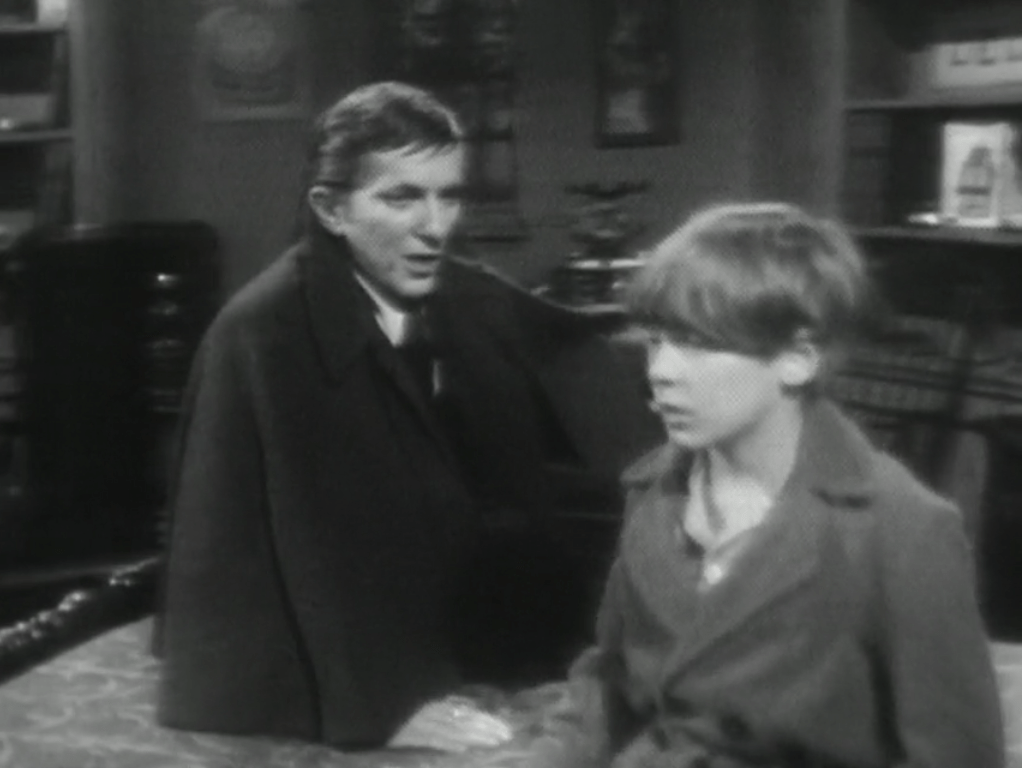
Liz ushers Barnabas into David’s room. Once the door is closed on the two of them, Barnabas questions David aggressively about Sarah and the secret chamber in the mausoleum. He asks him if Sarah told him about her family, twice mentioning her brother. When David says that Sarah hasn’t told him anything about herself, Barnabas accuses him of lying. He sits next to David on his bed. David doesn’t know that Barnabas is a vampire, but if he did he couldn’t look much more uncomfortable than he does when Barnabas assumes this position.

Barnabas sitting with David on his bed.

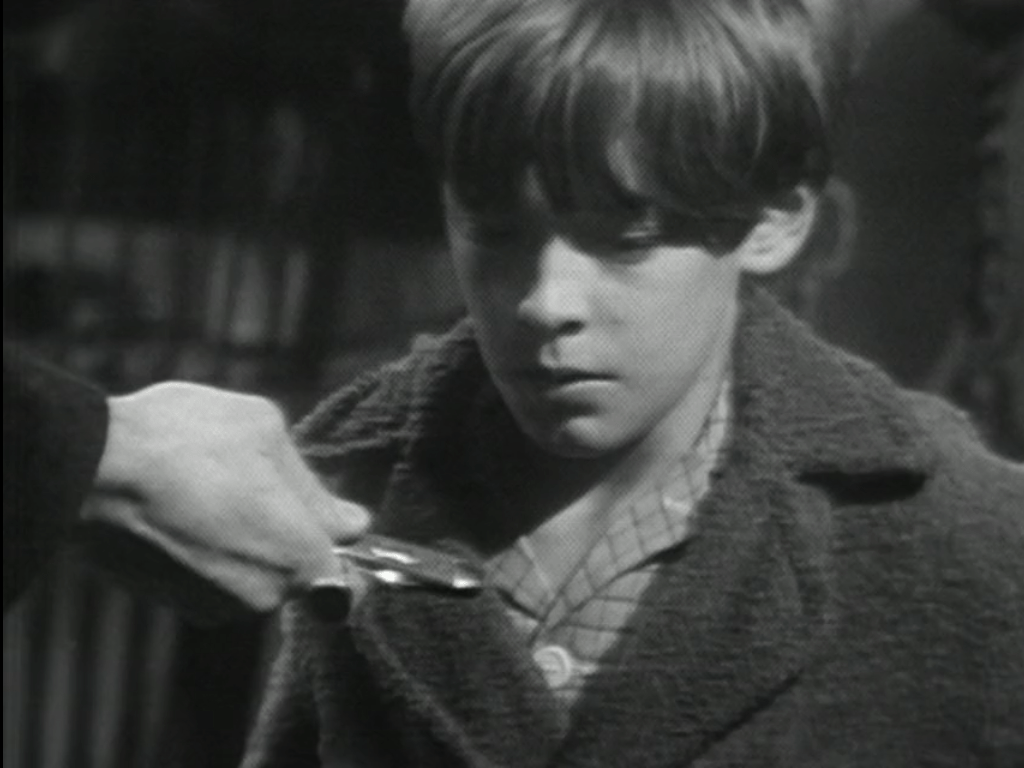
Barnabas tells David repeatedly that he knows he was in the secret chamber. David denies it, Barnabas again tells him he is lying, and to prove it shows him the knife he left there.

Barnabas confronts David with his knife

A knock comes at the door. It is Vicki. Vicki adores Barnabas, and the smile she wears when she enters the room shows her certainty that a heart-to-heart talk with him will have relieved David’s anxiety.

Smiling Vicki, sure everything will be all right

Vicki sees that David is still frightened, and her smile gives way to a look of confusion. Vicki was originally the audience’s point-of-view character; the audience is now composed chiefly of people who have tuned in wanting to see how they were going to fit a vampire into a daytime soap opera, and so of course she has to be Barnabas’ biggest fan at Collinwood. She and Barnabas leave David’s room together, and Barnabas wishes David “Pleasant dreams…”

We see David tossing in bed. He is talking in his sleep, calling out to Sarah. In yet another voiceover, we hear his dream. It is a bit of conversation from #306, when Sarah told him about the empty coffin.

We then see the beginning of another dream. It takes place amid a composite of decorations from the cemetery set and from the set representing Barnabas’ basement. David at first appears in a corridor like the ones we saw in the basement in #260.

The fog machine is working hard today.

He then encounters a faceless woman whom regular viewers will recognize as Barnabas’ co-conspirator, mad scientist Julia Hoffman.

David sees the faceless woman.

We see that she is wearing Julia’s wig and frock and holding the jeweled medallion she uses to hypnotize people:

Julia’s identifying marks.

David flees from the faceless woman, saying he has to find Sarah. He finds himself behind a grating like the one on the door to the Collins mausoleum:

Entering the tomb

He walks up a few stairs, and sees Sarah.

David finds Sarah

When David tells Sarah that she is hard to find, she denies it, saying that she is easy to find if you know where she is. David does not respond to this characteristically cryptic remark, but complains that she won’t tell him anything about herself. She asks what he wants to know, and says he wants to know who she is and where she comes from. She tells him:

Sarah: That’s easy. I was born the same place you were. I lived in a house on a hill until I was nine years old. Then I got very sick. Everyone came to see me, and they were very sad.

David: Because you were sick?

Sarah: No, because I died. I died, and everyone brought such pretty flowers.

“I died that time. I died, and everyone brought such pretty flowers.”

When David asks why she is around now if she died then, she tells him she doesn’t really know. All she knows is that she is looking for someone. David asks who that might be, and Sarah says she will show him. Suddenly he becomes frightened and does not want to go with her. She insists. She takes his hand and leads him.

Sarah leading David to her secret

The camera follows the children on their journey across the set. At first Sarah takes David down some stairs, leading him from depths to depths:

Sarah leads David down into the depths

The set is now unmistakably Barnabas’ basement, though with more candelabra casting more intricate shadows on the walls than we have seen there:

Vergil and Dante, junior edition

At last Sarah stops and looks straight ahead. They have reached their destination.

David is bewildered by the sight.

They see a coffin. David asks if this coffin is empty, as was the one in the secret chamber. Sarah tells him no. This one has a body in it. The lid starts to open. David points in astonishment, while Sarah looks on serenely.

The lid begins to open.

Barnabas rises from the coffin.

Barnabas rises.

David recognizes Barnabas and is stunned. Sarah has eyes only for her big brother.

David stunned.

Barnabas stands. He turns, and sees Sarah. He is glad to see her.

David watches Sarah’s reunion with Barnabas.

Barnabas notices David. He turns to follow him.

Barnabas blocks David from our view and from Sarah’s.

As Barnabas follows David, Sarah simply watches.

Sarah watching big brother.

Barnabas follows David through another corridor. The shadows on the wall and floor form a design suggesting David is caught in a web. Readers of Gold Key comics’ Dark Shadows series will recognize the bend of Barnabas’ knees and the angle of his cane in this shot as their usual depiction of him:

David caught in Barnabas’ web.

David’s back is to the wall and Barnabas closes in on him.

Cornered.

Barnabas raises the cane he used to block David’s escape in #315 and which regular viewers several times saw him use to beat Willie. We zoom in on the wall, where we see the cane’s shadow rise and fall while we hear David cry out in distress.

Sarah’s fixation on Barnabas and her passivity when Barnabas follows David mark a pivotal moment in her development. She looks and sounds like a friendly little girl, and we have seen her rescue people from danger. She usually seems like a cross between Caspar the Friendly Ghost and the Powerpuff Girls. But she is not that at all. She is a symptom of the same curse that has brought Barnabas forth to prey upon the living, and she is leading David ever deeper into a world where only the dead belong. The show has given us no reason at all to think that she can bring him back to the realm of the living.

Even if Sarah wants to save David, she may still represent a deadly threat to him. We saw this in the Laura story. When Laura tried to lure David into the flames, she told him that he, like her, would rise from the ashes and live again. We had heard her say things like this before, and she may well have believed it to be true. But unknown to her, we saw a séance in which David spoke with the voice of a son Laura had in one of her previous incarnations. She had burned him with her, but while she gained a new life in the flames, he had become one of the unquiet spirits of the dead. Perhaps Sarah, too, is unwittingly leading David to his death.

Closing Miscellany

When Liz leads Barnabas into David’s room, she tells David that “Unc- Cousin Barnabas” wants to have a man-to-man talk with him. In later years, Jonathan Frid would refer to his character as “Uncle Barnabas” when he talked with interviewers about how the Collinses responded to him. I wonder if Joan Bennett’s blooper is a sign that he was already calling him that at this time.

There is a slight puzzle in Sarah telling David she was “born in the same place” he was. We’d heard in the early episodes that Laura and Roger never spent a night together in Collinwood as man and wife- the day of their wedding, they went to their new home in Augusta, Maine, and David was born a few months later. Perhaps Sarah’s remark is a retcon, and we are now to think of David as having been born at Collinwood. Or perhaps Sarah really was born where Augusta would stand- we know that her birth year was 1786, and that was the year the settlement that would become Augusta saw the establishment of its first public whipping post. Maybe her parents wanted to go there to celebrate the occasion.

When Sarah tells David she lived on the hill until she was nine, she interrupts herself and shouts “Ten!” This is an odd little blooper. Just a few days ago, David told Barnabas that Sarah was ten, and Barnabas jumped down his throat asking if she wasn’t “almost ten?” Now Sharon Smyth has been on the show long enough to have celebrated a birthday, and they aren’t done with Sarah yet. So they are retconning Sarah as having made it to ten.

Episode 321: How many times do I have to tell you?

Maggie Evans, The Nicest Girl in Town, is not allowed to leave home. The yard outside her door is full of policemen. They are hoping that a rumor that her amnesia is breaking and she will soon remember who abducted her and held her prisoner will draw that person out of hiding. If he approaches the house, they will… it isn’t clear what they will do, exactly. Whatever they do, Maggie hopes that it will end the danger so that she can get back to her normal life.

Maggie and her father Sam talk about the situation. This conversation doesn’t advance the plot or give the audience new information, but it is somewhat interesting to people who have been watching the show from the beginning. For the first 40 weeks of the show, Sam was an alcoholic and Maggie’s attempts to keep him out of trouble were a substantial part of the story. Adult Child of an Alcoholic (ACoA, in the lingo of the twelve step movement) mannerisms such as advertising that she is happy by starting utterances with a laugh and stressing whatever syllables have a rising pitch are still a major part of Maggie’s characterization.

Father and daughter

But Sam isn’t an alcoholic anymore. Not only doesn’t his drinking cause him problems, but we’ve seen him function as a social drinker. He keeps a bottle of whiskey in the living room of the Evans cottage and occasionally takes a drink or two; he often goes to The Blue Whale tavern and enjoys happy hour there. But he declines drinks when they are offered at inconvenient times, doesn’t get drunk, doesn’t have trouble with his work, and Maggie doesn’t have any complaints. The other day, the show referred back to Sam’s drinking days. He and the sheriff went to The Blue Whale, where Sam started the rumor about Maggie’s memory. Sam pretended to be drunk and the sheriff pretended to hush him while he declared that Maggie would be leading the police to her captor any day now. But he was stone sober the whole time, even though he had had a drink at home before leaving for the tavern.

The show dropped the theme of Sam’s alcoholism when it gave up on the storyline of “The Revenge of Burke Devlin.” Sam had started drinking because of the events behind that storyline and his drunkenness made it unpredictable what role he would play in it. Since that ended in #201, the writers don’t seem to see a point in presenting Sam as an alcoholic, even as one in recovery. But I think that is a mistake. The actors and directors remember that Sam has that history, and it adds depth to both David Ford’s portrayal of Sam and Kathryn Leigh Scott’s of Maggie. You wouldn’t have to spend any more screen time presenting Sam as a recovering alcoholic than they spend now presenting him as a social drinker. All he’d have to do is reply to a remark about booze by saying that he never touches the stuff anymore, and you’ve made the point.

Viewers who have been with the show from the beginning will look at Sam and Maggie’s heart-to-heart talk and remember the scenes from the first 40 weeks where Maggie wound up playing the parent in the parent-child relationship. Seeing him really function as a father here will not only reassure us that they are free of that now, but will also explain why Maggie kept falling into all of the patterns of behavior that enabled Sam when he was a drunk. Today, he’s the Daddy she knew before alcohol got the better of him, the one she was always sure was still in there someplace.

Sam leaves the room, and Maggie gets a visitor. After Sam had assured Maggie that the house was so well-guarded no one could get in, we saw a shot of the permanently nine year old ghost of Sarah Collins outdoors, peering over a picket fence.

Looking for a friend

Maggie falls asleep, and wakes to find Sarah in the room with her. Maggie repeatedly asks Sarah how she got in, and Sarah keeps declining to answer. Maggie keeps trying to get her father into the room, and Sarah keeps telling her that if a third person comes in, she will have to go away. Sarah finds that Maggie is not in possession of the doll she gave her, and tells her that she will have to get it back as soon as possible and keep it with her at all times. Maggie asks more than one question about that as well, and Sarah again tells her that she can’t explain. Sarah gets to be quite exasperated that she has to keep reviewing the ghost rules with Maggie.

Sarah can not believe Maggie still doesn’t get it.

Several characters have entertained the possibility that Sarah might be a ghost, among them Maggie and Sam. They keep snapping back from really believing that she is. In the early months of the show, characters had speculated that there might be ghosts on and around the great estate of Collinwood, but they couldn’t let go of the idea that they lived in a world that basically made sense according to the usual natural laws. So no matter what they saw, they kept retreating from the full implications of the supernatural events that came to be a more and more obvious part of their experiences. Sarah’s impatience with Maggie today is reflected in the impatience many viewers of the show express when characters who have had encounter after encounter with the paranormal won’t stop droning on about how there must be a perfectly logical explanation.

Sarah keeps repeating herself and Maggie keeps missing the point. Maggie tells Sarah that she will like Sam, who likes little girls. That again is a poignant line to those who are thinking about the happy life Maggie had with her father before he started drinking and that has only recently resumed, though it is lost on newer viewers. We also know that Sarah already likes Sam- she visited him in this house in #260 and told him where to find Maggie.

But in the world of Dark Shadows, ghosts cannot appear to more than one person at a time. For example, in #141 strange and troubled boy David Collins took his mother, undead fire witch Laura Murdoch Collins, to the Old House on the grounds of Collinwood, hoping that the ghost of Josette Collins would appear to her. He left her alone in the house, explaining that Josette appears only to one person at a time. Josette did communicate with Laura after David left, though Laura concealed that fact from her son.

We’ve seen only two exceptions to the rule that ghosts appear to one person at a time. The first case was in #165, when Josette manifested herself in a room with David and Laura. The second time was in #294, when Sarah herself helped Maggie escape from the mental hospital where mad scientist Julia Hoffman was keeping her for evil reasons. Both Maggie and her nurse could see Sarah that time.

But those were special occasions. It was such a strain for Josette to present herself to two people that she could shimmer into view only when David was asleep, and a few words from Laura were enough to shoo her away before he could wake up, though he did feel her presence afterward. And Sarah’s appearance to Maggie and the nurse lasted for only a few seconds. Viewers reminded of Sarah’s earlier appearance to Sam will remember that she vanished before he finished a sketch of her that she very much wanted him to give her, so however great a power she might represent, we know that it is not entirely under her control. She can do what she is supposed to do and tell people what they are supposed to know, but she cannot simply do as she wishes, and when she has completed an assigned task or entered an uncongenial situation she will disappear.

Eventually Maggie insists on opening the door and calling to Sam. Of course Sarah has vanished when he enters, of course the men guarding the house didn’t see her, and of course Sam and Maggie fret that if Sarah could come and go unobserved so could the person they are trying to catch. Those bits bring on our frustration with characters who don’t get that they are living in a universe pervaded with supernatural beings. If they were proceeding from the premise that Sarah was a ghost and considering the possibility that Maggie’s captor may also have been some kind of uncanny being, that would indicate that the action is about to start moving a lot faster. As it is, it’s just filler.

Meanwhile, Julia has left her hospital and come to Collinwood, where she is in league with Maggie’s captor, vampire Barnabas Collins. Barnabas has heard the rumor that Maggie is recovering from her amnesia. Julia induced that amnesia to keep Maggie from exposing him and inconveniencing her.

In Friday’s episode, Julia tried to talk Barnabas out of killing Maggie. He had calmly and suavely told her that he had no choice but to yield to her arguments, and she had been satisfied that she had persuaded him. Today, he tells his sorely bedraggled blood-thrall Willie Loomis that he will set out for the Evans cottage as soon as the clouds cover the moon and give him a deep enough cover of darkness.

Willie sneaks over to the terrace at the great house of Collinwood, where he informs Julia of Barnabas’ intentions. Julia cannot believe that her powers of persuasion failed to win Barnabas away from his plan to kill Maggie. Willie has to repeat himself time and again, until he grows as exasperated with Julia as Sarah was with Maggie.

This is the first time we have seen Julia in denial. It’s understandable that she would overestimate her ability to bend Barnabas to her will- not only has she had a great deal of success so far at dominating their relationship, but she is usually able to manipulate people to a fantastic degree. When she induced Maggie’s current amnesia, she took her in a matter of minutes from a state in which she remembered everything that had happened to her to one in which an impenetrable mental block covered exactly the period in which Barnabas abused her. Someone who can do that might well have difficulty grasping the fact that she has not turned someone to her way of thinking.

Barnabas stares out the window of his house in the direction of the Evans cottage and thinks murderous thoughts about Maggie. My wife and I often laugh about the comment Danny Horn made on this scene in his post about this episode on his blog Dark Shadows Every Day:

Meanwhile, the dogs are howling, and Barnabas is standing at the window, staring out into the night.

“Goodbye, Maggie Evans,” he thinks. “I might have loved you. I might have spared you. Now… you must die.”

Man, what a diva. He even has backup singers.

Danny Horn, “Episode 321: What We Talk About When We Talk About Ghosts,” Dark Shadows Every Day, 3 February 2014

When the show dwells on the dog-noise, Mrs Acilius and I often turn to each other, say “the backup singers!,” and laugh. When we watched this episode yesterday, we laughed louder than usual because our beagle joined in with them, right on cue. He often looks up when the howling starts, the backup singers are the stars of the show as far as he is concerned, but it is unusual for him to sing along. They must be in particularly good voice in this one.

Episode 316: He just showed up one night

Strange and troubled boy David Collins got himself trapped in the secret chamber of the old Collins mausoleum in #310, and everyone has been searching for him ever since. Most of them want to get him home safe, but his distant cousin, Barnabas, has a different agenda. He suspects that David has learned that he is a vampire, and is determined to be the first to find him so that he can kill him.

Friday, David got out of the secret chamber and walked outside, straight into Barnabas’ hands. Today, we open with a reprise of that scene. After Barnabas greets his young cousin with a richly sinister “Hel-lo, David!,” he questions him sharply. He expresses dissatisfaction with David’s answers, then tells him that because no one is at home in the great house of Collinwood, he will be taking David to his own house. David grows more and more uncomfortable. Just as he is coming to be really frightened, the voice of local man Burke Devlin calls his name.

When Burke reaches them, David throws his arms around him and Barnabas squirms guiltily. Burke dislikes Barnabas, and gives him a suspicious look while he and David explain what has happened. When Burke says that there are people at home in the great house, David flashes a look of alarm at Barnabas. Barnabas says that no one had answered when he knocked on the door earlier, so he assumed everyone had joined the search. The two men take David home.

There, David eats a sandwich in his room while his father Roger asks him where he has been. This conversation is just magnificent. Roger is trying to be stern, but is such a flagrantly neglectful father that David knows full well that he can’t be bothered to punish him. So while Roger puts a series of pointed questions to him, David ignores him and muses aloud about Barnabas. “Barnabas is mysterious, isn’t he, Father?…You know, we don’t know anything about him. He just showed up one night.” Roger keeps urging David to forget about Barnabas and start answering his questions, but gets nowhere. Louis Edmonds and David Henesy were both talented comic actors, and they worked well together, so it’s no surprise this scene is laugh-out-loud funny.

Screenshot by Dark Shadows Before I Die.

Along with the comedy comes the thrill of a potential change in the show. In his post about this episode, Danny Horn writes: “It’s a great moment. It’s like the ‘logical explanation’ spell was suddenly broken, and David just realized how bizarre his life is.” The structure of Dark Shadows’ storylines has been that someone has a terrible secret, they are deep in denial about the extent to which the secret is deforming their lives, and when they finally let go of their secrets they are free. So matriarch Liz had a terrible secret that kept her from leaving her house for over eighteen years, she revealed the secret in #270, and now she’s happy to go anywhere. She’s on an extended visit to Boston at the moment. Roger had a secret connected with an incident for which Burke went to prison years ago and he spent all his time making a fool of himself as he struggled to keep it hidden; he admitted the truth in #201, and since then he has been a carefree fellow who can make anyone laugh. So the Collins family curse that Barnabas embodies is made up chiefly of denial, and it can be defeated by facing facts. If David has seen through all the lies and is willing to reckon with the truth, he has the power to bring everything to a conclusion. So when he says that Barnabas “just showed up one night,” we catch a glimpse of what it would be like if the entire series came to its ultimate climax.

We end with David still in his room, telling well-meaning governess Vicki that he feels someone evil is watching him. We cut to Barnabas in his own house, staring out the window at the great house in the distance, thinking his sinister thoughts. David’s feeling should be familiar to him- when his mother, undead fire witch Laura Murdoch Collins, was staying in the cottage in the estate, she often stared out her window and caused David to have nightmares.

Laura was a threat to David because the basic conditions of her existence drove to kill her son. Barnabas’ threat to him is a result of circumstances that were always likely to arise, but that might not have, and that might yet be changed. So when Laura was on the show, the suspense was how she would be destroyed before she could kill David. Now with Barnabas, there is a question whether he will try to kill David at all. So the suspense is more complicated, and there are more options for pacing. The plot doesn’t have to be either glacial or rapid, as it did with Laura, but can move at any of a variety of speeds depending on which of the many possible directions they decide to take the story.

Episode 278: If you become Josette

The first major villain on Dark Shadows was high-born ne’er-do-well Roger Collins, played by Louis Edmonds. Edmonds was a master of the sarcastic remark, so that Roger was often funny. But no matter how often he made the audience laugh, Roger was never a comic villain. That requires a character we can empathize with as we watch them scheme and plot, scramble and improvise, in pursuit of goals that could not be achieved without ruining all the fun. We laugh when we recognize our own foibles in an outlandish character, and laugh again when we realize that our ability to feel with others encompasses even those whose feelings have led them to do dastardly deeds.

Roger’s personality was too cold, his motives too contemptible for us to empathize with him. Where a comic villain thinks fast and puts himself in ridiculous situations, Roger stuck with his fixed ideas, using the same tactics time and again to bully his unwilling co-conspirator Sam to stick with their plan. Even when he bumbled about with a damning piece of evidence, a fountain pen left at a crime scene, he was never the coyote caught in his own over-elaborate trap, but a criminal in a police procedural. He was a melodramatic villain who was only incidentally funny.

The first supernatural menace on the show was Roger’s ex-wife, undead fire witch Laura Murdoch Collins, played by Diana Millay. Millay was hilarious, every bit as funny as Louis Edmonds. It was a shame the two of them didn’t play a married couple in a long-running comedy. They could have raised sarcasm to heights previously unknown to humankind. But while Millay gets laughs every time the script gives her the least chance, Laura was even less of a comic villain than Roger.

It is clear that Laura is a malign presence from beyond the grave and that, if she is not stopped, she will burn her young son David to death. But everything else about her is an impenetrable mystery. She is not part of a familiar mythology, and even the most basic questions about her remain unanswered. We cannot empathize with her motives, since we cannot begin to guess what her motives are or even be sure if she has motives.

The first comic villain on Dark Shadows was seagoing con man Jason McGuire, played by Dennis Patrick. Jason had his first comic turns only after he had been on the show for weeks, during which time we had been subjected to many iterations of a dreary ritual in which he made a demand of reclusive matriarch Liz, Liz resisted, he threatened to expose her terrible secret, and she capitulated. When his henchman Willie slips out of Jason’s control and he starts scrambling to contain the damage Willie is doing to his plan, Patrick finally gets a chance to play Jason as a comic villain, and the result is very engaging. But those scenes are scattered too thinly through Jason’s long-running, relentlessly monotonous storyline to make him a success as a comic villain.

Now, the show has struck gold. Vampire Barnabas Collins is becoming a pop culture phenomenon and bringing the show the first good ratings it has ever had. They have to keep Barnabas on the show indefinitely, and he has to be the most important character. That presents a practical difficulty. Vampires usually figure in folklore and fiction as unstoppable killing machines. Daytime soap operas explore the shifting relationships among large casts of characters. It’s going to be hard to maintain that cast if Barnabas sets about murdering everyone. To square the circle, they try to redefine Barnabas as a comic villain.

Barnabas is giving a costume party for his distant cousins, the living members of the Collins family. He has invited well-meaning governess Vicki to attend and to wear the dress of the legendary Josette Collins. In the first 39 weeks of Dark Shadows, Vicki had developed a close friendship with Josette’s ghost, so she is excited about this. For his part, Barnabas has borrowed an evil scheme from the 1932 film The Mummy. He will erase Vicki’s personality and replace it with Josette’s, then kill her so that she will rise as a vampiric Josette. So he is glad she likes the dress.

Barnabas asks Vicki to come to his house and help him pick out the antique clothes that the family will wear at the party. She enthusiastically agrees, saying that she loves to go through trunks full of old clothes. The clothes are in a trunk in Josette’s old room, which Barnabas has restored.

In the room, we see the ghost of Barnabas’ 9 year old sister Sarah sitting on the trunk. She vanishes a second before Barnabas and Vicki enter. Both of them have a strong feeling that someone just left the room. Barnabas tries to dismiss the sensation as nervousness, but Vicki has had too much experience with ghosts to be put off so easily.

Vicki has been our point of view character for most of the series. At first, that was because she was a newcomer to the great estate of Collinwood and the nearby town of Collinsport, and so we would learn everything we needed to know as we listened to people explain things to her. Later, it was because she was the key protagonist in the stories, so that the action got going once she knew what was going on. So when Barnabas equals Vicki’s sensitivity to Sarah’s presence, he is presented to us as another possible point of view character.

Barnabas keeps talking about the Collinses’ eighteenth century ancestors in terms that make it obvious that he knew them, so that he more than once has to clean up after himself with remarks like “I would imagine.” He does alarm Vicki when he blurts out something about what will happen to her should she “become Josette.” He hastens to say that he means that Vicki will become her for the duration of the party.

“Become Josette?”

Vicki goes back to the great house and talks with Liz about the party. Liz smiles happily, the first time we’ve seen this expression on her face in the whole run of the series.

Happy Liz

Vicki goes on about Barnabas’ connection to the past, saying that he gives the impression of someone who really is misplaced in time. She has the feeling that he needs to recreate a bygone era, and that he is doomed to be unhappy because of the impossibility of traveling backward in time. Vicki does not know what Barnabas’ plans for her are, but she understands his motives perfectly and empathizes with him deeply. That Vicki, Barnabas’ intended victim, can feel this way suggests that we can, too.

Back in Barnabas’ house, Sarah reappears in Josette’s room and sees her blue dress. She is excited to find it. She looks at her reflection in the mirror and smiles. Her good cheer is emphasized when her musical cue, an excerpt from “London Bridge,” is for the first time played in a major key.

Sarah’s reflection looks like it has never seen a ghost before

The minor key was appropriate during Sarah’s previous appearances. The first several times we saw her, Sarah was associated with Barnabas’ imprisonment of Maggie Evans, The Nicest Girl in Town. Maggie was the victim of Barnabas’ first mad attempt at Josettery, and Sarah intervened just in time to keep Barnabas from killing her. The other day, Barnabas killed Jason, and we saw Sarah when Barnabas was forcing Willie to help him hide his old friend’s corpse. Barnabas isn’t killing anyone today, so Sarah can be a bit more cheerful.

Sarah helps to establish Barnabas as a comic villain. As the ghostly sister who returned to the upper world when Barnabas was loosed to prey upon the living, Sarah and he are part of the same eruption from Dark Shadows‘ supernatural back-world into its main continuity. Perhaps she personifies his conscience, certainly she gives him an occasion to make schmaltzy speeches about his days as a human. More important than either of these, when we see that Barnabas’ 9 year old sister is his most powerful adversary, we begin to wonder just how seriously we should take him.

Closing Miscellany

Yesterday and today, Alexandra Moltke Isles delivered the recorded voiceover monologue at the beginning of the episode. The first 270 times she did this, it was in character as Vicki. Now, they’ve given up the idea that Vicki or any other one character will eventually find out about everything that we see on screen, so the openings are delivered by whatever actress is available as a nameless external narrator.

In those first 270 outings, Mrs Isles sounded like Vicki. She adopted Vicki’s distinctive way of speaking, carefully articulating one word at a time and often ending sentences with surprising little inflections- a curl of uncertainty here, a touch of breathy optimism there, a falling note of despair in another place. The voiceovers were usually remarks about the weather or the sea that were supposed to involve some vague metaphor for events in the story, so that it is open to question whether it was really worth Mrs Isles’ time to put so much effort into creating a character with them. But I guess a pro is a pro, and it was a matter of course that she would do her best no matter how little she had to work with.

In these last two, she has used a relatively flat voice, with none of Vicki’s particular vocal traits. The pacing has been structured, not around sentences, but around an attempt to convey an overall sense of urgency. They sound very much like The Narrator. I wonder what Mrs Isles would have made of The Narrator if the voiceover passages had extended beyond the opening moments and run through the episodes.

There is a famous production error under the closing credits, when a stagehand shows up in the window, realizes he’s on camera, and makes himself all the more conspicuous when he tries to escape from his predicament.

From PostImages