The reigning chief villain on Dark Shadows is a shape-shifting monster from beyond space and time. He refuses to shift his shape, since he likes being a tall young man. He isn’t interested in any part of space or time not connected with heiress Carolyn Collins Stoddard, with whom he has fallen in love. He can’t persuade anyone to call him by his preferred name, “Jabe,” so has resigned himself to going by “Jeb.”
As we open, Jabe is raising four men from the dead. That he can do such a thing might suggest that he is a formidable menace, but the introductory voiceover explains that he has no choice about it, since he is “unable to trust one living human being.” Whatever powers he may have, Jabe is surrounded by enemies whom he can battle only by resorting to the most desperate means. We are left wondering how much longer the show can keep the storyline going if it depends on such a feeble menace.
Jabe and one of the zombies are peeking through the window of the Old House on the estate of Collinwood, home to vampire Barnabas Collins, a distant cousin of Carolyn’s. Jabe sees Barnabas’ best friend, mad scientist Julia Hoffman, giving him an injection. He realizes that Julia is trying to treat Barnabas’ vampirism.
Jabe goes to the great house on the estate and orders Carolyn’s mother, matriarch Elizabeth Collins Stoddard, to keep watch over Barnabas’ blood thrall Megan Todd. Liz is one of Jabe’s few remaining followers. He is crude and abusive towards her; she protests that they are in her house, and when he responds to this with a sneer she gives him a look of disbelief. First-time viewers can understand how Jabe came to be so isolated.
When Barnabas was first on the show, from April 1967 to March 1968, Liz never figured out that he was a vampire. The show depended on keeping Liz in the dark about Barnabas’ curse, because she was too civic-minded to let him stay in a house on her estate if she had known that he was an abomination risen from the depths of Hell to prey upon the living, even if he was her cousin. In those days, the show seemed determined to keep Liz on the shelf lest she be stained by contact with the main story, and so they took care to give Barnabas’ adversaries reasons to keep from telling Liz about him.
Now, Liz is under the control of the forces Jabe represents. She is already hostile to Barnabas, and has told Jabe she would try to evict him from Collinwood if that is what he wants her to do. Jabe does not have any reason to withhold from her the fact that his enemy is a vampire.
Moreover, Liz is no longer the symbol of lawful goodness she was two years ago. In #956, she told eleven year old Amy Jennings that she hoped Jabe wouldn’t murder Maggie Evans, The Nicest Girl in Town. Her first reason for not wanting this to happen was that it would remind people of the other murders Jabe has committed. The second, and more important, was that it would tend to exonerate the person they have framed to keep the heat off Jabe. It seems likely that Jabe will soon defeated and Liz will be released from the spell under which she has been laboring, but if she comes out of that remembering what Barnabas is she will also remember that she herself is complicit in some pretty serious felonies, all of them well-known to Barnabas. Since Liz knows that Barnabas is invested in her position in the community and puts a high priority on protecting it, the show wouldn’t have a hard time explaining why she keeps him around, and she would be available to take part in whatever stories they might have going.
Liz is sitting with Megan. She can see that Megan is ill and goes to fetch her a glass of water. When she returns, Megan has gone. We see Megan at Barnabas’ house. Barnabas is intensely hungry. But he does not want to bite her. He knows that if he does so, she will die. She insists, and he gives in.
Julia enters and pronounces Megan dead. Barnabas is in a panic; he had earlier lied when Julia asked him if he had bitten anyone, and he flies directly into hysteria, accusing Julia of implying that he acted deliberately. She keeps her cool and assures him she does not see it that way. Usually Julia’s quickness to make excuses for Barnabas’ murders is an opportunity for Grayson Hall to amaze us with the spectacle of a brilliant woman rationalizing the behavior of a hopelessly evil man, but this scene is a showcase for Jonathan Frid. So they have taken care to establish that Barnabas was overpowered by the need for blood and have shown him taking steps to avoid biting Megan, allowing us to take Julia’s behavior more seriously and focus on Barnabas’ panic.
Barnabas tells Julia that to prevent Megan rising as a vampire they will have to drive a wooden stake through her heart. Previously Barnabas has simply strangled his victims or broken their necks after they died, and that has kept them from coming back. He did this as recently as #951, when he fed on Jabe’s would-be devotee Nelle Gunston. Regular viewers will know that the trip he and Julia make to the basement to fetch a stake is just a setup for them to return and find Megan already gone. Before that happens, there is a strange moment when Barnabas and Julia have the stake and are talking about driving it through Megan’s heart. Barnabas wants to spare Julia that horror, but she smiles warmly as if assuring him that it is her pleasure to join in the act.
Jabe dispatches his four zombie henchmen into the great house, saying that he has given them their orders and now it is time to “Carry them out!” Julia lives in the great house, and is working with some test tubes in her bedroom. It’s the first time we’ve seen Julia’s room in years, and the first time we have seen scientific apparatus of any kind there. One of the zombies knocks on her door, another emerges from behind the curtains, and a third comes up and slaps her in the face. Perhaps remembering Jabe’s words as he sent them into the house, they carry her out.
One of the zombies is named Thomas Findley. Longtime viewers will remember Madame Janet Findley, a psychic who made a big impression in three episodes in December 1968, and Margaret Findley, who was one of the ghostly Widows who were prominent in the show’s supernatural back-world in its first 26 weeks. Another zombie is a large bald man who will remind many viewers of Tor Johnson in Plan 9 from Outer Space.
Danny Horn’s post about this one at his great Dark Shadows Every Day is a fascinating comparison of the episode with four issues of Gold Key’s Dark Shadows comic book. Other commentators have mentioned that the graveyard scenes often evoke the sensibility of EC Comics, particularly in the character of The Caretaker, but Danny’s in-depth discussion of what this episode has in common with those four issues is far and away the most substantive analysis I have seen of the overlap between the visual grammar of Dark Shadows and that of comic books.
Episodes 1 through 274 of Dark Shadows opened with voiceovers by Alexandra Moltke Isles, usually in character as well-meaning governess Victoria Winters. What followed was therefore in some sense a story told by Vicki, implying that she would eventually learn everything that happened in it. Indeed, this was the case for the first 39 weeks of the show. Vicki represented our point of view, and nothing remained secret from her for long.
That changed after vampire Barnabas Collins joined the cast in #211. Originally it seemed that Barnabas would be merely the second in a series of supernatural Big Bads, and that like his predecessor, undead blonde fire witch Laura Murdoch Collins, he would meet with defeat after Vicki caught on to his true nature and rallied the other characters against him. But Barnabas drew a whole new audience to the show. After a few weeks, he had raised Dark Shadows from its place at the bottom of the daytime ratings; by the summer, the show was a sort of hit. It was out of the question to destroy him. They had to find a way to keep him on the show indefinitely. Since the core of Vicki’s character was her trustworthiness, she could not possibly know about a vampire and fail to destroy him. So she ceased doing the narrations, ceased functioning as the audience’s representative, and after a while ceased to have any reason to be on the show at all. Vicki was written out late in 1968, and is now almost entirely forgotten.
Mrs Isles’ final episode as Vicki was #627. In our last glimpse of her, she was talking with Julia Hoffman, a permanent houseguest in the mansion of Collinwood. That shot represented the hand-off from one audience point of view character to another.
Julia first joined the show in the summer of 1967 as a psychiatrist treating one of Barnabas’ victims, then came to Collinwood to join forces with Barnabas as she left psychiatry to pursue her true calling as a mad scientist. Julia soon knew everything about the horrors Barnabas and the other monsters who joined the cast perpetrated. As deceptive as Vicki was truthful, as incriminated as she was pure, Julia was perfectly at home in the all-villain cast that is the hallmark of the show’s strongest periods.
Julia was absent from the show for most of 1969, when Dark Shadows was a costume drama set in 1897. She traveled back in time to that year and took part in the action for much of September, but for the other seven months we were in suspense as to when she would find out what had happened and what she would do with the news. When her friend Barnabas returned to 1969 from his long stay in 1897, she expected him to bring her up to date. We knew that he had come under the influence of a mysterious group and was likely to be distant towards her, but were still shocked when he refused to tell her anything at all.
Today, Julia’s function as the character who knows what the audience knows is dramatized when matriarch Elzabeth Collins Stoddard and her brother Roger are in the drawing room at Collinwood having a conversation about Roger’s son David. Julia is on the stairs in the foyer, heading to her room, when she sneaks back down and places her ear to the door. In no way does this conversation concern Julia; she eavesdrops only to reassure us that she will know what is happening.
Julia’s friendship with Barnabas has been her starting point in most of the stories so far. She is so well established on the show that she doesn’t really need him, but she does need someone to talk to about her investigations and discoveries. A flunky who will follow her orders will suffice to serve that purpose for now, and so she has taken troubled drifter Chris Jennings on in that capacity.
When Vicki was leading the fight against Laura, she needed a flunky. So they gave her a boyfriend named Frank Garner. Every character has to have some connection to the ancient and esteemed Collins family; Frank and his father were the lawyers representing the family in its business dealings. Long before they were introduced, the show had moved on from the business stories of its first months. By that time, all we hear about the Collinses’ money is that they have an inexhaustible supply of it, and it occasionally attracts unwelcome attention. Conard Fowkes was a capable actor and did what he could with the part, but there was so little to it that he wound up doing a very convincing imitation of a person you might meet in a law office in Bangor, Maine in 1966, with no more entertainment value than you might expect such a person to offer.
Chris gives the writers far more to work with than Frank ever did. He is related to the Collinses through his great-grandfather Quentin Collins, and like Quentin is a werewolf. Chris and heiress Carolyn Collins Stoddard dated before his lycanthropy took hold, and they still have not resolved their feelings for each other. His little sister Amy lives at Collinwood, and is often involved in the stories. He hopes that Julia will be able to cure him of his curse.
Julia’s plan for accomplishing this goal centers on a man named Charles Delaware Tate. When Julia was in 1897, she befriended Quentin and learned that Tate had painted a portrait of him. On nights of the full moon the portrait becomes that of a wolf while Quentin remains human. In fact, Quentin himself came back to Collinsport a few days ago, still alive and to all appearances 28 years old. He has amnesia and refuses to believe any of the preposterous facts Julia tells him about himself, but is quite obviously Quentin. Julia has found two almost identical paintings done in recent years, one signed “C. D. Tate” and the other “Harrison Monroe.” Julia has tracked Monroe down in the hope that he really is Tate and that he will be able to paint a portrait that will do for Chris what was done for Quentin.
Yesterday, Julia had told Chris she wanted to go to Monroe’s place to see if he was Tate. Later, we simply cut to her in front of the door. She rang the doorbell, and a voice from a loudspeaker mounted above the door-frame told her to go away. She said she had a message from “Delaware Tate,” and the door drifted open. She entered the door as the episode ended.
Today’s opening reprise recreates the scene at the door, with a different voice coming through the loudspeaker and Grayson Hall remembering to put the “Charles” in front of “Delaware Tate.” When we come back from the main title sequence, she is wandering around inside a darkened house while a voice from another loudspeaker gives her directions.
Julia makes her way into a room where a young man sits at a desk. The room is as dark as the rest of the house, but she can see him clearly. She recognizes him as Tate, his appearance unchanged from what we saw in 1897. It is not entirely clear how she knows who he is- she and Tate did not meet during her sojourn in the past- but viewers who are faithful enough to know this also know that she represents our point of view. Since we saw far more of this unappealing character than we wanted, we are untroubled that Julia knows him.
The mysterious group that has coopted Barnabas is generating a story based on H. P. Lovecraft’s novella The Dunwich Horror. Fans of Lovecraft who are happy about this will recognize the shadowy figure in a corner of a room who speaks through an electronic amplifier as an homage to his The Whisperer in Darkness, throughout which the protagonist consults with a man who meets that description. Julia and we get a much closer look at Tate today than Professor Albert Wilmarth gets of Henry Wentworth Akeley until the conclusion of the story, at which point Akeley’s true appearance represents a twist ending.
Tate looks down throughout their conversation and keeps shouting at Julia that she should go away. His mouth moves in time with the words booming from the loudspeaker. He responds to everything she says with an announcement that it is of no interest to him. When she mentions that she has “transcended time” and compares that feat with Tate’s apparent success at finding “a way to suspend time,” he is as gruffly indifferent as if she had said she had washed her car and he has changed the oil in his. She tells him what he did for Quentin; he shouts that the story is “only a legend.” Finally, Tate looks up, he laughs, the lights flicker, a noise sounds, and he looks back down. Julia takes this as her cue to leave.
Accompanied as it is by the sound and lighting effects that precipitate Julia’s exit, I take it that the laugh is supposed to be maniacal or unearthly or something. Roger Davis had extensive training as an actor and has had a huge career on screen, so one supposes he could deliver such an effect had he chosen to do so. Instead, what he actually does is stick out his upper lip and emit a throaty guffaw, sounding very much like the Disney character Goofy.
“Hyuck-hyuck!”
I was left wondering why Julia left this meeting while still holding the strongest card in her hand. Quentin is not the only person who has come to town recently whom Tate knew in 1897. A woman calling herself Olivia Corey is actually Amanda Harris, who popped into existence one day in 1895 when Tate was painting a portrait of his ideal woman. Like Quentin, Amanda appears to be the same age she was when she was in Collinsport in 1897. Tate was obsessed with her then, but she and Quentin fell in love with each other. She still loves Quentin, and has now met him and set about trying to restore his memory. Julia knows all about Amanda, and has even come into possession of one of the portraits Tate painted of her. Had she said that she knew where he could find Amanda Harris, Julia could have expected a strong reaction from Tate. I suppose we can expect to see Julia team up with Amanda and then pay another visit to Tate.
The Whisperer in Darkness is not the only work of fiction Julia’s meeting with Tate recalls. It will also remind longtime viewers of #153 and #154, when Vicki and Frank went to a building in the old cemetery north of town and met the cemetery’s caretaker. Much of #153 was taken up with what writers call “shoe leather,” material showing how characters get from one scene to another. There was a whole act about Vicki and Frank setting out on a date for dinner in a restaurant, riding in his car, and her developing a vague sense they should go somewhere else instead. They quarrel about her vague sense, then he capitulates and takes a series of turns she dictates. It gradually dawns on her that the ghost of Josette Collins is feeding the directions into her mind. They find themselves in the cemetery, and Vicki relays further directions from Josette until they find themselves at the door. They knock, wait around, and are about to leave. Then, the door drifts open. They stand there staring inside. That’s the end of the episode.
Vicki and Frank were still at the front door in the reprise that opened #154. They were met there by the caretaker of the cemetery, who asked them if they were ghosts. The conversation got weirder from there, but he did let them into the building. Frank faded into the background during that scene, but his unfailingly rational, serviceably masculine presence did rule out any possibility that Vicki would be in any serious danger during the scene. Had Vicki been alone with the caretaker, there would have been some suspense as to what would happen between them. The setting is eerie enough that he might turn out to be a ghost himself, or some other kind of being who will be a threat to her. As it is, he is labeled a harmless old crank from the first moment we see him.
Yesterday’s episode dispensed with all of #153’s shoe leather. We’ve heard Julia wants to visit Monroe, we cut to her pressing a doorbell, and we assume that she drove to Monroe’s house. The door drifted open at the end of yesterday’s episode just as it did at the end of that one, but Julia actually went inside. She goes alone, so that she will not have anyone to help her fight any enemy she may find there or to corroborate her version of whatever events she may witness.
In those ways, these two episodes are an improvement over what we saw in #153 and #154. There is another way, however, in which they are a deep step down. The doddering old caretaker, played by Daniel F. Keyes, was hilarious, a refugee from EC Comics who got laughs every minute he was on screen. Tate, like other Roger Davis characters, elicits impatience at best and revulsion all too often. Julia, and we, deserve better than to have to see him again.
Judith Collins Trask, owner of the estate of Collinwood and all the Collins family businesses, has returned home after more than thirteen weeks confined to a sanitarium. Her return is supposed to be a big shock, but they spoil it by having Joan Bennett do the opening voiceover. They really should have paid more attention to that sort of thing.
Judith’s husband, the odious Gregory Trask, gaslighted her into the sanitarium, and has been exercising control over the Collins family’s wealth ever since. Today, Judith tells her stuffy but lovable brother Edward that Trask never visited her during her time as a mental patient. Edward is surprised, telling her that Trask left the house for an overnight stay every week during that period, and presented these absences as visits to her. In fact, he is on such a trip now. She does not want to hear any more, and says she will give Gregory a chance to explain himself when he comes back to Collinwood.
Judith claims to be entirely herself. That puts her in the minority today. When she left Collinwood in July, Judith had a stepdaughter named Charity Trask. When she enters today, she sees someone who is to all appearances Charity leading Edward and a lady named Kitty Soames in a séance. The body is indeed Charity’s, but sorcerer Count Petofi erased Charity’s personality in #819 and replaced it with that of the late Pansy Faye, a Cockney showgirl and “mentalist” whom Judith met in #771, when Judith’s late brother Carl brought her to Collinwood as his fiancée. Pansy noticed Judith’s disapproval of her when she was alive, and is quite indignant about it now. That Judith keeps live-naming her, calling her “Charity,” doesn’t help.
Judith does manage to do something Edward failed to do a while ago, and talks Pansy into moving back into the great house of Collinwood. She agrees to give up the apartment she rented in the village of Collinsport after she took a job doing her old act at the local tavern, the Blue Whale. We saw her at the Blue Whale in Friday’s episode; it was shortly before nine PM, and she was the only person in the place. So perhaps her income as a cabaret performer is not particularly lavish, and the mansion is a more appealing place to live than the apartment that job would pay for.
For her part, Kitty is still, most of the time, the dowager countess of Hampshire. But the ghost of Josette Collins has been possessing her off and on ever since she arrived at Collinwood in #844, and the trend is definitely towards “on.” In Friday’s scene at the Blue Whale, Kathryn Leigh Scott played Kitty quietly and let Nancy Barrett’s Pansy provide the scene with all its Crazy Lady Energy; today, it is Miss Barrett’s turn to stand back and let Miss Scott show that Kitty is Pansy’s match in that department.
Crazy Lady Energy, also known as “CLE,” the main driving force of Soap Opera Land. Screenshot by Dark Shadows Before I Die.
Judith and Edward’s brother Quentin is in an even stranger predicament than are Pansy and what’s left of Kitty. Between #854 and #856, Petofi forced Quentin to swap bodies with him, so that David Selby now plays Petofi and Thayer David plays Quentin. I call Mr Selby’s portrayal of Petofi “Q-Petofi,” and Thayer David’s portrayal of Quentin “P-Quentin.”
The initial shock of finding himself estranged from his own body and trapped in Petofi’s left P-Quentin bewildered. All he could do was go to one person after another and tell the true story of what had happened, which produced only a widespread belief that Count Petofi had gone mad. Now he is starting to figure out how to use his resources.
P-Quentin’s first attempt to take advantage of the fact that everyone thinks he is Petofi was not successful. In #859, he exploited Kitty’s fear of Petofi and threatened to make her vanish if she did not bring him a portrait of Quentin later that night. Kitty tried to comply, but failed, and now it is long past the deadline. Soon she will realize that his threat was an empty one, and so far from being useful to him as a cat’s paw, she will be in a position to expose him as powerless.
Today, P-Quentin runs a smarter game. He introduces himself to Judith as Petofi, and claims to have psychic abilities. He pretends to read her palm, and tells her a story from their childhood that very few people could know. She is delighted, and decides that Count Petofi is someone she wants to see more of.
In her bedroom upstairs at Collinwood, Kitty has another fit of Josettification. She opens the trunk at the foot of her bed and finds Josette’s wedding dress. She puts it on and wraps a red cloak around it. She goes to the top of Widow’s Hill, the cliff from which Josette jumped to her death in the 1790s. The ghost of Josette’s husband Jeremiah appears to her.
The show is set in 1897 now. It was set in the 1790s from November 1967 to March 1968. Miss Scott played Josette then, and for most of the segment Anthony George played Jeremiah. After Jeremiah’s death, Timothy Gordon played his ghost in a memorable part of the 1790s story. Gordon made two appearances as the ghost after the show returned to contemporary dress, playing him in #462 and #512. This is Jeremiah’s first appearance in 1897, and the second time, after #462, that Gordon’s name appeared in an on-screen credit on Dark Shadows.
From #1 to #274, each episode of Dark Shadows began with a voiceover narration by Alexandra Moltke Isles, usually in character as well-meaning governess Vicki. This identified Vicki with our point of view and suggested that she would sooner or later learn everything we knew.
Jonathan Frid joined the cast as vampire Barnabas Collins in #211, and quickly became the show’s great breakout star. If the upright Vicki found out what we knew about Barnabas, one of them would have to be destroyed. Vicki was the favorite of longtime viewers and Barnabas was attracting new ones, so that was out of the question. Therefore, other members of the cast started taking turns reading the voiceovers, and doing so not as their characters, but in the role of External Narrator.
Today marks the first time Frid himself reads the narration. His training first in Canada, then at Britain’s Royal Academy of Dramatic Arts, and later at Yale School of Drama prepared Frid well in the art of dramatic reading, and in later years he would concentrate on that aspect of his craft. Several of his colleagues are his equals in these voiceovers- I would particularly mention Kathryn Leigh Scott, whose conception of The Narrator is always arresting, and Thayer David, who could consistently achieve the most difficult of all effects in voice acting, a perfectly simple reading. So I can’t say I wish Frid had done all of them, but he is always good, and today’s performance is among his most gorgeous.
The action opens on a set known to longtime viewers as the Evans cottage, where from 1966 to 1968 artist Sam Evans and his daughter Maggie served as Dark Shadows‘ principal representatives of the working class of the village of Collinsport. In those days, it was on this set that we saw how the misdeeds of the ancient and esteemed Collins family had consequences that spilled out of the estate of Collinwood and warped the lives of people trying to make a more or less honest living nearby.
Now the dramatic date is 1897, and Sam hasn’t been born yet. But the cottage is already an artist’s studio. It is temporarily occupied by the nationally famous Charles Delaware Tate, who is painting a portrait of rakish libertine Quentin Collins at the behest of evil sorcerer Count Petofi. Charity Trask, a resident of the great house of Collinwood, is visiting Tate in the cottage when she sees the face in the portrait change from that of Quentin. It takes on a great deal of fur and long fangs, and reminds Charity of a wolf.
By the time Tate looks at the painting again, it has resumed its normal appearance. He tells Charity that the transformation must have been in her imagination. She is willing to consider the possibility, but we know better. Quentin is a werewolf, a condition Petofi knows how to cure. Portraits on Dark Shadows have had supernatural qualities at least since #70, including portraits we saw Sam execute on this set in 1966, 1967, and 1968, and the show has borrowed from The Picture of Dorian Gray before. Moreover, Tate’s reaction to Charity is one of barely controlled panic. Nancy Barrett has to ramp up Charity’s own emotional distress to the limit to make it plausible she would not notice Tate’s extreme agitation. Perhaps if Tate were played by a better actor than the ever-disappointing Roger Davis, his response might have been ambiguous enough that Miss Barrett could keep the tone a bit lower, but his unequivocal display of alarm leaves her nowhere to go but over the top.
Mr Davis was under no obligation to play the scene transparently, since Tate later goes to Petofi’s henchman Aristide and lays out in so many words his precise relationship to Petofi’s operations and his knowledge of them. Tate’s career is his reward for selling his soul to Petofi, and he has already experienced great sorrow as a result of that bargain. Tate knows that the portrait changed to reflect the full Moon’s influence on Quentin and that Petofi is currently in possession of twelve year old Jamison Collins. Aristide tells us that Petofi’s own body is in suspended animation while he acts through Jamison. He also says that it was in 1797 that Petofi’s right hand was cut off, and that if he does not reclaim the hand in a few weeks, by the date of the one hundredth anniversary of the amputation, he will die and so will Tate.
Jamison/ Petofi is in the prison cell in the basement of the Old House on the estate of Collinwood. Barnabas has traveled back in time from the 1960s with some vaguely good intentions and is hanging around 1897 causing one disaster after another. Now, he is doing battle with Petofi and has locked him, in the form of Jamison, in the cell. Barnabas’ reluctant sidekick, broad ethnic stereotype Magda Rákóczi, guards Jamison/ Petofi during the day. Early in the episode, Jamison/ Petofi calls Magda and pleads with her to release him. He tells her that he is “just a little boy” and that she is a “rather heartless creature.” She says she wishes he were a little boy again, but that she isn’t stupid and he won’t fool her. Indeed, the phrase “rather heartless creature” and Jamison/ Petofi’s manner in delivering it sound so much like Thayer David as Petofi that they hardly count as an attempt to deceive Magda.
Later, Jamison/ Petofi casts a spell to summon Aristide, then calls to Magda again. When Magda arrives, Jamison/ Petofi gives himself a better script than the one from which he had acted in his previous scene with her. He pretends not to remember how he got into the cell and to be shocked that Magda knows he is there. Perhaps the utter transparency of his earlier pleadings was an attempt to get Magda to underestimate his abilities as a trickster.
In #803, we saw that when Petofi took possession of him Jamison’s right hand disappeared from his wrist, matching Petofi’s own mutilated condition. When Jamison/ Petofi feigns the amnesia that might come upon recovery from possession, we might therefore expect Magda to demand that he remove his gloves to prove that he is himself again. But he plays the part of Jamison so convincingly that we are not really surprised he does fool Magda. She goes into the cell, embraces Jamison/ Petofi, and he kisses her on the cheek. It is this kiss that spreads his magical power, and she realizes too late that she has been had.
Aristide arrives a moment later, and Jamison/ Petofi calls his portrayal of an innocent boy “an award-winning performance.” Indeed, if there had been daytime Emmys in 1969, David Henesy might have won one for his portrayal of Thayer David playing Petofi playing Jamison.
Aristide wants to kill Magda; Jamison/ Petofi forbids this. Under his power, she announces that she is responsible for all the evil that has happened in 1897. She was responsible for releasing Barnabas and therefore for all the murders and other harm he has done; she made Quentin a werewolf, and is to blame for his killings in his lupine form and for the curse his descendants will inherit; she stole Petofi’s severed hand and is at fault for the deaths of Rroma maiden Julianka and of her own husband Sandor that resulted from the hand’s presence. She even takes the blame for Quentin’s murder of her sister Jenny, the act for which the werewolf curse was meant as vengeance. Magda says she must be punished. Jamison/ Petofi tells her that he is not interested in punishing her. He has another use in mind for Magda She will lead him and Aristide to Barnabas’ coffin today, and they will destroy him.
Longtime viewers will perk up twice when Aristide says that Petofi lost his hand in 1797 and that he has exactly one hundred years to recover it. From December 1966 to March 1967, Dark Shadows’ first supernatural menace was undead blonde fire witch Laura Murdoch Collins, who at intervals of exactly one hundred years incinerated herself and a young son of hers, who was always named David, in an unholy ceremony that renewed her existence, but not that of the Davids. Since the usual laws of nature don’t apply, the show needs some other causal mechanism to create suspense, and anniversaries will do as well as anything else. Another iteration of Laura was on earlier in the 1897 segment. It was fun to see her again, but they could shoehorn her into that year only by retconning away the one hundred year pattern in her immolations. It’s reassuring in a way to see that Petofi is bringing centenaries back.
The date 1797 is also significant. It was in 1796 that Barnabas died and became a vampire. We flashed back to that period for the show’s first costume drama segment in November 1967 to March 1968, and Barnabas went back to 1796 for a week in January 1969. So we may go back again some day, and if Petofi was alive and in his prime in 1797, we might run into him there.
Barnabas and Petofi are not the only characters from the 1790s who might be on the minds of attentive longtime viewers. Barnabas’ little sister Sarah died in 1796, and as a ghost was an extremely important part of the show from June to November 1967. We’ve been getting reminders of Sarah for the last several days. In #792 wicked witch Angelique produced a toy soldier of Barnabas’ that Sarah gave to strange and troubled boy David in #331. In #805, Charity found Sarah’s recorder, a prop that often served as Sarah’s calling card in 1967, and talked about learning to play it. And today, we see a portrait standing on the floor of the Evans cottage, a set which Sarah visited in #260, depicting a girl wearing a bonnet very much like the one Sarah wore as a ghost in 1967 and a pink dress just like the one she wore when we saw her as a living being in the flashback to the 1790s.
Portrait at the cottage.
I wonder if, when they were making up the flimsies for this part of the show, they had thought of reintroducing Sarah. That would have required a recasting of the part- Sharon Smyth was noticeably older when we saw Sarah die in January 1968 than she was when Sarah was a ghost in June 1967, and by now we would wonder what she has been eating in the afterlife that has made her get so much taller. Besides, Miss Smyth* had stopped acting by this point.
The process of planning the stories was in two stages, a rough sketching of themes six months in advance, and a capsule of each episode written thirteen weeks ahead of time. There was a lot of flexibility when it came to putting those plans into effect. Some stories that were supposed to end within thirteen weeks were extended over years, while others that were expected to be a big deal petered out before they got going. In an interview preserved by Danny Horn at his great blog Dark Shadows Every Day, writer Violet Welles said that many of the moments on the show that made the least sense were those written when the plans hadn’t worked out: “toward the end of the cycle, you’d have characters who were really not a lot of interest who had to play scenes with other characters who really didn’t have a lot of interest, dealing with things that basically didn’t concern them. Those were hard to write.”
This episode was taped on 25 July 1969; thirteen weeks before that was 21 May. Six months before was 25 January. By 25 January, Denise Nickerson had been on the show for two months as Amy Jennings. Nickerson was actually born on 1 April 1957, but they several times say that Amy is nine years old. When the show goes to 1897, Nickerson plays Nora Collins, who is also nine. On 19 May, Nickerson taped #761, the last episode she would appear in until #782. She is currently in the middle of a second long absence from 1897, unseen between #783 and #812. Her characters were so important in the months leading up to the 1897 segment and she played them so well that we wonder what they were thinking leaving her in the background so long.
Maybe they were thinking of bringing her back as Sarah. Nickerson didn’t look all that much like Sharon Smyth, and was a far more accomplished young actress than was Miss Smyth, but she did have brown hair, and the show prioritized hair color above all else in recasting parts. For example, two actresses followed Mrs Isles in the role of Vicki, neither of whom had much in common with her either in acting style or in looks, but who both had black hair. So perhaps there was a time when they intended to travel between 1897 and the 1790s and to meet Sarah, played by Denise Nickerson. If Nickerson were still alive, perhaps someone would ask her if she posed for the portrait that is standing on the floor of the Evans cottage today.
*She’s been using her married name for decades now, but when talking about her as a child it’s pretty weird to refer to her as “Mrs Lentz.” Since I use surnames for people associated with the making of the show and attach courtesy titles to surnames of living people, I have to call her “Miss Smyth.”
The opening voiceover, delivered by Kay Frye, tells us that a vampire named Dirk Wilkins has been destroyed. We hear that Dirk was the pawn of someone called Barnabas Collins, who hoped to use him to conceal a secret of his own. The narrator also says that “certain things cannot be forgotten, as Judith Collins will learn this day.” This implies that the day’s action will center on challenges in information management.
Returning viewers may not recognize Miss Frye’s voice. We have seen her as Pansy Faye, Cockney showgirl, improbable fiancée of prankster Carl Collins, and victim of Dirk’s first murder. As narrator, Miss Frye forgoes Pansy’s rather uncertain East London accent. She also takes a different approach to the role of narrator than she had to that of Pansy. When we first saw her, Pansy was putting on an act for Carl’s benefit, and Pansy is a terrible actress. When Carl left, Pansy dropped her act and we could see that Miss Frye is as capable a performer as the character is a poor one. Today’s voiceover gives Miss Frye a still better role. The crass and cynical Pansy did not call for much nuance. But as narrator, Miss Frye speaks with a quiet urgency and subtle modulation of the voice that leaves us wondering what might have been had she been cast in a bigger part.
We cut to what regular viewers recognize as the drawing room of the great house of Collinwood in the year 1897, where a man in a cassock is talking tenderly with a woman in a colorful dress. The man is very affectionate, even stroking the woman’s neck with two fingers.
The woman is the Judith Collins mentioned in the opening voiceover; the man is the Rev’d Gregory Trask. It is not mentioned in the episode, but Trask is the keeper of a boarding school called Worthington Hall. Also unmentioned is that Trask conspired with a Satanist named Evan Hanley to brainwash a young man named Tim Shaw, one of the teachers at Worthington Hall, and that once he was under their control they used Tim to murder Trask’s wife Minerva. Trask wanted Minerva out of the way, evidently because he plans to marry Judith and take control of her vast fortune.
Judith is disconsolate at the thought that she was under Dirk’s control. While Trask is talking sweetly to Judith, Tim enters. Trask pulls a gun on him and instructs Judith to call the police and report that Minerva’s murderer has been captured.
Tim, who has up to this point ranged from mousy to timid to utterly defeated, is suddenly assertive. He tells Judith that she won’t want to telephone the sheriff. He says that there are two murderers at Collinwood, and she is one of them.
Tim says that he came upon Judith in the act of shooting neurotic intellectual Rachel Drummond to death. Returning viewers know that this is true; Tim, Judith, and Rachel were all under Dirk’s power at the time, and for reasons that made sense only to the dim-witted Dirk he ordered Judith to kill Rachel. A vague memory comes back to Judith and prompts her to confess; when Trask realizes that Tim will not back down from his accusation and Judith will not participate in a cover-up, he tells Tim he will make a deal with him.
Trask calls the sheriff. He addresses himself to “Sheriff Furman,” a name we have not heard before. It quickly becomes clear that we are not likely to hear it again. He tells the sheriff that Tim was out of town the night Minerva was poisoned and that, in his grief, he had forgotten this fact. Returning viewers know that Evan has told the sheriff that he saw Tim with Minerva while she was dying. One might assume that Trask would at least have to call Evan first to ensure that he gave the sheriff a story to account for this discrepancy, but Trask doesn’t bother to contact Evan at all. Evidently the sheriff is such an abysmal moron that Trask can safely assume he won’t think of any questions.
Sheriff Furman’s manifest incompetence prompts one of Danny Horn’s funniest posts at Dark Shadows Every Day, in which he writes a series of hypothetical police reports about the killings we have seen so far in the 1897 segment. One of Danny’s recurring themes is that law enforcement characters on Dark Shadows serve only to delay the plot. There is so much story in 1897 that the producers saw no need to slow things down, so it shouldn’t be surprising that neither Sheriff Furman nor any of his deputies appear on-screen.
For my part, I wish they had stayed in 1897 considerably longer, so I would have liked to spend one day a week or so without much forward narrative movement. That might have included some episodes when the police show up and you do a lot of recapping, some built around character studies of the type Joe Caldwell wrote so well in 1967, some in which we reconnect with Collinwood as it is on the night in 1969 when Barnabas left for the past, and so on. Not only would that have extended the show’s strongest period and helped new viewers catch up to what is going on, it would also have enabled them to make more use of the many fine actors whom we go weeks on end without seeing. Even David Selby, whose handsome rake Quentin Collins is breaking out as a pop culture sensation at this point, hasn’t been on the show since #768. Other fan favorites are in the midst of even longer unexplained absences; for example, Lara Parker’s wicked witch Angelique has not been seen since #760.
Tim, who was out of the room while Trask was on the phone, returns. He “gladly!” agrees to leave Trask’s employ, and at first says that he will “gladly” leave the village of Collinsport. But then it dawns on him that he needs a job, and he blackmails Judith into assuring him that she will find a place for him in her business.
This will remind longtime viewers of the spring and early summer of 1967. At that time, Dark Shadows took place in a contemporary setting, and there were two major storylines. One was the introduction of the vampire Barnabas Collins. The other was the blackmail of matriarch Elizabeth Collins Stoddard by seagoing con man Jason McGuire. Like Judith, Liz owns all of the Collins family’s assets; also like her, she is played by Joan Bennett. Threatening to expose the terrible secret that she was a murderer, Jason forced Liz to take him into her home, pay his debts, give him a job, and agree to marry him. When she finally balked rather than go through with the marriage, it turned out Liz wasn’t a murderer after all, the whole thing was a scam Jason cooked up.
Jason was a short-term character brought on to tie up the last non-supernatural narrative loose ends and fill time while Barnabas found his footing, as witness the casting of Dennis Patrick, who refused to sign a contract for the role since he wanted to be free to move to Los Angeles without giving more than 24 hours notice. But in those days, before the internet or soap opera magazines, the audience had no way of knowing that. They may well have thought that Barnabas would be destroyed and Jason’s oppression of Liz would become the show’s backbone.
In yesterday’s episode, a vampire was in fact destroyed. In May and June 1967, Barnabas’ chief victim was Maggie Evans, who like Rachel was played by Kathryn Leigh Scott. It was possible then that he would kill Maggie and that she would rise as a vampire, as Lucy Westenra did in Bram Stoker’s Dracula, compelling the good guys to stake her. Rachel doesn’t become a vampire, but Trask does tell the sheriff that it was the men hunting Dirk who shot her, accidentally. So when the final appearances of Dirk and Rachel lead to Judith both submitting to blackmail because of her mistaken belief that she is a murderer and taking steps towards marrying an overwhelmingly evil man, longtime viewers will remember a resolution that seemed to be on the horizon back in 1967.
Carl enters. Judith has no patience for her childish brother, and dismisses his concerns about Pansy. She tells Carl to go with Tim to the Old House on the estate. Tim took Rachel to the Old House when she was dying. Barnabas, who has traveled back in time to 1897, is staying there, and he had befriended Rachel. Tim had hoped Barnabas would help them, but it was daylight and he was not available. Rachel died in the Old House, and Tim left her corpse there when he came to the great house.
When Carl and Tim leave, Trask warns Judith that she almost gave herself away. “You must be more cautious, Judith! Even Carl was suspicious.” Judith agrees, showing that Trask is luring her into his world of lies.
We see Tim and Carl at the Old House. Rachel’s body is no longer there. Who took it, and why didn’t Tim and Carl leave with them? We are not told. Carl goes on about how wonderful Pansy is, and says he is going to the police because he thinks someone at Collinwood has done her harm. Evidently Carl’s suspicions are more highly developed than Trask realizes. Trask underestimates Carl because he is focused exclusively on Rachel and Tim. He never met Pansy, and knows nothing about her.
Carl leaves the house, and Pansy’s ghost appears to Tim. Tim is bewildered, and asks Pansy if she is looking for Barnabas. That is a natural assumption- after all, it is Barnabas’ house and Tim has no idea who Pansy is. When she vanishes into thin air, he shouts for Carl. He finds Carl not far outside the door, and describes the woman he saw. Carl jumps to the conclusion that she is Pansy, and starts calling for her. He sends Tim along to the great house, and continues searching for Pansy.
Evidently Carl’s search did not take long, because we see him standing next to Tim in the drawing room at the great house in the next shot. It is Rachel’s funeral.
Trask delivers a eulogy in which he says of Rachel that “The littlest angels have a new teacher.” Even first-time viewers are likely to laugh out loud at this ridiculous turn of phrase, and those who have been with the show for a while will see more in it than that. From childhood on, Rachel was Trask’s prisoner, first as one of the pupils imprisoned in his horrible school, then when he extorted her into staying on as a teacher with threats that he would have her prosecuted on false charges of theft and murder if she tried to leave. He made flagrant sexual advances to her as well, all the more hideous because he has been responsible for her since she was a small girl. In Rachel and Tim’s helpless personalities, we saw what can happen when a criminal like Trask is given an opportunity to turn a person into filet of human being, and an ominous sign of what might lie in store for Judith’s nephew and niece Jamison and Nora, who are currently among the inmates at Worthington Hall.
Tim and Carl bury Rachel themselves. My wife, Mrs Acilius, asked “Isn’t this usually handled by professionals?” Presumably whoever took Rachel’s body from the Old House would have been a better choice for the work than are Tim and Carl, but that isn’t the Collins way.
Tim announces his intention to get drunk. Carl brings up other things they might do, and Tim says that those will have to wait until after he gets drunk. After Tim leaves to pursue his eminently sound plan, Carl hears Pansy singing. He wonders if she is dead. He realizes that her voice is coming from the mausoleum which we know to have been Barnabas’ longtime home. Carl is played by John Karlen, who in the parts of Dark Shadows set in the 1960s plays the luckless Willie Loomis. It was Willie who inadvertently released Barnabas from the mausoleum, so longtime viewers who see this actor on this set will expect something important to happen in the story.
The opening voiceover plays over this image, a type of visual effect we have not seen before at the beginning of an episode:
A transparent sticker of Barnabas superimposed on the exterior of the Old House. Screenshot by Dark Shadows Before I Die.
Barnabas Collins has bitten dimwitted servant Dirk Wilkins, turning Dirk into a vampire like himself. Barnabas has been out all night, searching for Dirk’s hiding place. He hopes to expose Dirk and frame him for his own crimes.
Barnabas comes home to the Old House on the estate of Collinwood to find that Dirk seems to be trying to do the same thing to him. There is a blood-drained corpse in an armchair in his front parlor. It is that of Miss Pansy Faye, Cockney showgirl and Dirk’s first victim.
Barnabas’ distant cousins live in the great house on the estate. One of them, prankster Carl Collins, brought Pansy home with the intention of making her his bride. No sooner does Barnabas discover Pansy’s remains than Carl starts banging on the front door, shouting that he wants to speak with her.
Barnabas hides what’s left of Pansy in a secret chamber behind a bookcase, then lets Carl in. Grisly as the circumstances are, one person lying to another about the presence of a third nearby is a stock situation from farce, and John Karlen and Jonathan Frid play the scene with the particular brand of desperate seriousness that only works in farce. Barnabas persuades Carl to go away and search the grounds of the estate.
That takes a few minutes, starting from what the opening voiceover told us in so many words was “an hour before dawn.” In what remains of that hour, Barnabas takes Pansy’s body to a cemetery and buries her in a shallow grave between tombstones, telling her to “rest in peace.”
Barnabas comes home, and finds Carl, who has in the interval not only gone to the great house, the groundskeeper’s cottage, and a house on the estate which is currently occupied by a school, but has also gone into the village of Collinsport and made inquiries about Pansy. A speedy bunch, the Collinses.
Before Barnabas returned to the house, Carl had heard Pansy’s disembodied voice singing the song she had so memorably performed for Barnabas in yesterday’s episode. He had spoken to Pansy’s voice telling her that his grandmother’s will gave him a house to live in and that she could live there with him. This is puzzling for returning viewers. In #714, it was made perfectly clear that the will did not mention Carl at all. Edith Collins left her entire estate to Carl’s sister Judith, and the only one of the brothers who was mentioned was Quentin, who received no money or negotiable assets of any kind but who was guaranteed the right to stay at Collinwood as long as he pleased. Perhaps they are retconning that away, perhaps Carl is lying to Pansy, or perhaps Carl is losing his grip on reality.
Whether or not we are supposed to doubt Carl’s sanity, Barnabas talks Carl into suspecting that he might have hallucinated Pansy’s voice. Carl leaves, and Barnabas has time to return to his coffin before dawn.
The rest of the episode is taken up with doings at the school Carl had visited. We saw Carl questioning Charity Trask, daughter of the school’s master, the overwhelmingly evil Gregory Trask. The prim Charity was exasperated that Carl kept asking about Pansy after she had already denied having seen her. The scene is an interesting one- Charity and Pansy are such total opposites that it is a shame they never met. It would be amusing to see them juxtaposed.
Charity is engaged to marry Tim Shaw, a teacher at the school. Neither of them is happy about this situation. Tim was in love with Rachel Drummond, another of the teachers, and Charity is Barnabas’ blood thrall. But Gregory blackmailed Tim and bullied Charity into accepting the arrangement.
Charity’s mother, prudish Minerva Trask, does not like Tim or want him as a son-in-law. She urges Charity to set her sights on Carl. Charity says that she would rather marry Barnabas; Minerva says that her instincts are sound, but that she ought not to settle for a cousin of the rich Collinses when one of the brothers is available. Even if they have retconned Carl into owning a house, he is clearly not a rich man, so this reveals that Minerva knows as little about his financial position as she does about the curse under which Barnabas labors.
Charity tries to engage Tim in conversation, and is baffled that he is not willing to talk to her. Indeed, he does not seem like himself at all. Not only is he dismissive with Charity, but when Minerva confronts him he is bold and insolent, a far cry from the broken man we have seen interacting with the Trasks previously. When Charity tells him their engagement is off, he does not express the relief that she and we expect, but puts on a stagey voice we have not heard him use before and marches off to apologize to her mother.
There is a reason for Tim’s behavior. Gregory enlisted warlock Evan Hanley to brainwash Tim so that he would kill Minerva. There is some business with the Queen of Spades, first when Tim mutters the phrase “Queen of Spades,” then when Evan sends him a note on which is scrawled “Queen of Spades,” and lastly when he walks in on Minerva playing solitaire and sees her turn up the Queen of Spades. Many viewers in 1969 would have remembered Richard Condon’s 1959 novel The Manchurian Candidate and its 1962 film version. In Condon’s novel, Raymond Shaw became a robot capable of murder when he saw the Queen of Hearts; in the film, the card was the Queen of Diamonds. Many first time viewers, seeing Tim Shaw’s reaction to the Queen of Spades, would have made the connection and understood why he ends the episode by poisoning Minerva’s tea.
Tim Shaw differs from Raymond Shaw in that he is under a spell for a long while, including the whole time we see him today, and he can talk and act independently while it operates on him. Raymond simply became catatonic when he saw the card and remained that way until he heard a command. He then executed the command and came back to himself once he was finished. Tim’s behavior may suggest a nod to another literary work, Pushkin’s story “The Queen of Spades.” That tale, which Tchaikovsky turned into an opera and which in 1949 was made into a feature film, is about a timid man who inadvertently kills a powerful woman and loses control of himself as a consequence. Like Tim, Captain Herman is coerced into marrying a woman he does not love. Presented with an opportunity to get out of the marriage, he finds himself making extraordinary efforts to go through with it, efforts which bring about his ultimate downfall.
Every character we see today is a trespasser at the great estate of Collinwood. Libertine Quentin Collins was banished from Collinwood the year before by his grandmother Edith, but came back shortly before Edith died and left the estate to his sister Judith. He then accepted $10,000 from Judith on condition that he would leave, but he did not keep his end of the bargain. Judith is too afraid of scandal to take Quentin to court for an eviction order, so he’s still living in his old room.
Judith fired maidservant Beth Chavez the other day. Beth never did leave, and now the family has given up and started giving her orders again.
Quentin and Judith’s distant cousin Barnabas was ordered to leave Collinwood forever by his father Joshua. That took place almost a hundred years before. Barnabas then became a vampire. Now he’s back, masquerading as his own imaginary great-grandson.
Quentin and Judith’s brother Edward is estranged from his wife Laura. Quentin and Laura had an affair, and she followed Quentin to Egypt upon his banishment. When she came back to Collinwood several weeks ago, Edward ordered her to leave. She threatened to make a scandal, and he caved in, agreeing to let her stay in the groundskeeper’s cottage on the property. Today she is in the great house, and Beth tells her that she has orders from Judith and Edward that she is to see to it that she leaves the house and does not come back. They quarrel, and Beth leaves her in the drawing room. Later, Laura comes back to the house and demands Beth let her back in the drawing room, and for some reason Beth feels she must comply.
The only person we see who has a legitimate reason to be in the great house is servant Dirk Wilkins. Dirk has been bewitched by Laura and now is her cat’s paw. She orders him to let himself into the Old House on the estate, where Barnabas is staying, and to steal any papers that might shed light on Barnabas. Dirk and Laura certainly know that neither Judith nor Barnabas would want them to do this, so Dirk winds up not only as a trespasser in that house, but as a burglar there.
The end of the episode takes us to an old graveyard for an even more egregious example of trespass. Dirk found an old document written by the late Ben Stokes confirming that Barnabas has a secret, but ending with Ben’s vow to take that secret “to the grave.” Laura takes this expression literally, and orders Dirk to dig up Ben’s grave. Sure enough, they find more papers hidden in the coffin.
Diana Millay was a fine actress, capable of subtle psychological drama and unsurpassed at dry comedy. But her delivery of today’s opening voiceover is stunningly bad. Between her first tour of duty as Laura in December 1966-March 1967 and her current run, Dark Shadows changed from a Gothic drama aimed at adults to a supernatural thriller popular among preteens. This left little room for what she did best. She may well have been frustrated by the new situation. If so, that frustration might show in her decision to deliver the summary of the plot so far as if she were a nursery school teacher reading to a group of groggy three year olds.
Three of the residents of the great house of Collinwood in the year 1897 are spinster Judith Collins, her brother, libertine Quentin Collins, and their grandmother, nonagenarian Edith Collins. At the opening of today’s episode, Judith walks in on Quentin strangling Edith in her bed. She tells him to stop it and leave the room. He complies, with a sulk. Edith shakes off her annoyance with Quentin, and she and Judith have a conversation about various matters.
One of Dark Shadows’ signature relationships is that between Bossy Big Sister and Bratty Little Brother. However serious the misconduct Bratty Little Brother commits in his disobedience to Bossy Big Sister, in the end she will cover it up and protect him from its consequences. Nothing at all will happen to Quentin as a result of his attempt on his grandmother’s life; Judith will just continue disapproving of him, as she has always done. Later in the episode, Quentin will remark to his recently arrived and quite mysterious distant cousin Barnabas Collins that Judith “gets carried away by delusions of authority. The fact is, she has no authority whatsoever.” Judith overhears this and objects to it, but Quentin’s presence in the house suffices to prove that her manner is not an expression of authority, but simply childlike role-playing.
Quentin’s motive for his attack on dear old grand-mama was his demand that she tell him the family’s “secret.” Edith has declared that she will pass this secret on only to Edward, who is Judith and Quentin’s eldest sibling. Edward is away, and Edith is terribly afraid she will die before he returns. After Judith shoos Quentin out of Edith’s room, she herself tries to wheedle Edith into telling her the secret. Edith tells Judith she is better off not knowing, but Judith does not seem to be convinced. Quentin has said in so many words that his only desire is to take control of the family’s wealth, and Judith is focused on preventing him from doing that. So we can assume that their frantic eagerness to learn the secret is rooted in the belief that the person who knows it will inherit the estate from Edith.
We see Edward. He is not at Collinwood, or even in the village of Collinsport. If I recall correctly, this is the first time the show has taken us anyplace out of town other than the mental hospital since we visited Phoenix, Arizona in #174, more than two years ago.
Edward is in a train station, impatient and irritable, talking with a young woman whose rigid posture and blank facial expression show that she is exceedingly uncomfortable. Her name is Rachel Drummond, and she is to be the new governess for Edward’s son and daughter. He says that he means for her to use her own judgment in making up their curriculum. Rachel says she will have a clearer idea of what her approach will be once she has met the children and Edward’s wife. Edward freezes, and says that he has no wife. Rachel apologizes for her assumption; he says that she has no need to do that, as he had given her no way of knowing about the situation. In a soft voice, Rachel asks about Mrs Collins’ death; Edward replies that “Mrs Collins no longer exists” and that is all he will be saying about the topic. Rachel asks how she should respond if the children ask about their mother; Edward tells her to say that she is away, nothing more.
Back at Collinwood, a recently arrived visitor named Barnabas Collins comes calling with a gift for Edith. It is a piece of jewelry that he inherited from Naomi Collins, whom he identifies as his great-great-great-grandmother. Judith accompanies him to Edith’s bedroom.
Meanwhile, Edward lets himself and Rachel in the front door. He is carrying their bags and grumbling about the lack of servants. Quentin enters. Edward is shocked that his ne’er-do-well brother has returned to the house from which he was banished a year ago, he hoped forever. He has little to say as Quentin teases him and Rachel, saying that she is too pretty to be either the new governess or Edward’s new wife. He asks if she is Edward’s mistress, angering him and making the already unhappy Rachel quite miserable. She says she is the new governess. Quentin asks if she is married. Edward erupts with “Would it make any difference to you if she were?” In the wake of the painful exchange about Edward’s wife no longer existing, this carries a suggestion that makes Rachel’s position even more difficult. Edward realizes what he has said and falls into a horrified silence.
Edward asks Rachel to excuse him and Quentin while they have a private talk. She has nowhere to go; she has not been shown around the house or told which areas she is free to enter, so all she can do is sit quietly in the foyer. Still, that would appear to be an improvement over the endless cascade of awkward exchanges she has had so far, and so she agrees without protest.
While Edward reads Quentin the Riot Act in the drawing room, Judith shows Barnabas into Edith’s room. The room is darkened so that only the outlines of their figures are visible. Judith opens the curtains to let the moonlight in, and sees Edward’s carriage outside. She hurries down to fetch Edward, leaving Barnabas alone with Edith.
Edith asks his name. When he says that he is called Barnabas Collins, she is startled. She sits up and uneasily asks him to step into the light so she can see his face. She reacts with horror. “You! You are the secret!” she exclaims. “Passed down from one generation to the other! You were never to be let out! We have failed! We have failed!” He approaches her. “Don’t come near me! I know what you are!”
When Dark Shadows premiered, the Collinses of 1966 had three big secrets. Matriarch Elizabeth Collins Stoddard had summoned a young woman who had never heard of her or of Collinwood, Victoria Winters, to be governess to her nephew David. Vicki was trying to find out who her biological parents were and why she was left at a foundling home as an infant; the show hinted heavily that Liz was her mother, but dropped that without any resolution. Also, Liz hadn’t left the house for 18 years. That turned out to be because she thought she killed her husband and that his body was buried in the basement. After 55 weeks of that story, it turned out she hadn’t killed him at all, and within days they forgot about the whole thing forever. The third secret was about Liz’ brother Roger. A man named Burke Devlin thought Roger had framed him on the manslaughter charge that cost him five years in prison, and vowed to destroy the Collinses in revenge. After 40 weeks, Burke forced Roger to confess that his suspicions were correct, but by that time Burke had decided to let bygones be bygones and that story also vanished with barely a trace.
With that record, all the talk about “the secret” that we hear when we first arrive in 1897 might make longtime viewers apprehensive that there will be another interminable guessing game that peters out with little or no resolution. But the show has changed. This secret is not only revealed to us within a week, it is a forceful and elegant solution to a major problem.
Barnabas is a time traveler from the 1960s. He has come back by means of some mumbo-jumbo to prevent Quentin’s ghost from haunting Collinwood and making life impossible for the Collins family in the year 1969. He is also a vampire. He originally lived in the 1790s, and Naomi was his mother, not his great-great-great-grandmother. A would-be thief accidentally freed him to prey on the living in April 1967; he managed to conceal his true nature from his living relatives, and in March 1968 he was freed from the effects of the vampire curse. When he came to this period, he found himself once more an undead abomination.
Barnabas has no idea why Quentin’s ghost has become such a problem in 1969, no idea how to investigate the question, and no idea what, if anything, he will be able to do to correct matters if he somehow does manage to find the answer. Since events are moving very fast in 1897, everyone there is deeply and intricately involved with everyone else, and Barnabas is a stranger, there is a distinct possibility that he will be sidelined. That happened to Vicki when she left November 1967 and found herself in the year 1795; by the time the show returned to contemporary dress four months later, she had been an ineffectual ninny for so long that she had lost the loyalty of the audience, never to regain it. As a vampire, Barnabas could make his way to the center of the story by killing everyone, but that would tend to create a narrative cul-de-sac. So Dark Shadows is taking an enormous risk with its star by putting him in this situation.
When Edith tells Barnabas that he is the secret, at one stroke she puts him at the center of the story, connects the part of the show set in 1897 with that set in 1795, and raises a whole set of questions about how the events of those two periods led to what we have seen in the parts set in the 1960s. She electrifies the audience with the promise of an entirely new kind of show.
She also answers a minor, but potentially nagging question. From #204 on, we saw that Barnabas’ portrait hangs beside the entrance to the great house, and we are repeatedly told that it has been there as long as anyone can remember. The Collinses know that the man who sat for it was a cousin of their direct ancestor, and believe that he left for England in the 1790s, never to return. Why display the portrait of so distant a relative in so prominent a place for so long?
Edith’s recognition of Barnabas tells us why. She has studied the portrait for as long as she has known the secret, and when he comes into the light she can see at once that he is its subject. The portrait was therefore meant to help the keeper of the secret defend the family against Barnabas. It actually had the opposite effect. In 1967 and again on his arrival at the great house this week, Barnabas appealed to his resemblance to the portrait as evidence that he was a descendant of “the original Barnabas Collins,” and so persuaded the living members of the family to let him make his home in the Old House on the estate.
The opening voiceover today is the same we heard yesterday and the day before. I do not believe they had ever replayed an opening voiceover even once prior to this; I’m sure they had never done so twice. This one just tells you that Barnabas has traveled back in time, and it is now 1897. Repeating it doesn’t hurt anything, but I do wonder what they were thinking. Were they considering changing the nature of the voiceover, making them so simple that they could be reused routinely? Or was there some kind of problem, say a technical difficulty with the equipment or an issue with the actors’ contracts, which kept them from recording fresh ones?
When vampire Barnabas Collins first came to the great house of Collinwood in April 1967, the living members of the Collins family were embattled, isolated, and desperate for friendship. In 1966, one of the major themes of Dark Shadows had been that the Collinses were running out of money and their nemesis, dashing action hero Burke Devlin, was using his own fortune to buy up their outstanding debts and alienate the people of the village of Collinsport from the Collinses. Everywhere they turned, they met hostility in one form or another. Their two most devoted employees had been plant manager Bill Malloy and handyman Matthew Morgan; in a fit of rage, Matthew killed Bill, and went on to abduct and try to kill well-meaning governess Victoria Winters. Roger Collins’ estranged wife, Laura Murdoch Collins, showed up; she turned out to be an undead blonde fire witch out to kill their son, strange and troubled boy David. No sooner had Victoria rescued David from Laura than seagoing con man Jason McGuire presented himself and set about blackmailing matriarch Elizabeth Collins Stoddard. Jason even forced Liz to give the bedroom next to her daughter Carolyn to his rapey sidekick, dangerously unstable ruffian Willie Loomis.
So when a man knocked on the door who looked exactly like the portrait of an ancestor who lived in a previous century and introduced himself as a distant cousin from England, a wealthy eccentric with courtly manners who wanted only to spend time on the estate where his forebears lived long ago, Liz and Roger were delighted to host him. Barnabas spent most of 1967 as a comic villain scrambling to maintain the pretense that he was native to the twentieth century, but as far as the adult residents of the great house were concerned his authenticity was established beyond doubt the first moment they saw him.
Now Barnabas has traveled back in time to the year 1897. In this period the Collinses of Collinwood are rich, powerful, and paranoid. Unknown to Barnabas, a woman named Magda Rákóczi, whom he had given a ruby ring as a bribe to secure her help after she learned that he was a vampire and that her husband Sandor was his blood thrall, had preceded him to the great house. Magda did not know why Barnabas had come to Collinwood, but she knew that he had some objective and that he would likely leave as soon as he had accomplished it. When Barnabas told Magda that he would keep giving her jewels as long as she helped him, he therefore gave her an incentive to slow him down as much as possible. She therefore told repressed spinster Judith Collins and Judith’s brother, libertine Quentin Collins, that they should beware of a “creature of darkness” who would be calling on them after sundown and who would claim to be “a friend, or perhaps a relative.”
Neither Judith nor Quentin has any respect for Magda, as much because of her Romani ethnicity as because of her mercenary ways. But when Barnabas introduces himself, Judith is deeply shaken. Quentin mocks her, suggesting that the resemblance between Magda’s prediction and Barnabas’ identification is as likely to be a coincidence as anything else, but as soon as he is alone with Barnabas Quentin pulls a sword, holds it at Barnabas’ throat, tells him he knows he is an impostor, and demands the truth within “five minutes” or he will run him through.
With this act, Quentin shows as little strategic nous as Barnabas had shown when he led Magda to believe that it was in her interest to make sure he stayed around for a while. Quentin does not know that Barnabas is a vampire, so that running him through with a sword would do nothing but give whoever saw it a story that he could not tell without branding himself a lunatic. But he does know that he is the black sheep of the family, and that his brothers and sister are eager to get him out of the way before their grandmother dies and her will goes into probate. If he kills a man in cold blood, they would have an excellent reason to have him committed to an asylum and whatever legacy he receives placed in a conservatorship they would control.
So Quentin’s threat is an empty one. Had Barnabas caved in and made a confession that he was a fraud, only Judith would have known of Quentin’s triumph, and she has made it clear that she is not about to yield a penny of her inheritance to him no matter what he does. At most, Quentin would have given Judith a new esteem for Magda, who herself has no use at all for him. And when Barnabas holds his ground, all Quentin can do is back down, losing face and making himself permanently ridiculous in his eyes.
The particulars of the scene are interesting, as well. Quentin tells Barnabas that he has “five minutes” to explain himself. When we heard that, my wife and I laughed out loud. Are we about to be treated to five minutes of silence while they hold their poses? Surely, we thought, it was a blooper- the scripted line must have been “five seconds.” But no! A moment later, Quentin says that “five minutes can go by rather quickly, when a man is about to die.” Had Barnabas been struck with terror at the sight of the weapon so close to him, he might have started confessing as soon as he saw it, but by the time Quentin doubles down on this “five minutes” it is obvious he has already lost the game.
Quentin tells Barnabas that he has just returned from a visit of about six months in England, during which time he discovered that he had no relatives there named Collins. This gives Barnabas an opportunity to insult Quentin, saying that his reputation may have preceded him and driven his relatives to make sure he did not find out about them. This stuns Quentin satisfactorily, but is not strictly necessary. There had been a great deal of migration from Ireland to England by the 1890s, more than enough that an Irish name as widespread as Collins would have been very familiar there. It is hardly likely that even if he had spent six months doing nothing but tracking down every Collins family in the country Quentin would have been able to have confidence that he had not overlooked some descendant of a Collins who had left Collinsport generations before. After all, they didn’t have ancestry dot com back then! It is clear that he must be lying.
Worst of all from Quentin’s perspective, he is still holding the sword at Barnabas’ throat when Judith comes in. At that sight, she has no choice but to set aside her own doubts about Barnabas. She demands Quentin apologize to Barnabas. Barnabas tells them that he can assure Quentin that he does not want any of the family’s money; in fact, he says, the English Collinses are quite comfortable financially and he plans to make some investments in local businesses while he is in Collinsport. Quentin perks up at this, no doubt seeing Barnabas as a possible mark for his next con game. Longtime viewers will remember that when Barnabas introduced himself to the 1960s iteration of the family, Roger was extremely interested in his apparent wealth and had several ideas about how he might help himself to a share of it.
Judith offers Barnabas a room at the great house. He says he would rather stay at the Old House on the estate. Judith breaks it to him that the current head of the family, dying nonagenarian Edith Collins, has let “Gypsies” live there. She makes it sound like a whole Romani clan has settled in, but in fact it is just Magda and Sandor. Barnabas feigns surprise, but still asks permission to inspect the house. Judith consents, and he sets out, alone
Danny Horn’s post about the episode on his Dark Shadows Every Dayfocuses on the ways it makes Quentin look like a child. I’d say it makes Judith look equally childish, even though she is clearly senior to Quentin. The two of them model one of Dark Shadows‘ signature pairings, that of Bossy Big Sister and Bratty Little Brother. Even when the big sister is in a position to exercise authority, as in the 1960s Liz was in a position to exercise authority over Roger, she winds up being merely bossy because however flagrantly he disobeys her, in the end she covers up his misdeeds and protects him from the punishment they merit. Longtime viewers suspect Judith will find herself doing the same.
In yesterday’s episode, Quentin entered maidservant Beth’s room and found her getting ready to go out. He asked if it was her day off; she said Judith gave her permission to run personal errands in town. He grabbed at her things and found an envelope with $300 cash. She claimed she saved this out of her salary, an obvious lie. He made leering insinuations about her relationship with his oldest brother Edward; she slapped his face.
Now, Beth is on her way back to Collinwood from her mysterious errand. Barnabas sees her in the woods and addresses her by name. She asks who he is and how he knows her. He introduces himself, and explains that he saw her photograph in an album at Collinwood. In fact, his friend Julia Hoffman saw such a photograph in 1969 and described it to him; Barnabas himself never saw it, but he did see Beth’s ghost. Evidently the photo had already been taken and put into the album, because Beth smiles when Barnabas talks about it. He asks Beth about the children at Collinwood. She mentions two; he asks about a third, and she says there is no third. He asks why he thought there was, and she seems uncomfortable. After she leaves, we hear his thoughts in a voiceover monologue. In 1969, Beth’s ghost led Barnabas’ friend Chris Jennings to an infant’s coffin; he wonders if that child has already died, and looks around, as if he might be standing on its grave.
Barnabas’ next stop is at the waterfront. When he was first a vampire in the late eighteenth century, Barnabas once found himself on the docks by chance and was overcome with thirst for the blood of the streetwalkers who worked there. This time he must have made a conscious decision to find a sex worker to drain of blood. Some wonder why he does not feed on Sandor and Magda, but longtime viewers know the answer to that one. When Barnabas was first on the show, Willie was his blood thrall, and each bite left Willie critically ill throughout the daylight hours. Barnabas needs Sandor and Magda to guard him during the day, so others will have to suffer to provide him with blood.
Barnabas picks up a small object from the pavement. He hears a soprano voice nearby, calling for an unseen “Charlie!” to help her find her lost makeup compact. The owner of the voice comes into view and introduces herself to Barnabas as Sophie Baker.* Barnabas gives her the compact. She thanks him and says it was a gift from a dear man, a Captain Strathmore. She asks Barnabas his name. He says he thinks it is best if he doesn’t give his name. “What an odd thing to say,” she responds. If she made her living the way Barnabas hoped the woman he found would make hers, it wouldn’t be odd at all; Sophie’s reaction is that of someone who has no idea that she is in a place where that trade is practiced. Evidently Sophie comes from a sufficiently comfortable background that prostitution does not impinge on her thoughts even as something other women do.
Barnabas tries to get away, and Sophie asks “Well, what’s the matter with me?” Charlie is hopelessly drunk, leaving Sophie without an escort. Barnabas is plainly alone, and the night is young. The pub is nearby- why don’t they stop in for a drink. Barnabas shows great reluctance, but finally agrees to walk Sophie to the door. She takes out her compact to freshen her face, looks in its mirror, and notices that Barnabas does not cast a reflection. She is stunned by this. Barnabas bares his fangs, and sates his bloodlust.
The compact with a mirror was apparently a new invention when one was advertised in the Sears & Roebuck catalogue in 1908, so it is an anachronism in 1897. But it is a perfect touch. Sophie’s discovery that Barnabas does not cast a reflection turns the scene from a little bit of farce into a tale of horror in a fraction of a second. That the compact allows such an efficient use of time makes it no wonder that they used the same prop in 1967, when Julia glanced in her compact to confirm her hypothesis about Barnabas’ nature in #288.
This time, the compact also goes a long way towards explaining Barnabas’ attitude towards Sophie. It shows that she can afford to buy the latest and most sophisticated trinkets, and that she expects to be seen using them. Barnabas picks the compact up and returns it to Sophie as a gentleman might a lady’s handkerchief. Sophie’s personality may have led her to match the outgoing and uninhibited manner that is a professional requirement for sex workers and that made them easy targets for Barnabas, but when he sees that she is not of their class he becomes reluctant to attack her. Thus we learn that snobbery Barnabas has shown in some of his darker moments is not just an occasional failing, but that his whole career as a vampire is primarily a war on poor people.
Back at Collinwood, Quentin spots Beth taking a tray of food upstairs. He waylays her, uncovers the tray, and demands to know who it is for. She says it is for Edith, and he declares that his grandmother is far too ill to eat so much. When he finally lets her go, Beth goes to Edith’s room and tells Judith about Quentin’s interrogation. They confer about the matter in urgent whispers. Judith tells Beth they will have to be far more discreet now that Quentin is back. She urges her to take care Quentin does not see her when she takes the rest of the food “upstairs.” Evidently there is someone in the house Quentin does not know about, and Judith and Beth are conspiring to keep it that way.
Judith leaves the room, and Quentin slips in. He pretends to be Edward. Edith is not fooled, and expresses her annoyance with him. She says she is not as far gone as he thinks she is, and he assures her that she is. She will die tonight, and will tell him the family secret before she does. He seems to be threatening to kill her himself by the time the episode ends.
Every episode of Dark Shadows begins with a voiceover delivered by a member of the cast. This one reuses yesterday’s opening voiceover. I believe this is the first time they have done this.
*The closing credits give her name as “Sophie Barnes,” but she very clearly says “Baker.”
We open with governess Maggie Evans entering the bedroom of strange and troubled boy David Collins. She had heard David’s screams and a man’s laughter coming from the room; the man is gone, and David is unconscious on the floor. He has a nasty burn on his arm, and as he is coming to he pleads with “Quentin” not to hurt him.
Once David is fully awake, Maggie asks who Quentin is. David frantically denies that there is any such person, and claims that the laughter she heard was his own voice as he was playing a make-believe game. She says that she knows he couldn’t have made those sounds. He points out that they are the only people in the room. Maggie does not even try to explain how anyone could have left the room unseen; she seems already to have concluded that Quentin is a supernatural being. Maggie identifies Quentin with a strange and frightening man she and housekeeper Mrs Johnson have both seen. David keeps trying to deny everything, and Maggie keeps telling him she wants to help. David sobs, and Maggie holds him.
Maggie holds David.
Quentin is indeed a ghost who is taking possession both of David and of Maggie’s other charge, nine year old Amy Jennings. With their help, Quentin has so far killed two people, tried to kill two others, and set about trying to drive everyone off the estate of Collinwood. Up to this point, Maggie has failed completely to represent any sort of obstacle to Quentin. She is a poor disciplinarian who lets the children run rings around her even when they are themselves, and is altogether at sea when they are doing Quentin’s bidding. This scene promises a breakthrough. Maggie is the first of the adult characters to learn Quentin’s name, she does not flinch from the evidence of his uncanny nature, she vows to fight him, and David finds comfort in her arms.
The breakthrough does not come today, however. After a moment, David declares that no one can help him, and he rushes out of the room. He goes downstairs to the foyer and hears a knocking at the door. He opens it and sees notoriously abusive actor Roger Davis standing there. He reacts to that sight as anyone might, running away without a backward glance.
Maggie follows David downstairs. There is again some question as to how much of the body language in the next scene is the blocking the director gave as an interpretation of Maggie’s response to the character Ned Stuart and how much is Kathryn Leigh Scott’s reaction to Mr Davis. Maggie tells Ned she can’t talk because she must go out in search of David; as she prepares to exit, she circles around with as much space as possible between her and him, never quite making eye contact but glancing back every time he moves towards her. This is not a pattern of movement we have seen before on the show, even when a character was dealing with a vampire or some other murderous foe. Miss Scott looks very much like a woman alone with a man whom she does not trust not to assault her. If he had, it wouldn’t be the first time he has physically abused a castmate on camera.
She keeps her eyes on his hands
A child’s voice is heard, singing the song “Inchworm.” It is Amy, and she is working a jigsaw puzzle in the drawing room. The drawing room brings out Amy’s musical side. She played “London Bridge” on the piano there in #656 and tapped a few random keys on the same instrument in #676. She is quite a good singer, perhaps not surprising since actress Denise Nickerson had been in the cast of the short-lived James Lipton/ Laurence Rosenthal Broadway musical Sherry! in 1967.
Ned enters and introduces himself to Amy. His lines are all perfectly polite and friendly. Amy is supposed to gradually sense that Ned is hostile to her big brother Chris and to become uncomfortable around him, but that is supposed to come at the end of their time together. As it plays out, she already seems uncomfortable when he first enters. A minute or so into the scene, Amy smiles at Ned. Nickerson was remarkably good at flashing quick smiles, but it doesn’t work this time. She looks like she is displaying her teeth to the dentist. When Amy is supposed to start edging away from him, Nickerson turns around and proceeds to her next mark at full speed. The camera pans back, but does not capture her movement- she has gone clean out of the shot, leaving Mr Davis alone in the frame.
She goes as far as she can as fast as she can.
Ned approaches Amy; he grabs her by the shoulders and pulls her back into the shot. Chris enters. Amy starts to warn him against Ned, and he tells her not to be afraid for his sake. Indeed, Chris is safe. It is only women and children who have to be afraid of Roger Davis.
Ned confronts Chris. Evidently something bad happened to Ned’s sister Sabrina. She can’t tell Ned what it was, but he thinks Chris is responsible and wants him to go with him to the Collinsport Inn to see her. Returning viewers know that Chris is a werewolf and that Sabrina saw him transform. He assumed that he had killed her while in his beastly form, and he is surprised to learn from Ned that she is still alive. Chris is a character we are supposed to sympathize with, so it is a bit disturbing that he does not seem particularly relieved to find that he did not kill Sabrina.
In the woods, Amy finds David. She learned some days ago that Quentin wants to hurt Chris, and she has been resisting Quentin’s influence ever since. She and David talk about ways they can work together to fight him. David says that he has decided to tell Maggie what has been happening; Amy objects that this is too dangerous. They seem to be getting somewhere when Quentin appears to them. They are terrified, and then resign themselves to their fate.
Later, the children are in the drawing room with Maggie. Amy is still working her jigsaw puzzle, and David is staring into the fireplace. Longtime viewers will remember that this is something his mother used to do. She was the show’s first supernatural menace and tried to lure David to his doom. Maggie’s predecessor, well-meaning governess Vicki, led the other characters in the campaign that saved David then. We wonder if Maggie will be able to match her success.
Maggie admires the puzzle and calls David over to look at it. David makes a show of being bored, leading Amy to remark airily that boys don’t like jigsaw puzzles. David complains that there is nothing to do. Maggie suggests the three of them sit down together for a heart-to-heart talk, an idea the children reject. They suggest a variety of games they might play. Maggie notices that their manner is quite different than it was earlier in the day. David is more assertive, Amy supercilious. She finally agrees to let them play dress-up.
In the first year of the show, the opening voiceovers often involved a weather report. “A cold wind blows from the sea to the great house of Collinwood, but the fog still hangs heavy on its vast lawns” that sort of thing. They stopped doing that some time ago, but today they slip in an almost comically detailed bit about atmospheric conditions- “Soon dark, threatening clouds will gather over Collinwood, and long, ever-lengthening shadows will creep menacingly toward the great house. By late afternoon, rain will come, a rain that will begin slowly but steadily increase into a raging storm.” You expect them to go on with “Expect cooler temperatures and clear skies after 8 PM, with a chance of frost in the morning.” But the rain, at least, plays a part in the story. It explains why David and Amy have to stay indoors, and a roar of thunder gives Amy a chance to sneeringly ask Maggie if she is frightened. It also occasions the use of this still of the exterior of the house, one which I do not believe we have seen before:
We don’t usually see that much of the lawn.
Later, Maggie goes to look for the children. She enters the study. This set has been familiar since early 1967, but today is the first time we see the outside of its door. Lately we have been seeing more of the little spaces that are supposed to join one room to another, part of a strategy to make the house seem like a bigger place.
The sequence before this suggests Maggie is heading into the long-deserted west wing, but once she goes through the door it is clearly the study.
Once in the study, Maggie hears Amy and David calling to her from no particular direction while Quentin laughs. She is bewildered, then the children join Quentin in laughing. His laughter is hearty, theirs is maniacal. Maggie goes out into the corridor, sees something frightening, and retreats into the study. She is only there for a moment when the doorknob starts turning. We end with Maggie staring directly into the camera, its lens representing the point of view of whatever it is that is terrifying her.
Maggie terrified.
This is the first of only two episodes credited to writer Ralph Ellis. Dark Shadows never had more than three writers on staff at any time. I often wish they had had many more. Ellis is one of those whom I would have liked to see as a senior writer on the show right the way through. The episode is well-paced, the characters are clearly defined, and the dialogue is smooth with just a touch of wit. If he had been in charge of, let’s say, every Monday’s script, the whole series would have been a cut above what it actually was. Since he only contributed two scripts, it is especially sad that Roger Davis had to crap on one of them, but even when Mr Davis is on camera you can still tell that Ellis did his job well.

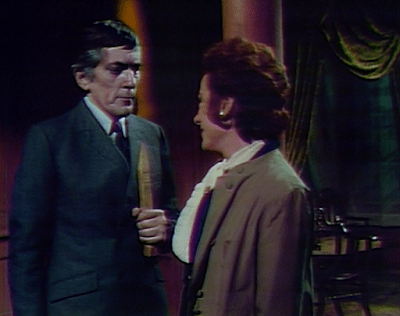
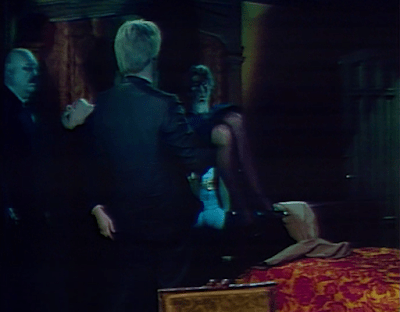
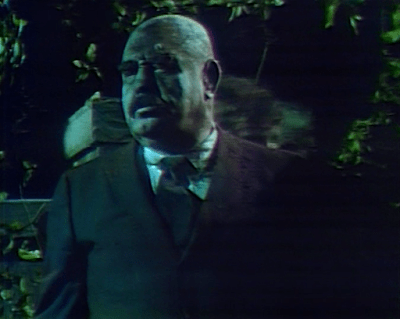
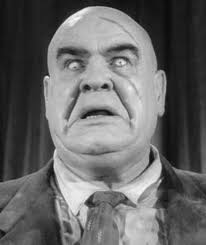

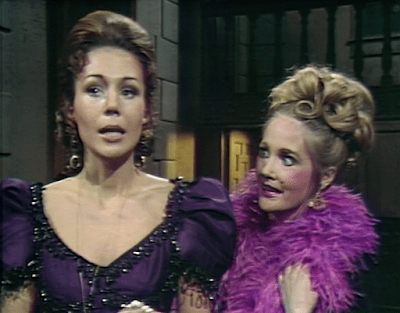
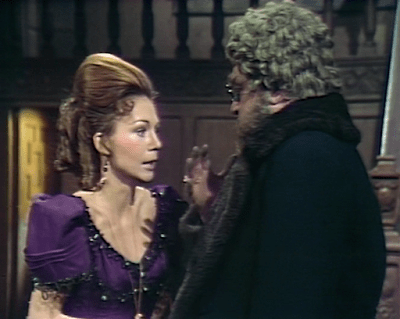

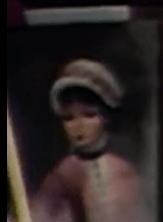

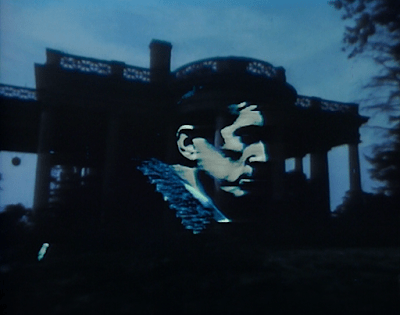

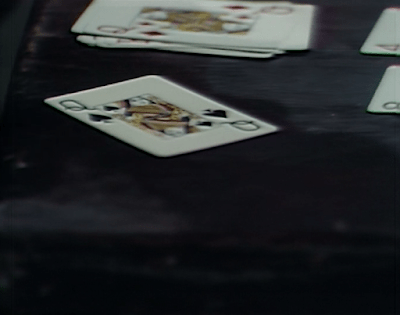
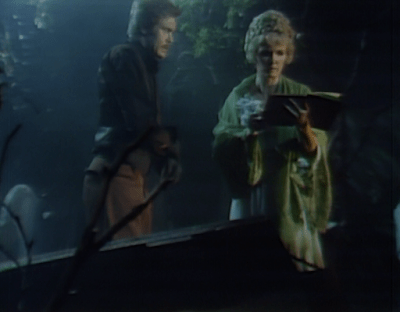
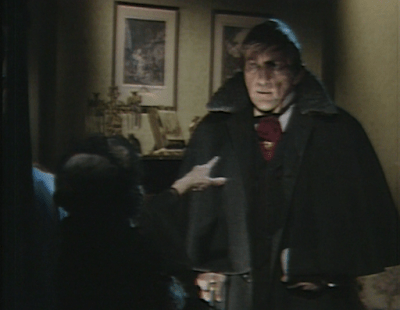


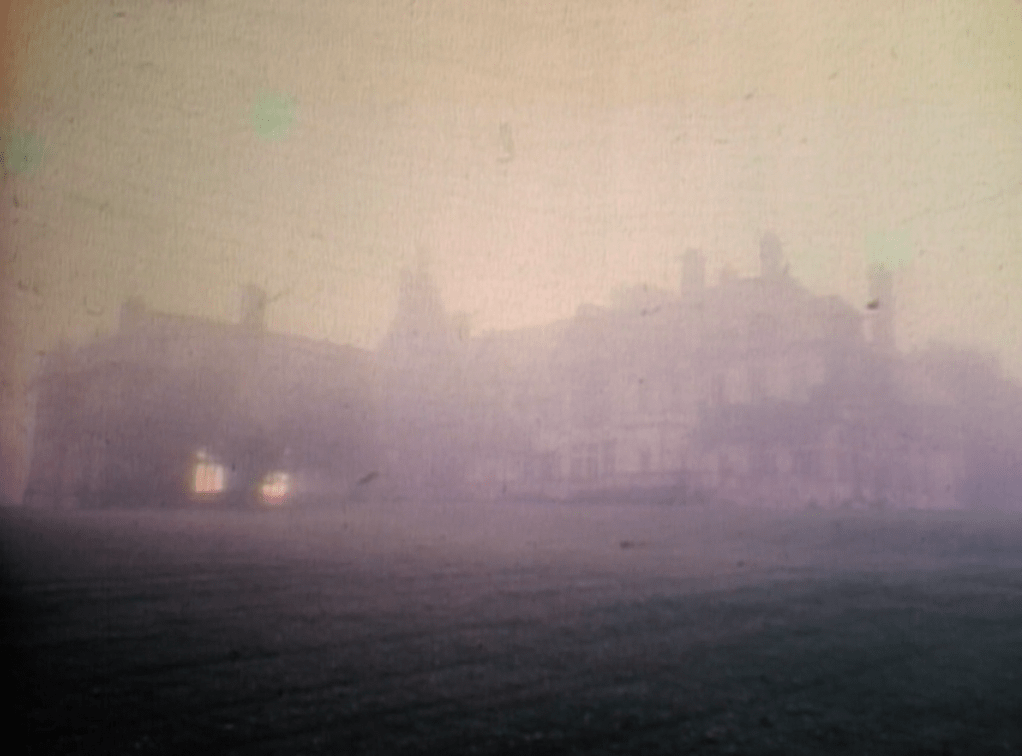

 Dark Shadows Commentary