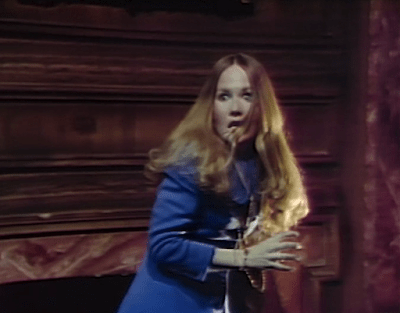
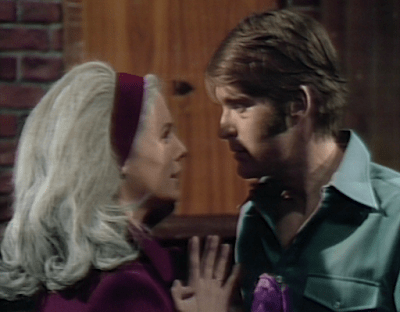
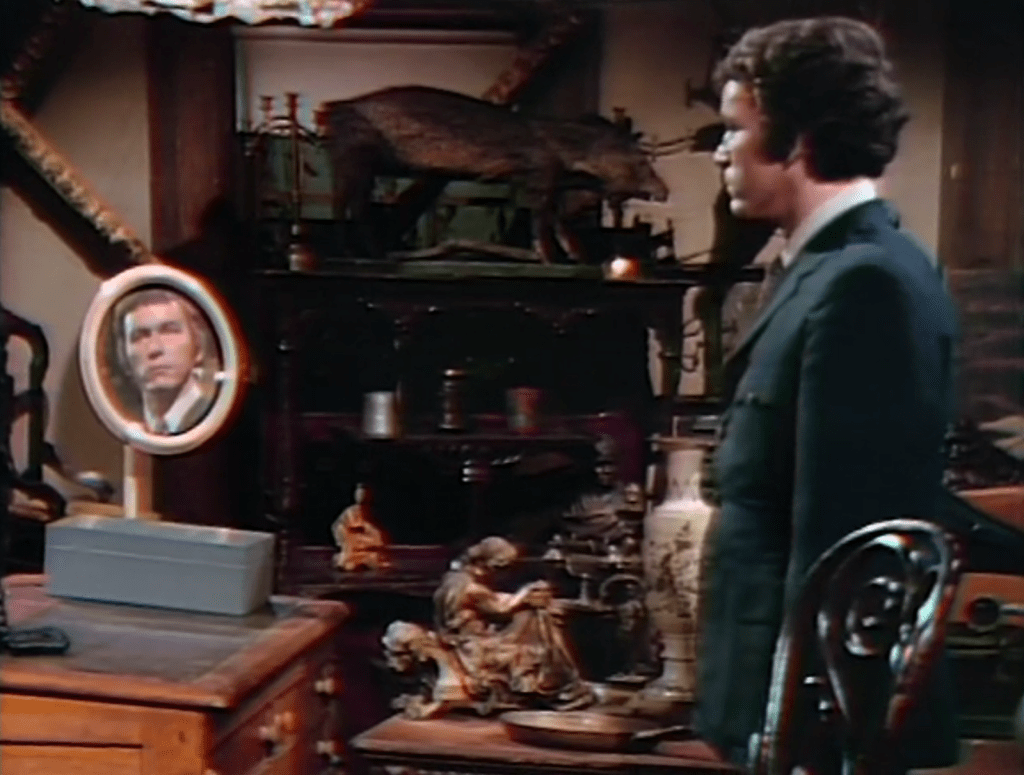
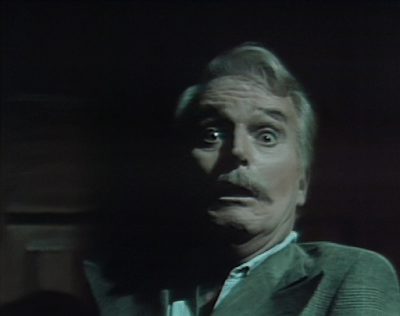
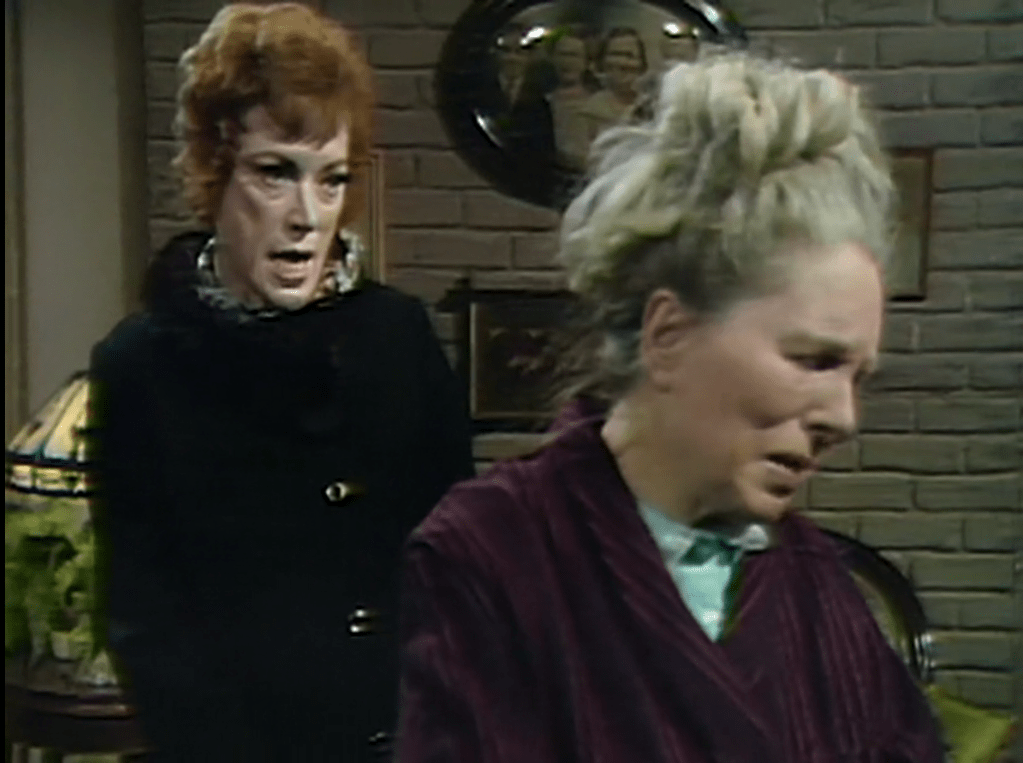
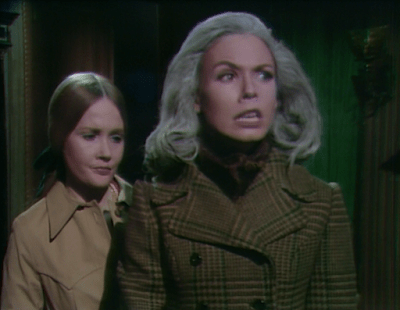
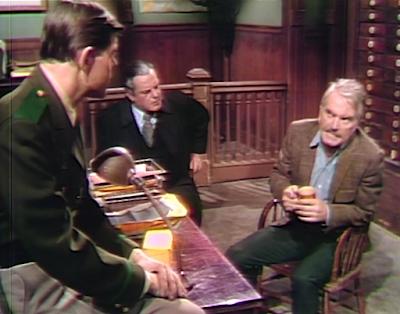
Episode 361 was virtually a one-woman show, featuring Grayson Hall as Julia Hoffman, MD. Julia was being tormented by haunted house-style effects resulting from her involvement with a supernatural entity. The script, by Ron Sproat, was largely a recycling of an episode Sproat had written for Never Too Young, the soap opera that ran on ABC at 4 PM before Dark Shadows premiered.
Episode 658 consisted largely of a one-man show, featuring Joel Crothers as fisherman Joe Haskell. Joe was being tormented by haunted house-style effects resulting from his involvement with a supernatural entity. The script, by Gordon Russell, owed a good deal to Sproat’s work on #361.
Episode 897 ended with a long scene that amounted to a one-woman show, featuring Marie Wallace as antique shop owner Megan Todd. Megan was being tormented by haunted house-style effects resulting from her involvement with a supernatural entity. The script, by Violet Welles, drew from both #361 and #658.
Many fans consider #361 to be The Worst Episode of Dark Shadows, and many consider Megan’s turn at the end of #897 to be The Worst Scene on Dark Shadows. To the extent that #658 is remembered at all, it is because it is one of Crothers’ last appearances on the show. The memory of this fine and well-loved actor makes the fans so weepy that no one can be very harsh about his final star turn.
Today, the second half of the episode is virtually a one-woman show featuring Nancy Barrett as heiress Carolyn Collins Stoddard. Carolyn is being tormented by haunted house-style effects resulting from her involvement with a supernatural entity. The script, by Gordon Russell, recycles elements of #361, #658, and #897.
Russell was usually one of the most careful writers on Dark Shadows, but this one is remarkably shoddy. Carolyn and her mother, matriarch Liz, are staying at the home of a woman named Angelique. Angelique tells them that she has to drive to the airport to pick up her husband, and that she will be away for “several hours.” A couple of minutes later, Liz is also called away, and she tells Carolyn that she is sure “Angelique will only be gone an hour or so.”
Worse, all the action of the episode is completely, flagrantly unnecessary. The calls that leave Carolyn alone in the house are part of a monster’s scheme to get at Carolyn. But Liz is the monster’s loyal servant- if he had told her to bring Carolyn to him, she would gladly have done so.
Carolyn’s torments aren’t quite a monodrama, since they are interrupted by a couple of brief scenes with other actors. But one of those is a dream sequence in which she talks to the monster while we see him silhouetted in darkness. The interaction between them is so limited he may as well be a recorded voice. She also has a few interactions with Angelique’s husband. Since he is played by Geoffrey Scott, he may as well be a cardboard standee.
One advantage this episode has over #361 is that Nancy Barrett was excellent at screaming, second only to Clarice Blackburn in her ability to produce a true blood-curdler. Grayson Hall, accomplished as she was, had asthma and was physically incapable of controlling the timbre of her voice when she raised its volume above a certain level. Sproat’s script for #361 required Julia to scream several times, and every time she tried it Hall emitted a croaking sound that raised a bad laugh. Miss Barrett’s closing scream today, by contrast, really puts the “opera” in “soap opera,” it sounds great.
This is one of the few episodes with no scenes on the estate of Collinwood, and one of very few to take place primarily in a location many miles from the village of Collinsport.
There’s also an interesting moment when Angelique claims to have met Liz and Carolyn’s distant cousin Barnabas while they were both living in England. Barnabas never lived in England, that’s a lie he has been telling his relatives to conceal the fact that he is a recovering vampire who hasn’t left Maine since George Washington was president. Liz is part of the current supernatural storyline and Carolyn has at various times known all about Barnabas, so we don’t expect to be reminded that he’s still peddling the “cousin from England” bit.
Maggie Evans, governess in the great house on the estate of Collinwood, is being held prisoner in a big mausoleum somewhere. Her captor appears to be a young man, but is actually a monster from beyond space and time. He is associated with the Leviathan People, a race of Elder Gods who are planning to take the earth away from humankind with the aid of some people whom they control and whom they have formed into a cult. The cultists call the monster Jeb, even though when we first saw him he said he wanted to be called Jabe.
Jabe orders Maggie to open a wooden box and look inside. He makes it clear to her that she is supposed to be under his control after she has done this, so she plays along. He lets her go, with orders that she is to spy on old world gentleman Barnabas Collins, a leader of the cult who has become disaffected from it and is working against Jabe.
Back in the great house, Maggie tells Barnabas what happened. Barnabas’ best friend, mad scientist Julia Hoffman, enters; he tells Julia that Maggie is their new ally in the fight against the Leviathans. When Barnabas was still loyal to the Leviathans, he tried to absorb Julia into the cult. That effort failed, and Barnabas explained that “certain people” were immune from absorption because of their “genetic structure.” Since Julia is the only Jewish character on the show, this sounded jarringly like a claim that the Leviathans were a restricted club. Evidently Maggie is now among those “certain people.” Since Maggie has a Welsh name and is played by a Minnesota-born actress of Scandinavian descent, that retroactively takes some of the anti-Semitic edge off Barnabas’ earlier remark for viewers who remember that episode (unless she converted.)
Maggie had taken an apologetic tone when she told Julia she wanted to be alone with Barnabas; Julia is very circumspect when she comes in at the end of their conversation. For a long time now, the show has been working on the idea that Julia wants a romantic relationship with Barnabas and is sad that he does not share her desire; for the last couple of weeks, they have been hinting that Barnabas and Maggie are getting pretty cozy. Regular viewers will be interested to see Grayson Hall playing Julia being a good sport about losing Barnabas to Maggie, and Kathryn Leigh Scott playing Maggie wishing she didn’t have to hurt her friend’s feelings.
We learned yesterday that Jabe is vulnerable to werewolves. As luck would have it, there is a werewolf at large in the Collinsport area. He is Chris Jennings, and Barnabas and Julia have been trying to cure him of the effects of his curse. He had been spending the nights of the full moon in a cell at Windcliff, a mental hospital Julia is in charge of, but last month came back to the caretaker’s cottage on the grounds of Collinwood. He couldn’t stand being cooped up, and chose to go back to his old practice of killing someone at random every month.
Julia and Barnabas don’t know that Chris is a weapon they can use against Jabe, and they want him to go back to Windcliff. The moon will be full tonight, so they are particularly anxious. But his onetime fiancée, Sabrina Stuart, has a different idea. She has been in contact with an expert on lycanthropy, and he has shipped her the only surviving specimen of the Moon Poppy. She brings the potted plant to Chris and tells him that the flower will open when the moon starts to rise. If he eats it while it is blooming, he will be cured. Otherwise, he will lose his chance- the plant will be dead before morning.
Chris’ transformation begins with moonrise, and once he has become the wolf he has no will of his own. When Barnabas stops by to take him to Windcliff, he points this out to Chris. But Chris is determined to try Sabrina’s cure. He is like every addict who talks himself into believing that this time, it will be different. Of course his determination fails him at the last moment, and by the time he can reach for the opening flower, it is a hairy paw, not a hand, that stretches towards it.
The flower cure and Chris the unlikable protagonist are both borrowings from the 1941 film The Wolf Man. Jabe lives in an antique shop; there’s an antique shop in that movie, too. There were some hints early on that werewolves were a threat to the Leviathans; evidently they had planned to bring these two stories together all along.
Closing Miscellany
Sometimes the closing credits are on cards, one after another; other times, they are on a continuous roll. Through the first year of the show, when they were on a roll costume supplier Ohrbach’s would be misspelled “Orhbach’s.” We haven’t seen that misspelling for a long time, but it’s back today. It will keep cropping up for the rest of the series.
Barnabas and Julia find a fake letter from Maggie saying that she’s been away visiting her Aunt Louise in Quebec. This is the first time we’ve heard of any members of Maggie’s family other than her late parents. Since the letter is a phony meant to cover up her abduction and neither Julia nor Barnabas seems to have heard of Louise before, it is possible there is no such person. Still, Maggie has been a major character since the first episode, so it does get longtime viewers thinking about how little we know about her background.
This is only marginally relevant to the episode, but I can’t resist bringing it up. The other day, a Twitter user named Zach Wilson (whose bio describes him as “watcher of TV, all of it, one episode at a time”) posted an image of pages of TV Guide from 22 April 1966 with the question “What would you watch?” An Educational TV station in whatever market it was running a WGBH-Boston produced telecast of the Boston Theater Company’s production of Gertrude Stein’s “Yes is for a Very Young Man,” starring Lisa Blake Richards. The Harvard Crimson had reviewed the stage production in November 1965; they said that “the play was lousy,” but they praised the cast for making the most of a bad script, singling out Miss Richards for the “outstanding job” she did “with a whining, pathetic character.” Sabrina isn’t exactly Lady MacBeth, either, and Miss Richards had her work cut out for her finding a way to make us want to see more of her.
Yesterday and today, a clock stopped at 8:00 featured prominently in shots when it was pivotal to the story that it was not 8:00. The clock is part of the merchandise in an antique shop, so it is understandable it does not run, but it is rather odd to see someone telling people that he didn’t wait for 8:00 when a clock face displaying that time looms over his shoulder. Today, it is important that a scene in the shop is taking place after 10:00. We open that scene with a view of a different clock, one that reads 10:20, but before long the stopped clock is back in full view.
At the great house of Collinwood, old world gentleman Barnabas Collins is rushing to the front door. Governess Maggie Evans asks him where he is going. He says that he is going to the village of Collinsport. She says she is going there as well and that she will ride in with him. He says that he can’t take her. He refuses to explain why. The other day, Maggie and Barnabas held hands and leaned in close to each other, talking softly about how important their friendship was. This sudden refusal to communicate pulls Maggie up short. She demands to know whether Barnabas trusts her. He says he does. She marches up to him and orders him to “Prove it!” The tight aspect ratio of old time TV combines with director Henry Kaplan’s habit of putting the actors as close to the camera as he can get them to make it seem, in the moment, that the feelings Maggie expects Barnabas to prove are of an erotic nature.
Maggie has been the governess at Collinwood for over a year now. Her predecessor, the well-meaning Vicki Winters, was written out of the show for a number of reasons, not least their inability to figure out an intelligible relationship between her and Barnabas. There was a long period when Vicki the character seemed to know that she was on a show starring Barnabas and she kept trying to involve herself in his storyline, even inviting herself to spend the night at his house. In theory, Barnabas was in love with Vicki and yearned for her, but no matter how flagrantly she threw herself at him he never did anything about it. Eventually they paired her off with an intolerable jerk, and the two of them disappeared into a rift in the space-time continuum.
Vicki never did take quite as direct an approach with Barnabas as Maggie does today. No matter how deeply Vicki drove the ball into his court, she always counted on him to show at least a little initiative. Maggie knows better than to rely on Barnabas, and she corners him into agreeing to see her and give some kind of explanation when he is done with the mission he is concealing from her, at 10:00 sharp.
Fans often fret about the “Vickification” Maggie undergoes while she is serving as governess. When it became clear that Vicki wasn’t going to matter to Barnabas, she couldn’t be allowed to affect the A story in any way. To keep her on the sidelines, she was written as an ever greater ninny.
Maggie is pretty bad at her job- she’s a squish when the children don’t want to do their lessons, which is every time we’ve seen her with them. But she’s still good with grownups, she’s smart, and she’s emphatically sexy. So she isn’t going to go down into irrelevance without a fight.
Maggie isn’t the only character insisting on her place in the story. A few weeks ago, it seemed that matriarch Elizabeth Collins Stoddard would be a part of the main plot for the first time in ages when she was inducted into a secret cult serving a mysterious race of Elder Gods who are trying to regain control of the Earth. But she has drifted back to the sidelines, and has yet to meet the cult’s leader in his current form.
Barnabas was Liz’ preceptor in the cult, and she is indignant with him for the decline in her part:
Liz: Barnabas, I must speak to you.
Barnabas: Not now, Elizabeth.
Liz: Have I done something wrong? Just tell me that.
Barnabas: No, nothing at all.
Liz: I’ve tried to follow the rules, as many as I know. You yourself can testify to my faithfulness. But David sees our leader, you’ve seen him.
Barnabas: Jabez?
Liz: Is that what he calls himself now? Well, no matter what name, he’s the same boy who used to play here. Surely he must remember me with some affection.
Barnabas: He is only recently matured enough to appear to us.
Liz: Why have I been ignored? Barnabas? You haven’t answered my question.
Barnabas: You’ll meet him soon enough but now is not the time.
Liz: Does the book specify when I am to meet him? Is that why you’re against it now?
During the show’s costume drama segments, Joan Bennett got to play dynamic roles, but she has been excluded from the action in the contemporary parts for so long that she has a tremendous amount of passion to bring to this scene. It is great to see her cut loose for once.
We open with a reprise of the end of yesterday’s episode. Quentin Collins and Amanda Harris are reenacting the myth of Orpheus and Eurydice. As in the ancient Greek story, they will live together if they can escape all the perils on the road from the realm of the dead to that of the living. Unlike that story, they are allowed to look at each other along the way, but they are not allowed to touch.
The teaser ends where Wednesday’s episode ended, with Amanda falling through a gap in a footbridge and Quentin crying out in anguish. After the opening title, we are surprised to find ourselves at the same scene. Amanda is not yet lost. Quentin pulls her up from the ravine she fell into. But that involves touch, so the ceiling of the cavern collapses and buries her. Suddenly, Quentin finds himself lying on the ground, in the upper world, with no sign of any way back to the place from which he just came.
Amanda’s demise marks Donna McKechnie’s final appearance on Dark Shadows. Miss McKechnie left to be in the original cast of Stephen Sondheim’s Company, paving the way for her enormous success on Broadway in the 1970s. Much later, Miss McKechnie would reprise the role of Amanda in a couple of Big Finish Productions’ Dark Shadows audio dramas, and nowadays she appears at the Dark Shadows conventions.
Any account of Donna McKechnie’s last day at 433 West 53rd Street would be incomplete without this story from Hamrick and Jamison’s book Barnabas and Company:
In rehearsal, we went through the scene with a few Styrofoam boulders and a little peat moss, no big deal. Nobody told me there was going to be ten times as much dropped during the taping. So, when it was time to tape the scene, I was looking up, and I just got buried. I got peat moss in my eyes and in my mouth and ears and nose… and I was covered in rocks. The way things worked at the studio, at the end of that scene, the lights went out, and the camera and crew and actors all moved on to the next scene, in another part of the studio. So there I was, laying under all those Styrofoam rocks and peat moss, and nobody helped me get out. I had to dig myself out, and that was my last experience on Dark Shadows.
Craig Hamrick and R. J. Jamison, BARNABAS AND COMPANY: THE CAST OF THE TV CLASSIC DARK SHADOWS (2nd edition, 2012) page 245.
They’ve been doing a bit of videotape editing recently, as several awkward cuts have made clear. One might think that the whole Underworld sequence, pre- and post-title, was edited in from tape left over from yesterday’s shoot. But Miss McKechnie’s story proves that is not so. The episodes were done in sequence, so if the last bit of tape they shot yesterday had been the crushing of Amanda there wouldn’t have been any next scene to run off to and Miss McKechnie would have had plenty of help digging herself out from under.
Some Sort of Monster was After Him
Meanwhile, the sheriff is at the home of occult expert Timothy Eliot Stokes. Stokes and his friend, mad scientist Julia Hoffman, have called him in because a monster wrecked Stokes’ bedroom, in the process killing a man named Paul Stoddard.
No law enforcement officer on Dark Shadows has yet solved a case, and Sheriff Davenport seems likely to prove the most useless member of the fraternity yet. At no point does he interrogate Stokes and Julia, or even show much interest in what they were doing while Paul was being killed. He refuses to believe Julia when she says that he should be looking for a monster, even though Collinsport has been overrun with monsters for years now and he has acknowledged that the wreckage at Stokes’ is like nothing he has ever seen. Julia tells him that the monster lives in the room at the top of the stairs in the antique shop operated by Megan and Philip Todd. In response, he flatly states that “They wouldn’t have anything to do with his death.” He finally agrees to get a search warrant for the Todds’ place, but when he presents it to Philip he says that he will execute it “unless of course, you don’t want me to?”
The meatiest part of the episode is a long scene between Megan and Philip. She is exultant that the monster has killed Paul and certain that it will go on to do other, even more wonderful things. He’s scared to death of what the monster will do to them if it is not defeated and of the retribution that will come to them if it is. She sneers at him as a coward. He admits that he is a coward, but insists that they run away and count themselves fortunate if they can escape with their lives.
In her first role on Dark Shadows, as Eve, The Fiancée of Frankenstein, Marie Wallace was called upon to show an unbending, unvarying contempt for Adam, the patchwork man she was supposed to marry. Since that was the only feeling Eve had ever shown for Adam, it wasn’t very interesting. But Megan loved Philip when we first met them. The other day, when she told the monster that she had loved Philip for a long time, we could believe her. So her scorn today does carry some force, and no one knows better how to play scorn and play it to the hilt than does Miss Wallace.
The part of Philip has not been a particularly congenial one for Christopher Bernau up to this point, but he too excels in the scene. He has lots of lines you would expect a man to find it hard to say, calling himself a coward and so on, but he speaks them smoothly and fluently. He shows his hesitancy and anguish not in his delivery of the lines, but in his facial expressions and movements while Megan is speaking. You can see him deciding to put aside all male ego and say something that might get through to Megan, no matter how humiliating it is for him to say it. With lines proclaiming his cowardice, Bernau creates the image of a remarkably brave Philip.
That in turn makes it possible for the episode to end on a suspenseful note. The closing cliffhanger has Sheriff Davenport turning the doorknob to the monster’s room, while Philip is frenziedly trying to come up with a way to talk him out of entering it. When we watched that, my wife, Mrs Acilius, said to the screen “If you don’t tell him what’s in there, it’s murder,” in a tone that suggested she thought Philip actually might tell the sheriff the truth. That such an idea could even form is a testament to Bernau’s outstanding performance in this episode.
For the first 55 weeks of Dark Shadows, matriarch Elizabeth Collins Stoddard was under the impression that she had killed her husband Paul and that Paul’s associate Jason McGuire had buried his corpse in the basement of the great house on the estate of Collinwood. She spent nineteen years at home, terrified that if she left the estate someone might find Paul’s grave and hold her to account for his killing. Finally it turned out that she had only stunned Paul. He and Jason had faked his death to trick Liz into giving them a lot of money. Soon, Liz was no longer a recluse and that whole story was forgotten.
Now, Paul has returned. He denies knowing anything about his fake death, claiming that Jason acted alone. Longtime viewers will be skeptical of this claim, and Liz certainly is. But she doesn’t care about it as much as you might expect. She is now part of a secret cult that serves mysterious supernatural forces known as the Leviathan People, who plan to take over the earth, supplanting the human race. Paul has learned that he inadvertently sold Carolyn Collins Stoddard, his daughter with Liz, to the Leviathans, and he has been trying to sound the alarm about them. As a serenely happy devotee of the Leviathan cult, Liz has agreed to keep Paul at Collinwood where she can drug him into immobility.
The power of the Leviathans has taken bodily form in a succession of children who live in an antique shop in the village of Collinsport. The shop’s owners, Megan and Philip Todd, were the first people inducted into the cult by Liz’ distant cousin, old world gentleman Barnabas Collins. The latest manifestation of this being, an apparently thirteen year old boy known as Michael, had been attracting attention that threatened to blow the cult’s cover, so Philip and Megan faked his death. They held a funeral this morning.
Michael is supposed to retire into his room above the antique shop and stay there until he has graduated to his next form. He comes out and tells Megan and Philip that he has decided not to go through with this plan. Philip picks him up and carries him there, putting a new lock on the outside of the door to keep him in until he has gone through another transformation.
Carolyn calls the Todds and extends her mother’s invitation to an evening at Collinwood. They accept.
Unknown to Liz or the Todds, Barnabas has become disaffected from the cult. He visits Paul in his room. He gives Paul clothes and a lot of money and urges him to go far away. Paul doesn’t trust Barnabas, and holds him at gunpoint throughout their entire conversation.
When the Leviathan cult first emerged, its members were siloed off from each other. Barnabas gave Philip and Megan their instructions in dream visitations. When they were awake, they would not recognize him as their leader. They and Liz were not aware of each other’s connection to the cult, though Liz did know that Barnabas was her leader and her nephew David Collins was a fellow cultist. It reminded us of secret operations in the real world, where only people who work with each other directly are allowed to know of their shared allegiance.
Now, all that security is out the window. Liz and the Todds stand around the drawing room at Collinwood having drinks and talking about what Barnabas has and has not told them about the Leviathans and their goals. They do still keep some secrets, however. Liz says that she can’t help but wonder what Carolyn’s role will be in the time to come. Barnabas and the Todds know that she is fated to be the bride of the force currently incarnated as Michael, but they are not allowed to tell Liz this. They look at each other with alarm, and Barnabas gives her some vague and hasty assurances.
There is an unintentionally hilarious moment during the cocktail party scene. Megan is seized by enthusiasm for the Leviathan project, and starts babbling all sorts of portentous phrases about the new world that is taking shape through their efforts. Marie Wallace was one of the most committed exponents of the Dark Shadows house style of acting, which consists largely of delivering your lines so vehemently that you are in constant danger of spraining your back. For her part, while Joan Bennett sometimes played to the balcony as Liz and her other characters, she never really let go of the urbane and relatively understated approach that made her one of the biggest movie stars of the late 1930s. When Liz responds to Megan with the amiable smile and subtly musical voice of a sophisticated society hostess, it all of a sudden strikes regular viewers who have got used to the show’s peculiarities just how incredibly bombastic Miss Wallace was.
Meanwhile, Paul goes through a lot of business with Barnabas and Carolyn in which he is told to wait an hour, no half an hour, no ten minutes, before leaving the house. He steals the keys from Megan’s purse and sneaks off to the antique shop. He has decided he must figure out what exactly is going on there. He lets himself into the room where the Leviathan force is kept when it is not embodied as a child. He hears a heavy breathing. The camera zooms in on his shocked face. With that, the episode closes. Paul’s future would appear to be extremely brief. On the day of Michael’s phony funeral, he seems likely to bring the show’s first fake death firmly into the realm of the actual.
Today marks Michael Maitland’s last appearance as Michael. He did a lot of acting as a child, including major roles on Broadway both before and after his run on Dark Shadows. Playing Michael didn’t give him much chance to show what he could do. His resume suggests that is a shame- he must have had a lot to offer to get all those big parts. And by all accounts, he was a very nice guy.
Michael Maitland died of cancer in 2014, at the age of 57. That means that three of the five child actors who appeared on Dark Shadows during the Leviathan segment have died. Denise Nickerson, who played Amy Jennings, was 62 when she died in 2019; Alyssa Mary Ross Eppich, who under the name Lisa Ross played the Leviathan child in the guise of an eight year old version of Carolyn in #909, was 60 when she died in 2020. David Henesy, who played David Collins, and David Jay, who played the Leviathan child as an eight year boy called Alexander, are still going strong. So too is Sharon Smyth Lentz, who played the ghost of nine year old Sarah Collins in 31 episodes in 1967 and the living Sarah in six episodes in 1967 and early 1968.
Antique dealers Megan and Philip Todd have called Julia Hoffman, MD, to the apartment above their shop in the village of Collinsport. They have been looking after a boy named Michael, and Michael has suddenly been taken very ill. Julia examines Michael and picks up the telephone to call for an ambulance. Before she can finish dialing, Michael has a seizure. She gives the boy a shot, but it does not stabilize him. She pronounces him dead.
Julia has many abilities that far exceed those of any other doctor- she can build Frankenstein’s monsters and bring them to life, cure vampirism, rewrite people’s memories with a wave of her medallion, and, when the occasion calls for it, transcend time and space and treat patients located in bygone centuries. But she has a curious shortcoming regarding death pronouncements. She has pronounced at least a dozen people dead, and almost all of them turned out to be alive and well. The death toll on Dark Shadows is so high that no category of character has as good a chance of survival as those who have been pronounced dead by Julia. So it isn’t much of a surprise when Michael comes downstairs into the shop at the end of the episode, none the worse for his experience.
Philip and Megan are members of a cult devoted to serving a supernatural force of which Michael is an embodiment. They have plotted to fake his death, perhaps to involve the actual death of his body in preparation for his reemergence in another form, to allay the suspicions that Julia and others have started to show. As a further step in this plot, Megan mentions the town of Coleyville, where a woman named Mrs Hutchins lives. She tells Julia that Mrs Hutchins took care of Michael before he came to live with her and Philip, and Julia goes to see her.
Violet Welles, writer of today’s script, likes to take us out of town. All we see of Coleyville is Mrs Hutchins’ living room and the area around her front door, but even so it is good to get away from Collinsport for a little while.
Mrs Hutchins tells Julia that Michael’s family were “the Hacketts.” The name “Hackett” has a history on Dark Shadows. In #223, dashing action hero Burke Devlin met with matriarch Elizabeth Collins Stoddard in the study of the great house of Collinwood and tried to talk her out of selling some properties to a man called “Hackett,” never heard of before or since. We also saw the name on screen twice. A few weeks after Burke tried to talk Liz out of the Hackett deal, her daughter Carolyn started dating a motorcycle enthusiast identified in the credits for #252 and #257 as “Buzz Hackett,” though in his other appearances he was listed simply as “Buzz” and his surname was never mentioned in the dialogue. Hackett is hardly a rare name, but it isn’t so common that this is likely to be a coincidence. Maybe Dan Curtis was a fan of comic Buddy Hackett, he was a big deal in those days.
Returning viewers know that everything Mrs Hutchins tells Julia is a lie. Michael did not exist until he took shape in an upstairs room of Megan and Philip’s shop in #913/914. Therefore, we pay close attention to Camila Ashland’s acting. She is a bit larger than life, but that is nothing unusual on Dark Shadows. After Julia exits, Philip enters and pays Mrs Hutchins for her performance; she asks him if there really was a little boy who died, and he sternly reproves her for asking questions. Ashland tones her performance down for Mrs Hutchins’ scene with Philip, suggesting that with Julia she really had been playing the role of an actress at work.
Julia admires Mrs Hutchins’ acting, while we admire Camila Ashland’s.
Philip leaves by the front door, and of course Julia is waiting behind the shrubbery to see him go. She goes to her friend Professor Timothy Eliot Stokes and tells him what she has learned. Stokes later goes to the antique shop to meet the Todds. He tells them he is in a hurry, but they peek out their window a few minutes after he has gone and see him across the street, looking at them. No one on Dark Shadows has much of a flair for OpSec, so this isn’t a great surprise.
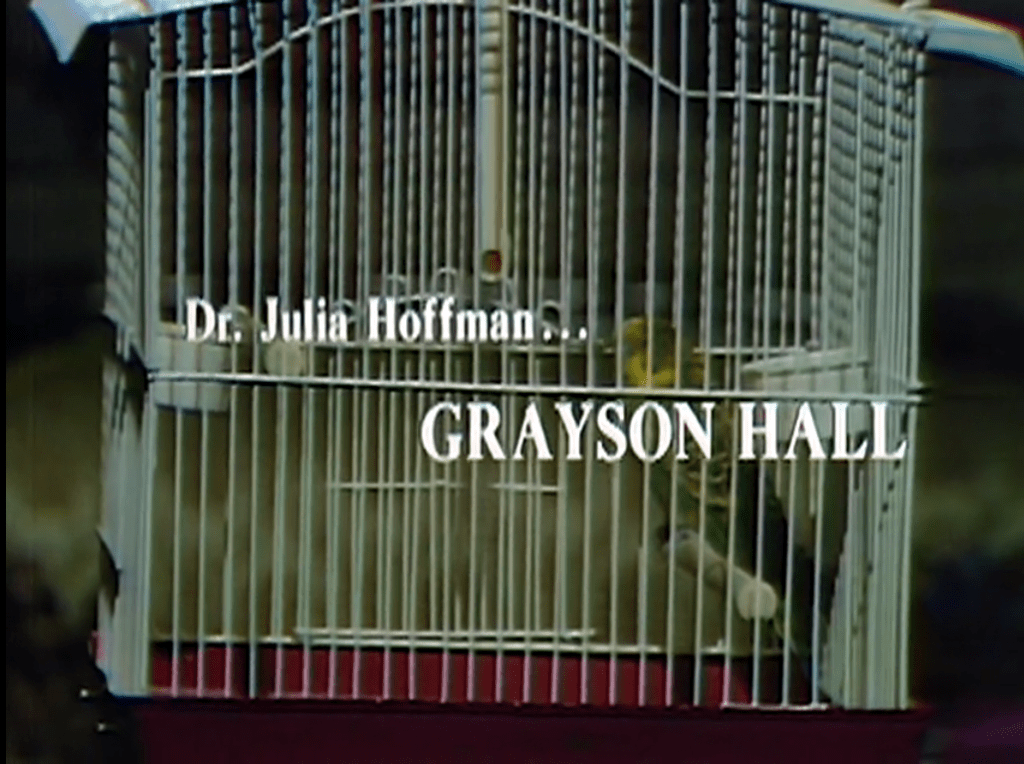
The closing credits run over a shot of Mrs Hutchins’ birdcage. The parakeet moves around as they roll. It is a charming shot, almost as good as the motorized puppets under the credits at the end of #904. That was another Violet Welles script, I suppose she was the one who decided to liven up the credits.
Mad scientist Julia Hoffman finds that wicked witch Angelique has married a businessman who has a house on an island off the coast of central Maine. Angelique tells Julia that her husband’s love has freed her to live as a human being, and that for the sake of that love she has renounced her powers. In #882, set in the year 1897, Angelique said that she would soon have to return to the underworld unless she could find a man who would love her. The show has since returned to a contemporary setting, and she met her husband less than a year before, sometime in 1969. Evidently her time wasn’t running as short as she led us to believe it was.
In the 1897 segment, the show was quite clear that Angelique was aligned with Satan and that the underworld she was talking about was a Hell that Dante or Milton or other Christians would have recognized. The deal she described with her master therefore made little sense then. But Dark Shadows has drawn freely on the mythologies of many cultures and has made up stories about supernatural worlds of its own. The borrowings from the Christian tradition are a relatively minor part of the universe they have been patching together, and they have recently given us reason to suspect it is something they are backing away from. So I don’t think we are under any obligation to reconcile Angelique’s account of the lord of the damned with the teachings of any church.
Angelique is afraid that Julia has come to reenlist her in the cosmic battles surrounding the estate of Collinwood. In fact, Julia had no idea she would find Angelique. She went to the island because she had figured out that a painting she was looking for was there. It is a magical portrait of rakish Quentin Collins, obscured by a landscape painted over it. Quentin has amnesia, and Julia apparently thinks that if she shows him the portrait she will be able to jar some memories loose.
Angelique agrees to let Julia take the painting and expose Quentin’s portrait, on condition that the overpainting be exactly reproduced on another canvas and brought back to the house on the island before her husband knows it was gone. Julia suggests they tell him a lie that will give them more flexibility, but Angelique says he is “a very thorough man” and would ask too many follow-up questions if they gave him any information at all.
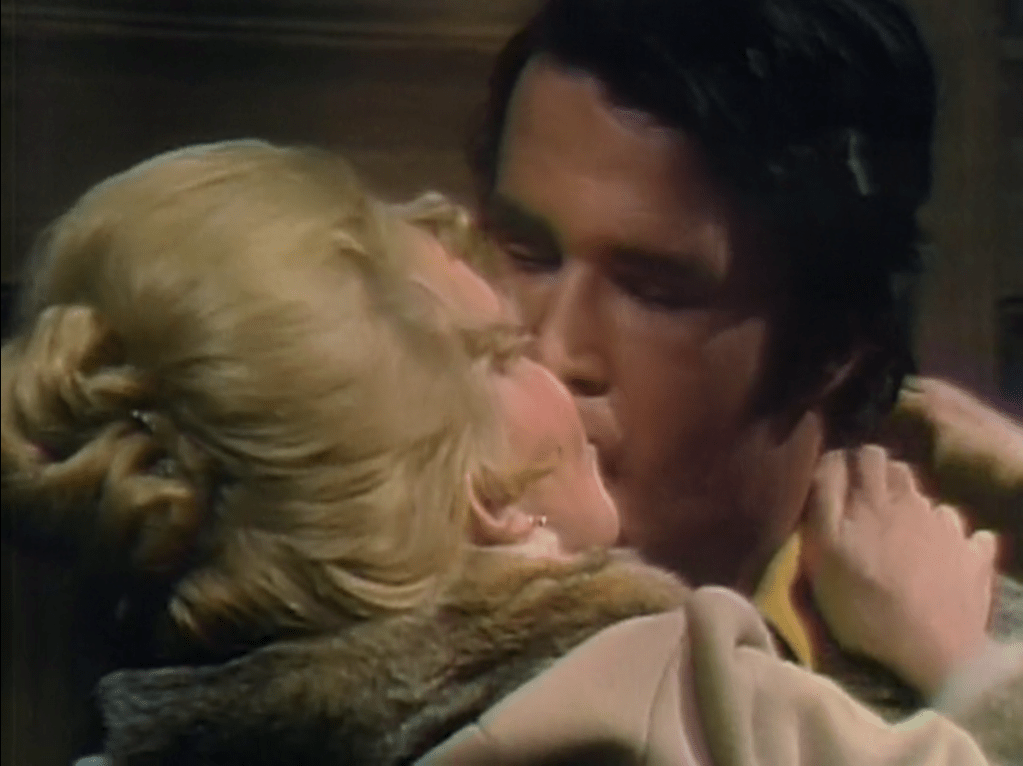
Before and after her scene with Julia, we see Angelique with her husband. The first scene begins with some very awkward kissing. The awkwardness is partly due to Geoffrey Scott’s total incompetence as an actor; he stands stiffly while Lara Parker simultaneously kisses him and nudges him to his mark, making it look like she is moving a couch. But part of the blame must rest with director Lela Swift, who set up the shot from an angle that puts the emphasis on the straining muscles in Parker’s neck and back. Perhaps Swift overestimated Scott’s abilities.
“Move three inches back and to the right, dummy, you’re supposed to be in the center of the frame!”
This scene is accompanied by some music for a small string ensemble; I don’t believe we have heard the track since the very early days of the show. It feels jarringly old-fashioned. All of Dark Shadows’ orchestral score strikes 21st century viewers as a relic of an earlier era, but it set it apart from other daytime soaps of the 1960s and early 70s, most of which had an organ playing on the soundtrack. Compared to the organ accompaniment, which today’s audiences would find simply intolerable, I suppose even these creaky old violins are relatively modern.
The second scene ends with a more successful kiss. It is accompanied by a woodwind piece that used to be associated strongly with well-meaning governess Vicki and her doomed love for dashing action hero Burke Devlin. Burke was written out of the show in 1967, Vicki in 1968, and this music cropped up occasionally in 1969 during sentimental moments. It is still noticeably more old-fashioned than the rest of the score, albeit more dynamic than the string serenade that went along with the first kiss.
Meanwhile, in the great house at Collinwood, strange and troubled boy David Collins is coming down with a cold. David’s governess, Vicki’s successor Maggie Evans, is trying to get him to take his schoolwork seriously. A boy known as Michael appears in the house and announces that he and David will be playing now. Maggie explains that it is not a good time, and Michael bullies both her and David into giving him his way.
Michael is not really human, but is a manifestation of a supernatural force that has subjugated David and many other people. Seeing Michael push Maggie around, we might remember May and June of 1967, when Maggie was the prisoner of vampire Barnabas Collins. Those episodes were bleak and at moments painful to watch, but they also drew a new audience and made Dark Shadows, for the first time, a hit.
Barnabas attracted a crowd, not simply because he was cruel to Maggie, but because we wondered how others would react to his evil deeds, because his motives were unbelievably zany, and because actor Jonathan Frid took a visible joy in playing him. He became a breakout star, familiar to millions who never saw a single episode of Dark Shadows or knew anything else about it, because he generated stories that allowed the whole cast to shine, followed his crazy ideas to the point where many of them became the realities of the show’s narrative universe, and had quirks that dovetailed perfectly with Frid’s strengths.
Michael has none of these things going for him. When he is nasty to Maggie, he does not produce any suspense as to what others will do. Not only do most characters assume that as a teacher she will be able to handle an obstreperous child by herself, but most of the people to whom she would likely turn for support are among Michael’s subordinates. There are no crazy ideas bursting out of him- he is just a little tyrant, who at no point seems to have any hidden motives or nuances of feeling. And Michael Maitland seems depressed the whole time he is on screen. As a result, Michael is as straightforward and tedious as Barnabas was luridly intriguing.
When Barnabas was holding Maggie prisoner, his blood-thrall Willie felt sorry for her. He occasionally made efforts to help her, none of which did anything but make her situation even worse. John Karlen’s portrayal of the feckless Willie brought him almost as much fan mail as Jonathan Frid received during that period. Today it is David’s turn to play Willie to Michael’s Barnabas, and he does not disappoint. Thirteen year old David Henesy plays David Collins’ conflicted feelings more subtly than Karlen had played Willie’s, and as a result we watch him very closely. Disappointed as we may be in Michael, Mr Henesy’s triumph in these scenes brings the episode to a strong close.
Yesterday, Amanda Harris told the story of a suicide attempt she made in 1897. A supernatural being whom she calls “Mr Best” thwarted this attempt, and told her that he would arrange for her not only to avoid death, but to remain young, for the years that it had been ordained she would live. If in that time she could reconnect with her lost love, rakish Quentin Collins, she and he would never die. Now it is 1970, and Amanda’s time is up. Mr Best is at her door. Amanda has found Quentin, but he has amnesia and is not ready to resume their relationship as Mr Best’s terms require.
Mr Best has changed startlingly since we met him in the flashback that showed us Amanda’s story. Then he was warm and solicitous; today he is truculent and cold. Even his makeup is different. A pale coloring suggests sunken cheeks, making him look corpse-like.
Amanda has reversed her own attitude as well. In 1897, Mr Best lamented her wish for death and pleaded with her to stay alive; now it is Amanda’s turn to beg Mr Best for more time while he shows impatience with her. When she tells him about Quentin’s amnesia, he asks brusquely “Are you making this up?” It merits a laugh that the story of Dark Shadows has become so far-fetched that even Death Incarnate finds it hard to believe. But Mr Best does soften, and gives Amanda seven more days to get Quentin to tell her he loves her.
Quentin’s own perpetual youth is the result of a magical portrait that immunized him from the effects both of aging and of the werewolf curse that was placed on him in 1897. Quentin’s great-grandson Chris Jennings has inherited that curse. Mad scientist Julia Hoffman had learned that artist Charles Delaware Tate was still alive, and hoped he would paint a portrait of Chris that would free him from lycanthropy. Tate told Chris he no longer had the gift, but Chris forced him to paint his picture anyway. The moon rose, Chris transformed, and as the wolf he murdered Tate.
One of Chris’ surviving victims is his ex-fiancée, Sabrina Stuart. Sabrina saw him transform, and as a result was struck dumb for years and went prematurely gray. She can talk now, but she’s still gray. She shows up today at the great house of Collinwood where she calls on heiress Carolyn Collins Stoddard. Carolyn tells Sabrina that she doesn’t love Chris and never will, but that she realizes Sabrina loves him. This adds to a growing list of reasons the show has given us to doubt that Chris will be on much longer. His premeditated murder of Tate establishes him as a pure villain. A villain’s function is to create problems for other characters to solve, and Chris has been too passive and too dependent on Julia to be an interesting villain. His relationship with Carolyn gave him a connection to the core cast, but Carolyn’s conversation with Sabrina makes it clear that that is gone now.
Sabrina insists Carolyn go on a road trip with her. She takes her to Tate’s house and leads her into the room where Chris murdered the artist. She tells her that a man was just killed there. Carolyn asks Sabrina if Chris did it. Sabrina looks pained, and says “Not Chris!” This further undermines Chris’ position. As long as Sabrina was mute, we could wonder whether she would blow the whistle on Chris once she regained the power of speech and if so what the consequences of that would be. But now we see that she is still in denial about him, and can set aside any hope that she might generate a story for him.
Carolyn asks Sabrina how she knows about the murder. No answer is forthcoming, and there doesn’t seem to be any way she could know. Evidently Sabrina has now developed some kind of clairvoyance about Chris’ murders. Since she is apparently determined to use that power to limit Chris’ relevance to the story, it is yet another reason to suspect he will be written out soon.
Julia enters the crime scene. She and Carolyn are surprised to see each other. Sabrina announces that Julia knows all about Chris, and gets upset about it. Julia, a psychiatrist by profession, slaps her in the face, the accepted treatment for angry women in 1960s television shows. Sabrina quiets down, and Julia sends her away with Carolyn. Once they are gone, she settles in at Tate’s desk and starts rummaging through his papers.
Julia wants to cure Quentin of his amnesia. She looked through an old Collins family photo album, and found that two pictures of him had gone missing. She is puzzled as to who took them; this is a continuity error, since in #686 and #687 there was a whole thing about ghosts removing photos relevant to Quentin from albums after Julia had looked through them. Be that as it may, Julia discovers in Tate’s papers that he had painted over Quentin’s portrait and that it is now in a big house on an island nearby.
We see a man holding a telephone and reciting lines of dialogue. He puts the phone down, looks at Julia, and recites more lines in the same unmodulated voice. Grayson Hall stays in character with her responses, and plays Julia asking to see the painting, but the man does not do anything that could be called acting. Dark Shadows has featured its share of lousy performances, but I cannot recall a member of the cast simply enunciating words as if he were in a neurologist’s office demonstrating that he had memorized the unrelated syllables given him to reproduce. It is genuinely bizarre.
The man’s name is Geoffrey Scott, and if anyone had told him he was supposed to act he would be playing a character called Sky Rumson. I suppose “Rumson” is a good name for a character who is identified with a house on the beach, since beach houses are what Rumson, New Jersey is known for, though the beach might not be front of mind in early January in central Maine. Sky is a go-go businessman, and his lines to Julia are about what a great hurry he is in.
Sky shows Julia the painting that covers the portrait of Quentin. He tells her that it isn’t very good. Indeed it is not particularly distinguished, but it is far superior to any of Tate’s other works, some of which they want us to regard as museum pieces. Sky says that he bought the painting for his wife, who has an unaccountable fondness for it. He shows Julia a painting of Mrs Rumson. Julia has seen the painting before, and knows the model very well. It is a portrait of her old frenemy, wicked witch Angelique.
For regular viewers, this ending will be as satisfying and as logical as Geoffrey Scott’s phonetic rendering of his dialogue is disconcerting and inexplicable. Eight weeks ago, the show returned to contemporary dress after a long stay in 1897, beginning a new clutch of stories. Angelique is often absent from the show for extended periods, but she always turns up sooner or later. None of the three major storylines- Chris’ werewolf curse, Amanda’s attempt to rekindle her romance with Quentin, and the menace of the secret cult devoted to supernatural beings known as the Leviathans- is very closely connected to either of the other two, and none of them has any particular sense of urgency. Angelique’s vast powers and maniacal narcissism make it easy for the writers to inject her into every plot and accelerate them all towards a common resolution. In the 1897 segment, they moderated both her might and her mania, so that they can now keep her on indefinitely without overwhelming the show. Angelique is not what Julia expected to find, but she may be just what the doctor ordered.
Professor Timothy Eliot Stokes has parked his car and is walking up to the great house of Collinwood, home to matriarch Elizabeth Collins Stoddard and her daughter Carolyn Collins Stoddard, among others. He sees a man lying on the ground and asks him what is wrong. The man pleads with Stokes to help him get away. Stokes asks him what he wants to get away from; the man responds “I can’t tell you.” Stokes asks who he is; he says his name is Stoddard. Stokes replies “You’re Paul Stoddard, Carolyn’s father.” Paul brightens momentarily at Carolyn’s name, but then draws up tight and asks “They sent you after me, didn’t they?” Stokes assures him that no one sent him, and tells him he will catch his death of cold if he continues lying on the ground.
Paul asks Stokes to take him to the police. Stokes nods to the house and says they can call the police from there. Paul cries out, “No! No, not to Collinwood. Please, Professor Stokes, you’ve got to take me to the police, it’s the only thing you can do for me. If you don’t, I’ll be dead. No, no, no, I am not being hysterical or melodramatic…” At this, Stokes turns to face his car. He gives Paul his arm, and says he will drive him to the police station.
The police station was a frequent set for about a year after its first appearance in August 1966. It hasn’t changed a bit when we see it today. The officer on duty is someone we haven’t seen before, but that doesn’t mean he is a new character. Four actors took turns playing Sheriff George Patterson between September 1966 and January 1969; this man is not named in the dialogue and there are no acting credits on screen today, so for all we can tell he might be a fifth. He is younger and slimmer than were any of the other incarnations of Sheriff Patterson, but maybe he’s been working out.
Stokes introduces Paul to the policeman, and explains that Paul will speak only to the authorities. The policeman sits Paul down, gives him some coffee, and assures him that everything will be all right.
Paul tells the policeman that “It will never be alright until they stop chasing me” and “They have been after me ever since I got here.” The policeman asks “What are these people doing to you?” and Paul replies that “At first, there were just little hints, phone calls, things like that- veiled threats. It was their way of making me know that I was under their control. And I was, too, because when I tried to get away they took me back to Collinwood.”
The policeman responds “I see,” and Paul bursts out with “No, you don’t see! You think I’m mad!” The policeman tries to reassure him that he will listen, and asks him if he can name any of his persecutors. “Yes, I’ll name one, all right! My [ex-]wife, Elizabeth Stoddard.” The policeman says “That’s a little hard to believe,” and Paul responds “It’s impossible to believe, and yet! You tell me why she took me back into Collinwood, after years of open hatred, unless they wanted me there! And you know this town, you know how they gossip. And you know my wife. Why, why would she risk all that gossip, unless they wanted her to do so?” He answers that even so, “It’s still a little hard to believe.”
Paul angrily says “Yes, and because it’s Elizabeth Stoddard who’s involved, you will do nothing!” The policeman responds “I didn’t say that. I intend to talk to Mrs Stoddard and the doctor and whoever else is involved. If you still feel you’re being held captive, well, we’ll have to do something about it.” Paul visibly relaxes.
Earlier in the episode, we saw Liz forcing medicine on Paul. Returning viewers know that Liz has been absorbed into an evil cult that is trying to do something terrible to Paul, and indeed to the whole human race. We saw today that Liz has assigned her housekeeper, Mrs Johnson, to trick Paul into taking the medicine. It quickly becomes clear that Mrs Johnson has no idea that Liz is involved in anything sinister- she simply trusts her employer to do the right thing, and she follows her orders. Liz owns most of the village of Collinsport, and most of its people would react as Mrs Johnson does.
When we saw the last Sheriff Patterson for the last time in #675, he told a prisoner that he was releasing him because Liz’ cousin Barnabas said he was with him when the crime was committed, and Barnabas is “just about the best alibi you can have in this town.” He shook hands with the prisoner and sent him on his way. Since we know that Barnabas is, off and on, a vampire, and that even when he is free from the effects of that curse he spends most of his time covering up murders, that left us with an impression of Collinsport law enforcement as hopelessly in the thrall of the Collinses. That reinforces the image left by Sheriff Patterson’s predecessor, Constable/ Sheriff Jonas Carter, who was last seen in #32, toddling off after taking Liz’ orders to accept an obvious lie as a way of closing a case against a family member. Paul has every reason to suppose that this new policeman will be as submissive to Liz and her family as were his predecessors.
Now that Paul can hope that the policeman will be different from the others, he asks him to lock him away, to put him under guard someplace where no one can get to him until his daughter Carolyn Collins Stoddard can come for him. Stokes agrees to telephone Collinwood and talk to Carolyn, and the policeman escorts Paul to a back room. Paul awakes from a nap, and smiles at the policeman. He tells him he can’t tell him how much better he feels. The policeman tells him someone has come to see him. Paul’s delight at the thought that Carolyn has arrived gives way to cries of terror when he sees Liz at Stokes’ side. She comes at him with a spoonful of the hated medicine while Paul tells Stokes and the policeman that they are traitors and killers.
This one is primarily a showcase for Dennis Patrick as Paul, but all of the acting is excellent. My wife, Mrs Acilius, found it very difficult to watch the episode to the end, saying that they did too good a job- she felt as trapped as Paul. It really is one of those episodes you could show to a person who had never before seen Dark Shadows with a reasonable confidence that they would understand why we like the series so much.
In December 1968, children David Collins and Amy Jennings explored the long-deserted west wing of their home, the great house on the estate of Collinwood. They stirred up the ghost of Quentin Collins, who turned out to be David’s great-great uncle and Amy’s great-grandfather. For the next several weeks, Quentin steadily gained power and wrought ever graver havoc, until by the end of February the great house had become uninhabitable and David was hovering between life and death. At that point, David and Amy’s distant cousin Barnabas Collins did some mumbo-jumbo to try to contact Quentin’s ghost, only to come unstuck in time and find himself in the year 1897, when Quentin was a living being.
For the next eight months, Dark Shadows was primarily a costume drama set in 1897. Occasional glimpses of 1969 showed us that the haunting was continuing. In #839, we saw David lying dead before his father Roger, finally having succumbed to the effects of the haunting. But while Roger was lamenting him, David came back to life. The events in the part of the episode set in 1897 had changed the future, so that the ghost of Quentin found peace and Collinwood returned to its usual condition. But that took effect as of the anniversary of the change. Everyone’s memories of the ten months of Quentin’s haunting and of the eight months of Barnabas’ absence in the past are intact.
Not only is Quentin no longer a ghost, he isn’t even dead. In the altered version of 1897 that we saw, an artist named Charles Delaware Tate painted a portrait of Quentin that had the same magical effects on him that Dorian Gray’s portrait had in Oscar Wilde’s novel. Quentin looks, moves, and sounds exactly like he did when he was 28 years old. He has recently returned to Collinsport, and has amnesia. He was found carrying identity papers in the name of Grant Douglas. He’s open to the possibility that that may not be his right name, but when he finds Dr Julia Hoffman, MD trying to convince him he is the 99 year old Quentin, he is incredulous.
At Collinwood
We open today in Quentin’s old room in the west wing. Julia has persuaded Quentin to sit there and listen to his record player. In the unaltered timeline, he was obsessed with a sickly little waltz, listening to it over and over in 1897 and inflicting it on Collinwood when he was a ghost. Julia plays the record, and it doesn’t mean a thing to him. She becomes frustrated and accuses him of lying when he says that he doesn’t remember that he is Quentin.
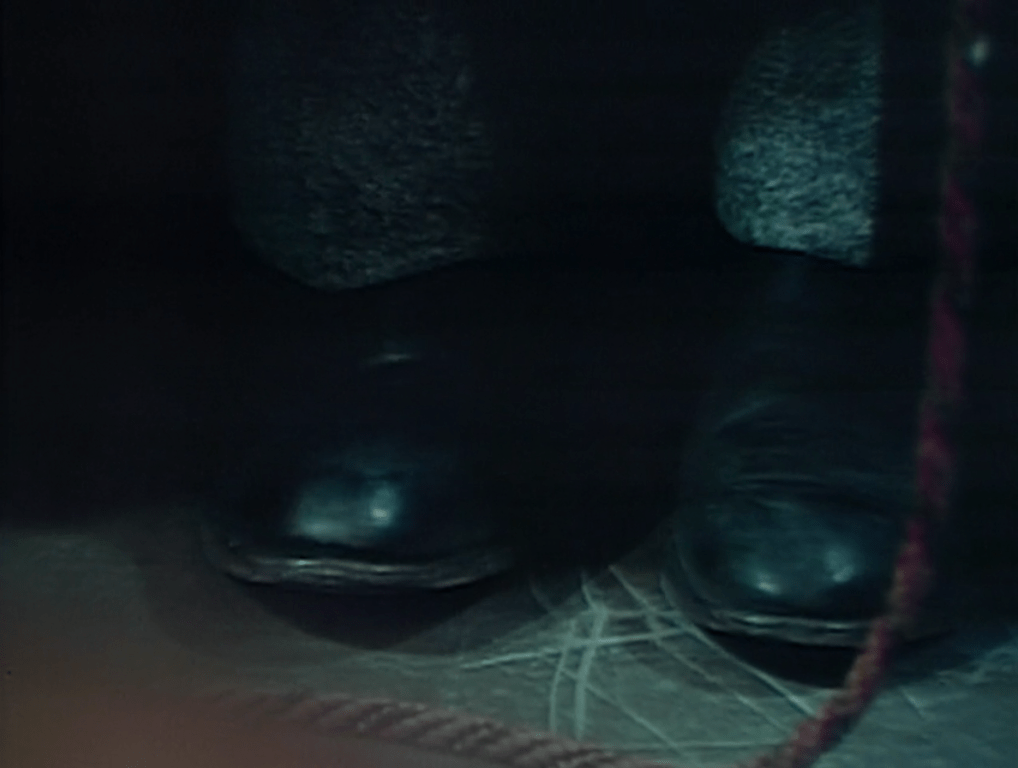
The music does ring a bell for someone else in the house. The sound of it reaches David and wakes him. Alarmed, he makes his way to Quentin’s room. By the time he gets there, Quentin is hiding behind a curtain. Julia tells David she went in to look for a painting, and that she thoughtlessly started the record player. He accuses her of hiding Quentin. While she is denying it, he sees Quentin’s shoes sticking out from under the curtain.
Quentin’s shoes, as seen by David.
In 1963, philosopher Edmund Gettier published a little paper about the traditional definition of knowledge as “justified true belief.” He gave several examples of justified true beliefs that most people would not regard as knowledge. His examples were kind of far-fetched, but it is easy to come up with more plausible instances. For example, I first read Gettier’s paper when I was in college, and at the same time I was reading Anthony Trollope’s novel The Eustace Diamonds. The main point of that novel is that everyone believes that Lizzie Greystock has stolen some diamonds from her late husband’s estate. She has in fact done so, and they have good reason for believing that she did so, but those reasons are so mixed up with misunderstandings of Lizzie’s motives and other circumstances that we wouldn’t say any of them really knows anything about her. My epistemology professor was excited when I told her about the novel, since the example she gave to our class to show that Gettier’s contrivances were not the only cases illustrating his point was something overly elaborate about believing that you have recognized someone whom you have partially seen while he is hiding most of himself behind a curtain.
David’s claim that Julia is hiding Quentin is another Gettier case. He believes it, the sight of Quentin’s shoes in Quentin’s room provides compelling justification for believing it, and it is true. Yet the Quentin whom Julia is hiding does not have any of the characteristics that give David’s belief the significance that he draws from it. His presence is not a sign that the haunting has resumed and that David is back in mortal danger. He is not a ghost at all and is not a threat to David or anyone else in the house. So while David has a justified true belief that Julia is hiding Quentin, that belief is so deeply entangled with a severe misunderstanding of the situation that we wouldn’t count it as knowledge.
Once David is gone, Quentin emerges and demands answers from Julia. She tells him something about Quentin’s ghost; he already finds her insistence that he is 99 years old to be so preposterous that the additional detail that he used to be dead prompts a merry laugh. By the time he is at the front door ready to leave, he is stern and telling Julia that he expects a “full explanation” tomorrow. Lotsa luck on that- ghosts, time travel, magical portraits, and a universe where the present is a stew made up of the consequences of several mutually incompatible pasts? And those are just the elements you can’t avoid in the executive summary of the situation. A “full explanation” involves werewolves, vampires, a humanoid Phoenix bent on incinerating her children, demons conjured from the depths of Hell, a sorcerer who still misses his pet unicorn, and about a thousand other fantastical topics.
David eavesdrops on Quentin and Julia’s parting conversation. When he was a ghost, we never heard Quentin speak- he communicated telepathically with David and Amy, and they could apparently hear his voice on a particular telephone, but he never stood around and talked with anyone like this. So the mere fact of the conversation undermines David’s belief that the man he is looking at is Quentin’s ghost. When David hears Julia call Quentin “Mr Douglas,” he can see that whoever this person may be, he is not exactly Quentin, not as he knew him. He does recognize the name “Mr Douglas” as that of a man his cousin Carolyn Stoddard met at the antique shop in the village where she works and whom she visited in the hospital when he first had amnesia, so his attitude towards him changes.
In the Antique Store
Unknown to Julia or Carolyn, David has been assimilated to a cult that serves unseen supernatural beings known as the Leviathans. Carolyn’s mother, Elizabeth Collins Stoddard, has also been absorbed into the cult, as has Barnabas. Megan and Philip Todd, the owners of the antique store, are members too, and they are fostering a mysterious creature who currently appears to be an eight year old boy and answers to the name Alexander. Liz takes David and Amy to the antique store, where they interrupt an uncomfortable conversation between Alexander and Julia.
Liz suggests to Julia that they should leave Amy and David in the store to play with Alexander. Julia doesn’t think this is such a hot idea, but Liz insists.
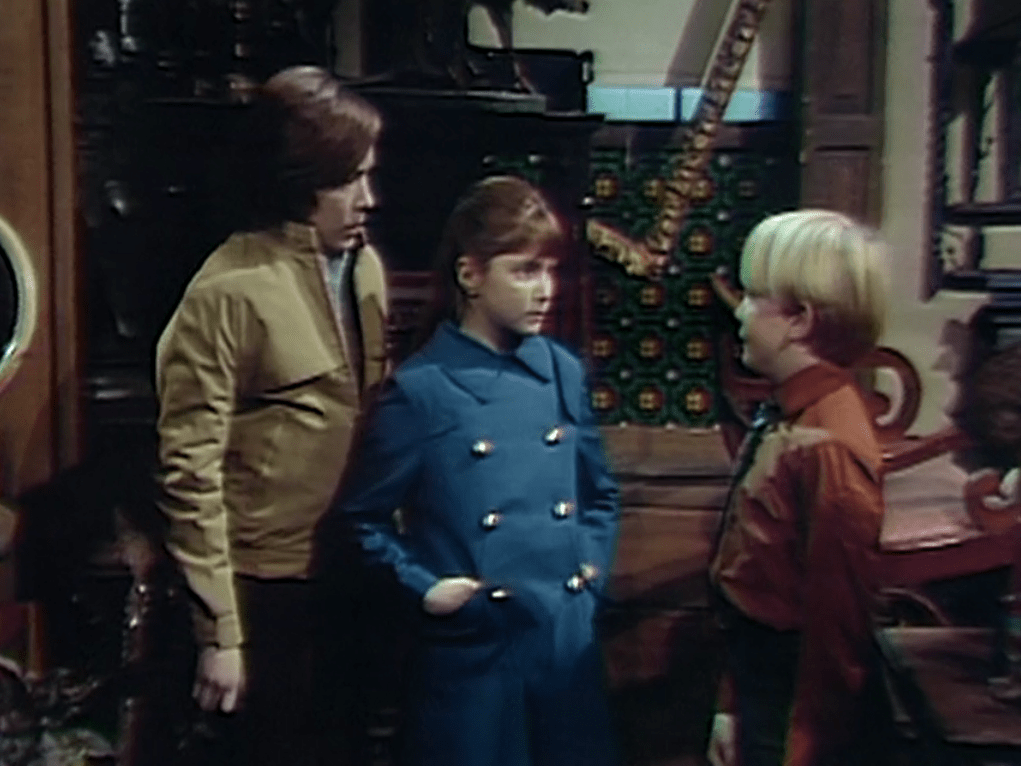
We then have the first scene on Dark Shadows populated by three child actors. It was a breakthrough when the ten year old David played with the ghost of nine year old Sarah Collins in the spring and summer of 1967; their scenes, the first interaction between children on Dark Shadows, advanced it towards becoming a kids’ show. David had up to that point been the only child on the show. He was first a homicidal monster who threatened the adults, then a figure threatened by his mother Laura and in need of rescue. When we saw him with Sarah, the two of them built a relationship that was of importance in itself and that had consequences which grew to dominate the story, leading directly to the show’s first time travel segment in November 1967. In David and Sarah, the fans running home from elementary school to watch the show could see characters their own age driving the action.
The current phase has been very heavy in adult interest. This first three-scene among children might be expected to take us back to territory Sarah and David did so much to open, but it does nothing of the kind. The three children do not really interact with each other at all. David is under the control of the Leviathans, Alexander is a manifestation of their power, and Amy is at a loss to figure out what’s going on. The forces motivating the action are not on screen, any more than they would be if the boys’ parts were played by marionettes.
David, Amy, and Alexander
Amy finds that Alexander has a photograph of Carolyn as she was when she was eight. She realizes that he stole it from a photo album at Collinwood. She declares that she will take it back to the house. Alexander forbids her to do so, and David takes his side. Amy is puzzled by David’s attitude. David threatens to sic Quentin on her. That shakes her up, but she says that Quentin is gone. David says he isn’t, and he and Alexander force her to play hide and seek. Once she is out of the room, David tells Alexander to keep her away for a couple of minutes. He telephones “Grant Douglas” and asks him to come to the shop to pick up a book he left there.
Amy comes back just in time to see and recognize Quentin. She runs upstairs and goes into the room which belongs to Alexander. She hears a heavy breathing there and sees something that terrifies her. Returning viewers know that what she saw was some inhuman thing that is of the Leviathans.
For his part, David is quite calm with “Grant.” Though we saw at the beginning that his connection to the Leviathans has not removed his fear of Quentin, he has reached the conclusion that he doesn’t need to be afraid of “Grant Douglas.” Maybe he thinks that someone using the names of two such prominentCanadians can’t be all bad. He gives Quentin the book and assures him Amy will be all right.
Quentin accepts David’s assurance, but we cannot. Amy is absent from the cast for long periods, and is usually unmentioned during those intervals. The same was true of Nora Collins, the character Denise Nickerson played in the 1897 segment. The show seems to be deliberately telling us not to get used to having this fine young actress in the cast. And the Leviathans haven’t done anything truly horrible yet- they are due to murder a character we really like. So it is quite possible we will tune in tomorrow and find that Amy is dead. Again, the contrast with the David and Sarah story is telling. David Henesy was a core member of the cast from the first week of the show, and the ghost of Sarah was a key part of the show for months. Dark Shadows was as much their show as it was that of any of the adults on screen. Keeping both Amy and Denise Nickerson at the margins, they make it clear that the kids are going to be taking a back seat.
David Henesy and Denise Nickerson were both highly capable performers, but eight year old David Jay just stands on his mark and shouts his lines. That need not have been a problem. Alexander has only been in human form for a week or two, so we don’t expect subtlety from him, and to the extent that he sounds like a real child he is supposed to be a vicious little bully trying to figure out what he can get away with. Such children often do put on acts and sound awkward, so Mr Jay’s professional ineptitude dovetails with the requirements of his part. That’s similar to the way Sharon Smyth’s limitations fit with the part of Sarah. We were supposed to be unsure whether Sarah knew that she was a ghost, whether she knew what year it was, and what if anything she remembered from one appearance to the next. Since Miss Smyth* was, as she says now, “clueless” about the craft of acting, she did a great job keeping us guessing. Later we saw Sarah as a living being, and Miss Smyth’s performance was less satisfactory. We know that Alexander is likely to transform into a shape that is not compatible with David Jay soon, so his shortcomings aren’t a particular concern. But again, the fact that Alexander comes with an expiration date keeps us from regarding him as one of the main characters.
The Store Room
While the kids were alone in the antique shop, Liz took Julia to a store room in the west wing of Collinwood to show her some photographs she had been asking about. While there, they come upon a painting. Liz says that she bought it about a year before at a charity auction, and that when her brother Roger saw how lousy it was he said he hoped that it was a worthy cause. She took it directly to the store room. It is signed “Harrison Monroe” and dated 1968. We will learn tomorrow that it depicts a place called Indian Hill. Julia recognizes the painting as extremely similar to an equally undistinguished landscape she bought a few weeks ago.
Detail from “A View of Indian Hill,” Harrison Monroe, 1968.
That painting was the work of Charles Delaware Tate, executed about 20 years previously. That Tate had been alive and working as recently as that gave Julia the hope that he might still be around and able to help a friend of hers who has problems. Yesterday, an expert called on to remove the landscape and reveal the portrait underneath it said that Tate died in 1959. But this painting is apparently the product of the same hand. Julia hopes that “Harrison Monroe” is a pseudonym of Tate’s.
It has been clear to the audience ever since Julia found the first painting that Tate would be back. That can’t be welcome news to many people. Like all characters played by Roger Davis, Tate is a loathsome man who shouts his lines and assaults his scene partners. So this pseudonym, as strongly redolent of oldVirginia as “Grant Douglas” is of twentieth century Canada, will bring a sinking feeling to much of the audience. Our reprieve that began when we left Tate in the nineteenth century five weeks ago cannot last much longer.
*Her name is Mrs Lentz nowadays, but that’s an odd title to give a nine year old. So I refer to her as Miss Smyth.