Episode 885: The girl in the portrait

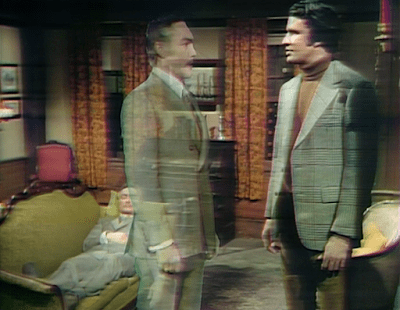
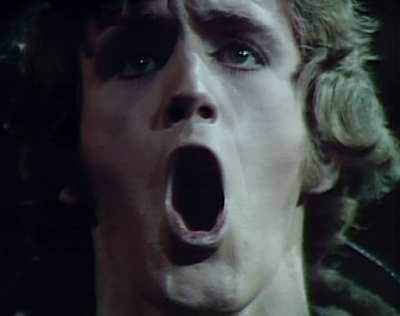
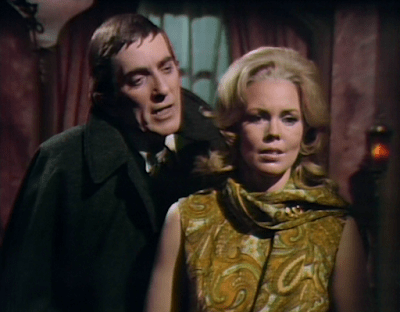
We open with a reprise of yesterday’s closing scene. It is November 1897, and time traveler/ recovering vampire Barnabas Collins is about to be reunited with his lost love, Josette DuPrés, who threw herself to her death from the cliff on Widows’ Hill in February 1796. Josette is now reincarnated in the person of Kitty Soames, the dowager countess of Hampshire. Josette’s personality has been emerging from the substrata of Kitty’s unconscious mind in the eight weeks she has been staying at the great estate of Collinwood. Now Kitty and Josette are merging into a symbiont, and that combined being has agreed to marry Barnabas tonight. Kitty/ Josette is in the Old House on the estate, in the bedroom once meant for Josette, waiting for Barnabas to return from the great house where he has told his distant cousin Judith of their wedding plans.

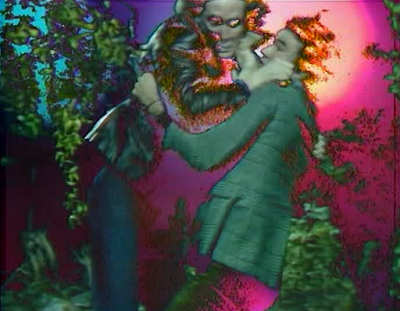
Barnabas enters the bedroom just in time to see Kitty/ Josette assumed bodily into the portrait of Josette that hangs over the mantel. He reaches up to touch Kitty/ Josette, and the two of them both vanish.

Barnabas finds lying himself on the ground, wearing clothes he last put on in the 1790s. He stands up and calls out for Kitty. “Kitty! Kitty! Where are you, Kitty?” He calls her name several more times. Oddly, he stops short of calling out “Here, Kitty, Kitty, Kitty!” In a comment on Danny Horn’s post about the episode at his great Dark Shadows Every Day, user “kosmo13” wrote “It would’ve been cool if they’d had a cat wander into the scene at that moment and had Barnabas say ‘No. Not you!'”*

Barnabas comes face to face with Ben Stokes, who was his indentured servant and fanatically devoted friend in the 1790s. Ben has no idea why Barnabas is talking as if they haven’t seen each other for a long time- they saw each other last night, as far as he is concerned. Barnabas realizes that he has traveled back in time again. He was in 1897 after being dislocated from the 1960s. Now he has returned to February 1796, to the very night Josette killed herself.

Barnabas tries frantically to keep Josette from repeating her suicide. He sends Ben to the great house of Collinwood to see if Josette is in her room there, as she is supposed to be. He is concerned that, since the trip through the portrait left him on the ground near the woods, there is no telling where it may have dropped Kitty/ Josette.

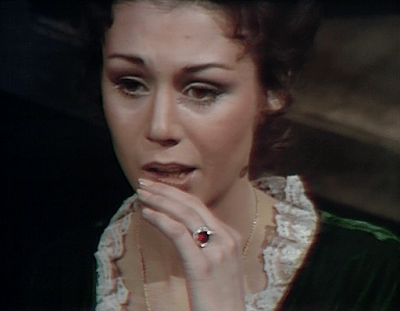
He needn’t have worried about that. We see Josette in bed, as she was in #425, the first time the show took us through this night. Her aunt Natalie, the Countess DuPrés, is with her, and is intensely afraid of a prophecy foretelling Josette’s death this night. That much is identical to what we saw in the previous timeline, when the show was set in the 1790s in February 1968. Josette does tell the countess that she had an odd dream in which she was wearing an unfamiliar dress and having a conversation with a portrait; that dream, which Josette herself dismisses as not at all important, is evidently the only trace of Kitty left in Josette’s conscious mind.

Josette tells the countess about her dream. Screenshot by Dark Shadows Before I Die.

This scene plays on the iconography of these two actresses. From the moment Kathryn Leigh Scott showed up as Kitty in #844, her title has reminded us of Josette’s aunt. So it is with a nice sense of inevitability that we see the show’s first countess again. Moreover, Miss Scott first joined the cast as Maggie Evans, The Nicest Girl in Town; Grayson Hall as Maggie’s psychiatrist, Julia Hoffman, MD. So it seems right to us when the countess becomes a therapist and listens intently to Josette’s account of her dream, growing only more interested as Josette insists that the dream was unimportant.

The first time through, Barnabas was trying to kill Josette and turn her into his vampire bride. Wicked witch Angelique, who had made Barnabas a vampire in the first place, lured Josette to the top of Widows’ Hill and showed her a vision of herself as a vampire. When Barnabas showed up, Josette ran from him and jumped off the cliff, flinging herself to a death on the rocks below rather than let him make her what he was.

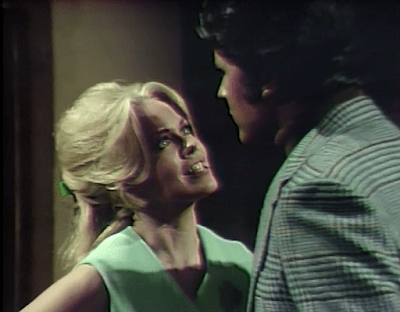
This time, Barnabas wants Josette to live. He knows what Angelique is planning. During his eight months in 1897, he and Angelique became allies, almost friends. So it is logical that he meets with her and asks her to leave Josette alone. But this is Angelique as she was in #425. She is enraged with Barnabas, and full of hate for Josette. She does listen to him, and for a moment she seems to be considering his request that she stay with him through the night. One wonders how she would have reacted had Barnabas leveled with her about what happened in 1897, explaining why he thinks they can be something other than enemies. But he holds back, telling her nothing. She makes a hostile remark, and vanishes.

Angelique does just what she did the first time- she tricks the countess into leaving Josette’s room, projects a voice that Josette mistakes for Barnabas’ voice calling her to go to Widow’s Hill, and causes Josette to see a vision of herself as a vampire once she is on top of the hill. At the end, we hear footsteps approaching. The last we saw Barnabas, he announced he was hastening to Widows’ Hill to keep Josette from jumping; if he arrives now, that is exactly what he will prompt her to do.

In the 1897 segment, Grayson Hall played broad ethnic stereotype Magda Rákóczi and also had a few weeks as Julia. Today she returns to the cast after an absence of more than five weeks. She spent that time in Excelsior Springs, Missouri, where she had a part in a movie called Adam at 6 AM. The cast included Michael Douglas, Joe Don Baker, Dana Elcar, Louise Latham, and Meg Foster. Actor Steve McQueen was one of the producers. Hall and Elcar were the only Dark Shadows alums in the company, though Foster later played an ultra-soapy story opposite David Selby in a miniseries called Washington: Behind Closed Doors.

We haven’t seen the countess since #666. In that one, Barnabas had traveled back to a night a few weeks after the one he arrives in today. He made a terrible mess of things, which is his function on the show, and Ben wound up inadvertently killing the countess. Seeing her today, regular viewers can hope that, whatever misfortunes Barnabas brings with him this time, at least that won’t happen. The countess is a likable character, and while there was a point to showing Ben becoming a murderer it is a point they have already made. They won’t lose anything if they imply that the events we are about to see prevent it from happening.

*Posted 25 December 2024 on Danny Horn, “Not in Canvas Anymore,” Dark Shadows Every Day, 21 June 2016.

Episode 882: The show must go on. That’s the one and only rule there is.

Many fantastic tales dwell on a sense that dreams have a great power in the world, and so their characters are often afraid of falling asleep. Dark Shadows has several times referenced Edgar Allan Poe, who explored that fear in stories like “The Premature Burial,” “The Tell-Tale Heart,” and “The Man of the Crowd.” The show brought up another writer of fantastic tales preoccupied with the fear of sleep in #808. Aristide, henchman of sorcerer Count Petofi, threatened an enemy of Petofi’s with “the mysterious shadow he can cast, the shadow that isn’t your own that follows you.” That was a reference to George MacDonald’s 1858 novel Phantastes, in which a man named Anodos is plagued by a shadow that moves about on its own, following him and blighting his existence. Not only does Anodos fear sleep from time to time in Phantastes, but the main theme of MacDonald’s other very popular novel, 1895’s Lilith, is Mr Vane’s long refusal to sleep and the great battle he must wage in the dream-world when he finally does allow himself to nod off.

Aristide’s threat suggested that the show was about to give us a story based on Anodos and the autonomous shadow. Aristide is dead now, and Petofi is running out of story, so that isn’t going to happen, at least not in the segment of Dark Shadows set in the year 1897. But today we do get a little bit of George MacDonald in the form of a battle against sleep. Petofi is casting a spell over himself and handsome young rake Quentin Collins. If Quentin loses conscious control of his mind for even a moment, he and Petofi will evacuate their respective bodies and be re-embodied as each other. Petofi will then transport himself, in Quentin’s body, to the year 1969. Quentin will be left behind in 1897, occupying Petofi’s aging form and waiting helplessly for Petofi’s mortal enemies to come and kill him, thinking they are taking their long-delayed revenge.

By the time Quentin finds out what’s going on, it is the wee hours of the morning, after he hasn’t slept for a couple of nights. His friends, Cockney showgirl/ mentalist Pansy Faye and time-traveler/ recovering vampire Barnabas Collins, keep marching him around the drawing room of the great house of Collinwood in an effort to keep him awake. They don’t brew up any coffee, strangely enough. But Barnabas does call on wicked witch Angelique and appeals to her to use her powers to put some kind of barrier between Quentin and Petofi.

Angelique tells Barnabas that she is reluctant to help Quentin because she is upset that he wants to go to New York and look for a woman named Amanda Harris. She had wanted Quentin to fall in love with her, and is jealous that he chose Amanda instead. Barnabas points out that if she doesn’t help Quentin, he won’t exist in the form that either she or Amanda knew. Angelique explains that she has a reason for her attitude:

Before I came here this time, I was in the everlasting pits of Hell, where other creatures of my kind live. Only, my stay here on Earth made me dissatisfied with my life there. I longed to come back here… To Earth, to become a human being. I begged my master for the chance.

Finally, he gave it to me on one condition and one condition only… That I make one man fall in love with me, without any use of supernatural spells or powers. One man, one chance. That’s what I was granted.

Since Quentin is the one man who represented Angelique’s one chance, letting him go to Amanda might mean that Angelique has to go back down. My favorite part of her speech is “Only, my stay here on Earth made me dissatisfied with my life there.” Sure, she could have been happy in the everlasting pits of Hell, as one is, but how ya gonna keep ’em down on the farm after they’ve seen Pa-ree. Or, since Angelique’s sojourns in the upper world have all brought her to Collinsport, after they’ve had the lobster roll at the Blue Whale.

While Barnabas is talking with Angelique, Pansy is on Quentin duty. She decides to keep him awake by compelling him to join in a performance of her song. A record of this song, performed by Nancy Barrett and David Selby, hit the stores the very day this episode was first broadcast, so this is product placement. But Pansy is doing exactly what she would do in this situation, Quentin is reacting just as he would react, and it is a charming moment.

The musical number is preceded by Pansy making what literary critics call a programmatic statement. “Feel like it or not, you gotta do it, the show must go on. That’s the one and only rule there is, love. So let’s have a bright chorus from that new team, Pansy Faye and Quentin Collins.” Pansy is not only a good pal and a gifted psychic, she is an accomplished scientist. She has indeed stated the complete physics, metaphysics, and every other operating principle of the universe of Dark Shadows when she says that “The show must go on.”

Angelique and Barnabas enter. Angelique insists on some time alone with Quentin. He says that once he gets to New York he most definitely will be looking for Amanda and that he has no interest in a relationship with Angelique. She looks away from him and talks herself into believing it will be OK if he falls in love with her after Amanda “has ceased to exist.” Longtime viewers can be fairly sure this means that Angelique is planning to murder Amanda, but at the moment the important thing is to get Angelique involved in helping Quentin against Petofi.

Angelique opens the door to the foyer, where we catch a glimpse of Nancy Barrett and Jonathan Frid doing a really marvelous mime depicting “intense conversation.” It’s one of those deliberately stagey bits of business that these twentieth century New York actors do so well.

Angelique opens the door on a silent “conversation.”

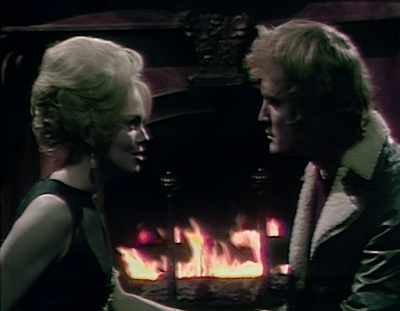
Angelique stares into the fire and tries to project psychic power Petofi-ward. We get a process shot simultaneously depicting Angelique in the drawing room and Petofi in his lair. The shot is not very successful, and Angelique explains that her efforts aren’t working either. She says that Petofi is in so deep a trance that she cannot reach him as she has done before.

Petofi’s surroundings are so heavily decorated that this shot just looks cluttered to me. I suppose having Petofi low in the shot and behind the flames is meant to remind us of Angelique’s old neighborhood, but the visual metaphor is spoiled by the cruddy 1960s TV color palette.
In black and white, as most viewers would have seen it in 1969, the shot has different problems- while the more abstract visual style does make the Petofi-as-Satan metaphor legible, it is less clear which shapes are in Angelique’s space and which are in Petofi’s.

Pansy, eavesdropping from the foyer, hears Angelique say that she will need to have something Petofi is wearing right now, something still warm from contact with him, in order to reach him with her powers. Pansy resolves to provide this, and she sneaks out. She makes her way to his lair, and is about to undo Petofi’s necktie when he comes out of his trance and tells Pansy she has interfered with his plans once too often. We have flashed to the motionless Petofi several times today, leading us to think that Thayer David was going to collect his fee without having to deliver a line. So it is quite effective when he springs into action.

Episode 871: The twin of life

In October 1897, sorcerer Count Petofi has hijacked the body of Quentin Collins and banished Quentin to his own aging form. I call the villainous Petofi played by David Selby Q-Petofi, and the forlorn Quentin played by Thayer David P-Quentin.

Today, wicked witch Angelique explains to P-Quentin how she and mad scientist Julia Hoffman cured time-traveler Barnabas Collins of vampirism, created a Doppelgänger of Barnabas, and used that Doppelgänger to persuade Quentin’s family in the great house of Collinwood that Barnabas never really was a vampire. Later, artist Charles Delaware Tate mistakes P-Quentin for Petofi, and tries to kill him. Q-Petofi then enters and takes control of Tate, using him for a project of his own.

Petofi stripped Angelique of her powers in #865, and deprived Tate of his ability to paint in #851. Angelique has been such an important part of the show for so long that regular viewers are confident she will be back eventually, but the 1897 segment seems to be lurching towards its close, and after her last exit there was no urgent reason in the story for her to come back. It’s good to see that she is still part of this arc.

Tate’s continued presence is rather less good news. Like all characters played by Roger Davis, he has an obnoxious personality and a grating voice, with a disturbing habit of invading his scene partners’ personal space. Today, he keeps grabbing at Q-Petofi’s coat while Q-Petofi bats him away; this is so irritating that it is unclear whether the line “You’ve got trouble with your hands” was scripted for Q-Petofi or ad libbed by David Selby.

For the last couple of weeks, we have had grounds for hope that Tate would just go away. When he sold the portrait of the lovely and mysterious Amanda Harris in #864, he lost his last connection to an ongoing plot point. We saw in that same scene that he had a lot of paintings he could sell for high prices if he took them back to New York or another major city. We also know that he has no friends or potential sources of income in the small town of Collinsport. So evidently he is just sticking around to punish the audience for watching the show.

Episode 868: The man we thought he was

In October 1897, sorcerer Count Petofi has used his powers to steal the body of handsome young Quentin Collins and to trap Quentin in his own aging form. I refer to the villainous Petofi who looks like Quentin as Q-Petofi, and to the forlorn Quentin who looks like Petofi as P-Quentin.

Q-Petofi

We open outside a cave near the estate of Collinwood, where Q-Petofi’s henchman Aristide is on the ground, gradually coming back to consciousness. Q-Petofi had ordered Aristide to hold wicked witch Angelique prisoner in the cave. Shortly after Q-Petofi left, Angelique slipped out of the cave and ran past him. Aristide followed her, and she bashed him on the head with a rock.

Aristide’s eyes focus, and he sees time-traveling vampire Barnabas Collins standing over him. The last time he saw Barnabas was in #842. Barnabas threatened to kill Aristide then, and he was so terrified that he ran away and didn’t come back until he heard that Barnabas had been staked in his coffin. The coffin is in the cave, and Aristide just saw Barnabas in it, the stake still in his heart, so he is shocked to see him up and about.

We cut to the great house of Collinwood, where Q-Petofi and Quentin’s stuffy but lovable brother Edward are recapping another storyline. Edward exits, and a telephone call comes from Ian Reade, MD. Dr Reade says that a strange man is in his office, asking for Edward. When he describes the man, Q-Petofi recognizes him as Barnabas. He takes a gun and goes to Dr Reade’s.

Q-Petofi finds Barnabas lying on Dr Reade’s exam table. He orders Dr Reade to leave. Dr Reade reminds Q-Petofi that they are in his office and refuses to comply with his commands. He does leave for a moment to call Edward again; when he comes back, he finds Q-Petofi holding Barnabas at gunpoint. He bravely tells Q-Petofi that if he wants to kill Barnabas, he will have to shoot him first.

Edward comes. Dr Reade trusts Edward and agrees to leave the room while he is there. After dawn breaks, Edward is astonished to see that Barnabas is still alive. Barnabas tells his old story that he is their cousin from England come to pay his respects. He says that when he first arrived, a man approached him in the dark woods, a man who, when he emerged from the shadows, proved to be his exact double. Until, that is, he opened his mouth and showed two long fangs. Barnabas says that he does not know what happened next or how much time has passed. All he knows is that this strange man kept him captive and dominated his will, from time to time appearing to him and repeating his original assault.

Edward is inclined to believe this story, Q-Petofi to shoot Barnabas on the spot. They compromise, and agree to take him to the cave. If Barnabas’ coffin is empty, they will shoot him. Dr Reade sees Edward and Q-Petofi carrying Barnabas out of his office, and objects that in his condition Barnabas may die if he is subjected to any exertion. When the question is asked if he is willing to go, Barnabas weakly croaks out a “yes.” At that, Dr Reade is willing to wash his hands of the whole thing. For someone who was willing to be shot a few minutes before, it’s quite a startling capitulation.

Q-Petofi does not know that Angelique and Aristide are no longer in the cave, so he insists on leading the way in. He finds that they are gone and the chains around Barnabas’ coffin have been broken. He invites Edward and Barnabas in. He takes it as obvious that the broken chains prove that the coffin is empty, but Edward, with his sense of fair play, insists on opening the coffin before they shoot Barnabas. The body is still there, the stake still in the chest. Barnabas reacts with horror, the others with amazement.

Doppelgänger time.

In #758, Angelique created a Doppelgänger of herself to trick an enemy into thinking that she had killed her, and in #842 she agreed to help Barnabas’ friend Julia Hoffman, MD in a plan to allow him to reestablish himself as a member of the Collins family. Julia was working on a medical intervention to free him of the effects of vampirism, and now we can see that Angelique contributed the grounds for the Collinses to believe that their cousin never labored under that curse.

When Dark Shadows was in production in the 1960s, the legends of King Arthur, the Knights of the Round Table, and the Holy Grail had been fashionable topics in English departments for decades. That vogue was reflected not only in the coursework the writing staff likely did when they were in college, but also in the popularity of novels like The Once and Future King and the Broadway show based on it, Camelot. When I was hanging out in used book stores in the 1980s and 1990s, mass market paperbacks printed in that era collecting the Grail sagas were still a staple.

The coffin in the cave recalls a prominent figure in one of those sagas, a king named Amfortas. In Heinrich of Turlin’s The Crown, Amfortas did not requite the love the mighty sorceress Orgeluse had for him. The humiliated Orgeluse inflicted a wound that both paralyzed Amfortas and made him immortal. In that state, Amfortas was confined to a coffin that was hidden in a cave. Sir Gawain found the coffin and freed Amfortas both of his paralysis and of his immortality.*

Longtime viewers of Dark Shadows will see many parallels to the story of Barnabas and Angelique in Heinrich’s story of Amfortas and Orgeluse. During the part of the show made and set in 1968, two mad scientists played the role of Sir Gawain in returning Barnabas to humanity. The first was a man named Eric Lang, the second was Julia. Now, Angelique herself, who was the original source of the curse that made Barnabas a vampire, combines the functions of Orgeluse and of Gawain. She not only frees Barnabas, but also redeems herself. The Grail legends also abound in other elements that figure prominently in this part of the show. For example, Count Petofi was originally on the show as a severed hand with magical powers, later to be reunited with the rest of its body. Gawain’s most famous story is of his battle with the Green Knight, who starts off as a severed head. Doppelgänger abound in the Grail legends, especially the so-called Vulgate Lancelot where a double of Queen Guinevere sets off a whole arc.

Dr Reade is played by Alfred Hinckley. Hinckley was in plays on and off Broadway, and when the networks ran a lot of programming produced in New York, his was a frequent face on American television. He was in Dark Shadows episode #1 as the conductor of the train that brought well-meaning governess Vicki Winters and dashing action hero Burke Devlin to Collinsport. Longtime viewers were reminded of that train in #850; maybe the production staff was reminded of it too, and that was why they called Hinckley to make his second appearance on the series today. It’s also his final appearance.

*Richard Wagner’s opera Parsifal features another version of the Amfortas legend, calling the sorceress by a different name, omitting Amfortas’ paralysis, leaving out the coffin in the cave, and giving the honor of healing Amfortas and succeeding him as king of the Grail to Percival rather than Gawain.

Episode 867: The name of your beloved

The dramatic date is October 1897. Sorcerer Count Petofi is using the body of Quentin Collins as a disguise. While he is doing this, I call him Q-Petofi.

Q-Petofi has stripped witch Angelique of her powers and confined her in the cave where the chained coffin of vampire Barnabas Collins is kept. In #845, we saw Cockney showgirl/ mentalist Pansy Faye open this coffin and drive a stake. Now, Angelique starts banging away at the lock on the chains with a rock. When Q-Petofi’s servant Aristide comes to investigate the noise, Angelique talks about pulling the stake out of Barnabas’ heart so that he will rise again. Aristide dismisses this idea.

Longtime viewers won’t be so sure that pulling the stake out will not bring Barnabas back. In #630, broadcast and set in November 1968, warlock Nicholas Blair pulled a stake from the heart of vampire Tom Jennings and put him back into operation. That came to mind in #846 when Quentin’s brother, stuffy but lovable Edward Collins, learned that Pansy had staked Barnabas and decreed, not that Barnabas’ body be taken out into the sunlight and allowed to disintegrate, but that the coffin be chained and the cave sealed up.

Presenting the stake in the vampire’s heart as an on/ off switch lets a lot of the suspense out of the show, and it feels like a cheat. But however bad the idea is, apparently it was not original to Dark Shadows. Two frequent commenters bring this out under Danny Horn’s post about the episode at his great Dark Shadows Every Day. “Courtley Manor” (also an FotB here) writes:

Well, in some vampire legends the stake through the heart (or often the stomach or solar plexus) served a two-fold purpose. Believing a corpse was bloated due to ingestion of blood (which we now know is rather caused by gases produced by microscopic organisms during decomposition), the vampire slayer would deprive the bloodsucker of its recent meal and also the ability to consume more blood by, in effect, bursting it like a balloon. Also, the stake pinned the nightwalker to the earth or coffin so it couldn’t roam about anymore. Dan Curtis and/or the writers may have been drawing on these older legends, and figured that removing the stake could conceivably allow the vampire to heal from its wound and rise again.

Comment left 9 March 2021 by “Courtley Manor” on Danny Horn, “Episode 867: Nothing Up My Sleeve,” 26 May 2016, at Dark Shadows Every Day.

“Goddess of Transitory” added this remark to “Courtley Manor’s”:

John Carradine played exactly this in the old film House of Dracula–he starts out as a skeleton in a coffin with a stake in its rib cage as part of a sideshow but when the stake is removed, he’s back–cape, hat, and bat transforming powers intact.

Comment left 12 April 2021 by “Goddess of Transitory” on Danny Horn, “Episode 867: Nothing Up My Sleeve,” 26 May 2016, at Dark Shadows Every Day.

Meanwhile, back at the great house of Collinwood, Q-Petofi is passing as Quentin. Edward is fretting that his girlfriend Kitty Soames is missing. Kitty, a young American woman who is the dowager countess of Hampshire, has been having psychotic episodes ever since she arrived at Collinwood in #844. Unknown to Edward, these are the result of the spirit of the late Josette Collins taking possession of her. Q-Petofi found Kitty in Josette’s room at the Old House on the estate earlier, and lost track of her when she ran out into the woods.

Kitty/ Josette comes wandering into the drawing room. She claims to have seen Barnabas in the woods. When she says where in the woods she saw him, Q-Petofi says “Near the cave!” Edward wants to go to the cave to see if Barnabas is still in his coffin. Q-Petofi, not wanting Edward to walk in on Angelique and Aristide, volunteers to go. When Edward says he thinks he ought to handle the matter himself, Q-Petofi causes Kitty/ Josette to feel a chill. She asks Edward to stay with her, and he agrees to let Quentin go.

Q-Petofi finds Aristide holding a gun on Angelique. Aristide tells him what has been going on, and they open the coffin. They find Barnabas still inside. We see him there, the stake still in his chest.

Hello, Barney, well, hello, Barney! It’s so nice to have you back where you belong.

This is the first time we have seen Jonathan Frid since #845. He’s been in Chicago doing a play. Clearly Dan Curtis isn’t going to pay his fee just to have him lie in the coffin and breathe rapidly while the others talk about how dead he is, so we know that Barnabas is back.

Q-Petofi says that he will come back later and that he and Aristide will destroy the coffin and the body. To keep Angelique from making any more trouble, he casts a spell and surrounds her with magical flames.

While Q-Petofi is back at Collinwood reassuring Edward and Kitty/ Josette that Barnabas is dead, Angelique offers to tell Aristide secrets that no mortal man knows if he will release her from the magic flames. Aristide has no supernatural powers or occult knowledge; he is just a lummox whom Q-Petofi employs because he likes his looks and finds his sadism useful when he wants someone tortured to death. But somehow Aristide is able to stop the flames. Before Angelique can start talking, he pulls a knife on her and tells her that he doesn’t want her secrets- he just wants to kill her. Aristide has a special knife that he makes a fetish of. He calls it “The Dancing Girl.” Except when he calls it “The Dancing Lady.” At any rate, this isn’t it.

Aristide is inefficient about taking the knife out of its hiding place. He gives Angelique time to run out of the cave. He runs after her, and she hits him in the head with a rock, knocking him out. When he comes to, Aristide sees a man standing over him, asking for help. It is Barnabas.

Episode 866: Some various phases of change

It is 20 October 1897. Angelique, immortal witch and time-traveler, has discovered that her sometime fiancé, Quentin Collins, is not himself. He is 150 year old sorcerer Count Petofi, and Petofi is him, having used his magic powers to force Quentin to trade bodies with him. I will refer to the villainous Petofi who looks like Quentin as Q-Petofi, and to the forlorn Quentin who looks like Petofi as P-Quentin.

Q-Petofi

Yesterday, Q-Petofi caught Angelique trying to help P-Quentin. He attacked her, and we open today in a cave where he has imprisoned her. He tells her he has stripped her of her powers. He demands she tell him what she and time-traveling mad scientist Julia Hoffman have been doing. Regular viewers know that Julia is gone, having vanished from 1897 and returned to the 1960s in #858. That Q-Petofi does not know this is one of the few signs we have had recently that he has limitations.

Q-Petofi leaves Angelique in the cave with a chained coffin. He tells her that it is the one in which her ex-husband, vampire Barnabas Collins, was staked (#845.) She looks at the coffin and gives a little soliloquy about how she needs Barnabas, but he cannot help her.

Q-Petofi is not the only resident of the great house of Collinwood who is not the person he seems to be. Kitty Soames, a young American woman who is the dowager countess of Hampshire, came to Collinwood intending to get Quentin’s stuffy but lovable brother Edward Collins to marry her by concealing some key facts about her financial status. But the very day she arrived, in #844, Kitty found that she was the one most gravely deprived of information about herself. As soon as she saw the portrait of Barnabas that hangs by the front door in the foyer, she became possessed by the spirit of Barnabas’ lost love Josette.

Kitty’s episodes of Josettification have continued. Today’s begins with another look at the portrait and a longing sigh. As sight of the chained coffin sets off Angelique’s yearning for Barnabas, so the portrait is the visual cue that triggers Josette to come to the surface of Kitty’s mind. By the end of the episode, she will be in Josette’s bedroom at the Old House on the estate, telling an unseen person that she is waiting for him.

Kitty is still herself most of the time. And we can assume that sooner or later, Petofi will be defeated and Quentin will return to his right body. But a third resident of the great house has made a permanent and irreversible change of spirit. Her body is that of Charity Trask, whose father, the odious Gregory Trask, is married to Quentin and Edward’s sister Judith. But in #819, Petofi annihilated Charity’s personality and replaced it with that of Pansy Faye, a Cockney showgirl/ mentalist who came to Collinwood in #771 and was killed that very night, without ever having met Charity.

Angelique and Kitty/ Josette yearn for Barnabas’ return. Increasingly, the audience does too- there doesn’t seem to be anywhere the story can go until he comes back. That sets them and us against Pansy. She doesn’t share our concern for narrative progression- she is such a daffy invention she can amuse us all by herself. And she knows that Barnabas was a vampire, who preyed on Charity and was ultimately, if indirectly, responsible for Pansy’s death. Indeed, it was she who drove the stake in #845. So Barnabas is absolutely the last person Pansy wants to see again. But now someone else has emerged in next to last place.

On Friday, Pansy looked at Q-Petofi and realized that he was not Quentin. She confronted him with questions that Quentin could answer but he couldn’t, exposing him to Angelique as an impostor. When Pansy shut herself in her room, Q-Petofi went upstairs and through her door threatened that if she didn’t keep quiet “her days [would be] numbered.” Now, she has passed a note to Edward reporting on the incident. Edward and Q-Petofi meet with Pansy in her room. She tells Edward about the visions and sensings that led her to conclude that the man with him is not really Quentin. Edward thinks Pansy is just a delusion Charity is having, and so cannot ascribe much evidentiary value to these experiences. Q-Petofi claims that when he said “her days are numbered” he meant that her days as a resident of the house were numbered if she went on saying bizarre things about him. Edward asks Pansy if she might be mistaken in her interpretation of her psychic data. She says she never has been before, but allows, in a very reasonable tone, that it is possible she could be this time.

Pansy is, at the moment, the only person who could possibly be an ally for P-Quentin in his attempt to return to his own body. She does not seem to be a match for Q-Petofi’s magical powers, and so others would have to be recruited to help in the fight. But if she is now as unsure as it seems, P-Quentin doesn’t even have a place to start.

When Kitty/ Josette is in the room at the Old House, she looks at the portrait of Josette and sees that it is signed and dated. We’ve seen the portrait many times since its first appearance in #70, and it has never before borne either a signature or a date. The signature is “Coswell,” which is as good as any.

The date on the portrait is 1797, which is rather less good. In #402, set early in January 1796, we saw the portrait delivered to the Old House. Moreover, it was in #425, set in February 1796, that Josette flung herself to her death from the top of Widows’ Hill. So if this portrait is a replacement for the original, it was painted at a time when the subject was unavailable for further sittings.

Moreover, Kitty misstates the current date as 1797 in a letter to her mother, which is supposed to be a sign of her Josettification. Viewers who remember the 1790s flashback will just be puzzled by this, while those who do not are unlikely to see much significance in the date at all. It is hard to see why they’ve decided to retcon this particular point.

Episode 865: The mind and the body

In October of 1897, the estate of Collinwood is the property of Judith Collins Trask. If Judith were to list the people resident in the great house on the estate, she would include two who are only apparently there. Contrary to Judith’s beliefs, neither her brother Quentin nor her step-daughter Charity is in fact on the premises.

In #819, 150 year old sorcerer Count Petofi erased Charity’s personality and replaced it with that of the late Pansy Faye, a Cockney showgirl and “mentalist” who was engaged to Judith’s brother Carl at the time of her death in #771. When they were both alive, Charity and Pansy never met, and they were polar opposites in every way. Now that Pansy lives again in the person of Charity, she not only retains all of the memories and habits she had before her death, but the phony psychic act she used to do has been replaced by a true second sight.

In #854 through #856, Petofi cast another, still more complicated spell. He switched bodies with Quentin. Now Quentin is shambling about in the aged and feeble form of Petofi, while Petofi is reveling in Quentin’s youth and vigor. During the body swap, I shall refer to the Petofi who appears to be Quentin as Q-Petofi, and to the Quentin who appears to be Petofi as P-Quentin.

We open today in the foyer of Collinwood. Pansy has been bickering with a houseguest named Angelique. Pansy wants to marry Quentin, and was irked when he became engaged to Angelique. Now the engagement is off, a fact which Pansy has been annoying Angelique by gloating about. Q-Petofi enters, and Angelique gives him a peck on the cheek. He exits, and Angelique sees that Pansy looks alarmed. Before Angelique can take satisfaction in having silenced her, Pansy declares “It ain’t him! It ain’t Quentin!”

Angelique has noticed that her onetime fiancé has been very different these last weeks, which was why she called off their engagement. So when Pansy tells her about her visions and sensings, she listens. Q-Petofi returns, and Pansy asks him to answer a series of questions to which she and Quentin would know the answer. He responds with bluster about not taking her orders. Pansy says that he doesn’t know the answers because he isn’t Quentin; Angelique suggests he just give the answers to quiet Pansy down. Pansy storms out, and Angelique tells him he handled the situation very badly. She says he oughtn’t have let himself become angry with a mentally ill person; we can see that she means more than that, and so can Q-Petofi.

Pansy’s vision gave Angelique all the information she needed to find P-Quentin. She calls on him, and he tells her everything. She agrees to take him with her on an errand she must run. Before they can go, Q-Petofi enters. He tells Angelique that she has made a grave error. If she had married him, she could have enjoyed both the mind of Petofi and the body of Quentin Collins. But instead, she has become his enemy. P-Quentin toddles off and sits in the corner, looking down helplessly.

Q-Petofi summons his servant Aristide, who threatens her with a torch. Angelique is a witch and has great powers, but we saw in #665 that she can be defeated by fire. So she cannot focus her energies on holding Q-Petofi at bay. He touches her with his right hand, where his magic powers are concentrated. She cries out and collapses.

Angelique had seemed to be P-Quentin’s last best hope to be restored to his own body. His first ally, time-traveling mad scientist Julia Hoffman, MD, vanished in front of him, returning to the 1960s mere moments after she realized what had happened to him. His second ally was his old friend and fellow Satanist, lawyer Evan Hanley. Evan attempted to invoke Satan to intervene and return Quentin and Petofi to their original bodies, but no help was forthcoming from the old fellow and Q-Petofi punished Evan for the attempt by enslaving him. Another of Quentin’s ex-fiancées, maidservant Beth Chavez, probably knows what has happened and would certainly like to help him. But Beth is terrified of Petofi and without resources to use against him, and there would be nothing to stop him from killing her if she made herself inconvenient to him in any way. So P-Quentin’s only potential ally at the moment is Pansy, and it is hard to see what power she might have that would be formidable to Q-Petofi. It has not even been proven that Pansy has the capacity to dance Q-Petofi’s cares away, let alone overcome his sorcery. The future looks grim indeed for P-Quentin.

Episode 864: Shipwreck Point

Sorcerer Count Petofi is currently occupying the body of rakish Quentin Collins. When he is in this form, I refer to him as Q-Petofi.

Q-Petofi. Screenshot by Dark Shadows Before I Die.

Lawyer/ Satanist Evan Hanley has displeased Q-Petofi. Q-Petofi has put the zap on Evan and made him dig his own grave. Evan begs for his life, but does so in a stilted, robotic voice that suggests he is struggling against Q-Petofi’s power. It is a neat job of acting by Humbert Allen Astredo.

Evan points out that it would raise suspicions if Q-Petofi were seen with his servant Aristide, especially inside the great house of Collinwood. Evan himself, however, is the Collins family’s attorney, trusted by everyone in the house. If anyone there has suspicions about Q-Petofi, they will confide in him. Q-Petofi decides that he may as well let Evan live, and orders him to keep tabs on wicked witch Angelique.

We cut to the foyer of Collinwood, where Angelique is staying. She is on the telephone trying to reach the local pharmacy, and is annoyed that the meds she wants are not yet available. Another houseguest, Cockney showgirl/ mentalist Pansy Faye, enters. Angelique hurriedly ends the call. Pansy taunts Angelique for the end of her engagement to Quentin. After Pansy exits, Angelique gets back on the phone and resumes talking to the pharmacist. Q-Petofi enters, and Angelique pretends she is talking to someone else, then hangs up.

Returning viewers know that Angelique is carrying on a medical intervention designed by time-traveling mad scientist Julia Hoffman, MD. Julia’s friend, vampire Barnabas Collins, made his way from 1969 to 1897, and she followed him. Julia had recreated an experimental treatment that put Barnabas’ vampirism into abeyance for a little while early in 1968 when she snapped back to her own time, vanishing from 1897. Shortly before Julia disappeared, Angelique agreed to complete the procedure and turn Barnabas into a real boy.

Angelique seems less powerful than usual today. Her dealings with the pharmacy are a logical consequence of her agreement to take over Julia’s plan, but she doesn’t usually have to get exasperated with people over the telephone, and not since her early days as a witch in the 1790s has she been so vulnerable to discovery by random passersby. Later, she goes to Barnabas’ hiding place, and Evan follows her. There have been times when Angelique could materialize and dematerialize at will, and it was impossible for any mere mortal to keep track of her whereabouts, but evidently she doesn’t feel up to that today. She does tell Q-Petofi she has a headache, maybe that’s true.

Pansy has a scene in the studio of artist Charles Delaware Tate. She tells Tate she wants to buy one of his paintings; he tells her that everything is for sale, but that his prices are high. She picks out a portrait of the lovely and mysterious Amanda Harris; he throws a tantrum and doesn’t want to sell it to her. When she reminds him that he said all the paintings are for sale, he names the ridiculously high price of $5000. That would be well over $150,000 in 2025. Without missing a beat, Pansy pulls out a few large-denomination bills and fans them under Tate’s nose.

Pansy’s only source of income was a cabaret act she recently did at the Blue Whale, a tavern in the village of Collinsport. We saw her there the other day shortly before nine PM, when she was the only person in the barroom. So it doesn’t seem likely she could have earned that quantity of cash there. Nor is there any apparent reason why Pansy would want a portrait of Amanda, whom she saw as a rival for Quentin’s affections. It seems likely that someone else put her up to buying it.

The obvious candidate would be Judith Collins Trask, owner of Collinwood and all the Collins family businesses. Judith is married to the odious Gregory Trask, whose late daughter Charity provided the host body through which Pansy, who died in #771, has been interacting with the world of the living since Petofi erased Charity’s personality in #819. Judith has persuaded Pansy to move back into Collinwood. Judith has herself recently returned to the great house after Trask had her confined to a mental hospital for a period of more than thirteen weeks. Her stuffy but lovable brother Edward told Judith that Trask spent much of that time trying to seduce Amanda, and Judith wants to get the facts about what went on in her absence.

Closing Miscellany

Director Henry Kaplan was not in good form in this one. In the opening, studio lights are clearly visible right in the middle of the screen, between Evan and Q-Petofi. The same thing happened in yesterday’s episode. The other directors might have made a mistake like that once, but I don’t think any of them would have done it two days in a row.

The camera is also frequently out of focus, as is typical of Kaplan’s shows, and it moves unsteadily. He must have been trying to get the camera operators to do something he hadn’t prepared them for, it looks really bad.

There are a couple of notable bloopers that aren’t particularly Kaplan’s fault. When Angelique makes a remark about Q-Petofi’s attitude towards brandy, David Selby says “Don’t you think it’s possible for one’s…change…or one’s taste to change in brandy?” That is followed by a silent beat, as both he and Lara Parker are stunned by the nonsense that just came out of his mouth.

When Tate lets Pansy into his studio, the shade falls out of the window. He looks at it for a second, then the scene goes on. It is one of the all-time great goofs.

Episode 860: I just say things

Edward Collins isn’t what he seems. His stuffy manner is real enough, as are his kind impulses when he sees people in distress. But he allows those who meet him to believe that he is the heir to the vast Collins family fortune, which in fact belongs in its entirety to his sister Judith. Judith is currently an inmate in a mental hospital. During her absence, her husband, the odious Gregory Trask, exercises control of all the family’s assets. Edward hopes to get out from under Trask’s thumb by marrying the dowager countess of Hampshire, a young American woman named Kitty Soames. He befriended Kitty while a houseguest of the late Earl’s, and now that she is widowed and is his guest at the great house of Collinwood he sees an opportunity to take over the Hampshire interests.

Kitty isn’t what she seems. The Earl was bankrupt when he died. He had lost all his wealth and been driven to suicide by sorcerer Count Petofi. Kitty wrote a letter to her mother the other day saying that unless she marries Edward and becomes the mistress of Collinwood she didn’t think she could raise train fare from central Maine to her home in Pennsylvania. Nor is this all. If Kitty were simply without funds, she and Edward would be on an even footing. But she is not what she seems in a metaphysical sense as well as a financial one. She is intermittently possessed by the ghost of the late Josette Collins. Regular viewers have reason to believe that she is Josette’s reincarnation, and that the fits of possession are part of the process by which Josette is reuniting her spirit with her body. But the characters don’t know what we know. As far as they are concerned, Kitty seems to be a plain lunatic.

At rise, Edward catches Kitty in his brother Quentin’s room. She is rummaging through an armoire, apparently looking for something. He asks her what she is doing, and she feigns one of her fits. Kitty is not nearly as good an actress as Kathryn Leigh Scott; she doesn’t fool us for a minute. But Edward believes her. He gently escorts her out of the room. As they leave, we see a face peering at them from the shadows. It is Quentin’s face.

Downstairs, we hear Kitty’s thoughts as she takes satisfaction in having fooled Edward into thinking she was having a fit. Mental health professionals often talk about how people learn to use the resources they have, so that patients who carry diagnoses of major disturbances will sometimes find ways to exaggerate their symptoms for effect. It’s true that psychotic episodes are not usually an asset in the husband-hunting business, but everyone in the segment of Dark Shadows set in 1897 has some issue or other, and Edward really does have a soft spot for mentally ill women (unless they are married to Quentin, but that’s another thing altogether.) So Kitty may as well play up her particular case of dissociative identity disorder.

Kitty was in Quentin’s room trying to steal a portrait of him. She was doing this from her fear of Petofi, whom she believed to have ordered her to bring him the portrait before 9 PM lest he use his magical powers and make her vanish. It is almost that time now, and she has no idea how to find the portrait, let alone get it to him before the deadline. While she is worrying about this situation, a woman named Angelique enters.

Angelique isn’t what she seems. She is one of Quentin’s fiancées, and Edward takes her to be an innocent woman, about 30 years old, who has been hard done by in the course of the supernatural doings of the last several months. In fact, she is a wicked witch who wrought immense destruction the first time she was at Collinwood, in the 1790s, and again the second time, in 1968. She has traveled back in time to 1897, and has been one of the most powerful participants in all of the strange goings-on.

Kitty tells Angelique that she saw Petofi in the vacant rectory on Pine Road, and that he told her the woman who had been squatting there vanished into thin air before his eyes. At this, Angelique turns and rushes off to investigate. It dawns on Kitty that Angelique knows more than she is saying. We cut to the drawing room, where Edward is bracing for a conversation with Quentin.

Quentin isn’t what he seems. In fact, he isn’t Quentin at all. Petofi forcibly swapped bodies with him a few days ago. It is Petofi, using Quentin’s body as a disguise, who confronts Edward and demands to know what he and Kitty were doing in the room. I refer to this form of Petofi as Q-Petofi, and the Quentin who looks like Petofi as P-Quentin.

Q-Petofi confronts Edward. Screenshot by Dark Shadows Before I Die.

Edward tells Q-Petofi that Kitty had had a “seizure.” Q-Petofi expresses skepticism about this claim. He proceeds to tell Edward that Kitty’s late husband died in poverty, shortly after being released from prison for a jewel theft. Edward is thunderstruck. He calls the story a lie, and forbids Q-Petofi from repeating it to anyone.

Kitty goes to the village of Collinsport, and pays a visit to The Blue Whale, the local tavern. She wants to see the entertainer, Miss Pansy Faye.

Pansy isn’t what she seems. She has met the Collinses twice. Miss Charity Trask, daughter of Gregory and enforcer in his operation, came to the great house in #727 and took up residence when her father married Judith. Pansy Faye, mentalist and Cockney showgirl, came to the estate in #771 as the coldly cynical fiancée of the childlike Carl Collins. Pansy was killed the night she arrived. A few weeks later, Pansy started to take possession of Charity, and in #819 Petofi erased Charity’s personality altogether and gave her body over to Pansy.

When Kitty enters, Pansy is alone in the bar. She is picking out her theme song on the piano. When Petofi was in the process of switching bodies with Quentin, Quentin was with Pansy in this room. Petofi took control of him briefly and played the same song on this piano. He played it very impressively.

Kitty is desperate to find out what is happening to her, and she knows that Pansy has powers. Once Pansy assures her that she doesn’t work for Count Petofi, Kitty offers her a diamond-encrusted brooch in return for information. Pansy is offended. She says that she will take a gift in return for her services after she has rendered them, but that she does not accept payment in advance. She tells Kitty that there is one way to find out what is happening to her, which is to have a séance. Kitty gets up to leave, and Pansy presses the brooch on her.

The diamond brooch is a puzzle. Perhaps Kitty was lying to her mother when she said that she couldn’t buy a train ticket to Pennsylvania? Or perhaps the brooch is part of the late Earl’s ill-gotten gains, and Kitty doesn’t want to show it to anyone more reputable than Pansy.

Nancy Barrett’s approach to all her roles on Dark Shadows was to throw herself completely into whatever the character was doing at any given moment. That isn’t to say that her performances lacked nuance or that she didn’t support her scene partners, but that her method was to take her part from the outside in, letting the action supply the motivation. As Kitty, Miss Scott has opportunities to take this same approach. But in Kitty and Pansy’s scene in the Blue Whale, she deliberately lets Miss Barrett drive the action. Since Pansy has already completed a process of possession and transformation like that into which Kitty is now entering, Miss Scott can convey a great deal of information about Kitty’s state of mind by giving rather subtle reactions to Pansy’s behavior.

Back at Collinwood, Edward and Q-Petofi are drinking. Edward shakes his head at his brother’s ability alternately to enrage him and charm him. Q-Petofi asks him to be the best man at his wedding to Angelique; Edward agrees at once. Angelique enters, and Edward exits.

Angelique says that she doesn’t want to get married after all. Q-Petofi insists they go ahead. She points out that it was her idea, and he was extremely reluctant to agree to it. This is true- the engagement was part of Angelique’s price for invoking the power of Satan to break spells Petofi had cast on Edward and his son Jamison. While Q-Petofi has managed to copy Quentin’s behavior towards Edward almost exactly, his behavior towards Angelique has been radically different than was Quentin’s. We don’t know what Angelique has made of this.

Edward finds Kitty and Pansy preparing the séance. After an initial protest, he declares he will join them. It ends with a visual quote from Dark Shadows‘ first séance, back in #170. As in that episode, a hooded figure appears in the doorway.

The hooded figure in #170 turned out to be undead blonde fire witch Laura Murdoch Collins. Another iteration of Laura was on the show as Edward’s estranged wife in April and May. It seems unlikely she is coming back, so longtime viewers are in suspense as to the significance of the allusion.

The hooded figure today is Natalie Norwick, making the last of her seven appearances as an uncredited stand-in on Dark Shadows. Norwick was in many plays on Broadway, as the lead in more than one, appeared in three feature films, and worked steadily in television from 1945 until the mid 1960s. She retired from acting in 1982, returning to the Broadway stage as understudy to her friend Julie Harris in 145 performances of The Gin Game from 1997 and 1998 when she was in her mid-70s. When Harris had a fall in 1999, Norwick took over the part, playing it in Florida and Washington, DC. She was chiefly based in Los Angeles in the late 1960s; perhaps she took the stand-in work to pay some bills during visits back east.

Norwick is best remembered for a single supporting performance on television in 1966. She appeared in “The Conscience of the King,” an episode of the original Star Trek, as Martha Leighton, the wife of Captain Kirk’s troubled friend Tom. She didn’t get much screen time, but she made the most of it. After Tom is murdered, she plays Martha’s understated reaction with a quietness that startles you no matter how many times you’ve seen it. Norwick is another of the significant talents one wishes Dark Shadows had found more to do with.

Episode 858: Despite all appearances

Sorcerer Count Petofi has forced the devastatingly handsome Quentin Collins to trade bodies with him. So Thayer David is now playing Quentin, a forlorn and helpless figure who goes around begging people to listen to his lunatic story, while David Selby plays Petofi as a gleefully cruel young man who takes advantage of all the pleasures available to Quentin. I will refer to Thayer David’s character as P-Quentin and David Selby’s as Q-Petofi.

Q-Petofi goes to Beth Chavez, who used to be a maidservant in the great house of Collinwood and is now one of Quentin’s fiancées, more or less. Beth is in what she identifies as her room. It looks very much like the set that represented her room in the servants quarters of Collinwood, but it is explicitly stated that this room is somewhere else. Maybe she took it with her as part of her severance package.

Beth is terrified of the count, whose slave she was for a while after she left Collinwood. P-Quentin manages to get her to take note of his words, though she seems sure that what he is saying is another of the count’s tricks. He tells the story of how twelve year old Jamison Collins found her about to commit suicide because of what his Uncle Quentin did to her and has refused to speak to him since. He pleads with her to go to Collinwood and see if the man who appears to be Quentin knows the same story.

Beth does go, and she does put Q-Petofi to the test. He has no idea what she is talking about, and tries to bluff his way out by saying that Jamison’s estrangement from him is too painful to discuss. He then yells at Beth, declaring that he knows the count put her up to asking him about Jamison. That means that he and Beth both know that he failed the test. Beth might become P-Quentin’s first ally. Unless, that is, Q-Petofi kills her before she can- there doesn’t seem to be anything stopping him.

P-Quentin does have other potential allies. One is Julia Hoffman, MD. A mad scientist from the twentieth century, Julia followed her friend, vampire Barnabas Collins, after he had traveled through time from the year 1969 here to 1897. An experimental treatment briefly freed Barnabas from the effects of vampirism in the spring of 1968; when she arrived from the future, Julia began trying to replicate that treatment. Most people now think that Barnabas has been destroyed, staked in his coffin in #845. But in #849 we saw that Julia was still working on the treatment, and in #853 someone named Kitty Soames barged into Julia’s hiding place and, possessed by the ghost of Barnabas’ lost love Josette, identified the room where Barnabas was hiding. Quentin, at that time still occupying his own body, was with Kitty at the time and realized that she was right. This alarmed Julia, because even though she and Barnabas regarded Quentin as a friend, they knew that he was already under Petofi’s influence and could not be trusted to keep a secret from him.

Another person who might come to P-Quentin’s aid against Q-Petofi is Angelique, the wicked witch who made Barnabas a vampire in the first place. At this point in 1897, Angelique is another of Quentin’s fiancées. Resenting Petofi’s influence over her prospective husband, she met with Julia in #842 and devised the plan they have been following since. Angelique has a couple of scenes with Q-Petofi in the drawing room at Collinwood today; she notices that his behavior is very different from what Quentin’s has been, but does not suspect that it is Petofi’s mind behind the face.

Angelique calls on Julia in her hiding place. Julia keeps hearing some sound effects we last heard during The Experiment, a storyline that ran through May and June of 1968, when she was building a Frankenstein’s monster in order to permanently cure Barnabas’ vampirism. She describes them as sounding like wind. Angelique cannot hear them, nor can she hear the voices which Julia also hears. When Julia recognizes the voices as occult expert Timothy Eliot Stokes and sarcastic dandy Roger Collins, she realizes that they are coming from 1969. The reason she can hear them and Angelique cannot is that she has a physical body in that year, while Angelique is all here, in 1897. Julia tells Angelique she cannot stay in 1897 much longer, and Angelique agrees to take over her part in what remains of their plan.

After Angelique has left her alone, Julia finds that Stokes and Roger can hear her if she shouts. This only lasts for a moment. The sounds fade, and she loses the connection altogether.

P-Quentin comes to Julia’s place. Thinking he is Petofi, she declines to speak to him. He insists he is Quentin. When he tells her some information they had shared privately, she decides he is telling the truth and starts calling him Quentin. In fact, she calls him “Quentin, Quentin,” as she often calls Barnabas “Barnabas, Barnabas.” She is about to tell him the next steps of the plan when she vanishes.

The lady vanishes. Screenshot by Dark Shadows Before I Die.

The first time traveler we saw vanish in this way was an unpleasant man named Peter Bradford whose personality largely consisted of yelling at people that he preferred to be called “Jeff Clark.” Peter/ Jeff was from the 1790s, but tried everyone’s patience for much of 1968, when the show took place in a contemporary setting. He faded away, returning to his own time, in #637. We didn’t hear any sound effects before he disappeared. The Experiment was still very fresh in our minds at that point, so the sound effects we hear today would not have been available, and besides, no one cares what the world sounds like to Peter/ Jeff. It was just a relief that he was finally gone.

Julia is as appealing a character as Peter/ Jeff was repellent, and it’s sad to see her go. We’ve had some signs lately that the 1897 segment will soon be ending, but we’ve had those signs before, and they’ve kept restarting it. If Julia isn’t coming back to this period, we can only hope that if it goes on much longer, they will find a way to intercut episodes set in 1897 with others set in 1969, where we will be able to spend time with her.