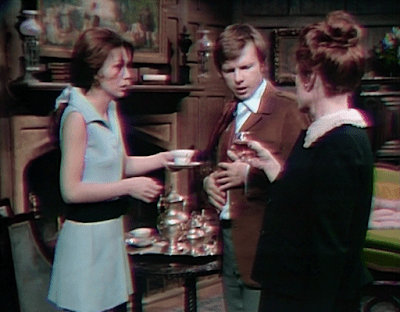
Episode 923: He kindly stopped for me

Yesterday, Amanda Harris told the story of a suicide attempt she made in 1897. A supernatural being whom she calls “Mr Best” thwarted this attempt, and told her that he would arrange for her not only to avoid death, but to remain young, for the years that it had been ordained she would live. If in that time she could reconnect with her lost love, rakish Quentin Collins, she and he would never die. Now it is 1970, and Amanda’s time is up. Mr Best is at her door. Amanda has found Quentin, but he has amnesia and is not ready to resume their relationship as Mr Best’s terms require.

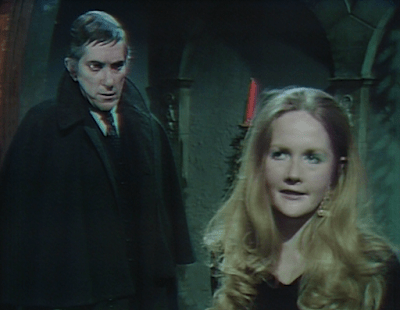
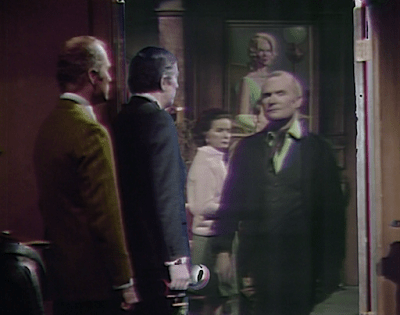
Mr Best has changed startlingly since we met him in the flashback that showed us Amanda’s story. Then he was warm and solicitous; today he is truculent and cold. Even his makeup is different. A pale coloring suggests sunken cheeks, making him look corpse-like.

Not so friendly anymore. Screenshot by Dark Shadows Before I Die.

Amanda has reversed her own attitude as well. In 1897, Mr Best lamented her wish for death and pleaded with her to stay alive; now it is Amanda’s turn to beg Mr Best for more time while he shows impatience with her. When she tells him about Quentin’s amnesia, he asks brusquely “Are you making this up?” It merits a laugh that the story of Dark Shadows has become so far-fetched that even Death Incarnate finds it hard to believe. But Mr Best does soften, and gives Amanda seven more days to get Quentin to tell her he loves her.

Quentin’s own perpetual youth is the result of a magical portrait that immunized him from the effects both of aging and of the werewolf curse that was placed on him in 1897. Quentin’s great-grandson Chris Jennings has inherited that curse. Mad scientist Julia Hoffman had learned that artist Charles Delaware Tate was still alive, and hoped he would paint a portrait of Chris that would free him from lycanthropy. Tate told Chris he no longer had the gift, but Chris forced him to paint his picture anyway. The moon rose, Chris transformed, and as the wolf he murdered Tate.

One of Chris’ surviving victims is his ex-fiancée, Sabrina Stuart. Sabrina saw him transform, and as a result was struck dumb for years and went prematurely gray. She can talk now, but she’s still gray. She shows up today at the great house of Collinwood where she calls on heiress Carolyn Collins Stoddard. Carolyn tells Sabrina that she doesn’t love Chris and never will, but that she realizes Sabrina loves him. This adds to a growing list of reasons the show has given us to doubt that Chris will be on much longer. His premeditated murder of Tate establishes him as a pure villain. A villain’s function is to create problems for other characters to solve, and Chris has been too passive and too dependent on Julia to be an interesting villain. His relationship with Carolyn gave him a connection to the core cast, but Carolyn’s conversation with Sabrina makes it clear that that is gone now.

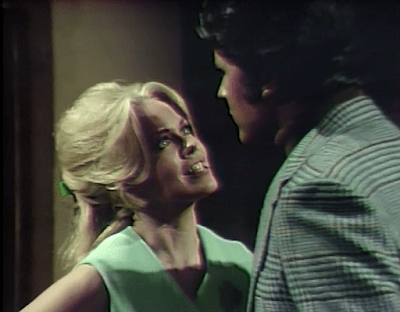
Sabrina insists Carolyn go on a road trip with her. She takes her to Tate’s house and leads her into the room where Chris murdered the artist. She tells her that a man was just killed there. Carolyn asks Sabrina if Chris did it. Sabrina looks pained, and says “Not Chris!” This further undermines Chris’ position. As long as Sabrina was mute, we could wonder whether she would blow the whistle on Chris once she regained the power of speech and if so what the consequences of that would be. But now we see that she is still in denial about him, and can set aside any hope that she might generate a story for him.

Carolyn asks Sabrina how she knows about the murder. No answer is forthcoming, and there doesn’t seem to be any way she could know. Evidently Sabrina has now developed some kind of clairvoyance about Chris’ murders. Since she is apparently determined to use that power to limit Chris’ relevance to the story, it is yet another reason to suspect he will be written out soon.

Sabrina making the most of her turn in the spotlight. Screenshot by Dark Shadows Before I Die.

Julia enters the crime scene. She and Carolyn are surprised to see each other. Sabrina announces that Julia knows all about Chris, and gets upset about it. Julia, a psychiatrist by profession, slaps her in the face, the accepted treatment for angry women in 1960s television shows. Sabrina quiets down, and Julia sends her away with Carolyn. Once they are gone, she settles in at Tate’s desk and starts rummaging through his papers.

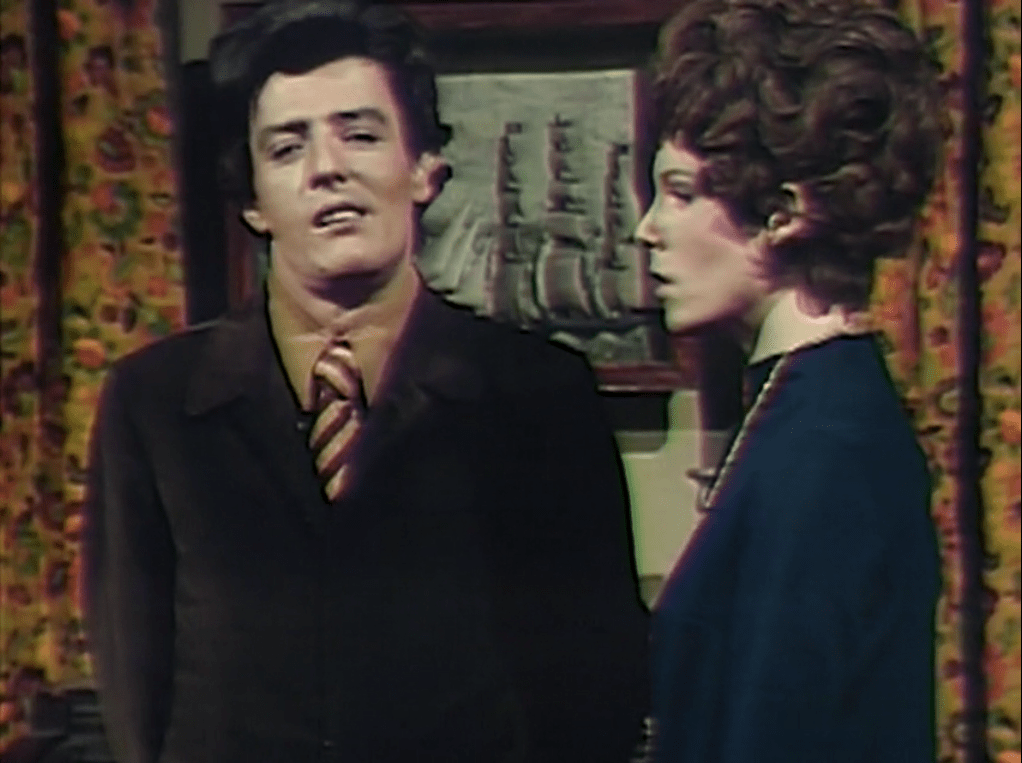
Julia wants to cure Quentin of his amnesia. She looked through an old Collins family photo album, and found that two pictures of him had gone missing. She is puzzled as to who took them; this is a continuity error, since in #686 and #687 there was a whole thing about ghosts removing photos relevant to Quentin from albums after Julia had looked through them. Be that as it may, Julia discovers in Tate’s papers that he had painted over Quentin’s portrait and that it is now in a big house on an island nearby.

We see a man holding a telephone and reciting lines of dialogue. He puts the phone down, looks at Julia, and recites more lines in the same unmodulated voice. Grayson Hall stays in character with her responses, and plays Julia asking to see the painting, but the man does not do anything that could be called acting. Dark Shadows has featured its share of lousy performances, but I cannot recall a member of the cast simply enunciating words as if he were in a neurologist’s office demonstrating that he had memorized the unrelated syllables given him to reproduce. It is genuinely bizarre.

The man’s name is Geoffrey Scott, and if anyone had told him he was supposed to act he would be playing a character called Sky Rumson. I suppose “Rumson” is a good name for a character who is identified with a house on the beach, since beach houses are what Rumson, New Jersey is known for, though the beach might not be front of mind in early January in central Maine. Sky is a go-go businessman, and his lines to Julia are about what a great hurry he is in.

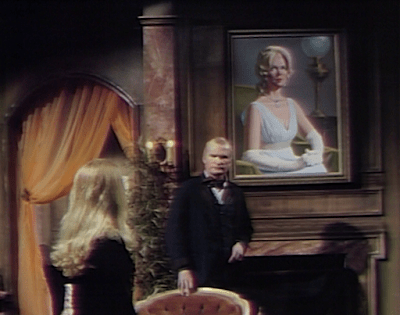
Sky shows Julia the painting that covers the portrait of Quentin. He tells her that it isn’t very good. Indeed it is not particularly distinguished, but it is far superior to any of Tate’s other works, some of which they want us to regard as museum pieces. Sky says that he bought the painting for his wife, who has an unaccountable fondness for it. He shows Julia a painting of Mrs Rumson. Julia has seen the painting before, and knows the model very well. It is a portrait of her old frenemy, wicked witch Angelique.

For regular viewers, this ending will be as satisfying and as logical as Geoffrey Scott’s phonetic rendering of his dialogue is disconcerting and inexplicable. Eight weeks ago, the show returned to contemporary dress after a long stay in 1897, beginning a new clutch of stories. Angelique is often absent from the show for extended periods, but she always turns up sooner or later. None of the three major storylines- Chris’ werewolf curse, Amanda’s attempt to rekindle her romance with Quentin, and the menace of the secret cult devoted to supernatural beings known as the Leviathans- is very closely connected to either of the other two, and none of them has any particular sense of urgency. Angelique’s vast powers and maniacal narcissism make it easy for the writers to inject her into every plot and accelerate them all towards a common resolution. In the 1897 segment, they moderated both her might and her mania, so that they can now keep her on indefinitely without overwhelming the show. Angelique is not what Julia expected to find, but she may be just what the doctor ordered.

Episode 919/ 920/ 921: The giver without a gift

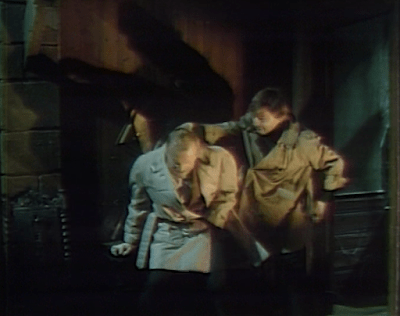
Centenarian Charles Delaware Tate, once a famous painter, is trapped in his parlor with a man who is threatening to kill him. The man is Chris Jennings. Chris tells Tate that there will be a full moon tonight, and he identifies himself as a werewolf. In 1897, Tate painted a portrait of Chris’ great-grandfather, Quentin Collins. That portrait had magical powers that immunized Quentin against both lycanthropy and aging, and Chris is demanding Tate do the same for him. Tate keeps telling Chris that he no longer has the ability to create such things, but Chris won’t listen. Tate does a sketch. He says that his work is finished and tells Chris to take it and leave. Before Chris can comply, he turns into the wolf and attacks Tate.

Chris had been in a secure room at a mental hospital controlled by his friend, mad scientist Julia Hoffman. He deliberately checked himself out and forced his way into Tate’s house because he wanted to use his condition as a weapon to coerce Tate. Julia is the audience’s chief point of view character these days, and she feels sorry for Chris. We also like two characters who care about Chris and don’t know that he is a werewolf. Heiress Carolyn Collins Stoddard is attracted to Chris and seems to have some lingering hopes that a romance might blossom between them, and Chris’ little sister Amy loves him and believes in him. Even one of Chris’ surviving victims, prematurely gray Sabrina Stuart, told Carolyn in #889 that while Chris is dangerous, “he is good.”

Despite everything these ladies are doing to help us like Chris, there can be no doubt that his attack on Tate is murder with premeditation and extraordinary cruelty. Roger Davis can usually be counted on to make us sympathize with anyone who is murdering one of his characters, but he plays Tate today with sensitivity and pathos, leaving us no way to avoid seeing a helpless old man locked up with a vicious killer. Chris’ future on Dark Shadows is limited for a number of reasons, chiefly his passivity in the face of his curse and his dependence on Julia and others to initiate action on his behalf. His abuse of Tate suggests that for whatever time he may have left on the show, Chris will be an unsympathetic villain.

Meanwhile, Carolyn is spending the day working as an assistant in an antique shop owned by her friends Megan and Philip Todd. Our first view of the shop today features Carolyn reflected in a mirror, but the main part of it is the taxidermied head of a baying wolf, emphasizing the danger Chris poses to everyone in and around the village of Collinsport.

The Wolf is loose, Carolyn is boxed in. Screenshot by Dark Shadows Before I Die.

A pair of hands cover Carolyn’s eyes. When they are pulled away, she expects to find that they belong to Philip’s eight year old nephew Alexander, but instead discovers that a thirteen year old boy she has never before seen has introduced himself to her by creeping up behind her and grabbing her face. The boy tells her that his name is Michael, that he is another of Megan and Philip’s relatives, and that Alexander has gone away. He tries to give Carolyn a pendant, but she recognizes it as one Megan wears and says that Michael can’t very well make a gift of something that doesn’t belong to him. He becomes very stiff and screams “How dare you not believe me!?” He doesn’t get any more pleasant as the scene goes on.

Philip comes in and tries to establish some kind of control; Carolyn takes the opportunity to excuse herself. As Michael and Philip talk, it becomes clear that they are part of a secret group with sinister plans. Returning viewers know that Michael and Alexander are not really human children, but are two manifestations of the same supernatural force. As Alexander, this force was a joyless, hateful little tyrant; Michael is no more appealing.

Dark Shadows originally ran on the ABC television network five days a week, from Monday through Friday. The episodes were numbered in a sequence reflecting the order of their original broadcast. When for whatever reason the show did not air on a given day, they would skip a number to keep the episodes airing on Fridays associated with production numbers divisible by 5. That made it easy to figure out how many weeks the show had been on, which in turn made it easy to keep track of where the show was in the thirteen week cycle that governed its long-term planning and the network’s decision to renew it.

In the last months of 1969, the show was being taped several weeks in advance of airdates, in a couple of instances more than five weeks ahead of time. This was atypical, and it led to a problem with the numbering. They knew that no episodes would air on Thanksgiving Day, Christmas Day, or New Year’s Day, but did not foresee that the network would preempt #891 for live news coverage of the return of the Apollo 12 astronauts to Earth on 24 November 1969. Since they had already shot that episode and many following it with the original production numbers on the opening slate, it wasn’t until this one that they had the chance to get the numbers back in synch. That is why it is listed with the three numbers 919, 920, and 921. The only other time they had to skip two numbers was in November 1966, when coverage of football games on and after Thanksgiving Day blotted out #109 and #110. Since that disruption to the schedule was planned, the slate for the next episode was just marked #111. This is therefore the only episode regularly referred to with a triple number.

Episode 918: Ways of remaining young

Mrs Acilius and I did our first watch-through of Dark Shadows on streaming starting in the spring of 2020, when there was no live theater to attend. When we got to the episodes introducing Barnabas Collins the vampire, I found Danny Horn’s Dark Shadows Every Day, which picks up with those and follows the series to its conclusion. I enjoyed Danny’s blog very much, and soon became one of his regular commenters. When we started this watch-through to coincide with the 56th anniversary, I looked for someplace to leave my comments on the episodes Danny didn’t cover, and found that all I could do was to start this blog of my own.

In his post about #412, Danny wrote: “This actor, Roger Davis, plays five roles on Dark Shadows, and they just get more and more angry. By the time we get to Harrison Monroe in late 1969, his character is literally an automaton sitting behind a desk, who yells at people nonstop until his head falls off. That is actually true.” I remember reading that in 2020 and doubting that it was actually true, but by the time we got to this episode and saw it happen, we had learned not to underestimate Dark Shadows. It is far and away the best Roger Davis moment on Dark Shadows. In fairness to Mr Davis, he is a highly trained actor who can do good work, but he chose to do so only a handful of times on the show. When we see that the writers are as sick of his obnoxiousness as we are, it’s an occasion to stand up and cheer.

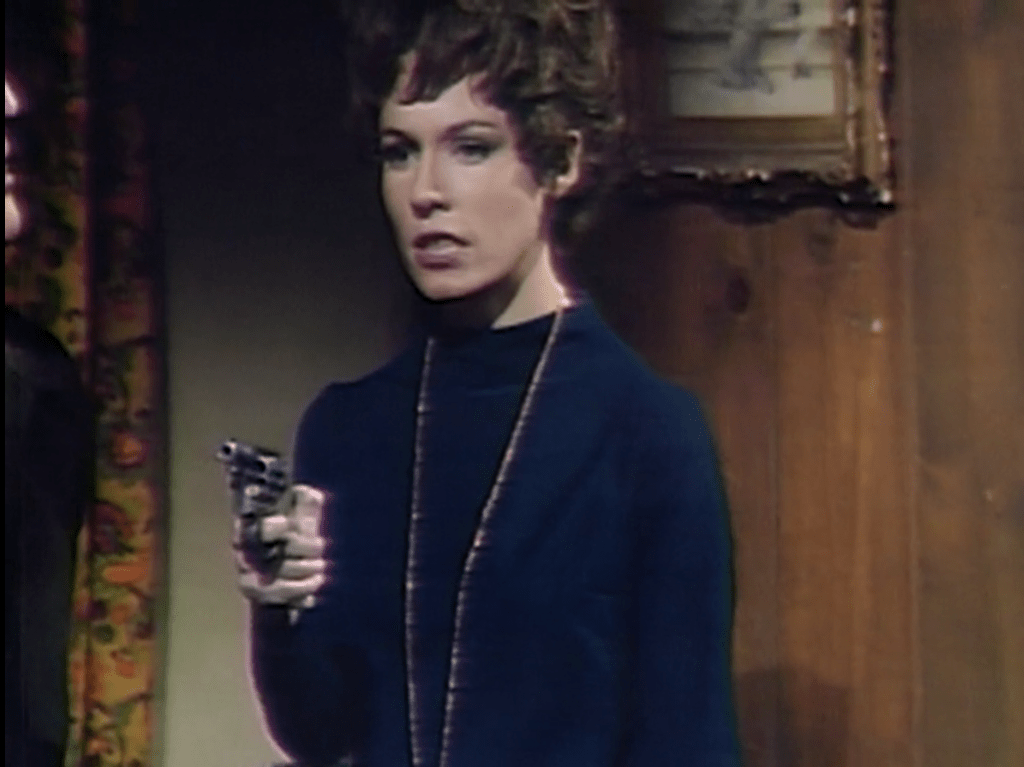
Much of the episode is taken up with some business about whether matriarch Elizabeth Collins Stoddard and her thirteen year old nephew David Collins are going to murder permanent houseguest Julia Hoffman. Liz and David have been absorbed into a secret cult devoted to unseen supernatural beings called the Leviathans, and Julia, who cannot be absorbed into the cult, is on track to uncover its existence. Liz takes a pistol and aims it at Julia’s back. Julia is absorbed in another crisis, and by the time she notices that someone else is in the room, Liz has put the pistol down.

Liz can’t bring herself to shoot Julia. Screenshot by Dark Shadows Before I Die.

Liz tells David she can’t bring herself to kill Julia, who has been very helpful to the family in the past. David sternly tells her that they must put aside all such considerations and think only of their duty to the Leviathans. They consult a sacred book the Leviathans have entrusted to them, and read that they must not kill anyone, since the ghosts of their victims are more formidable to them than are living people. Since most of the principal characters on the show, including Julia, Liz, and David, have committed or at least attempted homicide, this prohibition would seem to imply that the Leviathans are the good guys.

There is also a story about Quentin Collins and his great-grandson Chris Jennings. Quentin was a werewolf in the nineteenth century and Chris has inherited that curse. In 1897, a repellent little man named Charles Delaware Tate painted Quentin’s portrait. The portrait had magical powers, relieving Quentin of the effects both of lycanthropy and of aging. Quentin recently came back to town, suffering from amnesia and refusing to listen to Julia or Chris when they try to tell him he is 99 years old. Julia and Chris hope that Tate will be able to do for Chris what he did for Quentin, and they have figured out that he is still alive and using the name Harrison Monroe.

The moon was full enough last night to trigger the werewolf transformation, and will be again tonight. Chris turns up. She had taken him to a mental hospital she controls, to be locked up securely while he is in his lupine form; he checked himself out, and says he can’t stand being caged. Since the alternative is killing at least one person at random, it is rather difficult to sympathize with Chris’ insistence on letting himself out.

For her part, Julia was already afraid that a werewolf was on the loose before she knew Chris had left the hospital. She suspects Quentin may have reverted to lycanthropy. She goes to the apartment of the woman who has been keeping Quentin and finds him there, his face soiled and his clothing tattered as it might be the morning after a fit of werewolfery. It turns out that he did not transform- he simply got into a bar fight. When she tells Chris about this, he goes to his great-granddad and demands he accompany him to Tate/ Monroe’s house. Quentin isn’t interested in Chris or his problem or Tate/ Monroe, but he is too drunk to hold his ground for long.

Tate/ Monroe doesn’t want to let anyone in, but when Quentin announces himself he opens the door. Chris and Quentin see a young man sitting at a desk in a darkened room. The young man sees Quentin’s apparent youth and yells “Liar!,” shouting that he is too young to be Quentin. Quentin points out that Tate/ Monroe looks just as young as he does, and Tate/ Monroe responds by shouting something about being a genius. Within seconds, he is shouting that of course he recognizes him as Quentin. Confusing as this transition is, I don’t think it is a flaw in the writing, but in the acting. I suspect Mr Davis was supposed to put some sort of inflection on the lines in between to show that Tate has figured something out, but doing that would not be compatible with his technique of delivering all of his lines in an unvarying petulant shout.

Quentin can’t take Tate’s personality any more than the audience can. He throws a vase at him and runs out of the room. It’s when the vase hits the automaton that the head falls off.

The Leviathan story is based on some of H. P. Lovecraft’s stories. Chris and Quentin do not appear to have a direct connection to the Leviathans, but Harrison Monroe, and today’s closing revelation that he is a pile of junk arranged to look like a person, are taken from Lovecraft’s novella The Whisperer in Darkness. So perhaps werewolves and Leviathans have something to do with each other after all.

Episode 917: People take too much medicine as it is

Professor Timothy Eliot Stokes has parked his car and is walking up to the great house of Collinwood, home to matriarch Elizabeth Collins Stoddard and her daughter Carolyn Collins Stoddard, among others. He sees a man lying on the ground and asks him what is wrong. The man pleads with Stokes to help him get away. Stokes asks him what he wants to get away from; the man responds “I can’t tell you.” Stokes asks who he is; he says his name is Stoddard. Stokes replies “You’re Paul Stoddard, Carolyn’s father.” Paul brightens momentarily at Carolyn’s name, but then draws up tight and asks “They sent you after me, didn’t they?” Stokes assures him that no one sent him, and tells him he will catch his death of cold if he continues lying on the ground.

Paul asks Stokes to take him to the police. Stokes nods to the house and says they can call the police from there. Paul cries out, “No! No, not to Collinwood. Please, Professor Stokes, you’ve got to take me to the police, it’s the only thing you can do for me. If you don’t, I’ll be dead. No, no, no, I am not being hysterical or melodramatic…” At this, Stokes turns to face his car. He gives Paul his arm, and says he will drive him to the police station.

The police station was a frequent set for about a year after its first appearance in August 1966. It hasn’t changed a bit when we see it today. The officer on duty is someone we haven’t seen before, but that doesn’t mean he is a new character. Four actors took turns playing Sheriff George Patterson between September 1966 and January 1969; this man is not named in the dialogue and there are no acting credits on screen today, so for all we can tell he might be a fifth. He is younger and slimmer than were any of the other incarnations of Sheriff Patterson, but maybe he’s been working out.

Stokes introduces Paul to the policeman, and explains that Paul will speak only to the authorities. The policeman sits Paul down, gives him some coffee, and assures him that everything will be all right.

Paul tells the policeman that “It will never be alright until they stop chasing me” and “They have been after me ever since I got here.” The policeman asks “What are these people doing to you?” and Paul replies that “At first, there were just little hints, phone calls, things like that- veiled threats. It was their way of making me know that I was under their control. And I was, too, because when I tried to get away they took me back to Collinwood.”

The policeman responds “I see,” and Paul bursts out with “No, you don’t see! You think I’m mad!” The policeman tries to reassure him that he will listen, and asks him if he can name any of his persecutors. “Yes, I’ll name one, all right! My [ex-]wife, Elizabeth Stoddard.” The policeman says “That’s a little hard to believe,” and Paul responds “It’s impossible to believe, and yet! You tell me why she took me back into Collinwood, after years of open hatred, unless they wanted me there! And you know this town, you know how they gossip. And you know my wife. Why, why would she risk all that gossip, unless they wanted her to do so?” He answers that even so, “It’s still a little hard to believe.”

Paul does not trust the policeman or Stokes. Screenshot by Dark Shadows Before I Die.

Paul angrily says “Yes, and because it’s Elizabeth Stoddard who’s involved, you will do nothing!” The policeman responds “I didn’t say that. I intend to talk to Mrs Stoddard and the doctor and whoever else is involved. If you still feel you’re being held captive, well, we’ll have to do something about it.” Paul visibly relaxes.

Earlier in the episode, we saw Liz forcing medicine on Paul. Returning viewers know that Liz has been absorbed into an evil cult that is trying to do something terrible to Paul, and indeed to the whole human race. We saw today that Liz has assigned her housekeeper, Mrs Johnson, to trick Paul into taking the medicine. It quickly becomes clear that Mrs Johnson has no idea that Liz is involved in anything sinister- she simply trusts her employer to do the right thing, and she follows her orders. Liz owns most of the village of Collinsport, and most of its people would react as Mrs Johnson does.

When we saw the last Sheriff Patterson for the last time in #675, he told a prisoner that he was releasing him because Liz’ cousin Barnabas said he was with him when the crime was committed, and Barnabas is “just about the best alibi you can have in this town.” He shook hands with the prisoner and sent him on his way. Since we know that Barnabas is, off and on, a vampire, and that even when he is free from the effects of that curse he spends most of his time covering up murders, that left us with an impression of Collinsport law enforcement as hopelessly in the thrall of the Collinses. That reinforces the image left by Sheriff Patterson’s predecessor, Constable/ Sheriff Jonas Carter, who was last seen in #32, toddling off after taking Liz’ orders to accept an obvious lie as a way of closing a case against a family member. Paul has every reason to suppose that this new policeman will be as submissive to Liz and her family as were his predecessors.

Now that Paul can hope that the policeman will be different from the others, he asks him to lock him away, to put him under guard someplace where no one can get to him until his daughter Carolyn Collins Stoddard can come for him. Stokes agrees to telephone Collinwood and talk to Carolyn, and the policeman escorts Paul to a back room. Paul awakes from a nap, and smiles at the policeman. He tells him he can’t tell him how much better he feels. The policeman tells him someone has come to see him. Paul’s delight at the thought that Carolyn has arrived gives way to cries of terror when he sees Liz at Stokes’ side. She comes at him with a spoonful of the hated medicine while Paul tells Stokes and the policeman that they are traitors and killers.

This one is primarily a showcase for Dennis Patrick as Paul, but all of the acting is excellent. My wife, Mrs Acilius, found it very difficult to watch the episode to the end, saying that they did too good a job- she felt as trapped as Paul. It really is one of those episodes you could show to a person who had never before seen Dark Shadows with a reasonable confidence that they would understand why we like the series so much.

Episode 915: Emergency Leviathan Broadcast

In #701, old world gentleman Barnabas Collins traveled in time from 1969 to 1897. For the next eight months, ending in #884, Dark Shadows was a costume drama set in that year. On his way back to a contemporary setting, Barnabas took a detour to the 1790s, when he was a vampire. Before he left the 1790s, he was abducted by and absorbed into a cult that serves supernatural beings known as the Leviathans. At their behest, he took a small wooden box with him to November, 1969, and functioned as one of the leaders of the Leviathan cult in that period.

The first six weeks of the Leviathan story has had its strengths. Ever since Barnabas was first cured of vampirism in March 1969, he has been under the impression that he was a good guy and has been doing battle with various supernatural menaces. He was hopelessly inept at this, and created as much work for the other characters by his attempts at virtue as he formerly did in his unyielding evil. That has made him a tremendously productive member of the cast, but it does leave him with a tendency to seem harmless, even when he is trying to murder his way out of a problem. But Barnabas the Leviathan chief has been ice-cold and formidably efficient. Even though not much has yet been done to hurt anyone, seeing him in this mode adds a note of terror to the proceedings.

Moreover, the Leviathans have voided Barnabas’ friendship with mad scientist Julia Hoffman. Since the relationship between the two of them has been the heart of the show for over two years now, from the hostility of their early days to the close bond they formed in the summer of 1968, this reinvigorates the action. It is as interesting to see them fight with each other as it is to see them collaborate against a common foe, and their hate scenes gain an extra depth because we keep wondering about their eventual reconciliation. If they play their cards right, they should be able to keep this up for months.

Today, it all falls apart. Barnabas has drawn a huge following of very young fans who run home from elementary school to watch the show. The 1897 segment was a triumph in large part because it had a core of stories that could hold the attention of adults while also appealing to the preteen demographic. But the Leviathan arc has so far had little to offer anyone but grownups. Apparently the kids were writing angry letters, because this episode, rushed into production at the last minute and bearing signs of haste in every shot, turns Barnabas back into the would-be hero who was such a klutz that he couldn’t even stay in the right century.

The creature who emerged from the box Barnabas brought from the past now appears to be a 13 year old boy and answers to the name Michael. In the opening scene, Michael orders Barnabas to kill Julia. Barnabas declares that he will not, and goes home. There, he tells his troubles to the box, then falls asleep in his chair.

A hooded figure appears to him. This hooded figure says that he is a Leviathan, and tells Barnabas he must comply with Michael’s commands. The Leviathan is not named in the dialogue and there are no actors’ credits at the end, but reference works based on the original paperwork call him Adlar.

Adlar sets out to explain Barnabas’ position, much as Marley’s ghost did to Scrooge in Dickens’ A Christmas Carol. The shortened production schedule shows in inconsistencies that litter Adlar’s speeches. At one point he says that the Leviathans needed Barnabas to transport the box from the eighteenth century to the twentieth; at another, he claims that they are holding his lost love Josette prisoner in the eighteenth century and will inflict a new, far more horrible death on her than the one she died the last time Barnabas was in the 1790s, a threat they will be able to carry out only if they have their own means of traveling back and forth through the years. Barnabas doesn’t pick up on this or any of Adlar’s other inconsistencies; perhaps he is too distracted by the many jump cuts that make this episode look like the videotape was edited with a rusty butter knife.

Adlar threatens to make Barnabas a vampire again, then disappears. He does not tell him that he will be visited by three spirits, one representing his past, another his present, and the third the future he is risking by his present course of action, but this is in fact what happens. Barnabas goes outside, and sees a bat. It was a bat whom he first saw on this very spot who initially made him a vampire. Barnabas rushes inside, looks in the mirror, and does not see a reflection. He thinks of his mouth, and feels fangs growing there.

Next comes Megan Todd, a Leviathan cultist who with her husband Philip is fostering Michael in their home. Barnabas cannot take his eyes off Megan’s long white neck. Megan keeps telling Barnabas that he is the only one she can confide in about her concerns with the progress of the Leviathan plan; he keeps demanding ever more stridently that she leave at once. His bloodlust may explain why he doesn’t notice the continuity problem in the scene. They’ve made the point time and again that it is only while Barnabas is giving orders to her and Philip that Megan remembers that he is their leader. At other times, she thinks he is an outsider. But Megan is the only one who can tell Barnabas a story of family life in any way paralleling that which the Ghost of Christmas Present brings to Scrooge’s attention at the Cratchit house. Continuity has to go if the episode is going to fit into the form of A Christmas Carol.

Suddenly, Barnabas finds himself in an alley by the waterfront. A sign behind him says that he is next to the Greenfield Inn; we saw this sign in #439, set in the year 1796. Evidently the Greenfield Inn is a long-established, though not very reputable, place of lodging.

A woman approaches him. She is very aggressive about insisting he take her with him wherever he is going. He is reluctant at first, urging her to seek friends at the Blue Whale tavern, but she won’t take no for an answer. All of a sudden, he brightens and looks at her with desire. She says she is afraid of him. He asks if she wants to go, and she screws up her courage to declare that she will stay with him. He bares his fangs and attacks. The rough videotape editing adds to the violence of the scene. There is no sensuous bite, only a flash as he lunges at her and then is standing up again, protesting that he didn’t want to do it. When the camera zooms in on the bleeding marks on her neck, it is surprising to see that he didn’t rip her throat out altogether.

We cut back to Barnabas’ house. He is dozing in his chair, and the woman, displaying vampire fangs of her own, walks in through the front door. She approaches Barnabas. He awakens, and is horrified. Adlar tells Barnabas that “she is not up to your usual standards.” She’s standing right there, that’s pretty tactless. Also, she is future four-time Academy Award nominee Marsha Mason. The only other Oscar nominee Barnabas bit was Grayson Hall as Josette’s aunt, the Countess DuPrés, in #886. Hall was only nominated once, so if anything this woman is a step up for him.

Four time Academy Award Nominee Marsha Mason. Screenshot by Dark Shadows Before I Die.

Adlar makes the woman disappear, and shows Barnabas that he is not really a vampire again. With that, we see that she is a shade of a future that may come to be, not one that is already ordained. Adlar also tells Barnabas that it is not now necessary to kill Julia. But he does say that Barnabas will have to do something to ensure Julia’s silence, or else Josette will suffer. Barnabas hangs his head and says to the mirror that he has no choice to obey.

Episode 912: A little water won’t hurt her

In his post about this episode on his great Dark Shadows Before I Die, Danny Horn remarks that this is one where you don’t need any background- as a first-time viewer, you tune in, see the characters confronting each other, and you’re so curious as to what it is all about that “you are now a person who watches Dark Shadows.” So I will try to write it up as if I were coming to it cold.

We open in a corridor where a girl aged about eleven is vowing not to be frightened. She hears heavy breathing coming from behind a door. She opens the door. She looks forward and screams in terror.

We cut to what appears to be the home of someone with a hoarding problem, but which we will later learn is an antique shop. A creepy looking man in a dark cape enters and scolds an eight year old boy whom he addresses as Alexander. He demands to know why Alexander let the girl, whose name we learn is Amy, go into the room. Alexander is defiant, the man cold. Alexander asks the man if someone named David told him what happened, and he responds that it does not matter who told him. He tells Alexander that he will obey him when he is grown, but that as long as he is a child he will give the orders. Alexander must not do anything to upset the plan which some group they are in is putting into effect. The man then announces that he is going off to solve the problem Alexander created when he let Amy enter the room.

We cut to a door surrounded by foliage. Amy knocks on it. Receiving no answer, she lets herself in.

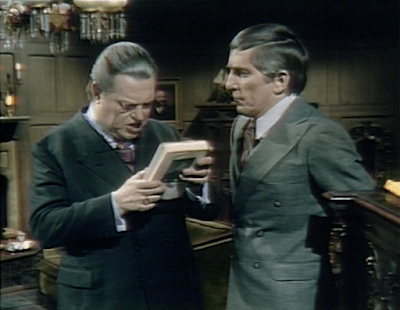
We cut to the foyer of a large house. A man and woman are looking at a startlingly bad portrait in oils. They are talking about how good it is, leading us to wonder if we are supposed to think there is something wrong with them or if we are expected to suspend our disbelief and pretend the painting is actually good. Other paintings hang on the walls of the set, some of them so far superior to this one that we are inclined to the first interpretation.

The art critics. Screenshot by Dark Shadows Before I Die.

The man’s name is Professor Timothy Eliot Stokes, the woman’s Dr Julia Hoffman, MD. They appear to be friends, answering to the names “Eliot” and “Julia” respectively. The painting is the work of an artist named Charles Delaware Tate. Julia has found another painting, one executed just a year before, which she believes to be another work of Tate’s, even though it is signed “Harrison Monroe.” Stokes says that a friend of his who is an expert on Tate attended Tate’s funeral ten years previously. Julia says that she wants to go to a nearby cottage to tell someone named Chris Jennings about the paintings. Stokes is surprised that Chris is interested in late Victorian art, and Julia says that he is helping her with a project.

We cut to a room in a small house. Amy is there. A young man comes in. She is frightened when she hears him approach, but runs to him and embraces him when she sees who he is. He asks what’s wrong, and she cannot speak. She takes a paper, and writes the single word “SHOP.” This tells the man nothing.

Julia enters. She addresses the young man as Chris. When Chris tells Julia that Amy cannot speak and that she wrote the word “SHOP,” Julia reacts strongly. She orders Chris to go and make David tell him what happened to Amy in the antique shop. Chris goes, and Julia asks Amy if Alexander hurt her. Amy’s eyes widen and she looks away. Julia pleads with her to relax and then try to talk.

The creepy looking man in the dark cape enters. Julia calls him Barnabas. Barnabas asks if he frightened them; Julia says that he did not, an obvious lie. He smilingly sets about diagnosing Amy, touching her forehead and saying she has no fever. The girl manages to say that she is thirsty. Barnabas directs Julia to fetch a glass of water. Julia refuses, and insists Barnabas do so. He eventually capitulates. While he is away, Julia urgently whispers to Amy that she must say nothing while Barnabas is with them.

Barnabas returns with the water. Amy drinks it, and he fondles her face in a manner that might not be alarming if she and Julia weren’t so tense and he weren’t so languidly pleased with himself. As it is, it is like an assault. He tells Amy that she will feel better soon. She takes a few wandering steps to her left and sinks into a chair, asleep. He tells Julia that she should let Amy sleep, then excuses himself.

Chris returns. He says that he did not interrogate David, because Alexander was with him. He did get a story about a man named Grant entering the antique shop and frightening Amy because she thought he was someone named Quentin.

Stokes enters. They talk about calling on Harrison Monroe at his home some miles away. Stokes says that he has a lecture to deliver tonight, but that he will be glad to go with Julia to Monroe’s place tomorrow. Julia is determined to go tonight. Julia says that she will go to Monroe’s by herself, and we see Amy looking alarmed, shaking her head.

Back in the larger house, we see Alexander and Barnabas in a drawing room, looking at a box. Barnabas tells Alexander that Amy “is in the intermediate stage” and that if they have been successful she will open the box and become part of their group.

In the foyer, the front door opens. Chris and Amy enter. Chris tells Amy that it is his job to take care of her. She says she knows that it is, and hugs him. He leaves, and Amy heads for the drawing room. Alexander opens the doors to the drawing room and stands in the doorway. Amy approaches carefully. She sees the box, and without a word opens it. She gives Alexander a snapshot and apologizes for not returning it to him earlier. He accepts it with poor grace, and she repeats her apology. She exits.

We cut to another door surrounded by foliage. Julia knocks on it. A voice booms from a loudspeaker mounted above it, commanding her to leave. She says that she has come on business relating to “Delaware Tate.” The door opens, and she enters.

This episode marks the final appearance of David Jay as Alexander. His character will undergo a metamorphosis and return as another actor in the next episode. Two of Danny Horn’s commenters (here and here) identified themselves as personal friends of Mr Jay’s. They reported that “David Jay” was a stage name, and that as of March 2021 he was alive and well and living an intensely private life.

Julia’s scene at Monroe’s door recalls the end of #153, when well-meaning governess Vicki and instantly forgettable young lawyer Frank knocked on a door that opened by itself and went into a tomb. Longtime viewers can only hope that once inside Julia will meet a character as appealing as the one Vicki and Frank met in #154.

Episode 910: Know or suspect

For eight months in 1969, Dark Shadows was a costume drama set in the year 1897. Old world gentleman Barnabas Collins and mad scientist Julia Hoffman traveled back in time from the 1960s to keep us company in that year. It was nice to have them around, but we didn’t really need them. Rakish Quentin Collins was the star then, and now that the show has returned to 1969 we are unsurprised that he has turned up, alive, well, and 28 years old.

Quentin has amnesia, which Julia is determined to cure. He spends all day today listing the things he doesn’t know about himself, such as his name, which of his hands is dominant, and why Julia and Broadway star Olivia Corey are fighting each other to see which one will keep him in the style to which he might like to become accustomed. He’s such a good-looking guy that this latter really can’t be all that mysterious to him, but maybe he’s just being tactful when he claims not to understand that part.

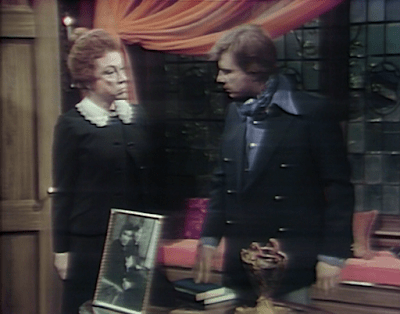
Quentin and Olivia go to her hotel room, which she has decorated with framed copies of her professional headshot and a bit of folded stage dressing that could be used to suggest windows. Apparently that’s just how actresses make themselves feel at home.

Quentin asks Olivia why she is interested in him. She tells him that they met a long time ago, but that she can’t tell him any more than that. This angers him; he knows nothing at all about his past, so it strikes him she is being cruel by withholding the information she has.

Regular viewers know that Olivia and Quentin were lovers in 1897, when she was known as Amanda Harris. Both of them owe their youth to magical paintings done by an artist named Charles Delaware Tate. Julia knows all about this, and has come into possession of a landscape Tate painted in the 1940s. Amanda/ Olivia came to Collinsport in hopes of getting the painting from her. The other day Amanda/ Olivia managed to have it x-rayed, and found that there was a portrait on the canvas underneath it. The x-ray could not show whose portrait it was. Later today, Julia will have the same examination made. When she gets the results, Julia arranges to have the landscape removed. It turns out that the underpainting is a portrait of Amanda Harris herself.

The expert who exposes the underpainting also brings bad news. He tells Julia’s sidekick Chris Jennings that Tate died about ten years before. Julia knows that Quentin’s portrait not only keeps him alive and youthful, but also prevents him turning into a werewolf. Since Chris is Quentin’s great-grandson and has inherited the werewolf curse, he and Julia were hoping that Tate was still alive and still empowered to paint magical portraits.

Closing Miscellany

Nowadays, Donna McKechnie says that, while she had been on Broadway as a singer and dancer before appearing on Dark Shadows, she was only a beginner in acting. It’s true that she is noticeably uncomfortable delivering her lines, but her scene partners- David Selby, Grayson Hall, and Don Briscoe- all give her such good support that she gets through it quite smoothly. Besides, she is so charming that the audience is willing to forgive her anything.

Danny Horn’s post about this episode on his great Dark Shadows Every Day is one of his occasional tours de force, a spoof of the postmodernist literary terminology that he learned in graduate school. I learned the same terminology when I was in graduate school, and I think his spoof of it is hilarious. But in the course of it, he has some really good insights. For example:

Chris:  Olivia Corey… I don’t get it! Why is she so interested in him?

Julia:  She must either know — or suspect! — that he is really Quentin Collins.

It’s telling that she puts the dramatic stress on the phrase “or suspect!” rather than the knowledge itself. To Dr. Hoffman, it’s the existence of suspicion! that is itself suspicious. Anybody can know something. It’s the act of suspecting! that reveals a new range of discursive positions.

Danny Horn, “Episode 910: Epistemology of the Portrait,” posted 8 August 2016 on Dark Shadows Every Day

Which is a great point! When the characters know facts about each other, those facts don’t move the story an inch unless they are clues that they can use to build on the suspicions they have about them or tools they can use to manipulate them into doing what they want. So Julia knows that Quentin lived in a particular room in the long-deserted west wing of Collinwood and that he obsessively listened to a particular sickly little waltz on his record player. Those facts are nothing in themselves, but when she takes him to the room and plays the waltz on the record player at the end of today’s episode, we have hope that Quentin might become himself again soon.

Towards the end of the 1897 segment, Judith Collins Trask and Tim Shaw bricked the evil Gregory Trask up in Quentin’s room. In #884, we heard her telephone Tim and instruct him to remove the bricks. When Julia takes Quentin into the room today, there is no trace of bricks. Evidently Tim did a good job clearing them out.

By the time Julia became best friends with Barnabas in 1968, she was in the habit of addressing him as “Barnabas, Barnabas.” In the 1897 segment, she addressed Quentin as “Quentin, Quentin.” Now she and Barnabas are on the outs, and Quentin isn’t answering to his name no matter how often you repeat it. So she addresses her henchman Chris as “Chris, Chris.” Don Briscoe was a likable actor and Chris has his points, but the character has some weaknesses that tightly circumscribe his future on the show. I suppose the point is that Julia has a higher opinion of Chris’ potential than the other characters do, but she so frequently represents the audience’s state of knowledge that it is a bit odd she thinks he belongs in a category with those breakout stars.

I believe this episode also marks the first time Julia addresses matriarch Elizabeth Collins Stoddard as “Liz.” She has been living in Liz’ house since the summer of 1967, so I guess it’s time she stop calling her “Mrs Stoddard.”

Episode 908: Mollycoddle that monster

The current phase of Dark Shadows is focused on the threat to the human race posed by the Leviathans, unseen supernatural beings who have taken control of several characters on the show. Among their devoted servants are matriarch Elizabeth Collins Stoddard and her nephew, strange and troubled boy David Collins. Today, Liz and David welcome a boy known as Alexander to the great house of Collinwood. Alexander appears to be an eight year old boy, but is in fact an extreme case of Soap Opera Rapid Aging Syndrome. Last week he was an infant, and a few days before a whistling sound coming from a wooden box. Whatever Alexander may really be, he holds a key position in the Leviathans’ plan.

At times, Dark Shadows becomes so much a kids’ show that it loses much of its adult audience. The Leviathan story so far has gone to the opposite extreme. A scene in which Alexander orders the thirteen year old David to give up the transistor radio he had long wanted and that his father just gave him will probably get similar reactions from viewers of all ages, but when Alexander scolds Liz for asking questions and she apologizes, only those who remember Joan Bennett as the great star she was in the late 1930s and early 1940s will get the full force of the moment. In general, adults will probably feel the distress Alexander’s tyranny is supposed to induce, while the fans who are running home from elementary school to watch the show will likely be either annoyed with the kid or amused to see the grownups getting theirs.

Liz’ ex-husband Paul is being persecuted by the Leviathans and their human agents. Paul is staying at Collinwood, and he is outraged to find Alexander in the house. Paul carries on like a crazy man, prompting Liz to tell him that if he doesn’t compose himself he will end up in a mental hospital. He tells Maggie Evans, David’s governess, about his suspicions; she listens sympathetically until he catches Alexander eavesdropping and roughs the boy up. Maggie then freezes in horror, and Paul goes on shaking Alexander and yelling at him until Liz enters and puts a stop to it. While Liz and Maggie stand in the corridor and talk about Paul’s lunatic behavior, he paces in the drawing room, telling himself that he mustn’t “fly off the handle” again.

David enters and hands Paul a small photo album. He says that it has pictures of Paul and Liz’ daughter Carolyn when she was a child. Since Paul wasn’t around when Carolyn was growing up, David says it occurred to him that Paul might want to look through it. Paul thanks David for his thoughtfulness.

As Paul leafs through the album, we get a look at a picture depicting Carolyn as she was when she was about ten. We haven’t seen the model before. Dark Shadows had such a tight budget that regular viewers will be fairly sure they wouldn’t have brought a girl in only to pose for a single photograph, so we might start wondering when we will meet the ten year old Carolyn.

Child Carolyn. Screenshot by Dark Shadows Before I Die.

We may also be wondering when we will see another girl of about the same age. Denise Nickerson, twelve years old in December 1969, has been in the cast for a year at this point, and has made major contributions every time we’ve seen her. We saw in #893 and #896 that her character Amy Jennings is still living at Collinwood and is still David’s chief playmate. But as is usual in episodes where she does not appear, Amy is unmentioned today. Liz tells Paul that David spends entirely too much time surrounded by adults, as if Amy does not exist. They followed the same pattern during the eight months of 1969 when Dark Shadows was set in 1897 and Nickerson played nine year old Nora Collins. When Nora was in the episode, she was often its brightest spot, but when she wasn’t her name never came up. It’s unnerving that the show does so little to reassure us that it will continue to make use of such a talented and appealing young actress.

Alexander sits on the bench that has been in the foyer at Collinwood throughout the whole series. The Dark Shadows wiki says this is only the second time the bench has been used. I want to say it is the third- I remember David sitting there in #176, when Maggie’s predecessor Vicki told him he could have two desserts, cake and ice cream, but I seem to recall either him or someone else sitting there at some point around that time. I’m not going to go back through those episodes to check, but if you’ve been watching them I’d appreciate it if you’d leave a note in the comments.

Episode 907: Knowing the criminals but not the crime

The current storyline on Dark Shadows revolves around the evil machinations of a cult that serves mysterious supernatural beings known as the Leviathan people. We haven’t seen the Leviathans themselves, and the humans who make up the cult have not yet done anything spectacularly destructive.

The vagueness of the Leviathans’ threat is lampshaded a couple of times today. We open with old world gentleman Barnabas Collins, a leader of the cult, standing over the hospital bed of his distant cousin Quentin Collins. He tried to kill Quentin, but managed only to give him a head wound resulting in massive amnesia. In our world that would represent an extremely severe injury, but in Soap Opera Land everyone gets amnesia from time to time. It’s like the common cold, only with a more definite prospect of complete recovery. Now he is thinking of finishing the job. He decides that since Quentin once saved his life, he will take a pass on killing him for now. We hear his thoughts as he counts that a payment in full of his debt to Quentin. Evidently he now considers himself free to kill Quentin at his next chance. That anticlimax sums up the whole story so far- lots of ominous suggestion, no resolutions.

The Leviathan cult has been menacing Paul Stoddard, a shady fellow who, in the late 1940s, married heiress Elizabeth Collins, sired her daughter Carolyn, and deserted the family after he realized he wouldn’t be getting his hands on Liz’ money. The night he ran off, he unwittingly made a Faustian bargain with a representative of the cult, handing Carolyn over to them. It is unclear why they have been so unpleasant to him lately, since he made his agreement twenty years before.

Now, Liz has been absorbed into the Leviathan cult. She has taken Paul back into her home, the great house on the estate of Collinwood. She told him yesterday that she wanted him close to her so that they could work together to fight his unseen enemies, but it dawns on him today that this is not her intention. She tells him that she and Carolyn have concluded that he is mentally ill and they want to get him help. He goes to telephone the police. Liz asks what crime he will report to them, and he realizes that he knows of none that has been committed.

Paul catches permanent houseguest Julia Hoffman, MD, eavesdropping on his conversation with Liz. He angrily accuses her of being “one of them.” Since Liz is talking about treating Paul as a mental patient and Julia is a psychiatrist in residence at Liz’ house, this is a natural assumption on his part. Before long, he realizes that Julia is in fact his likeliest ally. Between the summer of 1968 and the autumn of 1969, Julia and Barnabas were inseparably close friends. His absorption into the Leviathan cult put a stop to that, and now he can barely tolerate her presence. She does not know what is going on, but is avidly interested in whatever suspicions Paul can share concerning the change in Barnabas. Before they can get very far, Barnabas enters and Paul runs off. Julia faces Barnabas down, then goes after Paul.

Julia confronts Barnabas about his effect on Paul. Screenshot by Dark Shadows Before I Die.

Episode 906: Like an organization

Paul Stoddard has returned to Collinsport, Maine, the town he left twenty years before when he despaired of getting his hands on his wife Liz’ money. He is being tormented by a mysterious group. What the group is and what it is doing he does not understand, but he knows that they are destroying him and that they want to get their hands on his daughter, heiress Carolyn Collins Stoddard.

Liz shows up at Paul’s hotel room. He tells her about the shadowy force that is menacing him and Carolyn. He gives her the one fact he is sure of, that her distant cousin Barnabas Collins is a leader of that force. She gets a faraway look in her eyes and says that Barnabas has been different since he “came back,” and that perhaps Paul is right about him. To his astonishment, she invites him to move back into her home, the great house on the estate of Collinwood. If he is the one who has perceived a threat to the family, then he should be in the family’s home where he can make the maximum contribution to the fight against that threat.

Liz formulating her response to Paul. Screenshot by Dark Shadows Before I Die.

Liz’ reaction to Paul’s allegation against Barnabas is intriguing for two reasons. First, Liz has been kept out of the main story consistently since January 1967, when the story centering on blonde fire witch Laura Murdoch Collins was first turning Dark Shadows into a supernatural thriller. Laura cast a spell on Liz to get her out of her way, and she never did make it back into the action. So when we hear her saying that she has noticed something disturbing about Barnabas, concerning whom she has always had a breathtakingly vast blind spot, and that she is ready to do battle, we are presented with the possibility that her character might be reinvented completely. Liz has connections to every other character on the show, and Joan Bennett still had significant star power in late 1969. So a revitalization of Liz might well revolutionize the whole show.

Second, Barnabas’ personality has indeed undergone a drastic change of late. Since every established character on the show is well acquainted with Barnabas, this cannot be concealed for very long. That suggests that the current story will move at a much faster pace than we are accustomed to seeing. If even Liz is entering the action, longtime viewers will suspect that it is already coming to a climax.

Liz sends Paul off to fetch Carolyn. Once he is gone, she picks up the telephone and places a call. We cut to the other end of the call. We see that she is telling Barnabas that everything is going according to their plan. If Liz has merely become one of Barnabas’ minions, the change in her may be temporary and the story may still have some time to run. Paul’s life expectancy, however, may be rather shorter.