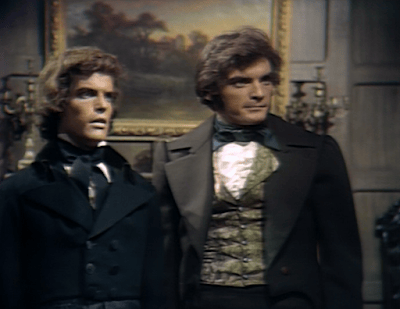
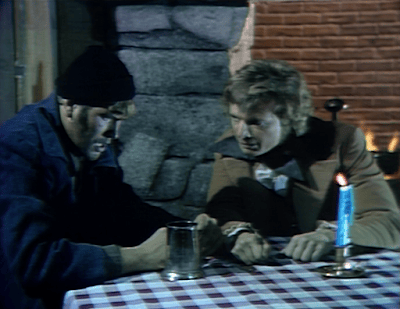
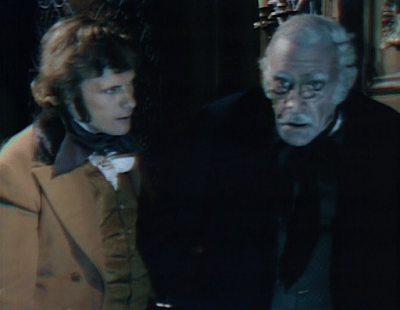
The dramatic date is 1840. This is quite an ambitious half-hour, featuring both a dream sequence and a flashback.
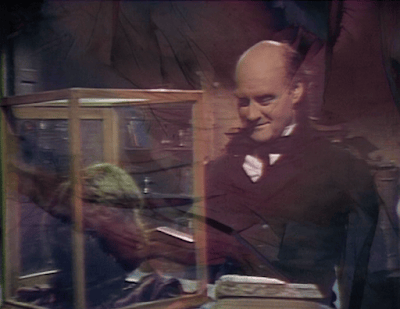
The head of warlock Judah Zachery and the rest of his body maintained separate residences from the time Judah was put to death in 1692 until the other day. Mad scientist Julia Hoffman and Cockney showgirl/ psychic Leticia Faye fell under Judah’s power and reattached the head to the body. Seagoing con man Gerard Stiles found his way to the vault where the reconstituted Judah was resting after this procedure. Judah attacked Gerard who in the course of escaping from him started a fire that destroyed the body. Now the head is back in its glass case, and Gerard is keeping it in his room. He is falling under Judah’s power, and has a dream today in which he sees his own head in the case while Judah stands outside. He hears Judah’s voice saying that he will take Gerard’s body for his own, and that Gerard will cease to exist. Regular viewers have likely seen this coming for some time, and it is a relief that Gerard is finally catching on.
Gerard is in the drawing room of the great house of Collinwood when wicked witch Angelique enters. They have not previously met. He introduces himself as Gerard Stiles. Before she can identify herself, he tells her that she once answered to the name Miranda. She is startled by this. He cannot explain why he said it. He says that he has never known anyone named Miranda. He excuses himself.
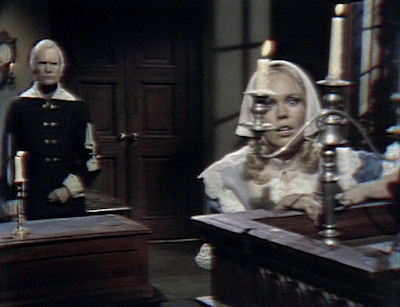
Angelique thinks back to the last time she was known as Miranda, which was in 1692. She was the key witness at Judah’s trial. We see Amadeus Collins browbeat Angelique with threats that she will be executed if she does not testify and with promises that she will be given safe passage out of the country if she does. She testifies, over Judah’s loud objections. Judah is convicted.
In his post about the episode on his great blog Dark Shadows Every Day, Danny Horn objects that the flashback represents a bad retcon. He describes it as “a perplexing revelation that basically eviscerates everything that we thought that we knew, and doesn’t replace it with anything.” I’d say it’s even worse. We first met Angelique late in 1967, when the show was set in 1795. At that time, we heard from people who knew her and her family when she was a little girl fifteen or twenty years before. We also saw that, while she had an awe-inspiring gift for black magic, she seemed to be a novice at it. She was continually surprising herself with the disastrous results of her spells. That made it possible for us to care about her later, when she became a more sympathetic character and an ally of the protagonists. If we suppose that she was already so skilled at witchcraft in 1692 that she could still be alive and not look a day older in 1795, that all falls apart.
The cosmology the show has developed with its journeys through time and the multiverse might leave a couple of options open to explain how Angelique could have been around in 1692, but what we see today forecloses those options. Perhaps she traveled back in time sometime between the 1790s and 1840. But as Danny points out, Lara Parker’s performance in the flashback eliminates that possibility. She plays “Miranda” as a true innocent, helpless between Judah and the court, without so much as a flicker in her eye suggesting that she might have some secrets of her own that she is keeping from Amadeus Collins.
We’ve seen “astral twins,” characters set in different periods who are played by the same actor and are in some sense the same person. Occasionally a sorcerer can cause the personality of one of these twins to invade the consciousness of the other. Angelique did this when a spell of hers caused Roger Collins to be intermittently possessed by his eighteenth century ancestor Joshua Collins in starting in #470. In #1107, a ghost which appeared to be Gerard, but which we now suppose to be Judah, caused the Quentin Collins who was born in 1870 to channel his great-uncle Quentin, who was born in 1810. But without the magical interventions, neither Roger nor Quentin knew much about his twin. Quentin had never even heard of his great uncle until he found his name in some old papers a few days before Gerard/ Judah mind-melded them. Angelique looks back on Miranda’s life as an earlier phase of her own, so regular viewers can exclude the “astral twin” explanation.
As Danny points out, the Miranda story is just an attempt to graft Judah onto the early history of the Collins family so that he seems dramatically satisfying as a major threat to them. They use Angelique because she seems to be the only major character whom they can patch back into a seventeenth century story. But since they get her there in a way that kicks load-bearing elements out of the continuity, it winds up making Judah seem even more like a random visitor.
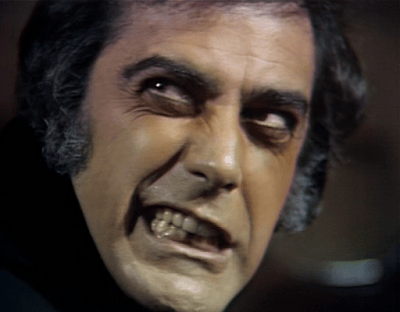
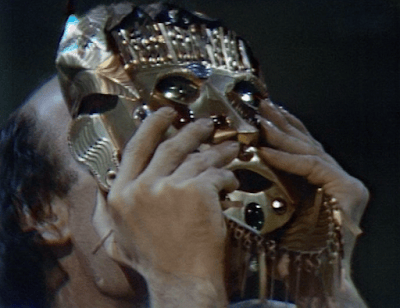
In his previous appearances as Judah, even in the episodes where Judah was in one piece, Michael McGuire was credited as “The Head.” Today, he is finally credited as “Judah Zachery.” But he shares the part with Keene Curtis. It is Curtis’ voice Gerard hears in his dream and Curtis who appears in the trial sequence as Judah wearing a black mask and objecting to Miranda’s testimony. They cut away from the speaking Judah and back to Michael McGuire in a matching costume. McGuire is built quite differently than Curtis, so the cut is jarring. McGuire pulls the mask off and shows the face we have come to think of as Judah’s.
It mystifies me that a show with such a tight budget as Dark Shadows chose to pay two actors for playing one part. McGuire had a fine actorly voice and had already appeared in several plays in New York, including the Broadway runs of The Passion of Josef D. and Child’s Play, and in the feature films Coming Apart and Where’s Poppa? (also known as Going Ape.) Curtis had an impressive face and was at this time acting in his 25th Broadway show. So either of them would have been well-qualified to play a whole part.
I first became aware of Michael McGuire in 1982, when he appeared in the pilot episode of Cheers as Professor Sumner Sloane, who dumps his date Diane Chambers and strands her at the bar. He reprised that role in two subsequent episodes of the show. None of McGuire’s three episodes of Cheers featured bar owner Sam Malone’s nemesis, John Allen Hill, who was played in his fifteen episodes by Keene Curtis. So when the characters talk about leaving Collinsport for Boston, we might wonder if they are looking to have a drink someplace where everybody knows their names.
At the end of #1109, mad scientist Julia Hoffman passed through a warp in spacetime and found herself at the great house of Collinwood in the year 1840. Lonely, she persuaded herself that if she went to the hidden chamber in the Collins family mausoleum and let vampire Barnabas Collins out of the chained coffin to which he had been confined since the 1790s he would remember the friendship that they began in 1968, and that they would be able to work together against the supernatural menace closing in on the Collinses of 1840.
In fact, Julia found that Barnabas had no recollection of anything later than the 1790s. He had no idea who she was, no interest in anything she tried to say, and no intention of letting her leave the chamber alive. It was only because his old friend Ben Stokes had followed Julia to the mausoleum and entered in the nick of time that Barnabas did not kill Julia then and there.
For the next several days, Barnabas rampaged through the grounds of Collinwood and the village of Collinsport. In #1114, he espied the lovely Roxanne Drew on the terrace of the great house, telling overbearing undertaker Lamar Trask that she hated him and would never yield to her father’s wish that she should marry him. Lamar looks and sounds just like his own late father, an enemy whom Barnabas loathed and took pleasure in torturing to death, so her hostility to Lamar wins Roxanne a place in Barnabas’ heart. In #1115, he bit Roxanne and left her to die, intending for her to rise as a vampire so that they could spend the rest of time preying on the living together.
In #1116, Julia and Ben found Roxanne and took her to the Old House on the grounds of Collinwood. There, Julia rigged up a medical apparatus and kept Roxanne alive. When Barnabas found what she had done, he was about to kill Julia. At the last second, his 1970 self projected his personality into his 1840 body, and Barnabas and Julia’s friendship picked up where it left off.
In #1117, Barnabas was remorseful about what he had done to Roxanne. He was distressed that Roxanne wanted him to bite her again and finish the job, and relieved that Julia was able not only to heal Roxanne’s physical wounds, but also to hypnotize her so that she did not remember the attack.
In #1129, Barnabas’ one-time wife, wicked witch Angelique, showed up and found that Barnabas was no longer in his coffin. In #1130, she went to the great house and introduced herself as Mrs Barnabas Collins. In #1133, she found that Barnabas and Roxanne shared a mutual attraction, and that Roxanne was shocked to hear that Barnabas was married. She told Barnabas that if he had anything more to do with Roxanne, she would cause the wounds on her neck to reopen, leading to her death and subsequent reappearance as a vampire. That curse would be Barnabas’ doing. Under this threat, Barnabas sent Roxanne a note saying they could never be together. Roxanne responded to that note yesterday by agreeing to marry Lamar.
Angelique’s threat should have been unnecessary. Barnabas knew full well that he was tempted to bite Roxanne and that if he did so she would likely become a vampire. Since he did not want that to happen, he should already have been at pains to avoid being alone with her. But a vampire is after all a metaphor for extreme selfishness, and so when he refuses to respect the logic of his own position and keeps stringing Roxanne along we might be frustrated with him, but we cannot really be surprised.
Barnabas cannot tolerate the idea of Roxanne as Lamar’s wife. He tells Julia that he is going to go to her and urge her not to marry Lamar. Julia tells him that if he does, Angelique will kill Roxanne. Barnabas asserts that Angelique will never find out. Since Angelique has powers including remote viewing, this is a bizarre thing to be sure of, and Julia tells him he is wrong. He ignores her. Desperate, she says she will go to Roxanne. Barnabas agrees to let her do this.
My wife, Mrs Acilius, points out that Julia is an extraordinarily skilled and inventive liar. While Barnabas might catch on if she does not go to Roxanne’s house, there is no reason once she is there she should not simply convey good wishes from Barnabas and herself for a happy marriage. But she presses Roxanne to admit she doesn’t love Lamar and insists that she call off the engagement.
Roxanne comes to Collinwood and tells Barnabas she loves only him. She embraces him. He can’t resist kissing her and telling her he loves her, too. Of course Angelique walks in on them.
Roxanne goes back home. Lamar is there. She tells him she cannot marry him, because she hates him. She loves Barnabas. We cut to Collinwood, where Angelique is casting her spell. Roxanne’s neck wounds reopen and blood comes spurting out.
Lamar bursts in the front door of Collinwood and shouts for Barnabas. Julia meets him. He tells her what has happened and declares that only Barnabas can save Roxanne, since he has cast a spell that is causing her to die. Julia insists Lamar take her to Roxanne. She gets to her just in time to hear her murmur Barnabas’ name as she dies. Lamar says that Barnabas is responsible for her death, which is of course true. He vows that he will exact vengeance for her on Barnabas, which is not likely to be true.
Back at Collinwood, Julia tells Barnabas that Roxanne is dead. Barnabas strikes a noble pose while saying that he feels responsible, then talks about how much he hates Angelique. He and Julia agree that the urgent thing now is to prevent Roxanne rising as a vampire. It is too close to dawn to make any plans, so they agree to talk it over in the evening. Julia does not bother to mention Lamar’s vow of revenge.
By order of the court, warlock Judah Zachery was decapitated in 1692. His body was buried in a large underground chamber in a graveyard, and his head was put on public display to deter his followers. The head disappeared. It cropped up again in 1803, when it was associated with a series of horrendous murders.
Now it is 1840. Wealthy dilettante Desmond Collins found the head in some kind of shop in Macau and brought it back to his home, a mansion known as Rose Cottage that lies near the estate of Collinwood. Desmond regained his senses too late to stop the head resuming its lethal career.
The head recently enslaved Cockney showgirl/ psychic Leticia Faye and mad scientist Julia Hoffman. Julia and Leticia set up a laboratory in the underground chamber, reattached the head to the body, and brought Judah back to life with electricity harvested from lightning.
Seagoing con man Gerard Stiles had seen Leticia with the jewel-encrusted gold mask that is part of Judah’s equipment. He followed her to the underground chamber, hoping to steal it. When he arrived there, Julia and Leticia were out, but Judah was just getting up. He approached Gerard with his hands out, as if to strangle him. Gerard bumped into a bottle of ether and started a fire. Amid the flames, he escaped from Judah. As Gerard scampered out into the graveyard, Judah remained in the burning chamber, pressing the mask to his face.
In the drawing room at the great house of Collinwood, Julia is getting a stern lecture from her best friend, vampire Barnabas Collins, about how she oughtn’t help Judah. She keeps protesting that she must help him, then cries out that Judah is burning. Suddenly Judah’s power over her breaks, and she is her old self again.
Barnabas insists that Julia take him to the underground chamber so that they can make sure Judah is dead. They find him under a pile of rubble. Julia checks his wrist for a pulse. He doesn’t have one. He didn’t when first she found him, so that wouldn’t seem to prove very much, but she and Barnabas decide it’s good enough. They leave the chamber, sure that Judah won’t be killing anyone else.
In his room at Rose Cottage, Gerard drifts off to sleep. He has a dream in which he is back in the underground chamber and a voice is ordering him to find “it.” He is puzzled, but as soon as he wakes up he knows exactly what he is supposed to do. He returns to the chamber, digs Judah out from under the pile of rubble, and removes the mask from his face. Judah blinks. What the point was of any of that, I leave as an exercise for the reader.
Barnabas and Julia are back in the drawing room at Collinwood, congratulating themselves on their great success. A man enters. He is overbearing undertaker Lamar Trask. He says that he just got engaged. In a very pleasant tone, Barnabas asks whom he will be marrying. Lamar is surprised at the question, as are returning viewers. Barnabas knows well that Roxanne Drew has been the object of Lamar’s suit for some time and that her father is very much in favor of the match. When Lamar identifies Roxanne as his fiancée, Barnabas is speechless. Lamar asks if congratulations are not in order, and Julia extends them.
Barnabas had shared a mutual attraction with Roxanne. As a vampire, he knew that he could not be alone with her without biting her, and he does not want to do that. When his one-time wife, wicked witch Angelique, showed up, she made him send Roxanne a letter saying that they couldn’t see each other again. It’s 1840, so Roxanne is probably going to marry someone. Much as Barnabas hates Lamar, he really should have braced himself for the likelihood that Roxanne would end up with him.
The scene in which Lamar proposes to Roxanne is the one high point in this otherwise wasted half hour. She talks about her desire to become “one of those new professional women,” and as Donna Wandrey delivers her lines we can see that she has given serious thought to that. Lamar stiffly declares that the only place for a woman is beside the man who loves her.
Lamar is the fourth villain named Trask whom Jerry Lacy has played, and the others excelled at snuffing out women’s dreams. So we recoil when he makes his sexist remark, but Roxanne does not. She smiles and says that if her father had not pushed them together, things might have been different between them. Miss Wandrey makes us believe that, while she does want an independent life, Roxanne is also a product of her time, and that she more or less believes in what she was raised to believe. Moreover, Mr Lacy does manage to make us believe that for all his obnoxiousness, Lamar loves Roxanne. So we can understand Roxanne’s motivations.
In March 1967, seagoing con man Jason McGuire showed up at the great house of Collinwood with a plan to help himself to the Collins family’s wealth. He had told matriarch Elizabeth Collins Stoddard that her husband was dead as the result of a blow she had dealt him. He used that story to force Liz to put him up in the great house.
After a few days, Jason’s friend, dangerously unstable ruffian Willie Loomis, showed up in town. Willie was to play a role in some plan of Jason’s that was never explained. Jason made Liz give Willie a room in the great house as well. After a couple of weeks, Willie stumbled onto vampire Barnabas Collins, who took him into his power.
Jason was on the point of success beyond his wildest hopes, about to marry Liz and become master of Collinwood. Suddenly it all came crashing down, and it was revealed that Liz’ husband wasn’t dead after all. Liz threw Jason out of the house. Spying on Willie and Barnabas, Jason saw that they had a fortune in jewels. Seeing one last chance to leave Collinwood a rich man, Jason went to Barnabas’ underground lair to help himself to the jewels. But he wound up opening the coffin just after sunset, and at the end of his final episode Jason had the hand of the undead menace Barnabas crushing his throat. In the next episode, Barnabas and Willie took Jason’s corpse to Barnabas’ old hiding place and Barnabas forced Willie to bury it there.
Now, Barnabas and his friend, mad scientist Julia Hoffman, have become the protagonists of Dark Shadows. They have traveled back in time to 1840 and the show is a costume drama set in that year.
Months before Julia and Barnabas arrived in 1840, seagoing con man Gerard Stiles showed up at the great house of Collinwood. He told Samantha Drew Collins and the rest of the family that her husband had died in a storm at sea, despite his efforts to save them. He used that story to persuade the family to put him up in the great house.
Around that same time, Gerard’s friend, Cockney showgirl/ psychic Leticia Faye, showed up in town. Leticia was to play a role in some plan of Gerard’s that was never explained. Gerard used his influence to persuade Flora Collins to give Leticia a room in her mansion, a place near Collinwood known as Rose Cottage. A couple of weeks into the 1840 segment, Leticia stumbled onto the disembodied head of warlock Judah Zachery, which took her into its power.
Gerard was on the point of success beyond his wildest hopes, about to marry Samantha and become master of Collinwood. Suddenly it all came crashing down when it was revealed that Samantha’s husband wasn’t dead after all. Gerard could not decently stay in the house. Spying on Leticia, Gerard saw that she had a golden mask encrusted with a fortune in jewels. Seeing one last chance to leave Collinwood a rich man, Gerard goes to Judah’s underground lair to help himself to the jewels. But he winds up uncovering him just after his body has been reconnected to his head and reanimated, and at the end of today’s episode the hands of undead menace Judah are moving towards Gerard’s throat.
Jason was always meant to be an in-betweener, a character who would help clear up a couple of unresolved storylines and introduce Barnabas. In those days before internet discussion fora and soap opera magazines, the viewers would not have known that actor Dennis Patrick never signed a contract when he was cast as Jason and already had commitments in California coming up in the summer. But those who had been watching for the previous four months had seen the story of undead fire witch Laura Murdoch Collins absorb one narrative thread after another, so many that it would be clear to them that the show had committed itself to being a supernatural thriller. We may not expect a vampire named Barnabas, but we do expect someone to succeed Laura as the show’s next uncanny Big Bad. Jason was obviously doomed, because he did not know what kind of show he was on. He thought it was still the noir drama it was from August to December 1966, when it told of the Murder of Bill Malloy and its aftermath. In that genre, a blackmailer or a thief might find a way to prosper. But in this world, he is just so much meat for the monster’s dinner table.
But the show has been building Gerard up for months. In July, Julia and Barnabas traveled to the year 1995, where they found that Collinwood was a deadly ruin presided over by Gerard’s ghost and had been since a mysterious disaster took place sometime in 1970. They then went to 1970, and found that they were as powerless to prevent Gerard’s ghost from destroying Collinwood in that year as they had been unable to fight him in 1995. And while his attempt to steal the mask shows that he has failed to understand the extent to which supernatural powers dominate his world, his association with Leticia and his own pose as a seer show that he can engage with those powers to some extent. Therefore, we cannot expect that we will see Judah standing over Gerard’s corpse tomorrow, ordering Leticia to dig a grave.
As the show has been building up the character of Gerard and with him actor James Storm, so it has been going out of its way to keep actor Michael McGuire and the physical presence of Judah on the sidelines. When a character heard a voice coming from the Head, another actor provided that voice. Even today, when Michael McGuire is playing a fully reconstituted and reanimated Judah, he is billed in the credits as The Head. Nor is there a portrait of Judah, as there was a portrait of Barnabas starting a week and a half before Jonathan Frid made his first appearance, committing the show to using the actor who modeled for it. So while they have established that Judah will be the Big Bad for some time to come, there is no reason to expect Michael McGuire to continue playing him.
For most of 1969, Dark Shadows was set in 1897. During that time, David Selby’s character Quentin Collins, whose great-uncle and Doppelgänger is Samantha’s husband and is also named Quentin Collins, became a huge breakout hit. In the second half of the segment, the arch-villain was sorcerer Count Petofi. Among his other powers, Petofi was able to forcibly swap bodies with people. In #872, Petofi, inhabiting Quentin’s body, managed to travel to the year 1969. It looked like Mr Selby would be playing Petofi in a contemporary dress segment, but after a brief moment he was snatched back to 1897.
Quentin had first been introduced as an unspeaking ghost wearing nineteenth century garb, giving people dirty looks, and figuring in a retelling of The Turn of the Screw. Gerard met exactly that description when the show was in contemporary dress in August and September 1970. When we traveled back to 1840, characters even remarked on the living Gerard’s similarity to that year’s version of Quentin. In #1120, Daniel Collins, father of Quentin, told Gerard that he was very much like Quentin, and after their attempted marriage collapsed Samantha bitterly told Gerard that all he ever wanted was to become Quentin. So we can easily suppose that the show is trying to replicate with Gerard and Mr Storm the success it had with Quentin and Mr Selby. Even if Judah displaces Gerard’s personality and begins operating through his body, that will be a reenactment of the Quentin/ Petofi story. If we hope that the possession will be broken, we will be hoping for Gerard to return, leaving us rooting for him and opening the possibility that he will be transformed from villain to protagonist, as Barnabas and Quentin have been.
But there is an obvious problem with the idea of adding a second Quentin to the cast of characters. Ever since the show left 1897 in November 1969, the show has been struggling to find a place in the story for the Quentin it already has. Abraham Lincoln used to say that a town that isn’t big enough to support one lawyer can always support two, and I suppose they might have hoped that two Quentins would clash with each other often enough that the same principle would apply. But even if that was on their minds, in Gerard’s similarity to Jason they hedged their bet. If Judah takes possession of Gerard, it will be as if Jason’s fatal misadventure had been followed by Dennis Patrick switching to the role of Barnabas. They’ve managed to keep Barnabas busy most of the time he’s been on the show, so perhaps they think they have space for an another character like him.
This episode does feature one scene that is so hilarious I think it must be an example of intentional comedy, intentional at least so far as the director and actors were concerned, if not the writer. Barnabas has discovered that Julia is under Judah’s power and is giving her a stern talking-to in the drawing room of the great house. Leticia enters to report to Julia that there is trouble in the hiding place. Julia looks at her and shouts “Leticia, get out! Get out, Leticia!” As she does so, Barnabas shouts “Come back! Come back!” The alternating cries “Get out!”/ “Come back!”/ “Get out!”/ “Come back!” had us laughing out loud.
C. S. Lewis’ novel That Hideous Strength was a popular success when it was first published in 1946, and has been in print ever since. It begins as a satire of university life and academic politics. When it turns out that the inner circle of the fictional Edgestowe university are a Satanic cult who take their orders from a severed head that once belonged to a warlock named François Alcasan and that their project involves extensive efforts to add to the head’s power with biotechnological interventions, it turns into a supernatural thriller. As one would expect of a writer as outspokenly Christian as Lewis, this all culminates in the Second Coming of Jesus.
It is psychiatrist Grace Ironwood who does the investigative heavy lifting that leads the protagonists to understand what is really going on. Jane Tudor Studdock, wife of ambitious professor Mark Studdock, has a series of bizarre dreams which she reports to Dr Ironwood. Dr Ironwood interprets these dreams as visions of the simple facts of what is happening at Edgestowe. Mark is arrested for a brutal murder the head committed, one that involved a near-decapitation of the victim, and Jane throws her lot in with Dr Ironwood and the other good guys. Dr Ironwood is then crucial in identifying Alcasan.
The A story on Dark Shadows is about another severed head that takes charge of a malign cult. The warlock from whom this head was cut was called Judah Zachery. The biotechnological intervention is not about connecting it with the “macrobes” Lewis invented, but with its original body. The cult takes shape not as a stable group as at Edgestowe, but serially, as the head takes control first of one person, then of another on or around the estate of Collinwood. The female psychiatrist who is a key member of the team opposing the head’s project is named, not Grace Ironwood, but Julia Hoffman. Today, the head takes Julia under its power, at a stroke both tearing the heart out of its opposition and recruiting the one person most likely to be able to reattach it to its body.
Before that happens, Julia and her best friend, vampire Barnabas Collins, are going over some documents she has found about Judah Zachery. The front door opens and Barnabas’ one-time wife, wicked witch Angelique, enters.
Since November 1967, when the show left its contemporary setting to spend four months in the 1790s, Dark Shadows has largely been about time travel. We met Angelique during that first jaunt into the past, when she was monomaniacally obsessed with taking control of Barnabas and first turned him into a vampire. She hadn’t changed much when we next saw her, when the show was back in contemporary dress for most of 1968. But in 1969, Julia and Barnabas met Angelique during a trip to 1897. In that segment, Angelique remembered the events of 1968 and had moved on from Barnabas, focusing her attentions on his distant cousin Quentin Collins. In the latter part of it, Angelique teamed up with Barnabas and Julia to fight sorcerer Count Petofi. Julia and Angelique even became friends in that time.
Back in a contemporary setting early in 1970, Angelique wound up aligned with Julia and Barnabas again, waging war against a race of Elder Gods known as the Leviathan People. During that segment, she told Barnabas that she regretted turning him into an undead abomination and murdering his family and friends, and he responded in a light tone that he didn’t suppose any of that really mattered all that much.
Now, Barnabas and Julia are in 1840. The Angelique they meet in this year does not remember anything that happened in 1897, 1968, or 1970. She has no idea who Julia is. But they remember it all. So, when Angelique walks in, we might look forward to her reaction when Julia greets her by exclaiming “Angelique! You’re the one person who can help us!”
But that doesn’t happen. Instead, it is Barnabas who calls Angelique by name. When she says she is eager to meet the new sister-in-law whom she heard about when she introduced herself at the great house on the grounds of the estate as “Mrs Barnabas Collins,” Barnabas simply shoos Julia away. Alone with Angelique, Barnabas vents his hostility as if 1897 and 1970 never happened. When Angelique points out that he cannot challenge her directly, Barnabas says that they have arrived at their “usual stalemate.” Stale is the word for this mating, that’s for sure.
Early in the 1840 segment, there were several days when Barnabas had only the knowledge he would have had at that time and did not recognize Julia. Had Angelique come back then, this scene would have made perfect sense. Perhaps it was originally meant to be so, and for some reason they had to displace it to this point, where it is a disappointment. I complained about this years ago in a long comment on Danny Horn’s post about this episode at his great blog Dark Shadows Every Day:
It’s too bad they didn’t have it take a good deal longer for Barnabas to project himself back from 1970. If Julia had managed to partially domesticate the 1840 Barnabas and get him on board with her investigation, his confrontation with Angelique would have been much improved. He wouldn’t have known anything that Julia and we know, and he couldn’t be counted on to listen to Julia. That would have made him a total loose cannon, as absolutely unpredictable in his reaction to Angelique as he would be unpredictable in his reactions to everyone else.
As it is, there’s only one intelligent way for him to respond to Angelique’s appearance. “Since you’re here, you may as well help us.”
“What makes me think I will help you?”
Barnabas and Julia tell her that they have traveled back in time from 1970, and that in the interval between 1840 and 1970 Angelique had twice joined forces with them against common foes.
“Do you expect me to believe this ABSURD TALE?”
They tell her that the foes they fought in 1897 and [1970] were Count Petofi and the Leviathans.
Smiling dismissively, she replies, “You can make up all the names you like, they won’t make me believe [your] story. But very well, tell me what name you have invented for the common adversary we are supposed to fight now.”
They say “Judah Zachery,” and she’s in. Murder Club is in session.
Having Barnabas and Angelique instead revisit their old scenes, right down to an improved version of the “My name is Cassandra!” bit, just tries our patience and makes Barnabas look even dumber than usual.
Comment left 13 February 2021 by “Acilius” on “Episode 11331: The Perils of Memory,” Danny Horn, Dark Shadows Every Day.
Norman Parker plays the body of Judah Zachery, while Michael McGuire plays the head. Michael McGuire gets to open his eyes a couple of times today, and Norman Parker reads the opening voiceover.
Dark Shadows featured several long costume drama segments depicting stories of time travel. From November 1967 to March 1968, well-meaning governess Victoria Winters bumbled around in the years 1795 and 1796, convincing the people of Collinsport that they should hang her. Meanwhile, we learned how old world gentleman Barnabas Collins first became a vampire.
From March to November 1969, Barnabas was the one making poor decisions in an era not his own when he found himself in the year 1897. Those eight months were by most measures the show’s most successful period. From March to July 1970, the show traveled sideways in time to an alternate universe where Barnabas and his friend, mad scientist Julia Hoffman, meddled in the problems of the family who lived on that version of the estate of Collinwood. The show insisted on calling that alternate universe “Parallel Time.”
Now, Julia and Barnabas have made their way to the year 1840. They know that something or other happened in that year that would lead to the destruction of the great house of Collinwood and its residents in 1970. They have no very clear idea what that fateful event was, and it is becoming increasingly clear that the writers don’t have any good ideas about it either.
While Barnabas, Julia, and the writers cast about in the darkness, we keep meeting characters who remind us of earlier phases of the show. Early on, we met Ben Stokes and Daniel Collins, two people left over from the 1790s segment. Ben helped Julia and Barnabas establish themselves with the current crop of Collinses by corroborating their story that they were cousins from England (or Philadelphia, whichever.) Daniel, who was a boy in the 1790s and is now the master of Collinwood, greeted them warmly and invited Barnabas to stay in the Old House at Collinwood as long as he liked. The presence of Daniel and Ben not only helped graft Barnabas and Julia onto the new stories, but also told longtime viewers that the 1840 segment will be a sequel to the 1790s segment.
We also see mergers of characters from the 1897 segment with those from Parallel Time. For example, charming rogue Quentin Collins became a huge breakout star in 1897; in Parallel Time, Quentin’s counterpart was the grumpy and irascible master of Collinwood. In 1840, Quentin is Daniel’s older son and sole heir, in charge of the house due to his father’s many problems. He is again grumpy and irascible, again in a loveless marriage. But like the 1897 Quentin, he is fascinated by the occult and creates trouble by his reckless involvement with it. Quentin’s best friend and fellow occultist is his cousin Desmond Collins, played by John Karlen. Desmond shares the irresponsibility of Karlen’s 1897 character, inveterate prankster Carl Collins. But Desmond has none of the extreme childlike quality that it made seem Carl had a cognitive impairment of some sort. He has the manner and bearing of Karlen’s Parallel Time character, drunken novelist Will Loomis.
Will was married to Carolyn Collins Stoddard, played by Nancy Barrett. In 1897, Miss Barrett played a villain named Charity Trask who fell afoul of evil sorcerer Count Petofi. Petofi erased Charity’s personality and replaced it with that of Cockney showgirl/ mentalist Pansy Faye. Carl had brought Pansy to Collinwood as his fiancée. Pansy was killed before she ever met Charity, who never had any use for Carl. Carl himself was killed before Petofi took Charity’s body away from her and gave it to Pansy. Miss Barrett’s acting style is to throw herself completely into each of her roles, so we quickly accepted her as Pansy. But when we heard Miss Barrett’s Pansy pine for her poor lost Carl, we were reminded that Petofi had murdered Charity and reanimated her form with Pansy’s mind.
In 1840, Miss Barrett is Leticia Faye, who is barely distinguishable from Pansy. She was brought to Collinwood by the evil Gerard Stiles to play some part in his never-explained scheme to cheat the Collilnses out of their money. When we first saw her, Leticia confronted Gerard over her suspicions that if he ever did get his hands on any of the Collins money, she wouldn’t see any of it. Then Gerard humiliated her by marrying Quentin’s widow Samantha, which promptly redounded to his own humiliation when Quentin turned up alive and well. Leticia confronted him again, brandishing her own pain and mocking his in what sounded very much like the sorts of things Carolyn used to say to Will. Now, Leticia has set her cap for Desmond, but also become involved in his occult mischief.
Most of the action in the 1790s was driven by wicked witch Angelique. A maniacal villain then, Angelique appeared in 1897 and became a multilayered personality. Angelique rejoined the cast of characters at the end of yesterday’s episode. We saw her enter the hidden chamber where Barnabas’ chained coffin was kept from the 1790s on and discover that it was no longer there.
Angelique’s counterpart in Parallel Time had a sidekick, a housekeeper modeled on Mrs Danvers from Rebecca who was herself Julia’s Doppelgänger. We didn’t get to see a great deal of that relationship, since Grayson Hall was off for principal photography for the feature film House of Dark Shadows during most of the first half of the Parallel Time segment. Today, we see that we will be getting another look at how Angelique handles a sidekick. Angelique Model 1840 has a servant, a man named Laszlo Ferrari.
Laszlo’s appearance evokes the 1897 segment. He is played by Michael Stroka, wearing the astrakhan hat that he wore when we first saw him as Aristide, servant of Count Petofi. His attitude towards Angelique is very much like Aristide’s towards Petofi, asking a question in a vaguely belligerent tone, occasionally making a show of defiance, and quickly collapsing into cringing obedience. So he asks Angelique why they keep coming to the tomb every year, and why she isn’t as happy as she usually is when she emerges from the secret room. She snaps at him in response, saying that she would have expected him to stop asking her questions by now, since she has never yet given him any answers. She orders him to go to the great house at Collinwood and find out if a man named Barnabas Collins has been around recently. Reluctant to go, he asks who Barnabas is. She says he is the only man she ever loved. He says “Other than me, of course!” and she agrees in a sarcastic tone. It’s all in very joking, but he scurries away to obey her. All that is missing is him addressing her as “Excellency!” and her remarking on his good looks, and we’d be right back with Aristide and Petofi.
At Collinwood, Laszlo meets Quentin’s younger brother, Gabriel Collins. Gabriel is amused by Laszlo’s attempt to persuade him that he can see into the future, and tells him that the pressing need is for someone who can see into the present. There is a headless body wandering the estate killing people, and if Laszlo can tell them how to put a stop to that he’ll be onto something. Barnabas shows up and scowls at Laszlo, who leaves.
Meanwhile, we learn that Leticia knows a great deal about the headless body. It used to be attached to a severed head that Desmond brought back from Macau as a gift for Quentin. That separates Desmond from Carl, who brought Pansy back from Atlantic City to be his own bride. Leticia is now keeping the head in her own room, and is acting under its influence.
The head and body are those of warlock Judah Zachery, executed in 1692. The head has turned up occasionally in the years since, each time figuring in a series of brutal murders. Apparently the situation will get even worse if the head can be reattached to the body. This also harks back to Petofi, whose hand had been cut from his wrist in the 1790s and had carried on its own career of malignity in the years before Petofi stuck it back onto the end of his arm in 1897. Since Angelique joined forces with Barnabas and Julia to fight Petofi then, showing a new and extremely engaging side of her character, longtime viewers may hope that she and Laszlo will be part of an alliance with our protagonists against Judah Zachery in this period.
Laszlo’s name evokes the movie Casablanca, in which the most morally upright character is French Résistance leader Victor Laszlo while the most morally debased character is crime boss Signor Ferrari. We can imagine Jerry Lacy breaking his character as overbearing undertaker Lamar Trask, putting on his celebrated Humphrey Bogart imitation, and saying of Angelique that “Of all the temporal anomalies in all the multiverse, she had to walk into mine.”
The Petofi/ Aristide relationship was based on one memorialized in another Humphrey Bogart film, Gutman and Wilmer in The Maltese Falcon. As Sydney Greenstreet played Ferrari in Casablanca, so he played Gutman in The Maltese Falcon. It may have been a bit on-the-nose to cast portly gentleman Thayer David as an analogue of Greenstreet, a criticism which cannot be leveled at the choice of the svelte and dazzling Lara Parker. In another departure from the Petofi/ Aristide model, Laszlo is a member of the Romani or Sinti people, the ethnicities often slurred as “Gypsies.” Petofi was vulnerable to certain Romani, and was deathly afraid of all of them.
Aristide was a lot of fun. Stroka came back in 1970 as two characters very like Aristide, first in the original continuity as a hitman known only as Bruno, then in Parallel Time as failed composer Bruno Hess, a member of a little cult that had grown up around that universe’s version of Angelique. The two Brunos were so similar to each other and to Aristide that regular viewers might be disappointed to see Stroka working the old stand one more time.
The essence of Aristide and the Brunos was an insecurity that rode very close to the surface of the character. Each man sneers as he asserts himself against his victims or puffs himself up as he attempts to assert himself against his superiors, then dissolves immediately into frantic backpedaling when he encounters opposition. Stroka made as much as anyone could of those parts, and I had hoped to see him in a role where the insecurity lies deeper in the character’s personality. I wanted to see him as an authority figure whose pompous self-satisfaction can withstand a fair amount of battering and whose eventual defeats prompt a more complex response from him than Aristide/ Bruno’s hectic flailing.
The two characters we have seen who meet that description were Joshua Collins in the 1790s segment and Edward Collins in the 1897 segment, both played brilliantly by Louis Edmonds. In 1840, Edmonds plays Daniel, who is the legal owner of the Collins fortune but whose mental and physical infirmities keep him from exercising much authority. In #1074 and #1076, an ancestor called Abner Collins was associated with the events of 1840; I wish that Barnabas and Julia had found that Abner, rather than Quentin, was Daniel’s eldest son and was in charge of Collinwood and the businesses. Quentin would then be free to be the insouciant wastrel who was such a hit in 1897, rather than a retread of the foul-tempered sourpuss who was a consistent downer in Parallel Time.
As Abner, Stroka could have taken advantage of his striking facial resemblance to William F. Buckley, Junior, making clever-sounding but specious arguments in defense of the family’s most objectionable business practices, littering his speech with seldom-heard polysyllabic words and, when he makes what he believes to be a persuasive argument, leaning way back in his chair and fluttering his eyelids. Buckley was a prominent figure nationally and especially in NYC in 1970. He had been hosting a nationally syndicated television show ever since his unsuccessful bid for mayor of New York in 1965, and in 1970 his brother James would defeat the Democratic and Republican nominees to be elected to the US Senate from New York as the candidate of the Buckley family’s Conservative Party. A spoof of him would therefore be something that grownups in the audience would likely find amusing, and that the New York based makers of the show would surely have enjoyed creating.
In the early days of the show, the most prominent supernatural presences were the ghosts of The Widows, women who flung themselves to their deaths after their husbands were lost at sea due to the inhumane practices of the Collins whaling fleet. The story of The Widows came forward as the first explanation of the origin of the Collins family curse. The whaling industry in New England was approaching its zenith in 1840; it was in the following decades that it finally surpassed cod fishing in the region’s economy. It would close the loop on that early story to present Abner as the man who ensured that the Collinses would be enormously rich for a long time to come by switching the focus of the fleet from a mature market to a rapidly growing one, but who also ensured that they would be the object of undying wrath among many in Collinsport by switching from a decentralized business in which many men had a realistic chance of becoming independent operators to a capital-intensive one in which a handful of magnates control everyone else’s destiny. Abner could become callous to conditions on the whaling ships, because he would see the men as easily replaceable parts of a single machine, not as professionals who had to use their judgment to track down the fish and who might at any time strike out on their own as his colleagues or competitors.
The switch from cod fishing to whaling and its consequences for the life of the village would hark back not only to The Widows, but also to the business stories incorporated in the early storyline of “The Revenge of Burke Devlin.” The theme of those stories was that the Collinses had trapped the people of Collinsport in a situation where the only way for an ambitious young man to improve his lot in life was to leave town. If the 1840 story went on long enough, they might have been able to explore that theme in some depth. Not only would that have appealed to the taste for social and political relevance that was so much in the air in the early 1970s, but by depicting Collinsport as a place full of people who are involved in the story it would also relieve the claustrophobia that stems from the all-Collins episodes that come up so often in the later phases of the show.
Vampire Barnabas Collins and mad scientist Julia Hoffman have traveled back in time to 1840. They know that events took place in that year that led to a disaster that destroyed the great house of Collinwood and everyone in it in 1970 and that left the whole estate of Collinwood a deadly, hag-ridden waste in 1995. They hope to find a way to change history.
Today, they discover a woman lying on the ground in the woods. She is Hortense, governess at the great house, and she is horribly injured. At first they think Hortense is dead, but Julia feels her wrist and says, using a bit of Collinsport English we haven’t heard since #672, that she can feel a “pulsebeat.” Hortense manages to speak the words “headless creature” before she dies.
Julia and Barnabas tell Quentin Collins, heir to Collinwood and its acting master, what happened. His reaction makes it clear that he knows what Hortense meant by “headless body.” Later, Barnabas gets Quentin to tell him the truth. His cousin Desmond found a severed head in a shop in Macau and brought it back as a gift for him. The severed head turned out to be that of warlock Judah Zachery, who terrorized the town of Bedford until he was executed in 1692. The head has cropped up again from time to time, most recently in 1803, when it was associated with four brutal slayings known as “The Bedford Atrocities.” Under the head’s influence, Desmond found its body. Now the body is roaming about. The head has also gone missing. Until Quentin heard that the body is still headless, he assumed that Judah’s parts had reconnected themselves. He still thinks they must be hanging around together someplace.
Barnabas and Julia decide that the head and body must be associated with the disaster they want to prevent. They make a note of it. But they have more definite knowledge about a woman called Daphne Harridge. They saw Daphne’s ghost in 1995 and 1970, and got to know her as a living being when she was briefly resurrected in 1970. She was governess at Collinwood in 1840, was killed along with her charges, teens Tad Collins and Carrie Stokes, in 1841, and was a part of the disaster in 1970. When they first arrived in 1840, they were puzzled to find that Hortense was the governess and that no one had heard of Daphne. But Daphne is in Collinsport now, and the governess’ position is vacant. Julia and Barnabas make it their top priority to keep her from becoming governess.
Quentin believes Barnabas and Julia to be his cousins from England (or Philadelphia, it doesn’t seem to make a difference.) He has trusted them with the secret of what he and Desmond have done involving the head. So you might think they would address this problem by trying to persuade him not to hire Daphne. But that doesn’t seem to occur to them. Instead Julia goes to Daphne’s room and tells her she is about to be offered the post of governess at Collinwood and that if she accepts it she will be in terrible danger. In response, Daphne asks Julia who she is and why she is threatening her. Julia tries to explain that she is a friend bringing a warning, but that doesn’t cut any ice. Regular viewers know that Julia is not only a prodigiously skilled and creative liar, but that she also has a magical power of hypnosis that enables her to rewrite people’s memories. With those qualifications, you’d think she could do better than that. When Quentin drops by later and says that Desmond has recommended her to be the next governess, Daphne is startled, but quickly accepts.
The episode ends with a hooded figure walking through the old cemetery north of town. We see the figure from behind as it enters the mausoleum where Barnabas’ family is entombed. The figure opens the secret panel. The camera stays low and does not allow us to see the face of the figure entering the hidden chamber where Barnabas was sealed in a chained coffin when he first became a vampire in the 1790s. When the figure is in position to see that the coffin is not there, the camera pans up and we see that it is wicked witch Angelique. The composition shows that this is supposed to be a big shock. Indeed it would be, had Lara Parker not delivered the opening voiceover, giving away that she is going to be in the episode.
They have ruined many surprises this way. This one is a particular shame. Regular viewers know that Angelique will probably turn up sooner or later, but this is the first time we have seen the character since #978.* Her return is a big deal, and we do have a right to expect the show to be more careful about getting the biggest bang they can out of it.
*Parker played an alternate universe counterpart of Angelique from April to July 1970. She’s been away for 72 episodes.
Quentin Collins, sole heir to the Collins family fortune, took his young son Tad with him and sailed away on a cruise meant to take them and Quentin’s friend Gerard Stiles around the world. He left his wife Samantha, Tad’s mother, behind in the great house at Collinwood.
Six months ago, in the spring of 1840, Gerard came to the great house with sad news. Quentin and Tad had been washed overboard off the coast of Brazil. He had tried to save them, but could not. They must be presumed dead. To the dismay of Quentin’s younger brother Gabriel, his father Daniel decided not to change his will when told of Quentin’s death. Samantha remains as sole heiress of all Daniel’s vast holdings.
Gerard was invited to stay in the great house as a guest, and did so. In #1119, Samantha decided that her period of mourning had gone on long enough and married Gerard. In #1120, Gabriel found that not even this had moved Daniel to change his will in favor of him and his children. On the contrary, Daniel says that he ought to adopt Gerard, who is the son he should have had. It seemed that all the Collins wealth was fated to pass from the family with Daniel.
Before Samantha and Gerard had been married a whole day, Quentin turned up, alive and well and reporting that Tad would be along as soon as he recuperated from a mild fever. They had spent the last six months as penniless tramps making their way through South America on foot. It quickly emerged that Quentin had no particular feeling for Samantha; he regarded the Enoch Ardenesque situation as a comedy. He invited Samantha to choose between him and Gerard. If she chose to resume their life together, he would endeavor to make a go of it. If she preferred to start fresh with Gerard, there would be no hard feelings.
Samantha is having trouble deciding. Today, Gabriel taunts her, imagining how she broke the news to Tad: “Dear Tad, there is something I must tell you. You’re going to have two fathers now.” In fact, this doesn’t sound like such a bad idea. Quentin and Samantha cannot be bothered even to pretend they love each other, and whatever Gerard may feel for Samantha pales by comparison to his yearning to live at Collinwood and enjoy the family’s riches. If all had gone according to Quentin’s original plan, he and Tad would probably still be living with Gerard on board ship at this time, with Samantha just an increasingly distant memory. And despite the awkward situation in which they find themselves, Quentin still regards Gerard as a friend. His memories of their time together before the accident at sea must be very warm indeed to prompt that attitude.
The whole situation will remind longtime viewers of the conflict between high-born ne’er-do-well Roger Collins and dashing action hero Burke Devlin that ran through the first 40 weeks of the show, when it was set in 1966. Burke and Roger fought over many things, not least their past involvements with Laura Murdoch Collins, David’s mother and Roger’s estranged wife. Each man suspected that Burke was David’s true father. Roger and Burke noisily hated each other, but as Louis Edmonds and Mitch Ryan played them they seemed to have some very complicated feelings for each other that came from places other than wounded pride or class conflict or jealousy about Laura. When Laura joined the cast of characters, Diana Millay joined Ryan and Edmonds in making it crystal clear that Burke and Roger had always been more focused on each other than either was on her. In #139, they fought in front of Laura and forgot she was in the room. She rolled her eyes, telling the audience that it was the same as it ever was.
Laura turned out to be an undead fire witch come to immolate David in order to perpetuate her own supernatural existence. When that dawned on Roger and Burke, they set their hostility aside and worked together to protect David. In #187, the two of them took their places beside David’s bed and gave him some important news. They looked so natural together that it was as if they had been raising David together all of his life. Up to that point Roger had been unnervingly cold and evil, remarkably cruel to David and potentially deadly to well-meaning governess Vicki. After we see him and Burke co-parent David so tenderly, Roger is never a villain again.
Tad is no likelier than David was to end up with two dads. Long before the show traveled back in time to 1840, we saw that Gerard’s ghost was the face of a disaster that reduced Collinwood to ruins in 1970 and was still taking the lives of those who dared venture there in 1995. We learned from other ghosts of those who had been on the estate in 1840 that Gerard murdered several people, Quentin and Tad among them. If history is to unfold again as it did that first time, Gerard will have to change. We have seen that he is greedy, dishonest, and cruel, but he hasn’t shown any enthusiasm for murder. And Quentin’s continued friendliness towards him suffices to show that he has a more agreeable side.
When the present-day characters were researching the Collinwood of 1840, they were surprised to find that there had been a man named Quentin Collins there at that time. They could find no reference to Tad or Samantha, and the only evidence of Gerard was his tombstone. So a resolution that leaves Quentin and Gerard living together happily ever after, but the rest of the family so scandalized by them that Daniel writes them out of history and leaves his estate to Gabriel and Gabriel’s children, would prevent the disaster while leaving in place a timeline in which the characters we know could be born and live the lives we have seen. I can imagine a story in which Gerard committed the murders only because he fell under the power of an evil spirit that promised to cure him of his same-sex desires. The disaster could then be prevented when he and Quentin decide to throw the conventional morals of the nineteenth century aside and commit themselves to each other.
Overbearing undertaker Lamar Trask is on a mission to find out what happened to his late father, fanatical witchfinder the Rev’d Mr Trask. Trask was last seen entering the gates of the estate of Collinwood in the 1790s. Lamar is pretty sure that he was murdered by Barnabas Collins and that his remains are in the Old House on the grounds of Collinwood.
Lamar is correct on these points. There is a Barnabas Collins staying at the Old House now; he has identified himself as the son of the Barnabas who was there in the late eighteenth century and who left for England. Unknown to Lamar or the others who live on and around Collinwood in 1840, he is in fact the same person, and never went to England. A witch turned him into a vampire in 1796, and he was sealed in a coffin in the old cemetery north of town after he had taken many victims. He was released to prey upon the living in 1967. Now, Barnabas and his friend Julia Hoffman have traveled back in time from 1970 in hopes of preventing a disaster that will befall Collinwood in that year as the result of events in the current year, 1840.
Lamar is in a mansion near Collinwood known as Rose Cottage. He is visiting Gerard Stiles, a guest of Flora Collins, the lady of the house. Lamar tells Gerard and Flora that he is searching for his father’s remains and that he hopes to take revenge on his killer. When he says that he believes Barnabas has something to hide, he piques Gerard’s interest. Barnabas saw Gerard’s ghost as the face of the disaster in 1970, and when he encounters a potential adversary Barnabas is incapable of concealing his hostility for one second. So when he met Gerard as a living being, Barnabas all but announced himself as his sworn enemy. Gerard wants to know who this new foe is and what he wants, so he suggests holding a séance to contact the late Mr Trask. Flora avidly agrees, and Lamar goes along.
The séance is barely underway when the disembodied voice of Trask rings out. It speaks of evil in the room and evil all around them. It says that soon the evil will walk again. Since Barnabas is not in the room and can already walk, it does not seem to be a reference to him. We cut to an alcove in the room shaded by a curtain; in it there is a glass case holding a severed head. Flora’s adult son Desmond brought it home with him from a trip to Macau, and it has already taken possession of him and killed two men. Returning viewers know that the evil Trask is speaking of is that which emanates from the head. Since Barnabas murdered Trask, and did so most cruelly, it really is quite decent of him to forgo an opportunity to ask that Barnabas be punished and to focus on this immediate problem.
Trask was a villain in life, whose fanatical sincerity not only led him to commit grave injustices but also turned itself into hypocrisy when he saw that only crime could prevent an embarrassment that would interfere with his mission. But he has been somewhat redeemed in death. In #523, made and set in 1968, a warlock raised Trask’s ghost and tried to manipulate his hostility to Barnabas for evil purposes, but he would not be used. He was about to warn well-meaning governess Vicki of the danger the warlock posed to her when he met a character played by Roger Davis. At the sight of him, Trask instantly returned to whence he came. Say what you will about Hell, at least you don’t have to put up with Roger Davis while you’re there.
None of Trask’s ominous utterances is very definite, but one would have puzzled the assembled spiritualists more than the rest. He warns them to “Beware the cross!” Trask wasn’t consistently orthodox in his approach to Christianity, but he was all for the cross. What we can see that Lamar, Gerard, and Flora cannot are cross-cuts to a secret underground chamber in an old cemetery. Desmond, in search of the body that used to go along with the head, uncovered the chamber and found a coffin in it. A large cross is wedged between the ceiling of the chamber and the lid of the coffin, holding the main part of it shut. There is a Dutch door cut into one end of the lid. Desmond opened it, and found a golden mask with many precious jewels embedded in it. The opening looked big enough to pull the body through, but Desmond decided to put the mask back and get help moving the cross.
Desmond went to the Eagle tavern. There, he found a drunken sailor named Tim Braithwaite. He offered Braithwaite a $20 gold piece if he would do a job for him, no questions asked. Tim starts asking questions. The first is whether Desmond wants him to beat someone up. His tone and manner suggest that Desmond has hired him to do that before. This reminds us that they’ve never got round to telling us much about Desmond. All we know is that he is the sort of person who goes to Macau and buys severed heads, which come to think of it is also the sort of person who hires guys to beat people up.
Tim is now in the chamber working the cross loose while Desmond is at the livery stable getting a cart in which to carry the coffin back to Rose Cottage. That’s the cross of which Trask wants Lamar, Flora, and Gerard to beware.
Tim finds the jewel-encrusted mask and decides to make off with it. The body comes to life, leaves the coffin, kills Tim, and escapes from the chamber.
Tim’s name recalls two other characters. At first glance I mistook actor Dick Sabol for Don Briscoe, and the resemblance between them is strong enough that every time Desmond calls him “Tim” I thought of Briscoe’s character Tim Shaw, who figured in the story when it was set in the year 1897. Tim inadvertently helped to reunite evil sorcerer Count Petofi with his severed and equally evil hand, so the resonance with that Tim is a clue to longtime viewers that this one will also thwart his own plans in the course of reconnecting the evil head with its missing body.
We’ve heard the name “Braithwaite” before as well. Abe Vigoda appeared in #684 and #685 as aged silversmith Ezra Braithwaite, and Edward Marshall played a much younger version of the same character in #764. We learned in those episodes that Braithwaite’s silver shop had been in operation in Collinsport continuously from 1781 to 1968. Vigoda returned to the show just last week, playing the head’s victim Otis Greene in # 1124. Nothing is said of any connection between Tim and the owners of the silver shop, though “Braithwaite” isn’t so common a name that we can assume he is not related to them. All we can be sure of is that the writers and producers had Abe Vigoda on their minds at this time.
A woman named Christine Domaniecki is seen gulping a drink at the Eagle. She is credited as “Christine Domaneck,” in the role of “Barmaid.” Whether “Domaneck” was a stage name or a typo, who can say. Ms Domaniecki has the role because she was the runner-up in the Miss American Vampire Contest, a promotion for the feature film House of Dark Shadows. She went on to become a highly accomplished makeup artist in Hollywood, working on dozens of well-known television and big screen productions. She was nominated for a primetime Emmy in 2016 for her work on a production of The Wiz. This episode is the first of six screen acting credits listed on her IMDb page. All of the others went direct to video, were produced in the 2000s, and involved her then-husband, Michael R. Thomas. Four of the five appear to be soft-core porn flicks.
The winner of the Miss American Vampire contest was Sacheen Littlefeather. Littlefeather made an appearance on a 1970 episode of To Tell the Truth in her capacity as Miss American Vampire, but was not able to be in New York to tape this episode. She became even more famous in 1973, when her friend Marlon Brando dispatched her to Hollywood to convey his refusal to accept the Academy Award for his work in The Godfather. As luck would have it, Abe Vigoda also had a part in The Godfather, playing doomed capo Sal Tessio.
Also, Brando’s performance in The Godfather always reminds me of David Henesy as strange and troubled boy David Collins in #667. I wonder if Brando insisted on holding a cat during the opening scene of the film because he didn’t want people catching on that he was copying Mr Henesy.
You come to my house on the day of my daughter’s wedding and you ask me to play dress-up? Screenshot by Dark Shadows Before I Die.
This one also includes a notable blooper. Jerry Lacy’s Lamar is telling Flora about his suspicions of Barnabas:
LAMAR: Ms. Faye corroborated my opinion. When I asked her to locate my father’s last remains, she had a vision of the Old House.
FLORA: But that is when the original Barnabas lived there, wasn’t it? Before the main house was built?
LAMAR: Yes, that’s true, but I don’t think… I do think he had something to do with it.
FLORA: You don’t think he had anything to do with it!?
LAMAR: What I think is my business.
It’s clear enough that Mr Lacy was supposed to stop with “Yes, that’s true…” and that he encroached upon Flora’s dialogue with “but I don’t think,” leaving him in a trap from which he could escape only by adding “I do think he had something to do with it.” Joan Bennett goes ahead with her scripted line, sounding exactly as you suppose she would if she had received the correct cue, and he responds with “What I think is my business.” Though the blooper makes this final line nonsensical, Mr Lacy delivers it with the full weight of Trask’s immense pomposity, and the effect is hilarious.
Desmond Collins has fallen under the influence of an evil spirit emanating from a severed head he bought in Macau, and is now trying to find the body that used to be attached to the head. Lamar Trask is an evil spirit unto himself, and is trying to find the body of his late father, fanatical witchfinder the Rev’d Mr Trask.
It is not clear what the severed head is hoping will come of a reunion with its body, though longtime viewers will remember the last time a body part was reconnected to its original possessor. Evil sorcerer Count Petofi stuck his hand back on the end of his arm in #814. As separate entities, Petofi and the hand both wielded considerable magical powers. Reunited, they seemed to be unstoppable.
What Lamar wants is much clearer. He believes that his father was murdered in the 1790s, 45 years ago. He hopes that the killer might still be alive and that he will be able to take revenge.
As it happens, Lamar is right about what happened to his father. Vampire Barnabas Collins walled Trask up in his basement and left him to die there. Barnabas is back on the estate of Collinwood, having been sealed in his coffin in 1796, freed in 1967, and dislocated in time in 1970. It might be just for Lamar to expose Barnabas and destroy him, but it would also ruin the show. Besides, Lamar and his father are both hilariously obnoxious, so it wouldn’t occur to anyone to root for them.
Lamar persuades Cockney showgirl/ mentalist Leticia Faye to hold a letter from his late father while she goes into a trance. She has a vision of the Old House on the grounds of Collinwood. Lamar interprets this to mean that his father’s remains are there. Barnabas interrupts this scene and reproves Lamar for taking advantage of Leticia. He might have pointed out that what Leticia was doing is by any definition witchcraft, and have gone on to point out that the Rev’d Mr Trask would be horrified that his son would participate in it. But that would put Lamar on the defensive, and the function of a Trask is always to attack.
The Collinses think that Barnabas left for England in the 1790s and died there. They also believe that he and his fellow time traveler, mad scientist Julia Hoffman, are the offspring of that original Barnabas come to visit their late father’s birthplace. The other day, Daniel Collins, master of Collinwood, invited Barnabas to stay in the Old House as long as he liked. So Barnabas does not have to sit still for Lamar’s attack later, when he goes home to the Old House and finds him poking around. Lamar explicitly says that he is looking for his father’s remains. Knowing that they are behind a brick wall which has attracted no one’s notice in the decades for which it has stood, Barnabas is quite relaxed about this search. He tells Lamar that he is risking his good name by taking Leticia’s visions so seriously, and tells him to leave the house.
Desmond and Leticia live under the same roof. She is his mother’s permanent guest in their home, a mansion known as Rose Cottage. But unlike Lamar, Desmond does not turn to Leticia for guidance today. At the beginning of the episode, she walked into the room where he keeps the head, exclaimed about the evil present there, and fainted. So he gives her a wide berth for the rest of the day.
Instead, Desmond calls in Otis Greene, who was associated with the head in 1803. The head possessed Otis, as it is taking possession of Desmond, and led him to commit four brutal murders. Otis confessed to those murders and asked to be punished, but his talk about the head led the court to exercise a leniency extraordinary for the period and to set aside criminal charges, instead committing him to an asylum. Released from there about ten years ago, Otis has established himself as a successful antique dealer.
Otis enters and at once begins admiring Desmond’s furniture and telling him about the prices it would fetch in his shop. He looks at one chair and says that he knows a collector who would pay the fantastic sum of $100 for it, equivalent to many thousands of dollars in 2026. Desmond says he is not interested in selling the chair, and directs Otis’ attention to a table that belonged to someone associated with a witchcraft trial.
Otis is played by Abe Vigoda, his second role on Dark Shadows. Vigoda’s first character made his entrance in #684 expressing admiration for the fine things around him, as Otis admires Desmond’s furniture today. That was Ezra Braithwaite, a silversmith. Ezra was brought on to provide information that would lead to the ghost of a man from his own past. Ezra did answer some questions, but the ghost killed him before he could make an exit.
Evidently writer Sam Hall remembers Ezra. Not only does Otis make the same entrance as Ezra, but like Ezra he is there to talk about his past. He tells Desmond that his grandfather was the executioner in the town of Bedford, and that his work brought a curse on the family. Desmond shows Otis the head, and he is shattered at the sight of it. Desmond demands to know where the body is. Otis resists answering, but is quickly overwhelmed with chest pains. Desmond screams in his ear, and he starts gasping out cryptic remarks. “The noose, a ring of gold, the stairs, top of the hill, direct line, an unmarked stone.” He falls dead, and Desmond vows that the hidden body will be found.
Unfortunately, this marks Abe Vigoda’s final appearance on Dark Shadows. Vigoda’s first television role came in 1949, when he was 28 years old. He played a character identified as “Old Man on Train” in an installment of Studio One. He went on playing old men on television, in movies, and on Broadway until his death in 2016. His most famous feature film role was that of doomed capo Sal Tessio in The Godfather (1972,) and his biggest TV part was as Detective Philip K. Fish on the series Barney Miller and its spin-off Fish (1977-1978.) He once sat on a panel of cast members at a Dark Shadows convention. When it was his turn to talk, he said “My name is Abe Vigoda. I played Otis Greene on Dark Shadows. I don’t remember much about it,” and passed the microphone to the next person.