Episode 348: A matter of fact

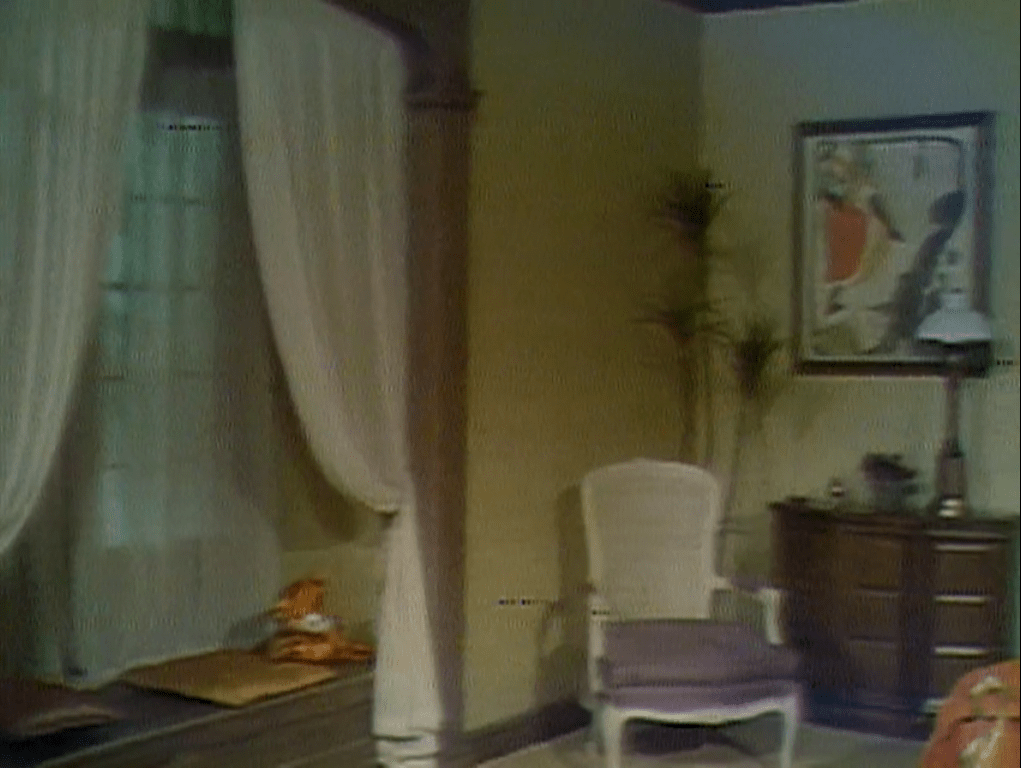
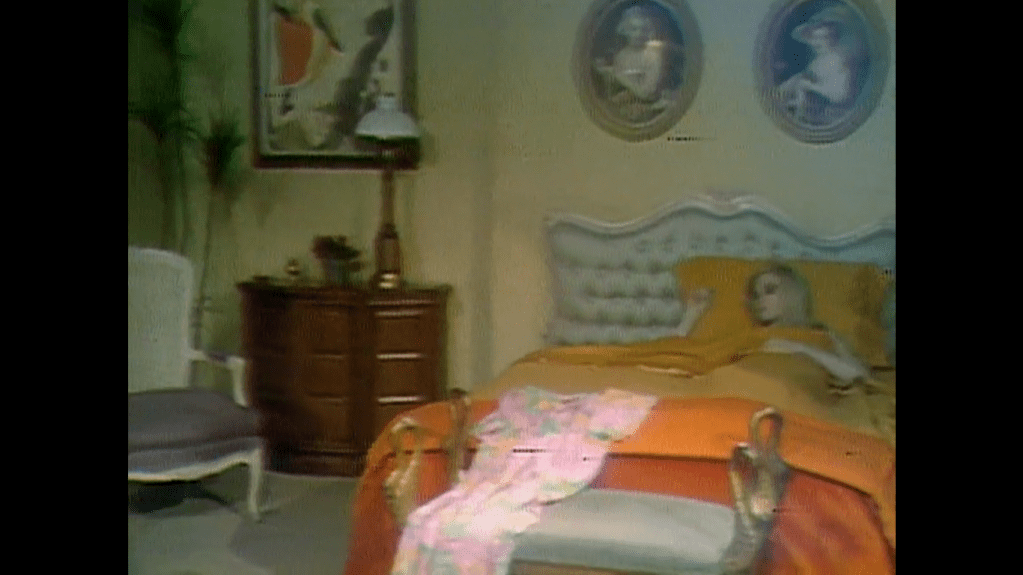
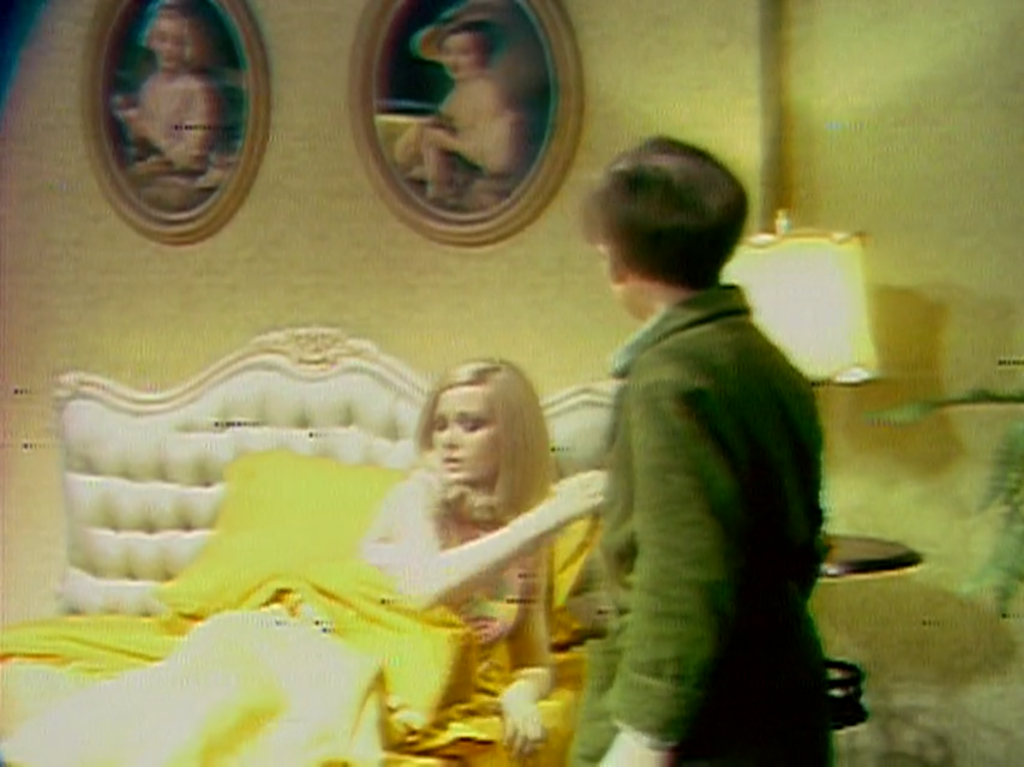
We open on a new set, the bedroom of heiress Carolyn Collins Stoddard in the great house of Collinwood. Dark Shadows has been in color since #295 in August. Though directors Lela Swift and John Sedwick were both ambitious visual artists, they haven’t been able to do much with color so far. With Carolyn’s bedroom, Swift and the staging team have accomplished one of their first real essays in color. It is composed mostly of shades of yellow, pink, and orange.

The color schemes of the other interiors we’ve seen up to this point run the gamut from sedate to subdued to drab to dank, so we already know we are in a unique space. The only other room in Collinwood that might have matched this one for brightness was the kitchen, but we haven’t seen that since #208.

Carolyn’s young cousin, strange and troubled boy David, lets himself into her room. He touches her, and she awakes with a scream. He explains that he just dropped in to make sure she wasn’t dead. When she turns on the light, the screen is so bright that I reflexively squinted, a reaction I’d never before had to an image on Dark Shadows.

Bright room.

David can’t quite explain why he was afraid Carolyn might be dead, but he does insist that she take an antique toy soldier, saying that she will be safe if she keeps it with her. Carolyn’s mother, matriarch Liz, comes into the room to investigate Carolyn’s scream. Liz wonders what David is doing there. Carolyn hastens to say that he was just making sure she was all right.

David goes, and Carolyn tells Liz she doesn’t think anything can be done for him at home. Liz is reluctant to send him away. Regular viewers will not be surprised by this. We know that Liz took David and his father, her ne’er-do-well brother Roger, into Collinwood at the beginning of the summer of 1966 and summoned her unacknowledged daughter, well-meaning governess Vicki, to come look after David starting with #1 on 27 June 1966, so that her conviction that the family ought to look after him got the whole show started. Nonetheless, Liz is so disturbed by David’s unusual statements and depressive affect that she agrees that he needs residential care.

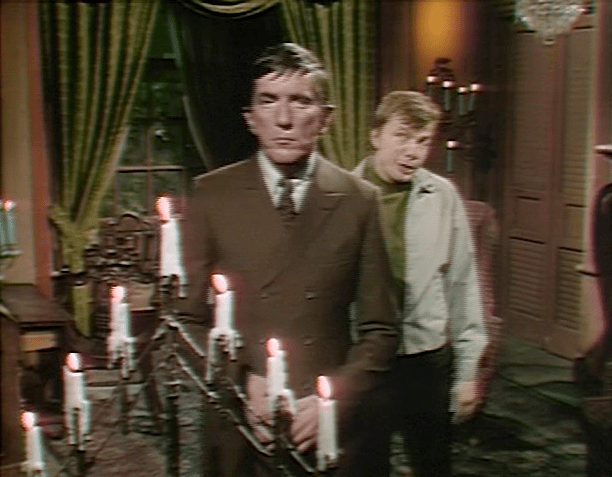
We cut to the Old House on the estate. Vampire Barnabas Collins is sitting in a basement room where mad scientist Julia Hoffman maintains a laboratory. The room is full of electrical equipment, a bit odd since the Old House has no electricity; the laboratory itself is lit by flaming torches. But if we’ve ever seen a Universal Studios production from the 1930s, we know that where you find a mad scientist, you will find electrical currents, so naturally things start buzzing when Julia flips a switch.

Barnabas confined

Julia is trying to implement a medical cure for Barnabas’ vampirism. In the first shot of this scene, we see a visual metaphor for that project. Barnabas, an uncanny being, is confined to a small space in the middle of an elaborate collection of technology. If Julia succeeds, the supernatural will be vanquished altogether and scientific rationality will fill the whole world. The color scheme emphasizes the contrast between Julia’s optimistic goal and the terrain on which she operates. The walls and floor are dominated by the grays and browns of the basement, but the frames and tubing of her equipment are a bright metallic hue, light plays on the glass components, and the intense greens, reds, and blues of the potions are distributed in a slightly unbalanced, lively pattern. The irregular shapes of the frames and tubing emphasize this pattern, and contrast with the solid gray of the floor and the even grid of the brickwork on the walls.

This image not only represents Julia’s plans, but also one of the major themes the show is exploring at this period. Too many characters have encountered too much evidence of supernatural forces and beings for anyone to simply deny that such things exist. But even those who have been most heavily exposed to them keep reverting to a naturalistic frame of reference. Sure, Julia spends all her time hanging around with a vampire and has encountered a couple of ghosts, but she’s determined to ring all of those phenomena around with scientific explanations and technological interventions until they yield to rational control.

Julia’s project has hit its first major setback, as the latest treatment led Barnabas’ hands to age dramatically. He expresses the fear that time will catch up with him, and his apparent age will soon catch up with his actual age, something like 200 years. Julia’s hope that her experiment will not only free Barnabas of his curse, but found a new kind of medicine that will free everyone else of aging and death, will thus be defeated.

Barnabas gives a remarkable little speech about the situation he finds himself in:

I’ve been granted privileges given to few other men… For most men, time moves slowly, so very slowly. They don’t even realize it. But time has revealed itself to me in a very special way. Time is a rushing, howling wind raging past me, withering me in one relentless blast and then continues on. I have been sitting here passively, submissive to its rage, watching its work. Listen. Time, howling, withering.

Writer Joe Caldwell has a fine sense of what actors can do, and this odd little bit of purple prose is right in Jonathan Frid’s wheelhouse. It doesn’t make a whole lot of sense, but the sound of his voice delivering it is so gorgeous it may as well be Shakespeare. Well, maybe not Shakespeare, but Ben Jonson at least.

It is possible to read this speech as a programmatic statement. Daytime soap operas of the 1960s were famously slow-paced; the old joke was that a viewer saw an episode that ended with a character hearing a telephone ring, missed four months of the show, and tuned back in to see the episode that started with the same character saying “Hello.” Even by the standards of the period, the first months of Dark Shadows were notoriously leisurely, with action often as not playing out in real time. When we are watching the 21 episodes centering on Roger’s attempts to find a fountain pen he misplaced, it is indeed the case that “time moves slowly, so very slowly.” But those days are behind us. The show is whipping through plot points at a pace that many prime time series contemporary with it would have had a hard time matching.

If the speech is programmatic, it is also autobiographical on the part of the screenwriter. A fast pace promises excitement for the viewers, but makes life hard for a writing staff that never numbered more than three. Indeed, this is the last episode Joe Caldwell will write for two and a half years. Perhaps he felt the demands of the new pace as “a relentless blast” withering his talents, and had to bow out.

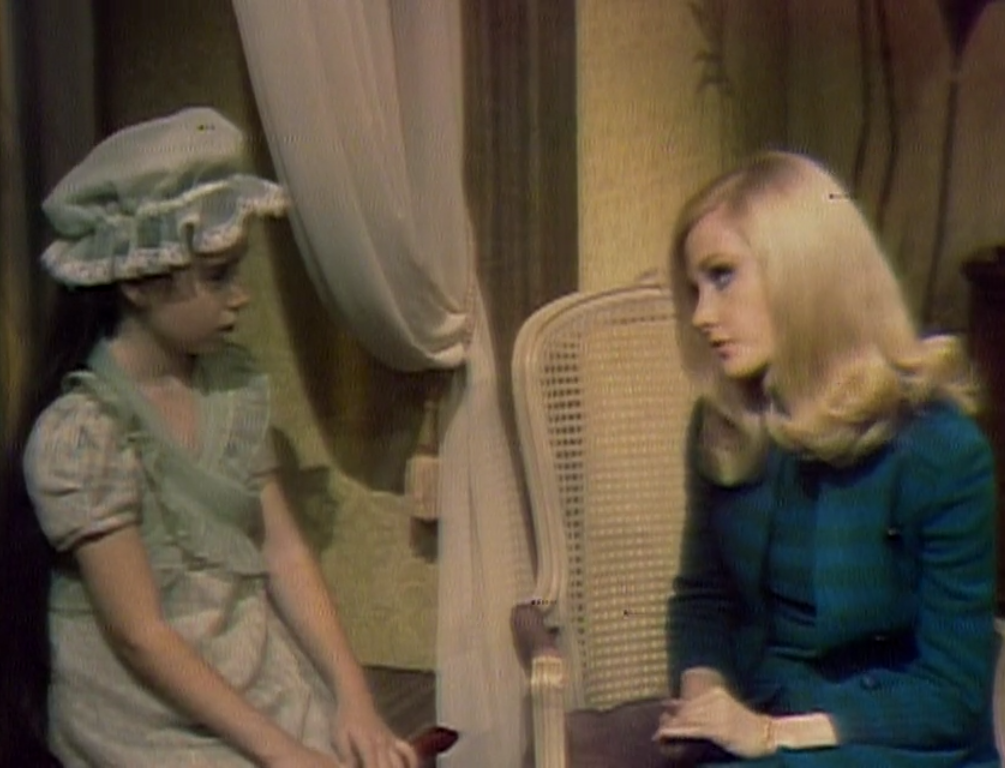
We return to Carolyn’s room. She is in front of her mirror, contemplating the toy soldier. She hears the strains of “London Bridge” playing on a wooden flute, which she has learned is a sign that the ghost of ten year old Sarah Collins is present. Carolyn grew up in this haunted house, so it may not be entirely surprising that her response is to lean back and enjoy the music. But she sits up when Sarah manifests herself in visible form.

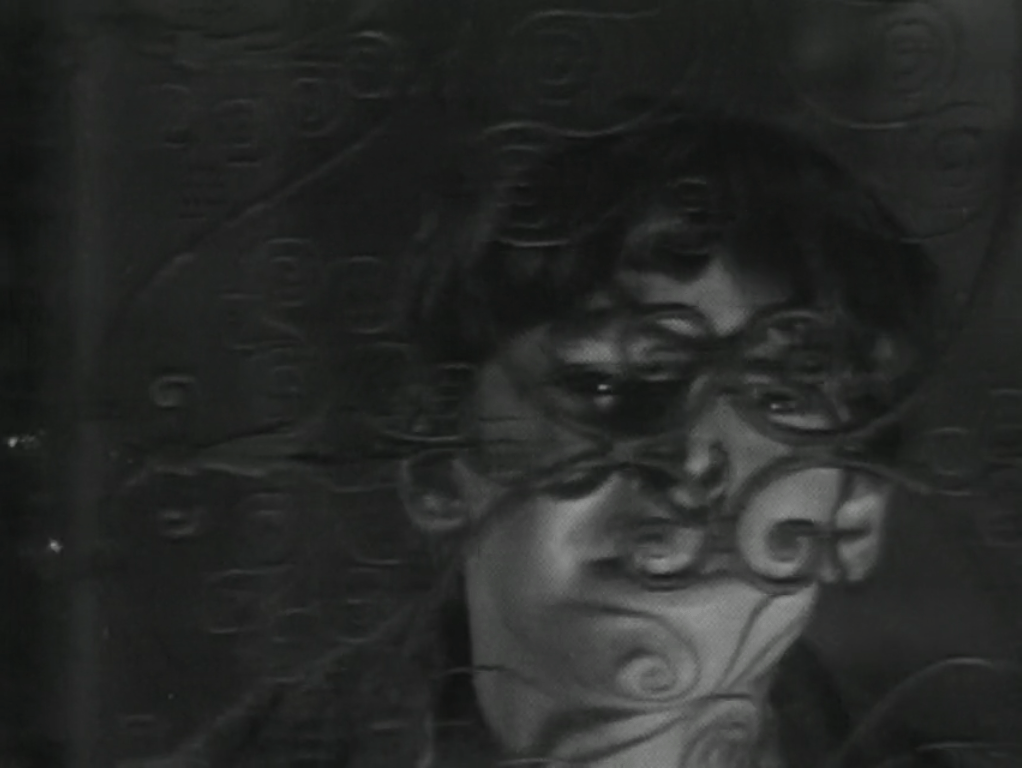
Ghost in the mirror

Sarah speaks, and Carolyn sees her reflected in her mirror. The following scene is so extraordinary I’m going to transcribe all of the dialogue:

Sarah: David must have given you that.

Carolyn: Sarah!

Sarah: He told you my name.

Carolyn: Sarah, how did you get in here?

Sarah: Didn’t David tell you?

Carolyn: Tell me what?

Sarah: All about me.

Carolyn: I’m not sure I understand.

Sarah: I think I’m a ghost. Matter of fact, I’m sure I am.

Giving the facts

This is the first time Sarah has described herself in any terms, certainly the first time she has called herself a ghost. Her coyness about herself had left David confused about what she was; it was not until #325 that he finally concluded that she was a ghost. After that, she became more forthright with him. When he wasn’t sure what she was, she would wait until she was out of his line of sight to appear and disappear. But in #327, she fades away while he’s looking right at her.

Coming out to David not only allowed Sarah to relax around him, but has led her to discard her coyness altogether. She is startlingly blunt with Carolyn as this conversation goes on:

Carolyn: B-but- I don’t believe in-

Sarah: Yes you do. Or I wouldn’t have been able to come here. You’re not afraid of me, are you?

Carolyn: No…

Sarah: If you are, I understand.

This is the first confirmation that Sarah can appear only to those who are prepared to believe in her. It’s true that most of the people who have seen and heard her- David; Maggie Evans, The Nicest Girl in Town; Maggie’s father Sam; Vicki; Barnabas; Julia; Barnabas’ sometime blood thrall Willie; and local physician Dave Woodard- have either had extensive contact with the supernatural or had reasoned their way to the conclusion that she existed. But she also showed herself to Maggie’s nurse at the mental hospital Julia runs, and we don’t know anything about her background or beliefs. And local man Burke Devlin heard Sarah when she and David were talking in #327. While Burke has had plenty of contact with supernatural beings and in the early days of Dark Shadows, when he was fun, was willing to believe in them, he was at that point tearing around bellowing that there were no such things as ghosts. So this is new and unexpected information.

Carolyn’s denial that Sarah frightens her is given in a trembling voice that shows it to be a lie. Still, she isn’t as frightened as she might be. The other day, in #344, Carolyn was in David’s room when Sarah manifested there, not in the visible form of a little girl, but as the sound of “London Bridge” and as information appearing in David’s mind about Burke’s imminent death. Carolyn was terrified of Sarah when she came that way.

Carolyn: Well, what do you want?

Sarah: Don’t send David away.

Carolyn: How do you know about that?

Sarah: I don’t know, I just do.

At this point, we see Carolyn’s fear fading. She is starting to react to Sarah as if she really were a ten year old girl.

Carolyn urging Sarah to be reasonable.

Carolyn: But Sarah, we have to send David away. It’s the only way we can help him.

Sarah: But if you send David away, I won’t have anyone to play with.

Carolyn: Well, maybe it isn’t good for David to play with you.

Sarah: Why do you say that?

Carolyn: Because it leads him into believing all sorts of things that aren’t true.

Sarah: How do you know they’re not true?

Carolyn: Well, they’re just not, they couldn’t be.

Sarah: He wasn’t lying about me, was he?

Carolyn: No.

Sarah: Well.. then maybe David is acting the way he is because no one will believe him.

Carolyn: But… it isn’t possible.

Sarah: People say I’m not possible, but I am. Why doesn’t that make the rest possible?

Carolyn: Sarah, maybe you don’t know the stories David’s been telling!

Sarah: Why do you think that?

Carolyn: Because they’re too fantastic! And besides, they’ve all been proved false.

Sarah: How do you know they’ve been proved false?

Carolyn: Sarah, are you trying to tell me that Barnabas actually slee-

This exchange is the ultimate example of a character accepting the existence of a particular supernatural being and then snapping back into a frame of reference that does not allow for supernatural beings. Carolyn knows that Sarah is a ghost, and starts arguing with her about how fantastic the world is permitted to be.

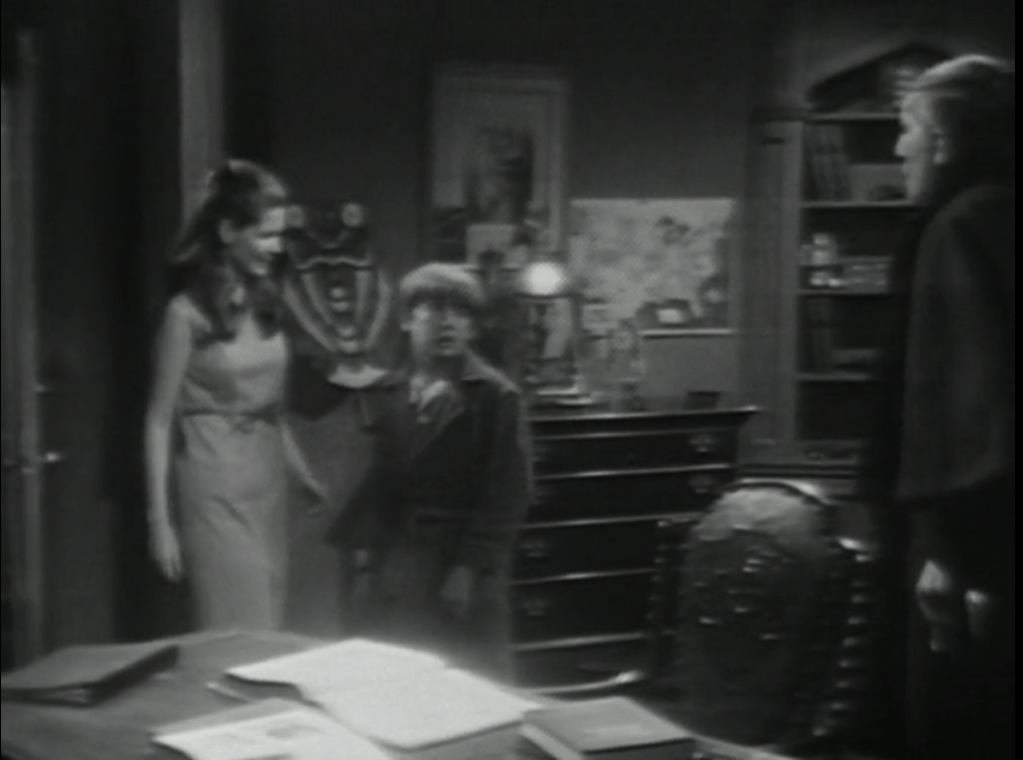
There comes a knock at the door. Carolyn turns away from Sarah to look at the door, and when she looks back, Sarah has vanished. Regular viewers know that Sarah was Barnabas’ little sister, that she wants to keep him from doing horrible things to people she likes, but that she will not say anything against him. So when Carolyn says Barnabas’ name, we know that Sarah is about to vanish.

Sarah’s part is an outstanding example of writing to an actor’s abilities, even more so than was Barnabas’ speech. Caldwell knew that Jonathan Frid had a flair for making flowery gibberish appealing, because that is what he has been doing the whole time he’s been on Dark Shadows. What Sharon Smyth has been doing well as Sarah is being a cutie pie and creating a vague and mysterious impression. When she has more than a few lines to deliver, things tend to get very wobbly. Today, she has to maintain a commanding tone and an adult demeanor throughout an extended patch of rapid-fire dialogue. Absolutely nothing we have seen on screen would suggest that she could handle that. But she pulls it off, more than competently. There are a few glances at the teleprompter, but at no point does she break out of the patient and authoritative manner she has to adopt. It is an impressive job of acting by any standard.

The person at Carolyn’s door is Liz. Liz is Dark Shadows‘ queen of denial. Viewers who have been with the show from the beginning have seen a few cracks in her facade of disbelief in the supernatural. In #10, she dozed off in the drawing room and started talking in her sleep about ghosts. When Vicki insisted to her in #127 that she had seen a ghost, Liz said she believed her. And in #280 and #281, Liz reluctantly agreed to participate in a séance, and afterward agreed that Vicki had been possessed by a spirit. But even in those moments Liz was fighting to keep the topic of ghosts at bay, and the rest of the time she has presented a blank wall to any attempt to face facts about the strange goings-on. So it is not surprising that Carolyn tells her mother she was talking to herself while tidying up her room.

Having talked Liz into sending David away, she now has to talk her back out of it. She manages to get her to agree to wait a few days. “London Bridge” plays. Carolyn reacts to it, Liz does not.

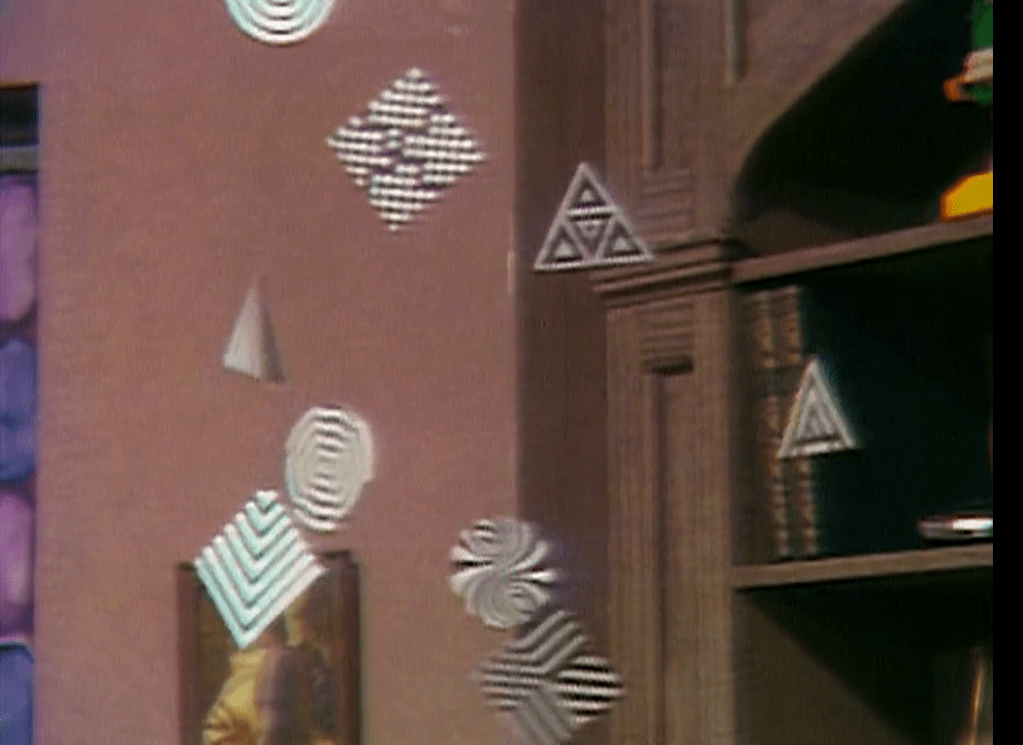
In his room, a distraught David is looking at a mobile. Its whimsical black and white markings suggest a puzzle and make a stark contrast with the vivid colors around them.*

Puzzling shapes.
Back to the wall.

Carolyn comes in. She brings the toy soldier and tells David she doesn’t think she will need it. He insists that she will, but she explains that Sarah visited her and now she believes him and knows how to help him. David is horrified by this. He says that Sarah visited Dr Woodard, that Woodard believed him, and that led to his death. He begs Carolyn not to believe him and claims to have been lying. He sobs and clutches her.

Anguished embrace.

Back in the Old House, Julia prepares to give Barnabas another treatment. He snaps at her. She tells him that whatever happens, she wants him to know that she always wished him well. That prompts him to unload a further stream of sour remarks about her competence and intentions. Julia carries out the treatments, only to find that the aged appearance of Barnabas’ hands has spread to his head.

In his post about this episode on Dark Shadows Every Day, Danny Horn puts it well when he says that “This is just good soap opera construction. People that we care about, facing terrible danger, and desperate to help each other.” He’s referring specifically to the scenes between David and Carolyn and Liz, but it applies to everyone. We care not only about the good people in the great house (well, they’ve been relatively good, lately,) but also about Barnabas and Julia, evil people who are the terrible danger David and Carolyn and Liz are facing, but who make the show fun to watch. We care about Sarah too, and she’s desperately trying to accomplish exactly the result we most want to see, an outcome in which David, Barnabas, and everyone else we enjoy watching stays on the show.

*Evidently this mobile was a commercially produced item. One of the commenters on Danny Horn’s Dark Shadows Every Day reports having had one like it as a child.

Episode 330: bat by Bil Baird

Dangerously unstable ruffian Willie Loomis spent a week staring at the eighteenth century portrait of Barnabas Collins in the foyer of the great house of Collinwood back in April, then tried to rob Barnabas’ grave. That turned out to be an awkward situation when Willie found that Barnabas wasn’t entirely dead. Barnabas was a vampire who bit Willie, turned him into his sorely bedraggled blood thrall, and had lots of conversations with him. Yesterday, Willie was written out of the show.

Today we open with strange and troubled boy David Collins staring at the same portrait. As Willie was obsessed with the idea that there were jewels hidden in the Collins mausoleum in the old cemetery north of town, where in fact Barnabas’ coffin was hidden, so David is preoccupied with the idea that Barnabas has something terrible stashed in the basement of the Old House on the estate, where in fact his new coffin is hidden. As Willie sneaked off to the cemetery on his ill-starred expedition, David will sneak off to the Old House today and try to search Barnabas’ basement.

Unlike Willie, David is not driven by greed. He is afraid of Barnabas, and his friend, the ten year old ghost of Barnabas’ sister Sarah, has told him that he must not go to the Old House. But his aunt Liz and his father Roger dismiss his attempts to warn them about Barnabas, and he thinks it is his duty to provide them with evidence. So he screws up his courage and makes his way across the property.

David lets himself into the Old House by opening the parlor window. Not only have we seen David do this before, but Willie’s sometime friend, seagoing con man Jason McGuire, got into the house the same way in #274. Barnabas would kill Jason when he reached the basement in #275, so you might think he’d have put a lock on that window by now.

Jason’s fate is certainly on the minds of returning viewers when David tries to open the basement door. It comes as a relief when he finds the door locked. Barnabas’ co-conspirator, mad scientist Julia Hoffman, catches him there.

Julia demands to know what David is doing in the house, and he tries to brazen it out. He claims that he has a right to be there, since it belongs to his Aunt Liz. This is a bit of a murky point- we never see Liz transfer title to Barnabas, but she and others act as if he owns the place and its contents. Julia doesn’t clarify it when she responds that Liz gave the house to Barnabas- she doesn’t deny that it still belongs to Liz, only says that it also belongs to Barnabas.

Back in the great house, Roger is banging away at the piano. We saw Liz play the piano in #47 and #91, a reference to the conception of her character writer Art Wallace developed in his original story bible, titled Shadows on the Wall, in which she, like similar characters in a couple of TV plays he wrote in the 1950s under the title “The House,” gave piano lessons. Since then, Liz’ daughter Carolyn tried her hand at “Chopsticks” in #119 and used the piano as a prop in a teen rebel scene in #258, and Jason poked at a few keys in #198. Roger isn’t exactly Vladimir Horowitz, but he’s the first one we’ve seen who actually achieves a melody.

Liz comes in and tells Roger that David isn’t in his room. They fret over David’s attitude towards Barnabas. Julia brings David home and tells Liz and Roger where she found him. After an angry scene between father and son, David goes upstairs, and Liz scolds Roger for his inept parenting. In these as in all of Liz and Roger’s scenes together, we see a bossy big sister who tries to govern her bratty little brother, but who ultimately abets all of his worst behavior.

In the Old House, Barnabas notices that Julia is troubled. He keeps asking what’s on her mind, and she has difficulty deflecting his questions. This is odd- Julia has been established as a master of deception, and Barnabas is the most selfish creature in the universe. All she has to do is start talking about something that does not affect him directly, and he will lose interest at once. Rather than talk about her personal finances, or the job from which she is apparently on an indefinite leave of absence, or some ache or pain she might have, or how sad she is to miss her Aunt Zelda’s birthday, she brings up Willie. That does get Barnabas’ mind off her tension, but it also reminds him of David. He thinks David knows too much about him, and is thinking of murdering him. Julia assures him that the boy doesn’t know so very much, that whatever he does know he hasn’t told anyone, and that if he does say something his reputation as an overly imaginative child will lead the adults to ignore him.

From the beginning of the series, we’ve heard people say that David is “imaginative.” The audience finds an irony in this, since we have never seen David show any imagination whatsoever. All his stories of ghosts are strictly literal accounts of apparitions he has seen. We’ve seen some drawings he has done and heard quotes from some essays he has written. Some of these are technically accomplished for a person his age, but they are just as literal as his ghost stories. And when he tells lies to cover his various misdeeds, he tells simple little tales that fall apart at once.

In #327, well-meaning governess Vicki became the first character to dissent from the “David is a highly imaginative child” orthodoxy. Liz and local man Burke Devlin were dismissing David’s laboriously accurate account of his latest encounter with Sarah as a sign of his “imagination,” and Vicki interrupted with “I don’t think it has anything to do with his imagination.” Now, Barnabas goes a step further. After pronouncing the word “imaginative” in a truly marvelous way that makes it sound like something I’ve never heard before, he tells Julia that she has given him an idea. Frightened, she asks what he means. All he will say is “You’ll see.”

Roger goes to David’s room and has a friendly talk with his son. Throughout the conversation and afterward, David is thinking intensely, trying hard to figure out what his next step should be.

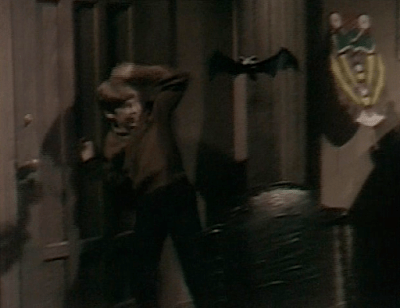
Once he is alone in the room, the window blows open and a bat enters. More precisely, a bat-shaped marionette is brought in on clearly visible strings by a pole that casts a shadow we can see the entire time, but no one who has been watching the show up to this point will doubt for a second that David’s fear, as depicted by David Henesy, is fully justified. David tries to flee from the bat, but he cannot open the door to escape from his room. His back against the door, David slides onto the floor and screams as the bat comes near him.

David finds that he cannot escape. Screenshot by Dark Shadows Before I Die.
David helpless before the bat. Screenshot by Dark Shadows Before I Die.

When Barnabas is about to attack someone, dogs start howling. Sometimes this works to his advantage, but it so often puts his intended victims on their guard that it doesn’t really seem to be something he is doing on purpose. So this bat represents something new. Perhaps Barnabas is using magic to control a bat- if so, it marks the first time we have seen Barnabas use magic to project influence over something other than a human mind. Or perhaps he himself has assumed the form of a bat. If so, that is the first indication we’ve had that he has shape shifting powers. In either case, Barnabas’ powers have just gone up a level.

Closing Miscellany

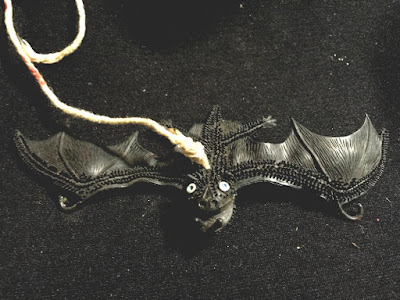
The bat was created by famed puppeteer Bil Baird. Most famous today for the puppets he created for “The Lonely Goatherd” sequence in The Sound of Music, Baird was a frequent guest on television programs like The Ed Sullivan Show, and Jim Henson cited Baird’s own TV series, the short lived Life with Snarky Parker, as a major influence on the Muppets. In December 1966, Baird opened a marionette theater in New York City, at 59 Barrow Street in Greenwich Village; it operated until 1978, and many leading puppeteers, including dozens who would go on to work with Henson, were members of its company in those years.

Bil Baird’s bat-credit. Screenshot by Dark Shadows Before I Die.
The original string wasn’t quite so conspicuous. Screenshot by Dark Shadows Before I Die.

This is the last episode to end with ABC staff announcer Bob Lloyd saying “Dark Shadows is a Dan Curtis production.” We do hear the announcement again in February of 1969, but that won’t be because Lloyd has returned- they used an old recording for the music under the closing credits that day, and they picked one with him on it.

Fans of Dark Shadows will often talk about “the early episodes” which ended with Lloyd making that announcement. So I suppose #330 is the last of “the early episodes.”

Danny Horn’s post about this one on Dark Shadows Every Day includes a morphology of episode endings. He divides them into five categories, Haiku,* Restatement of Threat, ** New Information,*** Crisis Point,**** and Spectacle.***** It’s an intriguing scheme, and he makes a good case for it.

*Danny explains that “Haiku” “aren’t necessarily recognizable as endings in the traditional sense, because nothing is resolved and no progress is made. It’s just a little moment when a character pauses, and possibly has a feeling about something… In some extreme cases, the audience may not realize that the episode is over until halfway through The Dating Game.”

**Restatement of Threat, at this period of Dark Shadows, usually means Barnabas looking at us through his window and saying that someone or other “must die!” Which of course means that you can safely sell a million dollar life insurance policy to that character.

***”A New Information ending provides an actual plot point, which either advances the story another step, or tells us something that we didn’t know.”

****”The Crisis Point cliffhanger is the big game-changer, and for best effect, it should come at the end of a sequence that’s been building up for a while. This is a big turn in the story, and it should feel satisfying and thrilling… The defining feature of a Crisis Point ending is that the resolution marks a change in the status quo, ending one chapter and setting up the next.”

***** “Obviously, plot advancement is always welcome, but every once in a while the show needs to set its sights a little higher. These are the moments when the show goes above and beyond, in order to surprise and dazzle you… The point of a Spectacle is: You can’t take your eyes off the screen. Housewives in the audience have put down the iron, and switched off the vacuum. Teenagers have stopped swatting at their siblings… A Crisis Point cliffhanger will bring you back for the next episode, because you want to see what happens next. But a Spectacle cliffhanger is bigger than that — you’ll be coming back for the next episode, but it’s because you can’t believe what you’re seeing, and maybe tomorrow they’ll do it again.”

Episode 329: The truth about Willie

We open in the Old House on the great estate of Collinwood, home to courtly gentleman Barnabas Collins. In a bedroom there occupied by Barnabas’ servant Willie, Sheriff George Patterson and artist Sam Evans have found evidence that convinces them they have solved the case of the abduction of Sam’s daughter Maggie. They found Maggie’s ring hidden in a candlestick. The room is in Barnabas’ house and he has unlimited access to it. Further, the house is the only place Willie could possibly have kept Maggie if he had held her prisoner. But for some unexplained reason, they are sure that the ring proves that Willie and only Willie abducted Maggie. When Barnabas says that he feels somehow responsible, Sam rushes to tell him that he mustn’t blame himself.

The sheriff says that he will be going to the hospital, where Willie is recovering from gunshot wounds the sheriff’s deputies inflicted on him when they were looking for a suspect. Barnabas hitches a ride with him.

At the hospital, Willie’s doctor, addled quack Dave Woodard, is conferring with his medical colleague Julia Hoffman. When he steps out of the room for a moment, we hear Julia’s thoughts in voiceover. She is thinking about killing Willie before he can regain consciousness and tell a story that will make it impossible for her ever to practice medicine again. She thinks of Barnabas’ voice demanding that she kill Willie. She is reaching for the catheter through which Willie is receiving fluids when Woodard comes back in. She tells him she was checking it, and he is glad when she confirms it is working correctly.

Returning viewers know that Barnabas is the one who abducted Maggie and committed the other crimes of which Willie is suspected, that he is a vampire, that Julia is a mad scientist trying to cure him of vampirism, and that in pursuing her project she has become deeply complicit in Barnabas’ wrongdoing. We also know that she has several times told him that she will draw the line at killing anyone herself, but that she has involved herself in so many other evil deeds that it was just a matter of time before she found herself on the point of crossing that line.

Barnabas and the sheriff arrive at the hospital. In the corridor, Barnabas is bewildered to find that the sheriff will not allow him to be present while he questions Willie. The sheriff has been so careless about treating miscellaneous people as if they were his deputies- for example, enlisting Sam yesterday to help him search Willie’s room- that Barnabas’ puzzlement is understandable. The conversation goes on for quite a while.

Note the poster that reads “Give Blood.” That’s a message Barnabas could endorse. Screenshot by Dark Shadows Before I Die.

The sheriff enters Willie’s room, and greets Julia as “Dr Hoffman.” Woodard thinks Julia has come to Collinsport to investigate Maggie’s abduction, and so he has agreed to keep her professional identity secret from most people in town, including the sheriff for some reason. Therefore, she is startled at this form of address. Woodard explains that now that Maggie’s abductor has been identified, he doesn’t see a point in keeping law enforcement in the dark.

Julia meets Barnabas in the corridor. When she tells him that she didn’t kill Willie, he fumes and calls her a “bungling fool.” He says he will do the job himself, but Julia points out that Woodard and the sheriff are in the room with Willie now. They wind up staring at the clock for hours.

Willie regains consciousness. He doesn’t recognize Woodard. When the sheriff shows him Maggie’s ring, his eyes gleam and he claims that it is his. Returning viewers will remember that before Willie ever met Barnabas, he was obsessed with jewelry. He is terrified when he learns that it is night-time, and says that he knows why he is afraid.

The sheriff and Woodard go out into the corridor to talk with Julia and Barnabas. Woodard tells Julia that she was right- Willie is hopelessly insane. Apparently when they asked him what he was afraid of, he mentioned “a voice from a grave. Nothing else made more sense than that.”

Julia and Barnabas go into Willie’s room. He looks at Barnabas and asks “Who are you?” Barnabas shows surprise that Willie doesn’t know him. Willie asks if he is a doctor. “Yes,” replies Barnabas. “I am a doctor.”

Sheriff Patterson is played by Dana Elcar today. It is Elcar’s 35th and final appearance on Dark Shadows. He would go on to become one of the busiest and most distinguished character actors of his generation.

Elcar had his work cut out for him with the part of Sheriff Patterson. If a police officer on the show ever solved a case, or followed any kind of rational investigative procedure, or interpreted a clue correctly, the story would end immediately. So all the sheriffs and constables and detectives have to be imbeciles. Elcar reached into his actorly bag of tricks almost three dozen times, and always came out with some way to make it seem as if something more was going on in Sheriff Patterson’s mind than we could tell.

My wife, Mrs Acilius, exclaimed “I’m so glad Dana Elcar is playing this scene!” when Barnabas and the sheriff had their long conversation in the hospital corridor. This week’s episodes were shot out of sequence, so yesterday’s was made after Elcar had left. It featured Vince O’Brien as Sheriff Patterson. O’Brien was by no means a bad actor, but he didn’t make the character seem any smarter than the script did. Elcar seems so much like he has something up his sleeve that Jonathan Frid’s insistent pleading makes sense as a cover for a mounting panic. Without Elcar to play against, it might just have come off as whining.

With the conclusion of Willie’s story, this is John Karlen’s last appearance for a long while. Beginning shortly after Barnabas’ introduction to the show in April, his conversations with Willie have been the main way we find out what he is thinking and feeling. More recently, Willie and Julia have been having staff conferences in which they come up with new ideas and add a new kind of flexibility and dynamism to the vampire storyline. From time to time, Willie’s conscience gets the better of him, and he adds an unpredictable element to the story as he tries to thwart one of Barnabas’ evil plans. For all these reasons, removing Willie from the show drastically reduces the number of possible outcomes in any situation they might set up involving Barnabas. His departure, therefore, seems to signal that some sort of crisis is at hand.

In fact, Karlen wanted to leave Dark Shadows because he had a better offer from a soap called Love is a Many Splendored Thing. But the producers knew that no one else could play Willie after the audience had got used to Karlen, and so they wrote the character out until they could get him back. Still, losing Willie puts Barnabas’ story on a much narrower track. So far, each development has led us to speculate about an ever-growing list of directions the story might possibly take. From now on, we are entering a phase where we will often be stumped as to what might be coming next.

Episode 325: Such pretty flowers

Strange and troubled boy David Collins was, for the first 39 weeks of Dark Shadows, the character most intimately connected to the supernatural back-world of ghosts and uncanny phenomena that would occasionally peek through the main action of the show. That changed in #191, when he chose life with well-meaning governess Vicki over death with his mother, humanoid Phoenix Laura Murdoch Collins. After that, he had little memory of his mother, and none at all of the paranormal experiences he had during her time with him on the great estate of Collinwood.

Not that David lost his connection to the supernatural all at once. When he first met his cousin Barnabas in #212, he cheerfully asked him if he was a ghost, and was disappointed to hear that he wasn’t. In #288, he speculated that his friend, mysterious little girl Sarah, might be a ghost, and he has taken it in his stride every time he has seen Sarah do something only a ghost could do. In #310, he took out his crystal ball, a gift he had received in #48 and hadn’t used since #82, and peered into it to try to find Sarah. He did see her in it, too.

Yet David seems to be resisting the idea that Sarah is a ghost, and indeed to be shying away from the whole concept of the supernatural. When she led him to the secret chamber in the Collins mausoleum in #306, she told him that the empty coffin there once had a body in it, but that the body got up and left. David objected that the dead don’t walk away, and was incredulous when she assured him that sometimes, they do. When David was trapped in the chamber in #315, Sarah materialized there and showed him how to get out. He had called on her to come, and was facing away from the only door when he did so, indicating that he knew she could pass through the walls. Yet when she did, he demanded a naturalistic explanation for her entrance, and when she vanished he asserted that she must be hiding in the chamber somewhere.

Now, David is terrified of Barnabas, much to the puzzlement of the adults he lives with. In the opening scenes, he is staring at the portrait of Barnabas in the foyer of the great house, and we hear Barnabas in voiceover, delivering the lines with which he frightened David in #315. He screams with terror, bringing his aunt Liz. She sees that David is upset, but he hurries away from her, upstairs to his bedroom.

There, we hear his thoughts in another voiceover. He remembers the events of #310, when he discovered that Barnabas and his servant Willie knew about the secret chamber in the mausoleum. In his agitation, he calls out to Sarah. He hasn’t admitted to himself that Sarah is a ghost, but evidently he expects her to materialize out of thin air. Sarah doesn’t come, but Vicki does, asking who he was talking to.

After David says he wants to work on his stamp collection, Vicki goes downstairs and finds Liz putting her coat on. She says that David is afraid of Barnabas for some reason, and that she is going to Barnabas’ house to ask him to help put the boy’s fears to rest. She says that David is more disturbed than he has been since his mother Laura was around; this is the first direct reference to Laura in months.

There is a knock on the front door. It is Barnabas, saving Liz the trip. Liz and Vicki explain how fearful David is, and Barnabas offers to have a talk with him.

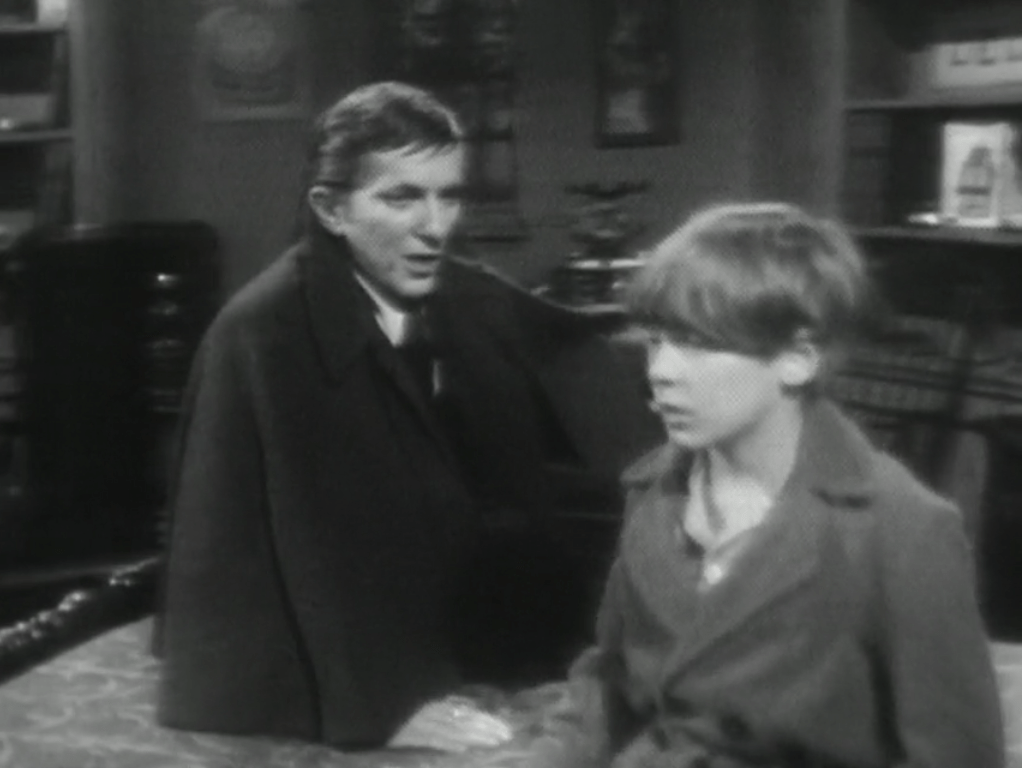
Liz ushers Barnabas into David’s room. Once the door is closed on the two of them, Barnabas questions David aggressively about Sarah and the secret chamber in the mausoleum. He asks him if Sarah told him about her family, twice mentioning her brother. When David says that Sarah hasn’t told him anything about herself, Barnabas accuses him of lying. He sits next to David on his bed. David doesn’t know that Barnabas is a vampire, but if he did he couldn’t look much more uncomfortable than he does when Barnabas assumes this position.

Barnabas sitting with David on his bed.

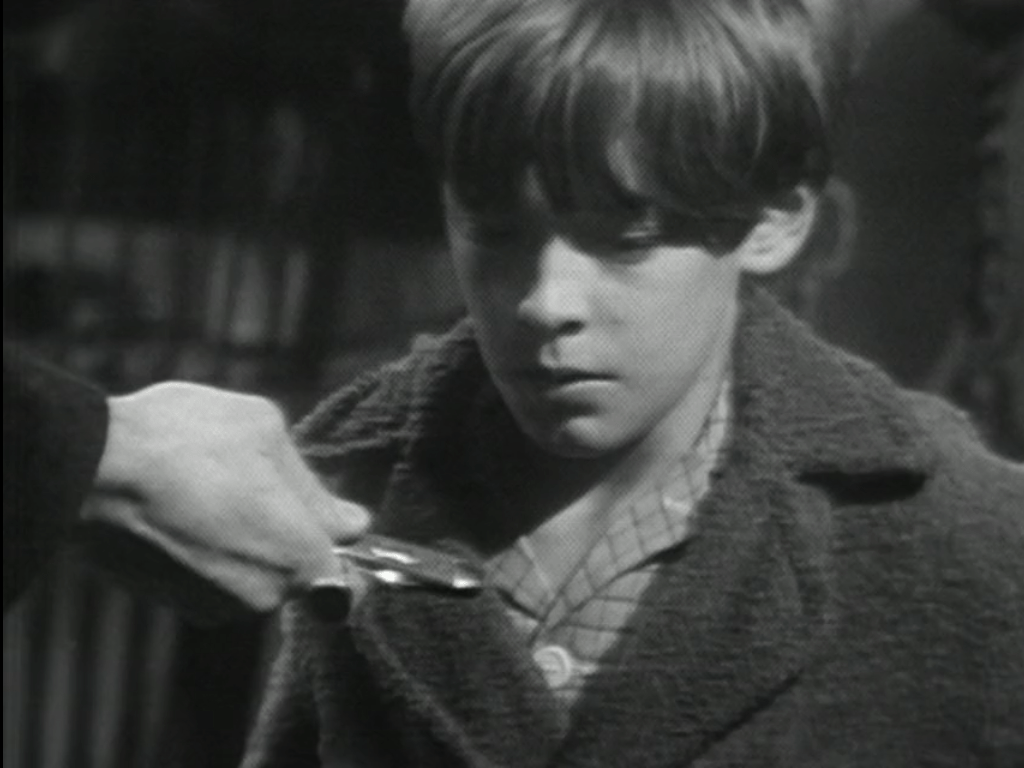
Barnabas tells David repeatedly that he knows he was in the secret chamber. David denies it, Barnabas again tells him he is lying, and to prove it shows him the knife he left there.

Barnabas confronts David with his knife

A knock comes at the door. It is Vicki. Vicki adores Barnabas, and the smile she wears when she enters the room shows her certainty that a heart-to-heart talk with him will have relieved David’s anxiety.

Smiling Vicki, sure everything will be all right

Vicki sees that David is still frightened, and her smile gives way to a look of confusion. Vicki was originally the audience’s point-of-view character; the audience is now composed chiefly of people who have tuned in wanting to see how they were going to fit a vampire into a daytime soap opera, and so of course she has to be Barnabas’ biggest fan at Collinwood. She and Barnabas leave David’s room together, and Barnabas wishes David “Pleasant dreams…”

We see David tossing in bed. He is talking in his sleep, calling out to Sarah. In yet another voiceover, we hear his dream. It is a bit of conversation from #306, when Sarah told him about the empty coffin.

We then see the beginning of another dream. It takes place amid a composite of decorations from the cemetery set and from the set representing Barnabas’ basement. David at first appears in a corridor like the ones we saw in the basement in #260.

The fog machine is working hard today.

He then encounters a faceless woman whom regular viewers will recognize as Barnabas’ co-conspirator, mad scientist Julia Hoffman.

David sees the faceless woman.

We see that she is wearing Julia’s wig and frock and holding the jeweled medallion she uses to hypnotize people:

Julia’s identifying marks.

David flees from the faceless woman, saying he has to find Sarah. He finds himself behind a grating like the one on the door to the Collins mausoleum:

Entering the tomb

He walks up a few stairs, and sees Sarah.

David finds Sarah

When David tells Sarah that she is hard to find, she denies it, saying that she is easy to find if you know where she is. David does not respond to this characteristically cryptic remark, but complains that she won’t tell him anything about herself. She asks what he wants to know, and says he wants to know who she is and where she comes from. She tells him:

Sarah: That’s easy. I was born the same place you were. I lived in a house on a hill until I was nine years old. Then I got very sick. Everyone came to see me, and they were very sad.

David: Because you were sick?

Sarah: No, because I died. I died, and everyone brought such pretty flowers.

“I died that time. I died, and everyone brought such pretty flowers.”

When David asks why she is around now if she died then, she tells him she doesn’t really know. All she knows is that she is looking for someone. David asks who that might be, and Sarah says she will show him. Suddenly he becomes frightened and does not want to go with her. She insists. She takes his hand and leads him.

Sarah leading David to her secret

The camera follows the children on their journey across the set. At first Sarah takes David down some stairs, leading him from depths to depths:

Sarah leads David down into the depths

The set is now unmistakably Barnabas’ basement, though with more candelabra casting more intricate shadows on the walls than we have seen there:

Vergil and Dante, junior edition

At last Sarah stops and looks straight ahead. They have reached their destination.

David is bewildered by the sight.

They see a coffin. David asks if this coffin is empty, as was the one in the secret chamber. Sarah tells him no. This one has a body in it. The lid starts to open. David points in astonishment, while Sarah looks on serenely.

The lid begins to open.

Barnabas rises from the coffin.

Barnabas rises.

David recognizes Barnabas and is stunned. Sarah has eyes only for her big brother.

David stunned.

Barnabas stands. He turns, and sees Sarah. He is glad to see her.

David watches Sarah’s reunion with Barnabas.

Barnabas notices David. He turns to follow him.

Barnabas blocks David from our view and from Sarah’s.

As Barnabas follows David, Sarah simply watches.

Sarah watching big brother.

Barnabas follows David through another corridor. The shadows on the wall and floor form a design suggesting David is caught in a web. Readers of Gold Key comics’ Dark Shadows series will recognize the bend of Barnabas’ knees and the angle of his cane in this shot as their usual depiction of him:

David caught in Barnabas’ web.

David’s back is to the wall and Barnabas closes in on him.

Cornered.

Barnabas raises the cane he used to block David’s escape in #315 and which regular viewers several times saw him use to beat Willie. We zoom in on the wall, where we see the cane’s shadow rise and fall while we hear David cry out in distress.

Sarah’s fixation on Barnabas and her passivity when Barnabas follows David mark a pivotal moment in her development. She looks and sounds like a friendly little girl, and we have seen her rescue people from danger. She usually seems like a cross between Caspar the Friendly Ghost and the Powerpuff Girls. But she is not that at all. She is a symptom of the same curse that has brought Barnabas forth to prey upon the living, and she is leading David ever deeper into a world where only the dead belong. The show has given us no reason at all to think that she can bring him back to the realm of the living.

Even if Sarah wants to save David, she may still represent a deadly threat to him. We saw this in the Laura story. When Laura tried to lure David into the flames, she told him that he, like her, would rise from the ashes and live again. We had heard her say things like this before, and she may well have believed it to be true. But unknown to her, we saw a séance in which David spoke with the voice of a son Laura had in one of her previous incarnations. She had burned him with her, but while she gained a new life in the flames, he had become one of the unquiet spirits of the dead. Perhaps Sarah, too, is unwittingly leading David to his death.

Closing Miscellany

When Liz leads Barnabas into David’s room, she tells David that “Unc- Cousin Barnabas” wants to have a man-to-man talk with him. In later years, Jonathan Frid would refer to his character as “Uncle Barnabas” when he talked with interviewers about how the Collinses responded to him. I wonder if Joan Bennett’s blooper is a sign that he was already calling him that at this time.

There is a slight puzzle in Sarah telling David she was “born in the same place” he was. We’d heard in the early episodes that Laura and Roger never spent a night together in Collinwood as man and wife- the day of their wedding, they went to their new home in Augusta, Maine, and David was born a few months later. Perhaps Sarah’s remark is a retcon, and we are now to think of David as having been born at Collinwood. Or perhaps Sarah really was born where Augusta would stand- we know that her birth year was 1786, and that was the year the settlement that would become Augusta saw the establishment of its first public whipping post. Maybe her parents wanted to go there to celebrate the occasion.

When Sarah tells David she lived on the hill until she was nine, she interrupts herself and shouts “Ten!” This is an odd little blooper. Just a few days ago, David told Barnabas that Sarah was ten, and Barnabas jumped down his throat asking if she wasn’t “almost ten?” Now Sharon Smyth has been on the show long enough to have celebrated a birthday, and they aren’t done with Sarah yet. So they are retconning Sarah as having made it to ten.

Episode 32: Where all criminals belong

In today’s compare-and-contrast, we see the sheriff and Bill Malloy demonstrating how mentally healthy people might react to the idea that a nine year old boy has devised and executed a plan to murder his father. Then we go to Collinwood, where we see how Liz and Roger react to the idea.

The sheriff can’t bring himself to say out loud what the evidence is leading him to suspect David has done. Bill can say it only in part, and then only to express shock and bewilderment.

The scenes between Liz and Roger in this episode are among the strongest in the entire series. Roger is quite drunk, almost giddy, almost laughing at the fact that his son tried to kill him. Liz cycles through a half dozen intense emotions before finally accepting the fact that David is the culprit. She orders Roger to lie to the sheriff and say that what happened to his car was a simple accident, that no one was at fault.

In response to her explanation that this is the sort of thing the Collinses have always done, Roger brings up his suspicion that David may not be a Collins at all. David was born less than nine months after Roger and Laura* were married; she’d been Burke’s girl… Liz won’t hear such things, and insists that David is a Collins, that he belongs to all of the ancestors. She blames Roger for raising David in a home where he knew nothing but hate from the moment he was born, hate he couldn’t understand or cope with.

Roger insists that David be sent away to a mental hospital; Liz says no, that he will stay in the house, that “Miss Winters and I” will give him the home life he needs. Her mention of “Miss Winters” in this connection makes it clear that Vicki is central to Liz’ plans for the future, whatever those might be.

The sheriff shows up. He’s taking his time to get to the point. Roger cuts him off: “Is it about David?” At that, even the background music falls silent. The sheriff starts talking. Liz jumps in and says that the sheriff should drop the investigation, that it was all just an accident. The sheriff looks uneasily from Liz to Roger and back again, and finally agrees to do so.

In the coda, Roger tells Liz that she will regret covering up for David. He gives her a look of contempt that is among the most powerful things I’ve ever seen on a screen. Liz is totally alone now; Roger will obey her, but he’ll never respect her again. Joan Bennett was pushed to the margins of the show in later years, but she really did fill her “Starring” credit in these first months. It isn’t every show that would present us the leading lady devastated like this.

*Aside from the prologue delivered by Alexandra Moltke Isles, there are no surviving cast members in this episode. As of 9 August 2022, it is the earliest episode of which that can be said.

**Laura’s name is first mentioned here.