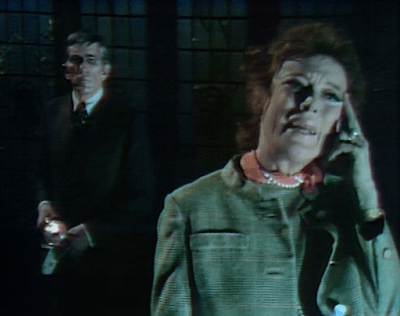
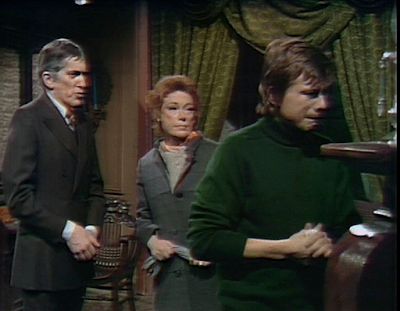
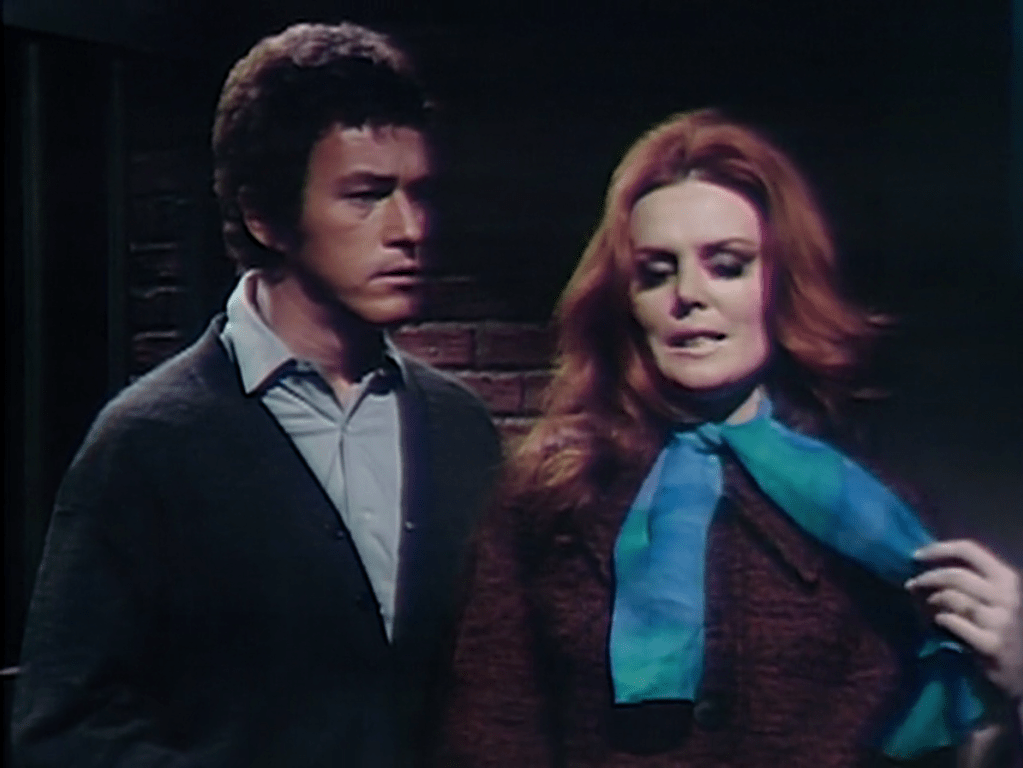
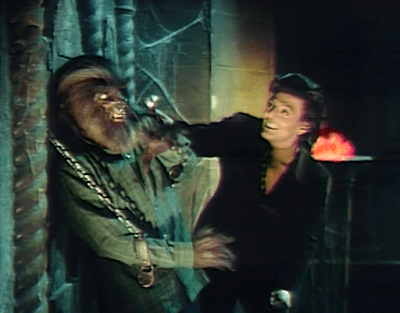
Episode 898: The keeper of the book

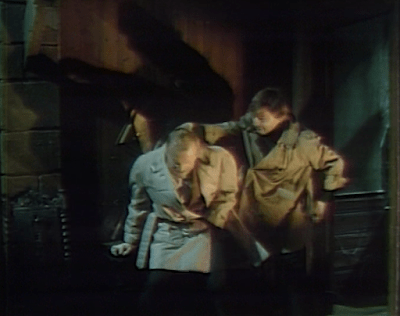
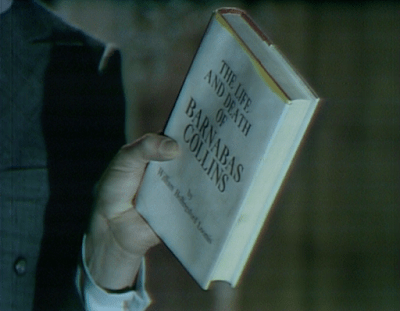
A cult devoted to the service of supernatural beings known as “the Leviathan people” is secretly establishing itself in and around Collinsport, Maine. Antique shop owners Megan and Philip Todd are members of the cult. Its acting leader, old world gentleman Barnabas Collins, has entrusted them with several items sacred to the cult. The Todds are responsible for a scroll, a box, a book, and a baby. Now the book has gone missing, and the baby is sick. Yesterday, Barnabas responded to this situation by brainwashing Philip into killing Megan. Today, we open with Philip entering the antique shop and choking Megan.

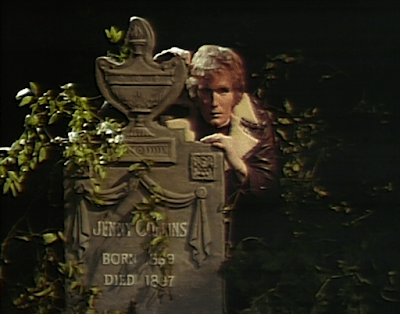
Megan is Marie Wallace’s third character on Dark Shadows. Her first, fiancée of Frankenstein Eve, was strangled by her intended spouse Adam in #626. Her second, madwoman Jenny Collins, was strangled by her estranged husband Quentin in #748. The murder of Eve came at the end of the Monster Mash period of the show that stretched throughout most of 1968, while the murder of Jenny marked a turning point in the eight-month costume drama segment set in the year 1897. The Leviathan arc is just beginning, and Miss Wallace’s character is already being strangled by her husband. If we were hoping for fresh new story ideas, we couldn’t be more disappointed.

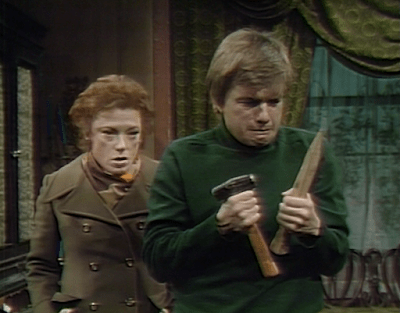
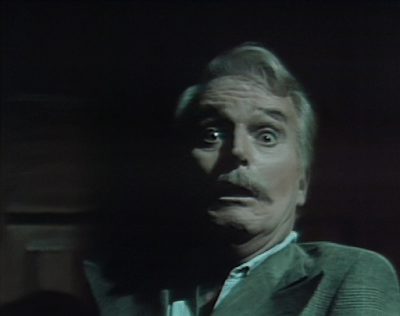
Until, that is, the strangulation is called off. Philip is holding Megan by the neck, reiterating that “There is no margin for error! Punishment is necessary!,” when strange and troubled boy David Collins appears on the staircase and announces “punishment is no longer necessary.” Philip releases Megan, and David informs them that he is now “the keeper of the book, and the protector of the baby.” He gives Megan and Philip medicine that will cure the baby of his illness. He tells them that if they need him, he will know and will appear.

Barnabas was a vampire when he joined the cast of characters in April 1967. As a villain he was unrivaled at giving everyone else things to do, whether as his victims, his accomplices, or his would-be destroyers. In March 1968, his curse was put into abeyance and he became human. He set out to be the good guy, but still had the personality of a metaphor for extreme selfishness. As a result, Barnabas the would-be hero created at least as many disasters as Barnabas the monster ever did. He thus remained the driving force of the show, as well as its star attraction.

While Barnabas can keep things going from day to day, Philip’s attack on Megan suggests that he cannot take the story in new directions. From episode #1, that has been David’s forte. The series began when well-meaning governess Vicki was called to Collinwood to take charge of David’s education, took its first turn towards grisly tales when David tried to murder his father, became a supernatural thriller when David’s mother the undead blonde fire witch came back for him, began its first time travel story when Barnabas was planning to kill David in November 1967, and was launched into both the “Haunting of Collinwood” that dominated the show from December 1968 through February 1969 and the 1897 segment that followed it by David’s involvement with the ghost of Quentin Collins. David was not always a highly active participant in the stories that began with him; indeed, he sometimes disappeared altogether for months at a time. But even from the outside, he is the instrument by which the basic architecture of the show is reshaped. Now that he is, apparently, the leader of the Leviathans, we can renew our hopes that something we haven’t seen before is still in store for us.

David is still in the shop when a gray-haired man enters. David greets him as “Mr Prescott,” the name by which he heard his cousin Carolyn address the man when he met her in the shop the other day. David has a smug look on his face that suggests he knows this is an alias. Indeed, we already know that the man is connected with the Leviathan cult, so the leader of the cult may well recognize him as Paul Stoddard, Carolyn’s long-missing father.

Paul asks the Todds to give a note to Carolyn. David says that he will be going home to the great house of Collinwood in a few minutes, and volunteers to take the note to her there. Paul gladly hands it to him.

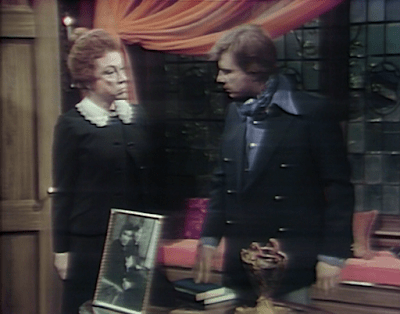
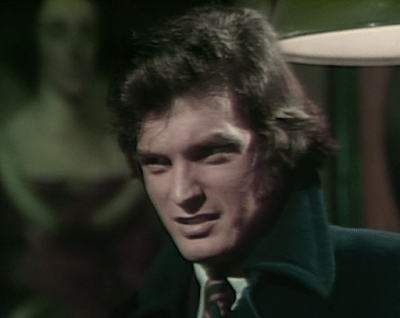
At Collinwood, permanent houseguest Julia Hoffman is conferring with mysterious drifter Chris Jennings. Yesterday, Jenny’s ghost appeared to Chris and told him that Quentin could help him with his big problem, which is that he is a werewolf. Jenny did not identify herself, and Chris had no clue who she was.

Julia shows him a Collins family photo album. She shows him a picture of maidservant Beth Chavez and asks if that is who he saw. He says it wasn’t, and they keep turning pages. It is interesting for regular viewers that they take a moment to put Beth’s picture on the screen and to make some remarks about her. Beth appeared several times during the “Haunting of Collinwood” segment, and was a major character during the 1897 flashback. The sight of her picture is the first reason we have had to suspect that either she or actress Terrayne Crawford will be back.

Chris and Julia look through a Collins family photo album. Screenshot by Dark Shadows Before I Die.

When Chris recognizes Jenny’s picture, Julia breaks the news to him that Jenny and Quentin were his great-grandparents, and that Quentin was the first to be afflicted with the werewolf curse. We know that Quentin and Jenny’s daughter was named Lenore, and that she was raised by a Mrs Fillmore. Chris confirms that his grandmother’s maiden name was Lenore Fillmore. Wondering how Quentin could help Chris, Julia decides they will hold a séance and contact Quentin’s spirit.

David enters, looking for Carolyn. Julia asks him to participate in the séance. He agrees, with the blandness appropriate in a house where séances have become almost routine. When Julia tells him that the spirit they are trying to reach is that of Quentin Collins, David becomes alarmed. As well he might- we left 1969 at the beginning of March, but in #839, broadcast and set in September, we saw that the haunting continued in the absence of the audience, and that Quentin’s ghost had killed David. That episode took place on the anniversary of an event in 1897 that was changed by time travelers from the 1960s, and so David came back to life and the haunting ended. But everyone at Collinwood still remembers the ten months that Quentin exercised his reign of terror, and David does not want to return to it.

Julia assures David he has nothing to be afraid of. She says that the past was changed as of September 1897/ September 1969, and that Quentin’s ghost was laid to rest forever. This doesn’t fit very well with her plan to disturb that rest, but David is still ready to go along with the plan.

When they have the séance, David goes into the trance. He speaks, not with Quentin’s voice, but with that of Jamison Collins, his own grandfather and Quentin’s favorite nephew. Jamison says that Quentin’s spirit is no longer available for personal appearances. He doesn’t know more than that, and excuses himself. When David comes to and asks what happened, Julia says she will tell him later and sends him to bed. Once he is gone, she tells Chris that she thinks Quentin may still be alive.

Quentin was a big hit when he was on the show as an unspeaking ghost during the “Haunting of Collinwood,” and became a breakout star to rival Barnabas when he was a living being during the 1897 segment. So the audience is not at all surprised that he will be coming back. But David’s behavior before, during, and after the séance is quite intriguing. He is not simply possessed by some spirit that is part of whatever it is the Leviathan cult serves. He is still David, is still afraid of Quentin’s ghost, and is still fascinated by séances. During the 1897 segment, Jamison was a living being; like David Collins, he was played by David Henesy. That Jamison can speak through his grandson and not express discomfort at the unfamiliarity of the atmosphere suggests that there are sizable expanses inside David which are still recognizably him.

There is a similar moment between Philip and Megan. She smiles at him and in a relaxed voice says she understands why he had to do what he did. Philip has no idea what she is talking about. She reminds him that he tried to strangle her earlier in the evening, and he suddenly becomes highly apologetic. She tells him he has nothing to apologize for, that it was his duty as a servant of their cause. He is still anguished about it. They share a tender embrace. Again, while the force that animates the Leviathan cult may have the final say over what Megan and Philip do, their personalities are still there, and the loving couple we met a not so long ago still exists. There is still something for us to care about concerning them.*

Paul also has a lot of activity today. He goes to the cairn in the woods that is the ceremonial center of the Leviathan cult and that only people associated with it can see. He wonders why he keeps being drawn to it. When he first returned to Collinwood in #887, he was watching when the cairn materialized in its place out of thin air. He didn’t react at all, but merely turned and continued on his stroll. That led us to believe he knew a great deal about the cult, enough that he not only expected to see this extraordinary sight, but knew he need take no action regarding it. But evidently his connection is more subtle, and he does not understand it himself.

In his hotel room, Paul goes into a trance and circles the date 4 December 1969 on his calendar. That was when the episode was first broadcast, so the original audience would have assumed he was merely circling the current date. But when it was taped, the makers of Dark Shadows had expected the episode to be shown on 3 December. In between, there had been a pre-emption when the ABC television network gave its news department the 4:00 PM timeslot to cover the end of the Apollo 12 lunar landing mission. So the intention had been that we would share Paul’s puzzlement as to what was so special about the next day.

Paul is already worked up because some unknown person left him a note at the antique shop reading “Payment Due, 4 December 1969.” By the end of the episode, he notices that a tattoo has appeared on his wrist. It is a symbol that the show refers to simply as “the Naga,” a group of intertwined snakes that represent the Leviathan cult. All of this combines to get him into quite a state.

* I should mention that Danny Horn made the same point in his post about the episode on his great Dark Shadows Every Day: “And then they kiss, and the creepy thing is that I think they’re actually in there… So far, I’ve been critical of Chris Bernau, but he’s the one who pulls this moment together. As far as he’s concerned, the unpleasant incident is entirely forgotten — but when Megan brings up the fact that he was seconds away from killing her, his apology is entirely sincere.” Danny Horn, “Episode 989: Executive Child,” on Dark Shadows Every Day, 12 July 2016.

Episode 897: Restore our flesh and bones

The Trouble with David

Yesterday we saw strange and troubled boy David Collins (David Henesy) go to a mysterious cairn in the woods, the ceremonial center of the cult of the Leviathan people, and announce that he was now one of the cult. The cairn then opened, revealing a little gap. David crawled into the gap. The gap was not quite big enough for him, so that the episode ended with an extended sequence of David Henesy wiggling his rear end at the camera while he tried to wedge himself into place.

Today we learn that the carpenters were not the only ones who haven’t caught on that Mr Henesy isn’t nine years old anymore. David has followed the gap to an underground chamber with a steaming cauldron. He takes some vegetation out of the cauldron and recites a cryptic poem, all the while staring portentiously off into space. His manner, words, and actions would be effective as part of a creepy little kid sequence, but the thirteen year old Mr Henesy looks mature enough that we just chalk him up as one more member of the Leviathan cult.

The Trouble with Chris

Heiress Carolyn Collins Stoddard calls on drifter Chris Jennings in his cottage. They talk about someone named Sabrina who has told Carolyn that while Chris is a nice enough guy, he will, in spite of himself, kill her if she keeps hanging around him. Chris tells Carolyn that this is true and that he is “a monster.” He does not explain. She leaves, and he takes out a pistol. First-time viewers will wonder if Chris has a compulsion to fire his pistol at people. Regular viewers know that he is a werewolf, and that his particular case of lycanthropy is so advanced that he sometimes transforms even when the moon is not full. We can assume that he plans to use the pistol to put himself out of his misery.

Regular viewers also know that Chris was safely confined to a mental hospital until he checked himself out recently. When he returned to the great house of Collinwood, he told his psychiatrist, permanent houseguest Julia Hoffman, that he just couldn’t stand the conditions at the hospital. Since leaving the hospital means that Chris will resume killing at least one random person a month, this decision just about completely erased any sympathy we might have for him as a character. It also undercuts his motivation in this scene. If Chris really wants to stop killing, he is free to go back to the hospital at any time.

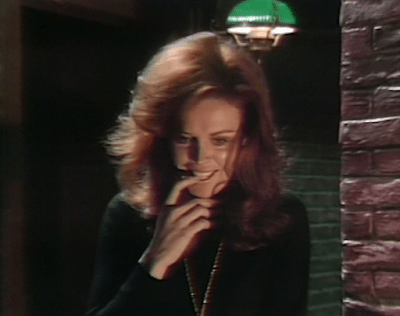
The ghost of Chris’ great-grandmother, Jenny Collins (Marie Wallace,) appears. She tells him not to commit suicide. Dark Shadows was a costume drama set in 1897 from March to November 1969; in those days, we got to know Jenny as “Crazy Jenny,” who played nothing but one mad scene after another. She was sane and well-put-together just once, when she appeared as a ghost in #810 and #811. In this second postmortem appearance, Jenny is extra mad, wearing a disheveled wig that reaches heights few hairpieces have dared. She does not tell Chris to return to the hospital, but to find his great-grandfather, Quentin Collins. She says that she cannot help him, but Quentin can.

This confirms what the show has been hinting, that Quentin is alive. Chris doesn’t know that, nor does he know of his relationship to Quentin. He is left bewildered and helpless by Jenny’s pronouncement. His response would no doubt be more complex if he were up to date, but he has been so ineffective at managing his curse and so irresponsible generally that we can’t imagine he would do anything constructive even if he knew everything we do. The character seems to have reached a dead end.

The Trouble with Barnabas

Upset by her conversation with Chris, Carolyn goes to her distant cousin, old world gentleman Barnabas Collins. She enters his home, the Old House on the estate of Collinwood, and finds the front parlor empty. She hears Barnabas’ voice coming from behind a bookcase, repeating over and over that “There is no margin for error. Punishment is necessary.”

Longtime viewers know, not only that a room is hidden behind this bookcase, but that Carolyn knows about that room. Her friend, David’s well-meaning governess Vicki, was held prisoner there by a crazy man in December 1966, several months before Barnabas joined the show. Carolyn is moving her hands, as if she is looking for the release that makes the bookcase swing open, when Barnabas comes downstairs.

When Carolyn says that she heard his voice, Barnabas explains that he was simply keeping busy by “conducting an experiment in electronics.” The candles around the room will suffice to show that the house doesn’t have electricity, and even if Barnabas weren’t so resolutely technophobic it would still require explanation that the text he set his speakers to reproduce over and over was “There is no margin for error. Punishment is necessary.” Moreover, Carolyn knows Barnabas well, and she can’t have overlooked that he is not his usual self these days. He is distant, calm, and utterly self-possessed, a far cry from the fussy, excitable chap who so often stumbles over his words. He remains formidably well-composed as he reiterates his position that Chris is a dangerously unstable person whom Carolyn should avoid, and that she has a bright future ahead of her. He gently but firmly guides her to the front door, and she is out of the house in record time.

Carolyn does not know that Chris is the werewolf, but at least she knows that there is a werewolf. She does not know that the Leviathan cult exists, and so it is understandable that she does not suspect that Barnabas is acting as its leader. But as the story unfolds, others will no doubt catch on that something is up, and so many people have spent so much time with Barnabas that it is difficult to see how they can all fail to notice the drastic change in his personality and to connect it with the strange goings-on. Putting him in this position makes it likely that the writers will have a harder time managing the story’s pace than they would if his involvement were more subtle.

Once Carolyn has exited, Barnabas opens the bookcase and reveals Philip Todd, antique shop owner. He rewinds a reel-to-reel tape and replays “There is no margin for error. Punishment is necessary.” Philip and his wife Megan are members of the cult, entrusted with the care of many of its most sacred items. Yesterday Barnabas found out that one of these, a book, had gone missing. He summoned Philip to the cairn, and it seemed he might be about to kill Philip. But now, he sends Philip off to administer the punishment to someone else, presumably Megan.

The Trouble with Megan

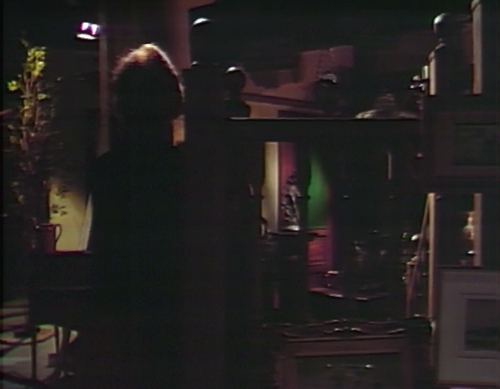
Megan (Marie Wallace) has been in an extremely overwrought state ever since she found that the book was gone. Today’s episode ends with a long scene in which she is alone in the shop, feeling that someone is coming to kill her, reacting sharply to every noise.

Danny Horn devotes most of his post about the episode on his great Dark Shadows Every Day to reasons why this scene does not work, among them the fact that a depiction of a person descending into madness requires that the person start off as something other than over-the-top loony. Megan has been so frenzied for the last few days that Miss Wallace has nowhere to go when she hears the ominous noises. Moreover, her first two characters on Dark Shadows, fiancée of Frankenstein Eve and Crazy Jenny, were both intense, overbearing characters who were so inflexible that they had little opportunity to respond to anything their scene partners might do. Longtime viewers therefore expect to see Miss Wallace screaming and carrying on by herself, so nothing she does here will unsettle us. They lampshade this iconography problem by showing us Crazy Jenny’s ghost today, but that doesn’t help at all.

Many fans compare this scene to episode #361. Most of #361 is devoted to a one-woman drama in which Julia is tormented by sights and sounds in her bedroom, suggesting that her mind is collapsing. I don’t think that episode is a success, but because Julia had always been in control of herself up to that point we can see what is supposed to be at stake in it. That’s more than we can say for Megan’s fearful turn.

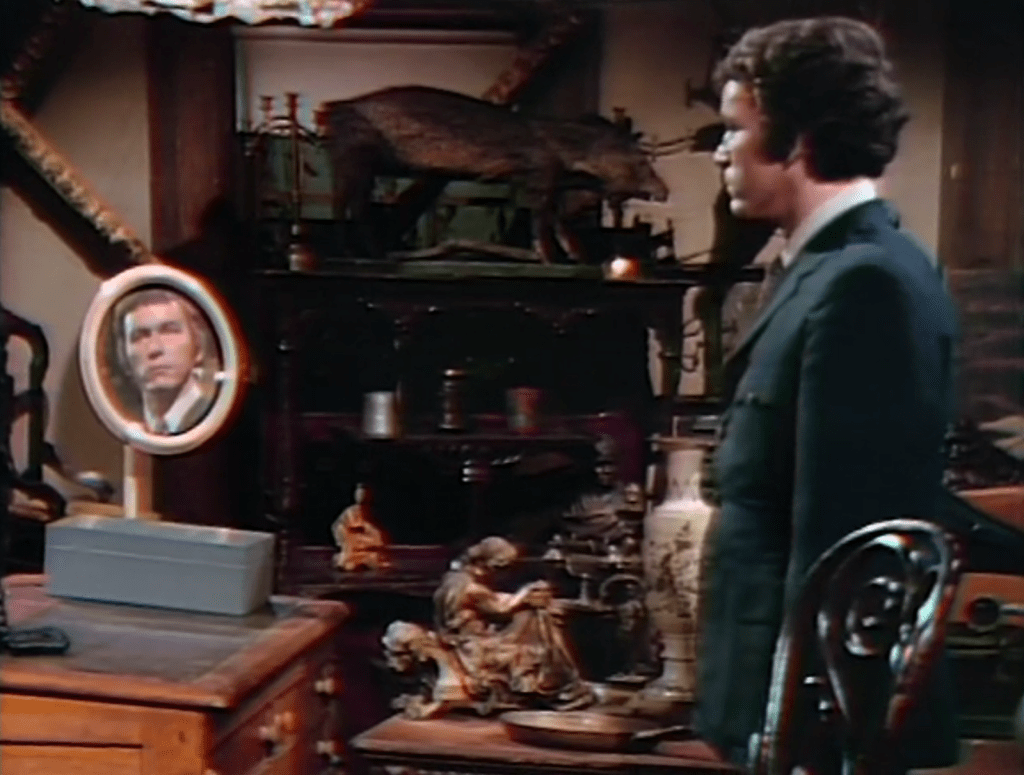
In John and Christine Scoleri’s post about the episode on Dark Shadows Before I Die, Christine points out the prominence of the taxidermied animals in the background, and speculates that the scene is an homage to The Night of the Living Dead. I wouldn’t have guessed that director Lela Swift or writer Violet Welles would have studied that film, but Christine provides screenshots from it and from the episode, and the parallels are so striking that I can’t see how she could be wrong.

Closing Miscellany

I think the tape recorder is the same one we saw in the summer of 1968, when it was part of the Frankenstein story. It also appears to be the one that parapsychologist Peter Guthrie brought to Collinwood early in 1967.

Her haunting of Chris marks Jenny’s final appearance. Miss Wallace reprised the role decades later in a couple of the Big Finish audio dramas.

During Megan’s big scene, the camera swings a bit to the left and we can see beyond the edge of the antique shop set. We get a good look at a tree that stands near the cairn in the woods. Making matters worse, when they turn the camera away from the tree they go too far right, showing a stage light on the other side.

The antique shop and the cairn. Screenshot by Danny Horn, Dark Shadows Every Day.

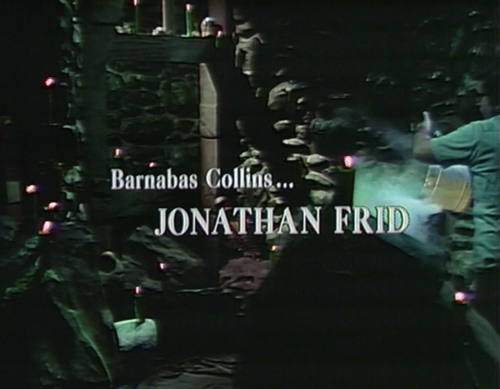
As the opening credits begin to roll, the camera is pointed a bit too far to the right and a stagehand is visible, adding dry ice to the steaming cauldron in the underground chamber.

Closing credits blooper. Screenshot by Danny Horn, Dark Shadows Every Day.

Episode 888: The place that he disappeared

The Prowler

Yesterday, we spent a lot of time watching an unidentifiable man wandering around the estate of Collinwood. We only saw him from the back; he was wearing a dark coat and hat, and had silver-gray hair. Evidently we were supposed to expect his face would mean something to us when it was finally revealed.

At the end of yesterday’s episode, permanent houseguest Julia Hoffman caught the prowler coming out of the Old House on the grounds of the estate, home of her friend, missing person Barnabas Collins. She did not recognize the man, and he refused to identify himself. We see him in today’s opening reprise. His face would not be familiar to her, but it is instantly recognizable to longtime viewers. It is that of actor Dennis Patrick, who from March to July 1967 played seagoing con man Jason McGuire. Jason blackmailed reclusive matriarch Elizabeth Collins Stoddard to the point of marriage. When Liz finally stood up to Jason, his scheme collapsed. On his way out of town, Jason went to the Old House hoping to steal jewels from Barnabas. That attempt also failed, and Barnabas strangled Jason.

We spend most of the episode wondering how Jason managed to rise from the dead. Near the end, Liz’ daughter Carolyn runs into the prowler. She gets a good look at him and talks to him for a few minutes, but does not recognize him. Carolyn would certainly recognize Jason, whom she was ready to shoot if Liz had gone through with the wedding. So Patrick must be playing another character. He does not give Carolyn his name, but his strong emotional reaction when she gives hers tells us that he has some kind of connection to her. We are again supposed to leave the episode wondering who he might be.

Unfortunately, word of that did not get to the people who make up the closing credits. Patrick is billed today as “Paul Stoddard.” Paul is Carolyn’s long-missing father, Liz’ ex-husband, and a close friend and partner in crime of the late Jason McGuire. This is not the first time on Dark Shadows the closing credits have identified a character whose identity was supposed to keep us guessing. For example, at the end of #124 we are supposed to be in suspense as to which of a few people a mysterious woman is, but the closing credits identify her as “Laura Collins,” a name which blows the secret completely for attentive longtime viewers. A mysterious little girl turns up in #255 and for a few episodes we are supposed to be in the dark as to who she is. But at her first appearance the character was billed as “Sarah Collins.”

It’s interesting to cast Patrick as Paul. Jason’s scheme was based on Liz’ belief that she had killed Paul, when in fact Paul and Jason had worked together to fake his death and swindle her of some money. Since Paul and Jason committed the two halves of the same crime, they merge together in the disastrous effects they have had on Liz’ life. So they may as well look and sound exactly alike.

Waiting for Barnabas

Barnabas vanished from his basement some time ago while he was involved with some supernatural doings. Julia has been hanging around the house for over a month, waiting for him to rematerialize. She explains to Carolyn that because he disappeared from the basement, it is the only place where he can reappear. They go into the house and Julia almost immediately suggests they leave. She is sure he isn’t there, because she locked the basement door. Evidently Julia has spent all this time waiting to hear Barnabas banging on that door demanding to be let out.

Carolyn points out that Barnabas might be unconscious, and if he is he would not be banging on the door even if he has come back. Julia exclaims “I hadn’t even thought of that! He- he could be down there now!” At this, my wife, Mrs Acilius, laughed and said “He could have been down there for a month!” By profession, Julia is a mad scientist. She knows how to cure vampirism, bring Frankenstein’s monsters to life, rewrite people’s memories at will, and travel back in time, but she has her blind spots.

Be that as it may, Julia checks the basement and finds Barnabas is not there.

The Antique Shop

Carolyn takes Julia to an antique shop that has just opened in the village of Colllinsport. Carolyn called the shop “divine” yesterday, and is still thrilled about it today. I suppose it reminds her of home- like all the unoccupied spaces in the great house of Collinwood, it is crammed with a lot of miscellaneous junk.

Carolyn may have a soft spot for the place, but she hasn’t lost all capacity for judgment. The proprietors, a young couple named Philip and Megan Todd, have just unpacked a painting they bought that morning. Philip says that when it came up for auction he couldn’t resist it. Carolyn widens her eyes, tilts her head back, and says in an incredulous voice, “Hmm, your taste must be quite different from mine, Philip. I could have resisted that.”

The painting Philip couldn’t resist.

Philip mentions that the artist’s name is Charles Delaware Tate. At that, Julia perks up. She asks Philip if he is certain that it is an authentic Tate; he assures her that he is. He astonishes her by saying that it was painted only about twenty years ago. Julia says that Tate would have been in his 80s then. Seeing that the painting is about as good as anything Tate ever did, she says that he was still at the height of his powers despite his advanced age. She wonders if, having been in such good shape so recently, he could still be alive. Philip doesn’t know about that.

Julia asks for the price. When Philip says he will part with the painting for $300, Julia takes out her checkbook. Carolyn looks on, amazed to see her shell out so much money so quickly for a mediocre picture. When it is time to go, Julia asks her if she is ready. Still agape, Carolyn replies “Yes.. for practically anything!”

For eight months, from #701 at the beginning of March to #884 last week, Dark Shadows was a costume drama set in the year 1897. In the second half of that segment, Tate was one of the minor villains. He had made a bargain with evil sorcerer Count Petofi. Petofi made him a nationally famous painter whose works were very much in demand. Many of his paintings also had magical powers. The magical powers were the result of Petofi’s spell, but it was never made entirely clear whether Tate’s fame was the result of a talent Petofi gave him to paint well or if Petofi’s intervention was more direct and he simply bewitched people into admiring Tate’s paintings and wanting to buy them. Indeed, if we had to classify the works of Tate that we saw, the most secure categorization would be “Nothing Special.” They certainly do not stand comparison to the best of the portraits that the ABC Network’s Art Department prepared for the Collinwood sets. Carolyn’s reaction today clearly suggests that once Petofi’s influence receded, the paintings lost their charm.

Julia’s interest in Tate is not aesthetic. Julia traveled back in time for a couple of weeks in September. She knows that Tate’s portrait of Quentin Collins prevented Quentin from turning into a werewolf. The prospect that Tate might still be alive leads her to hope that her friend Chris Jennings, a great-grandson of Quentin’s, might also be cured of lycanthropy.

The audience is unlikely to find much ground for optimism in the thought of more Tate. As is usual for characters played by Roger Davis, Tate is hard to watch. He delivers most of his lines in a shout, and he amplifies his voice by clenching his rectal sphincter muscles. The result is what Pauline Kael used to call an “anal screech.” He also has what we might tactfully call a poor sense of personal space; indeed, two of the tags that most often appear together on posts on this blog are “Roger Davis” and “Abusive Behavior on Camera.” So I would just as soon Julia give up her search for Tate.

The Todds

Megan and Philip exult over Julia’s purchase. They are in the middle of talking about how it is a good sign for their new business, when Megan is suddenly seized with a fit of foreboding. She wants to close the shop early; Philip protests that they still have time to make a few more sales. Megan then says she has a premonition that if they stay in Collinsport something terrible will happen to them. She says she wants to sell the shop and move away. Philip tries to soothe her. He puts his head against hers and kisses her. She just looks straight on, her eyes full of dread.

Philip working his way to Megan’s neck while it dawns on her that they are now characters on Dark Shadows.

Megan is the third role Marie Wallace played on Dark Shadows. Her first two were Eve, the Fiancée of Frankenstein, and Crazy Jenny Collins, Quentin’s estranged and deranged wife. Miss Wallace had a lot of fun with those parts, but neither of them gave her much opportunity to interact meaningfully with her scene partners. Eve was unyieldingly nasty to everyone, whatever they might say or do, and Jenny was just one long mad scene. As Megan, she gets to listen to Philip and react to what he says. That ends when she ignores his kissing her neck, but while it lasts it’s good to see.

Philip is played by Christopher Bernau. Some fans say that Bernau and Miss Wallace lacked “chemistry,” but their last shot today shows how misguided that criticism is. The key to chemistry is for one character to initiate a kiss and the other to kiss back. Megan is supposed to be too preoccupied with her premonition to notice anything in her environment, even her beloved husband kissing her. If she had responded to him at all, the whole point of the scene would have been lost.

It is true that Bernau does not perfectly embody a romantic lead in Philip’s scenes with Megan. As a happy couple, Philip and Megan constantly make little jokes with each other. The jokes in the script aren’t very good, and Bernau tries to put some life into them by imitating Jack Benny. In the 1920s and 1930s, Benny’s persona struck people as a spoiled rich kid, and in later years he was so famous that it just meant Jack Benny. But by the 1960s, any man other than Jack Benny would send a very different message if he were to speak with that drawl and walk with that mincing gait. When the man in question is an antique dealer wearing a belted sweater that looks suspiciously like a dress, it does not seem especially likely that he will passionately in love with his wife.

I think Philip borrowed this from Maggie Evans…

Several times in his career Bernau proved he could be effective in love scenes with women, most famously as ladies’ man Alan Spaulding on The Guiding Light. I mentioned that role in a comment on Danny Horn’s post about this episode on his great Dark Shadows Every Day:

I was a kid when Bernau joined GUIDING LIGHT. My mother watched that show, and I had several times attempted to watch it with her, but it always defeated me after 5 or 10 minutes. It just seemed like a window into the deepest level of Hell, the frozen cavern where absolutely nothing happens. But Bernau caught my imagination. I could watch entire episodes if he was in them.

Years later, when I watched DARK SHADOWS on the Sci-Fi Channel, I realized what made Bernau so compelling on GUIDING LIGHT. He was doing a Jonathan Frid imitation. Within moments of first seeing Barnabas, I exclaimed “Alan Spaulding!” It was only years later that I learned Bernau had been on DARK SHADOWS.

Comment left 10 December 2020 by Acilius, on Danny Horn, “Episode 888: Little Shop,” 26 June 2016, Dark Shadows Every Day.

I’m very fond of John Gielgud’s story that from the time he first saw Claude Rains give a performance, his acting style consisted of imitating Claude Rains. Gielgud went on to say that this represented a great improvement over his previous style, which consisted of imitating Noël Coward. I doubt Bernau’s style ever depended entirely on either Jack Benny or Jonathan Frid, but he certainly learned a great deal by watching each of them.

Episode 810: Not with pity

Charity Trask is in the drawing room of the great house on the estate of Collinwood trying to call the police when her abusive step-uncle, Quentin Collins, comes out of a secret panel and takes the telephone from her. He tells her that there is no longer any point in telling the police about Tessie, the injured woman upstairs. Tessie won’t be telling them anything. She has died. Apparently the sheriff of Collinsport is the same in 1897 as are his counterparts in other periods when Dark Shadows has been set- if you’re already dead, it’s too late for them to take an interest in you.

Charity says that Quentin killed Tessie. Charity knows that Quentin is a werewolf. He locks the door to the room and asks “Are you afraid to be locked in alone with a beast, a murderer, a creature of the supernatural?” This would seem to be rather an odd question, especially since he spent yesterday’s whole episode threatening to kill her.

Charity says that her father, Gregory Trask, will see to it that Quentin is brought to justice. Quentin takes a paper from his pocket and shows it to Charity. It is a confession to the murder of Charity’s mother, signed by her father. Charity claims that it was fabricated by Satan, which is what her father told her when she first saw it, and that Trask repeatedly tried to destroy it. This only convinces Quentin that the confession is true. He says that if either Charity or her father tells the police about him, he will hand over the paper. He adds “Now, Charity, I may hang for murder, but your father will be dancing at the end of a rope, too.”

Dark Shadows is set in the state of Maine, which in our universe abolished capital punishment in 1887. That used to be true in the show’s universe, as well. In #101, broadcast and set in November 1966, high-born ne’er-do-well Roger Collins told his son, strange and troubled boy David, that “They don’t hang people anymore. Not in this state, anyway.” But by the time the show left the 1960s for its first costume drama segment a year later, characters were already afraid of being sentenced to death. The morbid fascination of the gallows is so much of a piece with the show’s exaggerated melodrama that there must be a death penalty, no matter when or where the action is supposed to be taking place.

Quentin tells Charity that there is a chance- a small chance, he concedes- that he will be cured of lycanthropy before the next full Moon, so that she need not feel that she is an accessory to murder if she doesn’t turn him in right away. Miserable, frightened, and confused, she takes this seriously enough that she remains quiet at least through this episode.

We cut to a hiding place where a man known as Aristide is looking at himself in a mirror and primping his hair, moving his fingers through it with an exaggerated daintiness. We pan to broad ethnic stereotype Magda Rákóczi , who impatiently asks “Did you send for me so there would be two of us to admire you?” Aristide has some business to discuss relating to plot points not directly involved in this episode, and he and Magda trade menacing insinuations about the danger each faces from the various supernatural forces at work in the area. Magda says that what the ziganophobic Aristide calls her “Gypsy cunning” will protect her, and Aristide says that an amulet he wears around his neck will protect him.

Magda replies “All right, we’ve both got something to protect us. I go now,” and starts to leave. Aristide stops her, and says that she must recover the severed hand of Count Petofi. She says that a man named Tim Shaw stole the hand and ran off with it, and she has no way of knowing where Tim is. Aristide says she must find out and bring it soon, “before time runs out.” She asks “Before time runs out for who? You mean when Petofi comes back!” In fact, Aristide means more than that- his master, 150 year old sorcerer Count Petofi, will die in a matter of days unless he is reunited with the hand that was cut from his right arm a century before, in 1797. If he does recover the hand in time, he will become immortal. Magda fears Petofi and hates him, and would doubtless make any sacrifice to keep the hand away from him if she knew these were the stakes. So Aristide is mortified that he let slip the phrase “before time runs out,” and is anxious to avoid saying anything else.

Back at Collinwood, Quentin confers with a Mrs Fillmore. Mrs Fillmore has been looking after the twin children Quentin’s wife Jenny bore him after he left her and before he murdered her. This is the first time we have seen Mrs Fillmore. It is also the first confirmation we have had that Quentin has seen Mrs Fillmore. He didn’t know about the twins until #798, when the boy twin was already dead as the result of a curse that a woman named Julianka placed on Magda, who is Jenny’s sister. Now Mrs Fillmore tells Quentin that the girl is suffering the same symptoms the boy showed before he died, and that the doctor is at a loss what to do for her. Quentin says he will look for someone who might be able to help, and they both exit.

Charity is alone in the drawing room, making an earnest effort to get drunk. Magda enters and expresses surprise that the unbendingly prudish Charity has been drinking. Charity replies that she merely ate some chocolates that were filled with brandy. At the sight of an empty snifter, she says that after eating the chocolates she poured herself a small brandy. She then picks up and drinks another, regular-sized brandy. Charity starts talking about how terrible life at Collinwood is. Magda mentions Tim Shaw, who was once Charity’s fiancé and who was framed for her mother’s murder. Charity wonders if Magda can use the Tarot cards to find Tim and bring him back. She asks if Tim will have to tell the truth if he comes back, and Magda assures her that he will. Magda may assume that the truth Charity wants is about the end of her relationship with Tim; she does not know that Charity is desperate to revert to believing that Tim, not her father, murdered her mother.

Magda asks Charity to tell her as much as she can about Tim. Charity says that when Tim was a boy, his closest friend was named Stephen Simmons, and that “He and Stephen Simmons used to always say they would go to San Francisco when they grew up.” Magda asks where Stephen Simmons is now, and Charity says she thinks he lives in Worcester, Massachusetts. She goes to her bedroom to look for a Christmas card Stephen sent her last year, hoping it may have his current address.

Quentin returns and finds Magda. He asks Magda how she knew about his daughter. She asks what he means. When Quentin tells her that the girl is suffering the same symptoms that her brother showed immediately before his death, they rack their brains to come up with a potential defense against Julianka’s curse. Magda remembers Aristide’s amulet. It is capable of warding off vampires and witches- perhaps it will defend against Julianka as well. Magda tells Quentin where Aristide is hiding, and he decides to go to Aristide and rob him of the amulet.

Aristide is asleep when Quentin arrives. He awakens before Quentin can take the amulet, and declares “This pendant protects me from witches, warlocks, and unnatural spirits.” Quentin asks “How does it do against flesh and blood, Aristide?” Aristide draws a curvy piece of wood with no sharp edges and replies “For flesh and blood, I have The Dancing Lady.” The piece of wood is supposed to be a knife. When Aristide first displayed it in #792, he called it “The Dancing Girl.” Perhaps this is a case of Soap Opera Rapid Aging Syndrome, and in a couple of weeks it will be The Dancing Dowager, then The Dancing Crone. At any rate, Quentin replies “Then let her dance, Aristide, let her dance.” Quentin wins the subsequent fistfight. He knocks Aristide senseless, then takes the amulet from him.

Quentin and Magda go to Mrs Fillmore’s house, the first time we have seen this set. Appropriately for a member of the Collins family, the baby sleeps in a cradle shaped like a coffin.

Collins coffin cradle. Screenshot by Dark Shadows Before I Die.

Quentin talks with Mrs Fillmore about little “Lenore,” a name we have not heard before today. The only other girl of Lenore’s generation in the Collins family is the daughter of Quentin’s brother Edward, and she is named Nora. Since the name “Lenore” became popular outside Greece because speakers of English and French thought it was an alternative form of “Nora,” that would suggest rather a limited imagination regarding girl’s names on the part of whoever chose them.

But it is appropriate that Quentin and Edward have children with similar names. They are two variations on Dark Shadows’ first archvillain, Roger, whose evil largely expressed itself in his amazingly bad parenting of David. Edward’s attentive and caring interactions with Nora and her brother Jamison show that he is a less villainous Roger, while Quentin’s frequent assaults on his adult family members are among the evidence that he is an even worse version of the same character. Jamison is the only child we have seen Quentin interact with, and he is fond of him. But while we were still in the 1960s, Quentin’s ghost was possessing and killing the children at Collinwood, and in #710, only two weeks into the 1897 flashback, he and his fellow Satanist Evan Hanley used Jamison as a “sacrificial lamb” in a ritual meant to exploit his innocence for their own sinister purposes. Clearly, Quentin is no more to be trusted with the care of a child than was the early Roger.

Quentin asks Mrs Fillmore to leave him and Magda alone with Lenore. They apply the amulet, and it does not seem to work. Magda tries to raise the spirit of Julianka. After some pleadings and whatnot, there is thunder, wind, and other signs of ghostly presence. Magda cries out in hope that Julianka has come with pity. A figure materializes and says “Not with pity, Magda.” But the figure is not Julianka. It is Jenny.

In #804, we saw a photograph of Jenny in Quentin’s room. It was a full length picture in a period-appropriate costume, not just Marie Wallace’s professional headshot, raising a hope that we would see Miss Wallace again before too long. But after a week and a half, those hopes had begun to fade. Perhaps they took the picture months ago and never got around to using it when Jenny was on the show. If they had done that, they wouldn’t be above sticking in a scene of Quentin looking at the picture and discussing it with his distant cousin Barnabas the vampire so that they could get their money’s worth out of it. When Miss Wallace does in fact return, the show sends us out on a high note.

Episode 744: Sometimes he makes himself invisible

The House by the Sea

In September and October 1967, well-meaning governess Vicki and her depressing boyfriend Burke wanted to buy a long-disused property that everyone referred to as “The House by the Sea.” Collinsport is a coastal village, so many of its houses would lie by the sea, but at that point only that one was so designated on Dark Shadows. It was important that The House by the Sea lay on the other side of Collinsport from the great estate of Collinwood. When it was first introduced, matriarch Liz was eager to go there, signaling that the show was done with an old and unproductive theme presenting Liz as a recluse. And Burke was willing to live there with Vicki, whom he is determined to get away from Collinwood and the Collins family.

The house belonged to the Collinses, and the show suggested that it might be haunted in such a way that if Burke and Vicki lived there they would become possessed by the unquiet spirits of its former occupants, Caleb Collins and his wife, whom we know only by the initials “F. McA. C.” When Liz found in #335 that for legal reasons she would not be able to sell Vicki and Burke the house for a few years, the whole story vanished without a trace. We did not hear the phrase “The House by the Sea” again until #679, in January 1969.

At that point, the show was in fact running a story about ghosts taking possession of the living, a coincidence that leads me to wonder if the writers were making an inside joke about a story that was in the flimsies early in 1967, that was reflected in the talk about “The House by the Sea” that autumn, and that went nowhere. At the beginning of January 1969, strange and troubled boy David Collins was intermittently possessed by the ghost of his Aunt Liz’ great-uncle Quentin, and when Liz questioned him about some of his odd doings he made up a story about The House by the Sea to persuade her that he was just being silly.

In between those two stories, we did hear a great deal about another place called “A House by the Sea.” From #549 in August 1968 until #633/634 in November, this house was rented by suave warlock Nicholas Blair. At first it was said to be located at some distance from Collinwood, and it seemed that it might be the house Burke and Vicki had been interested in. But as we saw it, we could see that it was in quite a different architectural style. And as time went on, the house moved closer and closer to Collinwood. After a while, the opening narrations referred to it as “Another house on the same great estate.” That did not stop Big Finish Productions from conflating Vicki and Burke’s “The House by the Sea” with Nicholas’ “A House by the Sea” in their 2012 drama The House by the Sea, but the houses remained distinguishable on the show as of early 1969.

Now, Dark Shadows has become a costume drama set in the year 1897. Well-meaning time-traveler/ bloodsucking fiend Barnabas Collins has gone to that year, when Quentin was a living being, in hopes of preventing the events that made him into the all-destroying evil spirit of 1969. Barnabas does not have the slightest idea what those events were, and in the absence of that information he has decided that the best course of action is to antagonize as many people as possible.

Among the enemies Barnabas has made is the evil Rev’d Gregory Trask, head of a boarding school/ abusive cult called Worthington Hall. Another of Barnabas’ new enemies has, for reasons of her own, burned Worthington Hall to the ground. Trask has captivated the current mistress of Collinwood, spinster Judith Collins, and in #739 Judith offered Trask the use of a “small house on the estate” as a temporary base for the school until she can finance the restoration of the previous site. Today, Judith instructs a servant to take steps to prepare “the house by the sea” for this purpose.

Perhaps this means that Trask’s cruelty center will occupy the house Burke and Vicki wanted to buy. That Judith said it was “on the estate” would suggest that it is the one where Nicholas lived, and they have decided that so few people remember the dead-end storyline of autumn 1967 that they no longer need to keep the two houses distinct by calling only one of them “The House by the Sea.”

No More Knife

While Quentin was haunting Collinwood in late 1968 and early 1969, he showed himself to be a peculiarly corporeal sort of ghost. In addition to the usual ghostly business of materializing and dematerializing inside closed rooms, possessing children, and making noises resound from everywhere and nowhere all at once, he also poisoned one person, choked another, and came and went through a secret passage. Occasionally this served to show that Quentin’s power started small and grew steadily until he was irresistible, but it also left the impression that Quentin simply enjoyed feeling like he had a body. Now that we see Quentin as a living being, the impression that he revels in the flesh is frequently confirmed.

Quentin’s estranged wife Jenny has gone mad and is being kept prisoner in the great house by Quentin’s sister Judith and brother Edward, with the assistance of a couple of the servants. Quentin learned of Jenny’s continued presence at Collinwood only when she escaped and stabbed him a few weeks ago, and he still can’t figure out where in the house she is locked up. He has vowed to kill her once he does find her.

Jenny is on the loose again today. Judith has a close call in the drawing room. She finds Jenny there. Jenny menaces Judith with a knife; just as she gets Judith into a helpless position and it looks like she is about to stab her to death, Jenny picks up a candlestick and knocks Judith unconscious. Shortly after, Quentin comes in and finds Judith recovering from the blow. Judith tells him what happened. He gets a gun and goes out to hunt Jenny down.

Jenny makes her way to the Old House on the estate. She knocks on the door, and Barnabas answers. They introduce themselves to each other. His name means nothing to her; he arrived only nine weeks ago, long after she lost her marbles and was consigned to a hidden cell. No one has told her that Judith invited a distant cousin from England to stay in the Old House. But Barnabas knows exactly who Jenny is, and he listens to her every word and watches her every move with vivid interest.

Jenny announces that she has come to find Quentin. Barnabas says that Quentin is not there, and invites Jenny to search the house. As she walks through the front parlor, Jenny announces that “Sometimes he makes himself invisible.” That line will strike a chord with regular viewers who remember the ghostly Quentin of the 1960s, though Jenny is apparently thinking of a psychotic break she had earlier in the episode when she hallucinated his voice coming from various pieces of furniture in the drawing room. Nonetheless, Jenny is confident that she will know if Quentin is nearby.

Jenny talks about her “children”; Barnabas visited one of her former cells, and saw that there were dolls there. He asks twice if the children she is talking about are dolls, and each time she angrily insists that she has real live children and that they are in her room at Collinwood. She sings a lullaby in a minor key; she forgets the lyrics halfway through, and asks Barnabas if he knows them. She has a lovely voice, and he seems to be sincere when he says he is sorry that he cannot help her finish the song.

As Jenny talks about her children, it dawns on Barnabas that she may in fact have had children who were taken from her. His reaction to this is an important moment. In 1969, Barnabas learned that in 1897 a baby died and was buried in an unmarked grave on the grounds of Collinwood with an amulet meant to ward off werewolves. So far in his trip back to that year, he has found no babies and there is no werewolf. His response to Jenny’s talk of her children looks like a man making a wild surmise. If the baby in the unmarked grave was one of Jenny’s children, the werewolf must be coming very soon.

Barnabas makes the connection.

Jenny is sitting on the staircase for part of this conversation with Barnabas. Ever since Barnabas first met David in #212, he has had his most human moments while standing on the floor and talking to people on that staircase, and his talk with Jenny is an outstanding example. He talks to her very gently. Perhaps he has the presence of mind to try to befriend someone who might be useful to him, but whatever he is thinking he shows a real warmth.

Jenny tries to stab Barnabas; he takes the knife from her. She cowers in a heap on the floor, wailing that now he will kill her. He throws the knife in the fire and tells her she has nothing to fear. Of course, a metal blade could not harm a vampire, so it was easy enough for Barnabas to remain unruffled during the attack.

Barnabas vetoes Jenny’s demand to search the basement, where his coffin is, and takes her upstairs to a bedroom once occupied by his lost love Josette. In 1967, he restored that bedroom to the condition it was in when Josette lived there, and for some reason he has done the same this time. By the time they get to Josette’s room, Jenny thinks that she and Quentin are on their honeymoon and that Barnabas is a bellhop. She apologizes that she has no money to give him as a tip.

Jenny looks into the mirror and is revolted by the terrible person she sees there. Barnabas points to an assortment of lady’s toiletries and assures her that the terrible person will go away if she uses them. He locks her in the room and calls for his servant Magda.

Jenny is so crazy we can never be sure what she will make of any set of facts she encounters, and Barnabas is, for once, keeping his thoughts to himself throughout his scene with her. But however much ambiguity may be built into Barnabas and Jenny’s interactions with each other, there is no question what Marie Wallace and Jonathan Frid are doing. She is supposed to play Jenny without restraint, and she makes the most of that opportunity to be larger-than-life. He also seizes his chance to show what he can do when he has time to really learn his part. He is not only letter-perfect with his lines, but also subtle and precise in his characterization of Barnabas’ reactions and intentions. It is a fascinating performance.

Jenny hears Barnabas calling Magda’s name. She not only repeats it, but also says the name of Magda’s husband Sandor. Magda and Sandor have been in the Old House for quite some time, well before Barnabas showed up and forced them into his service, so it is no surprise that Jenny remembers them. It is interesting that she seems to have strong feelings about them, though. Before she left the great house, Jenny was talking to herself, saying that her father was “a king in India.” Sandor and Magda are Romani, and the Romani people originated in India. Their ethnicity may be what brought that part of the world to Jenny’s mind.

Magda and Sandor are out. The sun is rising. Barnabas leaves a note for Magda, and goes to his coffin for the day. Quentin enters, brandishing his pistol. He finds the note and a key, and goes upstairs. We close with him standing outside Josette’s room. He and Jenny talk to each other through the locked door. He tells her that he is coming to her and that they will never be separated again.

In a comment about Danny Horn’s post about this episode on Dark Shadows Every Day, David Pierce makes an interesting observation:

My favorite line was from Quentin to Judith when he wants to know how Jenny escaped: “What, did she leave by fasting and prayer?” He was misquoting Jesus from the New Testament, Matthew Chapter 17, verse 21 “Howbeit this kind goeth not out but by prayer and fasting.”

David Pierce, comment left at 12:01 PM Pacific time 13 January 2021 on Danny Horn, “Episode 744: Crazy Little Thing,” Dark Shadows Every Day, 9 October 2015

Quentin does paraphrase the Bible quite often, a habit which, combined with his penchant for Satanist ceremonial practice and his gleeful libertinism, suggests that he won’t pass up any potential source of delights.

Episode 743: A person of the supernatural

Rakish Quentin and time traveling vampire Barnabas have each been fighting undead blonde fire witch Laura, and today they agree to team up. This marks the beginning of their friendship, which will be central to Dark Shadows for the next 90 weeks.

The script has some problems. The dialogue between Quentin and Barnabas runs in circles, and there are scenes where, for no apparent reason, the two of them go back and forth between Barnabas’ house and the cottage where Laura is staying. But the episode is still fun. The actors deserve a lot of credit for that. David Selby and Jonathan Frid both turn in such fine performances that even the most unnecessary scenes between Quentin and Barnabas hold our interest, and Diana Millay finds ways to make Laura intriguing even when she is saddled with the disagreeable Roger Davis as her only scene partner.

There is also a happy accident with a special effect. Barnabas has called on Laura to appear in his house as a ghost; she is before him as a transparency when Quentin enters. Quentin’s presence breaks the spell, and she vanishes. In the cottage where she has been staying, a male servant whom she has bewitched is waiting for her. She reappears there; she materializes and passes out. The image of her overlaid on the picture is a little too small and a little too high in the frame, so that when she collapses she doesn’t quite reach the floor.

The result turns out to be better than it would if the effect had worked as intended. Laura’s appearance and her fainting seem to play out in a window briefly opened between one world and another.

The episode ends with Laura sending a telepathic message to Quentin’s estranged wife, madwoman Jenny. The scene plays out with Laura in voiceover while Jenny is alone in the cell where Quentin’s brother and sister have been keeping her. Laura wants Jenny to escape and kill Quentin. Again the dialogue is awkward and repetitive, but Millay and Marie Wallace save it.

Episode 721: If he stays dead now

Well-meaning time-traveler/ bloodsucking fiend Barnabas Collins enters a cottage on the grounds of the estate of Collinwood to find thuggish groundskeeper Dirk Wilkins standing over the freshly stabbed corpse of the rakish Quentin Collins. Since Quentin’s cause of death is a long-bladed thrusting dagger, a weapon also known as a “dirk,” it would seem clear that Wilkins is the culprit. But as it happens, Barnabas saw Wilkins enter the cottage a moment before, so he can be fairly sure he did not kill Quentin.

Nonetheless, Barnabas threatens to go to the police and accuse Wilkins unless he answers “a lot of questions.” Barnabas doesn’t have any witnesses to back up his version of events, and though he claims to be a relative of the ancient and esteemed Collins family he only arrived in town a few weeks before. But Wilkins isn’t hard to intimidate, so he answers some of Barnabas’ questions about madwoman Jenny Collins. Most importantly, he tells Barnabas that Jenny is the estranged wife of Quentin, not of Quentin’s brother Edward as the audience had been led to believe in the four weeks leading up to Friday’s episode.

As Wilkins, actor Roger Davis has been getting very careless with his lines. Jonathan Frid always had a lot of trouble with his own dialogue, but he is clearly sticking with the script in an exchange like this:

Wilkins: Mr. Collins, you gotta understand that she’s crazy in the head! She could hurt herself — or somebody!

Barnabas: Who do you mean by “we”?

This comes to a head with one of Dark Shadows‘ most famous bloopers:

Barnabas: Tell them that you saw no one here.
Wilkins: Oh, that’s fine. What am I gonna tell ’em?
Barnabas: That you saw no one here!

Jenny is being kept in a cell in the basement of the great house on the estate. Wilkins and maidservant Beth were assigned to watch her. On Friday Jenny bashed Wilkins on the head with her dinner tray, unfortunately not hard enough to kill him and get the odious Mr Davis off the show. She did knock him out, though, and ran off to the cottage to stab Quentin. We cut to the cell, where Jenny is babbling to Beth. It gradually dawns on Beth that Jenny is telling her she stabbed Quentin and killed him. Beth locks Jenny in the cell and rushes off to the cottage.

In the cottage, Barnabas has summoned wicked witch Angelique and asked her to bring Quentin back to life. Angelique points out some of the flaws in Barnabas’ plan, and tells him that even if she does grant his wish the price for her services will be very high. They seem to be approaching a tentative agreement when Beth arrives at the door and Angelique vanishes.

Beth finds Barnabas in the cottage. He tries to keep her out. It has long since been established that, as a vampire, Barnabas is far stronger than any mortal man, yet Beth pushes past him without apparent difficulty. For that matter, we also know that he is as capable as Angelique of vanishing into thin air, yet he hangs around while Beth sees Quentin’s body. Barnabas insists she tell no one what she saw in the cottage, and he is staring at her with the same intensity that has sometimes exerted an hypnotic effect on people. This doesn’t work on Beth. She says that she will tell Judith Collins, the mistress of the estate, that Quentin is dead and that Barnabas was with him. Barnabas just watches Beth go. Evidently he has given up on using his vampiric powers. Terry Crawford’s literal acting style doesn’t win her much enthusiasm from the fans of Dark Shadows, but it does add a touch of humor to a scene like this. Vampire? What’s that? Sounds like bullshit, I’m gonna report this to the boss.

We cut to the drawing room of the great house, where Quentin’s body is laid out in a coffin with candles burning on high stands by its head and foot. Barnabas and Beth are there. Beth tells Barnabas she has not yet spoken to Judith. Apparently she just took Quentin’s body to the great house on her own? And found a coffin? And carried it into the drawing room where she put Quentin in it? And that’s how the family is going to find out Quentin is dead, by seeing him lying in state in the middle of the house?

I have questions. Screenshot by Dark Shadows Before I Die.

Barnabas and Beth exit, and Angelique enters. She tells the corpse that she will raise him from the dead, and that once she does Barnabas will really be sorry.

Episode 717: I know what color a lie is

A showcase for the actors today. We begin in the room on top of the tower at the great house on the estate of Collinwood. Madwoman Jenny Collins, who has been locked up in that room for some time, is threatening to stab her sister-in-law Judith with a large pair of scissors. Judith and her brother Edward have been hiding Jenny and trying to keep the rest of the family in the dark about her presence in the house. For services to this secret, they have been paying maidservant Beth Chavez and, we heard in #707, someone named Mrs Fillmore. Beth comes in just in time to distract Jenny with talk about her “babies,” and thereby to prevent her from killing Judith. Jenny turns to some baby dolls, and cuddles them happily.

Judith goes downstairs and encounters newly hired governess Rachel Drummond. Rachel has caught on the someone is living in the tower room, and the other day sneaked up there and let Jenny out. Judith reprimands Rachel for seeing and hearing things that don’t exist. Rachel is a neurotic intellectual. Her insecurities compelled her to investigate the question of the tower room, and also make it plausible that she might eventually cave in to Judith’s attempt to gaslight her into believing that she didn’t really see what she saw.

Rachel goes out, and Beth enters. Judith shows how frustrated she is with the whole situation. This scene is a bit of a letdown. As Judith, Joan Bennett was brilliant opposite Marie Wallace’s Jenny, and brilliant again opposite Kathryn Leigh Scott’s Rachel. But she falls to pieces alone with Terrayne Crawford as Beth. So many of the fansites feature so much grousing about Miss Crawford’s literalist style of acting that I hate to pile on, but it is true that she did not give Bennett anything to play off of. When Miss Crawford delivers a line, its meaning is the dictionary meaning of the words that compose it, no more and no less. She never leaves you wondering what else is going on in Beth’s mind. Sharing a scene with her would be like sharing a scene with a sign labeled “No Right on Red.” Later, Miss Wallace will have a two-scene with Miss Crawford, but as a character in a psychotic state she doesn’t need support. Her lines in that scene are flowery gibberish that don’t work at all, but neither actress is to blame for that.

The master class in acting resumes as we cut to the Old House on the estate. The mysterious Barnabas Collins has recently arrived at Collinwood and is staying in the Old House as the guest of his distant cousins in the great house. Rachel and Barnabas are attracted to each other, and she tells him what has happened. He says that he believes her, and goes on to say that no one at Collinwood is what they seem. She pleasantly replies “Except for you!” He hesitates before agreeing.

More than meets the eye.

In fact, Barnabas has more than five hundred episodes of secrets he is keeping from Rachel and everyone else. Jonathan Frid’s work prior to Dark Shadows was almost entirely on stage, but he used his face like a movie actor, keeping every part of it but his eyes virtually immobile. With that, he can isolate emotions, playing just one feeling at a time. All anyone can see by looking at him in his scenes with Rachel today is that he is anguished. Rachel interprets that anguish as a sign that he cares about her, and she is delighted to think that she has such a straightforward and reliable friend.

Returning viewers know that Barnabas is in fact the most dangerous person Rachel has ever met. That knowledge on our part frees Miss Scott to play Rachel’s relief at Barnabas’ friendliness as broadly as she likes. Her unrestrained display of good cheer brightens the episode’s otherwise somber emotional palette, but the irony the audience finds in a woman having this reaction to Barnabas keeps the dramatic tension high.

Barnabas walks Rachel back to the great house. They have made a plan that she will bring him the key to the tower room and he will go up there to investigate. She impulsively kisses him on the cheek. Rachel goes in the house and finds to her surprise that Judith is still awake. Judith detains Rachel in the drawing room with a glass of sherry and a lot of disconnected talk. Judith doesn’t make eye contact with Rachel during this scene; she doesn’t want a conversation. She is simply enjoying her new position as head of the household. Rachel cannot get away until Beth enters and Judith abruptly dismisses her.

Barnabas has been watching the windows of the tower room and has seen lights go on and off. Nervous, he considers letting himself into the room without a key; he has the means to do that, but he would like to keep Rachel from knowing about his abilities, and so he resolves to wait for her.

After Rachel brings Barnabas the key, he goes to the tower room and uses it to let himself in. No one is there. He picks up the damaged, severed head of a doll, one of Jenny’s “babies.” Suddenly, he hears someone enter. He turns, and reacts with shock.

Episode 633/634: Now was the moment, or never at all

Suave warlock Nicholas has had bad news. His boss, Satan, will be recalling him to Hell, and does not plan to send him out to the world of the living again. Satan gave Nicholas two tasks to complete before his time runs out. He is to perform a Black Mass during which he will sacrifice Maggie, The Nicest Girl in Town, and afterward take her to Hell with him as his bride. He is also to complete the project he has been working on, forcing mad scientist Julia and old world gentleman Barnabas to resurrect Eve, the mate of Frankenstein’s monster Adam. Yesterday, we saw that Nicholas plans to make Barnabas and Julia use Maggie as the donor of the “life force” that will bring the mate back to life. It was entirely unclear how Maggie could both be sacrificed on Nicholas’ altar and used as the “life force.”

We open today with a reprise of yesterday’s closing sequence, showing Nicholas performing a rite while Maggie lies on his altar. We then cut to the basement of Barnabas’ house, where Eve’s body lies on a bed in a laboratory full of mad science equipment. Barnabas vows to Julia that this is the last time they will ever go through the vivification procedure; she asks “What’s the point of saying that? We’re at Nicholas’ mercy.” The other day, Barnabas confronted Nicholas with some demands, threatening to stop cooperating with his project unless he complied. Nicholas gave some ground in response, suggesting there might yet be some dramatic tension left in his relationship with Barnabas and Julia. But when Julia sounds this note of total defeat she is telling us that their conflict with Nicholas is exhausted, that the Frankenstein story has nowhere to go, and that Barnabas is therefore right and this is the last time we will see them run the experiment.

Julia looks at the body and expresses sympathy for “poor motherless Eve.” “There’s a poem about that,” she says. Indeed there is, and it is an apt reference here. Nicholas’ attachment to the ingenuous Maggie has always been jarringly out of character for him; Ralph Hodgson’s 1913 poem “Eve,” with its juxtaposition of the innocent Eve with the crafty serpent, not only tells a story that is as broadly melodramatic as any episode of Dark Shadows, but also dwells on the incongruity of Eve and the serpent, the sheer strangeness of the fact that they coexist at all. “Here was the strangest pair/ In the world anywhere.”

Yesterday we caught our first glimpse in a long time of a character who, like Maggie, was introduced in the first episode. He was Mr Wells, the innkeeper. Maggie has been with us through all of the show’s transformations, but we hadn’t seen Mr Wells since #61, when Dark Shadows was all about what went on among people while they were drinking coffee together. Seeing him again puts that 1966 show side by side with this dramatization of “The Monster Mash,” and that contrast is as jolting as anything Hodgson manages.

Visitors let themselves into the lab. First comes Nicholas. He is trying to seem cheerful. He comes down the stairs with a bounce in his step and greets Julia and Barnabas with a jokey “Why are my conspirators so reluctant?” He might be trying to evoke the same unholy jollity that we see at the end of Hodgson’s poem, “Picture the lewd delight/ Under the hill tonight/ ‘Eva!’- the toast goes round-/ ‘Eva’ again.” But the imminent prospect of his return to Hell has Nicholas in no jolly mood, and his mask of good cheer falls away the moment Barnabas complains of his untrustworthiness.

It is true that Barnabas’ complaint strikes Nicholas at a most sensitive spot. He tells him that “You seem to specialize in second chances” and gripes that he revived vampire Tom Jennings and left him to do the dirty work of ensuring Tom would never rise again. Giving second chances was the very habit for which Satan reproved Nicholas in #629 when he told him he would soon be returning to Hell. Stung by the echo of his master’s words in Barnabas’ mouth, Nicholas retorts that destroying a vampire must have been “traumatic” for Barnabas, who was until recently a vampire himself. Because of some magical business, Barnabas will revert to that condition if Adam dies, and it is Nicholas’ threat to kill Adam that has compelled him and Julia to assist in his diabolical plan. Having reminded Barnabas and Julia of the source of his power over them, Nicholas composes himself, agrees with Julia that there is no time for quarrels, and leaves the room.

A moment later, Adam enters. Adam hates Barnabas and Julia, believes that Nicholas is his friend, and looks forward to Eve’s resurrection. Barnabas tells Adam he doesn’t want him there, but Nicholas enters with the command “He stays, Mr Collins.” A third visitor follows and shocks Julia and Barnabas even more deeply. It is Maggie.

The rite on the altar dedicated Maggie to Satan, but it did not involve her death. When Julia and Barnabas see that Nicholas has brought Maggie, they declare that they will not go ahead with the procedure. But Maggie declares that she is there of her own free will. Quite calmly, she looks around the laboratory in Barnabas’ basement, and says “I’ve been here so often.” Indeed she has- in May and June of 1967, Barnabas was still a vampire, Maggie was his victim, and he kept her imprisoned in a cell here. Julia used her extraordinary hypnotic abilities to make Maggie forget her ordeal, but this line suggests that she now remembers what Barnabas did to her, and that she is, terrifyingly enough, happy about it.

When Maggie was Barnabas’ prisoner, he was trying to erase her personality and replace it with that of his lost love Josette. Later, the show took us back in time to the year 1795, where we saw Josette when she was alive and realized that she wasn’t on board with Barnabas’ plans then any more than Maggie was in 1967. But it looks like Nicholas has succeeded where Barnabas failed and remade Maggie as a companion fit for a demon. Barnabas is already miserable at being forced to toil in Satan’s cause, and now he goes nuts with jealousy.

Barnabas loudly protests that he will not be a party to the experiment. Nicholas silences him by causing Adam’s heart to beat dangerously fast. Their magic bond gives Adam and Barnabas the connection Alexandre Dumas’ Corsican Brothers had, so that Barnabas also suffers the pain. Julia was originally introduced as Maggie’s doctor, but she long ago betrayed her patient for Barnabas’ sake. She pleads with Maggie to stop Nicholas, but Maggie just smiles and asks “Why should I?” Julia tells her that otherwise Nicholas will kill both Adam and Barnabas. Perfectly relaxed, Maggie responds “Then you stop him. Do what he wants.” Julia capitulates, saying “We’ll use her.”

This glimpse of Evil Maggie is breathtaking for longtime viewers. In #1, Maggie premiered as a wisecracking waitress who was, in the words of the original series bible, “everybody’s pal and nobody’s friend.” Soon, we saw her with her father Sam, the town drunk, and she emerged very clearly as a classic Adult Child of an Alcoholic (ACoA.) In #20, Maggie left behind the short blonde wig she had worn in her first appearances, and from then on she was The Nicest Girl in Town.

When Barnabas first bit Maggie, she went through the phases the vampire’s victim usually experiences, including snappishness towards her loved ones when they try to get between her and the ghoul on whom she is becoming dependent. During her time in Barnabas’ house, her level-headedness and warm-heartedness reasserted themselves, and even when she was in the mental hospital as a psychological wreck after escaping from him she was never far from a display of kindliness. In the eighteenth century flashback, Kathryn Leigh Scott took on the part of Josette. Josette was so unfailingly virtuous that not even Miss Scott could find a way to make her interesting. This brief moment of a Maggie utterly indifferent to the value of human life, even her own, is such an extreme departure that we can immediately see a world of possibilities opening up for her as a character and for Miss Scott as a performer.

Maggie is strapped to a table and Julia and Barnabas get to work. We have seen the procedure often enough that it is far from fresh, but in-universe it is still highly experimental. The equipment doesn’t work as Julia and Barnabas expected; gauges indicate higher readings than they want, and the adjustments that are supposed to bring them down just make them go even higher.

Maggie cries out that she is dying; Eve barely moves. The readings get even worse; Barnabas shuts the apparatus down. Nicholas tries to cast a spell to immobilize Barnabas; he struggles against Nicholas’ power at first, but still smashes the equipment, and soon is free of the spell altogether. Nicholas calls out to his master and pleads “Don’t desert me now!” His powers gone, he runs to Adam and starts trying to choke him, but Adam brushes him aside easily. Nicholas runs away; Barnabas runs after him, saying that he will take the opportunity to kill Nicholas.

Adam is shocked that Nicholas attacked him. He and Julia find that nothing is left of Eve’s body but a skeleton with a wig. Adam sobs, declaring that now he has no one. Adam decides that Barnabas is to blame for Eve’s destruction. He goes upstairs, tells himself that Barnabas “doesn’t deserve to love,” then leaves the house. Later, we see him in the great house of Collinwood. Regular viewers know that Adam has in the past thought of punishing Barnabas by murdering well-meaning governess Vicki, in whom Barnabas does not actually take much interest but whom he frequently claims to love. So we can expect that Friday’s episode will involve some apparent danger to Vicki.

Julia is too busy with Maggie to take any notice of Adam’s doings. The last time Julia ran the experiment, the “life force” donor died. Julia is frightened when she cannot get Maggie to respond to any stimulus. She gives her a shot, and Maggie opens her eyes.

Longtime viewers wonder what Maggie will be like now. If Satan has lost interest in Nicholas, it seems unlikely that the heartless Maggie of a moment ago will stick around. If she returns to her usual sensibilities with her memories of Barnabas’ crimes restored, the show will no longer be able to use the sets representing the houses at Collinwood since Dark Shadows will become a prison drama about the activities of Barnabas and Julia on their respective cell blocks. If she just snaps back to the way she was before she got involved with Nicholas, it will feel like a cheat.

What they actually choose to do is to give Maggie total amnesia. She does not recognize her own name or Nicholas’, refuses to believe she has ever met Julia, and has no idea where she is. Julia tries desperately to reactivate Maggie’s memory. She takes her up to Barnabas’ living room. In a moment longtime viewers will find impossible to believe, Julia takes a music box and plays it for Maggie. She tells her that it once belonged to Josette and that Maggie has heard it many times. Indeed she has- Barnabas forced her to listen to it incessantly during the weeks when he was trying to Josettify her. Julia, who has gone to such great lengths to bury Maggie’s memory of what Barnabas did to her, is now trying to dislodge her recollection of his very worst crimes. When Maggie does not remember the music box, Julia takes her up to Josette’s bedroom, where Barnabas kept her for much of her time as his prisoner. It is simply impossible to imagine what Julia could be thinking at this point.

Meanwhile, Barnabas is skulking in the foliage near the peak of Widow’s Hill. He is eavesdropping on Nicholas, who is pleading with Satan to give him another week to get the Frankenstein project back on track. He dissolves into a process shot depicting flames, and Barnabas smiles the most evil grin anyone has ever managed.

Mr Warmth. Screenshot by Dark Shadows Before I Die.

Even though poor motherless Eve is on screen for only a minute or two, doesn’t open her eyes, has no lines, and moves only a couple of fingers and those just barely, they brought Marie Wallace back to play her. That was $333 well spent. Miss Wallace’s presence on screen convinces us that Eve is really dead and that she will not be back. Combined with Maggie’s amnesia, that leaves Nicholas without any connection to an unresolved storyline. The only former underling of his still at large is witch-turned-vampire Angelique, and she had broken from him decisively a couple of weeks ago. When he vanishes, we can accept it as a line drawn under the part of the show in which he was the principal villain.

Eve’s decomposition and Nicholas’ damnation are not the only departures today. This was the final episode directed by John Walter Sullivan. As “Jack Sullivan,” he was credited as an associate director on a great many episodes, from #15 to #549. When John Sedwick left the show in the summer of 1968, Sullivan took over his share of the directing duties, alternating with Lela Swift. He directed a dozen episodes as “Jack Sullivan,” from #504 to #580. He then took the name “Sean Dhu Sullivan,” and directed 50 more. Sullivan was not as accomplished a visual artist as either Swift or Sedwick, and the camera operators had more trouble keeping his episodes in focus than they did either Swift’s or Sedwick’s. But his scenes were never any more confusing than you would have expected, considering the ridiculously convoluted stories the scripts gave him to work with, and he seems to have been as good a director of actors as either of them. The period when he was helming segments happened to be the one when the show had its most explicitly Christian elements, which you might say made him a Sean Dhu for the Goyim,* but I doubt he had anything to do with that.

*This is my only chance to make this joke, please just let me have it.

Episode 622: A position to help each other

Well-meaning governess Vicki is on the terrace of the great estate of Collinwood. A man known variously as Peter and Jeff keeps clutching at Vicki’s arms so sharply that her biceps pulse, then holds her with one hand and paws her with the other as she stands rigidly still. First time viewers, knowing only that Dark Shadows features stories of monsters and crime, would think that the man had some power over the woman and that they were seeing him abuse that power. They would be right. Unfortunately, the man and woman are not Peter/ Jeff and Vicki, but actors Roger Davis and Alexandra Moltke Isles. Vicki is supposed to be in love with Peter/ Jeff and reluctant to part from him, but the instant she has spoken her last line she turns her face from him and runs away, without the slightest attempt to suggest that she wants to linger.

Roger Davis has his fun.

After Vicki escapes from Peter/ Jeff’s repellent attentions, a woman named Eve emerges from the bushes. Peter/ Jeff is angry with her. He grabs her roughly and throws her out of the frame. Peter/ Jeff then stalks off. Eve comes back into the frame. It’s a relief to see her upright and well-put-together- Mr Davis shoved Marie Wallace so hard she had to struggle to right herself as she spun out of view. It looked like she might have slammed her head against the floor.

Marie Wallace using her arm to regain her balance and keep from sustaining a serious injury.

In a comment on Danny Horn’s post about this episode on his blog Dark Shadows Every Day, Marc Masse reports what happened when this scene came up at a panel discussion at a Dark Shadows convention many years later:

This was the episode where Grabby Davis got so overly excited in his scene with Marie Wallace on the terrace that he grabbed her by the arms and threw her completely out of frame. You see her struggling to remain on her feet as she stumbles off to the right. Some 20 years later at a fan convention (it’s in Dark Shadows 25th Anniversary Special from the disc set that has the last episode of the series), Marie Wallace brought this up as Roger Davis was telling the audience of how they (or rather he) would cut up and laugh and have fun while they were making the episode, and of how they would just laugh off their flubs. Wallace then broke in to remind Davis of episode 622 as she recalled, “Hey, Roger? I didn’t laugh when you threw me out of frame in that scene, on camera. Remember that? Several times?” She explained to the audience how all during dress rehearsal he’d never touch her and then when he’d done it on camera he’d come up to her and apologize profusely, but Wallace told him then and there at the convention that she never believed him.

Marc Masse, as “Prisoner of the Night,” in a comment left 8 April 2015 on “Episode 622: Heated Conversations on Somebody Else’s Lawn,” Danny Horn, Dark Shadows Every Day, 8 April 2015.

In a response to another post of Danny’s, Marc added that in the same video you can see actress Donna Wandrey’s appalled reaction to Mr Davis’ statement, and her increasingly visible disdain for him as Miss Wallace makes her case against him.

After Peter/ Jeff is gone, another visitor comes and addresses Eve by name. She is Angelique. Angelique is not a Roger Davis character, she is merely a vampire, so everyone can relax.

Regular viewers have been wondering what would happen when Angelique shared a scene with Eve. Marie Wallace’s style as Eve relies on many of the same techniques Lara Parker uses as Angelique. Both use an elevated style with many catches of breath, changes of volume in mid-sentence, and striking of oratorical poses. Each was capable of making this exaggerated method work, but no one could conceal its profound silliness, and a scene consisting of two characters both using it would be too ridiculous even to make a good joke in a cartoon. What actually happens is that Parker demonstrates the quietest possible version of the style, while Miss Wallace shows a more typically brassy version. Recognizing their approaches as two poles of the same axis, we are not only interested in their encounter, but also in what they show us about the craft of acting.

Angelique persuades Eve to join her in an alliance against warlock Nicholas. This might be an exciting development. Nicholas is the show’s chief villain at the moment, and between them Angelique and Eve just might be able to bring him down. It is also the first alliance we have seen take shape in a long time. Many characters have tried to control other characters, to deceive them, to imprison them, to enslave them, to brain-wash them. But the only group working towards a common end is made up of old world gentleman Barnabas, mad scientist Julia, occult expert Stokes, and servant Willie. That team formed long ago, has not managed to get anywhere lately, and is, at the moment, immobilized by Barnabas’ absence. Yesterday Julia tried to form an alliance with Nicholas against Angelique, but at the last minute his inability to talk with her forthrightly aborted that effort. So it is refreshing to see that the show is still capable of imagining a new alliance.

Danny’s post about this one is one of his very best, a composition in free verse weaving together quotes from the dialogue with retellings of the overarching narrative with meditations on a number of topics that the episode touches on. If you are a Dark Shadows fan and haven’t read Dark Shadows Every Day, this is a fine post to start with. It’s like a song- you may not understand all the lyrics the first time you hear it, but the sound of it will carry you along.

The comments below it include some great stuff too. I’ve already mentioned Marc Masse’s remark about Marie Wallace’s confrontation with Roger Davis. There are also two fanfic ideas about how the show might have resolved the question of who Vicki’s parents were. Someone posting under the name “William” had this plausible one:

My own theory: Victoria the daughter of Jamison Collins and Betty Hanscomb. So she’s Roger and Liz’s half-sister. Liz knows and Roger doesn’t.

Jamison aggressively seduces Betty, on whom Roger had teenage crush. He makes her pregnant and then coldly casts her out. A pregnant Betty shows up at Collinwood and tells Liz and Roger about what happened.

Roger confronts his father in a fit of rage in the Tower Room during one of Collinwood’s famous storms.

Jamison Collins has a heart attack during the confrontation, and Roger leaves him in the room to die. Roger staggers out, and Liz finds her father dead.

Roger has a complete breakdown and is sent to Windcliff, where Dr. Julius Hoffman, uncle of Julia Hoffman, wipes out his memory of that night in the summer of 1946.

Liz, with the help of new guy in town Paul Stoddard, pays off Betty Hanscomb to leave town and arranges for her half-sister to be raised at the foundling home in New York. Grateful to Paul for his help, Liz starts to fall for his charms …

(And this is why Liz is so fond of Victoria, but not like she is with Carolyn. And this is why she refuses to tell Roger anything about why she brought Victoria back).

–“William,” in a comment left 22 August 2016 on “Episode 622: Heated Conversations on Somebody Else’s Lawn,” Danny Horn, Dark Shadows Every Day, 8 April 2015.

That has a lot of potential. Liz doesn’t seem ever to have loved Paul, she did marry him shortly after her father’s death, and Roger’s attitude towards Vicki in the first months of the show was a strange mixture of extreme hostility and obvious attraction. “William’s” story would account for all of those things. But it doesn’t hold a pale blue candle to this theory posted by Pedro Cabezuelo:

Everybody, we’re missing the obvious! Vicki IS Betty Hanscombe!!!!! Somehow she managed to time travel AGAIN and ended up in Collinsport circa the 1940s and adopted the Betty Hanscombe identity, working her way as a servant at Collinwood. She had an affair with Paul Stoddard, gave birth to herself (at which point the adult Vicki ceased to exist) and THAT’S what caused all the irreperable harm to the time stream/parallel time/anything else you want to blame on Vicki.

Pedro Cabezuelo, in a comment left 10 April 2015 on “Episode 622: Heated Conversations on Somebody Else’s Lawn, Danny Horn, Dark Shadows Every Day, 8 April 2015.

I have my own fanfic idea about Vicki’s origin. I’ve shared it here before, and will again. But Pedro’s is so good I want it to be the last word today.