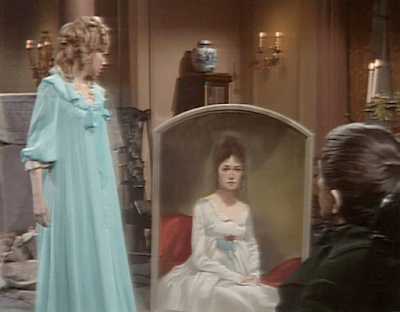
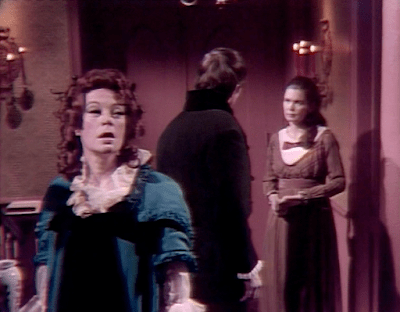
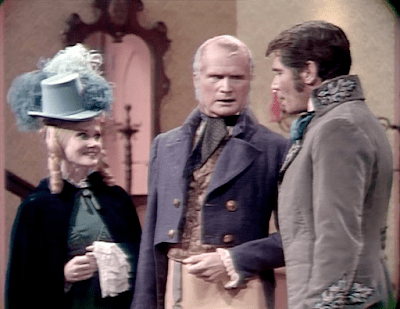
Undead blonde fire witches Laura and Angelique are trying to destroy each other, using Laura’s son Jamison and Jamison’s uncle Quentin as their cat’s paws. At the beginning of the episode, it looks like the spell Angelique and Quentin are casting is about to incinerate Laura; at the end, it looks like the spell Laura is casting is incinerating Angelique. In between, Quentin’s sister Judith notices that something is wrong with Jamison, and suspects that whatever Quentin and Angelique are up to is the cause.
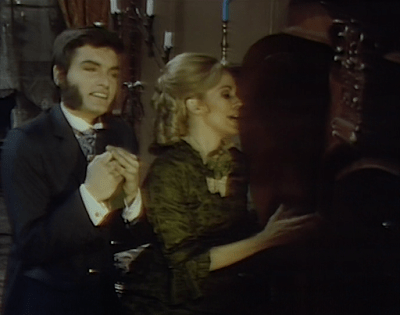
Quentin and Laura get all religioused-up asking the gods of ancient Egypt to help them against Laura. Screenshot by Dark Shadows Before I Die.
Laura is just about out of story, so we can see that she will be leaving the show soon. She has important relationships to all the characters on the show right now, so her departure will kick this segment of Dark Shadows, a costume drama set in the year 1897, into a new phase. Today’s episode is too deeply involved with the back and forth in the battle of the witches to give much indication as to what that next phase will be, but Judith’s perceptiveness suggests that whatever it is will keep up the rapid pace set in the first twelve weeks of the flashback, unencumbered by characters who slow things down by refusing to face facts.
Longtime viewers will be intrigued by variations on some familiar themes. Angelique orders Quentin to bring her a mirror and then leave the Old House on the great estate of Collinwood. Obviously she is going to use it to cast a spell that will protect her from Laura, but she refuses to tell Quentin the particulars. We know well how powerful reflections are in the universe of Dark Shadows; Wallace McBride of the Collinsport Historical Society made some very penetrating observations about how that motif was already in place in episode #1 in his 18 April 2020 post on that treasured, but now only intermittently available, site.
Later, Laura is in the drawing room at the great house on the estate about to tell Judith the secret of the mysterious Barnabas Collins, but Angelique enters, makes googly eyes at Laura, and thereby robs her of the power to speak. When the show had its first séance in #170 and #171, it was held in this room and another iteration of Laura was in attendance. It was that Laura who looked at the medium with bulging eyes when she began to speak, and that medium struggled to speak just as Laura does now. So today we see the tables turned on Laura.
Quentin and Angelique are alone for a moment in the foyer of the great house. He backs her against the portrait of Barnabas that hangs there and asks why she prefers Barnabas to him. That is a question that will have occurred to the audience. The two of them look great together and have a lot of fun together, while Barnabas hates Angelique. All she does is kill his family and friends to punish him for refusing to love her. She brushes Quentin off and orders him to go back to the Old House.
In the final scene, Quentin returns to the Old House and is baffled to find that Angelique not only got there before him, but that she has had time to play a long game of solitaire since returning from the great house. She dismisses his questions and tells him that she wants him to be with her when “it happens.” Before he can find the words to ask what she is expecting, she bursts into flames.
It seems that Angelique is in two places at once. More precisely, it seems that there are two of her, one that Quentin left in the great house, and another who was in the Old House all along waiting to be incinerated by Laura’s spells. Presumably the one in the Old House is a Doppelgänger that Angelique used the mirror to create. Nowadays, the idea of a home-made Doppelgänger fabricated to serve a specific purpose will remind many people of the 2017 season of Twin Peaks, with its concept of a “tulpa.” The Buddhist concept of the tulpa was indeed in circulation in the USA in the 1960s; Annie Besant had introduced it to the Theosophist movement, which had many followers in the Midwest, where writer Sam Hall was born. But Besant and her fans seem to have used the word in a sense closer to its original, in which people attaining Buddha-hood have the power to send copies of themselves back into the world to teach others pursuing enlightenment. Later heirs of Theosophy have tried to develop a non-Buddhist meaning for the word tulpa, but using it to refer to a lookalike that some practitioner of black magic can whip up to do a job appears to be the intellectual property of Lynch/ Frost Productions.
Be that as it may, we have seen ever since Laura was first on the show from December 1966 to March 1967 that each of the supernatural beings on Dark Shadows is a complex of related but independent phenomena, some of which may work at cross-purposes with each other. Angelique in particular seems to create another version of herself and send it out into the world each time she casts a spell. Since others of Angelique’s creatures have gone on to defy her, even trying to kill her, it must have come as a relief to know that this time the Doppelgänger would be going up in flames by nightfall.
Yesterday, we were in the great house on the estate of Collinwood when dying nonagenarian Edith Collins met mysterious newcomer Barnabas Collins. She told Barnabas that she recognized him. Edith had been entrusted with the Collins family’s darkest secret, which was about Barnabas. He is a vampire, entombed in the 1790s to be kept forever away from the living. Now it is 1897, and Edith sees that the family has failed. She must tell the secret to her eldest grandchild, Edward Collins. Edward comes into the room and Edith tries to tell him what has happened. She has difficulty speaking. Edward asks Barnabas to excuse them. He replies “Of course,” and leaves the room. He does stand at the door and listen to their conversation, apparently waiting to see if Edward will come out with a crucifix and a sharpened stake.
Today, we find that Edith was so shocked by the sight of Barnabas that she has lost her sense of her surroundings. Barnabas was kept in a chained coffin in an old family mausoleum, and Edith does manage to say the word “mausoleum” to Edward, but that’s as far as she gets with the secret. Thereafter, she weaves in and out of the moment, reliving several periods of her life, some as far back as the time of her wedding to Edward’s grandfather.
At the word “mausoleum,” Barnabas rushes back to the Old House on the estate, where he has been staying. He tells his unwilling servant, a woman named Magda Rákóczi, that she must fetch her husband Sandor and that she and Sandor must go to the mausoleum at once, take the coffin out of the secret chamber where it is hidden, leave no trace of any kind in the chamber, and carry the coffin to the house. Magda points out one of several facts that make it impossible to comply with these orders, which is that Sandor is in town where Barnabas sent him. Barnabas refuses to acknowledge this or any other insuperable difficulties, and goes back to the great house.
While Barnabas is sitting in the drawing room clenching his fists on the armchair where he is waiting to see what Edward will do when he learns that he is a vampire, a hidden panel opens and a man carries a pistol into the room. The man holds the pistol at Barnabas’ head and demands he tells him who he really is. The man identifies himself as Carl Collins, one of Edward’s brothers. Barnabas yields nothing. The man discharges the pistol, from which emerges a flag labeled “Fib.” He laughs. Barnabas is not amused. The audience may not share Carl’s sense of humor either, but the subsequent scene in which Carl claims to see that Barnabas has a kind face, predicts that the two of them will become close friends, and offers to let him borrow the pistol and play jokes with it himself, is hilarious. Jonathan Frid plays Barnabas’ icy reaction to Carl perfectly, and as Carl John Karlen does not betray the least glimmer of awareness of Barnabas’ affect.
Carl goes to the Old House to call on Magda. The scene there begins with Magda showing her palm to Carl. He wants her to read the Tarot cards; she says the cards will not speak unless she has money in her hand. Like his siblings, Carl is convinced that the secret which Edith keeps and which she has vowed to disclose only to Edward is the key to control of the family fortune. Magda knows better, but she goes through the cards anyway. They tell her that the family’s fortune is even larger than anyone knows, that when Edith’s will is found it will come as a surprise to everyone, that the surprise will lead to murder, and that the person who inherits the money will not keep it. The Queen of Cups turns up in a position that indicates Edith is still in control, but the last card Magda draws leads her to gasp and stand. She reels about the room, and declares that Edith is dead. “The cards are silent.”
Back in the house, Edward lets Barnabas into Edith’s room. He closes his grandmother’s eyes, and tells Barnabas that she did not tell him the secret. He vows to learn the secret even “if it’s the last thing I do!” We cut to Barnabas, looking uncomfortable. No doubt he is thinking of how inconvenient it would be if Edward were to find out the secret and he had to see to it that it was indeed the last thing he ever did.
This is the sixth consecutive installment to which I have given the “Genuinely Good Episode” tag, a record so far. Like the preceding five, it is stuffed with wonderful things. The acting is all very very good. Isabella Hoopes does a marvelous job as the delirious Edith, as Edward Louis Edmonds gives a master class in how to play a stuffy man, and the pairings of Grayson Hall, John Karlen, and Jonathan Frid with each other all unfold brilliantly, full of laughs but never losing their dramatic tension. So many of the episodes fans most enjoy would be drab for people coming to the show for the first time that it is always a memorable occasion when we see one like this, that anyone should be able to recognize as an outstanding half hour of television. It’s true the visual side lets us down a little; even by the standards of 1960s daytime television, the color is murky and there are too many closeups. But Sam Hall’s script and the performances are so good that no fair-minded person will complain very much about those problems.
Fans will take a special interest in Edith’s ramblings. When it first aired, viewers had no way of knowing how much of what she says about the family’s history will be reflected in upcoming episodes. The writers themselves probably didn’t have a much clearer idea about that than we do. But watching the series through for the first time, our default assumption about each of her lines is that it will have some significance as we go, so if we are committed to watching the show we listen closely.
We’ve already learned that Edith is over 90, so the very latest she could have been born is 1807. More likely she was born a bit before that, sometime between 1801 and 1806. She says today that her father-in-law was Daniel Collins. From November 1967 to March 1968, Dark Shadows was set in the late 1790s, and we saw Daniel. He was about 11 in 1795, so he would have been born in 1784 or thereabouts. So he could have been no more than 23 years old when Edith was born. Presumably his son Gabriel was the same age as his bride, though he might have been significantly younger. Edith does say that she always hated Daniel; perhaps she was a good deal older than Gabriel, and Daniel disapproved of her initially for that reason.
Edith tells us that Gabriel has been dead for 34 years, placing his death date in late 1862 or early 1863. She does not mention his cause of death or say anything about their son who was the father of Edward, Carl, and the others. It is firmly fixed that Edward and Carl’s brother Quentin was born in 1870, so Gabriel’s son must have survived him by several years.*
Edith says several times that the secret has been passed down from generation to generation and that she must tell it to Edward because he is the oldest. That seems to imply that Daniel told his oldest child, whom we presume to have been Gabriel, and that Gabriel told his oldest child, whom we presume to have been the unnamed father of Edith’s four grandchildren. He would then have told Edith before he died, either because Edward was not yet old enough to hear it, or because he was not available at the time.
But that implication is not at all secure. Edith says that Edward must be the keeper of the secret because he is the oldest- she doesn’t say what the connection is between being the oldest and keeping the secret. For all we know, she could have decided on her own to invent that tradition, starting with Edward and continuing with Edward’s oldest child. And when she says that it was passed down from generation to generation, she does not specify how many generations have been involved or which member of each generation did the passing. All we know is that someone of one generation learned it from someone else of a different generation, and that Edith believes it is the family’s responsibility to keep Barnabas from preying upon the living.
I think it’s reasonable to assume that sometime between 1897 and 1967 the secret was lost and not continually passed down. Perhaps in the original timeline Quentin was successful in killing Edith before Edward arrived, or maybe Edward died later in life before he was able to pass it on.
As far as Joshua passing the secret on, maybe he did, or maybe it was the elderly Ben Stokes who started the tradition?
Joshua was Barnabas’ father, and Ben Stokes was a much-put-upon indentured servant who was Barnabas’ devoted friend. They were the two people who knew that Barnabas was a vampire and that he was entombed in the secret chamber of the mausoleum. I replied to “Mike”:
I love that idea. Edith’s desire to tell the oldest son may lead us to assume that it has been handed down to the oldest son generation after generation, and it does lead the “Fab Four”** to assume that it brings with it some kind of power and access to riches. But their assumption is wrong, and ours may also be. Perhaps Joshua never told anyone. Perhaps the first person to tell the secret was Ben Stokes, and the person he told was Edith.
The scene between Barnabas and Magda brought another question to my mind. In #334, Barnabas was able to lock the panel in the mausoleum that leads to the secret room. Why doesn’t he just do that? It has also been made clear that as a vampire he is far stronger than are humans- if he wants to move the coffin from the mausoleum to the Old House, surely he could pick it up himself and do it more quickly and with less risk of detection than could Magda and Sandor. My wife, Mrs Acilius, agrees that we don’t know why Barnabas doesn’t lock the panel, but she says that it is perfectly clear why he can’t move the coffin- that is manual labor, and he is an aristocrat. His servants must do that.
*In a later episode, Quentin will mention that he knew Gabriel, throwing the 1862/3 date into question. But they never get around to any stories that depend on anything that happened in Gabriel’s later years. By the time we get to that one, only obsessive fans will remember his name. Eventually we meet two characters named Gabriel Collins, one in episodes that will air in 1970 and the other in the 1971 film Night of Dark Shadows, but a death date in the 1860s is not relevant to anything we learn about either of them.
**The “Fab Four” are Edith’s grandchildren, Edward, Carl, Quentin, and their sister Judith.
We begin the part of Dark Shadows set in the year 1897 with an episode featuring a glittering script, a strong cast, and a hopeless director. Henry Kaplan’s visual style consisted of little more than one closeup after another. The first real scene in the episode introduces us to Sandor and Magda Rákóczi, a Romani couple who live in the Old House on the estate of Collinwood. They bicker while Sandor throws knives at the wall. Thayer David really is throwing knives, but since we cut between closeups of the targets and of the actors we cannot see anything dynamic in that action. He may as well be whittling.
Magda ridicules Sandor’s pretensions as a knife-thrower and as a patent medicine salesman, and busies herself with a crystal ball. She tells him that when “the old lady” dies, they will have to leave Collinwood. He says he knows all about that. She wants him to steal the Collins family jewels so that they can leave with great riches. He eventually caves in and sets out for the great house on the estate, more to escape her nagging than out of greed.
Regular viewers will remember that we heard Magda’s name in December 1968. The show had introduced two storylines, one about the malevolent ghost of Quentin Collins and the other about werewolf Chris Jennings, and the characters were starting to notice the strange goings-on that Quentin and Chris generated. The adults in the great house had no idea that Quentin was haunting them or that Chris was a werewolf, so they held a séance in #642. Speaking through heiress Carolyn Collins Stoddard, Magda mentioned “My curse!” and said that “He must not come back!” It was clear in the context of the episode that the “He” who “must not come back” was Quentin. Chris was a participant in the séance, and he broke the circle before Magda could explain what she meant by her “curse.” Séances held in #170 and #281 were cut short by the person whose secret the medium was about to expose; that it is Chris who interrupts this one would suggest to longtime viewers that Magda not only knew Quentin, but that the curse she is about to explain was the one that made Chris a werewolf. Carolyn and her uncle Roger Collins talked a little about Magda in #643, and psychic investigator Janet Findley sensed the ghostly presence of a woman whose name started with an “M” in #648. We haven’t heard about Magda since.
As the living Magda, Grayson Hall manages rather a more natural accent than Nancy Barrett had when channeling her concerns about “my currrrrssssse.” The exaggerated costumes Hall and Thayer David wear make sense when we hear them reminiscing about the old days, when they made their livings as stage Gypsies with a knife-throwing act, Tarot card readings, and a magic elixir. Even the fact that Magda is peering into a crystal ball during this scene is understandable when they make it clear that they are staying in the Old House as guests of the mistress of the great house, an old, dying lady who enjoys their broadly stereotypical antics. But there is no way to reconcile twenty-first century sensibilities to Hall and David’s brownface makeup. Some time later, Hall would claim that one of her grandmothers was Romani. If that was a lie, it is telling that only someone as phenomenally sophisticated as Hall could in the 1970s see that she would need to invent a story to excuse playing such a character.
Objectionable as Sandor and Magda are, their dialogue is so well-written and so well delivered that we want to like them. Moreover, the year 1897 points to another reason fans of Dark Shadows might be happy enough to see Romani or Sinti characters that they will overlook the racist aspects of their portrayal. It was in 1897 that Bram Stoker’s Dracula was published, and it depicted the evil Count as surrounded by “Gypsy” thralls. The character who has brought us on this journey into the past is Barnabas Collins, and upon his arrival he found that he was once more a vampire.
In addition to the strengths of the dialogue, the acting, and the intertext, there is also a weakness in this episode that softens the blow of the brownface. Today the picture is so muddy that it is possible to overlook the makeup. That’s Kaplan’s fault. It would often be the case that one or the other of the cameras wasn’t up to standard, but when the director was a visual artist as capable as Lela Swift or John Sedwick, there would always be at least some shots in a scene using the good camera, and others where the lighting would alleviate some of the consequences of the technical difficulties. But Kaplan doesn’t seem to have cared at all. He had made up his mind to use a particular camera to shoot the Old House parlor with a subdued lighting scheme, and if that camera was not picking up the full range of color, too bad. He’d photograph a lot of sludge and call it a day.
Meanwhile, a man knocks on the door of the great house. He is Quentin, and the person who opens the door is Beth Chavez. We first saw these two as ghosts in #646. Beth spoke some lines during the “Haunting of Collinwood” story, but Quentin’s voice was heard only in his menacing laugh.
We already know Quentin as the evil spirit who drove everyone from the house and is killing strange and troubled boy David Collins in February of 1969. His behavior in this scene is no less abominable than we might there by have come to expect. He pushes past Beth to force his way into the foyer, does not bother to deny that he has come back to persuade his dying grandmother to leave him her money, pretends to have forgotten someone named “Jenny,” makes Beth feel uncomfortable by saying that her association with Jenny makes her position in the house precarious, orders Beth to carry his bags, twists her arm, and leeringly tells her that she would be much happier if she would just submit to his charms. David Selby sells the scene, and we believe that Quentin is a villain who must be stopped. But Mr Selby himself is so charming, and the dialogue in which he makes his unforgivable declarations is so witty, that we don’t want him to go away. He establishes himself at once as The Man You Love to Hate.
In an upstairs bedroom, the aged Edith Collins is looking at Tarot cards. Quentin makes his way to her; she expresses her vigorous disapproval of him. She says that “When Jamison brought me the letter, I said to myself ‘He is the same. Quentin is using the child to get back.'” Quentin replies “But you let me come back.” She says that she did, and admits that he makes her feel young. With that, Edith identifies herself with the audience’s point of view.
The reference to Jamison and a letter reminds regular viewers of #643, when Magda’s ghost caused a letter from Quentin to fall into Roger’s hands. It was addressed to Roger’s father, Jamison, and was written in 1887. It read “Dear Jamison, You must return to Collinwood. I need your help. You must intercede with Oscar. Only you can save me.” They’ve revised the flimsies quite a bit since then; now it is 1897, Jamison is 12, and we don’t hear about anyone named Oscar.
Not about any character named Oscar, anyway. Edith tells Quentin that “Men who live as you do will not age well.” Quentin tells Edith that she ought not to believe in the Tarot, because “This card always has the same picture and people change, even I.” On Dark Shadows, which from its beginning has taken place on sets dominated by portraits, these two lines might make us wonder what it would be like if it were portraits that changed while their subjects remained the same. Oscar Wilde’s Picture of Dorian Gray was published in serial form in 1890 and as a novel in 1891, and it was a sensation on both sides of the Atlantic. The dialogue is so witty that the characters must be well-read, making it quite plausible that Quentin’s remark was meant to remind Edith of the book. Especially so, since Wilde was released from prison in 1897, bringing him back to public notice in that year.
Edith tells Quentin that old and sick as she may be, she can still out-think him. She declares that all of her grandchildren will get what they deserve. All, that is, except Edward. Roger mentioned Edward in #697, naming him as his grandfather and Jamison’s father. Edith says that Edward is the eldest, and therefore she must tell him “the secret.” There is a note of horror in her voice as she says this; Quentin misses that note, and reflexively urges her to tell him the secret. She only shakes her head- the secret isn’t a prize to contend for, it is a burden to lament.
Isabella Hoopes plays this scene lying on her side in bed, a challenging position for any performer. Her delivery is a bit stilted at the beginning, but after she makes eye contact with David Selby she warms up and becomes very natural. I wonder if the initial awkwardness had to do with Kaplan. He held a conductor’s baton while directing, and he used to poke actresses with it. I can’t imagine a person in bed wearing a nightgown would have an easy time relaxing if her attention was focused on him. Once she can connect with Mr Selby, though, you can see what an outstanding professional she was.
Quentin goes to the drawing room, and finds Sandor behind the curtains. He threatens to call the police, and Sandor slinks back to the Old House. Magda berates him for his failure to steal the jewels, and he insists there are no jewels in the great house.
Meanwhile, Barnabas is in his coffin, trying to will someone to come and release him. In #210, dangerously unstable ruffian Willie Loomis had become obsessed with Barnabas’ portrait in the foyer of the great house, so much so that he could hear Barnabas’ heart beating through it. Barnabas called Willie to come to the secret chamber in the old Collins family mausoleum where his coffin was hidden. In his conscious mind, Willie thought he was going to steal a fortune in jewels. His face distorted with the gleeful expectation of that bonanza, he broke the chains that bound the coffin shut, and Barnabas’ hand darted out, choking him and pulling him down.
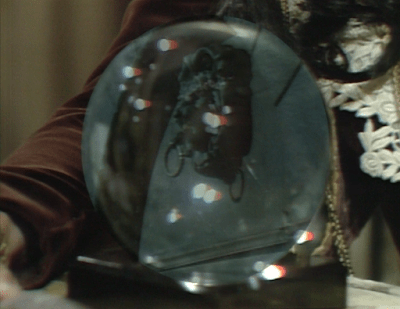
In the Old House, an image suddenly appears in the crystal ball. We can see it, the first time they have actually projected an image in such a ball since the first one made its debut in #48.
Magda notices the image, and tells Sandor to look. He recognizes the old mausoleum. She says that the jewels must be in “the room,” implying that they already know about the hidden panel and the secret chamber behind it. Sandor says it is absurd to imagine Edith going to and from the mausoleum to retrieve pieces of her jewelry collection. Magda ignores this, and urges him to go there. He reluctantly agrees to go with her.
The two of them are heading for the door when they hear a knock. It is Beth, come to say that Edith wants to see Magda. Edith wants what she always wants- to be told that Edward will return before she dies. Sandor says Magda can’t go, but Beth says she will regret it for the rest of her life if she does not. Magda tells Sandor to go on his way without her, and says that she will bring Edith some ancient Gypsy cards, cards older than the Tarot. When she talks about Romani lore, Magda taunts Beth- “but you wouldn’t know anything about that, would you?” Her sarcastic tone implies that Beth has tried to conceal her own Romani heritage.
Sandor opens the secret panel and looks at the chained coffin. He tells himself the jewels can’t be hidden there, then decides he may as well open it anyway- if he doesn’t, Magda will just send him back. Longtime viewers remembering the frenzy in which Willie opened the coffin in #210 will be struck by the utterly lackadaisical attitude with which Sandor performs the same task. Men’s lust for riches may release the vampire, but so too may their annoyance with the wife when she won’t stop carping on the same old thing.
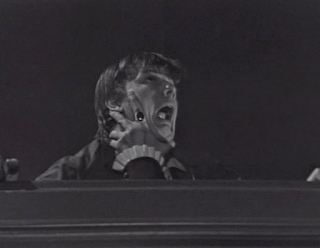
When Willie opened the coffin, it lay across the frame lengthwise and he was behind it. When he raised the lid it blocked our view of his middle. We could see only his face when he realized what he had done, and could see nothing of Barnabas but his hand. The result was an iconic image.
Farewell, dangerously unstable ruffian- hello, sorely bedraggled blood thrall. Screenshot by Dark Shadows Before I Die.
When Sandor opens the coffin, its end is toward us. We see Barnabas at the same time he does. Barnabas’ hand darts up, and also for some reason his foot. The camera zooms in as Barnabas clutches Sandor’s throat. Unfortunately, the shot is so dimly lit that not all viewers will see this. My wife, Mrs Acilius, has eyesight that is in some ways a bit below average, and she missed it completely, even on a modern big-screen television. It’s anyone’s guess how many viewers would have known what was going on when they were watching it on the little TV sets of March 1969, on an ABC affiliate which was more likely than not the station that came in with the poorest picture quality in the area. As a result, the image that marks the relaunch of Barnabas’ career as a vampire is nothing at all. There is so much good stuff in the episode that it easily earns the “Genuinely Good” tag, but Kaplan’s bungling of this final shot is a severe failure.
Wicked witch Angelique defied her supervisor, suave warlock Nicholas, one too many times. Yesterday, Nicholas stripped Angelique of her powers, including her immunity to aging. Since she is 194 years old, this leaves her with a sharply limited future.
Today, Nicholas tells Angelique he will think of sparing her from her imminent demise if she can persuade recovering vampire Barnabas to forgive her for her extreme abuse of him and of everyone he has ever cared about. She goes to Barnabas and begs him for forgiveness. Barnabas replies that when he asked her for forgiveness, she responded by turning him into a vampire. He does show signs of concern for her, but cannot pardon everything she has done. He specifically mentions The Dream Curse, a three month storyline that not only brought great suffering to him and a dozen other characters, but which also made the audience miserable. She dies.
Nicholas’ only acknowledged motivation to this point has been a selfless devotion to evil for its own sake. That makes it odd that he would place a value on forgiveness. Dark Shadows is pervaded with ghost stories, and ghost stories are, first and foremost, explanations of how unresolved conflicts in the past can poison relationships among people in the present. It is also a soap opera, and the biggest events in soaps are changes in the way particular characters feel about each other. So both genres tend to elevate forgiveness, not only as a virtue, but as the highest form of The Good in human life. We saw this in the first year of the show, when well-meaning governess Vicki kept forgiving strange and troubled boy David for his attempts to kill her, acts of forgiveness which culminated in #191 when David ran from the mother who was trying to lure him to his own death into Vicki’s arms and an acceptance of life. Two weeks later, in #201, dashing action hero Burke closed another narrative thread left over from episode #1 when he forgave sarcastic dandy Roger for an old grievance he had against him. With those events, it was pardoning that cleared the flotsam left over from Dark Shadows 1.0, paving the way for the introduction of Barnabas and the advent of Dark Shadows 2.0.
Perhaps Nicholas was so certain Barnabas would not be able to bring himself to forgive Angelique in the time available before her death that making her beg for forgiveness was his way of perverting the world’s best thing into yet another instrument of cruelty. Certainly he suggests this interpretation when he introduces the idea with a laugh and a comment that he might find it “amusing.”
When Nicholas stands over Angelique’s corpse, he tells her that her own hatred had made it impossible for Barnabas to forgive her because it had “become too much a part of him.” That Angelique’s hatred became a part of Barnabas rings a bell for longtime viewers. The show has always depicted supernatural beings, not as self-contained individuals, but as complexes of phenomena that operate more or less independently, often without each other’s knowledge, sometimes in pursuit of mutually exclusive goals. For example, in 1967 the ghost of Barnabas’ little sister Sarah visited David during the day and tried to prevent him finding out Barnabas was a vampire, but she also appeared to David in a dream and showed him everything the daytime ghost wanted to keep hidden. When David told the Sarah of the waking hours what her dream visitation form had shown him, she was horrified and forbade him from following up on any of that information.
When Angelique places a curse, she sometimes seems to create a little version of herself, give it possession of the person she is targeting, and turn it loose in the world. Sometimes that little Angelique turns against her. For example, she raised the body of Barnabas’ uncle Jeremiah from the dead to use for her own nefarious purposes, only to find that it would not return to its grave when she was finished with it. When Barnabas was a vampire, he had some obsessions that were strikingly similar to obsessions Angelique had shown. So Angelique wanted Barnabas to love her, and had the power to cast a spell that would make him do so, but instead wrought immense havoc on everyone else with one wild scheme after another, because she wanted him to come to her “of his own will.” Likewise the vampire Barnabas wanted to make Vicki his victim, but passed up one opportunity after another to bite her because he wanted her to come to him “of her own will.” That similarity is so close that it makes us wonder if the Barnabas we first met was simply Angelique in disguise. Not only her hatred, but all of her quirks had become part of him.
Angelique came from the 1790s to 1968 by some magical process that involved a portrait of her that is now on a stand in Vicki’s room. Today she uses a secret panel to let herself into the room and look at the portrait. We first saw that panel open when the show was a costume drama set in the 1790s. The room was occupied then by gracious lady Josette, and it was the vampire Barnabas who used the panel to enter. We haven’t seen the panel since, leaving it strongly associated with Barnabas in the minds of regular viewers. Angelique’s use of it today further suggests her identity with him when he is in his vampire state.
In his post about this episode on Dark Shadows Every Day, Danny Horn remarks on the recapping that permeates the dialogue and reckons it as writer Sam Hall’s critique of the ongoing storylines. That assessment will be familiar to those who, unlike Danny, have been watching the show from the beginning. When Ron Sproat joined the writing staff in October 1966, his first several scripts featured a systematic inventory of the available narrative material, with each plot very explicitly marked as suitable or unsuitable for further development.
In its first year, very little happened on Dark Shadows; now, it has swung to the opposite extreme, and there is a climax at every commercial break. But the result is oddly similar. They don’t take the time to explore the overall situation, so that little seems to be at stake even when a spectacular event takes place. No matter how much happens per minute of screen time, it feels like the pace is slow. We see suave warlock Nicholas in the gazebo on the grounds of the estate of Collinwood summoning his subordinate, the wicked witch known variously as Angelique and Cassandra, and hear him complain that she has spent weeks attempting to do what she should have accomplished in minutes. Thus Hall assures us that the pace will be picking up.
Angelique/ Cassandra comes to the gazebo, to which Nicholas refers as a “ga-ZAY-bo” in a bit of Collinsport English Angelique/ Cassandra herself introduced in #489. There, the two of them quarrel about her dilatory approach. They stand behind columns and look like debaters at podiums.
Maybe I’m reading too much into the set design, but in one of the photos Angelique and Nicholas are sperated by a statue of a Goddess (I assumed Venus). Wouldn’t it be awesome if it was Venus and that statue between them was to represent Angelique’s love for Barnabas blocking her efforts at villainy? More likely that the shot just looked better composed with the statue in the middle but how awesome if it was meant to be subtle symbolism! 🙂
“lakeplacidskater,” posted 25 February 2015 on Danny Horn, “Episode 528: This Tawdry Affair,” 21 November 2014.*
The statue appears to me to represent not Venus, but a harvest goddess. She is fully clothed, and there is a sack at her feet which seems to be full of grain. That makes a lot less sense than does the suggestion “lakeplacidskater” made. The Collinses derive their wealth from fishing and shipping, not from farming, so it is surprising that they would put a symbol of agriculture in such a prominent place. Perhaps she stands for wealth in general, but not for so much wealth that the family could afford to commission a statue of a sea goddess. And neither a bountiful harvest in particular nor wealth in general is any sort of obstacle between Nicholas and Angelique/ Cassandra. I suppose the visual metaphor might be emphasizing the image of the two of them as debaters, with the goddess serving as moderator.
Nicholas dominates Angelique/ Cassandra thoroughly and rather cruelly. Viewers who remember her from the portion of Dark Shadows set in the late eighteenth century may be taken aback by this. In those days, her power often seemed to be limited only by her own carelessness. That made for something of a shapeless narrative, since no one could oppose her effectively. Not only does Nicholas reduce her to a lowly state today, but he himself bungles a simple task when he sets out to do something nasty to well-meaning governess Vicki. Thus we see that the villains will have their work cut out for them.
Later, Vicki is in bed at her friend Maggie’s house. She has gone there to escape a curse Angelique/ Cassandra has placed that has caused several people to have the same nightmare. Since Maggie was at home when she was the first person to have the nightmare, and Vicki’s boyfriend Peter was sleeping there when he had it, it is hard to understand why Vicki thinks it is a place of safety.
We have several closeups of the face of the clock while Vicki goes to sleep. It’s an Ingraham eight day clock, apparently they wanted to make sure we knew that. When Vicki finally nods off, Angelique/ Cassandra materializes in the room with a jar of rose water that is supposed to make Vicki have the nightmare. Ever since the days when humanoid Phoenix Laura Murdoch Collins was on the show, we’ve been seeing undead witches materialize in people’s bedrooms while they sleep. This time, Maggie walks in and sees Angelique/ Cassandra. She screams at the sight. All of the women in the cast were required to scream frequently, so frequently that fans become connoisseurs of screaming. Kathryn Leigh Scott was one of the better screamers, not far behind Clarice Blackburn, so that makes for a satisfying ending.
*I can’t help but point that when “lakeplacidskater” left her post, all the members of the cast were still alive. Humbert Allen Astredo would die in 2016 and Lara Parker in 2023; Alexandra Moltke Isles, Roger Davis, and Kathryn Leigh Scott are still with us.
Well-meaning governess Vicki is in jail, about to be tried on a capital charge of witchcraft. That couldn’t happen in the New England that existed in 1795 in our timeband, but many things were possible in the world of Dark Shadows that we don’t see in ours.
Gallant gentleman Barnabas Collins has figured out that Vicki is innocent and that the real witch is his new wife, Angelique. Rather than go to the authorities with his evidence, he decides to take a more direct approach and murder Angelique. That won’t be much use to Vicki, but Barnabas can’t be bothered with details.
The longest sequence of the episode is a farce in which Barnabas pours two glasses of sherry, puts poison in the one he then gives Angelique, and tries to get her to drink. They don’t do “the old switcheroo” and mix up the glasses, but instead go with an equally hoary device of having Barnabas’ mother show up and take Angelique’s glass. Barnabas has to claim the glass is cracked and knock it from her hand.
After the failure of his attempt to poison Angelique, Barnabas opens a hidden compartment of his desk and takes out a dagger. If it weren’t for Robert Cobert’s solemn musical score, the effect would be that of seeing Wile E. Coyote open yet another crate from the Acme Corporation. He goes up to Angelique’s bedroom and lifts the dagger. Since there has been no indication that she has got into her bed, and all we see on it are a lump of covers, the audience has no reason to suppose she is in there. We end with the distinct impression that Barnabas, having barely avoided matricide, is stabbing a mattress.
We first knew Barnabas in the year 1967, when he will be a vampire and will develop from a profoundly bleak presence and an urgent threat to our favorite characters into a comic villain for whom we can’t help but feel a kind of affection as we watch him fail again and again in his elaborate schemes. In that way, his maladroit attempts on Angelique’s life today are entirely typical of the Barnabas we had met before Vicki traveled back in time in November.
In another way, this episode represents one of the biggest retcons in the whole series. Throughout his first eight months on the show, Barnabas nursed a bitter hatred for his uncle Jeremiah Collins. In the first weeks of the 1795 segment, we saw that Jeremiah eloped with Barnabas’ beloved fiancée, the gracious Josette, and that Barnabas responded to this betrayal by killing Jeremiah in a duel. When Barnabas is talking today about Angelique’s black magic, he realizes that Jeremiah and Josette ran off together only because they were under a spell, and that neither was responsible for betraying him. He has no hostility left for Jeremiah.
In the various accounts the vampire Barnabas gave in 1967 of his last years as a living being, he never mentioned Angelique. Nor did he ever say that he, Josette, or Jeremiah had been the victim of witchcraft. Instead, he had indicated that he himself had gotten involved in black magic. In #345, he told his sometime friend, mad scientist Julia Hoffman, that he became a vampire after trying to gain eternal youth, and that Josette killed herself when he offered her that eternal youth. In #358, he uses “the secret magic number of the universe,” which he had learned while studying witchcraft under a warlock on Barbados, to torment Julia. The Barnabas we met when we came to 1795 hadn’t done any of that. Until he learned the truth about Angelique, Barnabas was a man of the Enlightenment and didn’t believe that witches even existed.
Perhaps this is a change Vicki’s arrival and her bizarre behavior have wrought. The stories Barnabas tells in #345 and #358 both took place years after Josette and Jeremiah were married. So perhaps in the original timeline, with no one around yammering about what the first 73 weeks of the show were like, events moved much more slowly. The change of loves took place gradually enough that Barnabas did not feel he had to challenge Jeremiah to a duel, but he was still full of hatred and resentment. Angelique was able to cover her tracks so that no one suspected witchcraft was underway. She gradually lured Barnabas into the occult arts, perhaps giving up the idea of marrying him at some point, certainly losing his attention. By the time he brought the vampire curse on himself, the version of Barnabas in that timeline would have forgotten Angelique and would have come to be consumed by his grievance against Jeremiah. That fits far better with the April-November 1967 Barnabas than does the character we have seen so far in 1795.
Barnabas asks a key question in this episode. When Angelique says that she will always love him, he asks her what she thinks love is. She answers “Why of course I do!,” which probably means that the script called for him to ask if she knew what love was, but “What do you think love is, Angelique?” is a better question. She’s been destroying every relationship that makes him the man he is in order to have him all to herself, suggesting that if Barnabas pressed Angelique to explain what love is, she would wind up saying that it means having total control over someone. As a vampire, that’s going to be Barnabas’ working definition too, suggesting that he will be more like Angelique then than he already is now.
In this episode, the portrait of Josette is delivered to Barnabas’ home, the Old House on the estate of Collinwood. This portrait, haunted by Josette’s ghost, was the dominant presence in the Old House from its first appearance in #70 until Barnabas moved back in there in #221, and was important as a symbol of Barnabas’ obsession with Josette thereafter. The makers of the show left it on the wall of Josette’s bedroom at the beginning of the 1795 segment; we see it there in #374, but they replace it with a different portrait in #377. It’s hard to understand why it would already have been there before Josette formally became a member of the family- perhaps it was just a slip-up that it was there in #374, and they’d always planned to show its arrival at Collinwood.
It is 1795, and we are on the great estate of Collinwood. Under the influence of wicked witch Angelique, the kindly Jeremiah and the gracious Josette have eloped, breaking the heart of Josette’s fiancé, Jeremiah’s nephew and best friend Barnabas Collins. Barnabas, up to that point an idealistic man of the Enlightenment, responded by going against his beliefs and challenging Jeremiah to a duel.
Angelique is a lady’s maid. She was introduced as maid to Josette’s aunt, the Countess DuPrés, but today it seems she is Josette’s maid. She comes to Barnabas’ room. He demands to know why her mistress has sent her, meaning Josette, to which she replies she has come on her own account.
Angelique asks Barnabas why he has challenged Jeremiah to a duel, since he has never fought a duel or even seen one before. He explains that he could not stand being an object of pity- “I couldn’t be poor Barnabas.” In 1967, Barnabas will be a vampire. We saw him in that year, in #345, telling his sometime associate mad scientist Julia Hoffman the story of his relationship with Josette. The story he told was different from other versions he had told previously, for example in #233 and #236, and radically different from what we have seen play out in this extended flashback. In the story he told Julia, as in all other versions we had heard before coming to 1795, Josette was originally Jeremiah’s fiancée. One theme developed that resonates here was that all he could be to Josette was a faithful friend, and that he found that role humiliating. He was “poor Barnabas” in that version of the story, and he implies that it was to escape from that identity that he did whatever it was that made him the undead monster he became.
Angelique cast her spell on Josette and Jeremiah because she wanted Barnabas for herself. Now that she sees that he is likely to get himself killed before she can make her play for him, she asks him to wear a medallion of hers, one which she says will bring good luck. In the 1960s, a portrait of Barnabas hangs in the foyer of the great house of Collinwood. He is wearing a medallion in that portrait. Is Angelique’s medallion the one in the portrait? We can’t be sure.
Josette and Jeremiah have a conversation. They try to figure out what came over them. They don’t love each other, and regret hurting Barnabas. As their conversation goes on, Josette realizes that Jeremiah regrets it so deeply that he is planning to let Barnabas kill him in the upcoming duel. She is horrified by this. She doesn’t want anyone to die, and has accepted the fact that Jeremiah is the only husband she’s got. Nevertheless, she cannot dissuade him.
Josette’s father arranges for Jeremiah to have a final talk with Barnabas. Barnabas accuses Jeremiah of lusting for Josette all along, saying that “you wanted her the moment you saw her.” This is not true of Jeremiah, but in #345 it is exactly what Barnabas tells Julia he himself did. In that version, he conceived a wild passion for Jeremiah’s bride-to-be the moment he first saw her.
Barnabas tells Jeremiah “You must have hated me all your life.” As we have seen over these last few weeks, Jeremiah and Barnabas have been dear friends all their lives. But from his early days on the show in the spring of 1967 until we left for our voyage to the past in #365, Barnabas consistently said that he hated Jeremiah from his earliest days. The overall effect of comparing Barnabas’ various accounts of the past with each other and with what we are seeing in this flashback is something like reading the accounts of the patient’s memories in a case study by Freud. Not only does the order of the events jumble as retcon follows retcon, but guilt floats from one person to another and back again.
When Jeremiah tries to explain how he and Josette found themselves stricken with intermittent attacks of intense desire for each other and how they struggled against those attacks during the intervals between them, Barnabas asks “Why didn’t you come to me then?” That’s a good question, and it suggests another, equally good question. Angelique is casting spells because she and Barnabas had a brief affair before he became engaged to Josette. Why hasn’t he come clean to Josette about his past? If he had, Josette would not have put herself so completely in Angelique’s hands that she could bind her with her spells at leisure.
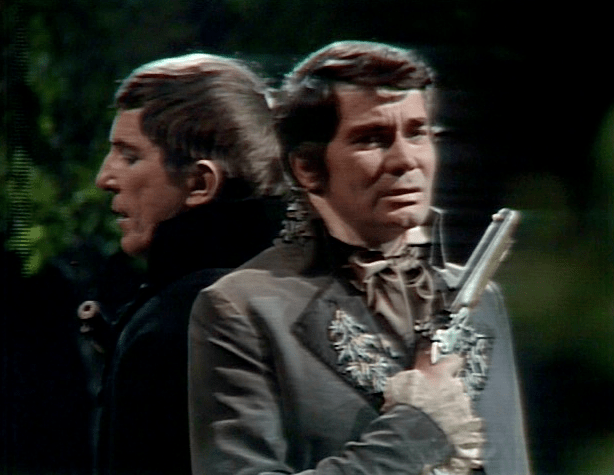
Jeremiah and Barnabas have their duel. We see them back to back, getting ready to pace off the prescribed distance. On Jeremiah’s face, we see his resolution to let Barnabas kill him.
The men are in place when Josette comes running up, pleading with them to stop. She arrives just in time to see Barnabas shoot Jeremiah. Some say they hear only one shot, but I hear two. I think Jeremiah deloped.
Josette goes to Jeremiah’s crumpled body and shouts at Barnabas. “You monster! You madman! You killed the only man I ever loved!” She claims that she and Jeremiah were happy together, and that in his pride Barnabas could not let them be happy. She refuses Barnabas’ offer to help move Jeremiah and get a doctor for him.
Angelique had rubbed Josette’s forehead with some of the rose water in which she had put her love potion not long before this, so Josette’s declarations that Jeremiah is “the only man [she] ever loved” and that they were happy together could be a sign of that influence. It could also be rooted in Josette’s realistic assessment of her situation. Earlier, she had told Jeremiah that she would never again allow herself to say that she loved Barnabas, and when Jeremiah said that his own death would make her a free woman she rejected the idea. Whatever the circumstances that led to the marriage, she is Jeremiah’s wife, and if she becomes his widow she will have an obligation to keep up certain appearances.
This was Anthony George’s last episode. George was woefully miscast when he first joined the show in #262 as the second actor to play Burke Devlin. Writers Ron Sproat and Malcolm Marmorstein kept writing Burke as if he were still being played by the explosively exuberant Mitch Ryan. George’s style was the exact opposite of Ryan’s. He was a cold actor whose characters keep us guessing as to their motives and intentions. He was utterly lost as the hot-headed Burke.
When Gordon Russell joined the writing staff in #292, things looked up for George. Russell understood what actors could do, and gave George some scenes he played very well indeed. In Jeremiah Collins, Russell and Sam Hall created a character who was perfect for George. It’s fascinating to watch Josette scrutinize Jeremiah until she gradually realizes that he has decided to throw his life away to do penance for the offense he and she have committed against Barnabas. It is also credible that, while we can see what Jeremiah is doing, Barnabas, who has known him all his life, would not catch on. George was so bad as Burke in the Sproat/ Marmorstein era that it seemed anything that got him off the show would be welcome. But Russell and Hall know so well how to take advantage of his strengths that it is sad to see him go.
All of the actors have trouble with their dialogue today, even the usually reliable Kathryn Leigh Scott and Lara Parker. Jonathan Frid always struggles, but is especially rough this time, and as for David Ford, what can we say. He mangles virtually every line. His character is supposed to be French; he doesn’t sound French, but doesn’t exactly speak English, either. Danny Horn transcribes many of Ford’s flubs in his post about the episode on Dark Shadows Before I Die, but you really have to hear it for yourself to absorb the sheer bizarreness of the speechlike sounds that come out of Ford’s mouth. I always enjoy watching Ford, and I think he made a major contribution to Dark Shadows‘ acting style when he first came on the show, but when he is off he is way, way off.
In 1966 and the early weeks of 1967, the Collinsport Inn was an important place on Dark Shadows. The restaurant there, presided over by Maggie Evans (Kathryn Leigh Scott,) The Nicest Girl in Town, was a place where people could meet each other unexpectedly and characters new to town could be introduced. Dashing action hero Burke Devlin (Mitch Ryan) lived in a suite at the inn, and the place often represented his territory, the base from which he conducted his war against the ancient and esteemed Collins family.
We haven’t seen Burke’s room since #206, at which point he had given up his vendetta against the Collinses and proceeded far down the road to irrelevance. We haven’t seen the restaurant since vampire Barnabas Collins (Jonathan Frid) met Maggie there in #221. By the time Anthony George took over the part of Burke in #262, Burke seemed to live in the Blue Whale tavern. He made business calls from the pay phone there, and in one episode apparently stayed behind when the bartender locked the place up for the night.
The inn makes a return appearance at the top of today’s episode. It is 1795, and Jeremiah Collins (Anthony George) is sharing a suite with Josette DuPrés (Kathryn Leigh Scott.) They are on their honeymoon.
Jeremiah and Josette eloped from the estate of Collinwood on the night when Josette was supposed to marry Jeremiah’s nephew, kindly gentleman Barnabas Collins (Jonathan Frid.) Josette truly loved Barnabas and Jeremiah was his dearest friend, but they were under a spell cast by wicked witch Angelique, who wanted Josette out of the way so she could have Barnabas for herself. The power of the spell waxes and wanes. When Josette and Jeremiah are in the grip of it, a trident shaped mark appears on their hands; when they return to their senses, the mark disappears.
When the episode begins, the tridents are showing, and the newlyweds are inflamed with passion. Shortly after, Josette’s mark is gone, Jeremiah’s still showing. She is filled with regret, he is still ardent.
Back in the manor house of Collinwood, Barnabas has a conversation with Josette’s father André and his own father Joshua. He resists André’s suggestion that Josette and Jeremiah must have left together, and resists even more strenuously Joshua’s declaration that they did so because they are the victims of witchcraft. Joshua says that his sister Abigail and André’s sister, the Countess DuPrés, found a blasphemous trinket in the quarters of governess Victoria Winters, and that a witch-hunting divine, the Reverend Trask, is coming to investigate the matter. Barnabas is appalled at the notion of an inquiry into witchcraft, and vows to defend Victoria if Trask comes. Joshua forbids him to do so.
Barnabas’ reaction to the idea of a witchcraft trial, coupled with what we have seen of him so far in the 1795 segment, looks like a retcon. In #358, only a week and a half before we began this uncertain and frightening journey to the past, vampire Barnabas told a story about studying witchcraft under a warlock on Barbados who taught him “the secret magic number of the universe.” Events are moving so fast that it doesn’t look like Barnabas will have time to sail to the Caribbean before he becomes a vampire, and he won’t be crossing any waters after that. But now he is a man of the Enlightenment, who scoffs at the idea of witchcraft today as he scoffed at the tarot when the countess introduced him to it in #368/369.
Jeremiah returns to the house. There is an exquisite little scene with a servant, Riggs, who is uncomfortable at the sight of the disgraced Mr Jeremiah. Riggs stands in for the establishment of Collinwood and the whole working class of the town of Collinsport, and in his reaction we see the disquiet that bad news from the big house on the hill would spread among the people whose livelihoods are at stake when trouble comes to the family there. Riggs makes haste when Jeremiah tells him to go out and fetch Joshua.
When Riggs is gone, Josette enters. The audience sees that the mark is gone from Jeremiah’s hand, and Josette can tell that his passion for her is gone. She tells him that he no more loves her than she loves him. He begins with a protest against this remark, but ends by saying that they must be kind to each other.
Joshua and André enter. André embraces his daughter and tells her everything will be all right; Joshua looks at his brother with distaste and demands an explanation.
Jeremiah says that he and Josette are married. He further says he realizes they are not welcome, and that they will return to the inn. This raises the prospect of a recreation of the early days, with the inn as a territory separate from and opposed to Collinwood. Joshua rejects the idea at once. He will not have the scandal of Jeremiah and his new wife living in town because they have been estranged from the rest of the Collinses. He decrees that they will live at Collinwood and put on a happy face for the townsfolk.
Barnabas enters. Joshua tells him that Jeremiah and Josette are married. He refuses to believe it until Josette confirms it herself. He takes the glove from Jeremiah’s hand and slaps him in the face. He gives him a choice of weapons.
Dueling may have been as alien to the ideals of the Enlightenment as were Barbadian warlocks, but so too is Joshua’s plan of forcing the whole family to commit itself to a massive lie in order to preserve its hereditary privileges. Joshua, the proud apostle of Jeffersonian republicanism, is simply being a hypocrite, but Barnabas is a more complicated figure. Seeing his every hope turned to dust before him, his ideals have become useless. He has only a moment to choose among the evils the Enlightenment had promised to stamp out, and he chooses the most macho one available.
Joshua forbids the duel, but Barnabas disregards his father’s authority and insists on it. In 1795 and for some time after, dueling was widely practiced in much of the United States, and particularly in the South and West a gentleman lost face if he refused a challenge. No such stigma attached in New England, where dueling was condemned by law and religion. Had Joshua or Jeremiah gone to the police, Barnabas would have been arrested. In 1719, Massachusetts, of which Maine was a part until 1821, passed a law making it an offense punishable by a fine of £100 (equivalent to about $7000 today) to challenge someone to a duel. Massachusetts law already considered it murder to kill someone in a duel, and prescribed death by hanging as punishment. Of course, Joshua’s declaration that Jeremiah and Josette will live in the house and the family will present a “united front” to deter scandal makes it clear he will never turn his son over to the police, and the pattern of cover-up with the support of law enforcement we saw among the Collinses in 1966 and 1967 leads us to doubt that anything a member of the family does will ever be a matter for the courts to judge.
There is a missed opportunity in the show’s lack of interest in Massachusetts’ actual laws about dueling. The 1719 law was amended to be even stricter in 1730. Among the provisions added to the law at that time was a requirement that anyone who had either been killed in a duel or been put to death for winning a duel would “be given an unchristian burial at a gallows or crossroads, with a stake driven through their body.” Since the audience knows that Barnabas is fated to become a vampire, there is a chilling irony in seeing him volunteer for a staked burial.
Dark Shadows became a hit after vampire Barnabas Collins joined the cast in April of 1967. Displaced from a previous era, Barnabas spent most of his time trying to con people into believing that he was a native of the twentieth century. The difficulties Barnabas encountered in his performance in the role of modern man dovetailed so neatly with those actor Jonathan Frid encountered in his characterization of a vampire that his every scene was fascinating to watch.
The audience’s main point-of-view character for the first year of the show or more was well-meaning governess Vicki. Now Vicki finds herself in a situation like that which made Barnabas a pop culture phenomenon. The ghost of Barnabas’ ten year old sister Sarah has sent Vicki back in time to 1795, when Barnabas and Sarah are both living beings and the vampire curse has not yet manifested on the estate of Collinwood. Vicki and Barnabas have traded places- she is now the time-traveler who must trick everyone into thinking she belongs in their period, while he is her warm-hearted, if uncomprehending, friend.
Unfortunately, the show has not chosen to write 1795 Vicki as a fast-thinking con artist. By the time the Collins family of 1967 met Barnabas, he was wearing contemporary clothing and telling them a story about being their cousin from England. Vicki shows up in her 1967 clothes and carrying a copy of a Collins family history printed in the 1950s. She goes around blurting out information she learned from reading that book and introduces herself to each character by telling them that they are played by actors who had other parts in the first 73 weeks of the show. Vicki’s natterings have convinced two ladies in the manor house, repressed spinster Abigail Collins and visiting aristocrat Countess DuPrés, that she is a witch.
Today, we open with the countess setting a trap to expose Vicki. Haughty overlord Joshua Collins vanished from the front parlor yesterday, in the middle of an argument with his brother Jeremiah. Jeremiah looked away from Joshua for a moment, and when he looked back his brother was gone and there was a small house cat in his place. The countess insists Vicki come into the parlor and reenact Joshua and Jeremiah’s argument. Vicki keeps protesting that the whole idea is silly, but the countess will not be stopped.
The countess imitates Joshua. This is the first time we have seen Grayson Hall play one character mimicking another, and it is hilarious. I suppose it would have ruined the laugh if Vicki had shown that she was in on the joke, but at least it would have provided evidence that Vicki hasn’t left her entire brain in 1967.
The countess tries to get Vicki to speculate on what goes on behind closed doors between Joshua and his wife Naomi. Vicki says that “It’s not my place to judge their marriage,” managing to sound like a dutiful servant, if not like an eighteenth century English speaker. The countess goes on testing Vicki with provocations that seem unconnected with each other, and she tries not to say anything wrong. That goes on until the cat reappears.
Barnabas is Joshua’s son. He enters and sees the cat. Vicki leaves, and Barnabas tells the countess he doesn’t think he has ever seen the cat before. Caddish naval officer Nathan Forbes enters to confer with Barnabas about the search for Joshua. Nathan overhears the countess suggesting to Barnabas that Vicki is a witch and is responsible for making his father disappear.
Nathan finds Vicki. He tries to warn her that the countess suspects her of being a witch. This is the second time we have seen someone explicitly tell Vicki that she will have to do a better job of faking her way through her current situation, after a scene in #367 where the kindly Jeremiah told her in so many words that she would have to make up a better story to tell people about herself. No one had needed to do that for Barnabas when he was lying his way through 1967, and if they had he would have had a stake in his heart before he’d been on the show a week.
At least Vicki tried to absorb what Jeremiah told her in #367. When Nathan tells her today how bad she has made things for herself, she just gets uptight. There have always been times when the writers solved plotting problems by having Vicki do something inexplicable, but now it seems Dumb Vicki is the only side of the character we will be allowed to see.
The countess confronts Vicki again, inviting her to take a lesson in tarot card reading. As the countess probes Vicki for information, we hear Vicki’s voice in a recorded monologue, wondering if she could tell the countess the truth. She may as well- she has pretty well blown any chance she ever had at establishing a false identity for herself.
When the countess asks Vicki where she was trained to be a governess, she says that she was raised in a foundling home in Boston and was trained there. The only false part of this account is that the foundling home was in New York. Changing the location to Boston only makes it that much easier for people based in Maine to check her story and prove it false. When the countess asks when she was born, she says “March 4, 19-” and catches herself. The countess remarks on the strangeness of the slip, and Vicki is conscious enough not to fall into her trap when she invites her to put the wrong digits after “17.”
By the end of their encounter, it should be obvious even to Vicki that the countess suspects her of witchcraft. The countess presses Vicki about her knowledge of the supernatural, telling her that Barnabas regards her as clairvoyant. Vicki tries to dismiss that as “his joke.” When Vicki protests that she does not know why the countess keeps asking her questions about the supernatural, the countess impatiently tells her that she certainly does know. She declares that something terrible is happening in the house, and that she is determined to find out what it is.
Having made it clear that she thinks Vicki is a witch, the countess leaves her alone in the room with the layout of tarot cards she had been studying. Vicki decides to rearrange the cards. She thinks to herself that she will thereby warn the countess of the upcoming tragedies. But the countess will know that the cards are not where she dealt them, and it will be obvious that it was Vicki who moved them. She will know that she is receiving a message, not from whatever realm tarot cards are supposed to access, but from Vicki. If that message foretells disasters that in fact occur, she will only be confirmed in her suspicions. It is difficult to imagine a stupider act Vicki could have committed.
Difficult, but for a writer as imaginative as Sam Hall it is not impossible. In the next scene, Vicki is talking to Barnabas while the countess stands nearby. Vicki tells Barnabas that Joshua will return. She speaks with such assurance that Barnabas takes it as another sign of her clairvoyance, and the countess reacts with horror, hearing the witch declare that she is about to lift her spell.
The moment when Mrs Acilius shouted at the screen, “Vicki, SHUT! UP!” Screenshot by Dark Shadows Before I Die.
Alone with the countess, Barnabas admits that he is starting to think that she may have a point about witchcraft. The countess answers that he is becoming wise.
Closing Miscellany
The asthmatic Grayson Hall has a coughing fit during her scene with Vicki and the tarot cards. It is one of the less amusing bloopers, she really sounds like she’s suffering.
I chuckled a little when Vicki stops at “19-” in giving her birthdate. Alexandra Moltke Isles’ year of birth is given on various websites as early as 1943 and as late as 1949. I think it is only fitting that someone so central to a show like Dark Shadows should be a little mysterious, so I’m glad that all we really know about Mrs Isles’ birth is that it took place on 11 February 194-.
Angelique, lady’s maid/ wicked witch, has cast a spell over kindly indentured servant Ben Stokes, making him her slave in an even deeper sense than he was already Joshua Collins’ slave. She gives Ben various tasks in support of her current project, black magic that will make the lovely Josette forget her fiancé Barnabas and conceive a mad passion for Barnabas’ uncle and dear friend Jeremiah. Most notably, she needs an unbroken spider web from an oak tree, and Ben brings her one.
Meanwhile, cousin Millicent Collins has come to the estate of Collinwood. Millicent is giggly, afraid of germs, and very, very rich. Joshua means for his bachelor brother Jeremiah to marry Millicent, a prospect that repels Jeremiah.
Time-traveling governess Vicki enters. When she sees Millicent, Vicki calls her “Carolyn,” because she is played by Nancy Barrett, who plays a character named Carolyn in the parts of Dark Shadows set in the twentieth century. The makers of the show wanted Vicki to keep the audience up to date on the cast members’ resumés, even though it makes all the other characters think she is a lunatic.
Alone with Vicki, Jeremiah confides that he does not want to marry Millicent. Vicki had studied Collins family history when she was living in the 1960s and has an idiotic compulsion to verbalize her every thought, so she declares that Millicent will never marry. Jeremiah remarks that she says the strangest things.
This scene is more tolerable than the others in which Vicki blurts out information she wouldn’t know if she belonged in 1795 because of the casting of Anthony George as Jeremiah. George was a cold actor who kept the audience guessing what was going on inside his characters’ heads. That made him a disaster as the second to play the hot-blooded Burke Devlin, but when we see him as Jeremiah we take his ready acceptance of Vicki’s bizarre behavior as a sign that he has something up his sleeve. If they can stop giving Vicki such tiresome lines, Jeremiah might be a promising love interest for her.