Episode 809: Back from your evening revels

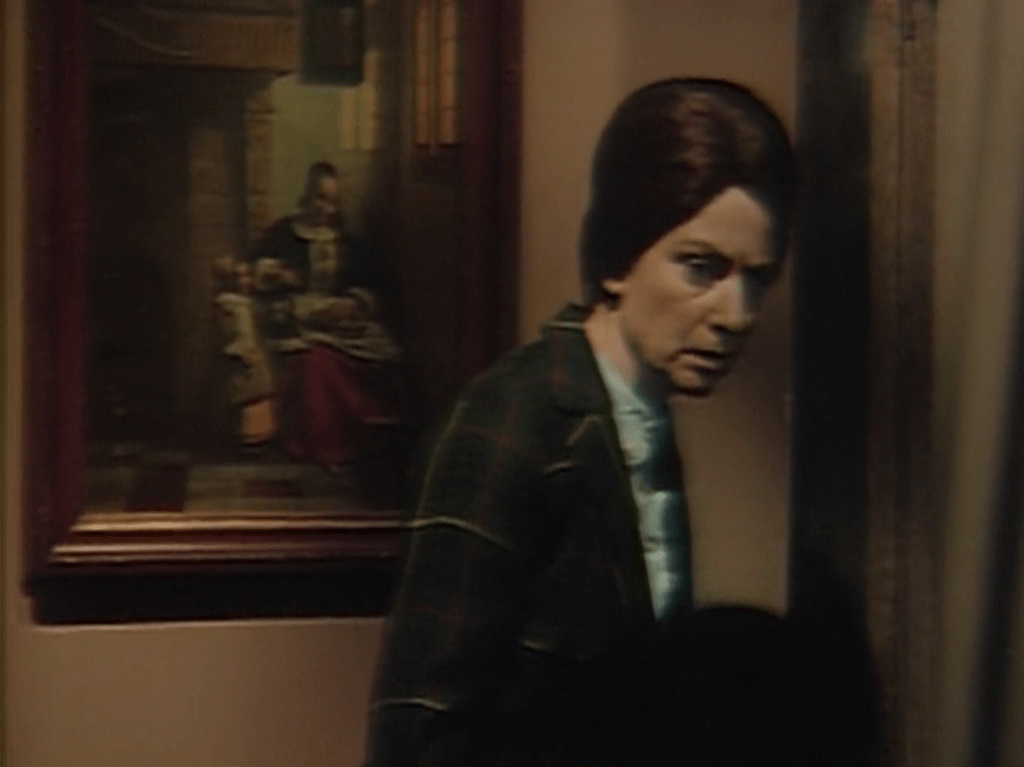
Charity Trask finds Quentin Collins unconscious and disheveled in the woods. She kneels beside him in a show of concern, then notices a woman on the ground near him. The woman’s face is covered with what on a black and white television look like slash marks and her clothing is badly torn. She regains consciousness just long enough to say Quentin’s name. Charity notices that Quentin is holding a scrap of cloth that matches the woman’s dress, and realizes that he is the werewolf who has been terrorizing the area.

Quentin comes to, and Charity tells him they must get help for the injured woman. Quentin’s response is to threaten to kill Charity if she says anything to anyone about what she has seen. He says that he will look after the woman, and repeats his death threats to Charity.

Charity goes home to the great house of Collinwood, where her father, the overbearingly evil Gregory Trask, orders her to marry Quentin by the end of the week. She is horrified and tells him she will not. She cannot explain why. Before Gregory can corner Charity and force her to give him information, twelve year old Jamison Collins enters. Jamison reports seeing the injured woman in the woods, and says that Gregory must go to her at once if she is to survive. Gregory dismisses this as a “tall tale” and says he will not be distracted from punishing Jamison for his long unexplained absence from the house. Charity, on the point of sobbing, urges Trask to take Jamison seriously, and he reluctantly goes to see if there really is a woman in the woods.

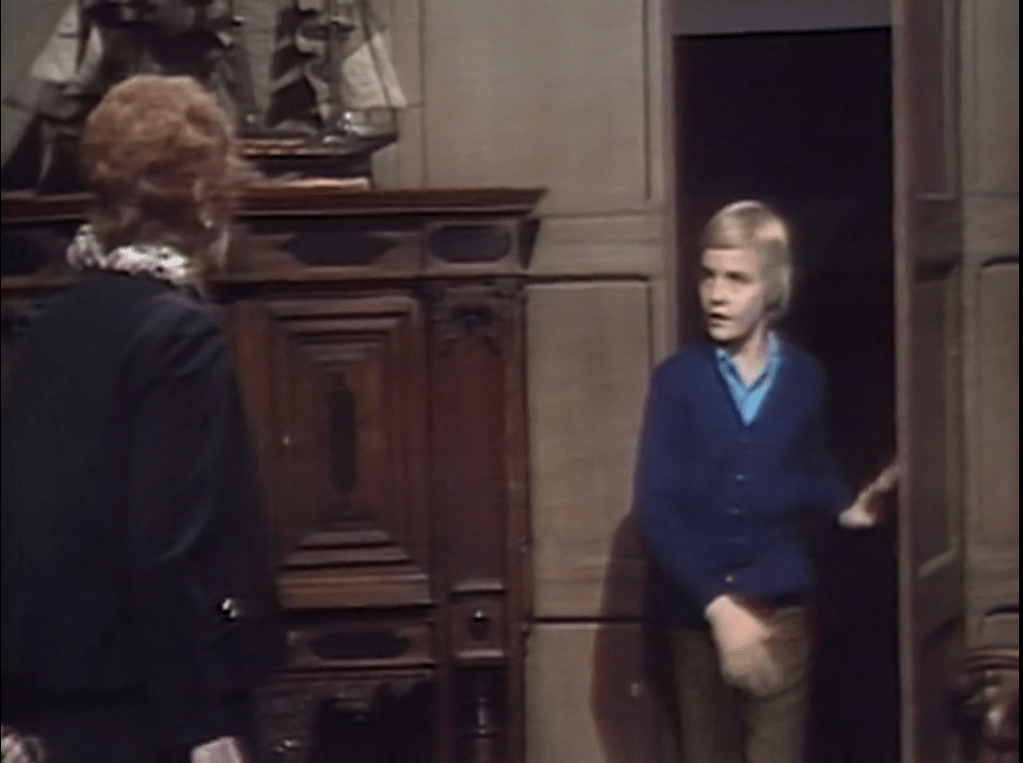
We know more than do Charity or Trask. We saw Jamison meet Quentin in the woods next to the woman’s body, and talk to him in an amiable and condescending tone about the possibility of turning this unfortunate incident to their mutual advantage. He also makes it clear that, despite his appearance, he is not simply Jamison. He is a sorcerer named Count Petofi, in possession of Jamison and acting through his body. When Charity asks Jamison/ Petofi if the woman was alone when he found her, he replies that of course she was. Smiling, he asks who she thought he might have seen. Terribly agitated, she soon excuses herself and goes into the foyer. Jamison/ Petofi looks directly into the camera and smiles. David Henesy was the first actor on Dark Shadows to use this technique, back in 1966 when he was playing strange and troubled boy David Collins. He’s been doing it a lot lately, and is still very good at using it to unsettle the audience.

He looks young for 150, but he’s grown quite a bit since 1966. Screenshot by Dark Shadows Before I Die.

Quentin comes down the staircase, wearing a tidy new suit. Charity is shocked that he did nothing to help the injured woman; he resumes his menacing tone and demands to know whether she kept her side of the bargain. He eventually deduces that she did not tell what she saw, and allows her to go upstairs to her bedroom. Quentin is usually charming, often funny, and occasionally aligned with good against evil, but even before he became a monster he was established as a homicidal maniac. When we first met Quentin, he was a ghost haunting Collinwood in the late 1960s and he kept killing people there. The first week of our trip back in time to 1897, we saw him trying to strangle his grandmother in her bed. And his sister-in-law turned him into a werewolf as revenge after he murdered his wife Jenny. Since we are focused on the horror of Charity’s situation as her father is pressuring her to marry Quentin, of course his bloodthirstiness is the aspect of his personality we see most clearly today.

Trask returns, carrying the injured woman. Quentin asks if she was conscious. Trask says she is not conscious. Quentin specifies that he wants to know if she has been conscious at any point while with Trask. This arouses Trask’s suspicions; Quentin protests that it is information he will need when he telephones the doctor. Trask says that she was not, and carries her upstairs.

Quentin goes to the drawing room. Jamison/ Petofi is there, and has some business to discuss. Quentin is too unsettled by the fact of the possession to talk candidly. Jamison/ Petofi decides to humor him. “I’ll become that beautiful child you so want to see… Can we play a game, Uncle Quentin?” Quentin is stunned by Jamison/ Petofi’s sudden change of tone and bearing. It is indeed impressive to see David Henesy drop his mimicry of Thayer David as Petofi and resume his usual approach to the role of Jamison. We’d forgotten just how deeply he had come to inhabit that imitation.

Jamison/ Petofi declares that they will have a treasure hunt. He gives Quentin a series of clues in the form of cryptic rhymes. Quentin is completely stumped by all of them. Finally Jamison/ Petofi just points at the desk drawer he wants Quentin to open and tells him there is a document in it that he can use against Trask. Quentin opens the drawer and pulls out heap after heap of paper, then declares “There’s no paper here!”

Quentin is not especially brainy; much of his appeal comes from the joy David Selby, Ph.D., took in playing a character who at no point says or does anything to demonstrate intellectual prowess. But we are not supposed to believe that he is stupid, at least not so stupid that it is plausible that “There’s no paper here!” was the scripted line. Maybe it was a blooper for “There’s no paper like that here!” or “There’s no paper here I haven’t seen before!” or something like that.

A document bearing a wax seal and a couple of signatures materializes on top of the papers Quentin has pulled out of the desk. He reads it, and sees that it is a full confession to the murder of Trask’s first wife, signed by Trask and lawyer Evan Hanley. All Jamison/ Petofi has to say is “It can be very useful, can’t it? Especially since it’s true… Aren’t games fun, Uncle Quentin?” and Quentin catches on that the document gives him power he can use against Trask.

Meanwhile, the injured woman has briefly regained consciousness in the upstairs bedroom where Trask and Charity are attending her. She spoke Quentin’s name, and Trask sent Charity to fetch him. Trask confronts Quentin about this. Quentin says that the woman’s name is Tessie, that he talked to her a couple of times when they ran into each other at the Blue Whale tavern, and that he knows nothing more about her. He admits he didn’t call the police after he called the doctor; he claims he simply forgot, in the confusion of the moment. Trask says that he will go and make the call. In an accusing tone, he asks “Most unfortunate, isn’t it, that you were the one who forgot?” He leaves Quentin alone with Tessie.

Tessie regains consciousness, looks at Quentin, and reacts with dismay. He tells her he didn’t mean to do it. She moans and dies. As she flops over, her right breast comes perilously close to springing out of her décolletage. When he realizes she has died, Quentin says “Tessie!” with a note of exasperation, as if she’s always doing inconvenient things like that. Mrs Acilius and I laughed out loud.

Downstairs, we see that Trask did not call the police after all. Charity is doing it from the telephone in the drawing room. Quentin enters through the secret panel behind her. We first saw him use this panel in #685, when it was 1969 and he was a silent but peculiarly corporeal ghost. He let himself into the drawing room and strangled silversmith Ezra Braithwaite, played by Abe Vigoda. A bit of an eldritch moment that the killer of Tessie is also the killer of a character played by the actor who would go on to play Tessio in the 1972 film The Godfather.

In Vigoda’s last scene in that movie, Tessio and Corleone Family consigliere Tom Hagen are at pains to assure each other that Tessio’s impending murder and the events that led up to it were strictly business, and that Tessio and his murderers still have the warmest regards for each other. Quentin’s attempt to deny his guilt to Tessie is of that same sort- he didn’t have any hostility towards her, his nature as a werewolf simply required that he kill the nearest person.

By contrast, Quentin’s interaction with Charity is intensely personal and intensely unpleasant. He takes the telephone out of her hand, something that men often do to women on Dark Shadows when they are trapping them, and moves deep into her personal space as he demands to know why she would want to call the police. She tells him her father ordered her to make the call; he says that Tessie will tell the police nothing now, because she is dead. Charity shouts that he killed Tessie, and that she will tell everything.

Danny Horn devotes much of his post about the episode at his great blog Dark Shadows Every Day to the absurdity of Quentin making a date with Tessie on a night when the Moon was full. In a comment, I pointed out that we have no reason to think he did make a date with her:

I don’t think it’s so hard to explain why Tessie was in the woods at dawn, though it does require a little fanfic.

Charity was in Quentin’s room in 806, inviting him to go for a walk on the beach when he’s busy getting drunk and listening to the same dreary little waltz over and over. To get Tessie into the woods, all we have to do is assume that shortly after that scene Quentin ran out of booze before he was drunk enough to stop caring about the upcoming full moon. Not wanting to deal with the Trasks, he didn’t go to the mansion’s liquor pantry, but staggered down to the Blue Whale.

There, Quentin met Tessie. She was upset with him for missing several dates in the last few days. He can’t very well explain what he’s been doing lately, and his refusal to answer Tessie’s questions angers her. She’s about to give Quentin a piece of her mind when he realizes that it will be dark soon, and rushes from the bar.

Now Tessie is really furious. She follows Quentin to the estate. Once there, she sees him change into the werewolf, and hides in terror for most of the night. Shortly before dawn, she thinks he is gone and leaves her hiding place. The werewolf appears and slashes away at her for a few minutes before changing back into human form and collapsing beside her.

And that’s when Charity finally takes her walk, and finds out.

Comment left 17 November 2020 by “Acilius” on Danny Horn, “Episode 808: Twice Burned,” Dark Shadows Every Day, 18 January 2016

Tessie is played by Deborah Loomis, and is the earliest screen credit on her IMDb page. Her next role listed there was in Hercules in New York, a 1970 film which also featured fellow Dark Shadows day player Erica Fitz Mears, who appeared in #594 and #595 as Leona Eltridge. Neither Miss Loomis nor Mrs Mears stuck with acting after the middle of the 1970s, but the two top billed members of the cast worked steadily for some years after. The first name in the credits was comedian Arnold Stang, who was best known at the time for a series of TV commercials for window screens ending with the tag “Arnold Stang says don’t get stung!” Second billed was Arnold Strong, a bodybuilder from Austria making his acting debut. Under his birth name of Arnold Schwarzenegger, Arnold Strong would go on to roles in several later films. I know of no evidence he ever auditioned for a part on Dark Shadows.

Episode 804: He is a gem, isn’t he

The evil Count Petofi, a 150 year old sorcerer, has taken possession of twelve year old Jamison Collins and is wreaking havoc in the great house of Collinwood. Due to Petofi’s spells, Jamison’s father Edward thinks he is a valet recently separated from the service of the Earl of Hampshire. Edward’s brother Quentin tries to explain to him what is actually going on, but Edward merely concludes that he is Quentin’s valet now. When Quentin follows the Collinses’ long-established protocol for dealing with mentally ill family members and locks Edward in the tower room, Edward bangs on the door and protests that he won’t be able to do his job if he is locked up. “And I will do it!” he vows.

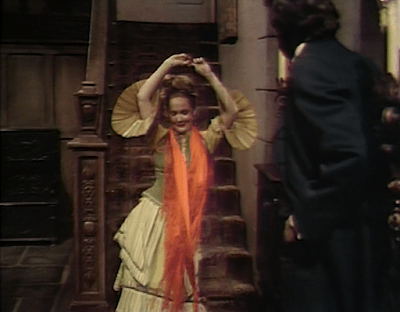
Charity Trask, disastrously uptight step-daughter of Quentin and Edward’s sister Judith, falls under Petofi’s influence and is possessed by the spirit of Cockney showgirl Pansy Faye. Pansy was on the show briefly in June. The childlike Carl Collins, brother to Judith, Edward, and Quentin, was engaged to marry Pansy before she was killed by vampire Dirk Wilkins. Pansy and Charity never met; when Carl asked Charity if she had seen Pansy, the scene was staged to make it seem absurd that the two women could exist in the same universe. Now, they exist in the same body.

Ta Ra Boom De Ayyyy… Screenshot by Dark Shadows Before I Die.

If Petofi has caused startling changes in Jamison, Edward, and Charity, the change in Quentin is perhaps the most jarring of all. He has been a ghost, a homicidal maniac, a Satanist, a zombie, and a werewolf, but always and everywhere a source of total chaos, who destroys all recognized order and is perfectly at home in the midst of sheer madness. Today, Quentin keeps making earnest attempts to restore everyone to their right minds and reestablish the proper and respectable relations within the household.

First time viewers will immediately catch on that the preteen David Henesy is not the actor who would usually play a 150 year old Hungarian nobleman, and when Nancy Barrett suddenly takes on an East London accent and enters wearing a garish costume and doing a dance with lot of hip shaking and pelvic thrusts, they will know that Charity is turning into someone else. The dialogue in the scenes involving Edward explains what is happening to him. They may not know that Quentin is not supposed to be the defender of the status quo. That information is supplied in two scenes. Charity/ Pansy receives a psychic message from the world beyond telling her that Quentin was involved in the murder of Carl, and she announces this information. Also, Quentin calls for help, and the helper who materializes is his distant cousin, Barnabas Collins the vampire.

At the end of the episode, Barnabas lays hold of Jamison/ Petofi and drags him into the secret passage leading from the drawing room to the west wing. It is usually bad news when a vampire abducts a child and shoves him into a dark space, but David Henesy brings such joy to the role of Jamison/ Petofi that we can hardly doubt that what comes next will be equally fun to watch.

Meanwhile, a painter named Charles Delaware Tate has presented himself. Tate’s first appearance will cause a sinking sensation in longtime viewers; he is played by Roger Davis, a terrible actor who delivers much of his dialogue by shouting while clenching the sphincter muscles in his buttocks, and who routinely assaults the women and children in the cast while on camera. We may have hoped we had seen the last of Mr Davis when his most recent character, Dirk, was destroyed shortly after murdering Pansy. But evidently Pansy’s return in the form of another actress has come at the price of Mr Davis’ return in the guise of another character.

For much of 1968, Mr Davis played a man known variously as Peter Bradford and Jeff Clark. His approach to characterization consisted of shouting “My name is Jeff Clark!” When this technique was played out, he took to shouting “My name is Peter Bradford!” He doesn’t shout today, mercifully. But he does say the name “Charles Delaware Tate” quite a few times.

Today’s story about Tate is potentially interesting. Jamison/ Petofi finds him when he answers the front door. Tate asks to see Jamison Collins; Jamison/ Petofi confirms that despite his appearance, he is indeed the person Tate has come to see. Tate accepts this with a blandness that suggests that he knows he is dealing with a magical personage.

Jamison/ Petofi gives Tate a photograph of Quentin and says that he wants a portrait of him. When Quentin comes to the drawing room and finds Tate sketching, he asks who he is. Again, Quentin adopts a stern tone which suits someone defending the sanctity of private property against an unknown intruder. Tate introduces himself and shows him a handwritten letter which Quentin instantly accepts as the product of his grandmother Edith. He tells Tate that Edith has been dead for some time and that he is not interested in a portrait of himself. Tate says that he has already accepted the commission and the money that Edith sent with it, and so he will rent lodgings in the village of Collinsport and finish the job regardless. Quentin does what viewers have hoped everyone who shared a scene with one of Mr Davis’ characters would do, and throws him out.

The forged letter is a fascinating touch for returning viewers. Petofi made himself welcome as a guest at Collinwood by showing Edward forged papers creating the impression that he shared Edward’s friendship with the Earl of Hampshire. That he has also created papers that Quentin immediately accepts as coming from Edith, who died long before Petofi had any reason to come to Collinwood, suggests that his powers of forgery are very extensive indeed.

Tate not only seems to know that Petofi has magical powers; he also shows an acquaintance with Petofi’s henchman Aristide.* When Tate mentions Aristide, he calls him “Aristeedy,” a sort of pet name with a diminutive suffix. This is probably just a blooper on the part of Mr Davis, but since Petofi is continually telling Aristide how lovely he is and how he is more attractive when he doesn’t speak, it does remind us of the gay subtext that runs through their scenes together. We might suspect that Petofi and Aristide’s sexuality is in one way or another one of the reasons they are connected to Tate.

The script opens all of these questions about Tate. Had he been played by an actor who was capable of depicting depth and highlighting ambiguity, it could have been a lot of fun to speculate about just what their answers might be. In #137, future movie star Frederic Forrest was a featured extra on the dance floor at The Blue Whale tavern; it’s easy to suppose he would have taken a speaking part. So when the show puts Mr Davis in front of us, I like to make the time a little more tolerable by imagining what Forrest might have brought to the role of Tate.

*His name is spelled “Aristede” in the closing credits, but it was “Aristide” in the original scripts.

Episode 706: What it was to be a Collins

Yesterday, we were in the great house on the estate of Collinwood when dying nonagenarian Edith Collins met mysterious newcomer Barnabas Collins. She told Barnabas that she recognized him. Edith had been entrusted with the Collins family’s darkest secret, which was about Barnabas. He is a vampire, entombed in the 1790s to be kept forever away from the living. Now it is 1897, and Edith sees that the family has failed. She must tell the secret to her eldest grandchild, Edward Collins. Edward comes into the room and Edith tries to tell him what has happened. She has difficulty speaking. Edward asks Barnabas to excuse them. He replies “Of course,” and leaves the room. He does stand at the door and listen to their conversation, apparently waiting to see if Edward will come out with a crucifix and a sharpened stake.

Today, we find that Edith was so shocked by the sight of Barnabas that she has lost her sense of her surroundings. Barnabas was kept in a chained coffin in an old family mausoleum, and Edith does manage to say the word “mausoleum” to Edward, but that’s as far as she gets with the secret. Thereafter, she weaves in and out of the moment, reliving several periods of her life, some as far back as the time of her wedding to Edward’s grandfather.

At the word “mausoleum,” Barnabas rushes back to the Old House on the estate, where he has been staying. He tells his unwilling servant, a woman named Magda Rákóczi, that she must fetch her husband Sandor and that she and Sandor must go to the mausoleum at once, take the coffin out of the secret chamber where it is hidden, leave no trace of any kind in the chamber, and carry the coffin to the house. Magda points out one of several facts that make it impossible to comply with these orders, which is that Sandor is in town where Barnabas sent him. Barnabas refuses to acknowledge this or any other insuperable difficulties, and goes back to the great house.

While Barnabas is sitting in the drawing room clenching his fists on the armchair where he is waiting to see what Edward will do when he learns that he is a vampire, a hidden panel opens and a man carries a pistol into the room. The man holds the pistol at Barnabas’ head and demands he tells him who he really is. The man identifies himself as Carl Collins, one of Edward’s brothers. Barnabas yields nothing. The man discharges the pistol, from which emerges a flag labeled “Fib.” He laughs. Barnabas is not amused. The audience may not share Carl’s sense of humor either, but the subsequent scene in which Carl claims to see that Barnabas has a kind face, predicts that the two of them will become close friends, and offers to let him borrow the pistol and play jokes with it himself, is hilarious. Jonathan Frid plays Barnabas’ icy reaction to Carl perfectly, and as Carl John Karlen does not betray the least glimmer of awareness of Barnabas’ affect.

Barnabas does not enjoy Carl’s greeting. Screenshot by Dark Shadows Before I Die.

Carl goes to the Old House to call on Magda. The scene there begins with Magda showing her palm to Carl. He wants her to read the Tarot cards; she says the cards will not speak unless she has money in her hand. Like his siblings, Carl is convinced that the secret which Edith keeps and which she has vowed to disclose only to Edward is the key to control of the family fortune. Magda knows better, but she goes through the cards anyway. They tell her that the family’s fortune is even larger than anyone knows, that when Edith’s will is found it will come as a surprise to everyone, that the surprise will lead to murder, and that the person who inherits the money will not keep it. The Queen of Cups turns up in a position that indicates Edith is still in control, but the last card Magda draws leads her to gasp and stand. She reels about the room, and declares that Edith is dead. “The cards are silent.”

Back in the house, Edward lets Barnabas into Edith’s room. He closes his grandmother’s eyes, and tells Barnabas that she did not tell him the secret. He vows to learn the secret even “if it’s the last thing I do!” We cut to Barnabas, looking uncomfortable. No doubt he is thinking of how inconvenient it would be if Edward were to find out the secret and he had to see to it that it was indeed the last thing he ever did.

This is the sixth consecutive installment to which I have given the “Genuinely Good Episode” tag, a record so far. Like the preceding five, it is stuffed with wonderful things. The acting is all very very good. Isabella Hoopes does a marvelous job as the delirious Edith, as Edward Louis Edmonds gives a master class in how to play a stuffy man, and the pairings of Grayson Hall, John Karlen, and Jonathan Frid with each other all unfold brilliantly, full of laughs but never losing their dramatic tension. So many of the episodes fans most enjoy would be drab for people coming to the show for the first time that it is always a memorable occasion when we see one like this, that anyone should be able to recognize as an outstanding half hour of television. It’s true the visual side lets us down a little; even by the standards of 1960s daytime television, the color is murky and there are too many closeups. But Sam Hall’s script and the performances are so good that no fair-minded person will complain very much about those problems.

Fans will take a special interest in Edith’s ramblings. When it first aired, viewers had no way of knowing how much of what she says about the family’s history will be reflected in upcoming episodes. The writers themselves probably didn’t have a much clearer idea about that than we do. But watching the series through for the first time, our default assumption about each of her lines is that it will have some significance as we go, so if we are committed to watching the show we listen closely.

We’ve already learned that Edith is over 90, so the very latest she could have been born is 1807. More likely she was born a bit before that, sometime between 1801 and 1806. She says today that her father-in-law was Daniel Collins. From November 1967 to March 1968, Dark Shadows was set in the late 1790s, and we saw Daniel. He was about 11 in 1795, so he would have been born in 1784 or thereabouts. So he could have been no more than 23 years old when Edith was born. Presumably his son Gabriel was the same age as his bride, though he might have been significantly younger. Edith does say that she always hated Daniel; perhaps she was a good deal older than Gabriel, and Daniel disapproved of her initially for that reason.

Edith tells us that Gabriel has been dead for 34 years, placing his death date in late 1862 or early 1863. She does not mention his cause of death or say anything about their son who was the father of Edward, Carl, and the others. It is firmly fixed that Edward and Carl’s brother Quentin was born in 1870, so Gabriel’s son must have survived him by several years.*

Edith says several times that the secret has been passed down from generation to generation and that she must tell it to Edward because he is the oldest. That seems to imply that Daniel told his oldest child, whom we presume to have been Gabriel, and that Gabriel told his oldest child, whom we presume to have been the unnamed father of Edith’s four grandchildren. He would then have told Edith before he died, either because Edward was not yet old enough to hear it, or because he was not available at the time.

But that implication is not at all secure. Edith says that Edward must be the keeper of the secret because he is the oldest- she doesn’t say what the connection is between being the oldest and keeping the secret. For all we know, she could have decided on her own to invent that tradition, starting with Edward and continuing with Edward’s oldest child. And when she says that it was passed down from generation to generation, she does not specify how many generations have been involved or which member of each generation did the passing. All we know is that someone of one generation learned it from someone else of a different generation, and that Edith believes it is the family’s responsibility to keep Barnabas from preying upon the living.

In a comment on Danny Horn’s post about episode 705 on Dark Shadows Every Day, someone calling himself “Mike” had a very interesting theory:

I think it’s reasonable to assume that sometime between 1897 and 1967 the secret was lost and not continually passed down. Perhaps in the original timeline Quentin was successful in killing Edith before Edward arrived, or maybe Edward died later in life before he was able to pass it on.

As far as Joshua passing the secret on, maybe he did, or maybe it was the elderly Ben Stokes who started the tradition?

Joshua was Barnabas’ father, and Ben Stokes was a much-put-upon indentured servant who was Barnabas’ devoted friend. They were the two people who knew that Barnabas was a vampire and that he was entombed in the secret chamber of the mausoleum. I replied to “Mike”:

I love that idea. Edith’s desire to tell the oldest son may lead us to assume that it has been handed down to the oldest son generation after generation, and it does lead the “Fab Four”** to assume that it brings with it some kind of power and access to riches. But their assumption is wrong, and ours may also be. Perhaps Joshua never told anyone. Perhaps the first person to tell the secret was Ben Stokes, and the person he told was Edith.

The scene between Barnabas and Magda brought another question to my mind. In #334, Barnabas was able to lock the panel in the mausoleum that leads to the secret room. Why doesn’t he just do that? It has also been made clear that as a vampire he is far stronger than are humans- if he wants to move the coffin from the mausoleum to the Old House, surely he could pick it up himself and do it more quickly and with less risk of detection than could Magda and Sandor. My wife, Mrs Acilius, agrees that we don’t know why Barnabas doesn’t lock the panel, but she says that it is perfectly clear why he can’t move the coffin- that is manual labor, and he is an aristocrat. His servants must do that.

*In a later episode, Quentin will mention that he knew Gabriel, throwing the 1862/3 date into question. But they never get around to any stories that depend on anything that happened in Gabriel’s later years. By the time we get to that one, only obsessive fans will remember his name. Eventually we meet two characters named Gabriel Collins, one in episodes that will air in 1970 and the other in the 1971 film Night of Dark Shadows, but a death date in the 1860s is not relevant to anything we learn about either of them.

**The “Fab Four” are Edith’s grandchildren, Edward, Carl, Quentin, and their sister Judith.

Episode 693: Contemptuous and evil spirits

Dark Shadows showed its first exorcism in #400. At that point the show was a costume drama set in the 1790s. The fanatical Rev’d Mr Trask was convinced that time-traveling governess Victoria Winters was a witch and that she was hiding in the Old House on the estate of Collinwood. He stood outside that house with a forked stick. He set the points of the stick on fire and shouted commands for the forces of darkness to come out.

Vicki was indeed hiding in the house, but she was not alone there. The actual witch, the wicked Angelique, set a fire of her own. She built a house of cards and burned it to cast a spell that caused Vicki to see flames in her room and respond by running out into Trask’s clutches. What surrounded Vicki were special effects superimposed on the screen, but what was in Angelique’s room was real fire, and it flared alarmingly close to actress Lara Parker’s lovely face. You’d think they’d have learned from #191, when an on-camera fire went out of control and nearly killed the entire cast, or perhaps from #290, when an off-camera electrical mishap led to fire extinguisher noise almost drowning out some dialogue. But apparently the prevailing philosophy was no injuries, no problem, so they went right on playing with fire.

Today we have another unsuccessful exorcism, and its failure leads them to make another attempt to burn down the set. Occult expert Timothy Eliot Stokes is informed that the evil spirit of the late Quentin Collins is haunting the great house of Collinwood and taking possession of strange and troubled boy David Collins. Stokes follows Trask’s rubric of standing outside the house, pointing a forked stick at it, and shouting inhospitable remarks at the spirits, but he doesn’t set fire to the points of the stick as Trask had done. There is a lot of excitement while he is performing the ritual, and once he finishes all of it dies down. Unsure of the outcome, he arranges to stay the night; while he is getting ready for bed, the curtains in his room catch fire. These are not special effects images; the curtains are really on fire, they are burning rapidly, and they are putting out a lot of smoke. The little building at 442 West 54th Street where Dark Shadows was made was packed with sets made of plywood and crammed with props, many of them highly flammable. Several sets were draped with huge fake cobwebs; I’m not sure what those were made of, but I doubt it was anything that would make a fire marshal very happy. It’s just amazing anyone who worked on the show lived to see 1971.

Hey, what’s the worst that could happen? Screenshot by Dark Shadows Before I Die.

There is a lot of very good stuff in this one. All of the acting is top-notch. David Henesy and Thayer David had scenes together as several characters, first as David Collins and crazed handyman Matthew Morgan in 1966, then as young Daniel Collins and much put upon indentured servant Ben Stokes when the show was a costume drama set in the 1790s, and now in 1969 as Ben’s descendant Professor Stokes and David. Those scenes all crackled, and today when Stokes catches David hiding behind the secret panel in the drawing room, demands he tells him the truth about what is happening to him, tricks him into admitting that he is afraid of Quentin, and warns him of the dangers ahead, the two make the exchange work magnificently.

There is also a scene in the drawing room between David Collins, his cousin Carolyn Collins Stoddard, and permanent houseguest Julia Hoffman while Stokes is performing the exorcism. He has to shout and writhe around a lot during this scene, very difficult things for child actors to do convincingly. But Mr Henesy had been acting professionally for four years before he joined the cast of the show in 1966, at the age of nine, and had studied acting under several distinguished teachers, among them Uta Hagen.

That background pays off; violent as the symptoms of the incipient possession are, Mr Henesy does not overplay them. It helps that he has support from Grayson Hall and Nancy Barrett; Hall plays Julia as firmly in control of herself, but obviously uneasy with the situation, while Miss Barrett shows Carolyn’s anxieties mounting until she shouts that David might be in real trouble. Since he is in convulsions and the crepuscular sound of the creaky old waltz that plays when Quentin is exercising power is emanating from the walls of the house, it would seem obvious that David is in real trouble. The line shows that Carolyn is starting to panic. When we see that neither the determinedly calm Julia nor the increasingly anxious Carolyn is having any particular influence on David’s emotions, we know that they are coming from someplace far removed from his visible surroundings.

Episode 692: The only existing link

There are two ongoing narrative threads in this part of Dark Shadows. One is the story of mysterious drifter Chris Jennings. Mad scientist Julia Hoffman knows Chris to be a werewolf and she is trying to help him. The other is the story of Quentin Collins, a ghost who is gradually gaining power and planning to drive everyone away from the great estate of Collinwood so that he can have the place to himself. Chris’ story had been the fast-paced A plot that kept expanding to involve more and more characters, while Quentin’s was the slow-paced B plot that consistently involved only Chris’ nine year old sister Amy, strange and troubled boy David Collins, and their governess Maggie Evans, with intermittent small parts for other established characters and the occasional chance for a day player to act a death scene. That changed yesterday, when Quentin decided that he had grown so strong he no longer needed to conceal himself from matriarch Elizabeth Collins Stoddard or the other adults in the great house. Quentin’s story is now the main topic, and Chris is the secondary feature.

We open today with Liz telling Julia what happened the night before. Julia tells Liz that she and old world gentleman Barnabas Collins had suspected that an evil ghost was at work in the house, and that they have seen another spirit that seems to be opposed to it. Liz says she has called occult expert Timothy Eliot Stokes. Stokes arrives and questions everyone.

Liz is alone at the desk in the drawing room when a secret panel leading to a passage to the long-deserted west wing opens. A cutout meant to suggest a disembodied hand appears on the screen. It picks up a letter opener from the desk and is about to stab her when Stokes enters.

Stokes shouts. The hand drops the letter opener and vanishes. He tells Liz what he saw. He notices the panel is open, and asks Liz about it. She says that it leads to the west wing, but that, as far as she knows, no one has used it in years. That answers a question that has been on the audience’s minds since October 1966. In that month, we saw Liz’ brother, high-born ne’er-do-well Roger, use the panel to play a dirty trick on well-meaning governess Victoria Winters. The panel was not seen or mentioned again until David and Amy started using it to do Quentin’s bidding several weeks ago. This line is our first confirmation that Liz knows that the panel and the passage behind it exist. Stokes asks Liz’ permission to perform an exorcism.

Meanwhile, Julia gets a telephone call from Chris. Liz’ daughter, heiress Carolyn Collins Stoddard, has taken a fancy to Chris and installed him in a cottage on the estate. Chris tells her that he is facing an emergency. Someone has come to the village of Collinsport who might know his secret.

In the cottage, Chris tells Julia that an unpleasant man named Ned Stuart has brought his sister Sabrina to the village and that he is demanding Chris meet with Sabrina. Chris had assumed Sabrina was dead, because she was in the room with him one night two years before when he underwent the transformation into his lupine form. Ned had told Julia and Barnabas that he was looking for Chris because he wanted to know what happened to his sister; he had always referred to Sabrina in the past tense, leading them to assume she was dead. Now Chris is in a panic, convinced that Sabrina will tell the police about him and that he will be punished for the many, many homicides he has committed as the werewolf.

Julia points out that if Sabrina were going to do that, she could have done so at any time. He would already have been arrested. Sabrina must not have told Ned or anyone else what she saw, and Ned must be telling the truth when he says he does not know what happened the last time Chris and Sabrina were together. She persuades Chris to go to visit the Stuarts in their suite at the Collinsport Inn.

Julia accompanies Chris on the visit. Ned is irritated that Chris did not come alone. His remarks are uncomfortable to hear, chiefly because of actor Roger Davis’ habit of clenching his anal sphincters when he raises his voice, making him sound like he is suffering from agonizing constipation.

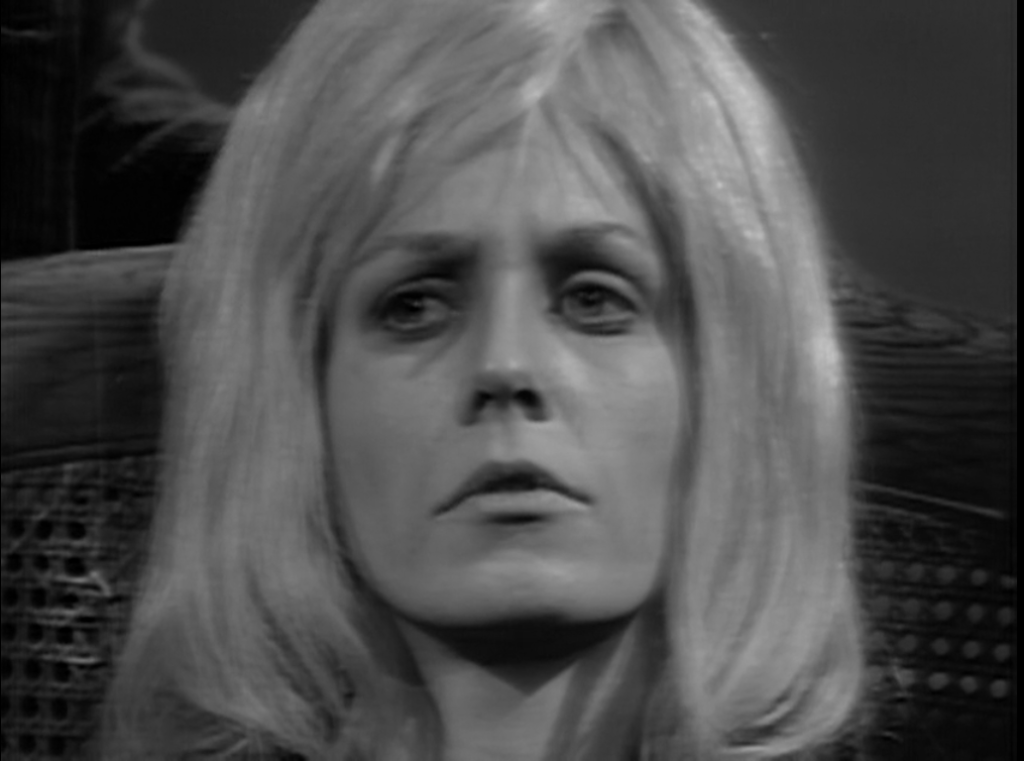
After Ned makes this fingernails-on-a-blackboard noise for a couple of minutes, he lets Chris and Julia into Sabrina’s room. She is in a catatonic state. Her hair is white, and her face is tinged with light blue makeup. The makeup makes her look haggard in color, but most TV sets in the USA in the 1960s received only in black and white. In black and white, the makeup is not very effective.

Ned says that Sabrina was like that when he found her, the morning after she paid her last visit to Chris’ apartment. Several takes of a framed copy of actress Lisa Blake Richards’ professional headshot invite us to imagine the before-and-after. Ned calls Sabrina’s attention to Chris; she rises from her chair, starts towards him, and collapses.

Episode 685: Barnabas, Quentin, and the Thing Glasses

Silversmith Ezra Braithwaite comes to the great house of Collinwood, bearing a ledger with information that old world gentleman Barnabas Collins wants. Barnabas is in the study, so twelve year old boy David Collins lets Mr Braithwaite into the house and escorts him to the drawing room. The two of them play a scene that may not have looked like much on the page, but as delivered by talented comic actors Abe Vigoda and David Henesy the lines are hilarious.

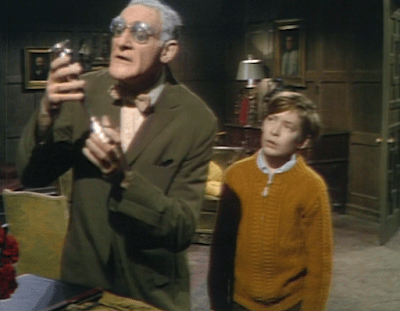
For example, Mr Braithwaite has two pairs of glasses, which he describes to David as his glasses for looking at things and his glasses for looking at people. David asks if the ones he is wearing are his “thing glasses.” We laughed out loud at that whole exchange. Mr Braithwaite asks David to go get “Uncle Barnabas”; David replies “He’s my cousin,” to which Mr Braithwaite answers “Ah, yes.” Again, that wouldn’t be a hit in a joke book, but Vigoda and Mr Henesy sell it. The purest example comes when Mr Braithwaite starts to change his glasses as he turns to the pages of the ledger and says out loud to himself “Oh, Ezra, Ezra, you already got on your reading glasses.” That is a laugh line entirely because of the way Vigoda stresses the words “got” and “on.”

There is a little exchange between Ezra and David that will stand out to longtime viewers:

Ezra: David is it? Well, I don’t remember a Collins being named David before. Now, my name is Ezra, as my father was and his father before him. You find a name like Ezra and you don’t give it up.

David: I guess not.

Ezra: Yes, now, David’s kind of a new-fangled name.

David: No, there’s King David in the Bible.

Ezra: Oh, of course, yes, yes. A good man, too.

In #153, it was established that no Collins ever bore the name “David” until undead blonde fire witch Laura Murdoch Collins insisted that her husband Roger go along with her plan to name their son “David Theodore Collins.” That turned out to be hugely important as evidence of Laura’s evil intentions. In #288, it sounded like they had decided to retcon that away when David looked in a family album, saw a portrait of a “David Collins” from a previous century, and wondered aloud if he had found his namesake. Nothing has come of that potential namesake in the 79 weeks since, and Ezra’s line that he didn’t “remember a Collins being named David before” would suggest that they’ve gone back to the original idea.

Mr Braithwaite, in his thing glasses, examines a piece of silver. David examines him. Screenshot by Dark Shadows Before I Die.

Each time Mr Braithwaite looks at someone through his “thing glasses,” we get a point of view shot showing that his eyesight is blurry. They then cut back to the other actor in regular focus. These shots are brief enough that the repetition isn’t a big problem, but it results in a series of exchanges the actors deliver to the camera rather than to each other. Those don’t work at all. Mr Henesy and Abe Vigoda had such a fine comic rhythm going that it’s a shame to break it up with this clunky stuff.

Reading the ledger, Mr Braithwaite says that the silver pentagram Barnabas wants to know about was bought in April 1897 by Miss Beth Chavez and paid for by Quentin Collins. We have seen Beth’s ghost. She is very tall and so thin you could clasp your fingers around her waist. Her complexion is pale as can be, her hair blonde, her eyes blue. I’ve met a fair number of Chavezes in my time, including a couple of Elizabeth Chavezes, and none has met this description. I have nothing to say against slender blondes, and actress Terrayne Crawford is movie-star beautiful. Still, if a fellow were excited about a blind date with a girl known to him only by the name “Beth Chavez,” he’d probably be a bit disappointed if the person who showed up met her description.

We have also seen Quentin’s ghost. Quentin is manipulating David into helping him with a number of murders he intends to commit. Beth has thwarted one of these murders so far, and is trying to prevent Quentin from achieving other evil plans of his. But Quentin is apparently more powerful than she is.

While Mr Braithwaite is alone in the drawing room, Quentin enters through a secret panel. Earlier in this episode, they made it clear Quentin can choose whether he is visible to the living people in the spaces he occupies; there is no need for him to hide. Why does he use the panel?

Longtime viewers may be able to make a surmise. We saw this panel for the first time in #87, when David’s father Roger used it for a sneaky errand. We didn’t see it or hear of it again until #643, when David told nine-year old Amy Jennings that there was a passage “very few people” knew about, and used it to lead her to the room in which Quentin was at that point confined. Quentin’s use of it will therefore suggest that he knows all the secrets of the house. It also suggests that when he dwelt there as a living being he was a naughty fellow who was in the habit of using its secret passages for the sort of underhanded mischief Roger got up to in #87 and #88.

Quentin strolls up to Mr Braithwaite and smiles at him. Mr Braithwaite is wearing his “thing glasses” and cannot see Quentin clearly. He asks Quentin if he is the friend Barnabas spoke of when he asked him about the pentagram. Quentin nods. Mr Braithwaite says that he himself made the pentagram in April 1897, when he was “fifteen and a half.” It is now February 1969, so we know that Mr Braithwaite is 87. He recognizes Quentin. Shocked to see a man who has been dead for decades apparently alive, well, and in his twenties,* Mr Braithwaite dies of a heart attack.

It’s a shame we won’t be seeing more of Abe Vigoda as Mr Braithwaite. At least they spelled his name correctly in the credits this time; yesterday he was “Abe Vigodo.”

*Two days past his 28th birthday, to be exact. Happy belated 84th to David Selby!

Episode 668: Very odd games

When Ron Sproat joined the writing staff of Dark Shadows in the Autumn of 1966, he used his first several scripts to catalogue the ongoing storylines and classify them according to their potential for future use. Now Sproat is approaching the end of his time on the show, and he is again in a self-referential mood. Today’s episode is mostly about the geography of the great house of Collinwood and the grounds around it.

We first heard about the servants’ quarters in Collinwood in #196, when seagoing con man Jason McGuire imposed himself on matriarch Elizabeth Collins Stoddard as a houseguest. Liz faced front and looked past the camera to stage right, saying she might find a room for Jason that way. He cut her off, saying that was where the servants’ quarters were. He insisted on a room upstairs, among the family.

Today, we see the servants’ quarters for the first time. Children David Collins and Amy Jennings are under the influence of the evil spirit of Quentin Collins, and David tells Amy that Quentin wants them to go to a particular room. Since it is late and they are supposed to be in bed, they take care that none of the adults see them. Rather than go past the other bedrooms and down the main staircase in the foyer, they cut through the long-deserted west wing and enter the drawing room through a secret panel. They are detained there briefly when they hear heiress Carolyn Collins Stoddard talking with Amy’s brother, mysterious drifter Chris Jennings, in the foyer. When Carolyn and Chris go away, Amy and David leave the drawing room and exit the same direction Liz had faced when she tried to get Jason to stay in the servants’ quarters.

The only servants living in the house now are housekeeper Mrs Johnson and her son, unsightly ex-convict Harry. Mrs Johnson comes down the corridor and hears the children talking behind a door. She is wearing her robe over her nightgown, confirming that the part of the house the children have gone to includes her bedroom. A very nice painting hangs on the wall of the corridor, showing that the Collinses’ habit of cramming their properties with fine art extended to every part of the house.

Mrs Johnson hears the children.

Also in this episode, Carolyn invites Chris to live in the cottage on the estate that was once occupied by crazed handyman Matthew Morgan, and later by undead blonde fire witch Laura Murdoch Collins. Carolyn tells Chris that the cottage is very far from the main house, profoundly isolated. It has been fairly well established that another mansion on the estate, the Old House, is a fifteen minute walk through the woods from the main house, so Carolyn’s tone suggests that the cottage, too, is about that remote.

This might bring a chuckleworthy image to the minds of longtime viewers. In #139, well-meaning governess Victoria Winters carried a breakfast tray loaded with tea things from the main house to Laura at the cottage. She is conspicuously careful with the tray. Vicki was at once so resolute when she had a task to accomplish and so utterly lacking in practical sense that it is very easy to picture her hiking the better part of a mile through the woods carrying such a thing.

Vicki brings a tray to Laura, #139.

Episode 648: Her name is Madame

This is the second of three episodes featuring Cavada Humphrey as Madame Janet Findley, a medium called in to investigate the strange goings-on at the great house of Collinwood. Humphrey’s performance so utterly dominates the segment, and I have so little to add to what I said about her style in yesterday’s post, that all I can do is make a series of more or less miscellaneous observations about its other aspects.

Today Madame Findley meets children David Collins and Amy Jennings. Amy and David are coming under the influence of evil spirit Quentin Collins. She questions them in the drawing room, and finds a hidden panel that leads to the long-abandoned west wing of the house. Over the children’s objections, she enters the secret passage. As soon as she is in, they hurriedly close the panel, locking her in. Evidently their objections were part of a ruse designed to lead her to Quentin’s stronghold. All too often on Dark Shadows, the audience knows too much about what characters are trying to do. This scene stands out, because they really do keep us guessing whether the children want Madame Findley to go into the secret passage. We don’t really know what their goals are until we see them shut her in.

Madame Findley goes into the darkness. Screenshot by Dark Shadows Before I Die.

Earlier in the episode, Amy’s brother Chris dropped in. He was very eager to see permanent houseguest Julia Hoffman, MD. Amy mentioned to Chris that there was another visitor in the house. When Chris asked who it was, Amy replied, “Her name is Madame- Madame something- at least that’s what they call her.”

I heard these lines in the voice of T. S. Eliot. The rhythm is reminiscent of a section of his poem The Waste Land, which in 1968 was an extremely familiar text to people with literary ambitions:

Madame Sosostris, famous clairvoyante,

Had a bad cold, nevertheless

Is known to be the wisest woman in Europe,

With a wicked pack of cards. Here, said she,

Is your card, the drowned Phoenician Sailor,

(Those are pearls that were his eyes. Look!)

Here is Belladonna, the Lady of the Rocks,

The lady of situations.

Here is the man with three staves, and here the Wheel,

And here is the one-eyed merchant, and this card,

Which is blank, is something he carries on his back,

Which I am forbidden to see. I do not find

The Hanged Man. Fear death by water.

I see crowds of people, walking round in a ring.

Thank you. If you see dear Mrs. Equitone,

Tell her I bring the horoscope myself:

One must be so careful these days.

It was indeed a mysterious Tarot card that prompted matriarch Elizabeth Collins Stoddard to call for help, and that call brought Madame Findley to the house. The card she interprets is the Tower of Destruction, which unlike the cards Eliot’s Madame Sostris describes actually appears in existing Tarot decks. She doesn’t have a cold, and she isn’t in the business of selling horoscopes door to door. On the contrary, as Humphrey plays her she is a dazzling presence.

Liz did not call Madame Findley directly. She telephoned occult expert Timothy Eliot Stokes, who introduced her to La Findley. At first sight, Stokes appears to be a stuffy academic with an impossible Anglophile manner, but as we get to know him he turns out to be very much at home in the bizarre netherworld in which the show takes place, so much so that his supernatural adversaries fear that he may have powers surpassing theirs. T(homas) St(earn)s Eliot was so much like T(imothy) Eliot St(oke)s in the first impression he made, so highly regarded by the sort of people who wrote Dark Shadows, and so generally famous in the 1960s that it is very likely that Stokes’ name was at least partly inspired by him.

It’s true that Madame Findley’s name lacks the exotic glamour Eliot gave his character. I suppose if you have all of Europe to choose from, you can take your stray Tarot cards to someone named “Madame Sosostris,” but if you are limited to central Maine, you have to settle for “Janet Findley.”

I made a remark about Madame Findley’s name in the comments on Danny Horn’s post about episode #647 on his great Dark Shadows Every Day:

It’s just delightful that they introduce an otherworldly, mystical character, played with an actress who brings a genuinely eerie note to her performance, and her name is… “Janet Findley.” It’s like Monty Python and the Holy Grail, when they meet the wizard who is known as “Tim.”

I wonder if there’s any connection between the name “Janet Findley” and the name “Janet Fisher,” whom Carolyn mentioned as a friend once of twice in the first season. Seems like a lot of Janet Fs. For that matter, I wonder if there’s a connection between Tim the Wizard from Monty Python and Tim(othy Eliot) Stokes, who a couple of episodes back had to tell Vicki that he isn’t a wizard.

Comment left by Acilius, 8 October 2020, on Danny Horn, “Episode 647: The Wire,” Dark Shadows Every Day, 12 May 2015

That remark drew a response from a commenter who posts as “Mary”:

Findley is a popular name on Dark Shadows. In addition to Janet, Margaret Findley is one of the ghostly widows, Thomas Findley is one of Jeb’s zombies in the Leviathan storyline and Findley’s cove is the location of Carolyn’s cottage in 1995.

Comment left by “Mary,” 18 February 2021, on Danny Horn, “Episode 647: The Wire,” Dark Shadows Every Day, 12 May 2015

When Madame Findley asks about the closed-off parts of the house, Liz tells her about both the west wing and an east wing. The phrase “east wing” had come up a couple of times in the first year of the show, but it always seemed to be either a case of the writers not having made up their minds which side of the house the deserted wing was on or a slip of the tongue by the actors. This is the first time the show makes it clear that the house really does have two deserted wings.

Humphrey was too perfect for Dark Shadows to play only one role. In a comment on Danny’s post about this episode, I indulged in a little fanfic about another part that would have been right for her:

Cavada Humphrey looks quite a bit like Jonathan Frid. I wonder what 1795 would have been like if Barnabas had had an older sister who bossed him around, stood around during his ridiculously childish fits of petulance, occasionally acted as his conscience, and time and again serve as his enabler and protector. It would have been funny to see Grayson Hall’s Countess express disapproval of such a relationship.

Heck, that older sister could have been Sarah. Just because she’s a child in her ghost form doesn’t mean she has to have died at that age. Maybe she comes back in the form in which her relationship to her brother took its permanent shape, when she was about nine and he was about seven. Of course, that possibility is foreclosed at Sarah’s first appearance, when she tells Maggie not to let her “big brother” know she saw her, but I suppose they could have retconned that away with a phony flashback where she says “little brother.”

Comment left by Acilius, 8 October 2020, on Danny Horn, “Episode 648: Astral Disturbances,” Dark Shadows Every Day, 14 May 2015.

I’m very fond of Sharon Smyth, and Sarah’s last appearance in the 1795 segment was so poignant it would have been a substantial loss for her not to have been in it. On the other hand, she had so much less to do when she was playing a living being than she did in the preceding months when Sarah was a ghost, and so much of what she did get to do was outside her rather sharply limited range, that it is not difficult to imagine a different kind of Sarah making the eighteenth century insert a more compelling drama.

Episode 643: Magda, whoever she is

The whole episode takes place within the great house of Collinwood. We start with conversations between heiress Carolyn Collins Stoddard, mysterious drifter Chris Jennings, and sarcastic dandy Roger Collins. They are trying to determine the significance of the events of a séance that took place yesterday, during which Carolyn was possessed by the spirit of someone named “Magda.” This name is unknown to anyone in the house.

Through Carolyn, Magda uttered a command to “Stop them!” because “My curse!” means that “He must stay where he is!” Returning viewers know that Chris’ little sister Amy and Roger’s young son David are in touch with the ghost of Quentin Collins, a great-uncle of Roger’s who lived in the late nineteenth century and whom the family history falsely records as having gone to France and died there. We can assume that Magda was a contemporary of Quentin’s, that he is the one who must remain where he is, and that she means the children when she says “Stop them!” But none of the adult characters knows what Amy and David are up to, and Magda’s words mystify them.

Roger is alone in the drawing room while Carolyn is showing Chris out of the house. He is about to take care of some work he brought home from the office when a book flies off the piano and lands on the floor. He finds a letter tucked in the book. Carolyn comes back, and he tells her what happened. He says that the letter is addressed to his father, Jamison Collins; this is the first time we have heard Jamison’s name. He says that it is dated 1887, when Jamison would have been a boy. And he tells her that it is signed “Quentin.” With a look of recognition, he says “We have a Quentin Collins as an ancestor. Actually, I didn’t know very much about him. I think he spent most of his time abroad.”

Roger reads the letter to her. The text is: “Dear Jamison, you must return to Collinwood. I need your help. You must intercede with Oscar. Only you can save me.” Considering how the book spontaneously leapt from the piano, Carolyn is sure that Magda’s ghost must have wanted them to read the letter, and that she is trying to warn them that someone in the house is in danger. It calls Quentin to their attention.

Roger goes upstairs to check on David. As it happens, Amy is in David’s room at the time, and they are about to go looking for Quentin’s ghost. They know that the adults will not tolerate this, and so David jumps into bed and Amy hides behind the door. There is some farcical business as Roger starts to go, Amy starts to come out, then he stops and she scurries back to her hiding place. Once his father is gone, David tells Amy that it was very unusual for him to drop in. “He never says good night to me.”

When Roger returns to the drawing room, Carolyn, who a few minutes ago announced that someone in the house- “It could be any one of us!”- was in imminent danger, asked Roger why he was “suddenly so concerned about David.” Even longtime viewers who remember Roger as the phenomenally bad father he was in the first 38 weeks of the show will think that this is overdoing it. After all, Magda’s warning to him and Carolyn came in the form of a letter addressed to a boy, and David is the only boy in the house. It is natural enough that the reference to Jamison would bring David to mind.

Amy had slipped into David’s room while he was sleeping. She woke him to say that Quentin was angry because “Something has happened.” She knows nothing about the séance or the conversations going on downstairs, and so cannot share our conjecture that Magda is an old enemy of Quentin’s and it is her activities that are disturbing him. David is at first reluctant to get up and irritated when Amy wants to contact Quentin. As he grumbles at her, they begin to sound like an old married couple, even though they only met on Monday and are eleven years old.

David grudgingly agrees to pick up the antique telephone through which he has heard Quentin’s breath and Amy has heard him speak. The breath is audible, and when he gives the receiver to Amy she hears Quentin says that “she would try to stop” them. He didn’t specify who “she” was, but Amy has drawn the conclusion that they should go to the room in the long deserted west wing of the house where they originally found the telephone and contacted Quentin. Every time David resists her ideas, Amy strikes exactly the note that will lead him to do what she wants. At one point, Amy tells David “You’re braaver than I am!” to which he bluffly replies “Because you’re a girl!” He then presses forward with the plan she had formulated.

You know how kids are, always on their phones. Screenshot by Dark Shadows Before I Die.

The children find that the door they had previously used to get into the west wing is now locked. David says that there is another way in, but that it is a secret very few people know about. He leads her to the door of the drawing room, only to find that Roger and Carolyn are still in there. They hide. Once the coast is clear, David leads Amy to a secret panel behind a chair next to the fireplace. We have seen this panel before, in #87. On that occasion, Roger had used it to sneak into the west wing unobserved and release well-meaning governess Vicki from the room to which David had confined her, hoping that she would die. It was unclear whether anyone other than Roger knew of its existence. We haven’t seen it since. Dark Shadows‘ ratings were very low in October 1966, and most of the people watching now hadn’t heard of it then. So when David says that very few people know about the secret panel in the drawing room, his words apply to the audience as well as to the characters.

David opens the panel. He and Amy go into the passage. When the panel is closed behind them, we see the chair move itself back into place in front of it, suggesting an occult power is at work.

David and Amy encounter various signs of supernatural opposition as they make their way to the room. At one point Amy sounds genuinely frightened and suggests turning back, but she has done her work too well- David is now determined to prove his courage. Once they are in the room, the door slams shut and they find that they are trapped. Longtime viewers who remember what David did to Vicki way back when will see an irony in his captivity in the west wing.

Skillful as Amy is in her management of David Collins, Denise Nickerson and David Henesy haven’t quite figured out how to work together yet. They had very different styles of acting, his coming from inside out as he uses his lines and stage directions to project the character’s feelings and intentions, hers coming from outside in as she throws herself into whatever the character is doing at the moment and finding her inner life through those. She is on top of her form right from the start, but he keeps getting thrown off, atypically mangling his dialogue several times and putting the emphasis in odd places in the lines he does get right. That won’t last long- soon David and Amy will be a “supercouple,” as fun to watch together as any other pairing on the show. But this episode is a bad day at the office for Mr Henesy.

Danny Horn’s post about this episode on his Dark Shadows Every Day takes the bits and pieces of information that will fit well with continuity months down the line, contrasts them with the bits and pieces that won’t, and focuses on a case that the writers didn’t have any plan in mind when they were writing the show. I think Danny simultaneously goes too far and not far enough with this point.

In a 1991 interview that Danny himself put online, writer Violet Welles confirmed that the writing on Dark Shadows, as on other soaps, began with a six month story projection that the writers would break down into “flimsies,” day by day outlines of how it might all play out. No one was going to force them to stick with those projections, much less with the flimsies, but creating them meant that the writers spent a lot of time kicking ideas around for possible plots and possible characters. They also meant that there were stacks of paper recording those ideas, so if someone suggests in November that Quentin might have been enemies with a witch named Magda, it won’t require a feat of memory to recall that suggestion in January. So it is going too far to dismiss all thought of a connection between what the characters say today and what we will see next year.

But he doesn’t go far enough when he suggests that the pressure the writers were under to crank out five scripts a week would have kept them from planning for events we wouldn’t see for several more months. They were indeed subject to impossible deadlines, and they did indeed have to improvise at the last minute. So much so that they did not know whether any given event would happen next week, next month, six months from now, or not at all. They may well have planned a story out in detail thinking they might need it soon, only to have it sit on the shelf until next summer.

I always try to write these commentaries as if I hadn’t seen any of the subsequent episodes, so when I mention foreshadowing I try not to say whether or how it will pay off. I also try to write from a perspective that would have been more or less possible for someone watching the show when it was originally broadcast, so when foreshadowing does pay off or when in other ways an episode echoes something we had seen earlier I try to note that echo first and to speculate about what it might mean later, confining any references to information that became public afterward to the bottom of the post. So I won’t quote the particulars of Danny’s argument, or of my comment on it. I hesitated to say as much as I have about Magda, but when I tried to make the same point without using names the results looked like algebra (“Let x be a ghost and y be a witch. Suppose that x and y lived in the same period; call this period P.”) Since the episode leans so heavily into the relationship between Magda and Quentin today, I resigned myself to the spoiler.

Episode 616: When a woman has a man in her power

In June 1967, vampire Barnabas Collins locked his victim Maggie Evans, The Nicest Girl in Town, in the prison cell in the basement of the Old House on the estate of Collinwood. The ghost of Barnabas’ little sister Sarah appeared to Maggie several times while she was in the cell. Sarah told Maggie that no one could know she had been to the cell, and particularly warned her not to tell her “big brother” she had seen her. With some reluctance, Sarah eventually gave Maggie a clue that led her to a hidden passage. Sarah’s father had sworn her to secrecy about the passage, and that not even her big brother knew about it. Maggie finally puzzled out the clue, enabling her to escape just moments before Barnabas came to the cell with the intention of killing her. When Barnabas chased Maggie through the hidden passage in #260, the wondering expression on his face confirmed that he had never had any idea the passage was there.

From November 1967 to March 1968, Dark Shadows was a costume drama set in the years 1795 and 1796, the period when Barnabas and Sarah were living beings and the Old House was their home. We saw how cruelly their father, haughty overlord Joshua, treated his indentured servant Ben, and we saw that Joshua had the great house of Collinwood built with a prison cell in its basement. Joshua confined Ben to that cell in #401. With that, we could be sure that Maggie’s cell was already in the basement of the Old House when Barnabas and Sarah lived there, and could surmise that Joshua really did forbid the living Sarah to share with Barnabas or anyone else what she had found about the hidden passage.

The show never explained how Sarah found out about the passage. We might imagine her hiding and watching Joshua or someone else do maintenance on the cell. But the fact that Joshua kept the existence of the escape hatch from Barnabas suggests he wanted the option of locking his son in the cell. Why not his daughter as well? Perhaps Sarah found the passage while confined in the cell herself. Or perhaps some other, older ghost appeared to her while she was there and told her about it. That the clue she gives Maggie is in the form of a rhyme (“One, two, away they flew…”) would suggest this latter possibility. Sarah may have memorized the rhyme as she memorized the lyrics to “London Bridge” and may have solved the riddle as Maggie solves it.

Shortly after Dark Shadows came back to a contemporary setting in March 1968, Barnabas was cured of vampirism. That cure was stabilized in May, when he donated some of his “life force” to the creation of Frankenstein’s monster Adam in an experiment completed by his friend, mad scientist Julia Hoffman. Barnabas and Julia locked Adam up in the basement prison cell for the first weeks of his life. Vampires and mad scientists are metaphors for selfishness, so it is hardly surprising that they are horribly bad parents. But if Joshua was in the habit of locking his children in that same cell, the moments when Barnabas takes fatherly pride in the imprisoned Adam take on a special pathos. It really does seem like a normal situation to him.

Adam escaped from the cell in #500, demolishing the doorway in the process. Today we see that it has been rebuilt. Perhaps to Barnabas, a house just isn’t a home unless it has a prison cell in the basement.

Now, Barnabas has himself become the blood thrall of a vampire, his ex-wife Angelique. Discovering the bite marks, Julia decides to address the situation by locking Barnabas and his servant Willie in the cell. Barnabas won’t be able to get out to heed Angelique’s summons, and Willie hangs a cross over the door to keep her from materializing inside it.

Left to right: Barnabas Collins (Jonathan Frid); Willie Loomis (John Karlen); Julia Hoffman (Lady Elaine Fairchilde.) Screenshot by Dark Shadows Before I Die.

We cut to Maggie’s house. Maggie’s memory of her ordeal as Barnabas’ victim has been wiped from her mind a couple of times. She receives a visitor, the suave Nicholas Blair. Unknown to Maggie, Nicholas is a warlock and Angelique’s master. He has a crush on Maggie which has distracted him from his managerial responsibilities, which to be frank he had not been handling very diligently in the first place. Maggie gives Nicholas several pieces of news that he really ought to have been aware of for some time. She tells him that her ex-fiancé, Joe Haskell, is still alive; that she visited Joe twice while he was at the Old House recovering from some injuries; that Joe is now in the hospital under police guard; and that Joe tried to kill Barnabas and keeps vowing that he will try again, since he believes Barnabas is trying to kill him. Nicholas is flummoxed by all of this, and meekly goes along when Maggie insists on visiting the Old House to pay a call on dear, sweet Barnabas.

The scene in Maggie’s house has an odd feature. We’ve just had a closeup of Willie hanging a cross above the door in the cell to keep Angelique away. In the early days of the vampire storyline, it was not at all clear that the cross would deter vampires in the world of Dark Shadows, since Barnabas was often seen strolling comfortably through a cemetery where half the grave markers were cross-shaped. It was not until #450, during the 1790s flashback, that we saw Barnabas recoil from a cross. In #523, we learned that the cross also immobilizes Nicholas. Yet Maggie is today wearing a dress the front of which is dominated by a red cross, and it doesn’t bother Nicholas a bit. The show is drifting into a spot where it may have to stop and spend time explaining its theurgy. Does the cross only work against a demonic creature if it is specifically aimed at that creature? Or if the person setting it up knows about the creature? Or is there some other qualification? It’s getting confusing.

At the Old House, Julia tells Maggie and Nicholas that they cannot see Barnabas, because he is resting. Maggie keeps insisting, and Julia shifts her ground, claiming that Barnabas went out, she knows not where. When Julia says this, Maggie is incredulous, but Nicholas brightens. Evidently he wants to believe that Barnabas has gone off to respond to Angelique’s call, and accepts Julia’s statement happily. Maggie apologizes for demanding to see Barnabas, and she and Nicholas leave.

Meanwhile, Barnabas is scheming to get out of the cell. While Willie is complying with his request to pour a glass of water, Barnabas bashes him on the head with an empty bottle. He then goes to the hatch for the secret panel, remembers that “Maggie found it a long time ago!” and figures out how to open it. Since we saw Willie open the hatch and show Adam Barnabas’ jewel box in #494, you would think Barnabas already knew how it worked. At that time, it also seemed that the passage behind the hatch had been sealed up, so that it no longer led to the beach. Apparently we aren’t supposed to remember that. Barnabas crawls out and closes the hatch behind him before Julia comes back.

As Barnabas, Jonathan Frid usually moves in the stateliest possible manner. When he escapes from the cell today, the camera lingers on him crawling, driving home the contrast with his typical gait. That is quite different from what we saw in #260, when he followed Maggie into the hatch- then, we saw him move toward the opening, but cut away before he had to take an ungainly position. Today, the makers of the show want us to hold the image of a crawling Barnabas in our minds.

Crawling suggests Barnabas’ weakness under Angelique’s power, certainly, but in this setting it suggests more. This is the house where he was born, and what he is crawling into is a lightless passage that it looks like he will have to squeeze through to emerge outside. He has regressed not only to infancy, but all the way back to birth. If Joshua did indeed confine him to this cell in his childhood, Barnabas would likely have experienced that same regression in those days as well.

The sign of the cross reminds us of one who said that we must be born again to receive a life in which our hopes will be fulfilled more abundantly than we can ask or imagine; Barnabas labored for 172 years under a curse that compelled him to die at every dawn and revive at every sunset, but perhaps even before that he was the prisoner of a cycle of abuse that forced him to experience the trauma of birth over and again, each time finding himself in the same narrow space, a stranger to all hope. Indeed, when Barnabas first became a vampire in the 1790s, he put his coffin in this basement, near the cell, and he persisted in putting it there even after it became obvious that it was very likely to be discovered. That persistence made no logical sense in terms of Barnabas’ need for operational security, but if he saw his vampirism as a continuation of his childhood experience of confinement in the basement cell, it would make all the sense in the world. That is his place, that is where he belongs, that is his reality.