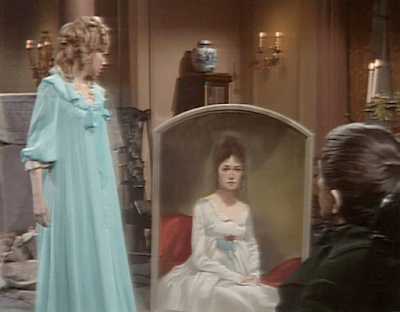
In the first months of Dark Shadows, the audience’s point of view was represented by well-meaning governess Vicki, who needed to have explained to her everything we might want to know and who reacted to all the strange goings-on with the mixture of disquiet and curiosity that the makers of the show hope we will feel.
Vicki has long since been replaced as our representative by mad scientist Julia. We no longer want characters to tell us what has been going on, nor are we making up our minds about our moral evaluation of the events in the stories. We find ourselves in the middle of a whole clutch of fast-moving plots, trying to keep up with them all and hoping that nothing will stop the thrills. Julia’s loyalty to her best friend, sometime vampire Barnabas, and her supremely well-developed capacity for lying put her in the same position, and her vestigial conscience is no obstacle to any juicy storyline.
When Vicki was our on-screen counterpart, her charge, strange and troubled boy David, was the show’s most powerful chaos agent. David precipitated a series of crises that seemed likely to expose the secrets of the ancient and esteemed Collins family, to kill one or more of the major characters, or both. In #70, David led Vicki to his favorite playground, the long-vacant Old House on the estate of Collinwood. David would keep sneaking into the Old House even after Barnabas took up residence there in #218.
Today, David again lets himself into the Old House. He is caught there by Julia and a man he has not seen before. Julia is stern with him for entering the house without Barnabas’ permission; he defends his presence there, reminding Julia that she promised him he could play with the tape recorder on Barnabas’ desk. He asks who the man is.
The man introduces himself to David as “Timothy Eliot Stokes.” This is the first time time we have heard his middle name. Soon, the show will phase “Timothy” out, and his friends will address Stokes as “Eliot.” I suppose that’s because he’s a professor, and “Eliot” suggests Harvard.
Stokes introduces himself to David.
In 1966, Thayer David played crazed groundskeeper Matthew. Suspected of murder, Matthew hid out in the Old House and kept Vicki prisoner there until some ghosts scared him to death in #126. David didn’t believe Matthew was a killer and didn’t know he was holding Vicki, so when he stumbled upon him in the Old House he brought him food and cigarettes. Even after he found Vicki bound and gagged behind a hidden panel, he kept Matthew’s secret. When David meets another character played by the same actor on the same set, longtime viewers can see that Stokes is as genteel and urbane as Matthew was rough-hewn and paranoid. For her part, Julia recalls Vicki when she scolds David for sneaking into the Old House, but where Vicki was doing her job as David’s governess and trying to enforce the rules of the household as a governess might, Julia is scrambling to keep David from finding out about her own secret activities.
Julia tells David to take the tape recorder and go home to the great house on the estate. As he makes his way to the front door, Stokes takes Julia aside and tells her that it will not be well if it is known in the great house that David has seen him. Julia hurries to David and tells him to keep quiet about the fact that he has seen Stokes. She says that she hates to ask him to lie; at this, I mimicked Julia and said “I know you share my devotion to the truth,” prompting Mrs Acilius to laugh out loud. Later, Julia will go to the great house, where she lives as a permanent guest, and David will cheerfully assure her that he kept her secret. The two of them seem quite relaxed together, leading us to believe that he will continue to do so.
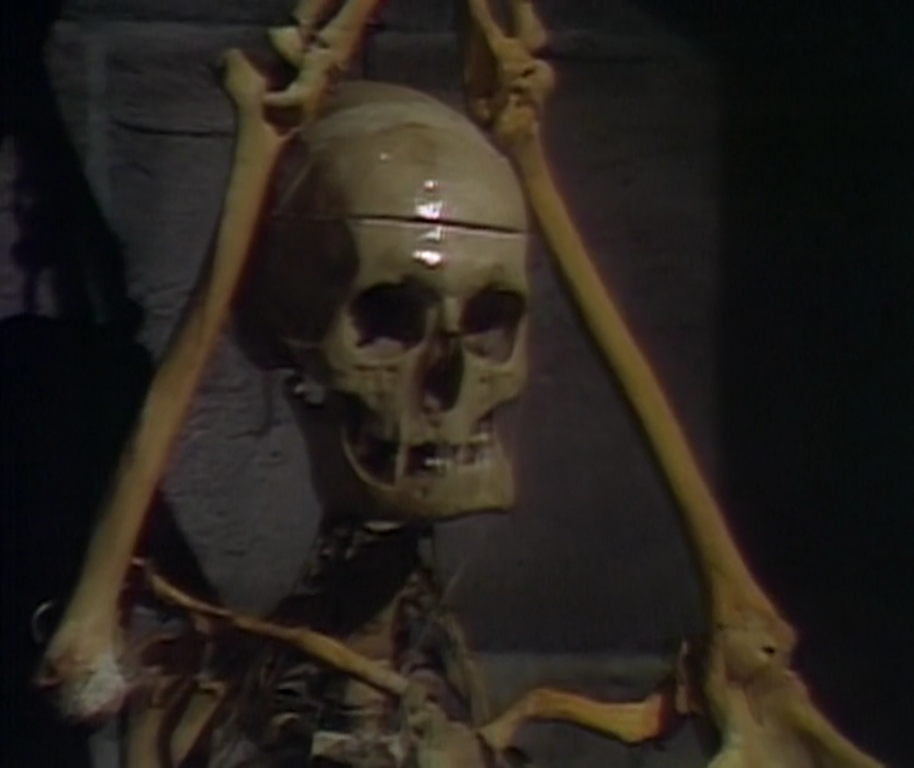
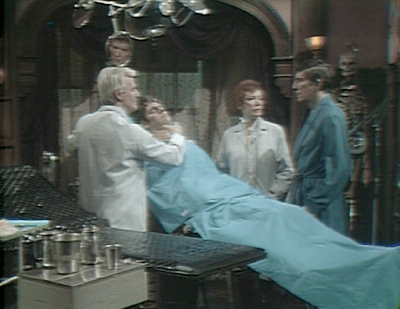
There is a bit of irony in Julia’s harshness with David for entering Barnabas’ house without his permission. She and Stokes didn’t have Barnabas’ permission to be there, either. Indeed, if he had known what they were up to he would likely have objected most strenuously. Along with a man named Tony, they held a séance in the part of the basement where Barnabas kept his coffin when he was under the full effect of the vampire curse. They were trying to contact the Rev’d Mr Trask, a Puritan divine whom Barnabas bricked up to die in the eighteenth century. The séance was so successful that the bricks crumbled, exposing Trask’s bones, still held together somehow in the shape of a skeleton hanging from the ceiling. At the end of the episode, Trask has resumed his corporeal form and set about taking revenge on Barnabas by walling him up in the same spot.
Odd that Trask’s skeleton holds together after all the ligaments and tendons have rotted away, odder that there is a straight cleavage separating the top of the skull from the rest, oddest of all that the section is attached to the rest of the skull by a piece of Scotch tape.
Sheriff Patterson, leading his deputies through the woods in search of a very tall man named Adam who has escaped from gaol, finds a scrap of Adam’s clothing on a tree. He looks ahead and sees the Old House on the estate of Collinwood. He remarks “That’s the old Collins house. Every time anything goes wrong around here, that’s where all roads seem to lead.” He takes his party toward the house. Once they are gone, Adam comes out from behind a tree, and goes in another direction. Unknown to the sheriff and his men, Adam is a Frankenstein’s monster. He is four weeks old and has a vocabulary of fewer than a dozen words, but he easily outwits Collinsport’s entire law enforcement community.
The Old House is home to Barnabas Collins, whom the audience knows to be a recovering vampire. The sheriff calls on Barnabas and recaps the story for his benefit. In his post about the episode, Danny Horn ridicules every part of this preposterous scene, getting half a dozen genuine laughs. I won’t compete with him, but I do want to point out that while in both Wednesday’s episode and yesterday’s, the sheriff said it took twenty men to subdue Adam and take him into custody, today he says it took six. Maybe by next week it will be down to one deputy and a mynah bird.
Adam has abducted heiress Carolyn Collins Stoddard. When he eludes the police, he goes to the abandoned structure where he has cooped her up. He had left her there to go look for food. That mission was interrupted by his arrest. Now, she asks to go home. He is carrying her back there when they meet the sheriff, his deputies, and Barnabas at the top of Widows’ Hill. From the second episode, we have known that people plunge to their deaths from this hill. We’ve heard stories about several such incidents, have seen a number of characters come close to falling from it, and in #425 we saw gracious lady Josette make the fatal leap. Carolyn slips from Adam’s arms to the edge of the cliff; the deputies see him pull her up. She runs into Barnabas’ arms, and Adam falls.
After Adam’s fall, we hear a message that is very familiar to us, but that Barnabas and his friends have never heard. Adam was created in an experimental procedure that was meant to relieve Barnabas of his vampirism. His creator, mad scientist Eric Lang, died shortly after recording an audiotape explaining that as long as Adam lives, Barnabas will be human, but that he will become a vampire again if he outlives Adam. This message plays out over images of the waves crashing into the rocks of the shore. It’s an effective visual complement to the message, a metaphor for the overwhelming power that will engulf Barnabas and the rest of them if Adam is in fact dead.
Mad scientists Julia Hoffman (Grayson Hall) and Eric Lang (Addison Powell) are conferring in Lang’s lab. Lang is putting the finishing touches on a Frankenstein’s monster into which he plans to transfer the “life force” of recovering vampire Barnabas Collins. Julia, Barnabas’ best friend, has been opposed to this experiment, but now has accepted that she can’t stop Barnabas and Lang from going through with it. She volunteers to assist.
Lang is having trouble concentrating because of a nightmare he had last night. Unknown to him, the nightmare was part of the Dream Curse, a dead end storyline about wicked witch Angelique sending a dream that each of a series of people will have. When the last person has the dream, Barnabas is supposed to revert to full-on vampirism.
Lang tells Julia about his nightmare. He says that she was in it. When he tells her that she did not speak, she smiles comfortably and says that that was proof that it was a dream. This is not only a genuinely funny line as Grayson Hall delivers it, but it is an extraordinary moment of self-awareness from Julia, a character who usually exists at the outer edge of heightened melodrama. It’s a shame that Addison Powell doesn’t know how to get out of Hall’s way for the half second it would take for it really to land with the audience.
Barnabas and his ex-blood thrall Willie are at home in the Old House on the great estate of Collinwood. Willie is smirking and Barnabas is rigid with embarrassment while the dogs howl outdoors. Willie laughs a little as he makes a remark about how Barnabas hasn’t changed as much as he thought he had. This exchange reminds us of the moment in #346 when Julia and well-meaning governess Vicki noticed that some fresh flowers Barnabas touched had died and shriveled up. Like the howling of the dogs when Barnabas feels bloodlust, the shriveling of the flowers was a consequence of his vampirism, effectively a bodily function that he cannot control. He squirmed when Julia and Vicki looked at him then, and he is stiff and flustered when Willie laughs at him now.
Barnabas orders Willie to take a letter to matriarch Liz at the great house on the estate. It will explain that he is going away on a long trip, and that Adam Collins, a young cousin from England, will be coming to stay in the Old House. Willie is alarmed by this.
Willie asks what Barnabas will do if Liz won’t let him stay in the Old House when he is in the form of Adam. Barnabas is sure she will, and dismisses Willie’s doubts. This is an interesting sequence to regular viewers. The show has never made it clear whether Liz still owns the house or has signed it over to Barnabas. A whole year ago, in #223, Liz was talking to strange and troubled boy David as if the Old House and its contents were Barnabas’ legal property. Since then, there have been moments that tend to confirm that impression, as when Barnabas takes Liz’ keys to the house away from David and does not give them back to her, and other moments that conflict with it. Willie’s question and Barnabas’ response would seem to prove that the house still belongs to Liz.
Another question we might ask is why Barnabas doesn’t go to Liz himself. Certainly she will be unhappy that he went away without saying goodbye to her. Moreover, when he showed up at the great house in April 1967, Barnabas told Liz that he was the only survivor of the English branch of the family. Liz will be skeptical if another member of this imaginary branch presents himself and expects to take possession of a big mansion on her property. She has had unpleasant experiences with Willie, so much so that a letter he delivers seems unlikely to allay that skepticism.
When Willie gets to the great house, Angelique herself opens the door. She is living there under the name Cassandra. She has cast a spell on Liz’ brother, sarcastic dandy Roger, and married him so that she will have a residence at Collinwood while she works to restore Barnabas’ curse to its full potency. Showing his typical degree of strategic ability, Barnabas has not bothered to tell Willie about any of this.
Angelique/ Cassandra ushers Willie into the drawing room, sits him down, and chats with him. Willie answers her questions about Barnabas, not realizing that he has any more reason to be discreet with her than with anyone else. He tells her that Barnabas has been spending his days with Lang. Angelique/ Cassandra already knows that it was Lang who gave Barnabas the treatments that put his vampirism into remission and that Lang is preparing further treatments for him. Barnabas should know that she knows this, since she went to Lang’s house and tried to kill him. Willie also tells her that sometimes Barnabas doesn’t seem to have changed as much as you might expect. Angelique/ Cassandra’s reaction makes it clear this is new information to her, and that it might help her in her efforts.
The scene raises yet another question. Barnabas had expressed the hope that once the experiment was complete, Angelique would see that his old body was dead, would assume that meant that he no longer existed in any form, and that she would then go away and leave him alone. But he knows that she knows about Lang, and now he is planning to come back to Collinwood, where she lives, as another “cousin from England.” The question is this- how dumb does Barnabas think Angelique is?
Back in the lab, Lang and Julia are preparing for the experiment. Barnabas shows up. When he talks with the doctors, his face is reflected in the mirror above Lang’s creature. Not only does this suggest the idea of his personality moving into the creature’s body, it also reminds us that until Lang gave him his first course of treatment, Barnabas did not cast a reflection. The whole idea of Barnabas’ reflection will remind longtime viewers of #288, when Julia first confirmed her suspicion that Barnabas was a vampire by peeking at the mirror in her compact and not seeing him. That draws a contrast between Lang, whose initial success with Barnabas appears to be leading to disaster because his impersonal, hyper-masculine approach leaves him unable to recognize the threat Angelique poses, and Julia, whose own attempts to cure Barnabas of vampirism did not match Lang’s spectacular results, but whose femininity, as symbolized by the compact, represents a fighting chance against the forces that really govern this universe.
Barnabas takes his place on a bed. He tells Julia he is glad she is with him, and she smiles at him with the sad tenderness of someone saying a final farewell to a loved one. As with her self-deprecating joke in the opening part of the episode, this smile shows a new side of Julia. For a time in October 1967 she tried to launch a romance with Barnabas, and he rejected her. Hall played Julia’s unrequited love in the same larger-than-life style that the rest of her action called for. Her feelings seemed to be an outgrowth of despair- she was by that point so deeply entangled with Barnabas that there was little hope she could ever make a life with anyone else, so even though he was an active vampire, she had little to lose by committing herself to him. But this sweet little exchange is played so gently that it opens a window on a more complex inner life for Julia.
As Lang starts the experiment, we cut to Angelique in the drawing room at Collinwood. She is talking to a clay figure, calling it “Dr Lang,” and saying that it cannot overcome her powers, for they were a gift to her from the Devil himself. She jabs at the clay figure. In the lab, Lang writhes in pain, interrupting the experiment.
It was not until #450 that Dark Shadows let on that there might be anything to Christianity. In that episode, good witch Bathia Mapes held Barnabas at bay by showing him a cross. Up to that point, Barnabas had many times strolled comfortably through the old cemetery north of town, where half the grave markers are in the shape of the cross, and they hadn’t bothered him a bit. The only representatives of the faith who figured in the story were repressed spinster Abigail Collins and fanatical witchfinder the Rev’d Mr Trask, both of whom were fools whom Angelique easily twisted to her own purposes. Now we have a character named Adam, a New Adam through whom a resurrection is supposed to take place, and he is wearing a headpiece that is photographed to look like a crown of thorns. Angelique’s reference to the Devil suggests that she can be defeated only through the aid of a being more powerful than the Devil, and since we haven’t heard about Ahura-Mazda or any other non-Christian deities who represented a supreme principle of good pitted against an otherwise irresistible evil, it looks like we’re drifting Jesus-ward.
It is daring to take that direction, even if it is only for a little bit. Vampire legends are pretty obviously an inversion of the Christian story, in which a man comes back from the dead, not having destroyed the power of death once and for all, but only to die again every time the sun rises. While Jesus feeds us with his body and blood in the Eucharist and thereby invites us to share in his eternal life, the vampire feeds himself on our blood and thereby subjects us to his endlessly repeated death. That’s why Bram Stoker’s Dracula has all those crosses and communion wafers, because it is a religious story of the triumph of the promise of resurrection in Christ over the parody of that resurrection that the vampire has settled for. It also explains why Dark Shadows so studiously avoided Christian imagery for so long. Christianity is such a powerful part of the culture that once you let any of it in, it tends to take over the whole story.
There are many reasons the makers of the show would want to avoid that fate. Not least is the tendency of religions to fracture and stories based on their teachings to become sectarian. Dracula itself is an example of that; the vampire is a Hungarian nobleman from Transylvania, connected with the Szekely clan. There really was such a clan, and like other Hungarian nobles in Transylvania its members were Calvinists, supporters of the same version of Christianity that Abigail and Trask represented. Stoker was a Roman Catholic from Ireland, a country where most Protestants are Presbyterians, a tradition that grew out of Calvinism, and so his depiction of the vampire is clearly driven by sectarian animus. The Collinses have an Irish surname, settled in New England when that region was officially Calvinist, and did very well there. So it would be easy to present their troubles as a cautionary tale about Calvinism. That would seem to be a surefire way to shrink the audience drastically. Not only are there millions of Calvinists whom it would offend, there are billions of people to whom Calvinism means nothing at all, and they would be utterly bored by a denunciation of it.
The episode is daring in several other ways as well. When Barnabas and Willie were first on the show, ABC-TV’s office of Standards and Practices kept worrying that viewers might interpret their relationship, which was founded on Barnabas’ habit of sucking on Willie and swallowing his bodily fluids, as somehow homosexual. Not only is the scene between them at the Old House reminiscent of the scenes that attracted memos from that office in the spring and summer of 1967, but the whole idea of Barnabas draining his “life force” into the body of Adam would seem to invite the same concerns.
The experiment scene would only intensify such concerns. The experiment is a medical procedure that is supposed to bring a new life into the world, which by 1968 was how Americans usually thought of the process of birth. Barnabas is the patient, he is lying down, and the doctors sedate him. Thus he takes on all the medicalized marks of a mother-to-be. Julia asked Lang if the process would be painful for Barnabas; he does not disappoint, but ends the episode screaming in response to labor pains. Not only does turning Barnabas into Adam’s mother invert the expected gender performance, but it also introduces a homosexual side to Barnabas’ relationship with Lang, who is Adam’s other parent.
Somebody ought to be there telling Barnabas he’s doing great and urging him to push. Screenshot by Dark Shadows Before I Die.
Christian imagery and gender-nonconformity would have been rather a queasy combination for most Americans in 1968. That’s unusual, in historical terms. Before modern times, Christians didn’t hesitate to discuss ways that familiar gender roles break down in the relationship of humans to Christ. The “Fathers of the Church,” the prominent Christian intellectuals of the fourth and fifth centuries, talked about that all the time, going into depth not just with the image of the Church as the Bride of Christ but of each human soul, whether male or female, as one of Jesus’ wives, and of the physical contact between humans and Jesus in the Eucharist as a consummation of their marriage.
For their part, Calvinists tended to be skeptical of the physical aspect of the sacraments, but that didn’t mean that they shied away from conjugal metaphors to describe the relationship between the soul and Jesus. John Donne, like most priests in the Church of England in the 16th and early 17th centuries, was basically a Calvinist, yet his sonnet “Batter my heart, three-person’d God” is one of the most vivid and uncompromising statements of the ancient idea of an erotic dimension to Christian life that transcends the binaries between masculine and feminine, male and female. That tradition makes today’s conjunction of Christian and homoerotic themes all the bolder- imagine if Dark Shadows wrote itself into a corner where they had no choice but to explain nuptial imagery and mystical eroticism in the writings of Saint Ambrose. The whole audience could fit into a seminar room.
Closing Miscellany
Lang and Julia wear white lab coats. This is the first time Julia has worn a white coat. Her previous lab coat was light blue, which looks white on the black and white TV sets most households had in 1968, but now that the show is being produced in color they are buying costumes and props for color televisions.
The idea of a machine that would cause a person to go to sleep in one body and wake up in another was a big deal on TV in the 1960s. Just today I saw this screenshot from The Avengers on Tumblr:
This episode marks the first appearance of Robert Rodan. When Adam was a nameless heap of flesh under a blanket, he was played by a stand-in named Duane Morris. Rodan had a few small parts on TV shows in 1963 and 1964 and was in a couple of commercials between 1964 and 1968. Adam was his first, and last, recurring role on a series. In 1969, he appeared in a little-seen feature film called The Minx, then spent the rest of his life selling real estate in Southern California.
In December 1966, crazed handyman Matthew Morgan (Thayer David) abducted well-meaning governess Vicki and held her prisoner in a secret room behind the bookcase in the front parlor of the Old House on the estate of Collinwood. Vicki had run into Matthew there when she saw his dusty footprints leading up to the bookcase in #115. Vicki’s charge, strange and troubled boy David Collins (David Henesy,) did not know that Matthew had abducted Vicki, and was convinced that he had gone into hiding because he was unjustly accused of murdering local man Bill Malloy. So when David found out Matthew was in the Old House, he brought him food and water. In #120, David heard Vicki’s muffled voice behind the bookcase; in #123, he pulled the bookcase back and found her; in #124, he was too frightened to help her escape.
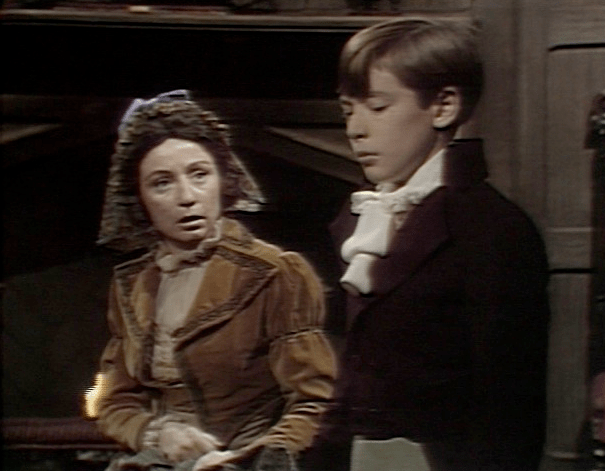
Now, Vicki has come unstuck in time, and found herself in the late eighteenth century. She made a promising start, landing a position as governess to the children at Collinwood, among them Daniel (David Henesy.) But she has adapted poorly to her new surroundings, so poorly that she has been convicted of witchcraft and sentenced to death. Accompanied by her boyfriend, an unpleasant young man named Peter, she has escaped from gaol. Vicki was shot in the arm while escaping, and is still bleeding. She and Peter have made their way to the Old House. There, much put-upon servant Ben (Thayer David) at once gives Vicki and Peter such help as he can.
When a knock comes at the door, Ben tells Vicki and Peter he will hide them. He goes to the bookcase, and Vicki whispers “The secret room.” When Vicki first saw Ben, they were in this parlor, and she was frightened because she mistook him for Matthew. In her hushed voice and the look of awe on her face when she sees Ben trying to save her life by putting her in the room where his Doppelgänger will try to kill her in 1966, Alexandra Moltke Isles’ Vicki conveys the thought that Ben and Matthew really are two versions of the same guy. Ben is a kind-hearted sort whose fierce loyalties sometimes overcome his good sense; Matthew a paranoid ogre whose single-minded devotion to matriarch Liz leads him to kill and menace those dearest to Liz. The difference between the two men begins in the events that have been taking place around Vicki in the 1790s. Ben grew up in the ordinary world of day and night, where natural laws apply and there is hope for goodness. Matthew has spent his whole life in a town laboring under an ancient curse. Matthew’s crimes would be the fruit of Ben’s virtues, had Ben been warped by the evil of centuries that hangs over the Collinsport of the 1960s.
While Vicki and Peter huddle in the secret room, Daniel bursts into the parlor. Ben tries to hurry him out, but the lad notices a trail of bloodstains leading to the bookcase. Before Ben can stop him, Daniel opens the bookcase and finds the fugitives.
Daniel is as convinced of Vicki’s innocence as David will be of Matthew’s, and he is eager to help her and her friend. Ben says he will take the fugitives to a safer hiding place, and forbids Daniel to follow them. Of course Daniel does follow them, and sees them enter the Collins family mausoleum in the old cemetery north of town. He cannot see inside, where Ben opens a secret panel and ushers Vicki and Peter into the hidden chamber behind. This chamber will be hugely important in 1967. Vicki will hear about it in that year after David, who spent a week trapped there ending in #315, tells people about it in #334. But David will be unable to show the chamber to Vicki or anyone else, and most adults assumed it was just something he had imagined. Vicki is astonished to see it today.
Daniel goes home to the great house of Collinwood, where his brother-in-law, naval officer/ sleazy operator Nathan Forbes, handles him roughly and demands to know where he saw Vicki. When Daniel denies having seen Vicki, Nathan asks him how he came to have a bloodstain on his sleeve. He tells Daniel that Vicki was wounded when she escaped from gaol, and declares that it is her blood on Daniel. He warns Daniel that it is a crime to withhold information about a fugitive. Daniel keeps denying everything.
Back in the hidden chamber, Vicki is asleep. She dreams that Nathan is trying to kill Daniel. Returning viewers know that this is in fact true. Nathan married Daniel’s sister, fluttery heiress Millicent, because wanted her vast fortune. He found out on their wedding day that she had signed everything over to Daniel. It has occurred to him that if Daniel should die, it will all revert to Millicent, so he is scheming to bring that death about. Vicki has been in gaol since all of this started; nothing she has seen or heard could have led her to conclude that Nathan was a threat to Daniel. We must take it as a message from the supernatural world. This is not the first time we have seen Vicki receive such a message while in a concealed place. In #126, when Matthew was bringing an ax to decapitate her, Vicki was visited in the secret room behind the bookcase in the Old House by the ghost of gracious lady Josette bringing her good news.
The segment of Dark Shadows set in the 1790s is nearing its end. They have killed off most of the characters, have stopped introducing new ones, and those who remain are all facing crises that can be resolved only by further reducing the number of people available to participate in the action. The echoes of #123 and #124 will underline that point for viewers who have been with Dark Shadows from the start. Not only did those episodes tip Matthew into the final part of his storyline, they introduced David’s mother, undead fire witch Laura Murdoch Collins, marking a new phase of the show. Calling back to those installments, and condensing the action of #115 through #126 into a few minutes, they are telling us that the end of the 1790s segment is near, and that when it comes it will come fast.
In #70, the deserted Old House on the great estate of Collinwood was introduced as the favorite hangout of strange and troubled boy David Collins (David Henesy.) Several adult characters tried to keep him away from the house, notably crazed handyman Matthew Morgan (Thayer David,) and Willie Loomis, servant to David’s distant cousin, vampire Barnabas Collins. David’s visits to the house precipitated a number of crises, including one that began when he found that Barnabas and Willie kept the cellar door locked and became intensely curious as to why. We knew that they did this to conceal Barnabas’ coffin at the foot of the stairs. That was when the show was set in 1967.
Today, young Daniel Collins (David Henesy) is introduced as a boy whose favorite hangout is the deserted Old House on the great estate of Collinwood. He finds much put-upon servant Ben Stokes locking the cellar door. Ben is the friend and accomplice of Daniel’s second cousin, vampire Barnabas Collins. Daniel is intensely curious as to why Ben is locking the door. We know that it is to conceal Barnabas’ coffin at the foot of the stairs. Now the show is set in 1796.
Ben initially responds to Daniel’s curiosity with the same angry bluster Willie had used in his efforts to keep David away from the house. By the end of their scene together, he has engaged Daniel in conversation, as Matthew often did with David. Daniel confides in Ben that he is planning to run away. Ben points out that Daniel is in no way prepared to strike out on his own, and persuades him to go back to the great house and to make a list of the things he will need. Combining Willie’s responsibility for protecting Barnabas with Matthew’s ability to persuade a boy that he is his friend, Ben seems well-positioned to keep Daniel from coming into conflict with the vampire in the family.
Back in the great house, repressed spinster Abigail Collins, Barnabas’ aunt, finds Daniel’s list and asks him what it is. He evades that question. As it happens, it is not the one she most urgently wants answered. She sits him down in the drawing room and asks him about a charm bracelet she had found somewhere around the house.
Daniel confirms that the bracelet belonged to Victoria Winters, the governess who used to teach him and Barnabas’ little sister Sarah. Vicki is now standing trial on charges of witchcraft. Sarah is dead, and Abigail is convinced that Vicki’s evil spells caused her death, among many other recent tragedies. The bracelet seems to Abigail to be evidence against Vicki. Abigail points to a charm in the shape of a devil and asks Daniel what Vicki told him about it. He says blandly that Vicki told him and Sarah that it was a devil. She asks him if Vicki instructed him and Sarah to fall to their knees and worship the Devil, and he reacts scornfully, asking who ever heard of worshiping a devil.
Abigail presses Daniel for more information about Vicki. He keeps talking about how much he and Sarah liked her, and tries to paint her in a favorable light. He tells Abigail that Vicki used to say that the day would come when people could fly through the air, covering hundreds of miles in a single hour, that there would be machines that would pick up voices traveling through the air and make them audible with the turn of a dial, and that other machines would be able to solve arithmetic problems. We know that Vicki is a time-traveler displaced from the 1960s and that she is describing airplanes, radio, and electronic calculators, and we further know that her time-travel was not the result of a spell she cast, but that Sarah’s ghost yanked her back in time. But Abigail interprets her stories as promises of rewards from the Devil, and most of those whom Vicki has told of her chronological dislocation have taken it to be a confession that she is a witch.
It dawns on Daniel that everything he is saying in his attempt to defend Vicki is making matters worse for her. David Henesy does a marvelous job showing us how miserable this makes Daniel. Abigail tells him he must go with her to Vicki’s trial tomorrow and repeat to the judges what he has told her. He resists the idea. She breaks off their conversation to announce she will go to the Old House. Daniel has told her that he saw Ben locking the cellar door, and she has jumped to the conclusion that he was hiding evidence against Vicki behind it. Daniel pleads with her not to go, but she insists.
We cut to the front door of the Old House, where Abigail encounters Ben. He begs her not to go in. She accuses him of being in league with Vicki and declares that his own trial will begin before long. Ben may have been able to soft-soap Daniel, but Abigail responds with hostility no matter what he says. Finally, he watches her go in. She has said that whatever happens to her inside will be her own responsibility; after she is gone, Ben echoes this statement, a savage note of satisfaction in his voice.
Abigail unlocks the cellar door, goes down the stairs, and sees the coffin. Of course, it is sunset; of course, she is just in time to see the coffin open and Barnabas rise. She watches in terror. Clarice Blackburn does an extraordinary job of acting in the closeup of Abigail’s reaction; she gives the purest possible look of fear, and her scream is perfectly open and smooth.
Barnabas looks at her and asks “Abigail, what are you doing here?” The audience can’t be in much doubt how their reunion will end, though we will have to wait until tomorrow to see just what happens between them.
Dark Shadows was made with very little advance planning, though we do know that they had settled on the name “Daniel Collins” for David Henesy’s character well before the 1795 segment began. In #350, three full weeks before Vicki starts her uncertain and frightening journey to the past, heiress Carolyn slips and calls David “Daniel.” So it is inexplicable that they’ve waited until the segment has been going for more than thirteen weeks before bringing Daniel in. Vicki and David’s relationship was the only thing on the show that consistently worked in 1966, and David’s scenes with Sarah were among the highlights of 1967. So when in #372 haughty overlord Joshua tells Vicki that she will be tutoring both his daughter Sarah and his young cousin Daniel, the audience would have been excited to see the three of them together.
Presumably the makers of the show were unsure how long they would be able to stay in the eighteenth century before the ratings started to suffer and they came under pressure to get back to a contemporary setting. That might explain why they wanted to keep the number of characters to a minimum, so that they would be able to show the four necessary events- Sarah’s death, Barnabas’ transformation into a vampire, Josette’s leap from Widows’ Hill, and the chaining of Barnabas in his coffin- without starting a lot of threads they would have to hasten away and leave dangling. Even so, there were plenty of longueurs in the first weeks when they could have fitted in a few scenes of Daniel and Sarah together, if they had had the time to plan them.
As it happened, the ratings were great for the eighteenth century segment, so they were under no pressure at all to go back to the 1960s. But the breakneck pace of the early weeks and the lack of detailed planning has come back to haunt them. Three of the four big points have all been covered. All that is left is to chain Barnabas in his coffin and to send Vicki home, and they can do both of those things in any one episode. They are going to have their work cut out for them to fill the remaining time with stories that are anything like as interesting as some of those they passed up because they didn’t realize they would have time to tell them. The result will be that, while the last few weeks of the eighteenth century segment feature some great moments and several Genuinely Good Episodes, they also involve a lot of disappointment for the audience.
The gracious Josette, recently ill, has disappeared from her bedroom in the great house of Collinwood. She did not exit through the door to the hallway, nor did she climb out the window. Josette’s aunt, the Countess DuPrés, asks the master of the house, haughty tyrant Joshua Collins, how her niece could have got out. Joshua says there is a secret passage, but he cannot imagine how Josette would know about it. He did not tell her, and the only other people who knew of its existence were his brother Jeremiah and his son Barnabas, both of whom are dead. Since Josette was engaged to Barnabas for a time and was later married to Jeremiah, perhaps one of them might have mentioned the passage to her, but this possibility does not occur to Joshua.
Everyone in the house becomes involved in a search for Josette. That includes untrustworthy naval officer Nathan Forbes, Nathan’s fiancée Millicent Collins, and Nathan’s wife Suki. Millicent does not know that Suki is Nathan’s wife. Suki introduced herself to the Collinses as his sister, and is content to go on masquerading as such so long as there is a prospect Nathan will pass along a great chunk of Millicent’s vast inheritance to her. Nathan did not expect Suki to turn up, and she has been making him extremely uncomfortable for the last couple of days. It has been magnificent to watch.
Nathan and Suki need to have a conference about some topics they cannot possibly discuss in a house where they might be overheard. It occurs to him that no one is living in the Old House on the estate. He tells Suki to wait for him there.
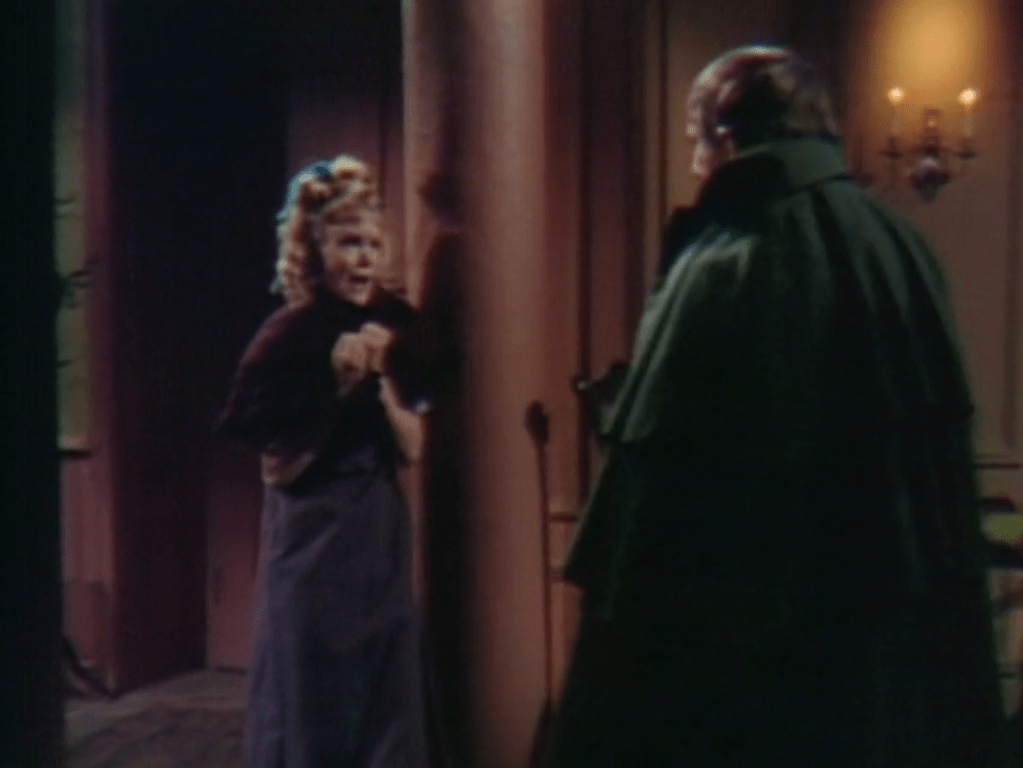
Nathan is not entirely wrong when he says that “there is no one living” in the Old House. However, there is one among those who are not living who is not simply dead. That is Barnabas, who has become a vampire. Suki enters the house and meets him.
Barnabas demands to know who Suki is. When she introduces herself as Suki Forbes, sister of Nathan, he soon declares “You are not his sister, you are his wife! Don’t bother to deny it.” He tells her that Nathan has no sister, therefore she could only be his wife.
Suki plays the innocent.
This conclusion is more impressive the more you think about it. Before Barnabas died, he and Nathan were friends, so it is reasonable that he would know Nathan has no sister. Suki is not carrying a bag or riding a horse or wearing strong boots, so she must be staying at the great house. She gives her name as Forbes, so she must be staying there as a connection of Nathan’s. Granted that she is lying about being his sister, the true nature of that connection must be something she and Nathan want to conceal from the Collinses. Barnabas knows that Nathan has persuaded Millicent to marry him, prospectively raising him from the genteel poverty of life on a junior naval officer’s salary to the great wealth of the New York branch of the Collins family. So the secret relationship must be one that would deny him that glittering prize. Suki, indeed, must be Nathan’s wife. It is a brilliantly logical inference, which makes it inexplicable that Barnabas draws it. He is a character who does smart things sometimes, foolish things frequently, but he has never before shown any great aptitude for sequential reasoning. Nonetheless, it is a wonderful moment. Wonderful moments multiply when Suki is around.
Suki is one of the most quick-witted and daring characters on the show. She recovers from the initial shock after a second or two and asks Barnabas what it is to him if she is Nathan’s wife. He speaks in his usual menacing way, and she tells him he is in no position to make threats. She recognizes Barnabas from the portrait of him that hangs in the great house. She realizes that the official story, the tale Joshua put about that Barnabas has gone to England, must be the cover for some shameful secret, and she sets about crafting a blackmail demand as her price for keeping that secret.
Suki thinks she has Barnabas over a barrel.
Suki finds Josette’s cloak on a chair. She realizes that Josette is in the house with Barnabas, and we see her thinking up new and higher blackmail demands.
Suki makes a discovery.
While Suki is involved with the cloak, Barnabas dematerializes. Bewildered, she looks for him in the parlor, then goes outside. A bat frightens her.
Suki frightened.
Suki retreats into the house. She melts down and starts sobbing with fear.
Suki reaches her breaking point.
The bat reappears in the room. It hovers near the lens of the camera, then gives way to Barnabas, one of the best efforts they have made at showing Barnabas change form. Suki tells him she can’t believe what she is seeing.
Suki cannot believe her eyes.
Suki brings out the best in the writing staff, driving them to show each character doing whatever it is they do that makes the biggest contribution to the show. Unfortunately, Barnabas makes his biggest contribution when he murders people. So he winds up strangling Suki at the end of this episode. It is a terrible shame that a character as dynamic as Suki is only on Dark Shadows for a few days.
So long, Suki.
It is also a shame that Jane Draper doesn’t come back to play another part in one of the segments of Dark Shadows set in a period other than the late 18th century. Perhaps the makers of the show thought that in Nancy Barrett, who plays Millicent in the 18th century segment, Carolyn Collins Stoddard in the 1960s segments, and many other characters in segments we will see later, the show already had a tiny blonde actress with a wide range and a forceful style. Her similarities to Miss Barrett may have prompted the producers to cast Ms Draper as Millicent’s rival/ would-be exploiter/ mocking Doppelgänger. Miss Barrett’s other characters tend to be very different from Millicent. They are given to abrupt psychological reverses, alternating between acute self-consciousness and fierce self-loathing and between irritable distrust and complete emotional dependence. Her characters are usually their own mocking Doppelgänger, so that there was no need to cast another actress to play such a part. But Ms Draper is so very good as Suki that there can be little doubt she would have been able to handle any role they threw her way.
Gallant gentleman Barnabas Collins discovered that his wife, Angelique, was a wicked witch and a deadly threat to his true love, the gracious Josette. He did not tell anyone what he knew about Angelique, but did persuade Josette to flee. Today, Angelique discovers that Josette is beyond the range of her powers.
In her rage, Angelique takes a doll belonging to Barnabas’ little sister Sarah. She sticks pins in it; Barnabas has learned that this causes Sarah to become ill. Angelique is about to stick a pin into the doll’s heart when Barnabas takes a dueling pistol and shoots Angelique.
Angelique drops the doll; Barnabas takes the pins from it. Angelique presses her hand to her shoulder while delivering a long, bombastic speech. Barnabas has plenty of time to reload the pistol and shoot her again, but chooses just to stand there and listen to her. This turns out to be a bad decision when she ends the speech by placing a curse on him. He will spend all eternity unable to rest, and everyone who loves him will die. Having completed her death scene, she ostentatiously collapses.
We hear a window smashing. A bat appears. It approaches Barnabas. He yells at it, flails his arms, and walks backward. This is an echo of #330, which ended with strange and troubled boy David Collins reacting the same way when the same puppet appeared in his bedroom. David was a neurotic and isolated pre-teen who had been through a lot of trauma, so that was an effective scene. Barnabas is a grown man who has been trying to function as an action hero. Seeing him as the equivalent of a cartoon lady standing on a chair screaming because she saw a mouse rather undercuts this. Anyway, the bat bites Barnabas on the neck, so now he’s going to be a vampire.
The bite. Not Barnabas’ cloak in the background, playing the role of The Grim Reaper. Screenshot by Dark Shadows Before I Die.
In #330, it was Barnabas who sent the bat against David. This is one of many indications that the vampire Barnabas we knew from April to November of 1967 was not only under Angelique’s curse, but that he was in some sense a manifestation of Angelique. Maybe when she casts a spell, she breaks off a chunk of herself and that chunk goes about the world pursuing its own objectives. The image of a supernatural being as a complex of vaguely related but independent phenomena has been standard in Dark Shadows since undead fire witch Laura Murdoch Collins first appeared on the show in December of 1966, so regular viewers are prepared to learn that the vampiric Barnabas is a subcategory of the syndrome known as “Angelique.”
This episode explains how a couple of the more important props got to be in the places we are used to seeing them. Early in the episode, Barnabas gives Josette a music box. This music box figured heavily in the story from May to August 1967 as a symbol of Josette and as a vehicle for some kind of magic spell that was supposed to turn other people into her. A bit later, we see that Barnabas has hung the portrait of Josette over the mantle in the front parlor of the Old House. It was there when we first saw the Old House in #70, and was the focus of all supernatural phenomena on the show from then until Barnabas reclaimed the Old House in #212.
Well-meaning governess Vicki is in jail, about to be tried on a capital charge of witchcraft. That couldn’t happen in the New England that existed in 1795 in our timeband, but many things were possible in the world of Dark Shadows that we don’t see in ours.
Gallant gentleman Barnabas Collins has figured out that Vicki is innocent and that the real witch is his new wife, Angelique. Rather than go to the authorities with his evidence, he decides to take a more direct approach and murder Angelique. That won’t be much use to Vicki, but Barnabas can’t be bothered with details.
The longest sequence of the episode is a farce in which Barnabas pours two glasses of sherry, puts poison in the one he then gives Angelique, and tries to get her to drink. They don’t do “the old switcheroo” and mix up the glasses, but instead go with an equally hoary device of having Barnabas’ mother show up and take Angelique’s glass. Barnabas has to claim the glass is cracked and knock it from her hand.
After the failure of his attempt to poison Angelique, Barnabas opens a hidden compartment of his desk and takes out a dagger. If it weren’t for Robert Cobert’s solemn musical score, the effect would be that of seeing Wile E. Coyote open yet another crate from the Acme Corporation. He goes up to Angelique’s bedroom and lifts the dagger. Since there has been no indication that she has got into her bed, and all we see on it are a lump of covers, the audience has no reason to suppose she is in there. We end with the distinct impression that Barnabas, having barely avoided matricide, is stabbing a mattress.
We first knew Barnabas in the year 1967, when he will be a vampire and will develop from a profoundly bleak presence and an urgent threat to our favorite characters into a comic villain for whom we can’t help but feel a kind of affection as we watch him fail again and again in his elaborate schemes. In that way, his maladroit attempts on Angelique’s life today are entirely typical of the Barnabas we had met before Vicki traveled back in time in November.
In another way, this episode represents one of the biggest retcons in the whole series. Throughout his first eight months on the show, Barnabas nursed a bitter hatred for his uncle Jeremiah Collins. In the first weeks of the 1795 segment, we saw that Jeremiah eloped with Barnabas’ beloved fiancée, the gracious Josette, and that Barnabas responded to this betrayal by killing Jeremiah in a duel. When Barnabas is talking today about Angelique’s black magic, he realizes that Jeremiah and Josette ran off together only because they were under a spell, and that neither was responsible for betraying him. He has no hostility left for Jeremiah.
In the various accounts the vampire Barnabas gave in 1967 of his last years as a living being, he never mentioned Angelique. Nor did he ever say that he, Josette, or Jeremiah had been the victim of witchcraft. Instead, he had indicated that he himself had gotten involved in black magic. In #345, he told his sometime friend, mad scientist Julia Hoffman, that he became a vampire after trying to gain eternal youth, and that Josette killed herself when he offered her that eternal youth. In #358, he uses “the secret magic number of the universe,” which he had learned while studying witchcraft under a warlock on Barbados, to torment Julia. The Barnabas we met when we came to 1795 hadn’t done any of that. Until he learned the truth about Angelique, Barnabas was a man of the Enlightenment and didn’t believe that witches even existed.
Perhaps this is a change Vicki’s arrival and her bizarre behavior have wrought. The stories Barnabas tells in #345 and #358 both took place years after Josette and Jeremiah were married. So perhaps in the original timeline, with no one around yammering about what the first 73 weeks of the show were like, events moved much more slowly. The change of loves took place gradually enough that Barnabas did not feel he had to challenge Jeremiah to a duel, but he was still full of hatred and resentment. Angelique was able to cover her tracks so that no one suspected witchcraft was underway. She gradually lured Barnabas into the occult arts, perhaps giving up the idea of marrying him at some point, certainly losing his attention. By the time he brought the vampire curse on himself, the version of Barnabas in that timeline would have forgotten Angelique and would have come to be consumed by his grievance against Jeremiah. That fits far better with the April-November 1967 Barnabas than does the character we have seen so far in 1795.
Barnabas asks a key question in this episode. When Angelique says that she will always love him, he asks her what she thinks love is. She answers “Why of course I do!,” which probably means that the script called for him to ask if she knew what love was, but “What do you think love is, Angelique?” is a better question. She’s been destroying every relationship that makes him the man he is in order to have him all to herself, suggesting that if Barnabas pressed Angelique to explain what love is, she would wind up saying that it means having total control over someone. As a vampire, that’s going to be Barnabas’ working definition too, suggesting that he will be more like Angelique then than he already is now.
In this episode, the portrait of Josette is delivered to Barnabas’ home, the Old House on the estate of Collinwood. This portrait, haunted by Josette’s ghost, was the dominant presence in the Old House from its first appearance in #70 until Barnabas moved back in there in #221, and was important as a symbol of Barnabas’ obsession with Josette thereafter. The makers of the show left it on the wall of Josette’s bedroom at the beginning of the 1795 segment; we see it there in #374, but they replace it with a different portrait in #377. It’s hard to understand why it would already have been there before Josette formally became a member of the family- perhaps it was just a slip-up that it was there in #374, and they’d always planned to show its arrival at Collinwood.
At the top of the episode, much-put-upon servant Ben is locked in a barred cell in the basement of the great house of Collinwood. Haughty overlord Joshua Collins and his family just moved into the house a week or two ago, and parts of it are still under construction. Evidently the basement cells are an essential part of any well-appointed home in the area, and had to be among the first amenities installed.
Until November of 1967, Dark Shadows was set in contemporary times, largely in this house. We saw the basement several times, but never had any indication that there were prison cells there. The old manor house had a cell in its basement, and in June 1967 vampire Barnabas Collins kept the lovable Maggie Evans prisoner in that cell. Maggie escaped when the ghost of Barnabas’ little sister Sarah appeared to her in #260 and told her a riddle that pointed to a secret passage out of it. Sarah told Maggie that her father had forbidden her to tell anyone about the passage, and that even Barnabas doesn’t know about it.
Joshua is Sarah and Barnabas’ father, so when he, they, and their mother Naomi moved out of the Old House in #393 without any reference to the cell downstairs we wondered if the show had decided to retcon away Sarah’s knowledge of it. The first indication that there were not going to do this came in #399, when Sarah visited her sometime governess, Vicki. Vicki had been accused of witchcraft and was hiding in the Old House as the guest of Barnabas, who is at this time alive and gallant. During their conversation, Vicki needs a place to hide while the house is being searched, and Sarah leads her to a room upstairs that Sarah says “everyone else has forgotten about- even Barnabas.” That Sarah knows parts of the house that are secret even from Barnabas is an unmistakable reference to #260, and shows that her knowledge was not a postmortem development. When we see today that Joshua has installed a cell in the basement of the new house, it is confirmed for us that there is one in the basement of the Old House as well.
Dark Shadows is set in and near the fictional town of Collinsport, Maine. This segment of the show takes place in 1795, when Maine was part of Massachusetts. Slavery was abolished in Massachusetts in the early 1780s, at which point the Old House would have been in use for many years. It is never made clear whether the Collinses held any African or indigenous people as slaves, but indentured servants like Ben were subject to beatings and confinement at the command of those who had purchased their labor. Their obligation was limited to a term of years and was not passed on to their offspring, unlike the status of slavery, but the treatment Joshua routinely metes out to Ben makes it clear that he was accustomed to regarding humans as his property. So it is hardly surprising that he maintains a dungeon to which he confines members of his household establishment who have displeased him.
Vicki has been caught and is now a prisoner in Collinsport’s public jail. Barnabas meets her there. He has come to suspect that his new wife, Angelique, is the real witch. During their visit, Vicki makes some remarks which convince him that this is so.
Barnabas believes that Angelique has put a spell on Ben to force him to do her bidding. The audience knows that this is correct. He finds Ben hiding in a fishing shack on the Collins family property. Angelique’s spell prevents Ben from speaking her name, but he does manage to draw her initial in the dust on a barrel top when Barnabas asks him to indicate the real witch’s name.
We spent a fair bit of time in the fishing shack in February and March of 1967. It was introduced in #173 as a favorite haunt of strange and troubled boy David Collins, and in #191 David’s mother, undead fire witch Laura Murdoch Collins, tried to burn him to death in the flames which destroyed the shack. There was a clear echo of #191 at the moment when Vicki was captured in Friday’s episode, and the return of the fishing shack today amplifies that echo for regular viewers. Today’s script is credited to Ron Sproat, the only writer from those days who was still with the show at this point. Sproat would have remembered that #191 marked the end of the first version of Dark Shadows, and would have known that by invoking it he would be telling regular viewers that the events taking place in these episodes are going to have major consequences for the show.
Sproat’s script is clean and direct, one of his best contributions. Lela Swift’s direction is typically crisp and tight. But what really elevates this episode is Jonathan Frid’s performance. Barnabas is alternately transparent and opaque. In the first scene he is open with Ben about his doubts concerning Vicki and Angelique. In the second he talks with Joshua and holds back all the most important information. In the third he is open with Vicki about his problems with her story. In the last, he knows exactly what he wants from Ben, and gets it by deceiving him about his attitude towards Vicki and Angelique. Whether Barnabas is showing his mental processes or hiding them, he is equally fascinating. In the transparent scenes, he draws us into his struggle to choose between two apparently impossible alternatives, and in his guarded ones he prompts us to try to discern his hidden thoughts. It’s a wonderful job, and well worth seeing.
Danny Horn’s post about this episode on his Dark Shadows Every Day is an essay about the similarities between Angelique on Dark Shadows and Samantha on Bewitched. He provides such an extensive and detailed list that there can be no doubt that the connection was intentional and that the audience was supposed to recognize it. I’m not sure what the makers of Dark Shadows wanted us to think when they drew so heavily on that popular prime-time show; in tone, Bewitched was light and silly, Dark Shadows absurdly serious, so I guess it could have been whatever the opposite of satire is. Or the reference to Bewitched could be a sign to the audience that Angelique’s relationship with Barnabas, horribly and all-consumingly destructive as it is now, might eventually settle into something that will run for years and years, as that show already had.
It is 1795. In the foyer of the great house of Collinwood, young gentleman Barnabas Collins stands on the staircase, his father Joshua stands on the floor. Joshua forbids Barnabas to marry lady’s maid Angelique on pain of disinheritance; when Barnabas declares he will marry her anyway, Joshua announces that they are no longer father and son.
In 1967, Barnabas will return to Collinwood as a vampire. In that year, in episode #214, he will take well-meaning governess Vicki on a guided tour of the foyer of the old manor house, indicate the staircase there, and say that “On these stairs, a father and son hurled words at each other, words that would lead to the death of the son.” He will then begin laughing maniacally and repeat the words “The death!,” seeing the desperate irony of referring to his own death in the past tense.
By today’s episode, the Collinses have moved out of the old manor house without any shocking scenes between Barnabas and Joshua playing out on the stairs there. That isn’t so surprising- that one remark eight months ago was the only reference to the stairs as the site of a fateful quarrel between Barnabas and Joshua, and the writer responsible for that day’s script, Malcolm Marmorstein, has been gone and forgotten since August. Neither today’s screenwriter, Gordon Russell, nor his colleague, Sam Hall, was with the show when Barnabas gave that speech to Vicki, and the third member of the writing staff, Ron Sproat, has been in the background for most of the 1795 segment so far.
But they do go out of their way to put Barnabas on the stairs of the new house for his showdown with Joshua today. It seems likely that they are hoping that at least some viewers will remember Barnabas’ remark in #214 and look for a significance in the connection. They did that sort of thing all the time in the early months of the show. For example, when they were developing a murder mystery about the death of beloved local man Bill Malloy in the last four months of 1966, they would show us a clock face in one episode, then weeks later have a character lie about the time established by that clock. Sproat more or less put a stop to those kinds of wild over-estimations of the audience’s attention span when he joined the writing staff near the end of 1966, but ever since the vampire story began in April of 1967 they had acquired obsessive fans who sent letters and gathered outside the studio. So they do have a reason to try to close the loop on a very long and very slender thread. What might the significance be of this particular nod to Barnabas’ first days on the show?
The 1795 segment began when the ghost of Barnabas’ little sister Sarah took possession of Vicki at a séance in #365, announced she wanted to “tell the story from the beginning,” and hurled Vicki back to her own time as a living being. But it is not simply a flashback explaining what made Barnabas a vampire. Vicki has completely failed to adapt to her new environment, and as a result has made significant changes to the timeline. She is now in hiding, suspected of witchcraft because of her endless stream of bizarre words and actions.
In fact, there is a witch at Collinwood. It is Angelique. Presumably, the first time these events took place Angelique pinned responsibility for her crimes on Sarah’s proper governess, Phyllis Wick. We caught a glimpse of Phyllis in #365; we could tell, not only that she was indigenous to the eighteenth century, but that she was quite cautious about anything that might suggest the paranormal. It would have taken Angelique some time and effort to set Phyllis up as a patsy, while Vicki volunteered for the role without any action at all on Angelique’s part. So maybe Vicki has speeded everything up. Maybe the family was still in the Old House when Joshua disowned Barnabas in the original sequence of events, but Vicki’s blunderings have accelerated matters so that they moved out before the conflict between them came to a head.
There is another puzzle about the writers’ intentions in this episode. It is established that without his inheritance or his position in the family business, Barnabas will be in a most parlous state. In separate scenes, both Barnabas and Joshua talk about the impossibility of Barnabas finding a job in Collinsport. Barnabas tells Angelique they will have to go at least as far as Boston before they can find anyone who will risk Joshua’s displeasure by hiring him. Later, Joshua tells Naomi that Barnabas won’t even be able to reach Boston- he doesn’t have enough money and won’t be able to get enough credit to stay in an inn, and he has no friends who will so much as put him up for a night if they know he doesn’t have an inheritance coming.
Barnabas’ mother, Naomi, has a solution to his financial problems. She gives him the Old House. The Old House is supposed to be a huge mansion, which it takes a very substantial income to maintain. How a man who can’t even afford a room for the night is going to meet those expenses is not made clear.
The frustrating thing about this is that they dwell at such length about the hard realities of dollars and cents immediately before, and then again after, Naomi makes her gift. By the laws of Soap Opera Land, a character who possesses a symbol of wealth such as a mansion does not need an income. We can accept that convention, and do in the 1967 segment, when a moneyless Barnabas occupies the Old House and can pay for all sorts of expensive things. But today they keep rubbing our faces in the implausibility of it.
My wife, Mrs Acilius, suggested they could have presented both themes if they’d dealt with the realistic financial problems in one episode and in a subsequent episode had gone back to the fantasy world. Maybe Joshua disinherits Barnabas on a Friday, he worries about getting a job on Monday, Tuesday we watch someone try to introduce Vicki to the concept of “lying,” Wednesday we see caddish naval officer Nathan woo feather-headed heiress Millicent, Thursday much-put-upon servant Ben Stokes tries to escape from the spell with which Angelique controls him, and then comes another Friday, when Naomi waves her magic wand and gives Barnabas the house. But as it stands, Barnabas talks to Angelique about how they have to go hundreds of miles to eke out a bare subsistence, Joshua talks to Naomi about Barnabas’ impending poverty, and then all of a sudden they remember that none of that matters, sorry sorry we shouldn’t have bothered you with it.
There were times in 1966 and 1967 when Dark Shadows only had one viable storyline, and no readily apparent means of starting others. But now they have several stories in progress, and an abundance of lively characters with whom they can make as many more as they like. There is no need for events in any one plot-line to move so quickly that incompatible themes crash into each other with such an unfortunate result.
Naomi’s gift to Barnabas was legally impossible in 1795. Until 1821, Maine was part of Massachusetts, and married women could not own property in Massachusetts until 1822. Maine did not pass its own Married Women’s Property Act until 1844. The show never brings this up, so it isn’t the same kind of problem as Barnabas’ lack of income.
Still, it does represent a missed opportunity. If Naomi’s family of origin had owned the house, they might have placed it in a trust over which she would have enough influence to deliver it to her son against her husband’s wishes. In fact, the show never makes the slightest allusion to where Naomi came from. If they’d given her relatives of her own, she would have had potential allies in a clash with Joshua and potential goals to pursue independently of him. As it stands, they have put her firmly in his shadow, so that the category of possible stories about Naomi is a subset of stories about Joshua. That’s a sad situation for a character who is capable of the dynamism she shows today, and a criminal waste of the talents of an actress as accomplished as Joan Bennett.