Dark Shadows has taken us to a parallel universe where the A story is a mashup of Daphne Du Maurier’s 1938 novel Rebecca with Edgar Allan Poe’s 1838 story “Ligeia,” and the B story is a retelling of Robert Louis Stevenson’s 1886 novella Dr Jekyll and Mr Hyde. Today we also get a good look at the C story, another mashup. The ingredients in this one are Dracula and Who’s Afraid of Virginia Woolf.
Drunken novelist William H. Loomis and his disappointed wife, the former Carolyn Collins Stoddard, take the roles of George and Martha. The parts of Nick, of Honey, and of George and Martha’s imaginary son are combined in vampire Barnabas Collins.
Honey is present at two conversations with George and Martha. She flees from each, moved to vomit by their cruelties, and after the second is never seen again. One session with Will and Carolyn was enough for Barnabas. The circumstances of his exit were rather different from those of Honey’s. Barnabas did not become physically ill when he saw Will and Carolyn quarreling, and is willing to keep skulking in and out of their basement when he is not out preying upon the living. But Will has other ideas. He has chained Barnabas in his coffin in the basement of their house and is planning to force him to tell him his life story, which Will thinks he will be able to use as material for a book that will restore his fortunes. In this he is the mirror image of his counterpart in the main continuity, who broke the chains that held Barnabas in his coffin in his own attempt to get rich quick.
As Martha taunts George for the dead end his career has reached, Carolyn is in the habit of taunting Will with his inability to write new books of his own. As Martha flirts aggressively with Nick in front of George, so Carolyn wants Will to release Barnabas so that he can drink her blood again. As George and Martha’s son turns out to be imaginary, not part of their material reality, so Barnabas is a visitor from the main continuity, not a part of this universe. Inasmuch as Jonathan Frid is away for several weeks making the feature House of Dark Shadows, Barnabas is present only as a topic in Will and Carolyn’s quarrels.
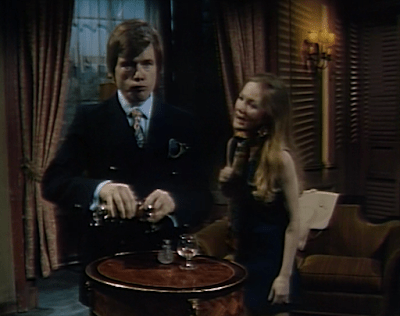
Will pours himself a glass of something, perhaps bergin and water. Screenshot by Dark Shadows Before I Die.
One might wonder if the idea of casting John Karlen as an analogue of George in an adaptation of Who’s Afraid of Virginia Woolf? occurred to the makers of the show around the time of #706. In that episode, Karlen played inveterate prankster Carl Collins, who held a gun at Barnabas’ head and threatened to shoot him. When he pulled the trigger, a flag labeled FIB! sprang out. George fires a rifle at Martha in Act One of the play, only to produce a similar effect with a Chinese parasol.
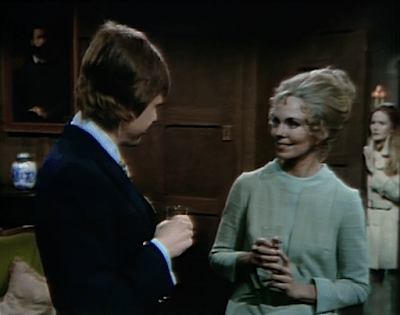
Later, Carolyn is eavesdropping outside the drawing room in the great house of Collinwood while Will is flirting with a lovely houseguest, a central character in the Rebecca/ Ligeia mashup. Carolyn stands in the doorway, in Will’s line of sight when he tries to make a date with the woman. Will has already rubbed Carolyn’s face in the intimate nature of her connection to Barnabas, and as his victim she can’t very well recreate Martha and Nick’s threat to cuckold George with any other male. So if we are going to have another scene built around that kind of insult, it will have to be Will who plays it with another woman.
Carolyn also spends some time with her friend Sabrina Stuart, who is part of the Jekyll and Hyde story. Sabrina is engaged to Dr Cyrus Longworth, the Jekyll character, and did not recognize him when last night he invaded her home and assaulted her in the persona of John Yaeger, the Mr Hyde character. Cyrus himself is puzzled when he comes to his laboratory in the morning and finds a terrible mess there, along with an IOU from Yaeger. A policeman shows up and asks him some questions, assuring him that he does not match the description of Yaeger. In his post about the episode on his great Dark Shadows Every Day, Danny Horn points out that this scene is recycled beat for beat from Dan Curtis’ 1968 TV movie adaption of Jekyll and Hyde.
Carolyn marches into Cyrus’ lab and tells him Sabrina is missing. She is angry with him for leaving Sabrina alone when the man who attacked her is still at large. He tries to assure her that Sabrina is in no danger, but since he cannot explain why he would believe that he only exasperates her further. She insists they go looking for Sabrina, and he acquiesces. It turns out Sabrina is in the great house of Collinwood, in a trance, trying to reenact the séance at which the Rebecca analogue died.
In the main continuity, Carolyn’s counterpart was married to someone whom she believed to be a man named Jeb. Like Cyrus, he was played by Christopher Pennock. Also like Cyrus, he was a shape-shifter who in his other form committed horrific acts of violence. Carolyn accepted Jeb’s refusal to tell him anything about himself, as Sabrina accepts Cyrus’ refusal to tell her anything that might lead her to suspect the nature of the potion he has developed. It is refreshing to see this Carolyn taking Sabrina’s side and insisting Cyrus do things a reasonable person might do.
Drunken sourpuss Quentin Collins and wealthy socialite Alexis Stokes enter the mausoleum where Angelique, Quentin’s late wife and Angelique’s identical twin sister, is entombed. They find a fancifully dressed man named Bruno Hess driving a chisel into the wall beside Angelique’s nameplate. When they demand to know what Bruno is doing, he explains that he is going to open the vault, show that Angelique’s body is not there, and thereby prove that Alexis is in reality Angelique come back to life.
Quentin says he will call the police if Bruno does not desist from his efforts. Bruno says that he does not believe that Quentin wants to involve the police, since that might raise questions that he would rather leave unasked. In response to this, Quentin looks down, and Alexis asks what on earth he is talking about. Quentin says it is an empty threat. He offers Bruno $25,000 to go away, rather a large amount of money to offer someone who has just made an empty threat. Bruno says he will go away without payment if he is allowed to open the vault and it turns out Angelique’s remains are there. Alexis is horrified by this idea, and she and Quentin manage to run Bruno off.
Returning viewers know that these characters are part of a story mashing up Daphne Du Maurier’s 1938 novel Rebecca with Edgar Allan Poe’s 1838 story Ligeia. Maxim de Winter put up with the presence of Jack Favell, his late wife Rebecca’s lover, on his estate because Maxim knew that Favell was willing to spread the rumor that Maxim had murdered Rebecca, and he feared that Favell might be able to prove that the rumor was true. Bruno was Angelique’s lover, and is ensconced on the estate of Collinwood. Quentin’s look down when Bruno scoffs at the idea of him calling the police suggests that he has the same exposure in regard to Angelique’s death that Maxim had in regard to Rebecca’s.
This part of the show is set in a universe parallel to the one where it spent its first 196 weeks. Angelique’s counterpart in the main continuity is a wicked witch who has returned from the dead many times. Poe’s Ligeia, like Du Maurier’s Rebecca and like the Angelique of the current continuity, was a great beauty who fascinated those who knew her and remained an inescapable presence in her husband’s house after her death and his remarriage. Unlike Rebecca, but like the Angelique of the main continuity, Ligeia was a woman of vast knowledge who could transcend death. At the end of Poe’s story, the unnamed narrator finds that his second wife, who has died, has come back to life, and that both her physical appearance and her personality have been transformed into those of Ligeia. Bruno, like other devotees of Angelique, is unshakably convinced that Alexis is lying when she says that she is not the resurrected Angelique.
Bruno is a subject in an experiment being conducted by aspiring mad scientist Cyrus Longworth. Cyrus was himself an admirer of Angelique’s. When he first saw Alexis, he too believed that she was Angelique risen from the dead. But he has accepted that she is who she says she is, and has immersed himself in his work, an attempt to create a potion that will turn whoever drinks it into a Dr Jekyll and Mr Hyde-like duality. Last week, we learned that this somewhat questionable project was Angelique’s idea.
We see Bruno in Cyrus’ laboratory, telling him about his activities in the mausoleum. Cyrus is amused by the story, and tells Bruno he wishes he had his daring. He makes fun of Bruno for getting caught, and turns back to his notes. Frustrated that he cannot enlist Cyrus in his attempt to prove that Alexis is Angelique redivivus, Bruno exits.
Bruno’s a pretty weird guy, but you’d think even he would hesitate before getting into that outfit. Screenshot by Dark Shadows Before I Die.
Later, Bruno shows up in Angelique’s old bedroom at the great house of Collinwood, where Alexis is staying. She demands he leave, and he demands she admit to being Angelique. She says that if he refuses to go, she will resort to force. He invites her to do so.
The Angelique we know in the main continuity has vast magic powers, and would be hard put to keep herself from turning Bruno into a toadstool. We don’t know if the Angelique who once occupied this room is a match for her, but the widespread belief among people who knew her well that she will transcend death suggests that she does have some kind of extraordinary ability, and a moment yesterday when Bruno believed she had cast a spell to interfere with his breathing confirms that she shared at least some of our Angelique’s talents. Bruno believes he will expose her true identity by provoking her into using them. My wife, Mrs Acilius, says that she found herself torn at this point. Returning viewers have ample reasons to dislike Bruno, and his invasion of Alexis’ personal space reinforces all of them. At the same time, she is very much inclined to believe that Alexis is Angelique. So even while she roots against Bruno, she also hopes he will succeed in this attempt.
Alexis does not cast a spell. Instead, she goes to the drawing room and tells Quentin that Bruno has invaded her room. Our Angelique would probably find it galling to have to turn to some guy and report that a meanie was bothering her, so if Alexis is an impostor we can believe she is an exceptionally well-disciplined one.
Bruno follows her. He and Quentin confront each other. Bruno taunts Quentin, saying that he always knew Angelique better than he did. Quentin reminds Bruno that he is not allowed in the house and forbids him to pester Alexis. Bruno mentions that Angelique died during a séance; this piques Alexis’ interest, and after Bruno leaves she asks Quentin about it. He doesn’t want to answer, and she drops the subject.
Cyrus goes to his laboratory late at night and finds evidence of an intruder. He discovers that the man is still there. Cyrus tells him to come out of the shadows so he can see him face to face. It is Horace Gladstone, a chemist from Boston who formulated an extremely exotic compound Cyrus bought as an ingredient in his potion. Cyrus asks Gladstone if he satisfied his curiosity when he was reading through his notes. Gladstone said he didn’t, because Cyrus’ handwriting is so bad. Gladstone says that if Cyrus will tell him what he is working on, he can be of great assistance to him. Cyrus keeps refusing, and Gladstone warns him that he is about to take “a lonely and dangerous journey.”
When he is alone, Cyrus drinks the potion. He makes noises suggesting acute gastric distress and collapses.
Quentin Collins, master of the estate of Collinwood, is in an even grimmer mood than usual. His new wife, the former Maggie Evans, has left him after only a week in the great house. She had had all she was going to take of his patronizing attitude towards her and of everyone else’s preoccupation with his first wife, the late Angelique Stokes Collins. Maggie was particularly satiated with Quentin’s houseguest, Angelique’ unmarried identical twin sister, Alexis Stokes. Maggie had found Alexis in Angelique’s bedroom, wearing Angelique’s frilly nightgown, and reaching out to Quentin while suggesting in a soft voice that “Perhaps we can comfort each other.” When that sight moved Maggie to voice objections to the situation, Quentin responded by forbidding her, for her own good no less, from mentioning Angelique’s name ever again. He was amazed that this led Maggie to leave the house. Considering the provocation, it is indeed amazing that Quentin did not require medical attention to remove his brandy decanter from whatever part of his anatomy Maggie could reach.
We open today with Quentin and Alexis back in Angelique’s room. She is fully dressed this time, but they are sitting together on the piano bench. They move their heads together, and lock their lips in a passionate kiss.
Returning viewers know that we are visiting a universe parallel to the one in which the action was based for its first 196 weeks of the show. Angelique’s counterpart in the main continuity is a wicked witch who has returned from the dead quite a few times, so when we first crossed over here and heard her devotees saying that they were sure their Angelique would find a way to come back to life we did not doubt that they were right. Maggie wants nothing to do with Angelique or the cult she built up around herself, but she is among those who are convinced that Alexis is in fact Angelique redivivus. The show has done an excellent job keeping us guessing whether she is or isn’t, and we will still be guessing when we come to the end of today’s episode.
Alexis pulls away from Quentin and is visibly upset. He apologizes for kissing her. She says that she is disappointed in him- she had thought that he, of all people would know that she is not Angelique returned from the grave. He says he does not think that she is. We can believe him- his counterpart in the main continuity usually had two or three fiancées at a time, and they were rarely his only love interests. So he wouldn’t have to believe Alexis was Angelique, or indeed that she was anyone in particular, to start a make-out session with her. After they clear the air, she agrees to stay on in the house until she can meet Quentin and Angelique’s son, her nephew Daniel Collins, who is on a trip at the moment.
Bruno, Sabrina, Cyrus, Gladstone, and the Bunny
Quentin and Alexis aren’t the only ones dealing with frustrated sexual desire. We cut from them to a closeup of a bunny. This universally recognized symbol of amorous enthusiasm is alone in a cage.
The episode originally aired on the second Tuesday of Easter 1970, maybe the bunny was resting up after his big day.
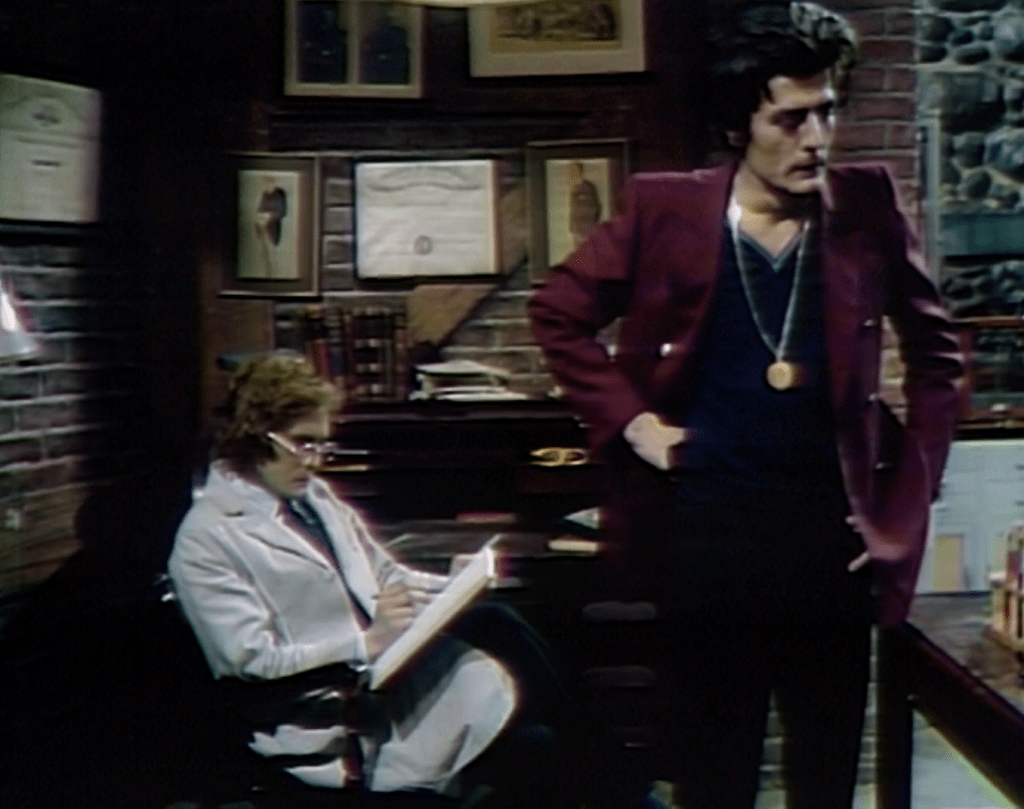
The cage is in a laboratory. A young woman in a lab coat is trying to work on a large apparatus for chemical experimentation while a man wearing a purple suit, a low cut shirt, a large medallion, and a huge bouffant hairdo is pestering her with clumsy attempts at flirting. She keeps laughing off his verbal gambits and swatting away his physical approaches.
A tall young man in a lab coat enters and calls out a booming “Sabrina!” The lounge lizard and the experimenter stand up straighter and step away from each other. Returning viewers know the tall man as aspiring mad scientist Cyrus Longworth and the ill-clad masher as Bruno Hess, musician and hanger-on of the late Angelique. We have not seen the woman before, but we recognize the actress as Lisa Blake Richards, who played another woman named Sabrina in the main continuity. That Sabrina was trapped in a go-nowhere storyline. Before today is done we will have grounds to hope that this one will give Miss Richards a task more in keeping with her considerable talents.
Cyrus sends Sabrina upstairs to wait for a package. Bruno gets ready for his part in Cyrus’ experiment, which involves giving a blood sample. Bruno asks Cyrus why he was so calm when he saw him trying to put the moves on Sabrina. Cyrus replies that he trusts Sabrina too much to worry that Bruno could come between them. He then jabs the syringe into Bruno’s arm with great force and without even looking at the spot from which he is drawing the sample, causing Bruno to jump. He may trust Sabrina, but he wants Bruno to know who’s boss.
Bruno tries to interest Cyrus in his theory that Alexis is Angelique returned from the grave. He eventually manages to get Cyrus to give him a quizzical look, but stops at that point, saying that if Cyrus won’t explain his experiment, he won’t explain his.
Sabrina comes downstairs and says that the package has come and that its bearer insists on meeting Cyrus himself. Cyrus is annoyed by this, but when it develops that the man is Mr Horace Gladstone himself, the very chemist who devised the unusual compound he has brought, Cyrus sends Sabrina back upstairs and Bruno out the basement door so that he can meet with the man alone.
Friday, Cyrus explained to his friend Chris that he is trying to devise a process for separating a human being into two parts, one good and the other evil. His scenes with Chris hit all the obligatory mad scientist notes, right down to disparaging non-mad scientists as unimaginative dolts who may as well believe that the Earth is flat. He won’t tell Gladstone what he is trying to do, perhaps because he has the same last name as did the man who was prime minister of the UK when Dr Jekyll and Mr Hyde was first published and so he reminds him that he is a character in a derivative storyline. But Gladstone does warn Cyrus that the compound he has purchased is a potent and dangerous one. Gladstone hints at the nature of the hazard when he says that he stepped back from active research when he feared that, even within the bounds of chemistry, he was about to uncover truths best left unknown.
Gladstone is played by John Harkins, in his fourth role on Dark Shadows. As before, he is playing a stranger from far away. In #174, he played Lieutenant Costa of the Arizona State Police. We saw him in a scene set in Phoenix, the first time Dark Shadows took us outside the northeastern USA. We did not leave that region again until #877, when sorcerer Count Petofi thought back to an incident in England in 1885, when he first met his henchman Aristide. Like Bruno, Aristide was played by Michael Stroka. The incident in England involved a man named Garth Blackwood, whom Petofi would bring back from the dead to punish Aristide. Blackwood was played by Harkins.
Harkins’ third character came from even further away than Arizona or England. He was Mr Strak, the representative of the Leviathan People, a race of Elder Gods long confined to the underworld. Strak appeared to Paul Stoddard in #899 and #900, and tricked Paul into selling his daughter Carolyn to the Leviathans. So far as Paul was concerned, Strak came from nowhere and disappeared to nowhere, so that he could never hope to explain to anyone what he had done, still less find a way to challenge the terms of the deal.
Gladstone is from Boston. Dark Shadows is set near the real-world location of Bar Harbor, Maine. The characters often mention Boston, but we’ve never had a scene set there. In #363, the ghost of nine year old Sarah Collins was perfectly bland when her friend, strange and troubled boy David, said he had been to China. Sarah said that her father and his business associates were always sailing to China. When David told Sarah that he was joking and he had actually gone to Boston, Sarah was thrilled. She had been to Boston herself once, and considered it a far more exotic place than China could possibly be. Gordon Russell was credited with the script for #363, and Joe Caldwell, the freshly returned author of today’s script, had finished his first tour of duty on the show three weeks before it was taped. But Sarah’s excitement about Boston is so much the kind of character moment Caldwell specialized in that I suspect it was a leftover idea of his that Russell found a place for. Perhaps the casting of Harkins as a Hub man reflects Caldwell’s idea of what Boston would represent to people in a coastal village in central Maine.
Bruno and Alexis
We cut to Bruno, who is on the telephone. He is talking to a person in an office somewhere. He learns that no ships from Genoa have docked in New York in the last week. This information excites him, but his excitement soon gives way to terror as he feels himself choking.
Bruno runs into Angelique’s bedroom, where Alexis is back on the piano bench. He gasps and demands she stop obstructing his breathing. She appears to have no idea what he is talking about.
The Angelique we have known since late 1967 did specialize in casting spells that made her enemies choke. We saw her do that as recently as #955, when her husband tried to set fire to her and she stopped him by twisting a scarf around the neck of a statue. On the other hand, Alexis seems genuinely bewildered by the situation.
When Bruno starts breathing again, he confronts her with the fact that no registered passenger ships from Genoa arrived in New York harbor the week before. She asks him if he considered that she might have been a guest on the yacht of some wealthy friends. He is stumped by this. Again, this keeps the suspense about her true identity alive. Alexis has been established as the sort of person who would be found on someone else’s yacht, but she doesn’t actually say that that is how she got back to the States. She merely asks Bruno if he had thought of the possibility that she may have done so.
Cyrus and Sabrina
Back in the lab, we see Sabrina collecting some equipment while Cyrus tends to his notes. She finds a small box, and asks him if he put it there for her to find. When he says he did, she opens it and finds a ring. She asks if it is an engagement ring. He says he hopes it is. She throws her arms around him and tells him she loves him. He holds her and does not say that he loves her too. He merely says that she knows how he feels about her, an ill-omen if ever we saw one.
Cyrus tells Sabrina that she knows how completely his work consumes his energies, and she says that is one of the things she admires about him. She asks what exactly he is working on. He is reticent, and she tries to walk the question back. He goes into his mad scientist ravings, and she gives him a stunned look. He tries to reassure her, saying that when he gets carried away he talks in cliches. He says that no one has found good or evil in a test tube… “yet!” The crazed gleam comes back into his eyes.
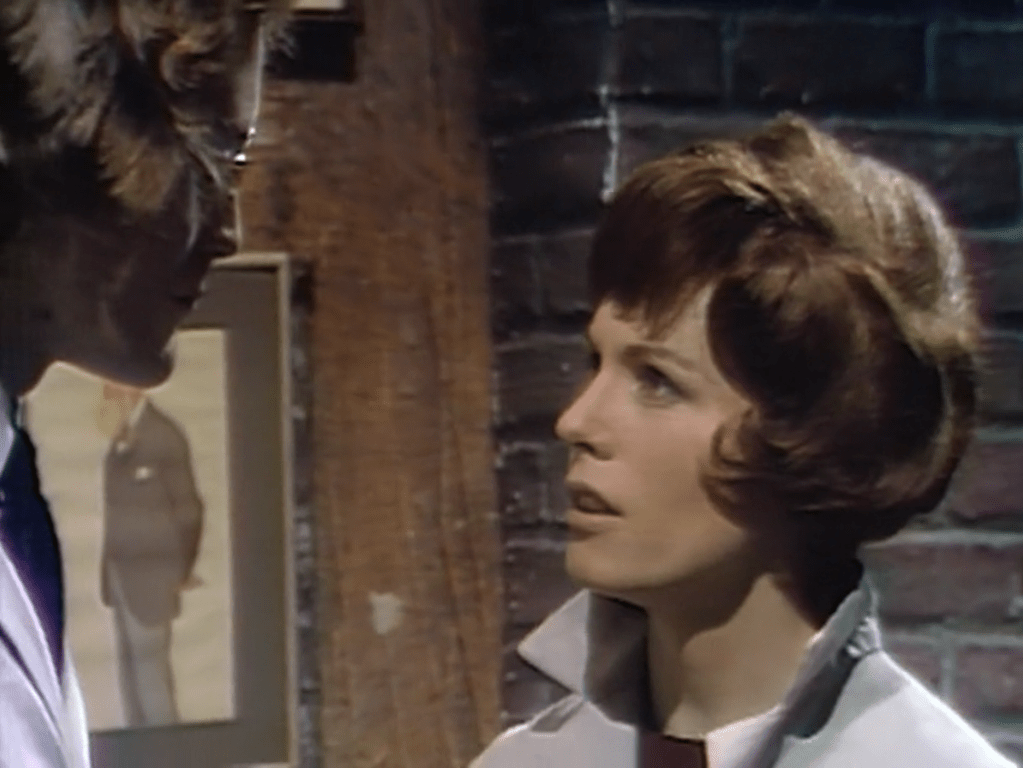
Sabrina is shocked by Cyrus’ ravings
This scene gives Miss Richards more to work with than she had had in her whole time in the main continuity. The look Sabrina gives at the end of Cyrus’ gust of lunacy is the first time she has had a chance to get a laugh, and she makes the most of it. As for Christopher Pennock, he had just been getting the hang of his previous part, hugely overgrown infant Jeb Hawkes, when he was written out. With Cyrus, he can to some extent pick up where he left off. Pennock had begun to find a way to suggest that there was a real sweetness bottled up inside one-man wrecking crew Jeb, and in Cyrus’ love for Sabrina he can play a character who is Jeb’s mirror image- abundantly sweet, but so deep inside his own head that he is about to become a monster.
Bruno
On Dark Shadows, wedding days usually come and go without anyone actually getting married. Typically, the ceremony is interrupted and someone has to go off and dig up a grave, in which they find an empty coffin.
Bruno has no manners and does not observe any of the recognized customs. So even though today is Sabrina and Cyrus’ engagement day, not their wedding day, he jumps the gun and starts opening Angelique’s grave, in which he believes he will find an empty coffin. We end with him chiseling at the wall of the mausoleum. I suppose you could say that he might be planning to work slowly, so that he won’t finish until the day of the wedding, but even if that were true it would be an outright violation of the accepted norm, and an undeniable sign that he is not the sort of person who can be expected to fit in at Collinwood.
This is the last script that will be credited to writer Violet Welles. Welles had done a substantial amount of rewriting on scripts attributed to her friend Gordon Russell before her name first showed up in the credits with #711, and she will do more ghosting for Russell later.
Danny Horn’s post about this episode on his great Dark Shadows Every Day is a tribute to Welles; I recommend it highly. Welles was far and away the best author of dialogue among the nine writers credited through the show’s 249 weeks, so much so that her uncredited contributions are easy to recognize. I will mention a week very close to the end of the series in 1971, a long time after the wheels came off, when all of a sudden characters start making witty remarks and developing interesting relationships. Then it’s back to the dreariness of a bunch of go-nowhere stories.
Welles rated herself low as an inventor of plot-lines. I don’t know what went on during the long hours she spent in story conferences with Russell and Sam Hall, but it was when she was in the room that the most fertile planning sessions Dark Shadows ever had took place. They sketched out flimsies thirteen weeks at a time, and from the time Welles became a regular part of the staff until thirteen weeks after she left, the show was packed with more lively ideas than at any other time. So if she was correct in that harsh self-assessment of what she did in the writers’ room, it was only in the narrowest sense.
Welles also spoke disparagingly of herself as a designer of dramatic structure at the level of individual episodes, but today’s installment shows that this was simply wrong. There is a tremendous amount happening in these 22 minutes, it is crystal-clear throughout what is happening and why we should care, and the actors get to do some of the best work they ever did do. We see two stories, one a mashup of Daphne Du Maurier’s 1938 novel Rebecca with Edgar Allen Poe’s 1838 short story “Ligeia,”* the other a retelling of Robert Louis Stevenson’s 1886 novella Dr Jekyll and Mr Hyde, also with a dash of “Ligeia.”
The episode is set in a different universe than the one in which the first 196 weeks of Dark Shadows took place, and most of the characters are “Parallel Time” counterparts of those we met in the main continuity. In the Rebecca/ Ligeia mashup, we today see Quentin Collins, master of the estate of Collinwood, owner of Collinsport Enterprises, and gloomy drunkard; Quentin’s new wife, Maggie Evans Collins; housekeeper Julia Hoffman, fanatical devotee of Quentin’s late first wife Angelique; and Alexis Stokes, Angelique’s freshly arrived identical twin sister. The bit from the Jekyll and Hyde story features scientist Cyrus Longworth and attorney Chris Collins. Angelique comes up in Cyrus and Chris’ conversation, and she is emerging in the role of Ligeia. Like the eponymous character in Poe’s story, she is a celebrated beauty who is dead but expected to return. Alexis herself brings up yet another reference. She wears a short bluish gray suit and chignon hairstyle with a tight spiral twist at the back, the look that the mysterious Madeleine wore and her impostor copied in Alfred Hitchcock’s Vertigo.
Jekyll and Hyde Meet Ligeia
I’ll start with the Jekyll and Hyde story, since it is the simpler one today. Chris is the estate manager at Collinwood, and his responsibilities include custodianship of Angelique’s personal effects. His friend Cyrus has called Chris to his basement laboratory to ask for a favor. Angelique had told him about a chemist in Boston who could help him with some obscure formula he needs for his current experiments. She gave him the man’s contact information, but he lost it, and he wants to look for it in Angelique’s address book.
Before they start talking about the address book, Cyrus tells Chris that he saw Angelique in town today. He tells him he was driving past the drug store and saw her walking down the street. He called to her and she did not answer, but he is certain it was she. Chris does not yet know that Angelique’s identical twin sister is in town, so he does not tell Cyrus about Alexis. He starts with a philosophical approach, then veers towards the explanation medical:
CHRIS: Cyrus, you’re a scientist. A scientist deals in established principle and fact. One thing we have to accept is that death is the end.
CYRUS: I often wonder. People used to believe that the world was flat. They believed that, that the sun revolved around the earth, and these were facts to them.
CHRIS: Uh, what are you saying?
CYRUS: I’m saying that I saw Angelique. I saw her walking down the street.
CHRIS: Well, I wish to submit that there’s an explanation for it. All of this.
CYRUS: What do you mean by that?
CHRIS: You’ve been working yourself too hard. You’ve been locked in this laboratory for over a year. Whatever you’re doing it can’t be worth your health and your peace of mind. It might even damage your mind.
Cyrus tells Chris what he is trying to do:
CYRUS: Let me begin by saying that, that man is chemical in his composition. Now, if the proper compound was distilled, and administered to a human being, this chemical composition could be radically changed, radically altered, and I’ve been working on this composition.
CHRIS: Why, why alter a human being?
CYRUS: Now let me also say this. That man is not one person, he is two. One is good, and the other is, oh, let us say for scientific conversation, the other is evil. Now, these two people are within each of us, and they are always fighting against each other. But if these elements could be separated, just imagine the possibilities. Evil could go its own way, completely free of any aspirations or remorse that are foreign to it. And good, good can have its own life, free of any struggle against, against evil impulses or hostile thoughts. My god, just imagine what a person…
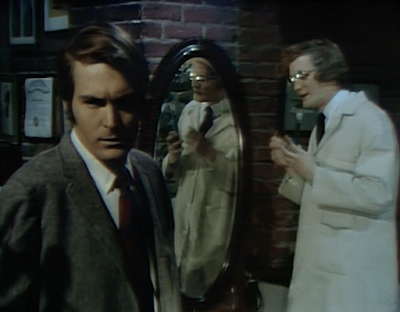
Chris is horrified by this idea, and is glad to be an obstacle to it. Director Lela Swift reinforces Chris’ conviction that Cyrus is destroying himself by placing Christopher Pennock next to a mirror during the most perfervid part of his mad scientist’s programmatic statement, a visual metaphor telling us that Cyrus is splitting himself in two.
Chris tells Cyrus that he won’t help him bury himself even more deeply in the strictly private world he has created. Cyrus says that it is not private, that it is something he shares with Angelique:
CYRUS: Angelique believed in this theory. She believed it could be done. And she was the one who started me on, on all these experiments. Separating good and evil.
CHRIS: (sourly) There is no doubt in my mind which of the two appealed to her.
Chris tells Cyrus that he has been anxious to see him. He has heard that he presented a paper on black magic to a scientific society, and that the news led him to fear that Cyrus’ mind is becoming unbalanced:
CHRIS: I admire your devotion, Cyrus, but not your direction. It can only lead to trouble.
CYRUS: It can only lead to glory. And it will. Very fast, if you’ll just give me the name of that chemist.
CHRIS: No. I’m sorry to withhold it from you, but it’s the only way I can stop you. And I think I have to stop you. I desperately think that.
Angelique was not only a great beauty and a gracious matron, but was also a scientific mind who inspired Cyrus to pursue his scheme. She could introduce an experimenter to chemists whose specialties are so obscure that they cannot be found in any published directory, and her influence leads to the study of black magic and a skeptical view of the finality of death. In these matters, Angelique recalls Ligeia. The unnamed narrator of Poe’s story, Ligeia’s widower, says of her:
I have spoken of the learning of Ligeia: it was immense –such as I have never known in woman. In the classical tongues was she deeply proficient, and as far as my own acquaintance extended in regard to the modern dialects of Europe, I have never known her at fault. Indeed upon any theme of the most admired, because simply the most abstruse of the boasted erudition of the academy, have I ever found Ligeia at fault? How singularly –how thrillingly, this one point in the nature of my wife has forced itself, at this late period only, upon my attention! I said her knowledge was such as I have never known in woman –but where breathes the man who has traversed, and successfully, all the wide areas of moral, physical, and mathematical science? I saw not then what I now clearly perceive, that the acquisitions of Ligeia were gigantic, were astounding; yet I was sufficiently aware of her infinite supremacy to resign myself, with a child-like confidence, to her guidance through the chaotic world of metaphysical investigation at which I was most busily occupied during the earlier years of our marriage. With how vast a triumph –with how vivid a delight –with how much of all that is ethereal in hope –did I feel, as she bent over me in studies but little sought –but less known –that delicious vista by slow degrees expanding before me, down whose long, gorgeous, and all untrodden path, I might at length pass onward to the goal of a wisdom too divinely precious not to be forbidden!
At the end of Poe’s story, the narrator’s second wife appears to die. Her body is eventually reanimated with the personality and even in the likeness of Ligeia. Cyrus’ un-nuanced belief that the woman he saw was Angelique come to life suggests that he expects her to follow in the footsteps of that other learned woman.
There is a poignancy now in seeing Don Briscoe play Chris’ concern for Cyrus. Briscoe suffered from bipolar disorder, and was at this time trying to self-medicate with street drugs. After he was violently mugged while trying to score a fix late at night in Central Park, he wound up leaving acting and moved into his parents’ house in Tennessee. He died there, morbidly obese, at the age of 64. I suppose what Dr Jekyll wanted was to come up with a drug that could sort the contents of the mind into orderly batches, so that people like Briscoe could live the lives they deserved to live.
Ligeia at Manderley
Meanwhile, at Collinwood, Quentin has been extremely stingy with information Maggie should know, and has neglected to tell her that Angelique had an identical twin. Hoffman and others on the estate are convinced that Angelique will somehow come back to life, and in their obsession with this idea they have made Maggie exceedingly uncomfortable in her imposing new home. Making matters worse, night before last Maggie heard a voice that she can believe to have been part of a prank played on her by Quentin’s son, strange and troubled boy Daniel, but which Daniel and we have reason to believe was actually Angelique’s ghost. So when Maggie opens the doors to the drawing room and sees Quentin giving a glass of sherry to a woman who, to all appearances, can only be Angelique, she flees in panic.
Quentin goes to Maggie in her bedroom. He explains that the woman she has seen is Angelique’s twin Alexis. At first he is relaxed and soothing, as charming as the Quentin of the main continuity has always been, almost as charming as David Selby is. But as Maggie insists on being left alone, his mood darkens. Alexis sticks her head in and suggests they should clear things up right away; Quentin asks her to wait downstairs. When Maggie refuses to be formally introduced to Alexis and play hostess to her, Quentin becomes stiff, grouchy, and patronizing, ordering her to do her duty as mistress of the house. She does not bend, and he leaves the room in a huff.
Back in the drawing room, Alexis tells Quentin she ought to leave rather than go on upsetting Maggie. Quentin dismisses Maggie’s concerns and proclaims that he alone makes decisions at Collinwood. Alexis is visibly startled by Quentin’s claim to autocracy, and doesn’t know where to look or what to do with her hands as she stammers out “Of course… you… make the decisions.” She goes along with Quentin’s decree that she will stay in the house starting tonight, before she can get her luggage back from the inn in the village.
Hoffman enters. At the sight of Alexis, she gasps “It- it’s you!” Hoffman composes herself quickly, and says that Angelique often spoke of her sister. She asks Alexis if she received the letter she sent her when Angelique died. Alexis says she missed it. Hoffman had sent it to her address in Tangier, but Alexis had moved from there to Florence by that time. Alexis does not seem to be in any particular business, and she describes her decision to return to Collinsport as motivated by a vague feeling of personal obligation, so we can assume that her long stays in these famous cities are a sign that she and Angelique have private resources that amount, if not to a fortune, at least to a competence. Hoffman suggests that Alexis stay in Angelique’s old room. Quentin does not object, and Alexis agrees.
Alone in the drawing room, Quentin wishes Alexis did not resemble Angelique so uncannily. In a gruff tone, he tells himself “I’m as bad as Maggie, I’m behaving like a frightened child.” Quentin’s attitude when he was lecturing Maggie about Alexis had indeed been that of an impatient adult ordering a child to stop having an inconvenient emotion. Since he does not believe he handled that exchange badly, it’s jarring to hear him say explicitly that he saw it that way. He pours himself a stiff drink.
In Angelique’s room, Hoffman tells Alexis she doesn’t have to lie to her. She may have her reasons to pretend with the others, but with her she can talk openly about the fact that she is Angelique risen from the grave. Alexis is thunderstruck by this, and tries to reason with her:
ALEXIS: You thought Angelique would come back? But that’s impossible, she’s dead.
HOFFMAN: She is not like others.
ALEXIS: She certainly wasn’t like anyone else. Nevertheless, she is dead. Do you hear me? She’s dead, and I’m her sister.
Hoffman tries to trip Alexis up by asking which nightgown she would like from Angelique’s dresser. Alexis points out that she has never seen any of them, so she can’t very well answer. Hoffman starts to apologize for her bizarre conduct:
HOFFMAN: I’m sorry, Miss Stokes, I’m sorry if I’ve said anything–
ALEXIS: It’s perfectly all right. I can understand how much you must miss her. But I wouldn’t intimate such a thing to anyone else if I were you. They might be very distressed by it, and so might you.
This exchange is very effective, particularly for regular viewers. Up to this point, Lara Parker has been playing Alexis quite differently than she played Angelique. Even when Angelique had been defeated in a conflict or was trying to seem like a wounded innocent, she always maintained eye contact with her scene partners and found a way to put a little more drama into her voice than any other performer would have thought to do. But Alexis looks down when she is confused, talks in a soft and casual tone when she thinks she understands what’s going on, and asks questions to which she obviously does not already know the answer. We can believe she really is a different character. But her last two sentences to Hoffman are exactly what Angelique would have said. When Alexis lifts her head and delivers them with her right eye fixed on Hoffman, we are suddenly in suspense as to whether Ligeia has already returned.
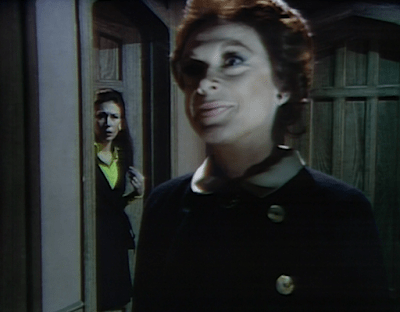
On her way out of the room, Hoffman passes Maggie. Without turning to face her, she explains that Alexis is staying, at Quentin’s orders. This brief scene is blocked as an homage to Hitchcock, whose 1940 film of Rebecca will have come to mind when Hoffman mentioned Angelique’s nightgowns. The censors tried to prevent the release of that movie, because of a scene in which obsessed housekeeper Mrs Danvers took a nightgown out of a wardrobe positioned in the same spot of the late Rebecca’s room as is the wardrobe in Angelique’s. Mrs Danvers went on and on about how sheer the nightgown was, how “You can see my hand through the material,” etc. Dark Shadows isn’t quite as bold with the homoerotic subtext of Hoffman’s devotion to Angelique as Du Maurier and Hitchcock were with that of Mrs Danvers’ devotion to Rebecca, but the shot is so much in his style and the movie was so famous that a large percentage of the grownups in the audience would likely have picked up on the reference.
Maggie goes to the drawing room, and finds that the decanter Quentin was drinking from is empty and lying on its side. She goes to Angelique’s room. She arrives just in time to see her obviously intoxicated husband in his first wife’s bedroom, with a woman who looks exactly like that first wife who is wearing a frilly nightgown, putting her hand on his shoulder, and saying in a soft voice “Perhaps we can comfort one another.” When we saw this, my wife, Mrs Acilius, said that she would not be especially pleased if she were to find me in such a situation.
Maggie and Quentin have a showdown about this in the drawing room. It’s a sensational scene, one of the best in the series. Selby plays Quentin as a drunken, condescending grouch, trying to tell Maggie she didn’t see what she clearly saw. Kathryn Leigh Scott is spellbinding as she plays Maggie’s rage. I think it’s her best moment since #265, when the Maggie of the main continuity was a mental patient and went completely nuts while singing “London Bridge.” That, I think, was the scariest scene they ever did, making us think our old pal Maggie was never going to be all right again.
This time Miss Scott doesn’t sound like any character we’ve heard her play before. In fact, she sounds more like a real person than anyone else ever does on Dark Shadows when Quentin has forbidden her to mention Angelique’s name and she responds “You forbid me! Forbid me like a child, and I am not a child, and I refuse to be treated like a child. Not by you or by anyone. I know what I heard and I know what I saw!” At that, Maggie Collins becomes a distinct character and the Parallel Time storyline jumps to a new level.
Quentin whines that Maggie isn’t giving him a chance, and she lets him have it:
MAGGIE: Nobody’s given me a chance. No. This is Angelique’s house, not mine, you’re Angelique’s husband, not mine.
QUENTIN: All right, if that’s the way you feel about it, get out of here!
MAGGIE: All right, Quentin.
QUENTIN: Leave Angelique’s house and leave Angelique’s husband!
MAGGIE: That’s exactly what I’ll do. That is exactly what I will do!
And to Quentin’s bewilderment, that’s exactly what she does. She rushes out the front door. After a bit, Quentin staggers after her. He looks outside. Alexis comes downstairs, in her sister’s frilly nightie, and asks what happened. Quentin frets that “She actually went out that door.” Alexis asks if he is going after her, and he says “No, why should I? She behaved like a child!” He’s still holding onto the idea that it is right and proper for him to regard his wife as a temperamental child. He wonders if perhaps Alexis is right, then hears Maggie drive away and announces that it’s too late to do anything. He wanders back towards the drawing room while Alexis looks on. We are left wondering if she is Angelique masquerading as her sister, or if Alexis, contrary to appearances, was actually the Evil Twin all along.
*I am indebted to Danny Horn’s commenter “Riccardo” for pointing out the connection to “Ligeia.”
Wicked witch Angelique made her first appearance in #368/369, set in the year 1795. We first saw Angelique when she entered the doors of the Old House on the estate of Collinwood, working as a lady’s maid and hiding her powers.
Today, it is 1970 and Angelique is back in the Old House. Her ex-husband, vampire Barnabas Collins, has summoned her and asked her to lift a curse she placed on Jabe, the husband of his distant cousin Carolyn. Barnabas tells Angelique that her quarrel was never with Jabe, but with suave warlock Nicholas Blair. Earlier in the episode we had seen Angelique and Nicholas having a discussion about how much they hate each other. He taunted her by claiming she has not changed in the last 200 years. When Barnabas invites Angelique to redirect her wrath towards Nicholas, she perks up. She orders Barnabas to fetch Carolyn’s husband and leave him alone in the Old House with her.
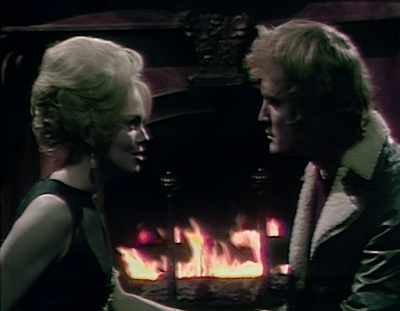
Angelique sits by the fire with Jabe and explains that she cannot simply liquidate the curse. It must end with someone’s death. But the good news is that it does not have to be his death. He can transfer it to someone else. He says he doesn’t want to kill anyone. She tells him that the person she has in mind is Nicholas. Suddenly he’s all ears as she explains the process for handing the curse over.
Angelique finds the limit of Jabe’s newfound reverence for life. Screenshot by Dark Shadows Before I Die.
Longtime viewers know that Nicholas was quite wrong to say Angelique has never changed. She was monomaniacal and utterly narcissistic in 1795. She wasn’t so very different when we next saw her in 1968, though the show’s pace was a bit slower at that point and so Lara Parker was free to play her with more nuance. That made a difference that the show underlined early in 1969, when Barnabas took a brief trip back in time to the 1790s and ran into Angelique as she was when first we knew her. Even though they were still enemies in 1968, they occasionally had to tell each other the truth, and occasionally had to leave each other alone to fight other adversaries. The unbending hostility the eighteenth century version of Angelique showed Barnabas startled him and us after we had seen the relatively circumspect approach she took to conducting a cold war against him.
Throughout most of 1969, Dark Shadows was set in 1897. Angelique showed up then, and she remembered the events of 1968. Barnabas and his friend, mad scientist Julia Hoffman, were there as time travelers. Julia actually befriended Angelique, and Angelique became Barnabas’ ally in the battles he attempted to wage in that period. Angelique even let go of her erotic obsession with Barnabas, transferring her affections to his distant cousin Quentin Collins.
After the show came back to contemporary dress, Julia stumbled upon Angelique. She found that Angelique had sworn not to use her powers, had married a man who made her happy, and had lost all interest in Barnabas or anyone else at Collinwood. She was as relaxed and attentive to others as in 1795 she had been frantic and self-absorbed. Only after it turned out the same supernatural enemies Barnabas and Julia were fighting had corrupted her husband did Angelique start casting spells again, and then in pursuit of more rational, identifiable goals than she had ever sought in the eighteenth century.
That arc of character development ends with this episode. We will see Lara Parker as several more characters up to and beyond the end of the series, some of them named Angelique, but none of whom went through the transformations we have seen.
Today also marks the final appearances of werewolf Chris Jennings and his girlfriend Sabrina Stuart. Evidently the makers of the show planned to bring them back in a few months, after an upcoming story plays out, but by that time actor Don Briscoe was unable to work. He had bipolar personality disorder and tried to self-medicate with street drugs.
Quentin was such a big hit in 1897 that they had a magic spell put on him that immunized him against aging and brought him intact to the contemporary setting. Today, Barnabas takes Quentin to a room in the long disused east wing of Collinwood where you can occasionally catch glimpses of an alternate universe. The effect manifests while they are looking in, then winks out, leaving the dark, bare room that is in that space in their universe. Once that happens, Barnabas announces “You have just seen Parallel Time.” Those of us who have been watching from the beginning know that he got the line wrong. You’re supposed to say “Parallel Time is a Dan Curtis Production.”


 Dark Shadows Commentary