Episode 798: A gift from the unicorn

In the first few decades of commercial television, ambitious shows tended to imitate live theater; since, they’ve tended to imitate feature films. Today’s episode is one of Dark Shadows’ stagiest, and it is a strong one.

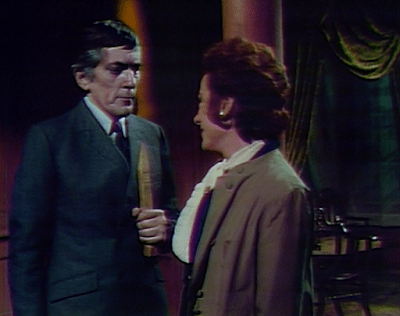
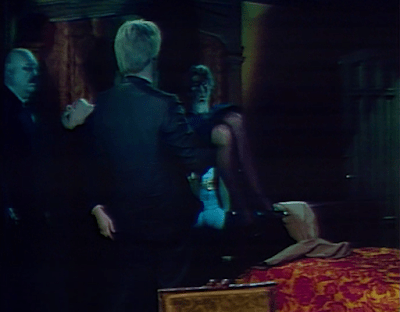
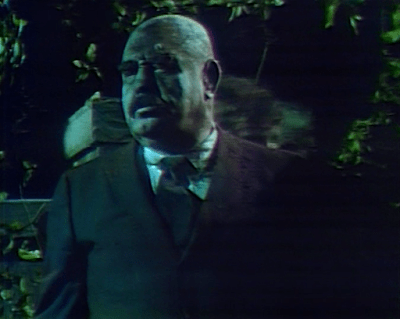
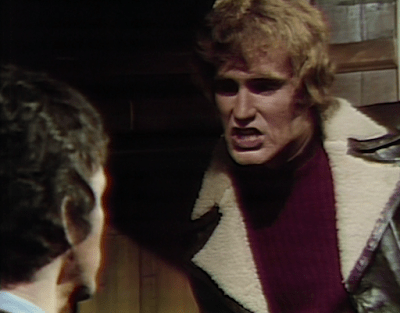
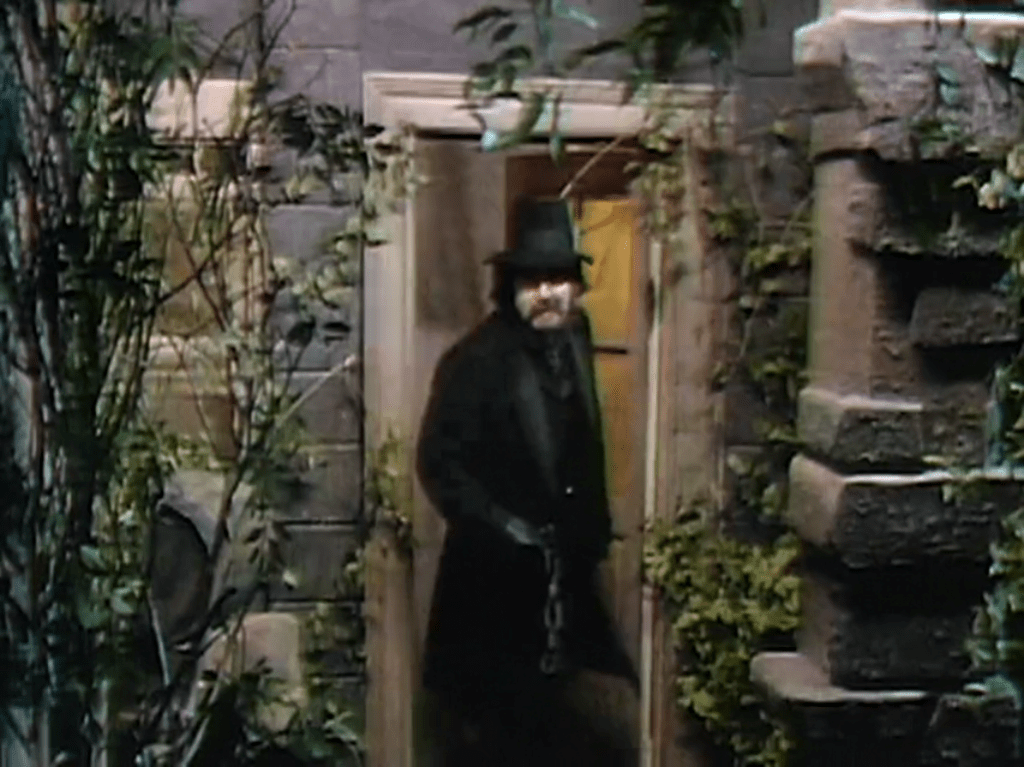
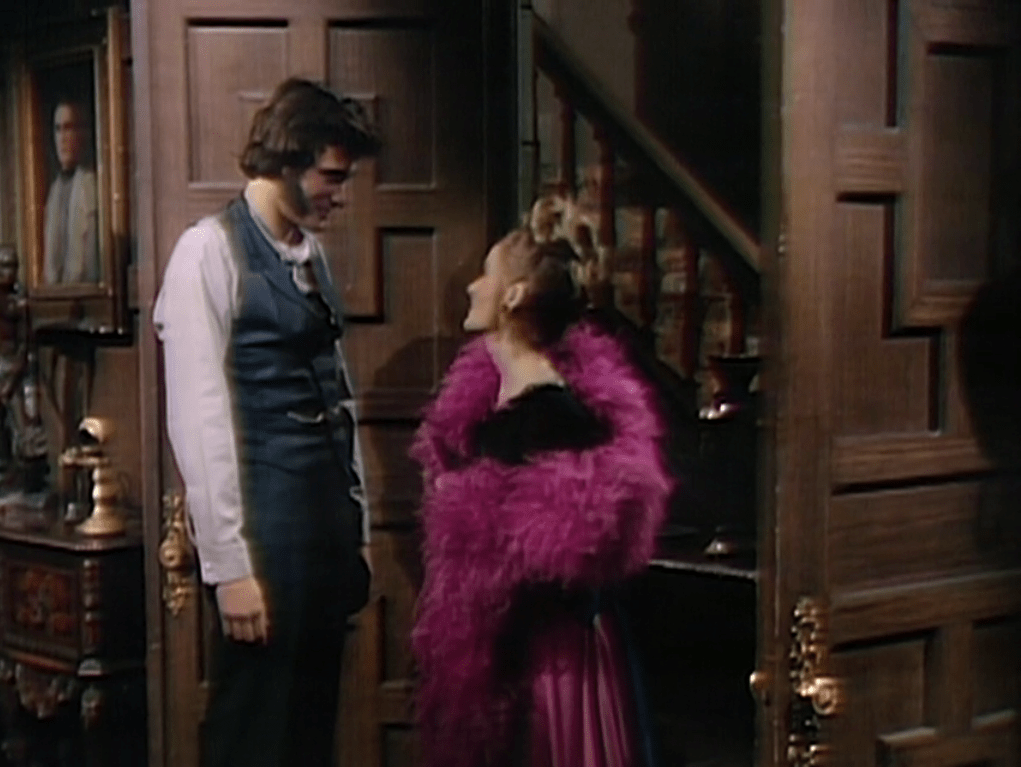
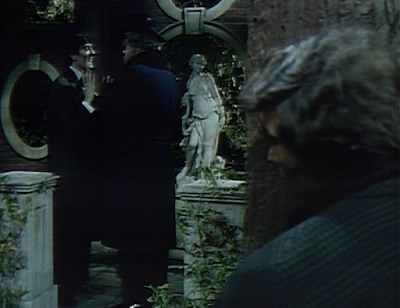
The rakish Quentin Collins has lost his hopes of being cured of werewolf-ism, and is moping in the gazebo on the grounds of the estate of Collinwood. He is staring at a revolver, trying to talk himself into committing suicide. He hears two men approaching, and takes cover in some nearby bushes. The men are known to Quentin by the names “Aristide” and “Victor Fenn Gibbon.”* The set is so small that the actors are only a few feet away from each other, but we are supposed to believe that Quentin can’t quite hear what Aristide and Fenn Gibbon are saying. So when the camera is placed at Quentin’s point of view, Michael Stroka and Thayer David vigorously mime the act of talking.

Quentin listens in from a great distance. Screenshot by Dark Shadows Before I Die.

Quentin sees Fenn Gibbon slap Aristide’s face. Aristide responds, not with violence of his own, but with a continuation of the talking he had been doing before, showing Quentin that Fenn Gibbon is Aristide’s boss. The other day, Aristide tied Quentin to a table and tried to kill him by reenacting Poe’s “Pit and the Pendulum,” so this tells Quentin that Fenn Gibbon is his deadly enemy.

We hear some of Aristide and Fenn Gibbon’s dialogue. Fenn Gibbon and Aristide are based on Gutman and Wilmer from The Maltese Falcon. In their previous appearances, Aristide has been eager to connect with every attractive young woman he sees, suggesting that we would not see the strong suggestions of a sexual relationship that come with Gutman and Wilmer both in Dashiell Hammett’s 1930 novel and the 1941 film. But today, Aristide’s unshocked reaction to Fenn Gibbon’s slap shows that he is accustomed to robust forms of physical contact with him, and when Fenn Gibbon tells Aristide that “I’m aware of your charms, my dear Aristide, but I know only too well conversation is not among them,” we can see that there is going to be a substantial gay subtext.

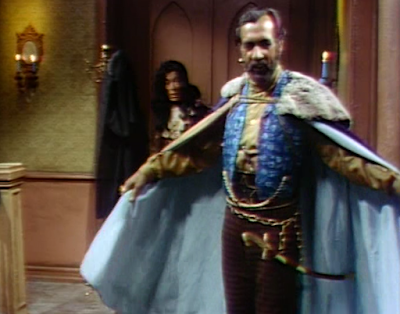
Fenn Gibbon is one of two roles Thayer David plays today. He appears in the opening teaser as broad ethnic stereotype Sandor Rákóczi, husband of the even more offensively conceived Magda. Yesterday, Magda was placed under a curse. At that time, the curse was that everyone who loved Magda would die, but today it is that everyone she loves will die. When Magda talks about the curse with visiting vampire Barnabas Collins, he says that he is under the same curse, which is exactly true- in #705, he was told that everyone who loved him would die, and from the next episode on it was said that everyone he loved would die. Whichever way the curse is put, one would expect it to strike terror in Magda’s heart regarding Sandor. They are a happily married couple, the only one we ever see on Dark Shadows, and so one would expect him to be the first victim of the curse.

The curse was supposed to start when Magda heard three knocks on the front door of her home, the Old House at Collinwood. She hears the knocks, opens the door, and sees Sandor. She immediately falls into the same pattern she exhibits every time she sees Sandor, accusing him of infidelity, accusing him of coming back to her only because he has run out of money, telling him not to bother to lie to her, and generally having a wonderful time. But he is standing rigidly still, his eyes are glazed over, and he can speak only a few words, none of them the usual insults they exchange. He falls dead, a knife in his back. Barnabas touches his body, and says that it is cold, as if he had been dead a long time.

Later, Magda goes to Mrs Fillmore, a woman in the village of Collinsport. Quentin’s late wife Jenny was Magda’s sister. Unknown to Quentin, Jenny gave birth to twins after he left her, and his brother Edward decreed that the twins would be raised by Mrs Fillmore. Magda has never seen the twins, but she loves them nevertheless- the boy twin, anyway; she tells Barnabas that “Gypsies do not prize girls.” When she comes back to the Old House, Magda tells Barnabas and Quentin that the boy twin is dead. Mrs Fillmore said he was perfectly healthy that evening, then she heard a mysterious scream from the children’s bedroom and she found him dead in his crib. His body was cold, as if he had been dead a long time. Quentin is numb, bewildered to learn that he was a father and simultaneously to learn that he has outlived his son.

There have been other episodes in which an actor played one character as a living being and another as a ghost. There have also been episodes that jumped between two periods in history, and in those there were actors who played one character in one time frame and a different one in the other. Thayer David’s doubling as Sandor and as Fenn Gibbon makes this the first episode in which the same actor plays two living beings contemporary with each other in the same episode.

Sandor’s death and Fenn Gibbon’s ascent to prominence mark a transition in the show. They are in the middle of a bloodbath, killing off a great many of the characters who have defined the first twenty weeks of the 1897 flashback. Previously, that has meant they were getting ready to reset the show and go back to contemporary dress. But 1897 has been such a hit that a transition need not mean a return to the 1960s. There is still enough going on in this period that they can introduce a bunch of new characters, develop some new stories, and get a new phase of Dark Shadows started right here in the late Victorian era. Who knows- if they play their cards right, this period might be the new home base for the show, and the 1960s might be an afterthought.

The contemporary world does make one appearance today. Before their encounter at the gazebo, Fenn Gibbon meets Quentin in the drawing room of the great house at Collinwood. Quentin is studying the Moon. The two of them have a little exchange about Quentin’s fascination with the Moon; considering that this episode aired a few hours after Apollo 11 lifted off on the journey that would put the first crew on the Moon, that fascination must have been pretty widely shared by the original audience.

*In this episode, everyone says “Fenn Gibbons,” which we have heard before. But the credits read “Fenn Gibbon,” so I’m sticking with that version.

Episode 780: Carl was not mad

In yesterday’s episode, inveterate prankster Carl Collins told his brother, the rakishly handsome Quentin, that their distant cousin Barnabas was a vampire. Quentin has problems of his own, and he is counting on Barnabas to help him. So he locked Carl up in Barnabas’ hiding place, expecting that when night came Barnabas would prune one more branch off the Collins family tree.

Today, Quentin finds that Carl has escaped. He goes to Barnabas and tells him what has happened. Carl’s practical jokes annoy Barnabas intensely, and Barnabas has never bothered to conceal his disdain for him. He reacts to Quentin’s news with fury and a lot of orders. When Quentin later finds Barnabas standing by Carl’s corpse in the drawing room of the great house of Collinwood, he is really torn up about his brother’s death for almost a whole minute.

Quentin mourns for Carl- blink and you’ll miss it. Screenshot by Dark Shadows Before I Die.

A knock comes at the door; it is the oppressively evil Rev’d Gregory Trask. Quentin keeps Trask in the foyer for a bit while Barnabas hides Carl’s body. When Trask forces his way into the drawing room, Barnabas is gone. Carl’s body is cunningly hidden… behind the curtains, propped upright. Of course it falls out almost immediately. Earlier in the episode, Carl took Trask to Barnabas’ hiding place, and we saw that Barnabas had single-handedly lugged his coffin and the structure on which it rests some distance away. If he is strong enough to do that, surely he could have tossed Carl’s body out the window. And regular viewers know that there is a secret panel in this room, of which Barnabas has repeatedly shown that he is well aware. They would probably have expected him to hide the body there. That he just stashes it behind the curtains where it is certain to come into Trask’s view suggests that he isn’t even trying to get away with this particular murder.

Closing Miscellany

John Karlen is breathing pretty deeply during Carl’s big closeup as a corpse. It’s really confusing, I thought they were telling us he wasn’t dead yet.

I don’t know what the writers planned for Carl in the flimsies they sketched out six months before this episode was made, though there is so little room for him in subsequent plot-lines that I suspect he was supposed to die at about this point in the story. Still, his death was accelerated because Karlen had other things to do. He won’t be back on the show until #956, in February of next year.

The creaky little waltz that Quentin listens to obsessively was released as a single in June of 1969 and would hit #13 on the Billboard Hot 100 in August. Regular viewers may be sick of it already, and the characters certainly wish Quentin would get another record. It’s Trask’s turn to complain about it today, giving him something in common with Barnabas.

Trask wears a cross which he uses as a weapon against Barnabas. The show is oddly inconsistent about the effect of the cross on vampires. We’ve seen other characters use crosses against them, and at one point it was said that a cross inside the lid of Barnabas’ coffin immobilized him. But his hiding place is in the middle of a cemetery full of grave markers in the shape of huge crosses, and we see several of them today. Barnabas just walks right past those with no problem. You might think that since the show was made in the USA, where sincerity is so highly regarded, that the cross might be effective against him only if it is wielded by the pure of heart. But Trask is every bit as evil as are Barnabas and Quentin, and it works for him. It’s a puzzlement.

In a long comment on Danny Horn’s post about this episode at Dark Shadows Every Day, I responded to a discussion about whether there is a point in thinking of Barnabas as someone possessed by demons:

I think of the climax of the Iliad. As Achilles moves in to kill Hector, Athena takes hold of his spear and drives it in, delivering the fatal wound herself.

For modern readers, this may ruin the story. The whole poem has been leading up to this moment; we’ve spent a lot of time with Achilles, listening to him try to figure out what it would mean for him to kill Hector. So why have the goddess take over at the last minute? Isn’t it an evasion of Achilles’ responsibility for his actions, and a cheat for us as we’ve been observing his psychological development?

For the original audience, it was not. They actually believed in their gods. Athena really existed, as far as they were concerned. When an event was important enough, they took a interest. If it was really huge, they would get involved. Moreover, the gods worked closely with each other. So much so that you didn’t pray to one at a time, but always to groups of them. When Athena joins Achilles in his fight, it isn’t her pushing him aside- it’s him doing something so important it blurs the boundary between human and divine.

Something like that is at work in the traditional, pre-modern, conception of demonic possession. To say that a person is possessed is a way of looking at behavior that is reducible neither to moralistic judgment nor to psychological analysis. It isn’t individualistic in the way that those modes of discourse are. Rather, it suggests that the boundaries between the person and the spiritual forces of darkness have broken down. Perhaps the person is partly to blame for that breakdown, but the whole point is that s/he is no longer a distinct being, but is merging into those supernatural forces.

So, imagine a version of Dark Shadows where Elizabeth Collins Stoddard really was the main character. Her whole approach to life is denial. So, you could have had a story with a beginning, middle, and end. In the beginning, we see the lengths she has gone to in her quest to keep from ever having to have an embarrassing conversation. In the middle, we see various horrors take place around her, each worse than the one before, each more obvious than the one before, and each time she finds a way to convince herself it doesn’t exist. At the end, a couple of innocent characters go to her in the drawing room of Collinwood to rescue her from the monsters who are running rampant there. She looks at them placidly and tells them she sees nothing wrong. Why ever do they think she would want to leave her home? All the while leathery-winged demons are fluttering about her head. She doesn’t see them, and they have no choice but to flee.

Comment left 10 November 2020 by “Acilius” on “Episode 780: The Establishment Vampire,” posted 2 December 2015 by Danny Horn at Dark Shadows Every Day

Episode 748: Here in the past

Madwoman Jenny Collins is hiding in the quarters of her formerly devoted servant, Beth. Beth enters with Jenny’s estranged husband, libertine Quentin. Jenny eavesdrops as Beth tearfully tells Quentin that she was once very close to Jenny, but that now she wishes her ill, because she is in love with him. Quentin and Beth embrace, and Jenny lunges at them with a kitchen knife.

Quentin disarms Jenny and strangles her. We were introduced to Quentin as a murderous ghost haunting the great house of Collinwood in 1969, and when we first came to the year 1897 to meet him as a living being it was a matter of minutes before he was squeezing his grandmother’s throat and threatening to kill her. Quentin has been going around the house announcing for days and days that he plans to kill Jenny, so it comes as no surprise to the audience that he puts his hands around her neck even though she has already been disarmed, fights off Beth’s attempts to stop him, and keeps choking Jenny until some time after she has stopped moving. We have been well-prepared for this unambiguous image of intentional homicide.

Once Quentin has finished his work, he runs out of the room. Beth goes to the foyer and, between sobs, tells Quentin’s stuffy brother Edward that Jenny is in her room, dead.

In Beth’s room, Edward feels Jenny’s wrist and says that she is indeed dead. Once Beth has given him a few of the salient details of the murder, he declares that he has heard enough. He orders Beth to take the knife back to the kitchen and put it where it belongs. They talk briefly about Jenny and Quentin’s children, whose existence has previously only been hinted to the audience and has been denied to other characters as recently as yesterday.

We cut to the foyer. Quentin comes creeping down the stairs, holding a bag and looking from side to side. When Quentin reaches the foot of the stairs, Edward seizes the bag and orders him to stay in the house. In the drawing room, Edward tells Quentin and Beth what story they will put about to cover up the murder and save the family name. Beth is to say that she found Jenny lying at the foot of the stairs, stunned. She helped Jenny to her room, then left her there for a moment while she went to look for help. Finding no one, she came back and saw Jenny lying on the bed. When she could not wake her, she realized she had died of the injuries she sustained in her fall.

Quentin says that the story will not work. He tells Edward that earlier in the evening, Jenny’s presence at Collinwood was revealed to three more people, distant cousin Barnabas Collins and ethnic stereotypes Magda and Sandor Rákóczi. Edward says that as a member of the family, Barnabas will not question the story, and that as “Gypsies,” Sandor and Magda will do anything in return for money. Quentin says that Magda and Sandor will not be so easy to deal with. When they learned that Jenny was in the house, Magda told Quentin something which he tells Edward and Beth “None of us ever knew,” that Jenny was her sister.

Edward is thunderstruck, and exclaims “You married a Gypsy!” Yesterday it seemed that Edward and Quentin’s sister Judith, the owner of the house, had known Jenny’s origin for some time, and that it was why she locked Jenny up in the house when she went insane rather than sending her to a mental institution where Sandor and Magda might be among her visitors. And as far back as #701, it seemed likely that Beth knew secrets relating to Jenny, to Magda, and to Romani heritage. In that episode, Quentin marveled that Beth was still around Collinwood when Jenny, who had brought her to the house as her servant, had left, and Magda taunted Beth by bringing up a bit of Romani folklore and laughing “But you wouldn’t know anything about that, would you?” So while Jenny’s background is news to Quentin and Edward, it may not be true that “None of us” knew.

Magda and Sandor come to the house. On their previous visits to the great house, they have acted like servants or like stage Gypsies come to tell fortunes and sing songs. But now that the word is out about Jenny’s true identity, they come in with their heads up and look Edward in the eye. They say that they have come to see Jenny. Edward turns away from them, and says that there has been an accident. Jenny is dead. Horrified, Magda asks where she is. Edward says that she is in Beth’s room, and offers to have Beth show them the way. Magda says that she knows where it is, and that she and Sandor want to go by themselves. Edward says “Of course,” very much in the tone a gentleman uses with his equals.

In the room, Magda notices that Jenny is holding a button in her hand. She concludes that she pulled it off the coat of a man with whom she was fighting for her life. Sandor notices heavy bruising around her neck.

Meanwhile, Edward is drilling Beth and Quentin in the stories they are to tell. Beth recites the whole thing, and he tells her to remember every word. Quentin is less cooperative, but still seems to have learned his part. He tells them not to speak until they are spoken to.

Sandor and Magda enter. She asks some questions; Edward answers, and shows offense when she tries to direct them to Beth. Before he can proceed to the next act of the little drama he has prepared, letting first Beth and then Quentin corroborate his account with the stories he has given them, Magda looks at Quentin’s coat. She can see that a button is missing and that the ones that remain match the one she found in Jenny’s hand. She calls him a murderer, and says that the police will hear of it.

Edward says that Quentin might have lost the button anywhere at any time. He asks her what the authorities in the village of Collinsport would do if asked to choose between a Romani person’s word and that of a Collins. Magda drops the idea of going to the police, and tells Quentin that she will place a curse on him that will make him suffer as Jenny suffered, but that his suffering will not be subject to the release that death has brought Jenny. Quentin is terrified, Edward dismissive.

Magda tells Quentin she will curse him. Screenshot by Dark Shadows Before I Die.

From the very beginning, one of the main themes of Dark Shadows has been denial, the psychological defense mechanism. In this one, we see that denial is, among other things, the wish that time would stop moving forward. Quentin says that he is not going to go to jail for something he did not mean to do. He obviously did mean to kill Jenny, but he does not want to accept any of the consequences that follow from that act. He wants to be frozen in his comfortable, carefree life, without punishment from the law or vengeance from Magda. Edward wants the family name to be frozen in the lofty regard in which it was held before Quentin murdered Jenny.

For her part, when Magda tells Quentin it will not be possible for him to die, she is promising to give him and Edward what they want, but not in the way they want it. A curse is a way of freezing time. The suffering it brings persists, unchanged, from year to year. It cannot be explained, it cannot be escaped, it falls on one person after another whatever their deserts. Its only logic is to renew itself endlessly.

Episode 640: Stay for another séance

Eleven year old Amy Jennings and her big brother Chris joined the show recently, and they are the stars today. Amy has discovered the ghost of Quentin Collins, who haunts a room in the long deserted west wing of the great house of Collinwood. Strange and troubled boy David Collins is rather miffed that Quentin prefers Amy’s company to his- after all, “Quentin Collins is my ancestor,” not Amy’s. They hold a séance in an attempt to bring Quentin to them. David has only participated in one séance, back in #186, when he went into a trance and gave voice to the late David Radcliffe, a boy who died (by fire!) in 1867. So he hasn’t had a chance to catch on that séances on Dark Shadows require a minimum of three people- the first to begin the ceremony and bark orders at everyone else, the second to go into the trance and act as medium, and the third to grow alarmed, try to wake the medium from the trance, and be sternly rebuked by the first. Since David and Amy have no third person, they have no chance of contacting Quentin.

Instead, a shadowy figure appears in the doorway. She is well-meaning governess Vicki, or a rough approximation thereof. David Collins’ scenes with Vicki had been the highlight of the first year of Dark Shadows, not because of the writing or the direction but entirely due to the rapport between actors David Henesy and Alexandra Moltke Isles. A few weeks ago Mrs Isles left the show, and Vicki was recast. Her brief appearance is Mr Henesy’s first scene with the new actress, Betsy Durkin. They can’t recreate his chemistry with Mrs Isles, and Vicki ran out of story long ago. As a result, the scene sounds a discordant note for longtime viewers, reminding us that Miss Durkin, whatever her talents, is here nothing more than a fake Shemp taking up screen time.

Unknown to the other characters, Chris is a werewolf. Chris accepts an offer from the Collins family to host Amy at Collinwood while he deals with his mysterious problems; in gratitude, he takes heiress Carolyn for a drink at the Blue Whale tavern. While there, he sees a pentagram on the barmaid’s face and hurriedly excuses himself. Later, he transforms into his lupine shape and returns to the barroom, not through the door this time but through the window. He kills the barmaid.

The werewolf drops in to the bar. Dark Shadows Before I Die.

The barmaid appears only in this episode; she doesn’t even get a name. But we see her face in closeup often enough that she feels like a person. Even more importantly, she is wearing the same wig that Maggie Evans, The Nicest Girl in Town, wore in her first four episodes (#1, #3, #7, and #12.) Since Maggie was also a server, working the counter at the diner in the Collinsport Inn, this wig tells longtime viewers that the werewolf’s victim could just as easily have been Maggie, one of everyone’s favorite characters.

Don Briscoe played Chris in his human phase, Alex Stevens as the werewolf. Stevens was credited not as an actor, but as “Stunt Coordinator.” Yet today, his credit card appears in between Briscoe’s and that of Carol Ann Lewis, who was cast as the luckless barmaid. Some of the original audience may have caught on that Stevens was the man in the character makeup, but others who noticed the odd billing order would have chalked it up as another of the show’s frequent imperfections.

Episode 626: The sad case of Victoria Winters and Peter Bradford

From November 1967 to March 1968, Dark Shadows was a costume drama set in the years 1795 and 1796. Well-meaning governess Vicki had come unstuck in time, found herself in that period, and failed utterly to adjust to her new surroundings. While she was in gaol charged with witchcraft, she befriended an unpleasant man named Peter, who served as her defense attorney. Peter handled the case so badly that he and Vicki were both sentenced to hang, but they nonetheless fell in love with each other.

Shortly after Vicki was whisked back to the 1960s, she found that Peter had also come back to life. Unfortunately, he had total amnesia covering everything prior to his arrival in the twentieth century, and he became belligerent every time Vicki tried to tell him about himself. These traits did nothing to improve Peter’s already repellent personality, but having fallen in love with him once Vicki remained grimly determined to make a life with him.

The other day, Peter and Vicki were about to get married when a mysterious woman known as Eve presented Peter with evidence that what Vicki has been telling him is true. He ran off to exhume the grave marked with his name and found that the coffin was empty. For some reason he took this to mean that he shouldn’t marry Vicki after all. He has gone back to his room, where he is packing his bags and looking at a train schedule.

Unknown to Peter, there have been two visitors in his room while he was away. Eve came in and called for him, saying aloud that she would “make it all right” for him. A man known as Adam followed her in and overheard this. Adam thus learned that, despite their names, he and Eve would never be a couple. He asked if, when “yesterday, you made me happy- that was a lie, wasn’t it?” She confirmed that it was, that she would never love him, that she had always hated him, and that she found him ugly. That last apparently struck a nerve, because Adam responded with great rage. He choked Eve, and she collapsed.

Vicki drops in on Peter while he is getting ready to leave town. He tells her they cannot be together, and she insists on giving their relationship a second chance. Peter opens his closet to get some more clothes to pack, only to close it quickly. Vicki opens it, and finds Eve’s strangled corpse crumpled on the floor.

There is a genuinely horrifying moment in this episode. Vicki thinks back to the night in the 1790s when she was taken to the gallows, and we see events from her point of view. At one point we see Peter’s face looming towards the camera with his lips puckered. We’ve seen how Roger Davis manhandles his female scene partners, and in particular how miserable Alexandra Moltke Isles is when he kisses her. The sight of him coming at us for a kiss is enough to make even the most seasoned horror viewer flinch.

Get away from me. Screenshot by Dark Shadows Before I Die.

Mrs Isles read the opening narration of episodes 1-274 in character as Vicki. After she lost her monopoly on the opening narrations, she read more than 100 others, no longer as part of that role. This is the final time she takes on that task. It is also the first time “and Alexandra Moltke as Victoria Winters” is followed on screen by other acting credits.

Episode 486: Endless corridors of trial and error

Today’s cast includes a vampire, a wicked witch, two mad scientists, a Frankenstein’s monster, and an irritable housekeeper. The deadly menace turns out to be the housekeeper.

In a laboratory in a house by the sea, mad scientists Eric Lang and Julia Hoffman are trying to transfer recovering vampire Barnabas Collins’ “life force” into the body of the creature Lang has built for the purpose, a creature Barnabas has named Adam. In the drawing room of the great house atop Widow’s Hill, wicked witch Angelique disrupts that attempt by sticking a pin into a clay figure that she addresses as “Dr Lang.” It is unclear how Angelique attached the clay figure to Lang, though since it has roughly the same acting ability as Addison Powell the pairing seems natural enough.

Lang gasps for air. Julia helps both him and Barnabas. Barnabas gets up from the operating table and declares he will go to the great house and stop Angelique. Lang tries to tell Julia how to carry on his work, but keeps breaking down. While Julia is out of the room getting some heart medicine, Angelique removes the pin from the clay figure. During that moment of relief, Lang is alone in the lab. He turns on his tape recorder and says that if both Barnabas and Adam live, Barnabas will be free of the vampire curse. Adam will drain it from him, but will not suffer from its symptoms. If Adam dies, Barnabas will revert to active vampirism.

Angelique resumes tormenting Lang as Julia returns to the laboratory. Lang cannot keep his breath long enough to tell Julia his message or make it clear that she should listen to the tape. Angelique says that Lang has suffered enough for tonight, and that she will put the pin away. As she is about to do so, the door to the drawing room opens and housekeeper Mrs Johnson comes in. Mrs Johnson startles Angelique, who inadvertently drives the pin through the clay figure, killing Lang.

This is the second death to which Mrs Johnson has contributed. The two cases are very similar. She unknowingly gave undead fire witch Laura Murdoch Collins the information she needed to cast the spell that killed parapsychologist Dr Peter Guthrie. Guthrie resembled Lang not only in holding a terminal degree, studying the uncanny, and doing battle with an undead witch, but also in his use of a tape recorder. In #170 and #171, Guthrie recorded the audio of a séance; in #172, Laura erased the recording and replaced it with the sound of fire; and in #185, he was on his way to get his tape recorder to use at another séance when Laura cast the spell that killed him. Mrs Johnson is a menace to a very specific kind of person.

Barnabas comes to the great house and threatens Angelique, calling her by the name “Cassandra,” the alias under which she has married sarcastic dandy Roger Collins and found a place in the house. At first he says he will burn her if Lang dies. She pretends not to know what he’s talking about, and says that she will expose him as a madman. He looks at her neck and leans in, a sign that his vampire urges are coming back. The telephone rings, and Mrs Johnson enters. Angelique/ Cassandra explains their compromising position by claiming that she was fainting; with that, she shows that her threat to air her complaints is a bluff, since she could easily have demanded Mrs Johnson call the police.

Barnabas is getting thirsty. Screenshot by Dark Shadows Before I Die.

Mrs Johnson says the call is for Barnabas. It is Julia reporting Lang’s death. Barnabas makes some grim remarks to Angelique/ Cassandra, then goes back to the laboratory and talks with Julia. She is distraught, but agrees to pick up where Lang left off.

We end with a dream sequence. Angelique has loosed a “Dream Curse” on the people of Collinsport. One after another, they have the same basic dream, in each case beginning with an appearance by the next person to have the dream beckoning them into a haunted house attraction and ending with a door opening to expose something the previous dreamers didn’t see. Julia’s dream begins with Mrs Johnson, telling us she will be the next up. It proceeds with her walking through a foggy room, including a clear shot of the fog machine. It ends with the sight of a skeleton wearing a wedding dress and the sound of Angelique’s distinctive laugh, telling us that the position Angelique has gained by marrying Roger is particularly dangerous to Julia. Since Julia lives in the same house as Angelique and they know all about each other, this is not exactly a major revelation.

Featuring a very special appearance by the fog machine. Screenshot by Dark Shadows Before I Die.

The dream involves the beckoner’s voice reciting a little bit of doggerel. As it goes on, some beckoners say “through endless corridors by trial and error,” others say “through endless corridors of trial and error.” I prefer “of trial and error.” That implies that the corridors are themselves made up of decisions people have made and of the consequences of those decisions. Saying that the characters are moving through the corridors “by trial and error” means that the corridors exist whether anyone engages with them or not. We saw Angelique start the curse, so we know it isn’t something that has been out there in reality all along, and it expresses itself in dreams, not in anything that persists when people stop paying attention to it. Besides, the whole idea of drama is to show decisions and their consequences, so “of trial and error” is better on every front.

Episode 451: The pit of my soul

Haughty overlord Joshua Collins and good witch Bathia Mapes decide to take Joshua’s son Barnabas to the deserted Old House on the estate of Collinwood. Bathia has agreed to do battle with the ghost of wicked witch Angelique in hopes of lifting the curse whereby Angelique turned Barnabas into a vampire. Bathia warns Joshua that if she is interrupted, Angelique will defeat her. In that case, Barnabas will remain as he is, and Bathia will die. Joshua assures her that no one will come to the Old House.

Bathia, Joshua, and Barnabas before they go to the Old House. Screenshot by Dark Shadows Before I Die.

In the great house on the estate, Barnabas’ mother Naomi talks with fluttery heiress Millicent Collins and Millicent’s new husband, naval officer/ sleazy operator Nathan Forbes. Millicent’s mental health has always been fragile, and Nathan has been making a concerted effort to shatter it altogether so that he can get his hands on her share of the Collins fortune. Making matters worse, Barnabas bit Milllicent the other day. She has a beautiful mad scene today, one of several that Nancy Barrett knocks out of the park during this storyline. She insists on telling Naomi that she has seen Barnabas. This distresses Naomi, who knows that Barnabas is dead but does not know about the vampire curse.

Millicent gives Naomi enough details to stir her curiosity about what is going on at the Old House. She goes there, interrupting Bathia’s efforts. Joshua manages to hustle Naomi out of the house, but the damage is done. Bathia bursts into flames and dies. In keeping with his habit of covering up compromising information, Joshua has kept everything from Naomi. Once more, we see the cost of this habit. Had he leveled with her about Barnabas’ condition, Barnabas might have been freed.

There is a detailed comparison of the script for this episode with the finished product on a tumblelog called sights9. It is in five parts, the first of them here.

A very famous blooper occurs before Joshua and Bathia take Barnabas from the great house to the Old House. Bathia is supposed to be giving instructions, but falls silent, stares at the teleprompter, and squints helplessly for a long moment. Then we hear the line producer, Bob Costello, prompt her with “Then go to the house” and she picks back up.

Episode 440: You’re bein’ more stupid now

Vampire Barnabas Collins arises from the dead, goes to the front parlor of his house, and finds a friend of his passed out drunk in an armchair. The friend, much put-upon servant Ben Stokes, had left the house the night before after saying that he would no longer help Barnabas in his murderous schemes. Barnabas brings this up, but apparently Ben has decided he has nowhere else to go, so he’s back.

Barnabas tells Ben that he has two projects going at the moment. He dropped his cane with its instantly recognizable silver handle in the shape of a wolf’s head at the scene of an attempted murder last night; the victim, a streetwalker named Maude Browning, screamed and someone came running. Barnabas orders Ben to find the cane and bring it back before it leads to his exposure.

The other project is Barnabas’ attempt to take revenge on the Rev’d Mr Trask, a visiting witchfinder who has wrought considerable havoc in town. Barnabas recently discovered he had some magical powers, and he has been using those powers to drive Trask insane. He says that he will stay in the house and cast more spells on Trask while Ben goes to Maude’s room over the feed store to look for the cane.

In his room at a local inn, Trask can’t keep a candle lit. He hears Barnabas’ laughter, and declares that it is the voice of the Devil. Or as Trask calls him, THE DE-VILLL!!!! A knock comes at the door. Trask is fearful, but answers when the knocker identifies himself as naval officer Nathan Forbes.

Trask believes hapless time traveler Vicki Winters to be the witch. A court has agreed with him, convicting Vicki of witchcraft and sentencing her to hang. Trask tells Nathan that the witch has started tormenting him. Since Nathan testified against Vicki, Trask warns that she might do the same to him next. When Nathan takes Trask’s warning lightly, he responds with some overheated rhetoric. To this, Nathan remarks that it’s never man-to-man with Trask. When he listens to him, he gets the feeling that sitting in a pew and that the rest of the congregation is absent.

Trask then tries to tell Nathan about the terrible visions he has been suffering. While he does so, he hears Barnabas’ voice and sees his hand. Nathan, of course, can neither see nor hear these manifestations.

Lately Nathan has established himself as a rather cold villain, but he used to be a good-hearted sort, though with some glaring personality defects. We catch another glimpse of the friendly Nathan when he tells Trask the trial must have taken a toll on him. He offers to take Trask out of his room and give him a place to rest. Trask responds indignantly to this offer, and demands Nathan leave him alone.

We cut to Ben searching Maude’s room. When Ben leaves, Nathan catches sight of him. Nathan follows Ben back to Barnabas’ house. Nathan stands at the window and eavesdrops as they talk about Ben’s search of the docks and of Maude’s room, of his failure to find the cane, and of the drunken ramblings with which Maude has been confusing the barroom patrons who want her to tell them about the attack she suffered.

Nathan eavesdrops on Barnabas and Ben. Screenshot by Dark Shadows Before I Die.

When the show was set in 1967, we saw several characters stand at this window and listen as Barnabas held incriminating conversations with his henchmen. Most notably in #274, seagoing con man Jason McGuire eavesdropped as Barnabas handled a box of jewelry and told his sorely bedraggled blood thrall Willie Loomis of his evil plans for Vicki. As Nathan has become more and more a villain, he has become more and more reminiscent of Jason. The night after Jason listened to Barnabas and Willie, Barnabas killed him. Seeing Nathan in this position, regular viewers will wonder if it implies that his death is as near today as Jason’s was then.

Barnabas and Ben leave the house. Ben suggests they leave Collinsport and go someplace where Barnabas will not be recognized. Barnabas will not hear of it. He moans that the house is the place where he and his lost love Josette were supposed to live and be happy. Ben pleads with him to let go of the memory of Josette. Having seen Barnabas in 1967, we know that this plea will fall on deaf ears. Barnabas calls himself “stupid” for leaving the cane at the scene of the crime; the ever-forthright Ben tells him he’s being more stupid now. None of Barnabas’ twentieth century confederates would have dared say a thing like that to him, making Ben’s boldness a refreshing change for regular viewers.

We cut back to Maude’s room. Nathan is bringing Maude home. She is much the worse for drink. He urges her to stay in her room with the door and window locked, then goes.

A bat squeaks at the window, Maude panics, and Barnabas materializes in the room. He asks her about the cane. She tells him she doesn’t have it, and he strangles her. It’s one of the most brutal on-screen murders we have seen so far.

From Maude’s room, we cut to the door to Trask’s. He stands in front of it and we hear him deliver a monologue in a recorded voiceover. This is the first time we have heard an interior monologue from Trask. He shouts so much that it often seems that if you could read his mind you’d see nothing but all-caps disquisitions about THE ALMIGHTY! and THE DE-VILLL! But in fact, he’s telling himself that Nathan must have been right and that all the visions he saw and voices he heard must have been the result of nervous strain brought on by his hard work during Vicki’s trial. He goes into his room, telling himself to calm down. He looks at his bed, and finds Maude’s strangled corpse sprawled there.

Episode 423: A position to threaten me

The gracious Josette, recently ill, has disappeared from her bedroom in the great house of Collinwood. She did not exit through the door to the hallway, nor did she climb out the window. Josette’s aunt, the Countess DuPrés, asks the master of the house, haughty tyrant Joshua Collins, how her niece could have got out. Joshua says there is a secret passage, but he cannot imagine how Josette would know about it. He did not tell her, and the only other people who knew of its existence were his brother Jeremiah and his son Barnabas, both of whom are dead. Since Josette was engaged to Barnabas for a time and was later married to Jeremiah, perhaps one of them might have mentioned the passage to her, but this possibility does not occur to Joshua.

Everyone in the house becomes involved in a search for Josette. That includes untrustworthy naval officer Nathan Forbes, Nathan’s fiancée Millicent Collins, and Nathan’s wife Suki. Millicent does not know that Suki is Nathan’s wife. Suki introduced herself to the Collinses as his sister, and is content to go on masquerading as such so long as there is a prospect Nathan will pass along a great chunk of Millicent’s vast inheritance to her. Nathan did not expect Suki to turn up, and she has been making him extremely uncomfortable for the last couple of days. It has been magnificent to watch.

Nathan and Suki need to have a conference about some topics they cannot possibly discuss in a house where they might be overheard. It occurs to him that no one is living in the Old House on the estate. He tells Suki to wait for him there.

Nathan is not entirely wrong when he says that “there is no one living” in the Old House. However, there is one among those who are not living who is not simply dead. That is Barnabas, who has become a vampire. Suki enters the house and meets him.

Barnabas demands to know who Suki is. When she introduces herself as Suki Forbes, sister of Nathan, he soon declares “You are not his sister, you are his wife! Don’t bother to deny it.” He tells her that Nathan has no sister, therefore she could only be his wife.

Suki plays the innocent.

This conclusion is more impressive the more you think about it. Before Barnabas died, he and Nathan were friends, so it is reasonable that he would know Nathan has no sister. Suki is not carrying a bag or riding a horse or wearing strong boots, so she must be staying at the great house. She gives her name as Forbes, so she must be staying there as a connection of Nathan’s. Granted that she is lying about being his sister, the true nature of that connection must be something she and Nathan want to conceal from the Collinses. Barnabas knows that Nathan has persuaded Millicent to marry him, prospectively raising him from the genteel poverty of life on a junior naval officer’s salary to the great wealth of the New York branch of the Collins family. So the secret relationship must be one that would deny him that glittering prize. Suki, indeed, must be Nathan’s wife. It is a brilliantly logical inference, which makes it inexplicable that Barnabas draws it. He is a character who does smart things sometimes, foolish things frequently, but he has never before shown any great aptitude for sequential reasoning. Nonetheless, it is a wonderful moment. Wonderful moments multiply when Suki is around.

Suki is one of the most quick-witted and daring characters on the show. She recovers from the initial shock after a second or two and asks Barnabas what it is to him if she is Nathan’s wife. He speaks in his usual menacing way, and she tells him he is in no position to make threats. She recognizes Barnabas from the portrait of him that hangs in the great house. She realizes that the official story, the tale Joshua put about that Barnabas has gone to England, must be the cover for some shameful secret, and she sets about crafting a blackmail demand as her price for keeping that secret.

Suki thinks she has Barnabas over a barrel.

Suki finds Josette’s cloak on a chair. She realizes that Josette is in the house with Barnabas, and we see her thinking up new and higher blackmail demands.

Suki makes a discovery.

While Suki is involved with the cloak, Barnabas dematerializes. Bewildered, she looks for him in the parlor, then goes outside. A bat frightens her.

Suki frightened.

Suki retreats into the house. She melts down and starts sobbing with fear.

Suki reaches her breaking point.

The bat reappears in the room. It hovers near the lens of the camera, then gives way to Barnabas, one of the best efforts they have made at showing Barnabas change form. Suki tells him she can’t believe what she is seeing.

Suki cannot believe her eyes.

Suki brings out the best in the writing staff, driving them to show each character doing whatever it is they do that makes the biggest contribution to the show. Unfortunately, Barnabas makes his biggest contribution when he murders people. So he winds up strangling Suki at the end of this episode. It is a terrible shame that a character as dynamic as Suki is only on Dark Shadows for a few days.

So long, Suki.

It is also a shame that Jane Draper doesn’t come back to play another part in one of the segments of Dark Shadows set in a period other than the late 18th century. Perhaps the makers of the show thought that in Nancy Barrett, who plays Millicent in the 18th century segment, Carolyn Collins Stoddard in the 1960s segments, and many other characters in segments we will see later, the show already had a tiny blonde actress with a wide range and a forceful style. Her similarities to Miss Barrett may have prompted the producers to cast Ms Draper as Millicent’s rival/ would-be exploiter/ mocking Doppelgänger. Miss Barrett’s other characters tend to be very different from Millicent. They are given to abrupt psychological reverses, alternating between acute self-consciousness and fierce self-loathing and between irritable distrust and complete emotional dependence. Her characters are usually their own mocking Doppelgänger, so that there was no need to cast another actress to play such a part. But Ms Draper is so very good as Suki that there can be little doubt she would have been able to handle any role they threw her way.

Episode 341: A fatal curiosity

Mad scientist Julia Hoffman and vampire Barnabas Collins are visiting Dr Dave Woodard in his office. Woodard has stolen the notebook in which Julia has recorded the truth about Barnabas and is planning to hand it over to the sheriff. At Barnabas’ insistence, Julia has prepared a hypodermic with a potion that will induce a heart attack. He orders her to give Woodard the lethal injection.

In her reluctance to kill her onetime friend, Julia suggests that Barnabas turn Woodard into a vampire. Julia believes she will soon find a cure for vampirism. So, Woodard will just be one more patient who will benefit from her imminent success. Neither he nor Barnabas receives her brainstorm with any great enthusiasm.

Woodard claims that, even if he became a vampire, he would have free will and would be able to fight Barnabas and destroy himself. He then asserts that Barnabas, too, has the ability to do the right thing. As viewers of drama, we are predisposed to believe that characters whom we hear talking and who have motivations we can understand are at liberty to choose what they will do, so we may believe that Woodard is right. But we haven’t seen any evidence to support his contention.

Julia keeps trying to postpone the killing. Exasperated with her procrastination, Barnabas tells her to hand him the hypodermic. She does so. As he is about to give the shot, Woodard claims to see the ghost of Barnabas’ little sister Sarah. Barnabas is so desperate to see Sarah that he falls for this and lets Woodard go. Julia calls out “Stop him!”

Barnabas is furious that Woodard has hit him at his most sensitive spot. As he regains his grip on Woodard, he jabs him in the shoulder with the needle. While Woodard crumples at his feet, Barnabas picks up on the words Woodard had earlier used to describe him, exclaiming “Loathsome I am, and evil! You can mock me for that, but leave my pain alone!” Even after that exclamation, Barnabas asks Julia if Sarah really was there. We don’t see her, but we do hear the strains of “London Bridge,” a song that has always before told us that Sarah is present.

Barnabas places Woodard’s corpse in the desk chair. He appears to be enjoying himself hugely while he taunts Julia for her squeamishness. He asks her, as a medical doctor, to verify that Woodard is dead; she can’t bring herself even to look at the body. She wants to leave immediately; he asks if she plans to leave the needle on Woodard’s desk. Once she puts the murder weapon in her purse, she again wants to rush out; he asks if she is planning to leave the notebook in Woodard’s pocket.

Even after they return to his house, Barnabas continues tormenting Julia. He tells her she will soon grow accustomed to her new identity as a murderer. She resists the label, and he magnanimously agrees to share half the responsibility for the killing. She says she will stop trying to cure him and go away; he tells her that will no longer be possible. They need each other more than ever now. When he tells her that he is her only friend, she hears Woodard’s voice saying “You no longer have friends.” As those words sound, so do the notes of “London Bridge.”

Barnabas is at his most compelling in these scenes, thanks to the actor who plays him. Jonathan Frid’s style of acting was rather old-fashioned even in 1967, but his achievement today is extraordinary. He takes us on a dizzying ride from horror at the brutal killing of Dr Woodard, to pity for the vastly lonely man longing for his little sister, and back to horror at Barnabas’ glee in bestowing the title of murderer on Julia. I can’t imagine any performer doing a better job.

The killing of Dr Woodard is quite a shock. It is only the second premeditated murder we see on Dark Shadows. Undead fire witch Laura Murdoch Collins used black magic to cause parapsychologist Peter Guthrie to have a fatal car crash in #186. There’s no magic this time- this is a plain old death by poisoning. We also saw Barnabas kill seagoing con man Jason McGuire, but that was not a premeditated act. Jason opened Barnabas’ coffin at sunset, and Barnabas, apparently by reflex, strangled him. That’s a reflex many of us might understand, I’m certainly not at my best when I first wake up. So when Barnabas wrestles with Woodard and jabs him with the needle, we are entering new territory.

When Julia and Barnabas are back in his house, she throws the needle into the fireplace. The Dark Shadows wiki disapproves of this action:

The destruction of the murder weapon was taken more lightly in this scene than it would have been in real life. The heat from a normal fireplace would not be hot enough to melt glass. The metal needle would have been blackened, and if someone looked through the ashes thoroughly, it would have been discovered. Had the syringe been discovered, Woodard’s death would have been ruled a homicide.

Dark Shadows wiki, episode 341.

I don’t see why the presence of a warmed-over medical sharp in Barnabas’ fireplace would mean that “Woodard’s death would have been ruled a homicide.” The police haven’t made any connection between Woodard’s death and Barnabas’ house. Even if they had, they would have no reason to suppose a hypodermic needle in his fireplace would have anything to do with Woodard. Julia is keeping it quiet that she is a medical doctor, but it isn’t a secret from the authorities. She spends most of her time at Barnabas’ house and is treating him for what she believes to be a rare blood disease, so she’s likely to have all sorts of medical supplies there. It is never specified what the chemical was that caused Woodard’s death, but if it was potassium chloride, it would have had the effects Julia describes and the heat of the fireplace would be sufficient to cause it to disappear without a trace in a little flash of dark purple flame. And of course potassium chloride dissolves in the bloodstream so completely that even a large dose of it cannot be detected in a normal postmortem examination. Unless they had dripped some of it into Woodard’s ashtray, Julia and Barnabas would have no reason to believe that the police would be looking for potassium chloride.

Julia moves to throw her notebook into the fire after the needle. Barnabas intercepts it in a move that looks so much like what you’d see on a basketball court that I count it as a blooper.

“Hoffman goes up, and is DENIED by Collins!” Screenshot by Dark Shadows Before I Die.

In between the scenes with Barnabas and Julia, there is some stuff with the sheriff and artist Sam Evans. The sheriff ambles into The Blue Whale tavern and finds Sam starting his fourth shot of whisky. They talk about Woodard, and Sam insists they go to his office to look for him. For the first 40 weeks of Dark Shadows, Sam’s alcoholism was a substantial story element, part of the “Revenge of Burke Devlin” arc. When that arc finally dried up in #201, Sam’s alcoholism went away. He’s a social drinker now. Still, he used to be the town drunk, and apparently that’s a higher post than sheriff. The sheriff follows Sam’s orders and accompanies him to Woodard’s office.

They knock on the office door. There is no answer. Sam suggests they break the door down. They haven’t tried to turn the knob, so they have no reason to suppose it is locked. Returning viewers will recall that yesterday Julia just walked into the office, without even knocking, and she and Barnabas did not lock the door behind them. So we can be fairly sure it is not locked. Still, orders are orders, so when the Town Drunk (Retired) says it’s time to break the door down, the sheriff watches him respectfully. Of course the whole set is made of a sheet of plywood, so when Sam “flings himself” against the door, he has to maintain a ludicrous gentleness to keep any part of it standing.

Inside, they find Woodard dead in his chair. Their response is bewildering. At first they are going to call for help, but then decide that because Woodard is dead there is no point. Eventually the sheriff remembers that he ought to call the coroner. They also take turns declaring that they believe Woodard’s death was the result of foul play.