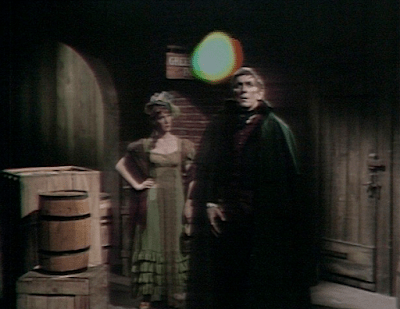
Episode 523: Back to Hell, from whence thee came!

The first episode of Dark Shadows, broadcast on ABC-TV on 27 June 1966, was a moody, atmospheric Gothic drama, characterized above all by its hushed tone. For months afterward, the show was almost an essay on the theme of quietness. Now we come to the second anniversary of that premiere, and quietness is the last thing we hear.

This installment marks the final farewell of the show’s single loudest character, revenant witchfinder the Rev’d Mr Trask. In #519, Trask performed an exorcism on the witch variously known as Angelique Bouchard Collins and Cassandra Blair Collins. The exorcism seemed to be a great success; it ended with Angelique/ Cassandra vanishing into thin air, and she has not been seen since. That might have left someone watching Dark Shadows for the first time with the impression that it is a specifically Christian show and Trask is one of its heroes.

Today, they take steps to correct that impression. A man calling himself Nicholas Blair and claiming to be Angelique/ Cassandra’s brother has turned up on the great estate of Collinwood. In the basement of the Old House on the estate, he finds Trask’s skeleton. He conjures Trask up and interrogates him. Trask declares Nicholas to be a tool of the devil. Regular viewers know that this is something Trask says to all the fellas, but this time he is obviously correct. He goes into the same exorcism rite that produced such spectacular results with Angelique/ Cassandra. Nicholas simply turns around and gives him a sarcastic little round of applause. Nicholas keeps making demands of Trask. Trask takes a cross from under his cloak. Nicholas recoils from that. Trask vanishes, but his skeleton is still missing, suggesting that he has not found peace.

Trask draws his secret weapon. Screenshot by Dark Shadows Before I Die.

That Trask’s exorcism worked on Angelique/ Cassandra but not on Nicholas suggests that it is not a means through which God acts in the world, but is just another magical weapon that can be wielded with greater or lesser effect depending on the skill and strengths those involved. His loyalty to “THE ALMIGHTY!!!” has given Trask enough power to defeat Angelique/ Cassandra, but Nicholas ranks higher than she does in the hierarchy of “THE DE-VILLL!!!,” high enough that Trask’s mumbo-jumbo cannot reach him. The cross has its effect, but with that Trask is setting aside his own efforts and calling directly on the boss. Nicholas is quite certain that he can undo the effects of the exorcism, so for all we know, he might be able to call his own home office for help sufficient to overcome his aversion to the sign of the cross.

The show not only puts Christianity and the spiritual forces of darkness on a par as sources of magical power, they aren’t even the only such sources. Though we don’t hear about any of them today, scientists and doctors Peter Guthrie, Julia Hoffman, Eric Lang, and Timothy Eliot Stokes apparently acquired supernatural abilities along with their advanced degrees. We even know that Guthrie was a professor of psychology at Dartmouth College. So the Dartmouth Department of Psychological and Brian Sciences joins Christianity and diabolism as reservoirs of uncanny might.

In the great house on the estate, heiress Carolyn Collins Stoddard tells Nicholas that Angelique/ Cassandra alienated the Collins family by her dalliance with local attorney Tony Peterson. Nicholas goes to the village of Collinsport and calls on Tony, whom he realizes Angelique/ Cassandra ensorcelled into serving as her cat’s paw. Angelique/ Cassandra put Tony into a trance by having him strike his cigarette lighter; Nicholas achieves the same effect by opening his cigarette case. Tony really needs to stop smoking.

When he first sees Tony, Nicholas is stunned by his resemblance to Trask. They are both played by Jerry Lacy, and Angelique/ Cassandra told him that she chose him because he reminded her of her old acquaintance. We already know that there is a mystical connection between Tony and Trask; Tony was the medium through whom Trask spoke at the séance which led to his return to the world of the living. While he has Tony entranced, Nicholas extracts information from him that only Trask could have known. This suggests a notion of reincarnation that would have reminded viewers of what many of them probably thought Hindus and Buddhists believed, and would thus suggest a syncretistic approach to religion that would represent another step away from the Sunday-morning flavor that the ending of #519 might have left.

We return to the great house. Well-meaning governess Vicki opens the front door and finds her boyfriend, an unpleasant man named Peter who prefers to be called Jeff. With this, a Christian world-view is pushed still further into the background, as a scene featuring Peter/ Jeff is enough to make anyone doubt the existence of a just and loving God.

Vicki and Peter/ Jeff talk about various events that don’t have anything to do with the show. He paws her awkwardly, and his hands dart to her neck as if he were about to strangle her. While he is out of the room for a moment, Trask materializes and tries to warn Vicki that “THE DE-VILLL!!!” is nearby. Before he can tell her that it’s Nicholas she should be worried about, Peter/ Jeff comes back in and starts yelling. At the sight of Peter/ Jeff, Trask wrinkles his nose and fades into nothingness, never to be seen again. Peter/ Jeff probably got a lot of that.
Episode 519: Poor suffering servant of Satan!

Roger Collins is on the telephone in the foyer of the great house of Collinwood. He is assuring the caller that it will be fine if Maggie, whom returning viewers know to be The Nicest Girl in Town, comes to stay. He says that he and Cassandra will be glad to have her for as long as she wants to be with them, and that he is sure Liz will approve. First time viewers thus learn that Roger has a wife named Cassandra, and that they live as guests in a house belonging to someone called Liz. A moment later, Liz enters, and is too distracted to hear anything Roger says to her.

Roger ends the phone call, and follows Liz into the drawing room. She stares out the window and makes a gloomy remark about death. He says he understands she must be very upset about Sam Evans. Returning viewers know that Sam was Maggie’s father, and that he died in yesterday’s episode. Roger goes on about how it is natural to be grieved at the loss of a friend like Sam, but soon learns that Liz’ mood has nothing to do with Sam’s demise- it’s news to her that he is dead.

Roger’s lines will startle longtime viewers. For the first 40 weeks of the show, Roger and Sam were united by a deep and abiding mutual hatred, and since then they have had no contact at all. Roger’s words about Sam as a family friend are so far from what we have previously seen that they should be considered a retcon.

Liz and Roger spend several minutes in the drawing room. She keeps going on about the all-pervasive reality of death, and he keeps urging her to see a doctor. There isn’t much to their lines, but Joan Bennett and Louis Edmonds were such extraordinary screen performers that it’s always fun to watch them together. This scene might be a particular pleasure to longtime viewers, who have rarely seen Roger as the responsible adult in any encounter.

We dissolve to a bedroom where a young woman in a black wig is sifting through some powders, looking directly into the camera, and telling Liz that her obsession with death will become even worse than it already is and will have dire consequences. Liz will believe that she is someone else, a woman who lived and died in another century, and may die by the same poison that killed that person.

There is a knock at the door. It is Roger. The woman hides her powders and lets him in. He addresses her as Cassandra and asks why the door was locked. Thus first-time viewers learn that she is his wife, that this is their room, that she is a witch, and that Liz’ problem is the result of a spell she has cast.

Cassandra tells Roger that she locked the door because David kept pestering her about Sam’s death and she wanted a moment to herself. With that, first-time viewers find out that David is Roger’s son, that Cassandra is his stepmother, and that she expects Roger to consider locking him out of the room an appropriate response to his grief about Sam.

Roger does not so consider it, and is bewildered by what Cassandra tells him. He tells Cassandra that Liz is in a bad way, and he is worried about her. Cassandra says she did not know that Roger was so concerned about his family. Baffled by this, Roger says that of course he is concerned, Liz is his sister. This tells first time viewers both what Roger’s relationship to Liz is, and that Cassandra has so little sense of family that she cannot imagine how other people feel.

Regular viewers will learn more. In the first year of the show, Roger’s keynote was his lack of loyalty to the family. That has now been set aside once and for all, and his normal attachment to his son and his sister provide a contrast with Cassandra’s apparently sociopathic coldness. Further, we saw a great deal of Cassandra from November 1967 through March 1968, when the show was a costume drama set in the 1790s and she was called Angelique. We saw then that Angelique had no conception of family or friendship, and that her idea of love begins and ends with her control over a person.

Cassandra promises to join Roger downstairs for a game of bridge in half an hour. He leaves, and she gets back to work spellcasting. As she does so, a figure in a black cassock materializes behind her. She turns, and the figure vanishes. In a quizzical tone, she says Roger’s name, revealing that she did not see the figure or realize that it is a supernatural presence. Together with her locking the door, scrambling to hide her magical paraphernalia when Roger knocked, lying to cover what she was doing, and failing to understand what a person with a reasonable amount of human empathy would consider acceptable behavior, her puzzlement shows that whatever her powers may be, they have definite limits.

Back in the foyer, another young woman with black hair lets a man into the house. She calls him Joe, and he calls her Vicki. Joe and Vicki talk about Sam’s death and about Maggie. Joe says that he wants to marry Maggie as soon as possible and to move away. Vicki is all for their marriage, but does not want them to go. Joe talks about how close he and Sam were. Longtime viewers will remember that when Sam and Roger were enemies, Sam was the town drunk. Even then, Joe was always happy to help him in whatever way he could, and did not see his condition as any obstacle to marrying Maggie.

Liz enters and angrily addresses Joe as “Lieutenant Forbes.” Joe has never heard of Lieutenant Forbes, and cannot understand why Liz, who knows him well, would not recognize him. Vicki clearly does know who Liz is talking about, and manages to calm her down. After Liz apologizes and hastens away, Vicki answers Joe’s questions only by saying that Forbes is someone from “the past.” Since we heard Cassandra talk about Liz taking on the personality of someone who lived in “another century,” this suggests that Vicki, too, has an unnatural familiarity with that same century.

Joe wants to go upstairs to the room where Maggie is sleeping so that he will be the first person she sees when she wakes up. Vicki is about to lead him to Maggie when Cassandra insists she join her in the drawing room to talk about David. Vicki tells Joe which door to open, and complies with Cassandra’s directions. This shows that Vicki is a member of the household staff whose responsibilities have to do with David. Regular viewers know that she is his governess, and that they are very close.

Cassandra tells Vicki that David has been asking about Sam’s last words. Vicki says that he addressed them to Maggie, not to her, and implies that she did not hear them. When Cassandra continues probing, Vicki protests. She asks if Cassandra can’t see that she is upset. Considering how clueless Cassandra was about human feelings in her conversation with Roger, it is entirely possible that she cannot. Vicki tells her that Liz is deeply depressed; Cassandra feigns ignorance. Vicki says in a cold voice, “You wouldn’t know anything about that,” then leaves.

Longtime viewers know that it was Vicki who came unstuck in time in #365 and took us with her to the 1790s. During her nineteen weeks in the past, Vicki came to know not only Forbes, but Angelique. She knows perfectly well that Angelique and Cassandra are the same person, that she is a witch, and that she is a deadly menace to everyone. She likely suspects that Liz’ depression is the consequence of one of Cassandra’s spells, and the tone of her parting remark would suggest that she does. Further, those who saw the show yesterday know that Vicki is lying about Sam’s last words. They were addressed to her, and she heard them clearly. She is choosing not to repeat them to Cassandra lest Cassandra use them for her nefarious purposes.

Cassandra is alone in the drawing room for only a few seconds. She is joined there by the same figure who had appeared in her room. This time she sees him. He confronts her.

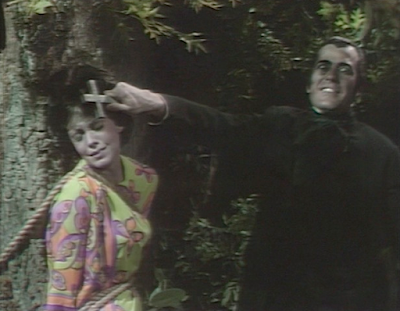
Regular viewers know that the figure is the Rev’d Mr Trask, a fanatical witchfinder who mistook Vicki for the witch in the 1790s and sent her to the gallows. He tells Cassandra that he now has the opportunity to correct that error. He shows her a cross, from which she recoils. We cut to a scene in the woods. Trask has tied Cassandra to a tree and performs an exorcism on her. This is Trask’s go-to technique; he tied Vicki to a tree in #385 and performed an exorcism on her in #386. Since Cassandra actually is in league with the devil (or as Trask would say, THE DE-VILLL!!!,) he has more success this time. Cassandra vanishes and leaves the ropes hanging on the tree.

Trask exorcises Cassandra. Screenshot by Dark Shadows Before I Die.

A first-time viewer might take this climax as an indication that Dark Shadows is a Christian show and Trask is its hero. Not only is Trask going after the right target, he is clearly making some headway. He says all the right things about casting the evil out of Cassandra and saving whatever good is left in her. His delivery of his lines is so fervent that Mrs Acilius, a vigorous Christian, cheered him on. In fact, Trask’s wild incompetence throughout the 1790s segment led to one disaster after another, and was of a piece with the show’s light regard for religion. Not until #450 did a cross provoke a reaction from a monster; that was the first suggestion the show gave that there might be anything to Christianity, and the scenes between Cassandra and Trask today are the second.

Dark Shadows borrows story points freely from all sorts of books, plays, movies, and folklore. So far, it has steered clear of Christianity as a source. For obvious reasons- most of the audience is at least nominally Christian, and Christianity is, in one way or another, a live option for the rest. So it’s a topic that can take over very quickly once it is introduced. I suppose a specifically Christian version of Dark Shadows could have worked, but I can’t imagine that the staff they had would have been particularly interested in making a show like that. So when it looks like they are going to let Trask have even a temporary win, we see the show running one of its boldest risks yet.

Episode 460: Lies beyond the grave

In #365, well-meaning governess Vicki came unstuck in time and found herself in the year 1795. Now, Vicki is about to be hanged for witchcraft, and the last of the story threads that have been playing out around her are about to be tied up.

Yesterday’s episode ended in the study at the great house of Collinwood, where naval officer/ sleazy operator Nathan Forbes shot a wooden bolt from a crossbow into the chest of vampire Barnabas Collins. At the top of today’s episode, Barnabas pulls the bolt out, telling Nathan that the bolt didn’t hit him. Barnabas’ voice is dubbed in over this, clarifying that Nathan missed his heart. We then switch to Nathan’s point of view and see Barnabas approaching for the kill.

After the opening title, we see that Barnabas is still in the study. Time has apparently passed. Barnabas’ father Joshua enters. Barnabas asks him if Nathan has been buried. Joshua says that he has, and lists the stories that he will tell to cover up all the deaths that Barnabas has been involved with over the last few months. Barnabas wants Joshua to shoot him through the heart with a silver bullet right now and destroy him forever. Joshua cannot do that, but he promises that he will put Barnabas out of his misery come daylight, when he is in his coffin. Barnabas asks two more favors of his father, that he free much put-upon servant Ben and that he prevent the execution of the wrongly convicted Vicki. Joshua promises to do these things as well.

Joshua and Barnabas. Screenshot by Dark Shadows Before I Die.

Throughout this scene, actors Louis Edmonds and Jonathan Frid hold back tears. Patrick McCray remarks: “Crying is not the most powerful thing an actor can do on stage. Rather, it is the attempt not to cry that seizes audiences. In these moments, Frid and Edmonds seize. In a medium of love scenes, there is none more poignant.”

The performers have a powerful theme to work with, one that Danny Horn explicates when he considers the question of why Joshua is still alive at the end of this storyline. When she made Barnabas a vampire, wicked witch Angelique decreed that everyone who loved him would die. Yesterday, Joshua confessed that he feared he was incapable of love, and Barnabas told him that such a disability might save his life. But when we see Edmonds and Frid struggling against the urge to weep, we know that Joshua loves Barnabas very deeply indeed, as we have in recent weeks seen that he loved others he has lost. Danny explains:

The reason why Joshua is spared from the curse is that the love he feels for Barnabas isn’t the kind of love that Angelique recognizes, and so he slips under her radar.

Angelique’s love is selfish, and spiteful. She uses it as a convenient excuse for running over anyone who gets in her way. She doesn’t understand love that arises from respect, and strength of character. And she will never feel the kind of deep, honest love that Joshua now realizes for the first time that he is in fact capable of.

Danny Horn, from “Eats, Shoots, and Leaves,” posted on Dark Shadows Every Day 16 August 2014

Danny goes on to explain that, while others had love for Barnabas that included a selfless element, there was also something in their feelings that Angelique could recognize, while Joshua’s love for him comes entirely from this higher plane. The portion of Dark Shadows set in the years 1795-1796 turns out to be The Tragedy of Joshua Collins, not only because Joshua has the highest social status among the characters, makes the most important decisions, and is played by one of the best actors, but because he grows into the sort of person who is governed by this kind of love. When the world around him is being ground down into dishonesty and cheapness, largely due to the consequences of his own misguided actions, Joshua discovers a new kind of strength within himself. Even amid the ruins of a world he himself did as much as anyone to wreck, Joshua represents the hope that something better might yet come into being.

After daybreak, Joshua stands beside Barnabas’ coffin in the secret chamber hidden inside the Collins family mausoleum, the pistol in his hand. Joshua cannot bring himself to fire the silver bullets into his son’s heart. Ben enters. Joshua orders him to affix a silver crucifix to the inside of the coffin to immobilize Barnabas there, and then to chain the coffin shut. Joshua and Ben assure each other that Barnabas will never be released. Later, we see Ben in the chamber, alone with the chained coffin. He looks at it and says “Goodbye, Mr Barnabas, goodbye.” Thayer David delivers that line with an unforgettable simplicity.

Returning viewers know that Joshua’s plan to keep Barnabas confined will work only until April of 1967, when Barnabas will be freed to prey upon the living once more. That July, in #276, Barnabas will stand in the hidden chamber and say that, while in chaining the coffin rather than destroying him his father “thought he was being merciful, what he did was no act of mercy.” This remark, combined with a story he told Vicki in #214 about his conflict with Joshua, just may have been the germ from which the whole story of Joshua grew. At any rate, the promise ABC-TV made to its viewers when it aired this promotional spot in November 1967 has been fulfilled:

Back in the study, Joshua frees Ben and gives him a severance packet of $100, worth about $2500 in 2024 dollars. When Ben thanks him for his generosity, Joshua denies that he is being generous. I have to agree with Joshua there- that amount might get a fellow out of town, but he’d have to find a new job pretty fast if he wanted to stay in the habit of sleeping indoors.

Another servant brings a note while Joshua and Ben are in the study. The governor has refused Joshua’s plea that Vicki’s execution be stayed. She will be hanged tonight.

At the gaol, Vicki’s boyfriend, an unpleasant man named Peter, is brought to her cell. The gaoler tells them they have five minutes before Vicki will be taken to her death. It is little wonder Vicki’s last request was to have time with Peter. Spending five minutes with him is like living to a ripe old age. Peter vows to overcome death and reunite with her. The last time we heard that was when Barnabas died the first time. In #409, he used his dying breaths to ask gracious lady Josette to wait for him to return to her. Fool that she was, Josette did, leading to disaster for her. Returning viewers may well wince, not only at the ominous parallel with Josette’s grim fate, but also at the memory of the many tedious scenes in which Josette at first insisted that Barnabas was coming back and was then at a loss when asked to explain herself. Besides, we don’t want to see any more of Peter.

The scene of Vicki’s hanging is quite elaborate by Dark Shadows standards. They’ve built a fairly realistic gibbet, hired several extras, put hats on them, and given them burning torches to hold. They test the equipment with a heavy sack, slowly lead Vicki to the place of honor, ask her if she wants a mask, and command the Lord to have mercy on her unrepentant soul. The camera drifts up to the top of the rigging, leaving Vicki out of the shot. When the time comes, we hear the drop and see the rope tighten.

Swing time for Vicki. Screenshot by Dark Shadows Before I Die.

This marks the end of the 1795 flashback, but not necessarily of Dark Shadows 3.0. In #437, Vicki told Peter that she often had nightmares in her childhood, so often that she became a connoisseur of nightmares. She would stay asleep throughout the whole process, waking up only at the very moment she was about to be killed. That was a rather heavy-handed way of telling the audience that Vicki would ascend the gallows, put her head in the noose, and find herself back in the 1960s. Once she is back in her own time, what she has learned in the 1790s will have consequences for what she does next. So we can expect an epilogue of some kind before Dark Shadows 4.0 begins.

Episode 450: That man who says he is Barnabas

Haughty overlord Joshua Collins and his long-term house-guest the Countess DuPrés have summoned good witch Bathia Mapes to lift the curse that has made Joshua’s son Barnabas a vampire. Meanwhile, Barnabas has bitten his second cousin Millicent and gone to the waterfront to find another victim. Bloggers Danny Horn, Patrick McCray, and John and Christine Scoleri have said so much so well about this episode that I have only a few points to add.

Millicent tells Joshua that it is wrong of him to have “that man who says he is Barnabas” in the house when he does such frightful things. Nancy Barrett’s performance as a woman made insane by her encounter with the undead is achingly beautiful. And her idea that Barnabas is an impostor is an intriguing one. Should Bathia succeed, Barnabas will need a story to account for the several sightings people made of him when he was cursed. That success seems unlikely- if Barnabas is freed from the curse now, what will we find when Dark Shadows stops being a costume drama set in the 1790s and returns to a contemporary setting? But it is something to file away for future use…

Bathia summons Barnabas away from the docks, where he is about to kill a prostitute, by sending the flame from a candle to him. The movement of the flame is an interesting effect, but what most held my attention was the scene between Barnabas and the woman he almost victimizes. Jonathan Frid and day player Rebecca Shaw play this scene in silence, with exaggerated movements, against a heavy musical score. The resulting balletic interlude is a striking departure from Dark Shadows’ previous form.

Barnabas disappoints his partner at the end of the ballet sequence. Screenshot by Dark Shadows Before I Die.

Bathia keeps Barnabas in place by showing him a cross from which he recoils. This is the first time we have seen this reaction. Barnabas routinely comes and goes through a cemetery where many of the grave markers are in the shape of the cross, and they don’t bother him a bit.

Not only is it the first time this particular symbol has been a problem for Barnabas, it is the first time Dark Shadows has suggested there might be something to Christianity. The representatives of the faith we have seen so far in the 1790s have been Barnabas’ Aunt Abigail, a disastrously repressed spinster; the Rev’d Mr Bland, of whom the best that could be said was said by the doomed Ruby Tate when she described him to Barnabas as the preacher who looked like a duck; and the Rev’d Mr Trask, a fanatical witchfinder who inadvertently became the handiest tool wicked witch Angelique had at her disposal. The 1960s characters, aside from one fleeting mention of the word “Christmas” in 1966, have not betrayed any awareness that there is such a thing as Christianity.

Bathia commands the spirit of Angelique to speak to them through Barnabas. When Angelique was first on the show, she very conspicuously kept doing many of the weirdest things Barnabas was in the habit of doing in 1967. So Barnabas exasperated his henchmen by fixating on well-meaning governess Vicki but refusing to bite her, insisting that Vicki would eventually come to him “of her own will.” Angelique exasperates her thrall, much put-upon servant Ben, by casting spells on everyone but Barnabas when her goal is to win Barnabas’ love, insisting that Barnabas would eventually come to her “of his own will.” When in 1967 Barnabas sends his thrall Carolyn to steal an incriminating document and she asks what will happen if she is caught, he replies “See that you don’t get caught.” When Angelique sends Ben to steal a hair ribbon from Abigail and he speaks of what will happen if he is caught, she replies “See that you don’t get caught.” Moments like these suggest that the vampire Barnabas is not simply cursed by Angelique, but possessed by her. Perhaps it was Angelique, wearing Barnabas’ body as a suit, that we saw in 1967, not the son of Joshua and Naomi at all.

Jonathan Frid as Angelique . Screenshot by Dark Shadows Before I Die.

This fits with the general idea of the supernatural developed in the first 73 weeks of Dark Shadows. The first supernatural menace on the show was undead fire witch Laura Murdoch Collins, who was on from December 1966 to March 1967. Laura was a complex of beings, made up of at least two material bodies and an indeterminate number of spirits, some of which seemed to be unaware of the other parts of the system and pursuing goals incompatible with theirs. From June to November of 1967, the ghost of Barnabas’ little sister Sarah kept trying to contain the damage her big brother was doing to the living characters. Sarah too turned out to be a complicated sort of phenomenon, and the form in which she visited people when they were awake was unaware of and at odds with the form in which she visited them in their dreams. If we go by Laura and Sarah, we would have to assume that supernatural beings are multifarious and fissiparous. So perhaps each time Angelique casts a spell, she splits a bit off of herself and the fragment springs up as another version of her, functioning independently of the rest. In that case, the vampire Barnabas is an avatar of Angelique. When Bathia compels Angelique to speak, she is compelling one of the Angeliques to drop a mask.

The given name “Bathia” is rare; the only person with it who ranks higher in Google search than Bathia Mapes is a musicologist named Bathia Churgin. Professor Churgin was born in New York in 1928, went to Harvard, and taught in the USA until she moved to Israel in 1970. So it is possible that someone connected with Dark Shadows may have heard of Professor Churgin and named Bathia Mapes after her, either as a tribute or just because the name stuck in their mind.

The surname “Mapes” is somewhat less rare; apparently “it is borne by around one in 903,601 people.” In 1963 and 1965, Frank Herbert published two novels that were later issued together under the title Dune; there is an elderly woman with a mystical bent named The Shadout Mapes in those. I’ve never taken much interest in Dune, and owe my awareness of this to comments on Danny Horn’s blog (from Park Cooper here and from “Straker” here.) There doesn’t seem to be much doubt that Bathia’s family name is a nod to The Shadout Mapes; whether it was Sam Hall or another of the writers or someone else who worked on Dark Shadows or one of their kids who had read Dune, I cannot say.