One night in 1797, nine Rroma men trapped the sorcerer Count Petofi in the forest of Ojden and cut off his right hand. With it, the count lost most of his magical powers. Sometime after, Petofi learned that he could live for exactly one hundred years without his hand. If he was reunited with it in that time, he would become immortal; if he was not, he would die.
Now, it is 1897, and the hundred years are almost up. Petofi has vacated his body and has for some weeks been operating in the person of twelve year old Jamison Collins. He has regained the hand, but as Petofi is dying, so is Jamison. Jamison/ Petofi collapses in the woods carrying the hand back to the place where his servant Aristide is waiting with Petofi’s own body. Jamison/ Petofi passes out shortly after Jamison’s uncle, the rakish Quentin Collins, catches up to him. Quentin carries Jamison/ Petofi and the hand to the caretaker’s cottage on the grounds of the estate of Collinwood, where he confers with his distant cousin, Barnabas Collins the vampire.
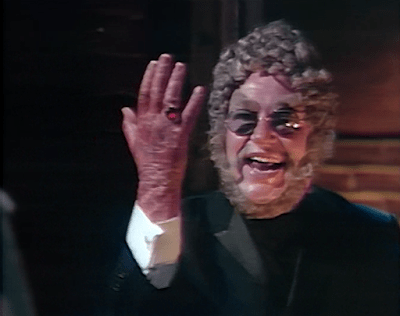
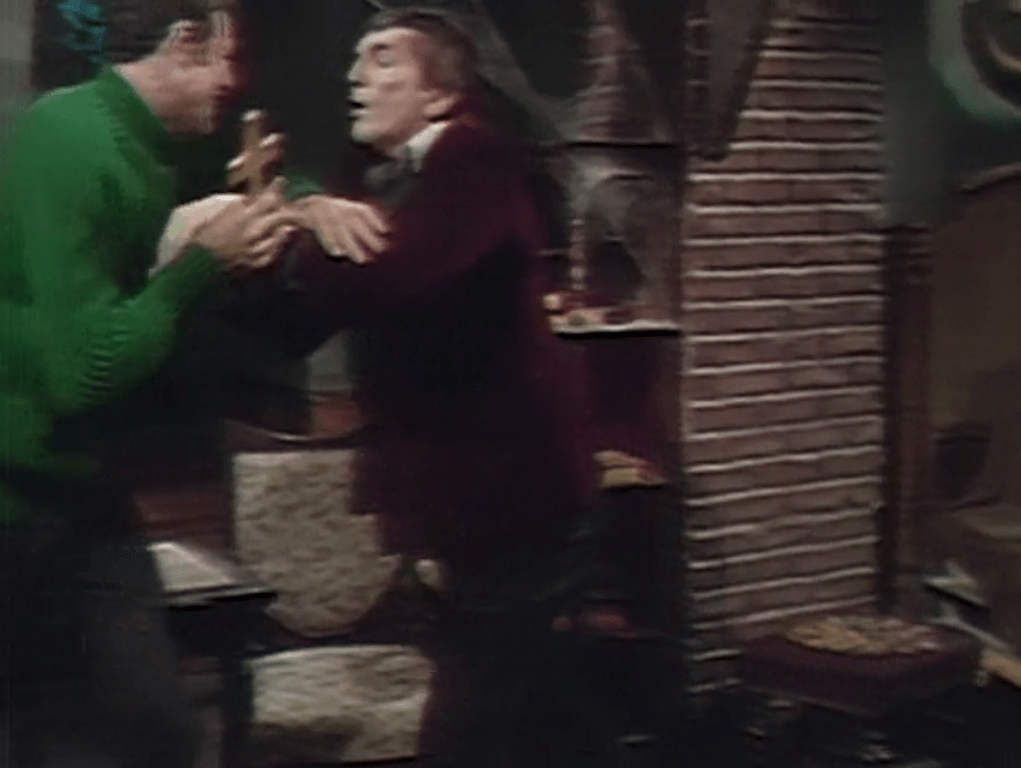
Quentin and Barnabas decide that if Petofi dies, Jamison will die as well. Therefore they have no choice but to take the hand to Aristide. Barnabas does get Aristide to promise that once Petofi has the hand, he will use his powers to cure Quentin’s werewolf curse, but no one seems to regard Aristide’s word as valuable. Barnabas makes a menacing move towards Aristide; Aristide wards him off with a cross. Aristide puts the hand on Petofi’s chest, says some magic words, and waits a little over an hour. During this time, he needles Barnabas by offering him tea, which he must know is not part of a vampire’s diet. Then Petofi comes out of his room, laughing his evil laugh and showing off his reattached hand.
“At last my arm is complete again!” Screenshot by Dark Shadows Before I Die. (Caption by Stephen Sondheim.)
In #767, Jamison had a dream in which Quentin told him that his doom was sealed when the one person he truly loved turned against him. It was already clear at that point that this person was Jamison, but today Quentin tells Jamison in so many words that he is the only person he ever really loved. So we can take this as an announcement that the climactic crisis of the part of Dark Shadows set in 1897 is approaching.
Vampire Barnabas Collins has come unstuck in time and traveled from 1969 to 1897, a year in which he hopes to prevent a disaster. Unfortunately, Barnabas generates disasters with his every action, and so he has taken the grim situation he found upon his arrival and made it incalculably worse.
Now, Barnabas has been exposed as a vampire. Shortly before dawn, he returns to the cave where he has been hiding his coffin. There, he finds lawyer/ Satanist Evan Hanley (Humbert Allen Astredo) waiting for him, holding a cross. When Evan makes it clear he has no immediate plans to destroy him, Barnabas says that he does not want to be treated as an exhibit for the curious or a subject for research. This will remind longtime viewers of Barnabas’ initial response when in 1967 Dr Julia Hoffman (Grayson Hall) offered to develop a medical treatment for his vampirism. That treatment was not entirely successful, but it set Julia and Barnabas on a path that led them to become fast friends, and a later medical intervention did free him of the effects of his curse.
Barnabas needs all the friends he can get, and indeed there have been some signs that he is about to make new ones. But Evan is not going to be one of them. He knows that Barnabas has the famed “Hand of Count Petofi,” a relic of someone to whom Barnabas refers as “the most evil man who ever lived.” When Dark Shadows was set in 1968, Astredo played suave warlock Nicholas Blair, who was hung up on the idea of recruiting “the most evil woman who ever lived” to take part in one of his schemes, an idea which led directly to the failure of his mission and his own recall from Earth to Hell. Evan forces Barnabas and Barnabas’ reluctant sidekick, broad ethnic stereotype Magda Rákóczi (Grayson Hall,) to let him look at the hand. That backfires immediately, and leaves Evan’s face severely disfigured. When Barnabas sees what has happened, he declares that Magda must not go through with her plan to use the hand to release rakish Quentin Collins from the werewolf curse she placed on him.
Meanwhile, the cruel and hypocritical Rev’d Gregory Trask proposes marriage to wealthy spinster Judith Collins (Joan Bennett.) In the parts of Dark Shadows set in the 1960s, Bennett plays reclusive matriarch Elizabeth Collins Stoddard. Liz stayed in her house for 19 years because she thought she had murdered her husband Paul; only when seagoing con man Jason McGuire tried to use this belief to force Liz into marrying him and giving him control of the estate of Collinwood and the Collins family businesses did she confess to the killing. It then turned out that Paul wasn’t dead at all, and the whole thing was a cruel trick he and Jason played on Liz.
Unlike Liz, Judith actually has killed someone. She shot neurotic intellectual Rachel Drummond to death in #775. Gregory prevented Judith from telling the police about this, persuading her that because she was under a vampire’s* power at the time she was not responsible. Since then, Judith has been putty in Trask’s hands. She accepts his proposal, and they are married by the end of the episode.
On Dark Shadows, wedding days are always occasions of horror and sorrow, and today is no exception. Trask’s wife Minerva was murdered in #773; unknown to Judith, Trask conspired with Evan to commit this crime and leave everyone thinking that a man named Tim Shaw did it. Trask’s plan to frame Tim fell apart in #777, when Tim showed up at Collinwood and revealed that he had seen Judith shoot Rachel. Since Trask killed Minerva in order to free himself to marry Judith and take control of Collinwood and the Collins businesses, he cannot risk Judith’s conviction on a murder charge, and so he tells the sheriff that Tim cannot have killed Minerva. When Trask and Judith come home from their wedding, Judith sees Minerva’s ghost in the drawing room. Evidently Minerva is not ready to rest and let Gregory reap the rewards of her murder.
*Not Barnabas, another one. Collinwood is crowded at night in 1897.
Nine year old Nora Collins walks in on her teacher, Charity Trask, being bitten by vampire Barnabas Collins. Barnabas tells Nora to “Look into my eyes!” He hypnotizes Nora and mind-wipes away her memory of him. Barnabas has been on Dark Shadows for more than two years now, and this is only the second time he has pulled the “Look into my eyes!” move with someone whose blood he has not been drinking. The previous occasion was also with Nora, in #756. In the parts of Dark Shadows set in the 1960s, Barnabas is usually paired with mad scientist Julia Hoffman, who is the master of a magical form of hypnosis that allows her to rewrite people’s memories at will. So if Barnabas exercised this traditional vampire power in those segments of the show, he’d be stepping on Julia’s territory. But this episode is part of a time-travel story set in 1897, and Julia is not here.
Barnabas has been exposed and is being hunted by a number of people. His current hiding place is inside a cave. He confers there with his reluctant sidekick, broad ethnic stereotype Magda Rákóczi. Today the show is being taped on new cameras, and the image is crisper and more nuanced than we have seen since it went to color in August of 1967. The cave would barely have shown up through yesterday’s cameras, but it looks nifty today.
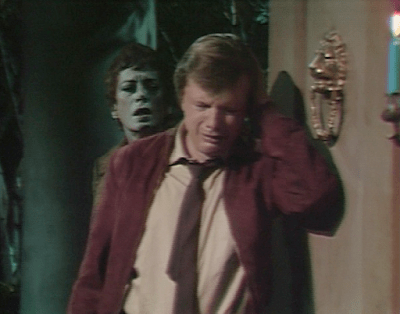
Magda is Barnabas’ sidekick, she is quick with lies, and she is played by Grayson Hall, but she does not do hypnosis. Screenshot by Dark Shadows Before I Die.
Magda has stolen a severed hand that a crime boss was keeping in a box, and believes that she can use it to undo a curse she placed on the rakish Quentin Collins. Barnabas is worried that they will not use the hand correctly when the time comes to release Quentin. Since there is no way to test the procedure they plan to use on Quentin, he asks if it will be able to help someone else. Magda says that it should. He has the bright idea to summon Charity. He evidently overate, and she is in danger of dying from loss of blood.
Vampires are metaphors for extreme selfishness, and with this suggestion Barnabas is a case in point. If the hand can lift curses from the people it touches, why does Barnabas not have Magda place it on him? If it freed him of vampirism, that would heal Charity and his other victims, and would allow him to stroll up to the vampire hunters on some sunny day and watch their suspicions of him collapse. But that is out of the question, because he does not know how to control the hand. He is simply using Charity as a laboratory animal.
Barnabas telepathically summons Charity. As it happens, lawyer/ Satanist Evan Hanley is at her bedside. Evan is among the vampire hunters, and knows Charity is under Barnabas’ power. He physically restrains her from leaving her room. Barnabas and Magda despair of bringing Charity and the hand together. The hand then disappears from its box. Magda thinks the hand is simply lost and is terrified that she will not be able to return it to its owner, but Barnabas is serenely convinced that it has gone to Charity under its own power.
This turns out to be true. The hand materializes in Charity’s room. Evan sees it, and, expert that he is in occult lore, exclaims “The hand of Ojden!” It settles on Charity’s face, and when it vanishes the bite marks are gone from her neck and she is once again her brisk, authoritative, and intensely priggish self, no longer a thrall of Barnabas. The hand reappears in the cave next to the box, and Barnabas smugly announces to Magda that it completed its mission.
For some reason, Barnabas’ self-satisfied certitude crumbles and he feels compelled to check on Charity to see that she has indeed been healed. He materializes in her room, but she is not there and the cock is already crowing. When he returns to the cave, Evan meets him, holding up a cross and keeping him from getting back into his coffin.
When vampire Barnabas Collins first appeared on Dark Shadows in April 1967, regular viewers may have thought they knew what to expect. They had just spent four months focused on undead blonde fire witch Laura Murdoch Collins, mother of strange and troubled boy David. David’s well-meaning governess Victoria Winters gradually realized that Laura was a deadly threat to him. After some initial confusion, Vicki rallied the other characters in opposition to Laura. Ultimately Laura went up in smoke and David escaped her clutches, choosing Vicki and life over his mother and death.
In many ways, the Laura story was modeled on Bram Stoker’s Dracula. So when Laura’s successor as supernatural menace was an out and out vampire, we may have expected further mining of that source. Barnabas bit and abducted Vicki’s friend Maggie Evans. As the daughter of drunken artist Sam, Maggie had played a key role in the “Revenge of Burke Devlin” storyline. But that storyline fizzled in the show’s early months, and by #201 even Burke Devlin lost interest in it. Maggie was at that point surplus to requirements, and when Barnabas added her to his diet we might have suspected that she would die and rise as a vampire. As Mina and the group she led in Dracula had to destroy her friend Lucy when Lucy rose as “the Bloofer Lady,” so Vicki and her friends would have to destroy Maggie. Vicki herself would then stake Barnabas. The average viewer would have expected this to be the sign to move on to the next menace; those who were aware of TV ratings and programming decisions might think it would be Dark Shadows‘ way of going out with a flourish before its impending cancellation.
Barnabas turned out to be a hit. The idea of a vampire on a daytime soap was such an oddity that a sizable new audience tuned in out of curiosity, and Jonathan Frid’s portrayal of Barnabas’ scramble to impersonate a living man native to the twentieth century resonated with so many of them that he became a breakout star. So they had to figure out a way to make him a permanent part of the cast. That meant Maggie couldn’t die. In the first place, they couldn’t risk making Barnabas responsible for the death of so likable a character. Second, as the survivor of the horrendous abuse Barnabas inflicts on her Maggie would have a new function, as the witness who might emerge to expose him and wreck the show. Third, while Maggie was in Barnabas’ clutches Kathryn Leigh Scott proved herself such a versatile actress that it would obviously damage the show to lose her. So Barnabas not only failed to kill Maggie, he completed only two homicides in the whole of 1967. Each of his two victims was a male character who had run out of story. As a result, the killings and the victims were quickly forgotten.
Barnabas’ nonlethal vampirism made it easier to keep the cast intact, but it also drained him of the lurid novelty that had made him such a draw. To reassure the audience that Barnabas really was a bloodthirsty fiend from the depths of Hell, the show had Vicki come unstuck in time in #365. She found herself in the 1790s, when Barnabas first became a vampire. That gave us a whole cast of characters whom we did not expect to see again once the show returned to contemporary dress. So Barnabas was free to slaughter people to his heart’s content.
The 1790s flashback was a hit in the ratings. When Vicki brought us back to 1968 in #461, the makers of the show had to figure out a way to keep the momentum going. They cured Barnabas of the effects of the vampire curse and surrounded him with a hectic parade of other refugees from 1930s horror movies- mad scientists, Frankensteins, witches, werewolves, and a couple of fresh vampires. After that Monster Mash period exhausted itself, they took us through a long, deliberately paced segment focusing on just two stories, one about a tormented werewolf and the other about a ghost who takes possession first of two young children, then of the whole estate of Collinwood. Barnabas, who has come to see himself as a good guy and the protector of the family, tries to cure the werewolf and reason with the ghost. His efforts instead transport him back in time to 1897.
In that year, Barnabas is a vampire again. He keeps saying that his only goal is to prevent the evils that will befall the family in 1969, but he is as uninhibitedly murderous as he ever was in the periods when he was unambiguously a villain. In Friday’s episode, he murdered one of the principal members of the Collins family, prankster Carl Collins, uncle of the Jamison Collins whose daughter and son are the adults at Collinwood in the 1960s. Barnabas had become so careless after so many killings that he left Carl’s body propped up behind the curtains in the windows of the drawing room, where it fell into plain view moments after Barnabas’ foe the Rev’d Gregory Trask entered. In this episode, Trask enlists Edward Collins, brother of Carl and father of Jamison, to help him hunt Barnabas.
My wife, Mrs Acilius, points out that when we see a character closing the doors to the drawing room, that person is in charge of the house. So in the early months of the show matriarch Liz was the one to close the doors; when Liz was taken to a hospital and her daughter Carolyn was in charge, Carolyn closed the doors. When Vicki was fully in command of the campaign against Laura, she closed the doors to consult privately with her lieutenants. When Trask and Edward go into the drawing room to discuss the situation, it is Trask who closes the doors. Vicki was good, so consistently so that she had to be written out of the show months ago. But Trask is overwhelmingly evil. That he has ascended to the rank of door-closer means that virtue has no stronghold anywhere.
Edward and Trask go to the Old House on the estate, where Barnabas has been staying. They find Barnabas’ reluctant sidekick, broad ethnic stereotype Magda Rákóczi. Magda denies that Barnabas is in the house and pretends not to know what Trask and Edward are talking about when they say that Barnabas is a vampire. Trask slaps Magda in the face; we have seen many face-slaps on Dark Shadows, but so far as I can recall this is the first delivered while the slap-ee has her back to the camera. Since he does not have to swing his hand very close to Grayson Hall’s face, Jerry Lacy can therefore put full force into the gesture, making it look like Trask is delivering a truly brutal blow to Magda. Afterward, Magda rubs her face and vows revenge on Trask. She quotes a rather confusing “old gypsy saying”: “Walk fast and the Devil will overtake you; walk slow and misfortune will catch you. You’d better not walk slow, because I will never be far behind.”
Edward and Trask search the Old House and find nothing. At dusk, Barnabas emerges from the secret room behind the bookcase in the front parlor. Magda hadn’t thought to look there, and Trask and Edward didn’t know the room existed. Barnabas says he will have to find a new hiding place for his coffin. Magda says she will do whatever she can to help him. Barnabas is surprised at her support for him; after all, he has bitten and enslaved her husband Sandor, and his destruction would mean Sandor’s restoration. Magda has an atypical moment of speechlessness, after which she says that Trask is an “animal” and must be punished at all costs.
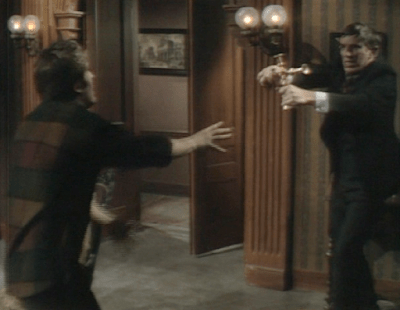
Trask and Edward went back to the main house early in the morning to look for the plans to the Old House. It apparently took them all day to find them. By the time they have gone through them and identified all of its secret rooms, Barnabas is already up. They come back to the Old House and find the empty coffin in the secret room. Trask says that he will make the coffin “unusable” for Barnabas before daybreak. He leaves Edward, who is carrying a gun loaded with silver bullets, to guard the house.
Barnabas goes to one of his blood-thralls, Trask’s daughter Charity. He tells Charity that he is “in serious trouble” and commands her to go to the basement of the Old House. There, she will find some soil from his original grave, which he needs to prepare his new resting place. He tells her about a tunnel from the beach to the basement which she can use to elude detection by Edward. Since Barnabas has just materialized in Charity’s room and will shortly materialize in the secret room in the Old House while Edward is standing on the other side of the bookcase, we wonder why he can’t use that same power to get into the basement himself.
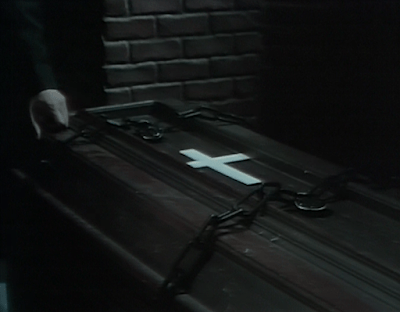
Barnabas finds that the coffin is topped with a cross. He can’t get close enough to take hold of the coffin and move it, so presumably even after he gets the soil he needs he will have to plunder a mortuary showroom to get a fresh resting place before dawn.
Charity does go to the basement. She puts some soil in her purse, then knocks over a crate, attracting Edward’s attention. She does not run away, but merely hides in an alcove until Edward comes down, sees her in shadow, and orders her to show herself.
In yesterday’s episode, inveterate prankster Carl Collins told his brother, the rakishly handsome Quentin, that their distant cousin Barnabas was a vampire. Quentin has problems of his own, and he is counting on Barnabas to help him. So he locked Carl up in Barnabas’ hiding place, expecting that when night came Barnabas would prune one more branch off the Collins family tree.
Today, Quentin finds that Carl has escaped. He goes to Barnabas and tells him what has happened. Carl’s practical jokes annoy Barnabas intensely, and Barnabas has never bothered to conceal his disdain for him. He reacts to Quentin’s news with fury and a lot of orders. When Quentin later finds Barnabas standing by Carl’s corpse in the drawing room of the great house of Collinwood, he is really torn up about his brother’s death for almost a whole minute.
A knock comes at the door; it is the oppressively evil Rev’d Gregory Trask. Quentin keeps Trask in the foyer for a bit while Barnabas hides Carl’s body. When Trask forces his way into the drawing room, Barnabas is gone. Carl’s body is cunningly hidden… behind the curtains, propped upright. Of course it falls out almost immediately. Earlier in the episode, Carl took Trask to Barnabas’ hiding place, and we saw that Barnabas had single-handedly lugged his coffin and the structure on which it rests some distance away. If he is strong enough to do that, surely he could have tossed Carl’s body out the window. And regular viewers know that there is a secret panel in this room, of which Barnabas has repeatedly shown that he is well aware. They would probably have expected him to hide the body there. That he just stashes it behind the curtains where it is certain to come into Trask’s view suggests that he isn’t even trying to get away with this particular murder.
Closing Miscellany
John Karlen is breathing pretty deeply during Carl’s big closeup as a corpse. It’s really confusing, I thought they were telling us he wasn’t dead yet.
I don’t know what the writers planned for Carl in the flimsies they sketched out six months before this episode was made, though there is so little room for him in subsequent plot-lines that I suspect he was supposed to die at about this point in the story. Still, his death was accelerated because Karlen had other things to do. He won’t be back on the show until #956, in February of next year.
The creaky little waltz that Quentin listens to obsessively was released as a single in June of 1969 and would hit #13 on the Billboard Hot 100 in August. Regular viewers may be sick of it already, and the characters certainly wish Quentin would get another record. It’s Trask’s turn to complain about it today, giving him something in common with Barnabas.
Trask wears a cross which he uses as a weapon against Barnabas. The show is oddly inconsistent about the effect of the cross on vampires. We’ve seen other characters use crosses against them, and at one point it was said that a cross inside the lid of Barnabas’ coffin immobilized him. But his hiding place is in the middle of a cemetery full of grave markers in the shape of huge crosses, and we see several of them today. Barnabas just walks right past those with no problem. You might think that since the show was made in the USA, where sincerity is so highly regarded, that the cross might be effective against him only if it is wielded by the pure of heart. But Trask is every bit as evil as are Barnabas and Quentin, and it works for him. It’s a puzzlement.
I think of the climax of the Iliad. As Achilles moves in to kill Hector, Athena takes hold of his spear and drives it in, delivering the fatal wound herself.
For modern readers, this may ruin the story. The whole poem has been leading up to this moment; we’ve spent a lot of time with Achilles, listening to him try to figure out what it would mean for him to kill Hector. So why have the goddess take over at the last minute? Isn’t it an evasion of Achilles’ responsibility for his actions, and a cheat for us as we’ve been observing his psychological development?
For the original audience, it was not. They actually believed in their gods. Athena really existed, as far as they were concerned. When an event was important enough, they took a interest. If it was really huge, they would get involved. Moreover, the gods worked closely with each other. So much so that you didn’t pray to one at a time, but always to groups of them. When Athena joins Achilles in his fight, it isn’t her pushing him aside- it’s him doing something so important it blurs the boundary between human and divine.
Something like that is at work in the traditional, pre-modern, conception of demonic possession. To say that a person is possessed is a way of looking at behavior that is reducible neither to moralistic judgment nor to psychological analysis. It isn’t individualistic in the way that those modes of discourse are. Rather, it suggests that the boundaries between the person and the spiritual forces of darkness have broken down. Perhaps the person is partly to blame for that breakdown, but the whole point is that s/he is no longer a distinct being, but is merging into those supernatural forces.
So, imagine a version of Dark Shadows where Elizabeth Collins Stoddard really was the main character. Her whole approach to life is denial. So, you could have had a story with a beginning, middle, and end. In the beginning, we see the lengths she has gone to in her quest to keep from ever having to have an embarrassing conversation. In the middle, we see various horrors take place around her, each worse than the one before, each more obvious than the one before, and each time she finds a way to convince herself it doesn’t exist. At the end, a couple of innocent characters go to her in the drawing room of Collinwood to rescue her from the monsters who are running rampant there. She looks at them placidly and tells them she sees nothing wrong. Why ever do they think she would want to leave her home? All the while leathery-winged demons are fluttering about her head. She doesn’t see them, and they have no choice but to flee.
Comment left 10 November 2020 by “Acilius” on “Episode 780: The Establishment Vampire,” posted 2 December 2015 by Danny Horn at Dark Shadows Every Day
Old world gentleman Barnabas Collins, himself a recovering vampire, bursts into well-meaning governess Victoria Winters’ bedroom just in time to prevent another vampire from claiming her as his victim.
Once the coast is clear, Barnabas explains to Victoria what happened, using the word “vampire” and telling her what it means. For the first 40 weeks Barnabas was on the show no one used that word, and even when Victoria was briefly Barnabas’ victim in March 1968 it seemed she didn’t understand what it was all about. The scene of Barnabas bringing Victoria up to date is interesting, but it could have been so much more. Victoria is played today by Betsy Durkin, making her second appearance in the role. Had Alexandra Moltke Isles still been in the part, it would have been electrifying to see Victoria reconnected with the plot after her long exile. Miss Durkin does what she can, but as a new face she simply does not bring the iconography of all those hundreds of episodes in which we saw Mrs Isles held at arm’s length from the story.
Barnabas and Victoria identify the vampire as the late Tom Jennings. Victoria tells Barnabas that she had, earlier that evening, gone to see suave warlock Nicholas Blair and confront him about his plans to marry Maggie Evans, The Nicest Girl in Town. Barnabas is shocked to learn of this plan, and agrees with Victoria’s surmise that Nicholas must have made Tom a vampire and sent him to kill her. He promises to take care of the problem, but won’t tell her how.
For his part, Nicholas is dealing with a visit from Tom’s brother, the mysterious Chris Jennings. Chris was introduced in #627, Mrs Isles’ last episode as Vicki. He is a drifter who refuses to answer any questions about himself, but he has plenty of questions for other people about what happened to his brother. While Nicholas is dodging Chris’ inquiries, he glances out the window and sees Tom. This implies videotape editing, since Tom and Chris are both played by Don Briscoe and Tom’s makeup is slightly different than Chris’. Chris himself notices a figure at the window, but does not get a good enough look to know who it is.
Later, Barnabas comes to see Nicholas. Nicholas has extorted Barnabas and his friend Julia Hoffman, MD, to perform an experiment. Only they can do the experiment, and if it is not completed, Nicholas’ boss, Satan, will punish him. Barnabas says that he and Julia will not continue working unless Nicholas can assure him that neither Victoria nor Maggie will be harmed and that Tom Jennings will be destroyed. Nicholas gives him those assurances, and he leaves. As dawn approaches, Barnabas slips back into Nicholas’ house. He meets Tom there. He uses two candlesticks to make a cross, and at the sight of it Tom is immobilized. The sun rises, and Tom vanishes, destroyed forever.
They gave a number to each episode of Dark Shadows reflecting its place in broadcast order. They skipped the numbers for the days the show wasn’t on, so that episode #620 was actually the 613th episode. Fascinating, I know. Even more interesting, there were a total of 1225 episodes, making this one the exact middle of the series.
When Dark Shadows started in June 1966, its undisputed star was Joan Bennett as matriarch Elizabeth Collins Stoddard. Describing Dark Shadows’ overall narrative structure, Bennett said “We ramble around.” At its beginning, the show was heavily atmospheric and slow paced, with stories very much aimed at an adult audience who remembered Bennett’s heyday in the 1930s and her father’s in the early twentieth century. As it developed, supernatural elements that had at the outset lurked in the background came to the fore and attracted a much younger audience. By this time, Dark Shadows is a slam-bang kid’s show with a cliffhanger at every commercial break and a cast including witches, vampires, mad scientists, and Frankenstein’s monsters. So it is appropriate that the episode at its chronological center is in a way the most unrepresentative of them all. Dark Shadows tended to go to great lengths to avoid anything that would get the audience thinking about Christianity. Yet this outing is all about the saving power of the cross.
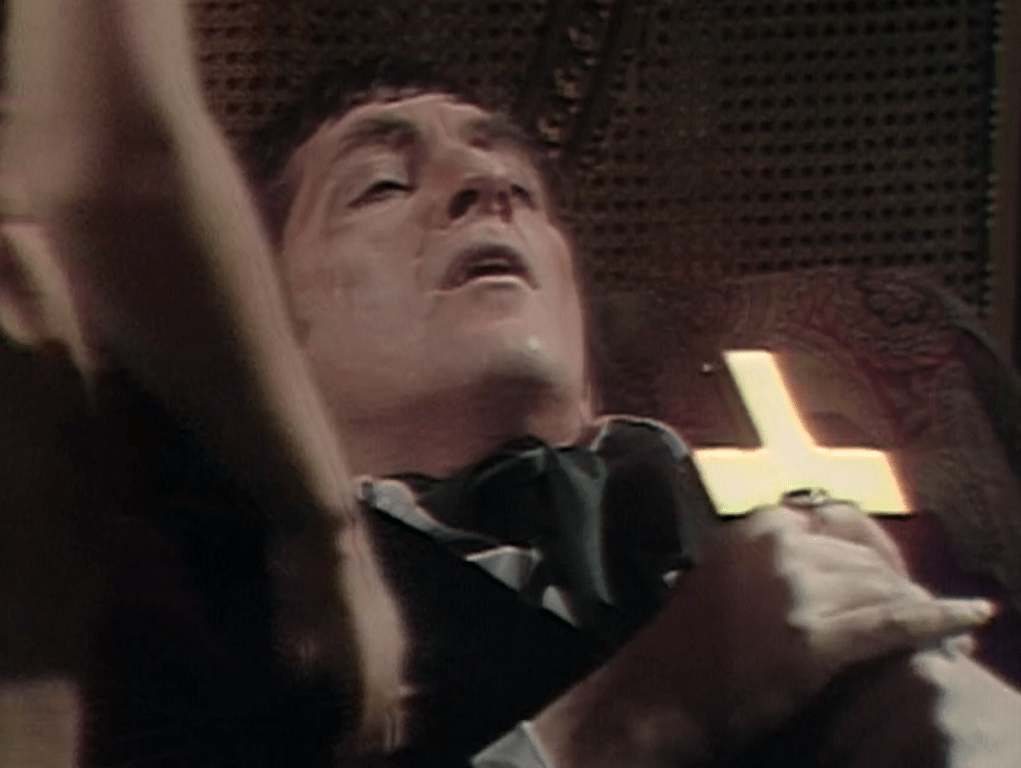
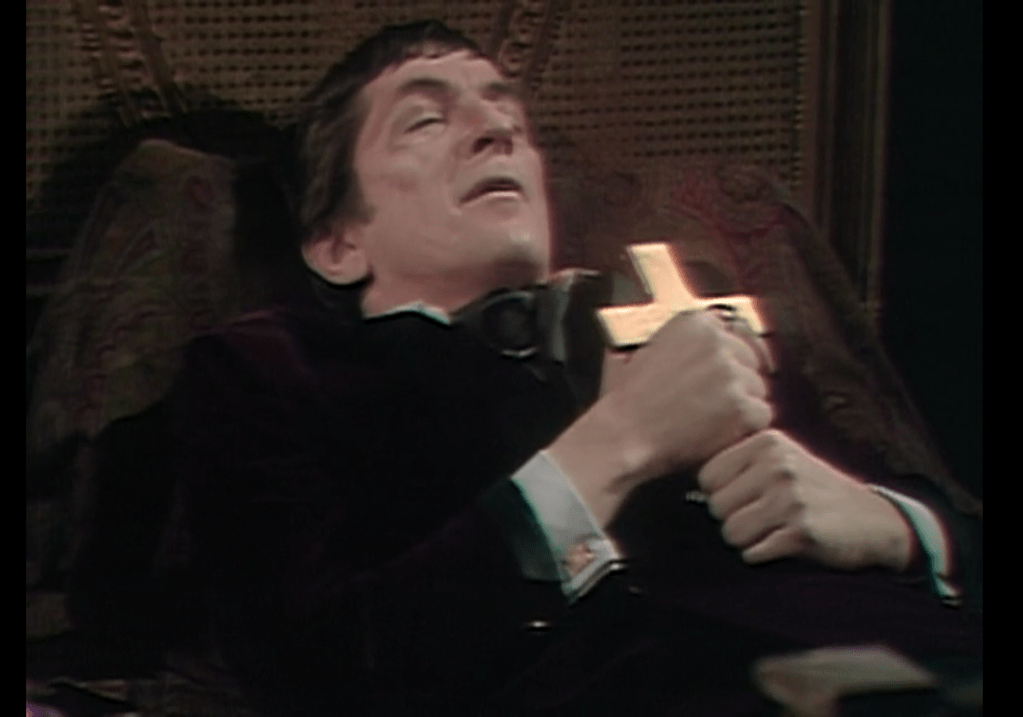
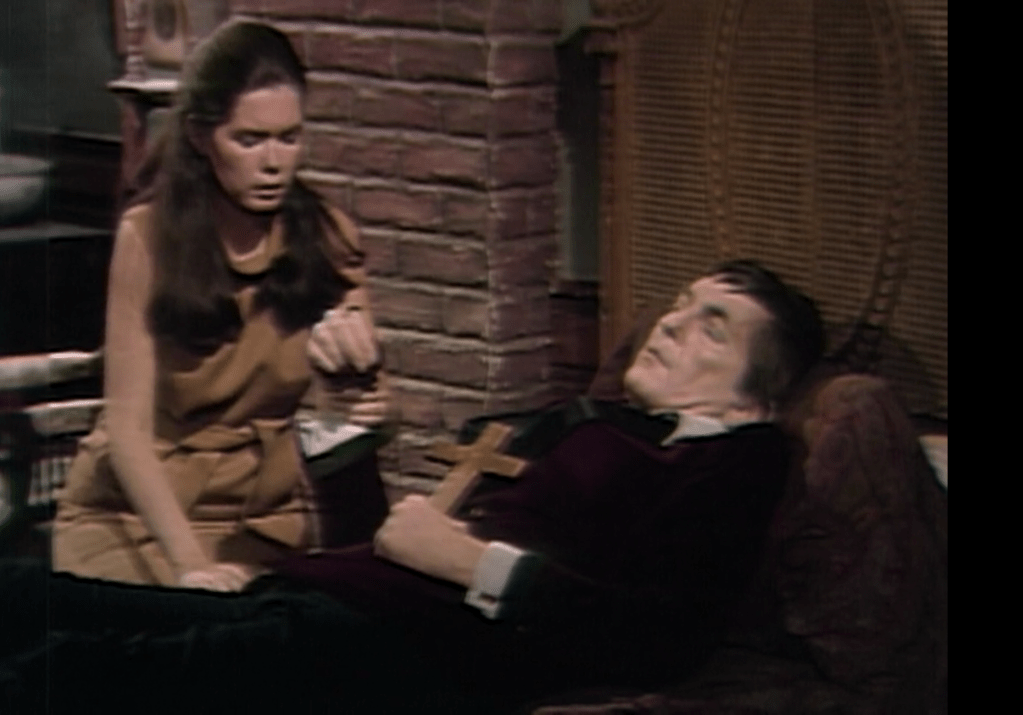
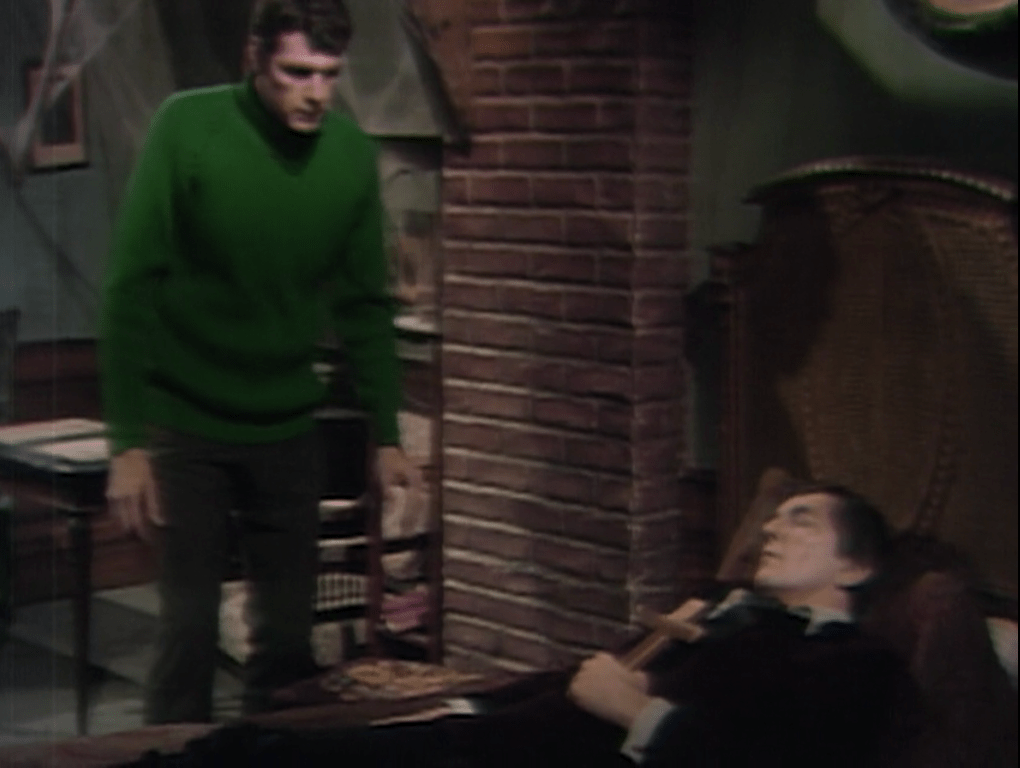
Old world gentleman Barnabas is hiding in the long deserted west wing of the great house of Collinwood. Well-meaning governess Vicki took him there after finding him lying on the ground in the woods, grievously injured. Vicki does not know that Barnabas is the victim of a vampire, and so she does not know why he is anxious that she bring him a cross. When he sees that she has brought one, he mutters “The cross… I need it so.” He clutches it to him and tells her “I need no one but you, and nothing but this.” At the middle of the episode, he is going on about this again, saying “No one frightens me… All I need is the cross. The cross!”
When the vampire’s helper Adam comes to steal the cross from him, Barnabas exclaims “The cross! The cross, it will save us both!” Adam takes the cross back to the vampire. He offers it to her. She recoils from it and tells him to destroy it. She runs away, and he looks at it in wonder, not knowing what it is. We are left to ask if he will find out what gives the cross its power, and if learning about it will indeed bring salvation both to him and Barnabas.
Over the next few weeks, much will change on Dark Shadows. There will be major changes in the cast, several storylines will be resolved, new storylines will start, and the pacing will become more deliberate. As that goes on, the show will curve back around to something at once more reminiscent of its early days and more suggestive of what is to come than is this utterly zany period. Not that it will stop being weird- the weirdness will just be developed in greater depth over longer periods. I would say that this bizarre detour into Christian piety marks the most remote point it ever reached in its rambling away from its original concept.
Well-meaning governess Vicki has found a grievously injured Barnabas Collins in the woods. Barnabas insists Vicki not take him to a doctor or anyone else, but hide him somewhere no one will find him. She thinks of a secret door to the long-abandoned west wing of the great house of Collinwood, and uses that to take him to a hiding place there.
For the first year of Dark Shadows, the west wing was strongly associated with Vicki. In #14, she alone saw the locked door separating the bedrooms from the west wing open and close, apparently by itself. That was the first unequivocal evidence of supernatural activity on the show. In #84, Vicki’s charge, strange and troubled boy David, led her into the west wing, the first time we had seen its interior. He then trapped her in a room there, hoping she would die. She would languish in that room until David’s father, high-born ne’er-do-well Roger Collins, rescued her in #87. When Vicki was engaged to Roger’s nemesis Burke Devlin in #338, matriarch Liz offered to restore the west wing and let Vicki and Burke live there. After Burke died in a plane crash in #345, Vicki vowed to go on with the project of restoring the west wing. In #347, permanent houseguest Julia Hoffman, MD, exploited Vicki’s interest in the west wing to get her to stare into a crystal supposedly taken from a chandelier there until she is in a state of deep hypnosis.
More recently, Frankenstein’s monster Adam stayed in the west wing for many weeks as the guest of heiress Carolyn. Vicki’s connection with the wing was renewed when Adam abducted her and hid her there for a few days starting in #553. Today, Vicki hides Barnabas in Adam’s old room, re-establishing the west wing as her space. Thus we loop back to a theme that goes back to the third week of the show.
Later in the episode, Barnabas wakes up and is distressed to find that it is almost sunset. He pleads with Vicki to bring him a cross as quickly as possible. The audience knows, but Vicki does not, that Barnabas is the victim of vampire Angelique. Vicki’s ignorance of this point reminds us that she has been excluded from the show’s A-plots ever since #211, when Barnabas was introduced, himself in those days a vampire. Her calm departure to go fetch a cross reminds us that she knows this part of the house well. Every room in it is stuffed with bric-a-brac, undoubtedly she will have seen something nearby that is in the shape of a cross.
Meanwhile, Julia is in a hospital room, visiting local man Joe Haskell. Julia has become Barnabas’ inseparable friend, and Joe is Angelique’s other victim. She does not know that Angelique is the vampire, though she had surmised as much in #608. She questions Joe. At first he denies everything, but after she discloses that she was for a time the victim of yet another vampire he tells her that she must know why he can’t tell her who has been sucking his blood. She asks if the suave Nicholas Blair is hiding the vampire. Joe closes his eyes and scoffs at the idea. This reaction does nothing to curtail Julia’s suspicions of Nicholas.
Julia goes to Nicholas’ house. He genially escorts her into his living room. There, he takes a seat while she stalks about the room and tells him what she knows about him. Barnabas has a self-defeating habit of showing his cards to his adversaries, and longtime viewers may at first be afraid Julia has picked it up from him. Since Nicholas is a warlock who not only controls Angelique but has a wide range of magical powers that he uses to promote Satan’s interests on Earth, he is not an opponent with whom one can afford to make mistakes. Angelique herself was once a witch who, in #378, was able to turn a man into a cat at a moment’s notice. Nicholas’ command of the black arts goes far beyond Angelique’s. He was able to strip Angelique of her powers, raise her from the dead at least twice, and turn her into a vampire. Julia is simply a mad scientist, and she does not have any equipment with her. There’s no telling what Nicholas might do to Julia if their interview displeases him.
On his great blog Dark Shadows Every Day,Danny Horn lists three reasons why we know Julia will survive this confrontation without being turned into a toadstool:
Really, the thing that everybody wants to know is: why can’t the Stormtroopers shoot straight in Star Wars? It turns out there are three simple answers. #1. Stormtroopers shooting laser bolts are more interesting to look at than Stormtroopers who stand around complaining. #2. Shooting Luke Skywalker in the head halfway through the first movie is going to leave a rather obvious gap in the trilogy. #3. ‘Strong Guy Kills Weak Guy’ is not headline news.
Danny Horn, Dark Shadows Every Day, “Episode 619: The Gunslinger,” posted 4 April 2015
This is all very true- of course Nicholas and Julia will not leave each other alone indefinitely, of course the show cannot spare her, of course she will overcome her disadvantages and come away from their showdown with the upper hand. But it misses the point. Suspense comes when we know what must happen, but cannot see any way it might happen. What makes the scene work is the moment when Julia tells Nicholas that Barnabas is missing. That is news to him, and as Danny says elsewhere in his post, it is “the first sign of a crack that’s going to bring his entire operation crashing down,” as his shocked reaction suggests it might be.
The scene is one of the best in the series, though it is marred by a miscalculated ending. In the early part, we see Julia making an effort to keep her cool while Nicholas sits watching her smugly. She succeeds in keeping her brave face on until she senses that she has Nicholas off guard, at which point she moves in for the kill and tells him about Barnabas. She is then firmly in command. He composes himself and dismisses her.
That’s when it goes wrong. When Julia is heading out the door, Nicholas recovers his smugness and tells her that he must admit that he admires her for coming to see him. She looks alarmed and asks why. He replies, in a half-whisper, “You know.” She hastens out. I can see that this ending may have seemed like a good idea. We clearly saw in the beginning how hard it was for Julia to keep her fear in check and how easy it was for Nicholas to bask in the superiority his powers give him over a mere mortal. Though Julia has emerged as the winner in this engagement, she still has grounds for immense fear, and he for boundless self-confidence. But it is so broadly drawn as to be confusing. Has Nicholas already found a way to turn Julia’s success against her? Has she realized too late that she has made a mistake we aren’t aware of?
We learn shortly after that neither of these things has happened. Angelique comes upstairs. She sees Nicholas being very still. She makes several attempts to engage him in conversation. He finally approaches her and strikes her across the face. He then orders her to undo what she has done to Barnabas before it ruins his plans.
This is the second time Nicholas has slapped a woman in the face. The first time was in #610, when he struck Frankenstein’s monster Eve. Humbert Allen Astredo and Marie Wallace executed that business well, as he and Lara Parker execute it well today. For that matter, Grayson Hall and Lara Parker had done a good job when Julia slapped Angelique in the face in #535. Watching them, you can admire trained professionals practicing a specialized aspect of their craft. But since Nicholas has such vast powers, he is persuasive as a villain only when we are left guessing about just what he is up to. When we see him is reduced to hitting a woman, he shrinks from avatar of Satan to cheap pimp.
After Julia leaves Nicholas’ house, she lingers in the woods outside, watching his front door. She sees Nicholas leave the house, then sees Angelique and realizes that she is the vampire.
Julia is the most intelligent character on the show, and while we watch her in the woods her face suggests that she is thinking clever thoughts. Unfortunately, we hear her interior monologue in a recorded voiceover, and her lines are remarkably obtuse. On the heels of her overdone fear on the way out of Nicholas’ house, it does as much to undercut Julia’s image as a smart person who can win a duel with the Devil as Nicholas’ physical abuse of Angelique undercuts his image as a demonic sorcerer.
In June 1967, vampire Barnabas Collins locked his victim Maggie Evans, The Nicest Girl in Town, in the prison cell in the basement of the Old House on the estate of Collinwood. The ghost of Barnabas’ little sister Sarah appeared to Maggie several times while she was in the cell. Sarah told Maggie that no one could know she had been to the cell, and particularly warned her not to tell her “big brother” she had seen her. With some reluctance, Sarah eventually gave Maggie a clue that led her to a hidden passage. Sarah’s father had sworn her to secrecy about the passage, and that not even her big brother knew about it. Maggie finally puzzled out the clue, enabling her to escape just moments before Barnabas came to the cell with the intention of killing her. When Barnabas chased Maggie through the hidden passage in #260, the wondering expression on his face confirmed that he had never had any idea the passage was there.
From November 1967 to March 1968, Dark Shadows was a costume drama set in the years 1795 and 1796, the period when Barnabas and Sarah were living beings and the Old House was their home. We saw how cruelly their father, haughty overlord Joshua, treated his indentured servant Ben, and we saw that Joshua had the great house of Collinwood built with a prison cell in its basement. Joshua confined Ben to that cell in #401. With that, we could be sure that Maggie’s cell was already in the basement of the Old House when Barnabas and Sarah lived there, and could surmise that Joshua really did forbid the living Sarah to share with Barnabas or anyone else what she had found about the hidden passage.
The show never explained how Sarah found out about the passage. We might imagine her hiding and watching Joshua or someone else do maintenance on the cell. But the fact that Joshua kept the existence of the escape hatch from Barnabas suggests he wanted the option of locking his son in the cell. Why not his daughter as well? Perhaps Sarah found the passage while confined in the cell herself. Or perhaps some other, older ghost appeared to her while she was there and told her about it. That the clue she gives Maggie is in the form of a rhyme (“One, two, away they flew…”) would suggest this latter possibility. Sarah may have memorized the rhyme as she memorized the lyrics to “London Bridge” and may have solved the riddle as Maggie solves it.
Shortly after Dark Shadows came back to a contemporary setting in March 1968, Barnabas was cured of vampirism. That cure was stabilized in May, when he donated some of his “life force” to the creation of Frankenstein’s monster Adam in an experiment completed by his friend, mad scientist Julia Hoffman. Barnabas and Julia locked Adam up in the basement prison cell for the first weeks of his life. Vampires and mad scientists are metaphors for selfishness, so it is hardly surprising that they are horribly bad parents. But if Joshua was in the habit of locking his children in that same cell, the moments when Barnabas takes fatherly pride in the imprisoned Adam take on a special pathos. It really does seem like a normal situation to him.
Adam escaped from the cell in #500, demolishing the doorway in the process. Today we see that it has been rebuilt. Perhaps to Barnabas, a house just isn’t a home unless it has a prison cell in the basement.
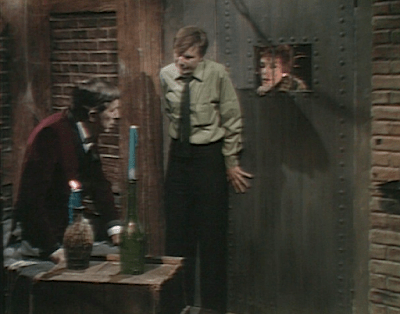
Now, Barnabas has himself become the blood thrall of a vampire, his ex-wife Angelique. Discovering the bite marks, Julia decides to address the situation by locking Barnabas and his servant Willie in the cell. Barnabas won’t be able to get out to heed Angelique’s summons, and Willie hangs a cross over the door to keep her from materializing inside it.
Left to right: Barnabas Collins (Jonathan Frid); Willie Loomis (John Karlen); Julia Hoffman (Lady Elaine Fairchilde.) Screenshot by Dark Shadows Before I Die.
We cut to Maggie’s house. Maggie’s memory of her ordeal as Barnabas’ victim has been wiped from her mind a couple of times. She receives a visitor, the suave Nicholas Blair. Unknown to Maggie, Nicholas is a warlock and Angelique’s master. He has a crush on Maggie which has distracted him from his managerial responsibilities, which to be frank he had not been handling very diligently in the first place. Maggie gives Nicholas several pieces of news that he really ought to have been aware of for some time. She tells him that her ex-fiancé, Joe Haskell, is still alive; that she visited Joe twice while he was at the Old House recovering from some injuries; that Joe is now in the hospital under police guard; and that Joe tried to kill Barnabas and keeps vowing that he will try again, since he believes Barnabas is trying to kill him. Nicholas is flummoxed by all of this, and meekly goes along when Maggie insists on visiting the Old House to pay a call on dear, sweet Barnabas.
The scene in Maggie’s house has an odd feature. We’ve just had a closeup of Willie hanging a cross above the door in the cell to keep Angelique away. In the early days of the vampire storyline, it was not at all clear that the cross would deter vampires in the world of Dark Shadows, since Barnabas was often seen strolling comfortably through a cemetery where half the grave markers were cross-shaped. It was not until #450, during the 1790s flashback, that we saw Barnabas recoil from a cross. In #523, we learned that the cross also immobilizes Nicholas. Yet Maggie is today wearing a dress the front of which is dominated by a red cross, and it doesn’t bother Nicholas a bit. The show is drifting into a spot where it may have to stop and spend time explaining its theurgy. Does the cross only work against a demonic creature if it is specifically aimed at that creature? Or if the person setting it up knows about the creature? Or is there some other qualification? It’s getting confusing.
At the Old House, Julia tells Maggie and Nicholas that they cannot see Barnabas, because he is resting. Maggie keeps insisting, and Julia shifts her ground, claiming that Barnabas went out, she knows not where. When Julia says this, Maggie is incredulous, but Nicholas brightens. Evidently he wants to believe that Barnabas has gone off to respond to Angelique’s call, and accepts Julia’s statement happily. Maggie apologizes for demanding to see Barnabas, and she and Nicholas leave.
Meanwhile, Barnabas is scheming to get out of the cell. While Willie is complying with his request to pour a glass of water, Barnabas bashes him on the head with an empty bottle. He then goes to the hatch for the secret panel, remembers that “Maggie found it a long time ago!” and figures out how to open it. Since we saw Willie open the hatch and show Adam Barnabas’ jewel box in #494, you would think Barnabas already knew how it worked. At that time, it also seemed that the passage behind the hatch had been sealed up, so that it no longer led to the beach. Apparently we aren’t supposed to remember that. Barnabas crawls out and closes the hatch behind him before Julia comes back.
As Barnabas, Jonathan Frid usually moves in the stateliest possible manner. When he escapes from the cell today, the camera lingers on him crawling, driving home the contrast with his typical gait. That is quite different from what we saw in #260, when he followed Maggie into the hatch- then, we saw him move toward the opening, but cut away before he had to take an ungainly position. Today, the makers of the show want us to hold the image of a crawling Barnabas in our minds.
Crawling suggests Barnabas’ weakness under Angelique’s power, certainly, but in this setting it suggests more. This is the house where he was born, and what he is crawling into is a lightless passage that it looks like he will have to squeeze through to emerge outside. He has regressed not only to infancy, but all the way back to birth. If Joshua did indeed confine him to this cell in his childhood, Barnabas would likely have experienced that same regression in those days as well.
The sign of the cross reminds us of one who said that we must be born again to receive a life in which our hopes will be fulfilled more abundantly than we can ask or imagine; Barnabas labored for 172 years under a curse that compelled him to die at every dawn and revive at every sunset, but perhaps even before that he was the prisoner of a cycle of abuse that forced him to experience the trauma of birth over and again, each time finding himself in the same narrow space, a stranger to all hope. Indeed, when Barnabas first became a vampire in the 1790s, he put his coffin in this basement, near the cell, and he persisted in putting it there even after it became obvious that it was very likely to be discovered. That persistence made no logical sense in terms of Barnabas’ need for operational security, but if he saw his vampirism as a continuation of his childhood experience of confinement in the basement cell, it would make all the sense in the world. That is his place, that is where he belongs, that is his reality.
A magical bat has bitten recovering vampire Barnabas Collins on the neck and Barnabas appears to have died. Barnabas’ friend Julia and his servant Willie have a conference to discuss their next steps. Barnabas had expected such an attack, knowing that the witch who made him a vampire in the first place has been working to renew her curse. Willie laments the situation, crying out, “Aw, now we’re gonna hear the dogs howlin’ again!” Evidently that’s the bad part.
Barnabas had directed Julia and Willie to drive a stake through his heart once it had stopped beating. They can’t do it. They decide to bury him in the woods instead. Willie mentions a cross; a silver cross inside the lid of his coffin had kept Barnabas immobilized for the 171 years before Willie inadvertently released him to prey upon the living in April 1967, so perhaps that’s how they plan to show mercy to their friend.
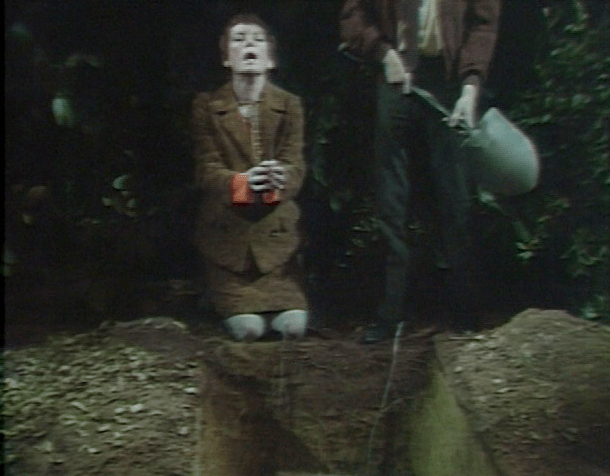
Once Willie has dug the grave and put Barnabas’ coffin in it, he and Julia decide to pray. She takes the lead, kneeling and throwing dirt, presumably including stones, onto the coffin. Dark Shadows avoided the topic of religion almost completely until repressed spinster Abigail Collins made her first appearance in #367; she and the Rev’d Mr Trask, introduced in #385, presented a wildly unfair, highly entertaining lampoon of eighteenth century New England Congregationalism. Recently the show has been lurching towards a vaguely friendly attitude towards Christianity. If Julia keeps strewing stones onto the grave once it is filled in, we might think that this friendliness extends to Judaism as well.
Meanwhile, a very tall man named Adam is having a bad time. Adam is a Frankenstein’s monster, and when he was created he drew the effect of the vampire curse from Barnabas. He does not feel the effects of that curse, but he does suffer pain when Barnabas is injured. When heiress Carolyn calls on Adam at the old shack in the woods where he is hiding, she finds that his neck hurts where Barnabas was bitten. When Julia declares Barnabas dead, we cut back to the shack, where Adam has stopped moving. Occult expert Timothy Eliot Stokes has joined Carolyn; he feels Adam’s wrist, and in a bit of Collinsport English that is becoming increasingly prominent on the show says that he can find no “pulsebeat.”
Barnabas was bricked up in a wall from #512 to #516, and Adam felt his pain during that period. So it is no surprise to returning viewers that Adam suffers along with Barnabas now. We also have heard countless repetitions of something neither Julia nor Willie has ever heard, an audiotape in which Eric Lang, the mad scientist who created Adam, explains that as long as Adam lives Barnabas will be free of vampirism. So we doubt that Barnabas’ curse will return, and hope that Adam’s suffering will be the clue that leads Julia and Willie to rescue Barnabas from being buried alive. Since Julia and Willie have no idea where Adam is and Adam hates them both, it’s as difficult to see how they could find out what he’s going through as it is to see how Barnabas could get out of the grave any other way. In that difficulty is the suspense with which the episode ends.





 Dark Shadows Commentary