Episode 1082: I haven’t been wrong very often when it comes to judgment of people

Barnabas Collins and Julia Hoffman have returned to 1970 from a cosmic journey that took them first to a parallel universe, then to the future year 1995. In the parallel universe, they met a comatose woman named Roxanne Drew. Barnabas was immediately smitten with Roxanne, and was still attracted to her even after she gained the ability to open her eyes and move around. By the time she was able to speak, he was in love. Roxanne couldn’t come along when they left her universe, and he’s been down in the dumps about that. Barnabas could always go to the hospital and look for another comatose woman, but I suppose that might not be quite the same, somehow.

Now, Barnabas has met Roxanne’s counterpart in his own universe. She is attached to astrologer Sebastian Shaw, whom Barnabas had been pestering for reasons having to do with the efforts he and Julia have been making to prevent a mysterious disaster they learned about during their stay in 1995. Sebastian was so fed up with Barnabas that he walked out of his own living room, leaving Barnabas alone there. Then the door opened, and a Roxanne Drew entered, carrying a brown paper grocery bag. Barnabas greeted her by name, to her puzzlement.

When Barnabas explains that he knew another Roxanne Drew who looked exactly like her “in another time,” Roxanne assumes he means many years ago. He allows her to proceed under this assumption, which does seem less likely to prompt a call to the police than introducing yourself to a stranger with a story about how you’ve been traveling between parallel universes and back and forth in time. Roxanne comes out with a theory that two people with the same name born on the same day in different parts of the USA might become “astral twins” and look just alike. This idea may not be less plausible than what Julia and Barnabas have actually done, but it does seem considerably less likely to be useful in making up interesting stories. So it comes as a great relief when Roxanne stops talking about it.

Barnabas asks Roxanne to meet him for dinner at 10 PM. This is an odd invitation, since Barnabas is a vampire. Where is he going to take her, the blood bank? She hesitates, but at length agrees to meet him “there.” They haven’t named a place.

Later, Roxanne calls the great house of Collinwood. Julia answers. Roxanne identifies herself, and Julia reacts with amazement. Roxanne says she must be thinking of “that other Roxanne Drew.” She says that she won’t be able to meet Barnabas for dinner “there” after all.

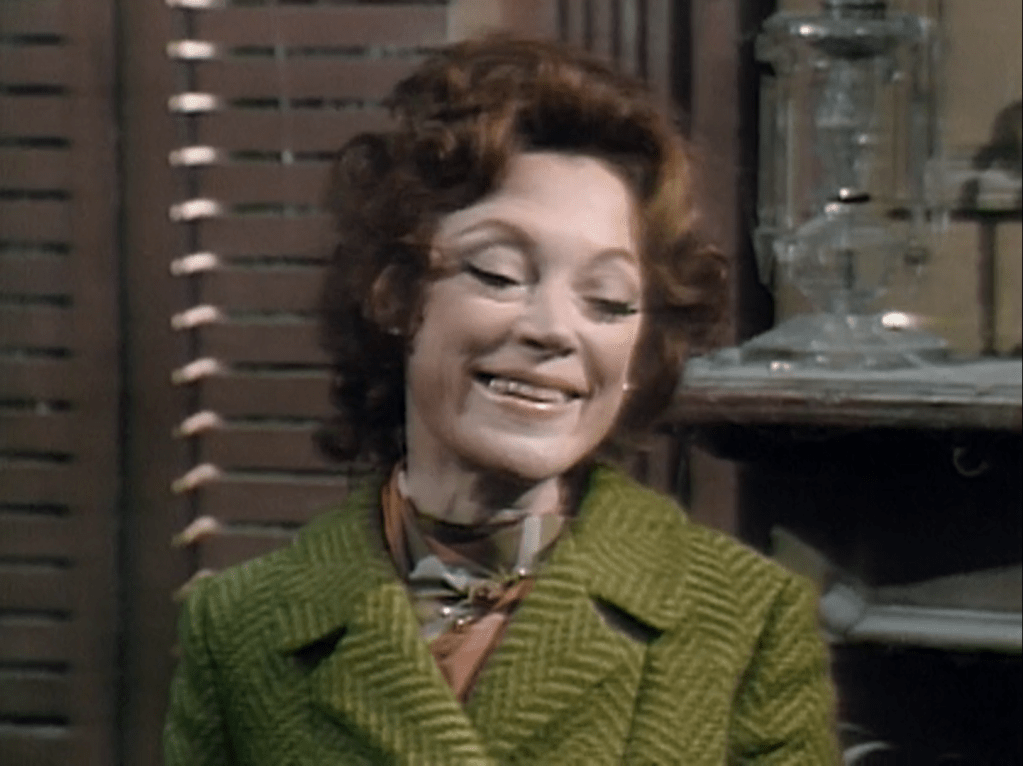
Barnabas enters. He is excited to tell Julia about Roxanne. She tells him she already knows about her, and gives him Roxanne’s message. Julia reminds him that some people in the parallel universe were radically different from their counterparts in this universe, giving herself and her counterpart as an example. Barnabas refuses to admit that this Roxanne Drew is not the same person as the one whose immobility and silence so charmed him in the other continuity. Julia keeps warning him, and he declares that “I haven’t been wrong very often when it comes to judgment of people.” This remark will astound regular viewers. Barnabas is a worse judge of character than any figure in all human history. I myself can’t claim to be all that perspicacious, but neither I nor anyone else I know has ever misjudged a person so desperately we were turned into vampires as a result. That has happened to Barnabas twice. Julia is so stunned by Barnabas’ bizarre remark that all she can do is humor him and say that she agrees with his assessment of himself.

Barnabas goes back to Sebastian’s apartment and speaks to Roxanne. She says he must not have received her message. He says he did, but asks to come in anyway. She allows it, and he gets strangely aggressive with his insistence that they will eventually go out together. He’s usually a lot more pleasant with people, unless he’s been feeding on their blood or threatening to kill them. He wants to charm Roxanne, so we may wonder why he gets in her face, adopts a sullen tone, and vows that she will someday date him. The other Roxanne had an obnoxious ex-boyfriend named Claude North. In his sulky and petulant refusal to take no for an answer, or even for an indication that he has to change tactics, Barnabas sounds a lot like Claude.

Meanwhile, Julia has been trying to find out which house in the area was known as “Rose Cottage” in 1840. During their sojourn in 1995, she and Barnabas received some cryptic clues about the disaster that will befall the great house of Collinwood and everyone in it later in 1970, one of which was the phrase “the night Rose Cottage was destroyed.” Also during that trip they saw the ghosts of some people who lived in 1840, and since returning have found a document from that year that mentions a house called Rose Cottage, but does not say which house it was.

Teenagers Hallie Stokes and David Collins had died in the version of 1995 Barnabas and Julia visited. They saw ghosts who looked just like them, but were in fact those of figures from 1840 named Carrie and Tad. Julia suspects that David and Hallie are withholding information from her about paranormal occurrences in the house, as she and Barnabas are withholding information from them. Rather than leveling with Hallie and David about what they learned in 1995 and asking them to reciprocate, Julia has decided to be as inexplicably harsh and aggressive with Hallie as Barnabas is with Roxanne.

Hallie finds Julia going through some old tax records today. When Julia says that she is trying to figure out what house in the area used to be known as “Rose Cottage,” Hallie mentions that Julia had previously asked her if she’d ever heard of such a place. Julia takes that remark as an opportunity to fix Hallie with an unwavering stare and drill her with question after question. During this bizarre interrogation, the ghost of Tad and Carrie’s governess Daphne Harridge appears to Hallie, reminding her not to answer. Julia loses interest in Hallie and turns back to the tax records. Hallie excuses herself and follows Daphne out of the room.

David has a dream in which he finds Hallie in an unfamiliar corridor. He asks her where they are. She says they are in Rose Cottage. She tells him to follow her to a birthday party. He is unhappy that he has not brought a present; she laughs a little at this. They go into a small room and see two dummies sitting opposite each other at a table. Hallie says that they will sit in the other two places at the table. There are placecards identifying them as Carrie and Tad. They sit down, and Daphne’s gigantic face appears at the window. Daphne has been silent in all her appearances so far. She breaks her silence in this dream, laughing maniacally at the sight of David and Hallie sitting with the dummies.

Happy Dappy. Screenshot by Dark Shadows Before I Die.

David wakes up. He goes to a little-used part of the house. He finds Hallie in front of a door behind which there is usually a linen closet. Sometimes, however, the space transforms into a larger room stocked with antique toys. Hallie and David refer to that room as “The Playroom.” They have seen Daphne there several times and have sensed the presence of another, more blatantly hostile spirit, one which Julia and Barnabas came to know in 1995 as Gerard Stiles. Hallie asks David why he has joined her. He tells her about his dream. It turns out she had the same dream. They resign themselves to entering The Playroom. Inside, they see a dollhouse that has previously been set up with its facade towards them is now set on a lower table with its interior on display. There is a room that looks just like the one in their dream, complete with dolls sitting at the table.

Barnabas and Julia visited The Playroom several times in the future, and the dollhouse was there then. It always seemed likely that the dollhouse was a model of Rose Cottage. Now, it is confirmed that it is not merely a model of it, but is in some sense identical with it. Perhaps it is a ghostly survival of a house that no longer exists, or perhaps it is a mystical reflection of a haunted house that stands somewhere else in the area. One way or another, it seems that Hallie and David are fated to lose their independent existence and become inert playthings confined to an inaccessible space.

David, Hallie, Daphne, and Gerard are part of a recycled story. In late 1968 and early 1969, Dark Shadows adapted Henry James’ The Turn of the Screw with David and his friend Amy in the roles of the children Miles and Flora and the ghosts of Quentin Collins and Beth Chavez as the ghosts of Peter Quint and Miss Jessel. The whole point of the novella is that it is an open question whether the ghosts are real and the new governess is heroically trying to save the children from them or the ghosts are figments of the imagination of the governess, a crazy woman who is a mortal threat to her charges. Benjamin Britten’s opera preserves that ambiguity to some extent, but screen adaptations tend to come down firmly in favor of the ghosts being real. The first “Haunting of Collinwood” left no room for doubt on that score, and the current Re-Haunting of Collinwood is just as emphatic.

The ghosts of Quentin and Beth were silent when we first saw them in 1968, as Daphne’s ghost has been silent until she laughs maniacally today. They made their first appearance in #646, but neither of them made a sound until Quentin laughed maniacally in #689. Gerard has yet to make himself heard, though actor James Storm read the opening voiceover narration in #1066.
Episode 1079: Just join hands with us and you’ll know everything

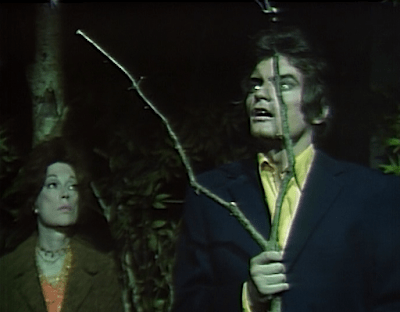
The ghost of Daphne Harridge wants to kill Quentin Collins, for no reason the show divulges to us; then she doesn’t, again for no reason we can see. Daphne insists teenager David Collins and Hallie Stokes not look at her, then insists they do look at her. David refuses to join hands with Hallie and Daphne to gain mystical knowledge, then demands Hallie join hands with him in a séance. Quentin is under Daphne’s power and unable to assist Julia Hoffman in her quest to free the great house of Collinwood from the hauntings; then he orders Julia to attend him while he performs an exorcism of the house.

Quentin the exorcist. Screenshot by Dark Shadows Before I Die.

In his post about the episode on his great Dark Shadows Every Day, Danny Horn said everything I wanted to say about how unsatisfying all of this is. The show has had its ups and downs. I call this segment The Re-Haunting of Colllinwood, because the A story from December 1968 to March 1969 is often called The Haunting of Collinwood and this is a recycling of that. The original Haunting of Collinwood was itself pretty slow-paced and frequently got bogged down with ominous games of dress-up. This time around the pace is again slow and the rounds of dress-up are even more tedious.

It is somewhat interesting to listen to Quentin reciting traditional Christian formulas as he conducts the exorcism. When we first got to know him, Quentin was a devout and enthusiastic Satanist. I suppose all religions lose adherents from time to time.

Episode 1078: The only answer

Quentin Collins and David Collins are under the influence of the unspeaking ghost of Daphne Harridge. Quentin and David each fret about their inability to resist Daphne, to understand their own actions, or to tell each other or anyone else what is going on. Since Daphne is herself a total enigma at this point, the audience learns nothing when these characters are on screen.

Barnabas Collins and Julia Hoffman know that Daphne is associated with an impending catastrophe. They are trying to learn about her as part of their efforts to prevent this catastrophe. Since Daphne will not allow either David or Quentin to give them any information, they are helpless.

The episode ends with Daphne about to stab Quentin in the back. This is not much of a cliffhanger. Quentin is 100 years old, but has the body of a 30 year old because of a magic spell that also makes him impervious to physical injury. Daphne can stab him all day and all night, and all that will happen is that his enchanted portrait will get a little grislier.

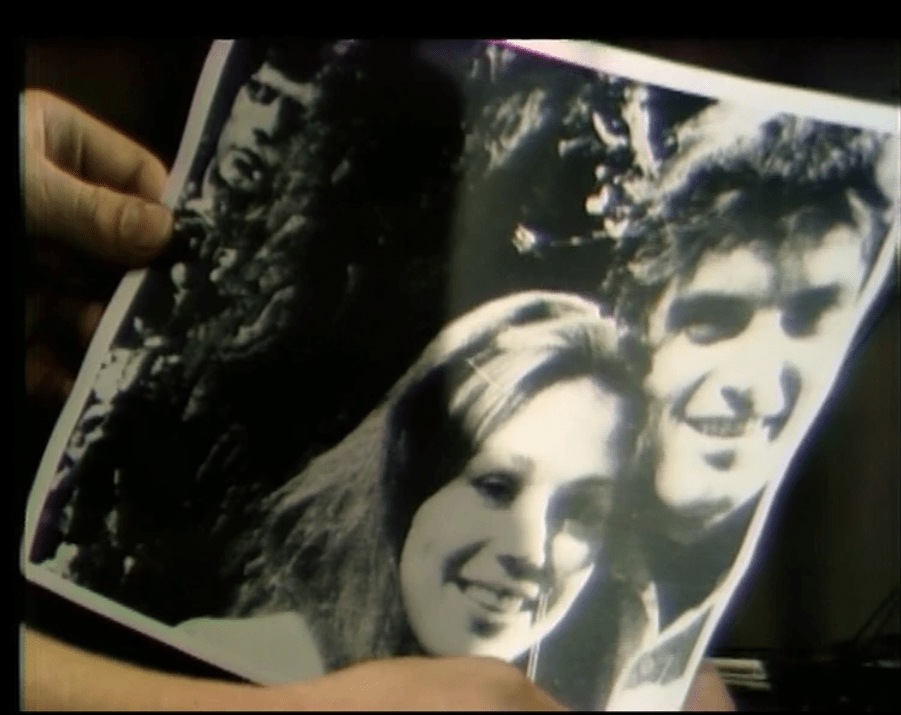
There is some business about a photograph David took. We saw this photograph in #1064, when there was some dispute about whether one of the ghosts was visible in it. Today David shows it to Quentin and asks him if he sees a face in it. Quentin says that it does look like a face, but he thinks it’s just an optical illusion created by the sunlight on some leaves. We imagine that the face will be a subtle thing, as it would have to be if it were somewhere in the photograph we saw in #1064, but when they show it to us later the face is as prominent as any other feature of the image. The result is an insult to the audience’s intelligence.

The original photograph, as seen in #1064.
The photograph as presented today.

Episode 1076: The addition of the letter O

Grouchy New England teen David Collins and his live-in girlfriend Hallie Stokes go to a playroom for small children that intermittently manifests itself in a space otherwise occupied by a linen closet in the west wing of the great house of Collinwood. Hallie is possessed by the spirit of a girl named Carrie, who died in 1841. David hasn’t caught on that Hallie isn’t herself, and in his exasperation he asks her to “stop acting like the world’s number-one weirdo.” Carrie is puzzled by the word “weirdo.” She recognizes it as a derivative of “weird,” but claims that “the addition of the letter O makes it completely incomprehensible.” Evidently Carrie wasn’t all that quick on the uptake. If someone called me a “peculiar-Z,” I might not know why the letter Z was added, but it would be perfectly clear to me what they were saying. Historians of American English often say that the 1830s and 1840s were the single busiest period for the invention of new slang terms the USA has ever seen, so that if Carrie were as stumped by the “O” on “weirdo” as she claims to be, she would likely have been unable to conduct a conversation with many of her contemporaries.

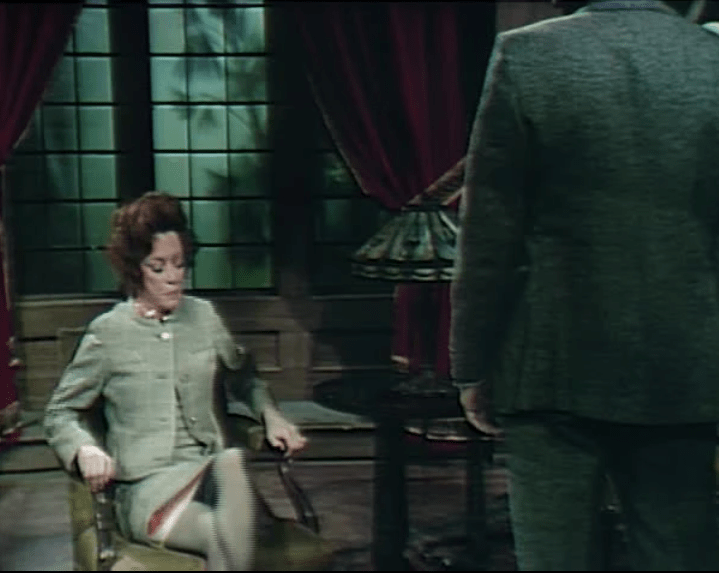
David’s realistic 1970 dialogue and Carrie’s antiquated verbiage bounce off each other to produce some intentional comedy; my wife, Mrs Acilius, thought the scene was really funny. It is certainly more appealing than the rest of the episode, which is yet another series of events that take place only because the characters cannot bring themselves to tell each other what’s going on. Because the ghosts won’t let them, yes yes yes, we’ve been through all that many times before. The fansites seem bored enough by the whole thing that one of biggest points of discussion is whether it is reasonable to say that, because a bit of Grayson Hall’s slip is visible under her skirt at one point, we can say that we see her “underwear.” I guess the slip is “underwear” in the sense that she is wearing it under something else, and it probably wasn’t supposed to be visible, but you’d have to be a very specific kind of person to get excited about it.

Feast your eyes, pervs.

Hall plays Julia Hoffman, MD. Julia is a psychiatrist, among other things. She tells Quentin Collins that the ghost of Daphne Harridge, a governess who like her charge Carrie died in 1841, fills the room with the scent of lilacs when she is near. Quentin is so obviously lying when he tells Julia that he has not smelled that scent that we are probably supposed to assume that Julia is onto him.

Episode 1074: Talking doesn’t help

For the first six months of Dark Shadows, reclusive matriarch Elizabeth Collins Stoddard kept the story from moving by refusing to tell anyone what she knew about the major storylines. With the introduction of undead blonde fire witch Laura Murdoch Collins in #123, the show became a supernatural thriller. The characters driving the new storylines took care to exclude Liz from the action by never letting her find out what was going on.

Now, old world gentleman Barnabas Collins and mad scientist Julia Hoffman have returned to 1970 after a visit to 1995. They have told Liz and others what they saw in that future year, warning that a terrible disaster is impending that will destroy the great house of Collinwood and everyone in it. Julia and Barnabas are not sure just what will happen or when, but they know it will occur before the year is out and that it will center on teenagers David Collins and Hallie Stokes.

The adults have decided to keep the relevant information from Hallie and David themselves. That’s the whole problem today- a series of uncanny events occur that David and Hallie would recognize as signs of the disaster and about which they would be able at least to sound the alarm had they been given the relevant information. Since they have been kept in the dark, they are helpless and the events are pointless.

Not only are the characters not learning from each other, Liz and David have forgotten a great deal that they used to know. From the first week of the show, David was on intimate terms with the ghosts of Collinwood. But today he mentions to Hallie that when he saw a ghost he was not afraid, and he cannot understand why he wasn’t afraid. Liz’ daughter Carolyn mentions that she found Hallie wearing an antique dress. Liz responds that putting on an antique dress can hardly precipitate the kind of disaster Barnabas is talking about. Yet precisely the kind of disaster Barnabas is talking about already befell Collinwood in March 1969, and the first step towards it came when David and his friend Amy Jennings played dress-up, wearing antique clothes under the influence of the malign ghost who would eventually drive everyone out of the great house.

At moments, the script seems to acknowledge that the whole episode is a waste of time. Liz asks Carolyn if she believes in astrology. Carolyn says she doesn’t believe in anything, so she might as well pay attention to her horoscope. It’s no more meaningless than anything else.

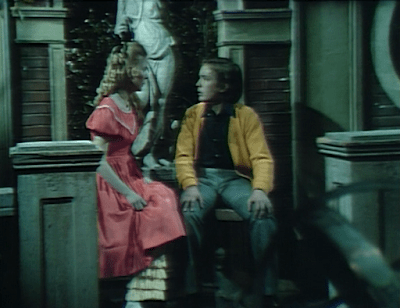
The opening scene, in which David and Hallie spend what seems like an hour hanging around the gazebo and talking about the fact that she doesn’t remember putting on her dress, is particularly bad. I’m reluctant to complain about any of the actors, since the conditions under which they had to work were extremely difficult. I’m especially reluctant to single out performers like Kathleen Cody, who gets a lot of negative comment from fandom. But she is very bad in this scene, just terrible, loud and fake and hard to put up with. Not that I can see what anyone could have done to make the scene interesting, but the situation is so slight it cannot for one moment bear the emotional load Miss Cody piles on it.

There are a few moments of unintentional comedy today revolving around wardrobe. David wears a sweater over a sports shirt and a pair of trousers with the belt fastened somewhere above his navel. David Henesy is in his late 60s now; he still isn’t old enough to wear that outfit. But combined with David’s grouchy attitude, the costume makes him seem like some old guy from New England.

Why don’t nobody know how to make clam chowdah no more? Screenshot by Dark Shadows Before I Die.

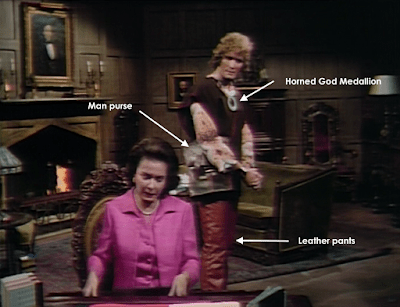
Chris Pennock shows up as astrologer Sebastian Shaw. Sebastian’s costume was bizarre even by the very generous standards of 1970. John and Christine Scoleri labeled some of its more unusual features in their post about it at Dark Shadows Before I Die:

I mean really. Screenshot by Dark Shadows Before I Die.

The utter preposterousness of Sebastian’s getup goes some way towards relieving another bad taste in the mouths of longtime viewers. Pennock also played Carolyn’s late husband Jabe, whom everyone insisted on calling Jeb. When Carolyn first sees Sebastian, she is shocked at the resemblance. The show first went all-in on its repertory approach to casting in November 1967, when well-meaning governess Vicki traveled back in time to the 1790s. She found that the characters she met in that epoch were played by actors she knew from the first 73 weeks of the show, and tried everyone’s patience by telling them about their previous parts. That unbelievably stupid habit marred the 1790s segment and utterly destroyed the audience’s interest in Vicki. Carolyn’s recognition that Pennock was Jeb before he was Seb brings that unpleasant memory back, and any distraction from it is welcome.

At one point Liz finds David standing over Hallie while she is in bed in the small hours of the morning. Liz demands to know what he’s doing there, and is particularly indignant that he is “still dressed.” Mrs Acilius and I laughed out loud at that. It’s better he should be naked?

Episode 1068: Almost pleased

I wonder how long the actors had the script before they started taping this one. As unspeaking, barely mobile ghosts Gerard and Daphne, James Storm and Kate Jackson didn’t need much prep time; as lunatics Carolyn Fredericks (neé Stoddard) and Quentin Collins, Nancy Barrett and David Selby probably didn’t need much more. But vampire Barnabas Collins has a lot of dialogue today, and Jonathan Frid rarely seems to be within a country mile of his scripted lines. That isn’t so unusual, but Grayson Hall’s trouble really stands out. Barnabas’ friend, Julia Hoffman, MD, is possessed by Gerard and is pleased that Barnabas keeps meeting with one failure after another. We are supposed to know this, Barnabas isn’t. But she has a huge grin on her face each time she gloats to Barnabas about one of his setbacks. The one time Frid is clearly delivering a line that was written for him, Barnabas tells a conspicuously blissed-out Julia that she seems “almost pleased.” Hall was a highly accomplished actress, and we would expect her to be able to do “secretly pleased” in her sleep. But when this line comes up, she gets a bad laugh.

Far and away the happiest we have ever seen Julia, this strikes Barnabas as “almost pleased.”

The episode ends with Barnabas going to the drawing room of the great house of Collinwood in response to a note from Carolyn. He finds her sitting at the desk there. He talks to her for a moment, then notices that she is not moving. He touches her, and she falls over dead. The episode has its problems, but that is an extremely effective closing curtain.

Episode 1067: Collinwood works on all our imaginations

Dark Shadows just spent sixteen weeks in an alternate universe where Quentin Collins was neither the family-annihilating ghost he was when first we saw him in December 1968 nor the charming rogue we got to know when the show went back in time in March 1969. Instead, he was a foul-tempered sourpuss who treated his wife like an irritating child and refused to learn anything from anyone. Like those previous iterations of the character, “Parallel Time” Quentin had a compulsion to choke people, but unlike them he was no fun to watch.

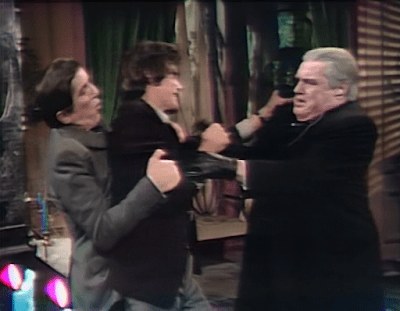
Now we have traveled forward in time to the year 1995. Here, Quentin is an escaped mental patient who is sometimes extremely docile and at other times just as extremely refractory. But one thing hasn’t changed, which is his zeal for strangling anyone who bothers him. He sees the elderly Timothy Eliot Stokes, expert in the supernatural, and at once grabs him by the throat. Quentin’s friend Barnabas Collins pulls him off of Stokes. Barnabas suggests that Dr Julia Hoffman should give Quentin a sedative. He responds “The only sedative I need is to get my hands around Stokes’s neck. I’ll be calm for the rest of my life!” That’s our Quentin.

Barnabas tries to keep Quentin from giving Stokes his signature Collinwood Handshake. Screenshot by Dark Shadows Before I Die.

Quentin blames Stokes for the fact that the estate of Collinwood has been a demon-ridden ruin for the last 25 years. Stokes has been telling Julia and Barnabas that it was that way when he got there. He returned from a trip to Europe in the autumn of 1970, a few months after Barnabas and Julia left on their journey into the alternate universe and out to this future year, and found the place in its current condition and everyone associated with it destroyed in one way or another. But Quentin says that the real disaster came only when Stokes tried to exorcize a ghost. That just made the ghost angry.

Once Quentin is out of the way, Barnabas tells Stokes he believes that Quentin’s madness is a symptom of the ghost’s continued hegemony over Collinwood. He is determined to try another exorcism. Stokes advises him against it, but says he will try to help him if he does go ahead.

Meanwhile, the ghost, who according to the credits is named Gerard, has taken possession of Julia. The ghost has ordered Julia to do something she does not want to do. She keeps this from Barnabas. She tells Barnabas they should give up and go away. He refuses, and she sadly says that whatever will happen will happen. From the look on her face, it seems that the ghost has ordered her to do away with Barnabas and she is resigned to the idea that she will eventually obey this command.

There are other ghosts in the area as well. Yesterday Julia and Barnabas saw the ghosts of two teenagers who were apparently named Tad and Carrie while they danced a minuet and exchanged a chaste kiss, and they heard Quentin talking earnestly to an invisible person he called Daphne. A woman with long black hair briefly comes into Barnabas’ view in his parlor today; the credits confirm that she is Daphne. Anyone who watched US television in the 1970s, 1980s, or 1990s will already know that she is Kate Jackson, and might be interested to know that she is making her first screen appearance.

When Daphne appears, the air smells of lilacs. That comes as something of a relief. The opening voiceover told us that Collinwood is ruled by “a ghost whose mere presence corrupts the surrounding air.” That would suggest rather a less pleasant odor than that of lilac perfume.

The ghost of the gracious Josette was the chief supernatural presence on the show for its first 42 weeks, and an occasional visitor for some time after. Her signature was the scent of jasmine, so longtime viewers are getting a hint that Daphne will turn out to be important.

Episode 1066: And all that

For many months starting in late 1968, the estate of Collinwood was haunted by the ghost of Quentin Collins. Quentin’s presence became steadily more intolerable until the living members of the Collins family had to abandon the great house in #694. At the end of that episode, we saw Quentin standing on the walkway at the top of the foyer stairs, laughing in triumph.

Vampire Barnabas Collins traveled back in time in #701 and blundered around until history was changed. In #838, set in September 1897, Quentin’s death was prevented. On the anniversary of that event in September 1969, the haunting broke, though the people who lived through it remembered Quentin’s ghost and the events of the haunting. A magic spell was cast on Quentin keeping him forever young, and late in 1969 he took his place among the Collinses whom he had once driven from the family home.

Now, Barnabas and his friend, mad scientist Julia Hoffman, have come unstuck in time again. They find themselves in Collinwood in the year 1995. The house is in ruins, the members of the family either dead, missing, or insane, and the village of Collinsport full of people who won’t answer any of their questions. Quentin is around, having escaped from a psychiatric facility and come back to the estate. Today, Barnabas and Julia have taken him to the great house to try to get him to tell them something useful.

Julia and Barnabas want Quentin to see an upstairs room that is in much better shape than the rest of the house. They open the door, and see a ghost which appears to be strange and troubled teen David Collins. Quentin flees in terror and makes his way to the foyer while Barnabas and Julia watch the ghost vanish.

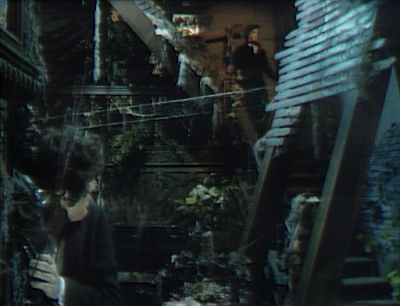
Quentin finds that he cannot open the front doors. He sees the ghost of a young man staring at him from the walkway at the top of the stairs. Like Quentin during “The Haunting of Collinwood,” this ghost has lots of curly black hair, does not speak, and wears a dark suit from the nineteenth century. Since David Selby is very tall and James Storm is rather the other thing, I can’t help but think of him as Mini-Quentin. The credits tell us that his name is Gerard.

Quentin cannot abide the sight of Mini-Quentin. Screenshot by Dark Shadows Before I Die.

Quentin rolls around on the floor, terrified of Gerard. Barnabas and Julia come and try to calm him down. Quentin says the doors won’t open; Barnabas opens them. Quentin runs out. Julia says she senses an evil presence, which, considering that every character we’ve seen so far is a murderer, is not too surprising. She and Barnabas leave.

Two ghosts dance a minuet by the gazebo. Julia and Barnabas think that one of the ghosts is David; the other is a blonde girl whom they do not recognize. The ghosts kiss each other. They walk towards the woods and vanish.

Barnabas and Julia go to the Old House on the estate. They find Quentin, and overhear him talking in an anguished voice to someone named “Daphne.” He tells them that the ghost they saw was not David Collins, but was named Tad. Julia remembers that they found a birthday card addressed to “Tad” and signed “Carrie.” If the ghost who looks like David is actually Tad, one might assume that the blonde girl is Carrie, though she could be Daphne or some other personage.

The next afternoon, Quentin finds Julia sleeping in an armchair in the parlor of the Old House. He asks to see Barnabas. Julia reacts with puzzlement. She says Quentin knows perfectly well that Barnabas cannot rise until the sun sets. He says he doesn’t know what she’s talking about. Julia is shocked. Once you’ve learned that a fellow is a vampire, that information doesn’t usually slip your mind. But he seems quite sincere. He wanders off.

The blonde girl appears at the window and beckons to Julia. Julia follows her, silently. It seems at first that Julia is in a trance, since she does not call to the girl by the names “Carrie” or “Daphne.” But when the girl leads her into the great house, Julia keeps moving her head around as she watches her step, making it clear she is wide awake. The girl leads her into the strangely intact room, where Gerard is waiting for her.

Danny Horn’s post about the episode on his great Dark Shadows Every Day is full of remarks about how cleverly they blur the line between soundtrack music that the characters can’t hear and atmospheric sounds that they can, disorienting us in a way that adds greatly to the effect of the scares and confusion. It is indeed powerful, and there is a lot of other good stuff in this one.

But this is the first episode of the 1995 segment I wouldn’t show to someone new to Dark Shadows to entice them into watching the show. The pacing is just too slow for the material. We have time to start asking questions that take us out of the story. For example, Julia and Barnabas lament that they have no idea what is going on and are desperate for Quentin to tell them what he knows. But as soon as he volunteers a piece of information, telling him that they saw Tad’s ghost rather than David’s they flatly contradict him. Also, Julia gives Quentin a sedative. We wonder where she got it, since her prescription pad is 25 years out of date and any samples she had in her bag have been sitting out, unrefrigerated and exposed to dry rot, for that same period. Those and other incongruities are the sorts of things we could easily overlook if we were moving as fast as we moved in all five episodes last week, but when events move as leisurely as they do today they mean trouble.

Episode 1147: The Strain

I say that David Henesy and Alexandra Moltke Isles, as David and Vicki in the first 42 weeks of Dark Shadows, used nonverbal communication to triumph over poor writing to present an interesting story of a troubled boy and a young woman learning to trust each other. I then try to explain why Henesy was unable to repeat that success as Tad in the “Meet Gerard” segment of the series. 

Episode 1147: The Strain