Episode 1020: The last of the bachelors

Angelique Stokes Collins has risen from the dead, but her renewed existence may end within seconds. She is overwhelmingly cold, and can warm up only by draining the heat from the body of a living person. Someone is coming in the front door, just in time to be her victim and die in her stead. She wonders who it will be.

Almost all the characters currently on Dark Shadows are either so important to an ongoing story that their deaths would end a major arc or have so many connections to everyone else that their deaths would start a new one. So if she kills mad scientist Cyrus Longworth, his fiancée Sabrina Stuart, or barmaid Buffie Harrington, Angelique will be ending the Jekyll and Hyde story, or at least shifting it into a radically new phase. If she kills drunken sourpuss Quentin Collins, his wife Maggie Evans Collins, or housekeeper Julia Hoffman, she will be ending the adaptation of Rebecca. If she kills Carolyn Loomis or her husband Will, she will be ending the restaging of Who’s Afraid of Virginia Woolf?

If Angelique kills woebegone homebody Elizabeth Collins Stoddard or her brother, sardonic dandy Roger Collins, she won’t be ending any ongoing stories. But Liz and Roger are the counterparts of characters who were central to the life of the great house of Collinwood in the first 196 weeks of Dark Shadows, when it was set in another universe, and are played by actors who have substantial followings. If either of them is murdered, the audience will expect major consequences. Angelique’s son Daniel Collins and Daniel’s cousin Amy Collins aren’t doing much just now, but if Angelique kills a child, especially her own son, the ABC network’s office of Standards and Practices would join the audience in insisting she face a serious reckoning that would take up a lot of screen time. This fit of heat vampirism came on Angelique too suddenly to make sense as the start of a new arc, so we can rule all of those candidates out.

There are also a couple of characters who were introduced to fill in for actors who were away the previous couple of months filming their parts in the theatrical feature House of Dark Shadows. Among those are Angelique’s Aunt Hannah and butler Mr Trask. They are possibilities, but are both played by actors who have enough going for them that it would be a bit surprising to bring them back just to kill them off. There are also a few miscellaneous day players whose characters would have no reason to let themselves into the great house of Collinwood- a bartender we saw in #991, a landlady we saw in #997, etc.

So it would seem that there are only two people who could be Angelique’s next meal. One is sleazy musician Bruno Hess, a former boyfriend of hers who lives in the cottage on the grounds of Collinwood and is friends with Cyrus, but who has been neither seen nor missed for some time. The other is Larry Chase, attorney at law.

Bruno is played by the dynamic Michael Stroka, who twice made a mark when cast in stories set in the other universe. Larry was written into the show as a last-minute substitute for a part played by an actor whose health problems made it impossible for him to continue. They didn’t have time for auditions, so they drafted associate director Ken McEwen for the part. McEwen was in the building, and he had a guild card because of some small parts he’d taken in TV shows he’d worked on in the 1950s. When he has enough time to rehearse, which is to say when he has had more time to rehearse than actors usually got on a show like Dark Shadows, McEwen gets his lines right, except for adding “Well…” at the beginning of every single one. You can tell he is making a sincere effort not to ruin the show. But that’s about all you can say for him. Even at his best he’s stiff and distracted, and when he hasn’t been able to get his part down, he disintegrates completely. So it isn’t much of a surprise that Larry is the one who opens the door. It wasn’t a surprise to me, I should say; writing these posts keeps all the details fresh in my mind. My wife, Mrs Acilius, looked at him for about thirty seconds and asked “Who’s that?”

Larry plays the same scene with Angelique that her second victim, Fred the transient handyman, had played with her in #1003, right down to telling her that he had wanted to hold her since he first saw her. Fred was played by Edmond Hashim, and anyone who sees the two versions of this scene side by side will come away with a new appreciation for Hashim’s talents as an actor. This is McEwen’s final on-screen appearance, though he will pinch hit as the opening narrator in three upcoming episodes. He will continue as an associate director through episode 1179/1180 in December.

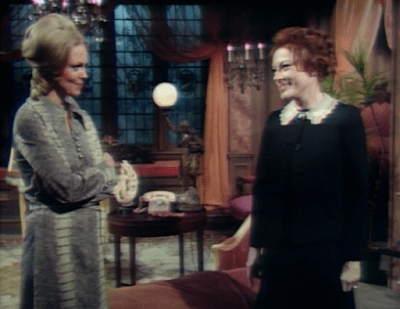
Will enters to find Angelique screaming and Larry dead. Angelique, who is impersonating her late identical twin sister Alexis, claims that Larry was just standing there when he had an attack of some kind and dropped dead. Will touches the corpse and says that he is so cold he must have been dead for hours. “Alexis” insists he just died a moment before. Will calls Cyrus, who is the Collins family physician.

Cyrus is in his lab, looking at the potion which turns him into the Mr Hyde-like John Yaeger. He is about to capitulate to his craving when the telephone rings. Will tells him that Larry is dead and asks him to come to Collinwood. Cyrus puts the potion back in his safe and rejoices that he is “Saved!” Larry was Cyrus’ lawyer and apparently a social friend as well. We’ve already seen Cyrus do enough horrible things that this sociopathic reaction is no shock.

Back at Collinwood, Will and “Alexis” are talking with Barnabas Collins. Unknown to “Alexis,” Barnabas is a visitor from the other universe. Her counterpart in his world was the wicked witch who turned him into a vampire, so Barnabas cannot keep a hostile edge out of his voice and manner when he is talking to her. Will is one of Barnabas’ victims, and knows all of his secrets.

When they are alone in the drawing room, “Alexis” questions Will about Barnabas. Will denies knowing him particularly well. Barnabas is staying at Will’s house, and several years ago Will wrote a biography of Barnabas’ counterpart in this universe, a man who lived a quiet life and died a natural death in 1830. Barnabas claims to be a descendant of that Barnabas Collins, and to have come to Collinwood to meet the author of the biography. Will becomes more and more disturbed as “Alexis” presses him harder and harder for information. She is perplexed that he won’t tell her anything. Lara Parker and John Karlen have both been on the show for a long time, but this is the first substantial two scene between them, and it is terrific. Their acting styles were very different, but they couldn’t have meshed better.

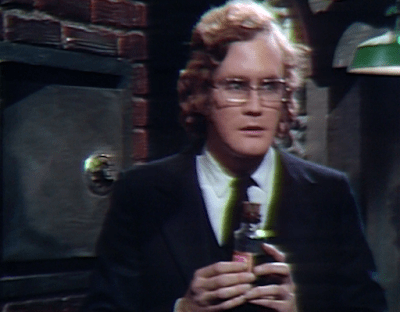
Barnabas is sitting at a table in the Eagle tavern. There is a glass of reddish liquid in front of him. In view of his condition, one wonders what that liquid might be.
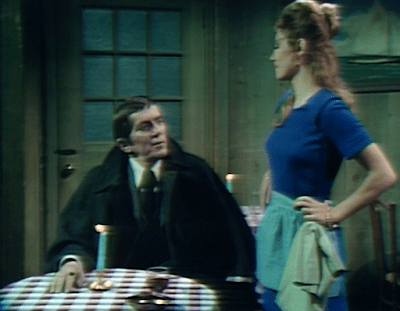
Enjoying your AB Negative, Mr Collins? Screenshot by Dark Shadows Before I Die.

Barnabas invites Buffie to sit with him. Since there are no other customers, she agrees. He tells her he is from South America. The son of this universe’s Barnabas Collins whom he claims as his great-grandfather went to Peru; when he introduced himself to the family, he said that his forebear did not die in that country. But evidently his imaginary descendants stayed on the continent, somewhere.

The Eagle is the counterpart of the Blue Whale in the other continuity. In #3, Burke Devlin was sitting at a table in the Blue Whale with hard-working young fisherman Joe Haskell when he said that his success in life began when a strange man picked him up in a bar in Montevideo. That was the show’s only reference to Uruguay, but Burke, the Blue Whale, and Brazil came to be strongly associated with each other. The song “Aquarela do Brasil,” a big hit in the English speaking world in the 1960s under the title “Brazil,” played on the jukebox at the Blue Whale, and it became Burke’s theme song. Ultimately Burke would die on a business trip to Brazil. Barnabas and Burke were enemies; when he sits at this table and claims to have a South American background, longtime viewers may wonder if he is thinking that the new universe is a place where he can try out a new personality and maybe he will start by imitating Burke’s.

Burke was a dashing action hero, attractive to women. Barnabas’ attempt to imitate him breaks down almost immediately. He winds up mimicking another prominent bachelor from his native universe, Professor Timothy Eliot Stokes, when he asks Buffie if she’s ever heard of the theory of “Parallel Time.”

Buffie shakes her head no. Barnabas says that some people believe that there are many universes, and that a copy of each of us can be found in each of them. They may look the same, but they lead different lives because they have made different choices. Buffie laughs and says that she hopes her other selves are having more fun than she is. She hastens to say that she doesn’t mean she isn’t having fun at the moment, sharing a table with Barnabas; she means that her life in Collinsport, as viewed from the most all-encompassing perspective and analyzed in the most thorough philosophic manner, well and truly sucks shit. Barnabas says that the other Buffies in the multiverse might have left Collinsport* and had wonderful adventures.

Longtime viewers saw one of those other Buffies in #951, when we were still in the original continuity. She had a different name; she went by Nelle Gunston. And as befits a mirror universe, she moved in the opposite direction. Rather than leaving Collinsport to look for something new as Buffie wishes she had done, Nelle left her parents’ home in Virginia and went to Collinsport because she had joined a cult dedicated to the destruction of the human race and its replacement by a loathsome breed of Elder Gods known as the Leviathan People. Barnabas had been the leader of the Leviathan cult, and when Nelle came to town she sat with him by the same table where Buffie and Barnabas sit today. They even take the same seats.

Buffie is charmed by Barnabas’ talk; between the suavity that Jonathan Frid brings to his part today and the energy with which Elizabeth Eis presents Buffie’s enthusiasm for him, it is far easier than it usually is to believe that Barnabas is a sexy dude. Maybe we are supposed to think that role-playing as Burke has enabled him to loosen up.

The conversation is really warming up when the bell attached to the front door rings. “Customer,” Buffie ruefully says to Barnabas as she rises. It is Cyrus.

Barnabas invites Cyrus to sit with them. He declines, saying that he came only to ask Buffie if she had seen John Yaeger lately. She tenses up. Yaeger used to beat her up and force her to help him with his crimes. She says that Cyrus himself had told Buffie that Yaeger wouldn’t be back in Collinsport. Cyrus says that he did, but that he is worried he might not be able to predict Yaeger’s movements as well as he thought he could. He offers Barnabas a lift back to Collinwood. That’s a bit surprising, since Cyrus got uptight when he saw Barnabas. As Yaeger, Cyrus discovered that there is a coffin in the basement of Will and Carolyn’s house, and he suspects that Barnabas spends his days there. But longtime viewers can remember the days Barnabas and Burke had conversations at the Blue Whale that were just as tense as the one he and Cyrus have in the Eagle, and Burke never failed to observe the small graces. It’s just the done thing, I suppose.

Cyrus leaves, and Buffie remains standing. She and Barnabas keep talking. He gets close, and goes in for a bite. He stops himself at the last second, to her surprise and disappointment. She was apparently ready for a kiss on the neck. He says he has to go. She is even more disappointed by that, but he promises to come back at closing. He asks to walk her home, and she happily agrees.

Will and Cyrus are in the drawing room at Collinwood. Will urges Cyrus to join him in a drink. When Cyrus declines, Will reminisces about the old days at Collinwood, when the party would just be getting started at this hour. In those days, people would leave the great house in the small hours of the morning and continue their revels at the Eagle. Cyrus says he won’t find much company there tonight. When he says that the only people in the place earlier were “the girl who works there” and Barnabas, Will looks alarmed. All of his mannerisms that suggest drunkenness drop away, and he rushes out.

Will gets to the tavern, and finds Buffie alone. The alcoholic author is obviously one of her favorite and most lucrative customers, so even though she has already blown out the candles she tells him he is in time for last call. To her amazement, he is not interested in a drink. He asks her where Barnabas is. She says he’ll be back and that he is taking her home. He says no, and she asks what’s wrong. Before he can answer, Will hears Barnabas’ voice behind him, echoing Buffie’s question. Laboring under the vampire’s power, Will has no choice but to leave Buffie alone with Barnabas.

Nelle, too, had agreed left the tavern with Barnabas. She expected to meet the leader of the Leviathans at his place, and was unhappy to find that the two of them were alone. Buffie is again an inverted mirror image of her counterpart. She takes Barnabas to her place, and is quite happy to be alone with him. The two close in for an embrace. He bites her neck, and she collapses. He had bitten Nelle, too. At that moment, Cyrus enters the room.

Cyrus does not exactly have a counterpart in the other continuity, but Christopher Pennock did play the Leviathan leader whom Nelle expected to meet. Like Cyrus, that character was a murderous shape-shifter. So Cyrus’ unexpected arrival mirrors the Leviathan leader’s unexpected absence.

When we first cut to Buffie’s room, the camera lingers for several seconds on an extremely unusual prop. It is a television set. The only other time we have seen a television set on Dark Shadows was in #27, in the other universe, when Burke visited investigator Stuart Bronson in a hotel room in Bangor, Maine where there was a small portable unit. It looks like it might be the same set.
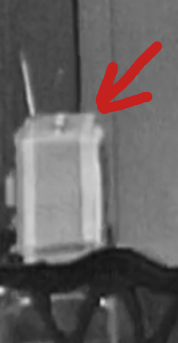

The shot goes on so long, and the set is such an odd thing to see in the context of the show, that they must be making some kind of point with it. We have wondered why Buffie submitted to Yaeger’s abuse, when she is such a strong and intelligent person. Her reflection in Nelle suggests a partial answer. Nelle was drawn to the Leviathans, who offered to destroy her and all other humans. We can assume that Buffie, too, was following a self-destructive urge when she went along with Yaeger. Associated with her, the television is a symbol of the annihilation of the self. Turn the idiot box on, turn your mind off. If you aren’t careful, you may even wind up spending your weekdays staring glassy-eyed at ABC’s daytime lineup.

*He actually says “Collinwood.” Which is a blooper, but since Buffie mentioned in her first episode that she used to work at Collinwood it is kind of an interesting one. Maybe when another Buffie left her position as an upstairs maid or whatever she was, she got further than the nearest tavern.
Episode 1019: Engaged in a war of nerves

Quentin Collins finds a voodoo doll in his wife Maggie’s suitcase. She tells him she hasn’t seen it before. At length it dawns on him that it is physically possible for a person to place an object in someone else’s suitcase. He remembers that housekeeper Julia Hoffman was in the room for no good reason last night while Maggie was sleeping. Several weeks ago, he was able to see the abundant evidence that Julia was trying to drive Maggie out of the house. He knows that Julia was fanatically devoted to his late wife Angelique and must know that Angelique was involved in black magic, so that Julia would be the obvious suspect in an awkward situation concerning Maggie and a voodoo doll.

The next day, Quentin talks the situation over with Cyrus Longworth, his physician and an expert in black magic. Later, he confronts Julia; she denies leaving anything in the room. He does not have any further evidence to use to challenge her denials, so he leaves it at that.

What Julia knows that Maggie, Quentin, and Cyrus do not is that Angelique has returned from the dead. She murdered her identical twin sister Alexis and took Alexis’ place as Quentin’s houseguest. Julia and Angelique are conspiring to drive Maggie and Quentin apart so that Angelique can resume her place as Quentin’s wife and the mistress of the great house of Collinwood. Julia and Angelique keep congratulating themselves on how upset Maggie is getting, apparently not noticing that Quentin is suspicious of Julia and thinking of firing her.

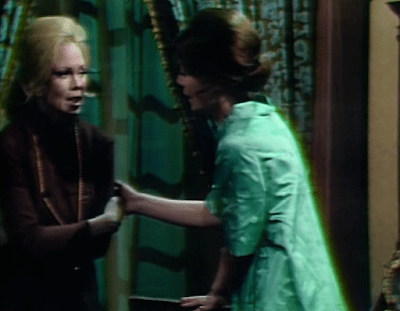
Angelique, masquerading as Alexis, calls on Maggie in the master bedroom. She says that she realizes her presence in the house has been stressful for Maggie, and offers to leave if she wants her to do so. Maggie says that she is not stressed now, because she realizes that she is Alexis. She describes herself as childish and hysterical in her initial reaction, when she thought she was Angelique returned from the dead, and tells her to stay in the house as long as she likes. “Alexis” takes this statement at face value, and goes on to explain her belief that Angelique was murdered and her determination to find the person responsible.

My wife, Mrs Acilius, pointed out that there is more going on in this scene than Angelique knows. Quentin has a habit of calling Maggie childish and hysterical, and she rejects those labels. So when she applies them to herself, regular viewers know that she is not giving her sincere opinion.

Moreover, being accepted as Alexis is not the winner with Maggie that Angelique believes it is. In #985, Maggie found Quentin and Alexis in Angelique’s old bedroom. Alexis was wearing Angelique’s frilly nightgown, pressing herself to Quentin, stretching her hand to him, looking into his eyes, and saying softly “Perhaps we can comfort each other.” Maggie ran from that sight to the drawing room, followed by Quentin. He tried to tell her she did not see what she saw. She told him that she would no longer be treated like a child, and left to spend the next six weeks at her sister’s place in New York. Angelique was in her grave at that time, and neither Alexis, Quentin, nor Maggie told her about it. So she does not know that by impersonating Alexis she is inviting Maggie’s distrust. She does not understand the warning Maggie is giving her when she tells her that she knows she is Alexis.

Maggie’s view of Alexis as a rival for Quentin also explains why she characterized her decision to go to stay with her sister as motivated solely by her own irrationality. Alexis is the last person with whom she wants to discuss her differences with Quentin, so of course she claims total responsibility for their earlier rift.

Angelique’s resurrection can last only so long as she can keep warm, and she can do that only by draining heat from the bodies of the living. Now the cold comes up on Angelique again. It strikes her during her scene with Maggie. Maggie can see that “Alexis” is ill, and reaches a friendly hand towards her. Angelique says this is just something that happens to her occasionally, and that she has to get under some blankets as soon as possible. She rushes out.

Maggie is concerned for “Alexis.” Screenshot by Dark Shadows Before I Die.

When she is in this condition, all Angelique has to do is touch a person and they will be an icy corpse. It is interesting that she chooses to pass up her chance to kill Maggie. Perhaps she is afraid that doing so would lead to her exposure. Alexis was her first unwilling heat donor; a handyman named Fred, who had the ill fortune to cross Angelique’s path in #1003, was the second. Angelique has concealed Alexis’ death by impersonating her, and Fred was due to leave town anyway. So no one has missed either of them. But there would be no covering up Maggie’s death.

Through the first half of the scene, Lara Parker’s hair and Kathryn Leigh Scott’s keep fluttering. The window on the set is closed, so that just makes us wonder how high the air conditioning was in the studio. After they come back from commercial, that problem is solved, but it was conspicuous enough to add a bad laugh to Angelique’s heat vampire symptoms.

Angelique runs down to the foyer, crying out for Julia. When she comes, Angelique orders her to fetch a victim whose body heat she can consume. Julia refuses, and Angelique tells her that if she doesn’t provide someone else she will herself be the next donor. Julia goes.

A moment later, Angelique feels she is about to succumb to the cold. She sees the doorknob turning, and resolves to claim whoever is about to enter. “Who will it be?” she asks, “Who… will… it… be?” There aren’t many candidates. There have been periods when the show had a bunch of characters in reserve who were not directly connected to any ongoing stories, but there are only a handful of those now, and only one or two would be likely to let himself or herself into Collinwood.

Five and a half years ago, I defended the episode in a comment I left on Danny Horn’s great blog, Dark Shadows Every Day. This segment of Dark Shadows is set in a different universe than the one where the first 196 weeks took place; the show insists on calling it “Parallel Time.” So the letters “PT” are sometimes put in front of the characters’ names to differentiate them from the versions of the characters we met in the original continuity. Danny and many of his commenters were getting impatient with Parallel Time by this point, and some compared it unfavorably to the trips the show took back in time within the main continuity, especially the costume drama segment set in the 1790s that ran from November 1967 to March 1968.

I’m liking it.

PT Angelique’s harebrained scheme isn’t really any worse than were most of Angelique-Prime’s schemes. So the difference between PT Maggie and Quentin on the one hand and 1795 Josette and Jeremiah on the other is that Maggie and Quentin have some brains. They talk to each other about what they’ve seen, confront Miss Hoffman, and consult with the resident Doctor of Spookology. For viewers who had seen 1795, that must have come both as a relief- thank goodness they aren’t going to simply recycle that story- and as a source of suspense- when Angelique sees her first evil plan fail, what other, even more evil plan will she devise?

Comment left by “Acilius,” 12 January 2021, on Danny Horn, “Episode 1019: Peer at a Prop,” Dark Shadows Every Day, 7 May 2017

I would have gone on to talk about all the stuff between Maggie and Angelique, but Mrs Acilius only pointed that out to me this time through. I’m sure that while I was watching the scene I responded emotionally to the nuances in Miss Scott’s performance, but I didn’t have it in mind after the episode was over.

The closing credits still bill Lara Parker as “Alexis Stokes,” a month after Angelique killed Alexis and took her place. Mrs Acilius explains this by reminding me of all the times when actors have strolled onto the set during the credits. She imagines someone walking on, seeing the credit that identifies Angelique, and reacting with shock.

Episode 1016: Fire, be my kinsman now

Maggie Evans Collins is staying with her sister Jennifer in New York.* She writes a letter to her estranged husband, Quentin Collins. Maggie says that there is no point in being married if they aren’t going to live together, so she is going to talk with Jennifer’s lawyer. She crumples the letter up and tosses it in the wastebasket. A moment later, the telephone rings. It is Quentin’s sister, Elizabeth Collins Stoddard. Liz tells Maggie that she must come home immediately.

Maggie at Jennifer’s place in New York. Screenshot by Dark Shadows Before I Die.

Quentin appears to be having a heart attack. Liz found him writhing in pain in the drawing room. He was accompanied by someone Liz had never seen before. Eventually this person identified himself as Barnabas Collins, a distant cousin of theirs. Barnabas told Liz that Quentin had collapsed with severe chest pains, and urged her to call a doctor. She telephoned Cyrus Longworth, a friend of Quentin’s.** Cyrus doubts that Quentin will recover. Barnabas suggested Liz call Maggie, saying that she could get a flight and be at the great house of Collinwood within hours.***

The source of Quentin’s trouble is his first wife, the late Angelique. Angelique has risen from the dead, murdered her identical twin sister Alexis, and taken Alexis’ place as a houseguest at Collinwood. Angelique wanted Quentin to bring Maggie back to Collinwood so she could make them fall out of love with each other and reclaim her old place as his wife. To that end, she stuck a pin in the heart of a voodoo doll representing him. When that results in a possibly fatal cardiac event, she picks up the doll and cries that “You failed me!” She pulls the pin out. Cyrus’ prognosis that Quentin would die within minutes is thus defeated, but he is still gravely ill.

The camera settles on the clock in the foyer. It is 6:00. The shot lasts for five or ten seconds; they really want us to know it is 6:00. Barnabas has been in the house for several hours. He only exists when it is dark, since he is a vampire. When this episode premiered on 18 May 1970, the sun rose in central Maine at 4:29 AM and set at 8:00 PM. We may be able to believe that the date of broadcast doesn’t match the dramatic date, and accept that Barnabas can still be around at 6:00 AM. But it is not clear why they are asking us to do this.

We cut from the clock’s big closeup to another room, where Liz and Angelique are talking. Liz says that Cyrus was called away to attend another emergency. Angelique asks who is with Quentin. Liz says that Barnabas is. That left us wondering if the writers somehow forgot that Barnabas is a vampire. Why on earth would he agree to keep a vigil at an hour when the roosters are already crowing?

Maggie enters. She assumes Barnabas is the doctor. He tells her he is not. She apologizes; he dismisses it as a logical mistake. He hangs around when Liz and Angelique return and talk with Maggie. He accompanies Maggie when she goes in to the drawing room to see Quentin. He is still there when Quentin regains consciousness. He takes it upon himself to tell Quentin that Maggie is there. Quentin shouts that Maggie must not stay in the house. She does not go anywhere, but neither does Barnabas. He gives a shocked reaction, and is still lingering when the credits roll.

It is understandable that Barnabas would take a risk if it meant he could meet Maggie, and even more understandable that he would be reluctant to part from her once he had. He is not in fact related to anyone in this episode at all, not even as the extremely distant cousin he claims to be. In fact, he is from an alternate universe, which the show insists on calling “Parallel Time.” He knows another Maggie Evans there, one who looks and sounds just like this one but who is not married to Quentin. Barnabas had a long and fraught history with that Maggie. When he left his own continuity to come here in late March, he and the Maggie he knew had been moving towards a romance for several weeks. There was a bit of a bump in the road when Angelique’s counterpart cast a spell causing Maggie to fall in love with Quentin’s counterpart, but that was something that came and went. Barnabas never found out about it. So of course he wants to connect with this Maggie in some way.

*Presumably the city, though they never specify.

**Some in fandom protest that Cyrus is not a medical doctor. But he wrote a prescription for his fiancée, Sabrina Stuart, in #989, and in #1015 he resolved to give up his evil ways and “be a doctor again.” So I think these protests are ill-founded.

***Nowadays the idea of going to the airport in the middle of the night and buying a ticket for the next flight to central Maine seems to be of a piece with the most fantastic elements on Dark Shadows, but it wouldn’t have in 1970. Not that I can remember 1970- it was the year I was born, if you want to know- but well into my adult years it was still possible to show up at an airport gate with a handful of cash and buy a ticket for a plane that was already waiting there. I never did that myself, but I saw it done many times.

Episode 1015: A debt to be paid

Vampire Barnabas Collins has left the universe where the first 196 weeks of Dark Shadows took place and found himself in a universe chiefly populated by counterparts of people he knows. His own counterpart lived a quiet life and died in 1830, so he won’t be running into him.

In his own universe, Barnabas had an affair with wicked witch Angelique Bouchard in the 1790s, dooming his chance to find happiness with his true love, the gracious Josette. We saw the events associated with this disaster from November 1967 to March 1968, when Dark Shadows was a costume drama set in those days.

That Angelique came to the estate of Collinwood as a lady’s maid. In #372, she met much-put-upon indentured servant Ben Stokes. Ben thought Angelique had a romantic interest in him, only to find that she had cast a spell to turn him into her slave in furtherance of her scheme to take Barnabas away from Josette.

In the current universe, it is 1970. Angelique’s counterpart was born in the village of Collinsport in 1939 and died at Collinwood in 1969. Three weeks ago, she came back to life, murdered her identical twin sister Alexis, and took her place as a houseguest at Collinwood. Angelique and Alexis’ maiden name was Stokes; their father is Tim Stokes, counterpart of Professor Timothy Eliot Stokes, who is Ben’s descendant. Today, Barnabas talks with Angelique, who tells him that a Ben Stokes who was an indentured servant at Collinwood and an Angelique who came to the house as a lady’s maid in the 1790s are her ancestors. She also says that the Angelique of the 1790s is buried among the Stokes family. So we learn that we are in a “time-band” where Barnabas left Angelique alone and Ben wound up married to her.

The main event today is that Angelique reveals her true identity to Miss Julia Hoffman, housekeeper at Collinwood and most fanatical member of the cult Angelique built around herself in her lifetime. When Angelique admits she is not Alexis, she addresses Hoffman as “Julia,” the first time anyone has called her this. Julia admits that she is afraid of Angelique, since she is dead. Angelique orders Julia to hold her hand and feel her warmth. When she does, Julia asks how she managed to defeat death. Angelique resists telling her, but Julia insists. She dwells on the lack of sensation during the period when she was physically dead. In response to Julia’s continued prodding, Angelique says that her tomb was opened by her widower, drunken sourpuss Quentin Collins, with assistance from his friend, mad scientist Cyrus Longworth. Finally Julia can’t conceal her jubilation at the resurrection, and they cackle gleefully as they start discussing their plans to reestablish Angelique as Quentin’s wife and therefore as mistress of Collinwood. Angelique manages not to tell Julia that she murdered her sister.

Reunited at last. Screenshot by Dark Shadows Before I Die.

The episode number “1015” signifies that this was the last episode of the 203rd week of Dark Shadows. There were some days in 1966-1971 when no episode of the show premiered on the ABC network. They skipped episode numbers on those days to keep the Friday episodes divisible by five. So far, there have been fifteen of these preemption days. That makes this the one thousandth episode aired. And therefore the one thousandth I have reviewed. A bit of a personal milestone, that.

Episode 1014: Violence in love

Wicked witch Angelique has returned from the dead, murdered her twin sister Alexis, and assumed Alexis’ identity. Angelique’s widower Quentin had already welcomed Alexis as a more or less permanent guest at the great house of Collinwood. Quentin’s new wife, the former Maggie Evans, has left him. Angelique wants Quentin back, but has decided that she cannot overcome his obsession with Maggie unless Maggie returns to Collinwood, where she will be able to fight her directly. So she has cast a spell on Quentin to inflame his feelings for Maggie. Angelique expects this will cause him to bring Maggie home. Once she is there, Angelique will be able to complete her evil plan, which the writers don’t seem to have come up with yet.

Angelique’s spell goes awry. At the beginning of the episode, Quentin slashes a portrait of Maggie; at the end, he believes he has killed her, and is getting ready to hang himself so that he can join her in death. In between, he goes off and tells his friend, mad scientist Cyrus Longworth, how miserable he is. Angelique and Cyrus have a conversation about how sad Quentin is.

The performances are all good, but the only one that serves a purpose in the story is Christopher Pennock’s as Cyrus. Cyrus has devised a potion that changes his appearance so drastically that even the people who know him best do not recognize him when he is under its influence. This is supposed to be a Jekyll and Hyde story in which the innocent Cyrus is being consumed by his evil alter ego, “John Yaeger.” But it is all too obvious that Yaeger is just a disguise Cyrus puts on when he has decided to commit acts of rapine and slaughter. Today, Pennock really makes Cyrus seem like a well-intentioned nerd. When he puts the potion back in his safe and resolves never to become Yaeger again, we can believe that he is a better person when his hair is red than he is when it is dark.

Cyrus resolves to break his addiction to “Do Not Touch” juice. Screenshot by Dark Shadows Before I Die.

Also, he and Lara Parker have a fun moment when Cyrus and Angelique are talking about Quentin’s feelings. He gets carried away with a mad scientist rant about the horrible evil that dwells at the base of every human heart, prompting her to give him a puzzled look. It’s an effective comic take.

This episode marks the last appearance of Paula Laurence as Angelique’s aunt, Hannah Stokes. As Hannah, Laurence imitated some of the most recognizable mannerisms Parker incorporated in her portrayal of Angelique. This helped longtime viewers believe she was related to Angelique, and when she had scenes with Alexis the contrast showed us that Parker really was playing a different character. But the show isn’t big enough for two Angeliques, so Hannah’s days have been numbered for a while.

Episode 1012: Does he look to you like a man under a curse?

Vampire Barnabas Collins has escaped from the continuity in which Dark Shadows took place until late March 1970 and found himself in an alternate universe, which the show insists on calling “Parallel Time.” This universe is largely populated by people who remind Barnabas of their counterparts in his own world, but their personalities and relationships are very different from those he knew. His own counterpart is a case in point. That other Barnabas Collins never became a vampire, but lived a quiet life and died a natural death in 1830.

Barnabas’ first few weeks in Parallel Time were spent trapped in a coffin. Alcoholic novelist Will Loomis found out about Barnabas after he saw fang marks on the neck of his wife, the former Carolyn Collins Stoddard, and decided he could force Barnabas to give him a complete history of his career as a vampire. Will was under the impression this would make a good book. Will’s irresponsibility in keeping a vampire as a pet, his cruelty in exploiting a fellow creature for his own gain, and his lack of literary judgment in imagining that a recounting of the plot of weeks 43 through 196 of Dark Shadows would be both a bestseller and a critical favorite come back to bite him. More precisely, Barnabas comes to bite him when Will lets him out of his coffin and turns his back on him for a moment during their interview, taking the cross out of his sight and freeing Barnabas to attack.

Barnabas forces Will to burn all the pages he has already written. The idea of a book detailing Barnabas’ crimes featured in #326, #510, and #756, and may have planted the seed for the whole conception of Will Loomis.

Will and Carolyn live in the Old House on the grounds of the estate of Collinwood, which in the original continuity belongs to Barnabas. The pages are still in the fireplace when drunken sourpuss Quentin Collins, master of the great house of Collinwood and proprietor of the family businesses, bangs on the door and demands admittance.

Quentin interrogates Will. The name “Barnabas Collins” has been cropping up in the oddest connections lately, and Quentin is convinced Will knows why. Their exchange is getting quite warm when Barnabas enters and introduces himself.

Quentin is bewildered to see Barnabas. Through a time warp that occasionally manifests in the east wing of his house, he has caught a few glimpses of the original continuity, mostly in the form of people standing around talking about how Barnabas is missing and is under a terrible curse. So he is inclined to be leery of this fellow claiming to be a descendant of the Barnabas who died in 1830. Barnabas specifies that his great-grandfather was the son of that Barnabas, the son who went to Peru in the nineteenth century. Quentin had read that that son of Barnabas died while still in Peru. Barnabas says that he did not die in that country. He does not specify where his ancestor went after leaving Peru, but says he spent the rest of his life in poverty. He was so ashamed of this circumstance that neither he nor any member of his family could bear to reconnect with the rich Collinses in Maine. Barnabas claims that he has now made a fortune of his own, leading him to conclude that the time is right for a reunion. Barnabas invites himself to the great house in an hour. Quentin says that the morning would be better, to which Barnabas replies that he will not be free then. Quentin acquiesces.

Quentin exits, and Barnabas orders Will to accompany him to the grave of his counterpart. Longtime viewers will remember #660, when Barnabas managed to travel back in time by going to a grave and yelling at its occupant. Now he hopes to travel sideways in time, returning to his own universe, by the same technique.

Barnabas and Will enter a graveyard we have seen several times in the last seven weeks. It differs from the cemeteries we have seen in the original continuity in that none of the grave markers is in the form of a cross. Most of the graves in the cemetery from which Barnabas emerged were marked with crosses, and he strolled by them with perfect equanimity. The cemetery set was built for Barnabas, so evidently it was not the original plan that the cross would be formidable to him. It wasn’t until #450, 48 weeks after Barnabas debuted, that he was first held at bay with a cross. Even after that, he still strolled placidly through the field of crosses in Eagle Hill Cemetery. Now the apotropaic power of the cross is a major point, and they have designed the cemetery in this universe to accommodate Barnabas’ special needs.

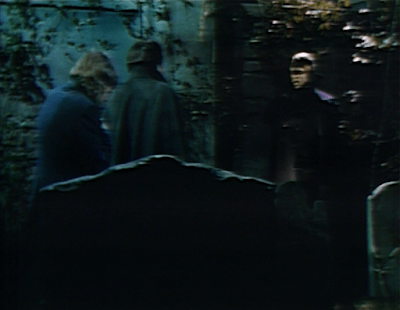
Barnabas calls on his counterpart. He conjures up a spirit, but it is not that of Barnabas Collins (d. 1830.) It is Joshua Collins, father of that Barnabas. The sight prompts Barnabas to gasp “Father!” Joshua denies that Barnabas is any kin to him. Barnabas tries to explain that, while that is true, he is nonetheless Barnabas Collins, son of Joshua, eliciting an angry command “Do not profane those names!” Joshua tells Barnabas to take his vileness back where it came from. Before Barnabas can explain that is what he is trying to do, Joshua vanishes.

Joshua orders Barnabas to go back where he came from. Screenshot by Dark Shadows Before I Die.

Joshua appeared to Quentin and Angelique in #1009. That turn was not particularly effective. The visual composition made it too clear that Louis Edmonds was standing in the same space as David Selby and Lara Parker for the actors to create any sense of the uncanny. And Joshua hung around too long and had too many lines for it to make sense that he couldn’t give any useful information. But this time Joshua is off to the side, lit by his own light, and he disappears after just a few seconds. It is a powerful scene, especially for longtime viewers who remember the relationship between Barnabas and Joshua we saw when the show was set in the 1790s from November 1967 to March 1968.

Will is terrified. The apparition leaves him trembling and speechless. So far Will has cut an arrogant, self-assured figure. He handled his encounter with the vampire with aplomb. Even after Barnabas bit him, his resistance to the command to burn the pages showed that self-assured personality is still partly functional. But the ghost of Joshua has blasted away the last of it.

Barnabas tells Will that he now has only one way back to his own universe, the way he came. There is a room in the east wing of the great house that is bare and vacant in Barnabas’ universe, but that is fully furnished, richly decorated, and brightly lit here. When Quentin’s wife Angelique Stokes Collins was alive, it was her bedroom. Now Quentin has given it to Angelique’s identical twin sister Alexis to occupy while she is his guest. The barrier between the universes is at its thinnest there. Barnabas could occasionally see into Angelique and Alexis’ room from the main continuity, and it was when he was looking through the doors to the room that Quentin has seen that other Collinwood. Barnabas was in the room when it changed, and found himself here. Now he wants to go back to the room, and make the opposite journey.

What neither Barnabas nor Quentin knows is that Angelique has returned from the dead and murdered Alexis. Angelique is now impersonating Alexis. In her life, Angelique had built a little cult of people who expected her to transcend death. The only one she has so far told that she has actually done so is her aunt, Hannah Stokes. Everyone else believes she is Alexis.

Barnabas enters the drawing room of the great house, where Quentin introduces him to “Alexis” and to housekeeper Julia Hoffman, the most devoted member of Angelique’s cult. Hoffman and “Alexis” had been talking about Barnabas before he arrived. Hoffman expressed certainty that Barnabas is a fraud. But after he and Quentin leave to examine the room where the Parallel Time phenomenon can sometimes be seen, she admits that his resemblance to the portrait of Barnabas is too strong to disregard. “Alexis” remembers what Quentin heard while he was watching the people in the room, and asks Hoffman if Barnabas looks like a man under a curse. She does not appear to have expected this question.

Quentin takes Barnabas to the room. Sure enough, the other continuity is visible. Barnabas’ best friend is there, talking to herself about how much she hopes to see him again. She is mad scientist Julia Hoffman, MD, counterpart of Hoffman. Julia is as devoted to Barnabas as Hoffman is to Angelique. Seeing her, we wonder how long Angelique can keep it a secret from her Julia Hoffman that she has returned.

Episode 1011: In death he dictates

Mad scientist Cyrus Longworth has developed a potion that changes his appearance so drastically that even those closest to him cannot recognize him when he is under its influence. In this disguise, he calls himself “John Yaeger” and indulges his sadistic impulses. He has just committed his first murder, killing a man who had learned his secret. The potion he needs to restore his usual looks is in his lab, but he can’t get there without passing the police. So he has ordered Buffie Harrington, a young woman he has been terrorizing, to fetch it for him. He was waiting for Buffie in a cave on the beach near the estate of Collinwood when he saw the signs of a secret passage, and decided to see where it would lead him.

It has led him to the basement of the Old House on the estate, home of writer Will Loomis and his wife, the former Carolyn Collins Stoddard. We have known that this passage was here since #1003, when strange and troubled teen Daniel Collins suggested that his young cousin, Amy Collins, join him in opening it and exploring the basement. Amy refused to go there at night, prompting Daniel to taunt her as a scared-y-cat. We also know, if only because the opening voiceover has been telling us every day for the last five and a half weeks, that vampire Barnabas Collins is chained in a coffin in the basement. Will is holding him captive and forcing him to dictate his autobiography to him.

Barnabas is a visitor from a parallel universe. Longtime viewers are familiar with that universe; Dark Shadows was set there for its first 196 weeks. There is a tunnel between the beach and the basement there as well, and each time it has figured there has been a major development in the story. So when Cyrus, disguised as Yaeger, follows the tunnel and discovers Barnabas’ coffin, we can believe something big is about to happen. He starts to unchain the coffin; if he frees the vampire, that would certainly qualify.

Will and Carolyn are upstairs. She hears the sounds Cyrus is making in the basement and tells Will to go down and check. He takes this as an invitation to another of their drunken quarrels, in which he taunts her for being Barnabas’ victim. Eventually he does go downstairs, where he pistol-whips Cyrus into unconsciousness. He and Carolyn rather improbably manage to carry Cyrus up to the parlor.

When Cyrus comes to, he finds Carolyn aiming the pistol at him. He calls her by name. She does not recognize him, and asks how he knows her. He tells her that he makes it his business to know who all the attractive women are. He asks why Will isn’t there. She doesn’t answer the question. He sees that she is trembling so violently that she can barely keep hold of the pistol; he knocks it out of her hands and runs away. Later, he will meet Buffie in the cave, get the potion from her, and shed his disguise in time to get away with his crimes.

Will rejoins Carolyn in the parlor. He scolds her for letting the intruder escape; she says he was wrong to leave her alone with him. He says he was busy sealing up the panel so that no one else could come into the basement through the tunnel. He says that Barnabas’ coffin must be moved. His idea is to carry it up the stairs and hide it in a secret chamber behind the bookcase in the parlor.

This chamber, too, has its counterpart in the original continuity. We first saw it in December 1966, when crazed handyman Matthew Morgan abducted well-meaning governess Victoria Winters and planned to kill her there. After Barnabas joined the cast of characters in April 1967 and became the master of the Old House, he several times used the chamber as a hiding place. Matthew’s plans for Vicki backfired on him when the ghosts of Collinwood and scared him to death before he could carry out his fell design. None of the occasions when Barnabas used the chamber worked out very well for him. So longtime viewers may suspect that, even if Will and Carolyn can somehow transport Barnabas and his coffin up the stairs and into the hidden chamber, things will not go as they project.

Will and Carolyn let Barnabas out of his coffin. They wear large crosses around their necks, and hold them towards him when he looks at them. They get him up the stairs and into the secret chamber this way.

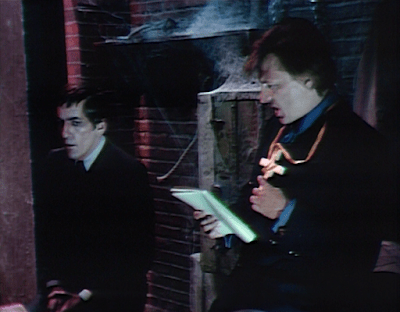
Once there, Will resumes interrogating Barnabas. Barnabas protests that Will has “enough story” and ought to set him free; Will disagrees. One wonders if Barnabas’ line represents Sam Hall’s feelings as one half of the two-man staff currently charged with writing five scripts a week for Dark Shadows.

Story conference. Screenshot by Dark Shadows Before I Die.

Will’s counterpart in the original continuity is Willie Loomis, who was Barnabas’ sorely bedraggled blood thrall. In #326, Barnabas had framed Willie for some of his own crimes, and the police had obligingly shot him several times. Barnabas was worried that Willie was not dying quickly enough. He railed to his associate, mad scientist Julia Hoffman, that Willie continued to “cling to life with leech-like persistence!” When Julia assured him that Willie would probably die without regaining consciousness, Barnabas said that he might just as easily make a full recovery and set about “writing his memoirs!”

The show picked up on that line after it went back in time to the 1790s. We learned in #510 that Ben Stokes, the much-put-upon indentured servant who was Barnabas’ friend before and after he first became a vampire, did indeed write a memoir, and in #756 we learned that Ben’s memoir included the story of Barnabas’ curse. I wonder if Barnabas’ line to Julia about Willie writing his memoirs was the seed, not only of Ben’s memoirs, but of the whole story of Will Loomis.

Barnabas’ cartoonish villainy in #326 was hilarious, but his objections to Will’s behavior today are quite reasonable. Will would have been doing his civic duty had he staked Barnabas, and indeed Barnabas asked Will to let him die when he first found him in his coffin. Keeping him trapped in the coffin endangers the community irresponsibly, and when Will opens it night after night with Barnabas immobilized by the cross and forces him to produce an oral history he can use use as a source of material he is choosing to be as much of a parasite on Barnabas as Barnabas’ curse has forced him to be on his victims.

Moreover, when Will tells Carolyn today that the book he extracts from Barnabas will be “all true” and that “every critic” will hail it as “a classic,” he seems to be delusional. If it is “all true,” the book will be a novelization of the last 160 weeks of Dark Shadows. The show is fun to watch, but that’s largely because the writers know what kind of material the actors and directors can use to create exciting moments. I can’t imagine anyone looking at it as so much text sitting on the page and calling it “a classic.”

Will turns his back on Barnabas and takes a note. Seeing an opportunity, Barnabas grabs the cord by which the cross hangs from Will’s neck, choking him. Will falls to the floor, and Barnabas bares his fangs.

I haven’t read Anne Rice’s 1976 novel Interview with the Vampire. Ms Rice says she wrote a short story about a reporter taking an oral history from a vampire no later than 1969, the year before this storyline premiered. That story has never been published, but biographers of hers report having seen it and they accept the dating. She also says that she decided to turn it into a novel in 1973, not because she had seen Dark Shadows, but because her daughter had died and she thought it would be a way of exploring her grief. So, any similarities are mere coincidence. I bring it up here, because it represents the definitive refutation of Will’s expectation that “every critic” would hail his retelling of Dark Shadows from the time Barnabas debuted as “a classic.” Ms Rice was free to craft a story that would be right for a novel, unconstrained to copy material produced to keep a soap opera spinning, and most of the reviews she received were quite hostile.

Episode 1009: Remember the dead

The Graves of All Those Who Once Lived Here

The name “Barnabas Collins” has been coming up in the oddest circumstances around the estate of Collinwood. The only person of that name known to drunken sourpuss Quentin Collins, the master of the great house, was an ancestor of his who lived a long dull life and died a natural death in 1830. Quentin has decided that it is time to ask Barnabas’ spirit what’s going on. He wants housekeeper Julia Hoffman to join him and his late wife Angelique’s identical twin sister, Alexis Stokes, in a séance.

Hoffman is reluctant to participate, and when the invocation prompts theremin music to start playing in the background she breaks the circle of fingers and runs out of the drawing room. But Hoffman is not the most problematic participant. Alexis is not in fact present. Angelique returned from the dead, murdered her, and took her place. Unknown to Hoffman or to Quentin, it is the undead Angelique who is at the table with them.

“Alexis” tells Quentin that she felt a presence before Hoffman broke the circle, but that it is gone now. Suddenly a figure appears in the corner of the room. He identifies himself as the ghost of Joshua Collins, father of Barnabas. Joshua addresses his remarks to Quentin, ignoring “Alexis.” He says that Quentin knows all he needs to know about his son Barnabas, but that there is another entity at Collinwood, an evil that is at once living and dead. “Alexis” looks shocked and says “Living and dead? How can that be possible?” I suppose we should praise Lara Parker for resisting the temptation to pad her part by visibly squirming and playing up the fact that this describes her character precisely. She is giving the audience credit for the brains needed to make that connection. But if I wanted a show that gave me credit for brains, I wouldn’t watch Dark Shadows every evening, so I’m disappointed. I wish she were tugging on her collar and fidgeting like a Hank Azaria character on The Simpsons.

Joshua can’t be any more specific. This might have been OK had he just flickered into view for a few seconds, uttered his vague warning, and flickered out. We would then be left thinking of the awe-inspiring improbability of even the most fleeting communication between the living and the dead. But as Joshua, Louis Edmonds stands there for several minutes, in the same light as the other actors. They’ve had trouble with one of the microphones lately, occasionally making one actor sound like they are far away from the person standing next to them, but that microphone isn’t used in this scene. Both the audio and the video make it clear Joshua is occupying the same space as Quentin and “Alexis.” The result is an embarrassment for which writer Gordon Russell and director Henry Kaplan must share the blame.

This embarrassment is particularly disappointing under the circumstances. The scene is Edmonds’ first appearance since going off to play his part in the feature House of Dark Shadows after #990, and the first appearance of this Joshua Collins. Edmonds played another version of Joshua from November 1967 to March 1968, when Dark Shadows was set in a different universe. That Joshua figured in a costume drama segment set in the 1790s. He emerged as the central figure in a tragedy in the course of which his son Barnabas became a vampire and he had to decide what to do about him.

This Joshua never dealt with such a curse. The audience knows, if only because the opening voiceover told us, that the vampire Barnabas has crossed over into this universe, into this year 1970, and that he is at present trapped in a chained coffin in the basement of the home where the Joshua we meet today raised that other, luckier Barnabas. We last saw the other Joshua in #623, and longtime viewers will be excited at the idea of seeing Edmonds reprise the character who was perhaps his greatest triumph. To see him in such a debacle lets us down hard.

After Joshua leaves, Quentin and “Alexis” talk for a moment. Then Quentin’s brother Roger enters. Roger is also played by Louis Edmonds, but neither Quentin nor “Alexis” notices that he looks like Joshua. This works well enough, since Edmonds takes a very different posture and tone as Roger than he had as Joshua. Joshua was erect and stentorian, Roger curls to his left as he sits on the couch and purrs about how tedious it is to read about the life of the late Barnabas.

Quentin exits, and Roger talks with “Alexis.” He says that despite her resemblance to her sister, he never for a moment thought she was Angelique. In fact, when he first met the real Alexis he was utterly shocked, certain she was Angelique, and she had to work hard to bring him around. But Angelique doesn’t know about that, and Roger doesn’t want to remember it, so she just looks at him placidly while he goes on and on about how unlike anyone else Angelique was and how he knew her more intimately than anyone else could, even though she was married to Quentin.

I suppose Russell may have been trying to make a point by juxtaposing Joshua’s long pointless speech in which he keeps referring to Quentin’s responsibilities as the master of Collinwood with Roger’s long pointless speech in which he keeps referring to his mystical connection with his brother’s late wife. We saw in the 1790s segment that the Joshua of the other continuity was the victim of his own virtues. A forceful, dynamic man devoted to his family and its honor, he became a tyrant in pursuit of his worthy goals, and saw everyone he loved destroyed in part because of his haughtiness. As generation followed generation, Joshua’s misguided strength and brittle courage would yield to ever weaker, ever-softer descendants. Perhaps in the contrast between this Joshua’s attempt to help his successor use the authority he once held when he cannot impart any useful information and Roger’s fatuous pretense to have known Angelique uniquely well when he cannot recognize that he is talking to her we can see the same decline in this iteration of the Collins family.

The Legal Eagle

Meanwhile, mad scientist Cyrus Longworth has a problem of his own. Cyrus has developed a potion which, when he drinks it, transforms his appearance so drastically that even those closest to him cannot recognize him. When thus disguised, he calls himself “John Yaeger,” spends a lot of money, and beats people up. This makes him very happy, but now chemist Horace Gladstone, his connection for one of the potion’s vital ingredients, has learned his secret. Gladstone will not supply him with more of the ingredient or keep his mouth shut about Cyrus’ crimes unless he gets $10,000 in cash.

Cyrus’ lawyer, Larry Chase, comes to his laboratory. On Cyrus’ instructions, Larry has drawn up a will naming “Yaeger” as the sole beneficiary of Cyrus’ estate. Larry has met “Yaeger” and been appalled by him. He urges Cyrus to reconsider. Cyrus signs the papers and invites Larry to a late supper. Larry declines, saying that Horace Gladstone called him earlier and wants to meet him outside the Eagle tavern at 10 PM.

Larry was in the drawing room at Collinwood going over some papers with Quentin when he got Gladstone’s call. Cyrus’ newly drafted will fell out of Larry’s briefcase, and Quentin read through it while Larry was looking for another document. Quentin asked some questions about the will. Larry responded to the first by saying that he couldn’t talk about it, but thereafter blabbed away, revealing everything Quentin could want to know. With that level of regard for a client’s confidential communications, we aren’t surprised when Larry tells Cyrus who he is going to meet at what time in what place.

After Larry goes, Cyrus takes the potion, that is, puts on his disguise. He goes to the alley next to the Eagle, in which the sign for the Greenfield Inn hangs. He corners Gladstone there. He beats Gladstone to the pavement with his heavy cane. Gladstone begs for mercy, and Cyrus sneers at him. He releases the bayonet from inside the cane, stabbing Gladstone with it. The first time Cyrus took the potion, he had amnesia after he resumed his normal appearance, and we could believe that he was less than fully responsible for what he did while under its influence. But he has had his full memories on each subsequent occasion, and has shown pleasure when told of the harm “Yaeger” has done and the fear he inspires. By this point, we can classify Cyrus’ killing of Gladstone as nothing other than premeditated murder.

Cyrus doesn’t really surprise us by this act. It is Larry who does something we would not have expected. While Gladstone is in the alley, Larry is already in front of the tavern. We see enough of the set that we cannot believe he is more than 30 or 40 feet away from Gladstone, just around the corner. Gladstone cries out when “Yaeger” attacks him. We cut to Larry, and see him react to that cry and start towards the alley. “Yaeger” stands over Gladstone and pontificates for a minute or two before stabbing him. Even after that, “Yaeger” still has time to get most of the way out of the alley before Larry finally arrives. It took Joshua Collins less time to get from the abode of the dead to the drawing room at Collinwood than it takes Larry to walk the few steps from the sidewalk to the alley. Maybe he had to stop somewhere along the way to make some more announcements about a client’s business.

Larry hears a cry for help. Screenshot by Dark Shadows Before I Die.

Episode 1008: One obvious person

From the time he joined the cast of characters in April 1967, vampire Barnabas Collins has been the most famous thing about Dark Shadows. We haven’t seen him in over a month. He passed through a cosmic rift in #980, leaving his native universe behind and arriving in another “time-band” populated largely by counterparts of people he knew. In the original continuity, Barnabas was freed from his coffin when dangerously unstable ruffian Willie Loomis unchained it, believing he would extract from it a treasure in jewels that would make him rich. Here, Barnabas is trapped in his coffin when Willie’s counterpart, author William H. Loomis, chains it, believing he will extract a story from Barnabas that will make him rich.

We haven’t seen any of Will Loomis’ oral history sessions with Barnabas, since John Karlen and Jonathan Frid have both been in Tarrytown, New York. Along with many other key members of the cast, they have been filming their parts in the feature House of Dark Shadows. That production is nearing a wrap, and several other cast members have already come back. Today’s story is all about Barnabas’ impending return.

When Barnabas found himself in “Parallel Time,” the first person he met was Will’s wife, the counterpart of Barnabas’ distant cousin Carolyn Collins Stoddard. He told Carolyn that he was a descendant of the eighteenth century Barnabas Collins, of whom a portrait hangs in the foyer of the great house of Collinwood. In his own universe, that portrait does hang there, and it has been Barnabas’ letter of introduction to the Collinses more than once. But Carolyn told him there was no such portrait there or, so far as she knows, anywhere else. So he bit her and made her his blood thrall.

Indeed, the other day we saw the spot on the wall where Barnabas’ portrait hangs in the main continuity, and it was not there. Instead, there was a metallic decoration reminiscent of a coat of arms. That decoration hung there before Barnabas’ portrait first appeared in #204. So few of the people watching at this point in 1970 had been in the audience in early 1967, and so few of those would have made note of what was hanging on the walls, that I can’t imagine one viewer in ten thousand would have caught the reference during the first broadcast. None of the writers currently with the show was on staff then, nor was line producer Peter Miner. It’s one of those moments when I suspect director Lela Swift and art director Sy Tomashoff were decorating the set for their own amusement.

Today, a portrait of Barnabas has taken the place of the coat of arms. Children Daniel and Amy Collins found it in the attic of Will and Carolyn’s house, and for some reason housekeeper Julia Hoffman and butler Mr Trask decided to hang it up by the front door. It is a copy of the one we have seen over the last three years. It depicts Barnabas’ counterpart in this universe, a man who lived a quiet life and died a natural death in 1830.

Daniel and the portrait of Barnabas Collins (d. 1830.) Screenshot by Dark Shadows Before I Die.

The master of Collinwood, drunken sourpuss Quentin Collins, is shocked to see the portrait, and orders it to be removed immediately. Daniel’s counterpart, strange and troubled boy David Collins, had been the first to speak Barnabas’ name when he called Willie’s attention to the portrait in #205. Shortly after, Willie heard a heartbeat coming from the portrait, which led him to make his fateful trip to open the coffin. In this continuity, it is Daniel who hears the heartbeat, and he will today try to find and open the coffin.

Quentin has caught two glimpses of the other universe in the room in the east wing that was his late wife Angelique’s bedroom. Unknown to Quentin, Angelique has returned from the dead and murdered her identical twin sister Alexis. Quentin thinks that it is Alexis who is his guest in the great house, staying in her sister’s old room. When he tells her today what he saw, “Alexis” thinks he is losing his mind. But she then sees the phenomenon herself. She sees Hoffman’s counterpart calling for Barnabas, as Quentin had seen her talking about Barnabas’ “terrible curse.” “Alexis” and Quentin decide that they and Hoffman should have a séance to contact the spirit of the Barnabas Collins who died in their universe in 1830, the only Barnabas Collins they know of.

In the main continuity, séances are a frequent occurrence; we have seen fourteen of them there, and heard a detailed account of a fifteenth. In the early days, there was always one participant who tried to break the circle, only to be sternly reproved by the leader. The characters stopped doing that as they got to be familiar with the procedure, but séances are rarer in this universe. As things start to get interesting, Hoffman can’t take it anymore. She breaks the circle and runs out. “Alexis” says that the presence she felt is gone. But then a ghost materializes in the corner of the room.

Episode 1007: Accumulating guilts

Chemist Horace Gladstone has been selling a strange and powerful synthesis of his own invention to Cyrus Longworth, an independent medical researcher. Cyrus refuses to tell Gladstone what he is using the synthesis for. Gladstone has now figured it out for himself. Cyrus has concocted a potion which he drinks to change his appearance, disguising him so effectively that even the people who know him best do not recognize him. In that disguise, Cyrus calls himself “John Yaeger,” spends a lot of money, and indulges his sadistic impulses.

Gladstone comes to Cyrus’ lab and tells him what he knows. Cyrus tries to deny that he is Yaeger, and Gladstone lists the evidence he has collected proving that he is. Gladstone tells Cyrus that he doesn’t believe he can do without the thrills he gets from his activities as Yaeger. The story has been crafted as an account of addiction, so returning viewers are sure Gladstone is right. He says he will go on serving as Cyrus’ connection for the drug he craves, but the price has gone up. He demands $10,000.

Cyrus first learned Gladstone’s name from his late friend Angelique Stokes Collins. Angelique was a woman of vast learning in a variety of fields, much like the title character in Edgar Allan Poe’s story “Ligeia.” Also like Ligeia, Angelique has returned from the dead. She is now back in the great house of Collinwood, impersonating the identical twin sister whom she murdered on the night of her resurrection, and occupying her old room as the guest of her widower, drunken sourpuss Quentin Collins.

Cyrus calls Gladstone a blackmailer. In reply, Gladstone makes a cryptic remark: “Why do you think my number was in Angelique Collins’ phone book? She’s led many lives. Each person only gets one. Good night.” We have indeed been wondering how Angelique came to know Gladstone, and now we wonder if he is aware of just how literally true it is that “She’s led many lives.” It doesn’t make any sense to follow “She’s led many lives” with “Each person only gets one,” but actor John Harkins was so precise in his delivery that I’m sure that was the scripted line. If there was a slip, it came from Sam Hall’s typewriter, not from Harkins’ tongue.

If it isn’t a slip, I think we would have to go out on a limb to explain what Gladstone could mean. Angelique built up a cult around herself, including several people who were firmly convinced that she was going to rise from the dead. When her sister Alexis came to Collinwood, housekeeper Julia Hoffman, sleazy musician Bruno Hess, and Angelique and Quentin’s son Daniel were certain that the prophecy had been fulfilled and they were seeing Angelique redivivus. This was also the first thought that came to Cyrus, to Quentin’s brother Roger, and to Angelique’s Aunt Hannah, though they were more easily persuaded that Alexis was a separate person. The cultists are impressive enough in their certainty that even people outside their ranks were sure Alexis was Angelique returned from the grave. Daniel’s cousin and playmate Amy Collins was horrified to see her for that reason, and Quentin’s second wife, the former Maggie Evans, fled the house in part because she could not shake her belief that Alexis was Angelique.

If Gladstone is familiar with Angelique’s cult and has been involved with it, he might be saying that each person gets to participate in only one of Angelique’s lives. We’ve already seen that is not the case, but that doesn’t mean he doesn’t think it is. Angelique may at some point have taught her followers a doctrine like that. While Hoffman, Bruno, and Daniel expected Angelique to come back and rejoin them, Cyrus, Roger, and Hannah were unsure they would see her again, even though they were certain that she was not simply dead. Indeed, Angelique is still telling her most of her devotees that she is Alexis. The only one to whom she has fully revealed herself is Hannah. Perhaps she had a plan to transcend death, but did not know just how it would work. Or perhaps she has decided the rest are not yet ready to be initiated into the esoteric truth of her return.

Sam Hall was a serious Lutheran, so much so that he insisted Shirley Grossman convert from Judaism before she married him and became Grayson Hall. Christian studies in twentieth century academic institutions were largely taken up with speculation about differences of opinion in the church before the codification of the New Testament and the formulation of the creeds. This sort of thing is still prominent in divinity schools today, and is often heard from pulpits in mainline Protestant denominations. Hall must have been familiar with it, so he probably gave it some thought when he spent Easter season 1970 writing scripts about a figure whose followers sort of expected her to rise from the dead and who surprised them by the way in which she actually did so. I doubt he was making any particular point about the various schools of thought that seminary professors postulate in the primitive church, but when he presents Angelique’s cult as divided into several strains of opinion from the start he is developing an idea that he did not have to invent himself.

We cut from the scene between Cyrus and Gladstone to the basement of Collinwood. Angelique leads Quentin to a little chamber hidden behind an alcove. A human skeleton stands in the chamber. You may wonder how a skeleton can stand, but Quentin doesn’t. He is too busy being surprised that he didn’t realize this chamber was in his basement.

The skeleton is that of Dameon Edwards, a friend of Angelique’s who went missing about a year before. Dameon’s ghost has been haunting the place for a couple of weeks. Angelique tells Quentin that Hannah found the skeleton and exorcised the ghost. Yesterday, we saw Angelique exorcise the ghost. Returning viewers know that she is giving credit to Hannah because she is masquerading as Alexis, who did not share her sister’s interest in the occult or her aunt’s. Quentin thinks that Bruno probably killed Dameon. Indeed, the ghost confirmed this yesterday. Quentin very much wants to get rid of Bruno, so you might think he would be interested in bringing a murder charge against him. But he decides that would be too much trouble, and it hurts his feelings when “Alexis” snaps at him that he shouldn’t be wasting his time reporting Dameon’s murder when he isn’t doing anything to investigate Angelique’s. So he calls Cyrus, and the two of them bury the bones on the grounds of the estate.

Meanwhile, two long-absent characters have returned from trips out of town. Quentin sent Hoffman to visit friends of hers in Boston because she kept antagonizing Maggie. Quentin’s sister Elizabeth Collins Stoddard also went away for a long stay in New York, where she visited Maggie. In off-screen reality, Grayson Hall and Joan Bennett were both in Tarrytown, New York with several other cast members, working on the feature film House of Dark Shadows. Liz complains that Hoffman didn’t meet her at the train station with a car, and Hoffman explains that she just got back herself.

Hoffman says she missed Collinwood terribly while she was in Boston; Liz says she can’t understand that. If she were in Quentin’s place, she would sell the house and move to the city. That will interest longtime viewers. For its first 196 weeks, Dark Shadows was set in a parallel universe, where Liz’ counterpart owned Collinwood. When the show started, she was a recluse who hadn’t left the house for eighteen years. Her brother Roger often urged her to sell the place so that they could live someplace less gloomy, but even after she stopped being a recluse Liz wouldn’t hear of that. She was a symbol of the family’s commitment to the house. We have already seen that this Liz is the opposite of her counterpart in other ways, and now we wonder how far they will take that mirror image motif.

Angelique is in the foyer, talking on the telephone to Hannah. Villains on Dark Shadows have remarkably little sense of OpSec, and this is a case in point. Quentin, Liz, and Hoffman are a few feet away from her in the drawing room, and each of them knows that Alexis and Hannah couldn’t stand each other. All Angelique has to do is call Hannah by name and she will raise their suspicions. Yet not only does she use Hannah’s name several times, she uses one incriminating expression after another about how no one will suspect what they are up to. If any of them listens in, or of anyone else in the house happens by on their way to the front door, Angelique will have tipped her hand.

It is Hoffman who eavesdrops on the call. After Angelique catches her, they have an awkward exchange and Hoffman goes upstairs. Angelique then stands at the door to the drawing room and eavesdrops on a conversation between Liz and Quentin. Liz wants Quentin to go to New York and ask Maggie to come home, he throws a tantrum and says that Maggie is too childish for him to do such a thing.

Hoffman is in Angelique’s old room, talking to the portrait of her that hangs there. The members of Angelique’s cult make a practice of coming to the room and carrying on conversations with the portrait; when Alexis was staying in the room, she sometimes walked in on them while they were confiding their thoughts to it. Angelique eavesdrops on the last part of Hoffman’s account that when she was in Boston, she felt a mystic assurance that when she returned to Collinwood she would find Angelique come back to life. When Hoffman says that everything seems to be the same as it was when she left, she is close to tears.

The resurrected Angelique eavesdrops on Hoffman’s conversation with the dead Angelique. Screenshot by Dark Shadows Before I Die.

Angelique takes a step forward, and Hoffman realizes she is not alone with the portrait. She apologizes to “Alexis,” and Angelique says she needs a friend she can trust. Hoffman claims to be such a friend. “Alexis” then launches into her reasons for believing that Angelique was murdered. After the first couple of sentences, returning viewers know what she is going to say, so we dissolve to Quentin and Cyrus in the drawing room.

Quentin and Cyrus have just buried the skeleton, prompting Quentin to feel sorry for himself. He then tries to explain to Cyrus something extremely weird he saw the other evening. He went to Angelique’s old room to see Alexis. He opened the door, and saw a space that lacked the room’s furniture, lights, and decor. He saw two children whom he took to be Daniel and Amy, and they said something about Barnabas Collins. The only person of that name of whom Quentin or Cyrus is aware died in 1830, but the children were talking about someone they knew. An invisible barrier kept Quentin from entering the room, and he could not attract the children’s attention. Regular viewers know that Quentin was catching a glimpse of the other continuity, and that the children were not Daniel and Amy Collins, but their counterparts David Collins and Amy Jennings. Cyrus hasn’t been watching the show, so all he can do is suggest Quentin take a vacation.

They’ve been experimenting with videotape editing, and they make a jump cut from the drawing room scene with Quentin and Cyrus to Quentin walking up to the doors of Angelique’s room. The effect is startling, I suspect intentionally so. Quentin opens the doors, and again sees the other universe.

This time Quentin sees the counterparts of Liz and Hoffman. As David and Amy had been, they are talking about Barnabas, who was last seen in this room. Hoffman, whom Liz addresses as Julia, says that they must keep the room open so that Barnabas will have a chance to return to them. She says she wants to stay there, because it makes her feel close to Barnabas. Liz excuses herself, and Julia calls out to Barnabas. As Hoffman had grown emotional talking to the Angelique whom she believed to be absent, Julia grows emotional when she talks to the missing Barnabas. She looks at the hallway, seeing not Quentin but the dark, empty space that is there in her universe. She asks if Barnabas is there, watching her. Grayson Hall plays these two scenes so similarly that we can have no doubt that whatever the one Julia Hoffman feels for Barnabas, the other feels for Angelique.

Quentin calls out to Hoffman’s counterpart, as he had called to Daniel and Amy’s counterparts. As the children had been unaware of his presence, so this other Julia Hoffman is unaware of him. And as Daniel and Amy had come to the hallway and asked why he was shouting for them, Hoffman comes to the hallway and asks why he is shouting for her.