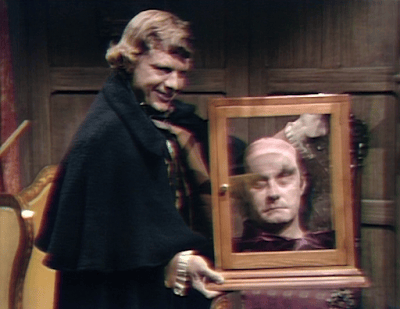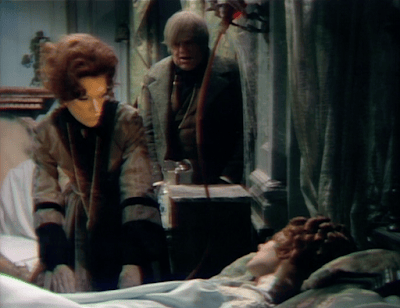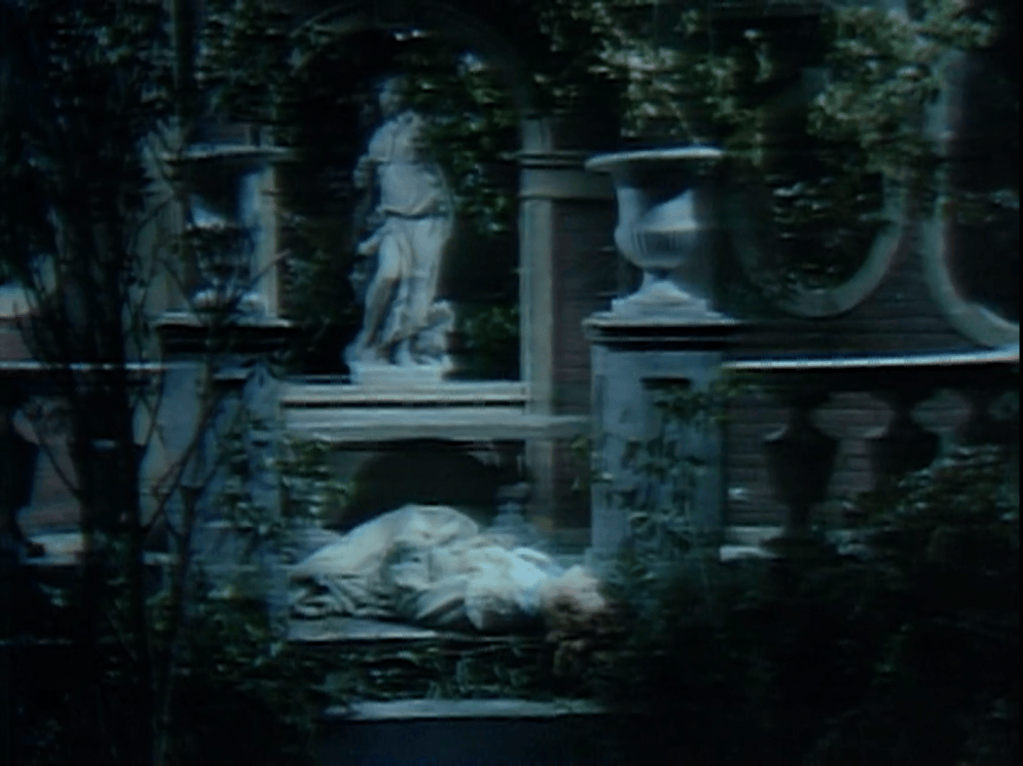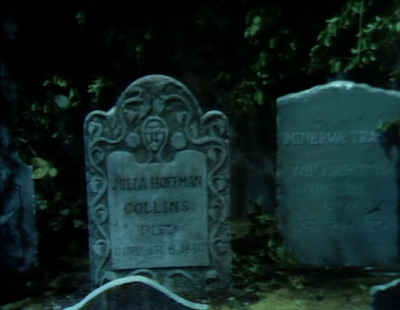
Episode 1130: A better place to imagine than to live in

Dark Shadows featured several long costume drama segments depicting stories of time travel. From November 1967 to March 1968, well-meaning governess Victoria Winters bumbled around in the years 1795 and 1796, convincing the people of Collinsport that they should hang her. Meanwhile, we learned how old world gentleman Barnabas Collins first became a vampire.

From March to November 1969, Barnabas was the one making poor decisions in an era not his own when he found himself in the year 1897. Those eight months were by most measures the show’s most successful period. From March to July 1970, the show traveled sideways in time to an alternate universe where Barnabas and his friend, mad scientist Julia Hoffman, meddled in the problems of the family who lived on that version of the estate of Collinwood. The show insisted on calling that alternate universe “Parallel Time.”

Now, Julia and Barnabas have made their way to the year 1840. They know that something or other happened in that year that would lead to the destruction of the great house of Collinwood and its residents in 1970. They have no very clear idea what that fateful event was, and it is becoming increasingly clear that the writers don’t have any good ideas about it either.

While Barnabas, Julia, and the writers cast about in the darkness, we keep meeting characters who remind us of earlier phases of the show. Early on, we met Ben Stokes and Daniel Collins, two people left over from the 1790s segment. Ben helped Julia and Barnabas establish themselves with the current crop of Collinses by corroborating their story that they were cousins from England (or Philadelphia, whichever.) Daniel, who was a boy in the 1790s and is now the master of Collinwood, greeted them warmly and invited Barnabas to stay in the Old House at Collinwood as long as he liked. The presence of Daniel and Ben not only helped graft Barnabas and Julia onto the new stories, but also told longtime viewers that the 1840 segment will be a sequel to the 1790s segment.

We also see mergers of characters from the 1897 segment with those from Parallel Time. For example, charming rogue Quentin Collins became a huge breakout star in 1897; in Parallel Time, Quentin’s counterpart was the grumpy and irascible master of Collinwood. In 1840, Quentin is Daniel’s older son and sole heir, in charge of the house due to his father’s many problems. He is again grumpy and irascible, again in a loveless marriage. But like the 1897 Quentin, he is fascinated by the occult and creates trouble by his reckless involvement with it. Quentin’s best friend and fellow occultist is his cousin Desmond Collins, played by John Karlen. Desmond shares the irresponsibility of Karlen’s 1897 character, inveterate prankster Carl Collins. But Desmond has none of the extreme childlike quality that it made seem Carl had a cognitive impairment of some sort. He has the manner and bearing of Karlen’s Parallel Time character, drunken novelist Will Loomis.

Will was married to Carolyn Collins Stoddard, played by Nancy Barrett. In 1897, Miss Barrett played a villain named Charity Trask who fell afoul of evil sorcerer Count Petofi. Petofi erased Charity’s personality and replaced it with that of Cockney showgirl/ mentalist Pansy Faye. Carl had brought Pansy to Collinwood as his fiancée. Pansy was killed before she ever met Charity, who never had any use for Carl. Carl himself was killed before Petofi took Charity’s body away from her and gave it to Pansy. Miss Barrett’s acting style is to throw herself completely into each of her roles, so we quickly accepted her as Pansy. But when we heard Miss Barrett’s Pansy pine for her poor lost Carl, we were reminded that Petofi had murdered Charity and reanimated her form with Pansy’s mind.

In 1840, Miss Barrett is Leticia Faye, who is barely distinguishable from Pansy. She was brought to Collinwood by the evil Gerard Stiles to play some part in his never-explained scheme to cheat the Collilnses out of their money. When we first saw her, Leticia confronted Gerard over her suspicions that if he ever did get his hands on any of the Collins money, she wouldn’t see any of it. Then Gerard humiliated her by marrying Quentin’s widow Samantha, which promptly redounded to his own humiliation when Quentin turned up alive and well. Leticia confronted him again, brandishing her own pain and mocking his in what sounded very much like the sorts of things Carolyn used to say to Will. Now, Leticia has set her cap for Desmond, but also become involved in his occult mischief.

Most of the action in the 1790s was driven by wicked witch Angelique. A maniacal villain then, Angelique appeared in 1897 and became a multilayered personality. Angelique rejoined the cast of characters at the end of yesterday’s episode. We saw her enter the hidden chamber where Barnabas’ chained coffin was kept from the 1790s on and discover that it was no longer there.

Angelique’s counterpart in Parallel Time had a sidekick, a housekeeper modeled on Mrs Danvers from Rebecca who was herself Julia’s Doppelgänger. We didn’t get to see a great deal of that relationship, since Grayson Hall was off for principal photography for the feature film House of Dark Shadows during most of the first half of the Parallel Time segment. Today, we see that we will be getting another look at how Angelique handles a sidekick. Angelique Model 1840 has a servant, a man named Laszlo Ferrari.

Laszlo’s appearance evokes the 1897 segment. He is played by Michael Stroka, wearing the astrakhan hat that he wore when we first saw him as Aristide, servant of Count Petofi. His attitude towards Angelique is very much like Aristide’s towards Petofi, asking a question in a vaguely belligerent tone, occasionally making a show of defiance, and quickly collapsing into cringing obedience. So he asks Angelique why they keep coming to the tomb every year, and why she isn’t as happy as she usually is when she emerges from the secret room. She snaps at him in response, saying that she would have expected him to stop asking her questions by now, since she has never yet given him any answers. She orders him to go to the great house at Collinwood and find out if a man named Barnabas Collins has been around recently. Reluctant to go, he asks who Barnabas is. She says he is the only man she ever loved. He says “Other than me, of course!” and she agrees in a sarcastic tone. It’s all in very joking, but he scurries away to obey her. All that is missing is him addressing her as “Excellency!” and her remarking on his good looks, and we’d be right back with Aristide and Petofi.

At Collinwood, Laszlo meets Quentin’s younger brother, Gabriel Collins. Gabriel is amused by Laszlo’s attempt to persuade him that he can see into the future, and tells him that the pressing need is for someone who can see into the present. There is a headless body wandering the estate killing people, and if Laszlo can tell them how to put a stop to that he’ll be onto something. Barnabas shows up and scowls at Laszlo, who leaves.
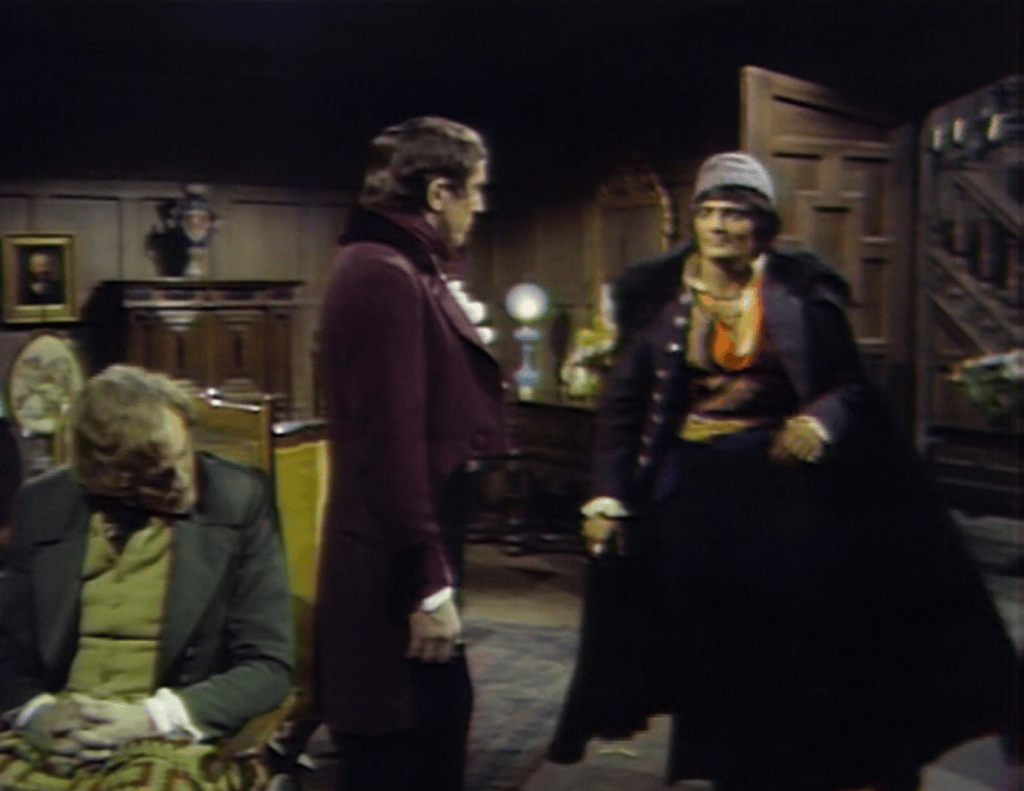
Barnabas doesn’t like the looks of Laszlo. Screenshot by Dark Shadows Before I Die.

Meanwhile, we learn that Leticia knows a great deal about the headless body. It used to be attached to a severed head that Desmond brought back from Macau as a gift for Quentin. That separates Desmond from Carl, who brought Pansy back from Atlantic City to be his own bride. Leticia is now keeping the head in her own room, and is acting under its influence.

The head and body are those of warlock Judah Zachery, executed in 1692. The head has turned up occasionally in the years since, each time figuring in a series of brutal murders. Apparently the situation will get even worse if the head can be reattached to the body. This also harks back to Petofi, whose hand had been cut from his wrist in the 1790s and had carried on its own career of malignity in the years before Petofi stuck it back onto the end of his arm in 1897. Since Angelique joined forces with Barnabas and Julia to fight Petofi then, showing a new and extremely engaging side of her character, longtime viewers may hope that she and Laszlo will be part of an alliance with our protagonists against Judah Zachery in this period.

Laszlo’s name evokes the movie Casablanca, in which the most morally upright character is French Résistance leader Victor Laszlo while the most morally debased character is crime boss Signor Ferrari. We can imagine Jerry Lacy breaking his character as overbearing undertaker Lamar Trask, putting on his celebrated Humphrey Bogart imitation, and saying of Angelique that “Of all the temporal anomalies in all the multiverse, she had to walk into mine.”

The Petofi/ Aristide relationship was based on one memorialized in another Humphrey Bogart film, Gutman and Wilmer in The Maltese Falcon. As Sydney Greenstreet played Ferrari in Casablanca, so he played Gutman in The Maltese Falcon. It may have been a bit on-the-nose to cast portly gentleman Thayer David as an analogue of Greenstreet, a criticism which cannot be leveled at the choice of the svelte and dazzling Lara Parker. In another departure from the Petofi/ Aristide model, Laszlo is a member of the Romani or Sinti people, the ethnicities often slurred as “Gypsies.” Petofi was vulnerable to certain Romani, and was deathly afraid of all of them.

Aristide was a lot of fun. Stroka came back in 1970 as two characters very like Aristide, first in the original continuity as a hitman known only as Bruno, then in Parallel Time as failed composer Bruno Hess, a member of a little cult that had grown up around that universe’s version of Angelique. The two Brunos were so similar to each other and to Aristide that regular viewers might be disappointed to see Stroka working the old stand one more time.

The essence of Aristide and the Brunos was an insecurity that rode very close to the surface of the character. Each man sneers as he asserts himself against his victims or puffs himself up as he attempts to assert himself against his superiors, then dissolves immediately into frantic backpedaling when he encounters opposition. Stroka made as much as anyone could of those parts, and I had hoped to see him in a role where the insecurity lies deeper in the character’s personality. I wanted to see him as an authority figure whose pompous self-satisfaction can withstand a fair amount of battering and whose eventual defeats prompt a more complex response from him than Aristide/ Bruno’s hectic flailing.

The two characters we have seen who meet that description were Joshua Collins in the 1790s segment and Edward Collins in the 1897 segment, both played brilliantly by Louis Edmonds. In 1840, Edmonds plays Daniel, who is the legal owner of the Collins fortune but whose mental and physical infirmities keep him from exercising much authority. In #1074 and #1076, an ancestor called Abner Collins was associated with the events of 1840; I wish that Barnabas and Julia had found that Abner, rather than Quentin, was Daniel’s eldest son and was in charge of Collinwood and the businesses. Quentin would then be free to be the insouciant wastrel who was such a hit in 1897, rather than a retread of the foul-tempered sourpuss who was a consistent downer in Parallel Time.

As Abner, Stroka could have taken advantage of his striking facial resemblance to William F. Buckley, Junior, making clever-sounding but specious arguments in defense of the family’s most objectionable business practices, littering his speech with seldom-heard polysyllabic words and, when he makes what he believes to be a persuasive argument, leaning way back in his chair and fluttering his eyelids. Buckley was a prominent figure nationally and especially in NYC in 1970. He had been hosting a nationally syndicated television show ever since his unsuccessful bid for mayor of New York in 1965, and in 1970 his brother James would defeat the Democratic and Republican nominees to be elected to the US Senate from New York as the candidate of the Buckley family’s Conservative Party. A spoof of him would therefore be something that grownups in the audience would likely find amusing, and that the New York based makers of the show would surely have enjoyed creating.

In the early days of the show, the most prominent supernatural presences were the ghosts of The Widows, women who flung themselves to their deaths after their husbands were lost at sea due to the inhumane practices of the Collins whaling fleet. The story of The Widows came forward as the first explanation of the origin of the Collins family curse. The whaling industry in New England was approaching its zenith in 1840; it was in the following decades that it finally surpassed cod fishing in the region’s economy. It would close the loop on that early story to present Abner as the man who ensured that the Collinses would be enormously rich for a long time to come by switching the focus of the fleet from a mature market to a rapidly growing one, but who also ensured that they would be the object of undying wrath among many in Collinsport by switching from a decentralized business in which many men had a realistic chance of becoming independent operators to a capital-intensive one in which a handful of magnates control everyone else’s destiny. Abner could become callous to conditions on the whaling ships, because he would see the men as easily replaceable parts of a single machine, not as professionals who had to use their judgment to track down the fish and who might at any time strike out on their own as his colleagues or competitors.

The switch from cod fishing to whaling and its consequences for the life of the village would hark back not only to The Widows, but also to the business stories incorporated in the early storyline of “The Revenge of Burke Devlin.” The theme of those stories was that the Collinses had trapped the people of Collinsport in a situation where the only way for an ambitious young man to improve his lot in life was to leave town. If the 1840 story went on long enough, they might have been able to explore that theme in some depth. Not only would that have appealed to the taste for social and political relevance that was so much in the air in the early 1970s, but by depicting Collinsport as a place full of people who are involved in the story it would also relieve the claustrophobia that stems from the all-Collins episodes that come up so often in the later phases of the show.
Episode 1129: Headless body on boundless estate

Vampire Barnabas Collins and mad scientist Julia Hoffman have traveled back in time to 1840. They know that events took place in that year that led to a disaster that destroyed the great house of Collinwood and everyone in it in 1970 and that left the whole estate of Collinwood a deadly, hag-ridden waste in 1995. They hope to find a way to change history.

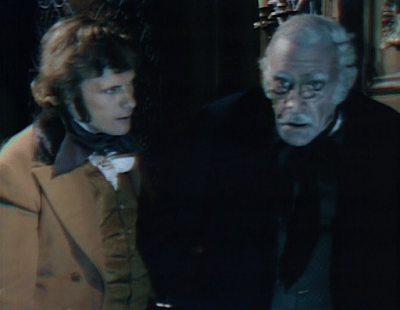
Today, they discover a woman lying on the ground in the woods. She is Hortense, governess at the great house, and she is horribly injured. At first they think Hortense is dead, but Julia feels her wrist and says, using a bit of Collinsport English we haven’t heard since #672, that she can feel a “pulsebeat.” Hortense manages to speak the words “headless creature” before she dies.

Julia and Barnabas tell Quentin Collins, heir to Collinwood and its acting master, what happened. His reaction makes it clear that he knows what Hortense meant by “headless body.” Later, Barnabas gets Quentin to tell him the truth. His cousin Desmond found a severed head in a shop in Macau and brought it back as a gift for him. The severed head turned out to be that of warlock Judah Zachery, who terrorized the town of Bedford until he was executed in 1692. The head has cropped up again from time to time, most recently in 1803, when it was associated with four brutal slayings known as “The Bedford Atrocities.” Under the head’s influence, Desmond found its body. Now the body is roaming about. The head has also gone missing. Until Quentin heard that the body is still headless, he assumed that Judah’s parts had reconnected themselves. He still thinks they must be hanging around together someplace.

Barnabas and Julia decide that the head and body must be associated with the disaster they want to prevent. They make a note of it. But they have more definite knowledge about a woman called Daphne Harridge. They saw Daphne’s ghost in 1995 and 1970, and got to know her as a living being when she was briefly resurrected in 1970. She was governess at Collinwood in 1840, was killed along with her charges, teens Tad Collins and Carrie Stokes, in 1841, and was a part of the disaster in 1970. When they first arrived in 1840, they were puzzled to find that Hortense was the governess and that no one had heard of Daphne. But Daphne is in Collinsport now, and the governess’ position is vacant. Julia and Barnabas make it their top priority to keep her from becoming governess.

Quentin believes Barnabas and Julia to be his cousins from England (or Philadelphia, it doesn’t seem to make a difference.) He has trusted them with the secret of what he and Desmond have done involving the head. So you might think they would address this problem by trying to persuade him not to hire Daphne. But that doesn’t seem to occur to them. Instead Julia goes to Daphne’s room and tells her she is about to be offered the post of governess at Collinwood and that if she accepts it she will be in terrible danger. In response, Daphne asks Julia who she is and why she is threatening her. Julia tries to explain that she is a friend bringing a warning, but that doesn’t cut any ice. Regular viewers know that Julia is not only a prodigiously skilled and creative liar, but that she also has a magical power of hypnosis that enables her to rewrite people’s memories. With those qualifications, you’d think she could do better than that. When Quentin drops by later and says that Desmond has recommended her to be the next governess, Daphne is startled, but quickly accepts.

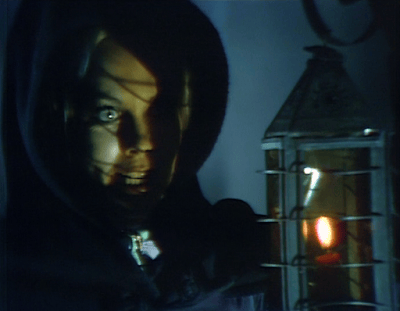
The episode ends with a hooded figure walking through the old cemetery north of town. We see the figure from behind as it enters the mausoleum where Barnabas’ family is entombed. The figure opens the secret panel. The camera stays low and does not allow us to see the face of the figure entering the hidden chamber where Barnabas was sealed in a chained coffin when he first became a vampire in the 1790s. When the figure is in position to see that the coffin is not there, the camera pans up and we see that it is wicked witch Angelique. The composition shows that this is supposed to be a big shock. Indeed it would be, had Lara Parker not delivered the opening voiceover, giving away that she is going to be in the episode.

Oh look, it’s Angelique. Screenshot by Dark Shadows Before I Die.

They have ruined many surprises this way. This one is a particular shame. Regular viewers know that Angelique will probably turn up sooner or later, but this is the first time we have seen the character since #978.* Her return is a big deal, and we do have a right to expect the show to be more careful about getting the biggest bang they can out of it.

*Parker played an alternate universe counterpart of Angelique from April to July 1970. She’s been away for 72 episodes.

Episode 1124: Where the bodies are buried

Desmond Collins has fallen under the influence of an evil spirit emanating from a severed head he bought in Macau, and is now trying to find the body that used to be attached to the head. Lamar Trask is an evil spirit unto himself, and is trying to find the body of his late father, fanatical witchfinder the Rev’d Mr Trask.

It is not clear what the severed head is hoping will come of a reunion with its body, though longtime viewers will remember the last time a body part was reconnected to its original possessor. Evil sorcerer Count Petofi stuck his hand back on the end of his arm in #814. As separate entities, Petofi and the hand both wielded considerable magical powers. Reunited, they seemed to be unstoppable.

What Lamar wants is much clearer. He believes that his father was murdered in the 1790s, 45 years ago. He hopes that the killer might still be alive and that he will be able to take revenge.

As it happens, Lamar is right about what happened to his father. Vampire Barnabas Collins walled Trask up in his basement and left him to die there. Barnabas is back on the estate of Collinwood, having been sealed in his coffin in 1796, freed in 1967, and dislocated in time in 1970. It might be just for Lamar to expose Barnabas and destroy him, but it would also ruin the show. Besides, Lamar and his father are both hilariously obnoxious, so it wouldn’t occur to anyone to root for them.

Lamar persuades Cockney showgirl/ mentalist Leticia Faye to hold a letter from his late father while she goes into a trance. She has a vision of the Old House on the grounds of Collinwood. Lamar interprets this to mean that his father’s remains are there. Barnabas interrupts this scene and reproves Lamar for taking advantage of Leticia. He might have pointed out that what Leticia was doing is by any definition witchcraft, and have gone on to point out that the Rev’d Mr Trask would be horrified that his son would participate in it. But that would put Lamar on the defensive, and the function of a Trask is always to attack.

The Collinses think that Barnabas left for England in the 1790s and died there. They also believe that he and his fellow time traveler, mad scientist Julia Hoffman, are the offspring of that original Barnabas come to visit their late father’s birthplace. The other day, Daniel Collins, master of Collinwood, invited Barnabas to stay in the Old House as long as he liked. So Barnabas does not have to sit still for Lamar’s attack later, when he goes home to the Old House and finds him poking around. Lamar explicitly says that he is looking for his father’s remains. Knowing that they are behind a brick wall which has attracted no one’s notice in the decades for which it has stood, Barnabas is quite relaxed about this search. He tells Lamar that he is risking his good name by taking Leticia’s visions so seriously, and tells him to leave the house.

Desmond and Leticia live under the same roof. She is his mother’s permanent guest in their home, a mansion known as Rose Cottage. But unlike Lamar, Desmond does not turn to Leticia for guidance today. At the beginning of the episode, she walked into the room where he keeps the head, exclaimed about the evil present there, and fainted. So he gives her a wide berth for the rest of the day.

Instead, Desmond calls in Otis Greene, who was associated with the head in 1803. The head possessed Otis, as it is taking possession of Desmond, and led him to commit four brutal murders. Otis confessed to those murders and asked to be punished, but his talk about the head led the court to exercise a leniency extraordinary for the period and to set aside criminal charges, instead committing him to an asylum. Released from there about ten years ago, Otis has established himself as a successful antique dealer.

Otis enters and at once begins admiring Desmond’s furniture and telling him about the prices it would fetch in his shop. He looks at one chair and says that he knows a collector who would pay the fantastic sum of $100 for it, equivalent to many thousands of dollars in 2026. Desmond says he is not interested in selling the chair, and directs Otis’ attention to a table that belonged to someone associated with a witchcraft trial.

Desmond questions Otis. Screenshot by Dark Shadows Before I Die.

Otis is played by Abe Vigoda, his second role on Dark Shadows. Vigoda’s first character made his entrance in #684 expressing admiration for the fine things around him, as Otis admires Desmond’s furniture today. That was Ezra Braithwaite, a silversmith. Ezra was brought on to provide information that would lead to the ghost of a man from his own past. Ezra did answer some questions, but the ghost killed him before he could make an exit.

Evidently writer Sam Hall remembers Ezra. Not only does Otis make the same entrance as Ezra, but like Ezra he is there to talk about his past. He tells Desmond that his grandfather was the executioner in the town of Bedford, and that his work brought a curse on the family. Desmond shows Otis the head, and he is shattered at the sight of it. Desmond demands to know where the body is. Otis resists answering, but is quickly overwhelmed with chest pains. Desmond screams in his ear, and he starts gasping out cryptic remarks. “The noose, a ring of gold, the stairs, top of the hill, direct line, an unmarked stone.” He falls dead, and Desmond vows that the hidden body will be found.

Unfortunately, this marks Abe Vigoda’s final appearance on Dark Shadows. Vigoda’s first television role came in 1949, when he was 28 years old. He played a character identified as “Old Man on Train” in an installment of Studio One. He went on playing old men on television, in movies, and on Broadway until his death in 2016. His most famous feature film role was that of doomed capo Sal Tessio in The Godfather (1972,) and his biggest TV part was as Detective Philip K. Fish on the series Barney Miller and its spin-off Fish (1977-1978.) He once sat on a panel of cast members at a Dark Shadows convention. When it was his turn to talk, he said “My name is Abe Vigoda. I played Otis Greene on Dark Shadows. I don’t remember much about it,” and passed the microphone to the next person.

Episode 1122: The drama will begin to unfold

A disaster destroyed the great house of Collinwood and everyone in it in 1970. The ghosts of some people who were alive in 1840 were part of this disaster. Vampire Barnabas Collins and mad scientist Julia Hoffman have traveled back in time in hopes of preventing the disaster.

One of the ghosts was that of governess Daphne Harridge. When Julia and Barnabas first arrived in 1840, they were bewildered to find that no one at Collinwood had heard of Daphne. Now, Barnabas has found Daphne skulking about in the woods on the grounds of the estate. He confronts her, and demands she answer a series of questions. Desmond Collins, a cousin of the Collinses who live in the great house, shows up just in time to hear Barnabas threatening to force Daphne to tell him what he wants to know. Desmond asks why he would do that, and Barnabas has no choice but to back down. Desmond and Daphne walk away together.

Barnabas has a habit of introducing himself to his adversaries by declaring that he has come to fight them. He did that when he met the evil Gerard Stiles, whose ghost he saw as the face of the disaster in 1970. But the living Gerard has no idea who Barnabas is. For all Barnabas knows, it might be possible for him to get close enough to Gerard to pick up a great deal of information from him that he can use to reshape the future. Daphne doesn’t recognize him either, but when in the twentieth century he and Julia interacted with her ghost and with a resurrected version of her, Daphne was often helpful to them. Barnabas’ aggressive manner in this scene blows any chance he may have had to build the same kind of relationship in this period. Even worse, when Desmond walks in on the encounter what he sees confirms the suspicions he has already expressed, costing Barnabas another possible ally.

My frustration with Barnabas’ part in this scene drove me to fanfic a few years ago. In a comment on Danny Horn’s post about the episode at his great blog Dark Shadows Every Day, I wrote:

One of my pet peeves is Barnabas’ habit of introducing himself to people as their enemy. He does it with Daphne in this episode, and he did it with Gerard last week. Not only is it irritatingly stupid, but it creates a pacing problem. They establish the enmity right away, then they have nothing to do while we sit around for weeks and weeks waiting for a confrontation. If he’d made an effort to charm Gerard, we could watch that effort crumble, and the last part of its collapse could coincide with their showdown.

The scene where Barnabas meets Daphne calls out for a different sort of fix. Everyone watching the show knows that Barnabas is a vampire, and everyone who saw the cliffhanger at the end of #1121 knows that Daphne is going to be important. So have him do a “Look into my eyes!” bit. Then we are in suspense- will he get useful information? Will he bite her? They show us Desmond approaching, and the suspense shifts- will Desmond catch them in a compromising situation? If he does, will Barnabas kill him? Even if the scene ends up doing as little to advance the plot as the scene they shot in fact does, the result would be an exciting sequence that promises big developments later on.

Comment by “Acilius,” 10 February 2021, on “Episode 1121: The Lost World,” Dark Shadows Every Day, 31 January 2018

In the great house, Julia is having a conversation with Gabriel Collins. She has told the family that she is a medical doctor. Nine more years will pass before Elizabeth Blackwell is admitted to that profession in 1849, making Julia the first woman to practice medicine in the United States. Extraordinary as her claim to be a doctor is, everyone accepts it equably enough. Gabriel says that one of these days Julia will have to see if she can do anything about his legs, which haven’t been able to bear his weight since an accident he had when he was a child. He starts to explain what his brother Quentin did to cause that accident. He is chattering away happily when he suddenly falls silent and drops his teacup. He is stunned to see Quentin entering the room.

Gabriel had thought Quentin was dead. Everyone thought that until a day or two ago, when Quentin returned after an absence of six months. He explained that while it is true that he and his son Tad were washed off the deck of a ship in a storm, they survived and made their way through South America by a highly circuitous route. Julia knows this, and greets Quentin calmly. But no one bothered to tell Gabriel. If that were not enough to tell us where Gabriel ranks in the hierarchy at Collinwood, it is made abundantly clear after Julia excuses herself and leaves the brothers to talk. Quentin says that he always felt guilty about his part in Gabriel’s injury, which is why he has put up with him so much longer than anyone else. But now, even he has had enough of Gabriel’s intolerable personality.

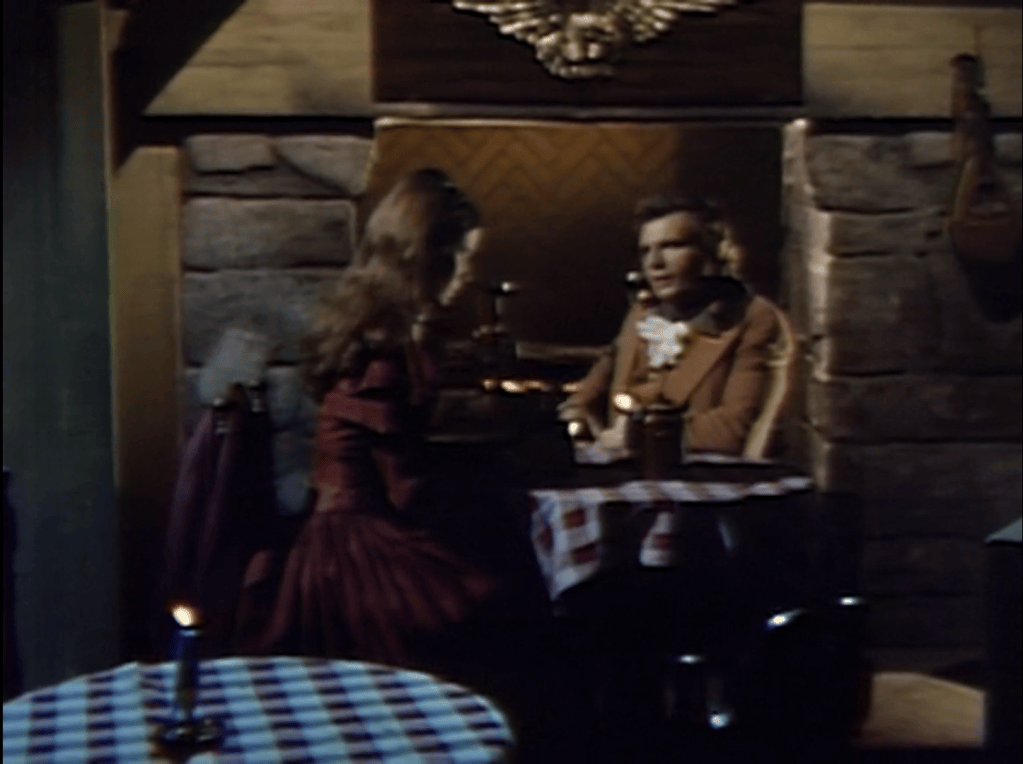
We see Daphne and Desmond sharing one of two circular tables covered with checkered cloths in front of a fireplace. On the wall above the fireplace is a metallic decoration in the shape of an eagle. In the foreground is a bar with a rack of drinking glasses. Longtime viewers know that the tavern in Collinsport was in the eighteenth and nineteenth century known as The Eagle, and that its tables were covered with checkered cloths even in the 1790s.

Daphne and Desmond at The Eagle

Daphne was prominent in the twentieth century segments that led us to 1840, while Desmond was never mentioned. His very existence seems to be omitted from the documents that Barnabas and Julia examined when they were trying to figure out what happened in 1840. So it is clear to us that he doesn’t have a shot with Daphne, but not to him. He’s dialed the charm up to 11, or would have if he weren’t such a grouchy New Englander that the most charming manner he can produce rises to about 4. She won’t answer any of his questions, but finally agrees not to check out of the Collinsport Inn and leave town until tomorrow.

Desmond goes home to a mansion known as Rose Cottage. He has brought a curio from his recent trip to southeastern China, intending it as a gift for Quentin. It is a human head in a glass box. When his mother reacted to the sight of this blasphemous thing with horror, Desmond told her that he was sure it was “a carving of some sort,” not an actual body part, and asserted that there was nothing frightening about it. He has since had second thoughts, though the head keeps waiting for Desmond to look away before it opens its eyes.

Quentin turns up and tells Desmond that he has come for the present he had told him he has for him. Desmond has changed his mind about giving the head to Quentin, so he has to scramble to come up with another present. Finally, he tells Quentin that the present is a couple of books about the occult. Quentin is delighted with them. He says he has been eager to get back into the study of “the lost world that we can’t understand, or even see.” He sits down and starts reading them right there, and Desmond suggests that it is time to go. Quentin is disappointed to have to wait to get home to read the books, but goes anyway.

Barnabas shows up and pesters Desmond about Daphne. Desmond is unimpressed with Barnabas, but does tell him that, contrary to the promise she made at the Eagle, Daphne has checked out of the inn and left no forwarding address. He shoos Barnabas away.

Back at Collinwood, Julia and Barnabas are in the drawing room. The doors to the rest of the house are wide open as they declaim loudly about how they are pretending to be people they are not and dare trust no one with their terrible secrets. Fortunately for them, the only person who overhears them is Daphne, who is sneaking into the house to leave a note in the foyer for Quentin.

Back at Rose Cottage, Desmond is yelling at the head. An image of the head is superimposed over him, and he shows signs of distress. We saw aged retainer Ben Stokes have a similar reaction the other day when the image of the head was superimposed on him; Ben died as a result. Desmond hears a voice telling him that he will follow its commands. We are to take it that he is now possessed by the head.

Episode 1121: It has become a comedy

Six months ago, in the spring of the year 1840, a man named Gerard Stiles came to the great house of Collinwood bearing a sad tale. Quentin Collins, heir to the house and all the family’s fortune, had been washed off the deck of a ship at sea with his son, Tad Collins. Gerard had done what he could to rescue them, but Quentin and Tad could be presumed dead. Gerard was invited to stay at the great house as a guest, and that is where he has been ever since. Quentin’s widow Samantha has married Gerard, and Quentin’s father Daniel has said he thinks he should adopt Gerard. The couple stands to inherit everything once meant for Quentin, much to the dismay of Quentin’s younger brother Gabriel.

Now, Quentin turns up at the house, alive and well. The audience might have seen this coming, but the audience is familiar with the story of Alfred Lord Tennyson’s poem “Enoch Arden,” either from reading it in school or from seeing one of the many plays and movies based on it. Since that poem won’t be published until 1864, the characters are at a disadvantage.

Enoch Arden saw how happy his wife was with her new husband and decided to slink off into the darkness, never telling them he was alive. Quentin is even more gallant, telling Samantha that he will respect whatever decision she makes. If she chooses to resume her life with him, he will do his best to make a go of it; if she chooses to stay with Gerard, she can go with his blessing.

What this show needs is a good villain. Screenshot by Dark Shadows Before I Die.

Quentin goes to the drawing room, and sees a man whom he recognizes as a distant cousin recently come to the house from England. He has been told that Barnabas Collins is visiting, and that he is a dead ringer for the portrait of his late father that hangs in an upstairs bedroom. What he does not understand is why Barnabas reacts to the sight of him with a shocked exclamation of “Quentin!” He asks how he knows him, and Barnabas claims to have seen a drawing of him.

The truth is that Barnabas is a time-traveler from the year 1970. In that year, Gerard’s ghost will precipitate a disaster that will destroy Collinwood and everyone in it. He recognizes Quentin because Quentin looks just like his great nephew, another Quentin Collins who is a friend of Barnabas’ in that future time.

Another ghost who was prominent in 1970 but who has not yet been seen in this period is that of governess Daphne Harridge. In fact, none of the 1840 characters has heard of Daphne, and the governess at Collinwood is someone named Hortense. Returning viewers have been in suspense as to when we would see Daphne. That suspense is ruined today when Kate Jackson does the opening narration. Barnabas spots a figure skulking about in the woods at the end of the episode; he’s the only one who is surprised to see that it’s Daphne.

Episode 1118: Relics of the Anti-Saints

From March to June 1969, during a segment of Dark Shadows set in the year 1897, John Karlen played inveterate prankster Carl Collins. Carl could barely contain the manic glee his own practical jokes inspired in him, even though they rarely moved anyone else to more than irritation. A childlike man, Carl quickly dissolved into helplessness before even the slightest challenge.

Now, the dramatic date is 1840. Karlen is Desmond Collins. We met Desmond yesterday, and he seemed to be cut from the same cloth as Carl. He has returned from a trip to East Asia, and has brought a severed human head in a glass display case. His mother Flora reacted to this object with horror, as one would expect. In response, Desmond kept insisting that there was nothing frightening about the head and averring that he could not understand Flora’s reaction. His demeanor is calm and mature, setting him apart from Carl. But as regards the head, his judgment seems to be just as ludicrously poor.

Desmond does show good sense in one matter. Yesterday, Desmond expressed distrust of two people who have recently presented themselves at the great house of Collinwood under the names Barnabas and Julia Collins. Julia and Barnabas have identified themselves as brother and sister, and have said that their father was the Barnabas Collins who lived on the estate in the late eighteenth century and left for England in the 1790s. Desmond talks with Barnabas in the drawing room of the great house today, and is still openly suspicious.

The two people at Collinwood now who were there in the 1790s are Ben Stokes, an old man who was an indentured servant at Collinwood back then, and Daniel Collins, who was a child then and is now the master of the house. Daniel reacts with amazement to the sight of Barnabas. He is convinced he is the same man, unchanged after four and a half decades. Barnabas tells him he is the son of that Barnabas. There is still a note of suspicion in Desmond’s voice when he remarks that it is Barnabas’ night for being mistaken for his father, but he can hardly keep doubting that he is a member of the family.

As it happens, Daniel’s first impression was right. Barnabas is the person he knew long ago. Julia is not related to the Collinses at all. Barnabas has not aged, because he was turned into a vampire in the 1790s and was sealed in a coffin from that time until Julia released him a few nights ago. She is a time traveler from the year 1970, where she and Barnabas are friends. Barnabas is also a time traveler of a sort; he used some mumbo-jumbo to project his 1970 personality into his 1840 body, so that he and Julia are on the same page now. They have traveled into the past in hopes of preventing a disaster that will befall the Collins family in 1970, so their motives are good. But after all, one of them is a vampire and the other is a mad scientist. They are not likely to be an unmixed blessing to any house they enter.

Ben is visiting Flora at the house she and Desmond share, a mansion near Collinwood known as Rose Cottage. He sees the head, and recognizes it as something that figured in a series of murders many years before. Those murders took place in and around a town called Bedford, and are therefore known as The Bedford Atrocity. Ben asks Daniel if he remembers the matter. He certainly does, and mentions that his late sister Millicent had a book that included a chapter about it. He suggests Ben look for the book in the attic.

Ben finds the book there, and he is sure that if he shows it to Desmond he will convince Desmond to destroy the head. He takes the book to Rose Cottage. No one is home. He leaves the book in the room where the head is kept and writes a note for Desmond. He explains to the head that he is going to destroy it. This turns out to have been an unwise move. When Ben is walking home through the woods, an image of the head is superimposed over him and he reacts with distress.

In a day concerned with nautical mishaps, it is somehow fitting that Ben gets stuck in the head. Screenshot by Dark Shadows Before I Die.

There are a couple of other points worthy of mention. Daniel is conscious of his position as master of Collinwood, but he is not the haughty overlord Louis Edmonds played when he was Joshua Collins in the part of the show set in the 1790s or the stuffy but lovable figure he created as Edward Collins in the 1897 segment. He is dignified, courteous, and kindly. But he is also gravely mentally ill. When first we saw him, he tried to kill Julia, not for any of the good reasons anyone might have to do such a thing, but because he thought she was his late wife, whom he killed years ago and keeps trying to kill again every time she shows up disguised as someone else. He cannot remember who is alive and who is dead, or what year it is. (In fairness, these are very difficult things to keep track of on Dark Shadows.) It’s a cliche that Jonathan Frid played Barnabas “as if he were playing King Lear.” In his scenes today, Edmonds quite literally is playing King Lear. Mrs Acilius and I marveled at the depth and complexity of the characterization.

Barnabas meets the evil Gerard Stiles. Barnabas knows that Gerard’s ghost will cause the destruction of the great house and its residents in 1970 and that he will still preside over its ruins in 1995. Gerard tells Daniel a story about the deaths of his son and grandson, Quentin and Tad Collins. Barnabas is in the room when Gerard tells this story, and has reason to disbelieve it. Later, he is alone with Gerard and challenges his story. Barnabas learns nothing from this encounter, but Gerard learns that Barnabas is his enemy. Barnabas very often introduces himself to his foes by showing his cards in this way. That habit does keep the plot moving, but it is frustrating that the protagonist does not even try to ingratiate himself to his adversaries and get information from them he can use to advance his goals.

Episode 1117: That Hideous Strength

The Signal of Another Start*

In June 1970, Dark Shadows was set in a universe other than the one where it usually takes place. The show insisted on calling that other continuity “Parallel Time.”

In the main continuity, mad scientist Julia Hoffman is the friend and enabler of vampire Barnabas Collins. When Barnabas crossed over to Parallel Time, he found that Julia’s counterpart there was as devoted to wicked witch Angelique as the Julia he knew was to him. He made himself Angelique’s enemy, and in #1036 Hoffman was poised over him with a stake and a hammer, ready to destroy him. In the nick of time, Julia arrived from the main continuity and saved Barnabas. She bashed Hoffman’s head in, stole her clothes, and set about impersonating her. When Barnabas first saw Julia in Parallel Time, he thought she was her Doppelgänger, and since she was in his hiding place he was going to kill her. Fortunately for Julia, Barnabas had got into the habit of making speeches to people before he murdered them, so she was able to tell him who she was. With that, the murder was off and their friendship was back on track.

Now, it is Julia who has crossed over into another world. She has traveled back to the year 1840, and has told the family in the great house of Collinwood at that time that she is the daughter of the Barnabas Collins who supposedly left for England in the 1790s. She has also told them to expect her brother, Barnabas Junior, who, she says, looks just like their old man.

In a moment of extreme folly, Julia went to the room where Barnabas was sealed in his coffin in the 1790s and released him. This mirrored the folly of her waiting around in his hiding place after she killed Hoffman in Parallel Time. The Barnabas of 1840 had no idea that any time had passed since he was imprisoned four and a half decades before, and certainly did not know what Julia was talking about when she claimed that they had met in 1967 and become friends in 1968. He was about to kill her when his old friend Ben Stokes turned up in the nick of time and stopped him.

Now, Barnabas has discovered that Julia is interfering in his plans. He has bitten the lovely Roxanne Drew, intending for her to die and rise as his vampire bride. Julia and Ben found Roxanne and brought her to the Old House on the grounds of Collinwood. Julia is giving Roxanne a blood transfusion which has prevented her death. When Barnabas sees what is going on, he grabs Julia and is about to bite her.

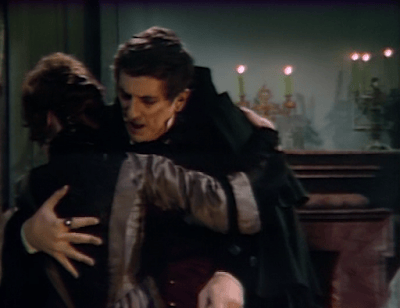
Barnabas is already flashing his fangs when he has a seizure and collapses. He stands back up and finds Julia holding a cross at him. He tells her that he is the Barnabas of 1970, projected into his 1840 body by some mumbo-jumbo involving the I Ching. He could be making that up based on things she has already told him, so she keeps holding the cross. He goes on to give specific facts about several people they know in 1970. She realizes he is telling the truth. She puts the cross down, and gives him a hug. As Julia came from the main continuity and destroyed her own Doppelgänger to save Barnabas, so Barnabas has come from the future and destroyed his previous self to save Julia.**

Embraceable vampire. Screenshot by Dark Shadows Before I Die.

The 1970 model Barnabas does not want Roxanne to be a vampire, and he is ashamed of his earlier self for having tried to make her one. Roxanne comes to, sees him, and is delighted to think he has come to bite her again. When he says that things have changed, she is disappointed and he is embarrassed. He goes away.

Julia has a superhuman power of hypnosis that she has often used to erase people’s memories and overwrite them with information that will not incriminate Barnabas. She tries this on Roxanne. She is halfway through the process when some noises outside prompt her to leave the room and investigate. The room is at the top of the stairs, and has been a major set for years. We’ve caught glimpses of the door that opens to it a couple of times, but this is the first time there is set built all the way to the railing.

Julia goes to the railing and calls downstairs, asking if anyone is there. No one answers, so she goes back into the room. Roxanne has somehow got away.

Barnabas goes to the great house and introduces himself as Julia’s brother. Julia comes. They get a private moment, during which Julia tells him that Roxanne escaped and that she does not know whether the hypnosis was successful. Roxanne enters, looks at Barnabas, and announces to the assembled Collinses that she knows who he is. She is escorted upstairs. Barnabas and Julia are on the verge of panic until Roxanne’s sister, Samantha Drew Collins, comes down and says that Roxanne doesn’t remember anything of the last couple nights.

The Gods are Weak at First*

The 1970 version of Barnabas is not the only character to make his grand entrance today. We also meet Desmond Collins and an acquaintance of his.

Desmond is the son of Flora Collins, a lady novelist and all-around silly person who lives in the nearby mansion called Rose Cottage. He has just returned from a long journey with a present for his friend, Quentin Collins, husband of Samantha and heir to the Collins estate. Flora breaks the sad news that Quentin and his son Tad Collins were lost at sea some time ago, that they have been missing ever since, and that they are now presumed dead.

The present is in a large cube that is covered with a cloth. Desmond removes the cloth and exposes a glass box holding a severed head. Flora reacts with horror; Desmond laughs and says that it is surely a carved figure of some sort, entirely harmless. We know better; the episode ends with the head opening its eyes.

The perfect gift for the man who has everything, except a sense of decency. Screenshot by Dark Shadows Before I Die.

In 1945, C. S. Lewis published the third volume of his “Space Trilogy,” a novel called That Hideous Strength. It was a commercial success at the time, and has been in print ever since. I have mixed feelings about Lewis’ writings; I essentially agree with his religious views, but he often expressed them in a cutesy-poo style that is still endemic among Anglican writers and that makes me wish I were a Zoroastrian or a Buddhist or something whenever I encounter it.

But the first fifty pages of That Hideous Strength are terrific. I teach in a university, and the account of life inside the fictional University of Edgestow is the most insightful depiction of campus politics I’ve ever read. The place is dominated by a clique of administrators who keep talking to each other about what “Our Head” wants them to do. In British institutions of higher education, “Head” is a title for a permanent director of a department or institute, so that’s what you think they are talking about. But no, it’s an actual severed head through which the voice of Satan speaks to them. They worship the head and follow the commands they receive from its mouth.

That Hideous Strength was certainly popular enough that it is likely the writers of Dark Shadows had looked to it as a source of material. In particular, Sam Hall was a serious enough Protestant that he persuaded Shirley Grossman to convert from Judaism and join him in the Lutheran church before they married and she became Grayson Hall. Lewis was so celebrated for his apologetics that it would be rather odd if his name did not attract Hall’s notice. So we can expect that Desmond and others will form a cult of some sort and that the Head will give them diabolical orders to follow.

The Head is that of Michael McGuire, making the first of scores of television appearances. One of my favorite parts of his was Sumner Sloan, the prominent academic who dumped Diane Chambers in the first episode of Cheers and came back for her in her last episode as a regular part of the cast of characters. McGuire also appeared in my favorite episode of Columbo, “A Friend in Deed,” in which his character tries to confess to killing his wife in a fit of rage only to find himself involved in a plot to kill another man’s wife in cold blood. I suppose one of McGuire’s specialties was “Do Not Date This Man.” I’ve never heard that he was anything other than a nice guy in real life, though.

*These section titles are taken from William Dickey’s 1961 poem, “Continued in Our Next”:

Over the quiet paper, in light that is

Interested only in a casual way,

All quite polite, the neat pen idly marries

Third sons to princesses.

They go away,

To the widest margin, to a land of white,

Wholly uninhabited until they came,

And from the sacks with which they are provided

Stock it with leaping trout and huntable game.

Hounds to be cursed at when the blood trail falters,

Eventually, reasons why the hounds went wrong.

Then to the reasons they establish altars.

The gods are weak at first.

When they grow strong

They bring into the world their choicest thunders.

Plagues, curses color the narrow countryside.

The peasantry speaks of horned, unnatural wonders,

And in the violence takes a natural pride.

But all the while the map-makers are busy.

Faint explorations die in the savage hills,

Others go on to the farthest fabled city,

Where for six months the sun is lost, and the cold kills.

Geometers prove the world, and it is conquered.

Truth overtakes the aborigine.

The gods depart. Mankind is anchored

To clear historical necessity.

Until one day at midday

When the sun ought to be loudest in the shouting sky

Shadow occludes it. Suddenly life is done.

The fire goes out. The constellations die.

Only, above the following page, the pen,

Whose quality is not to have taken part,

Hovers in uncommittedness again,

Poised for the signal of another start

Towards some fresh country, princesses more golden,

And younger sons who wage a bolder fight,

Stags nobler, hounds more diligent than the olden,

The page lies empty in the easy light.

This poem reminds me of Dark Shadows. The creative process is so close to the surface of the show that an image of a writer with pen and paper is a suitable way to start a description of it. When the third sons and the princesses are moved to the “widest margin, to the land of white” it’s ambiguous if that just means the writer is making notes on the otherwise blank edge of the paper or whether the characters are going off to the Arctic. We see the same ambiguity in “the pen whose quality is not to have taken part.” That brings to mind both the characters visiting from other times or other universes and the writers who use those cosmic journeys to start the story fresh.

The “natural pride” that the “peasantry” takes in the crimes of the “unnatural wonders” explains both why there are characters who are willing to go on living in Collinsport and why the audience keeps coming back to the show. The wish for “princesses more golden” and for “younger sons who wage a bolder fight” casts our minds to stories like the conflict between Barnabas and Jeremiah Collins over the love of the gracious Josette and the ongoing scheme Gabriel Collins has devised to do away with his sister-in-law Samantha, grubby little imbroglios that never could lead to anything but sorrow, and leaves us wondering why we choose to follow this show rather than seeking out happier and more glorious tales.

**My wife, Mrs Acilius, had a lot to say about this inverted parallel.

Episode 1116: Her temperature could rise

Friday’s episode ended with one of the most effective scenes in all of Dark Shadows. Vampire Barnabas Collins summoned his latest victim, Roxanne Drew, to the gazebo on the grounds of the estate of Collinwood. Roxanne looked at Barnabas adoringly and told him she was willing to die for him. He took her up on this. He bit her, draining her body of blood and letting it fall to the floor of the gazebo. He told her that her corpse would be found in the morning and that her family would grieve for her during the day. At dusk, she would rise as a vampire and would belong to him forever. He walked away from the gazebo, leaving her body lying there. Jonathan Frid and Donna Wandrey showed the full terror of this unimaginably cruel scene. The result chills the audience as deeply as anything they have shown us.

Today, it turns out Roxanne isn’t dead after all. That gives Roxanne’s sister Samantha a chance to find her, and Barnabas’ friends Julia Hoffman and Ben Stokes a chance to hide Roxanne from Samantha and to keep her from dying. When Barnabas finds out what Julia is doing, he moves to attack her, but collapses in the nick of time.

Julia uses some medical equipment she has improvised to give Roxanne a blood transfusion. Screenshot by Dark Shadows Before I Die.

There is also some activity involving Samantha and the evil Gerard Stiles, but that’s basically it. They can’t all be gems of course, but last week was a such bright spot that these twenty two minutes of busywork come as a big disappointment. We can only hope the show gets back up to speed soon!

Episode 1115: The woman in question

The year is 1840. Vampire Barnabas Collins summons his latest victim, Roxanne Drew. They meet at the gazebo on the grounds of the estate of Collinwood. He says he has a way they can be together forever. She says she would die for him. That’s what he had in mind. He bites her, drains her body of blood, and lets her fall to the floor of the gazebo. He tells her corpse that it will be found tomorrow, and that Roxanne will be mourned. The following night, she will rise as a vampire. He walks off, leaving her.

Roxanne, left like a cat leaves a mouse for its people to find.

Roxanne’s sister Samantha also has a new relationship, and may also be murdered as a result. Her husband, whose name is Quentin Collins, is missing and presumed dead after a shipwreck. Quentin and Samantha’s son Tad was with his father and is also missing. Quentin’s friend Gerard Stiles has been a guest at the great house of Collinwood for some time. We saw the other day that Samantha turns to Gerard when she needs comforting, and they kiss today.

After Gerard and Samantha’s love scene, Gerard is alone in the drawing room with Quentin’s brother Gabriel. He is in the act of walking out on Gabriel when Gabriel addresses him as “Mr Miller.” Gabriel leafs through a stack of papers about the life of crime Gerard led under his original name, Ivan Miller. Gerard grabs the papers from Gabriel. Gabriel clutches at Gerard’s arm and squeezes it so hard Gerard falls to his knees. Gerard is stunned by Gabriel’s strength. Gabriel gets around by pushing himself in a manual wheelchair, which does indeed build the muscles in the arms and upper back, so it is a believable moment.

Gabriel then hands Gerard the papers and says that they are his copy. He has another copy stashed where it will go to the authorities should any harm befall him. He says that he will hold them back provided Gerard makes himself useful to him. First he dispatches Gerard to acquire a large packet of arsenic. Then he tells Gerard that his next duty will be to poison Samantha with the arsenic a little bit at a time, so that she dies a painful, lingering death. Gerard says that he would rather just leave Collinwood and make a fresh start somewhere else rather than do that. Gabriel says that since Samantha’s death will make him the heir to his terminally ill father’s vast estate, he will be able to pay Gerard very handsomely for the task. He offers him 10% of the Collins fortune. Since Gerard apparently murdered a woman in Portugal a few years back, Gabriel is quite sure he will not be squeamish about murdering another woman, especially when he stands to profit so richly. Gerard says they have a deal.

In #1077, set in 1970, another Quentin Collins was reading the family history when he learned for the first time that he had a “grand uncle” who lived in 1840 who was also named Quentin Collins. Not even the family history mentioned Tad’s name. Since that Quentin was born in 1870 (though he looked much younger than his hundred years,) we could take it that neither Grand Uncle Quentin nor his widow was the one through whom ownership of the Collins family wealth passed to the other generations we have seen. Indeed, longtime viewers may recall that in #701 and #702, set in 1897, Quentin’s very elderly grandmother Edith Collins reminisced on her deathbed about her husband Gabriel. So we know that Gabriel and Edith are the parents of a son who will sire that other Quentin and his siblings, among them Edward Collins, whose son Jamison will go on to be the father of Elizabeth Collins Stoddard and Roger Collins, the adults at the great house in the 1960s.

As of this day in 1840, however, Gabriel’s father Daniel Collins has named his son Quentin his sole heir, with Tad in second place and Samantha in third. Told that Quentin and his son are dead, Daniel has refused to rewrite the will in Gabriel’s favor. Early in the episode, Samantha tells Gabriel that when Daniel dies, it will be up to her to take care of him and his wife, and that she will do so provided they behave themselves. Knowing that it does not work out that way, we can believe Gerard will actually carry out the assignment Gabriel gives him today.

The disappearance of Quentin and Samantha from the Collins family’s memory by the late nineteenth century is only the first of four reasons we might believe Gabriel’s plan will come to fruition. The second is the casting of Samantha. Virginia Vestoff was a splendid actress whose performance lets a great deal of fresh air into every scene she appears in. However, Samantha is Vestoff’s first role on Dark Shadows. If she were a member of the show’s established repertory company, we might be confident that Gerard will disappoint Gabriel and let her live. But first timers, even spectacularly talented ones with solid backgrounds on Broadway and in daytime television, often turn out to be short-timers. So her presence adds to the suspense about her character’s future.

The third reason is an echo of the circumstances of one of Dark Shadows‘ most prominent on-screen murders. In 1967, Barnabas coerced his associate, mad scientist Julia Hoffman, into preparing a lethal injection for her old friend Dave Woodard, who was threatening to expose their crimes. As Gerard brings the arsenic to Gabriel today, only to be shocked to hear that he will have to commit the murder himself, so Julia offered the hypodermic to Barnabas, only to be told that she would administer the deadly shot. The murder of Woodard actually came off, so longtime viewers have another reason to expect that Samantha, too, might die. And of course that Gabriel pulls the same maneuver on Gerard that Barnabas pulled on Julia shows that they really are members of the same family and that they are bearers of that family’s curse.

The fourth reason grows from what we have seen of the future of Collinwood. In segments set in 1970 and 1995, we have seen that Gerard’s ghost will destroy Collinwood and rule over its uninhabitable ruins for decades after. Today that starts to make sense. If Gabriel’s descendants own the house and hold their position in the community as the result of a hideous crime their ancestor committed through Gerard, then it is fitting that Gerard should be the face of the long-delayed reckoning for that crime.

I should mention that Vestoff is not alone in giving an excellent performance today. Christopher Pennock was pretty hard to take when he first joined the show as monstrous man-child Jabez Hawkes in #935; he moved well, but he delivered his dialogue with so much bombast that he stood out even among the cast of Dark Shadows. He was noticeably better as Jekyll/ Hyde characters Dr Cyrus Longworth and John Yaeger from #985, but still enunciated his lines too self-consciously to really draw the audience in. As astrologer Sebastian Shaw from #1073, he was a little more natural, but Sebastian was such a poorly conceived character that he couldn’t really show his stuff.

As Gabriel, Pennock finally comes into his own. He is smooth as silk in Gabriel’s scenes with Gerard today; it’s a pleasure to listen to him sidle his way from one syllable to the next. He’s just as pitch-perfect projecting Gabriel’s humiliation and uncontrolled rage in his scene with Samantha as he is at the opposite end of the emotional spectrum with Gerard. Certainly Vestoff and James Storm are first-rate scene partners; they may deserve a share of the credit for Pennock’s fine work. Or maybe he just needed to sit down, I don’t know.

It’s no news to fans of Dark Shadows that Jonathan Frid was capable of great work. He’s been on top form this week. The other day, Barnabas’ aged friend Ben Stokes told him a bizarre story, to which Barnabas replied “You’re mad, old man.” No actor could deliver Henry V’s dismissal of Falstaff, “I know thee not, old man” more heart-breakingly than Frid delivers that line. And watching his face as Roxanne falls dead in Barnabas’ arms, you can feel the terror and the awe of the moment. The murders sometimes come so thick and fast on Dark Shadows that watching them we can feel like we are seeing the coyote raise yet another the mushroom cloud at the end of his fall after failing to catch the roadrunner, and Barnabas himself often takes killing very lightly. But there is nothing cartoonish about what he does to Roxanne.

Episode 1114: I am the stranger

In June, Dark Shadows was set in an alternate universe to which vampire Barnabas Collins and mad scientist Julia Hoffman had traveled. Julia and Barnabas found a comatose woman. Barnabas took one look at her, saw how silent and immobile she was, and fell in love. He’s dead half the time, so we can’t judge him for that reaction.

The woman’s name was Roxanne Drew, and Barnabas’ love for her survived even after she regained the ability to walk and talk. Roxanne didn’t make it to the original continuity when Barnabas and Julia returned there in July. Barnabas’ sorrow for her was lightened in #1081, when he met Roxanne’s counterpart in his native universe. Their relationship took a turn for the worse in #1106, when he discovered that she, too, was a vampire. In #1107, he found out that Roxanne was alive in 1840, and that she underwent a mysterious and terrible change in that year.

Now, Barnabas is keeping Roxanne chained in her coffin in the secret room behind his bookcase. Julia has traveled back in time to 1840 and hopes to prevent a disaster that has destroyed the great house of Collinwood and its residents. Trying some mumbo-jumbo that he hopes will lead him to join Julia in the past, Barnabas has a vision of a tombstone saying that she died on 6 October 1840. He and his friend Timothy Eliot Stokes go to the graveyard and see such a tombstone there. Barnabas says that 6 October is three days away; the episode was originally broadcast on 1 October 1970, which is more than three days from 6 October. But there is a weekend in between, and days when the show isn’t on don’t count.

The stones. Screenshot by Dark Shadows Before I Die.

Barnabas says that he must find a way to travel back in time before 6 October. Stokes asks why, and Barnabas says he himself doesn’t understand how it works. But regular viewers know that anniversaries have a power in the cosmos of Dark Shadows that physical laws have in our world. If an event took place exactly 130 years ago, or any other number of years ago, it is possible for people in the present to interact with that event in ways they cannot on other days of the year. That has been the case ever since undead blonde fire witch Laura Murdoch Collins was on the show, before Barnabas made his first appearance.

Julia’s grave is next to one commemorating Minerva Trask, a hateful biddy who was one of the most effective villains during the period in 1969 when the show was set in 1897. That turns out to be foreshadowing. The scenes with Barnabas and Stokes in a contemporary setting are a prologue to an episode set mostly in 1840. Julia meets the living Roxanne, who is accompanied by Lamar Trask, a kinsman of Minerva’s loathsome husband Gregory.

Julia is a guest at Collinwood, impersonating Barnabas’ imaginary daughter and telling the family to await the arrival of her brother, Barnabas Junior, who looks remarkably like their late father. Julia is in the drawing room, talking to herself about how much she misses Barnabas, when Roxanne enters. Roxanne makes a little joke about talking to inanimate objects, and introduces herself as the sister of Samantha Drew Collins, wife of the missing Quentin Collins and lady of the house.

Trask enters. Julia is startled to see him. Roxanne asks Julia to guess what business Trask is in. She says she could not possibly, and Trask protests that guessing games are silly. That’s a shame. Julia must have seen What’s My Line?; we can imagine her asking “Is there a product connected with what you do? Is the product bigger than a bread box? Is the product alive? Are your services equally available to men and women?” etc.

Roxanne says that Lamar is an undertaker. She spits the word out, and asks him sarcastically if he prefers to be called a mortician. She reviles his profession in quite vigorous language. The dramatic date may be 1840, but at this moment we are very clearly in the aftermath of Jessica Mitford’s 1963 book The American Way of Death, an extremely influential polemic against the mortuary industry.

Lamar insists that Roxanne go out on the terrace to talk with him privately. When they are gone, Julia wonders to herself what will happen later this year to turn Roxanne into a vampire. She really ought to know. She released Barnabas from his chained coffin the other day, hoping that he would already be her friend returned from the future. But instead he was the same monster sealed up there in the 1790s, who had no idea who she was. Had his old friend Ben Stokes not shown up in the nick of time, Barnabas would have killed Julia then and there. He has gone on to take other victims, killing some of them, and remains at large. So it seems quite likely that Barnabas will bite Roxanne to death, causing her to rise as a vampire. When that happens, Julia will be to blame.

This is a temporal paradox. Julia hadn’t traveled back to 1840 when she first met the vampiric Roxanne, and Barnabas hadn’t been out of his coffin between the 1790s and 1897 at that point. Roxanne’s vampirism was involved in the circumstances that led to Julia’s trip to 1840. So the vampirism caused the trip that caused the vampirism. And Roxanne the vampire had clearly never seen Barnabas before when she met him in 1970. Of course it doesn’t make logical sense, but so much of the story is made up of the consequences of Julia and Barnabas’ bungling that it would be wrong if it were any other way.

On the terrace, Lamar asks Roxanne to marry him. She refuses, angrily. My wife, Mrs Acilius, said that it was odd Lamar wanted to marry Roxanne, since she obviously hates him. I pointed out that he seems to hate her as well. Many married couples come to hate each other over the years, so I suppose it is a time-saver of a kind if two people get married who already hate each other.

Lamar keeps telling Roxanne that he made a deal with her father to marry her, and she keeps telling him that she doesn’t care. She wants to marry a mysterious stranger who will sweep her off her feet and show her a new life. Barnabas is eavesdropping from behind the wrought iron fence. He has not met Roxanne before, and cannot see her well, but he can well imagine himself being a mysterious stranger who will change everything in a woman’s life. Moreover, Barnabas hears her raging at Trask, whose late father was an enemy whom Barnabas killed with an even higher degree of sadism than is usual for him. Since Trask Junior looks and sounds just like Trask Senior, Roxanne’s hostility to him is enough to make Barnabas feel a special closeness to her.

Barnabas approaches Roxanne after Lamar has left. He persuades her to invite him to her home. When Barnabas was first on the show in April and May of 1967, they made good use of the trope that vampires can enter only where they are invited, but they soon became very inconsistent about that. It places a restriction on Barnabas’ movements that can be story-productive though, so I’m always happy when it seems they will be bringing it back.

In her room, Roxanne is disappointed Barnabas did not call. He materializes inside her window. She can’t very well be happy about that, but he talks her out of screaming. She looks into his eyes and falls into a trance. He bares his fangs, and she tilts her head to offer him her neck. Her fate would appear to be sealed.

This is the first episode credited to Lela Swift as line producer. Swift has been with the show as its principal director from the beginning. Even though Henry Kaplan is listed as director today, it has the crisp look and inventive compositions that characterize Swift’s style, not the muddy images and extreme closeups with which Kaplan was content to fill the time. We can hope that, with Swift in the driver’s seat, the show will consistently meet her high standards of visual strategy.