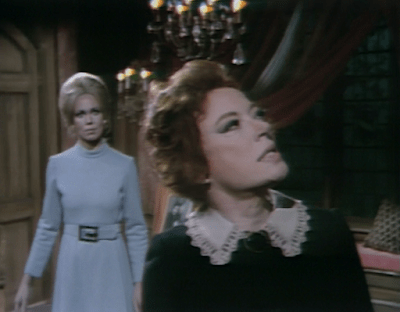
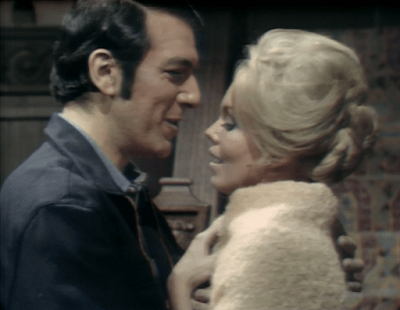
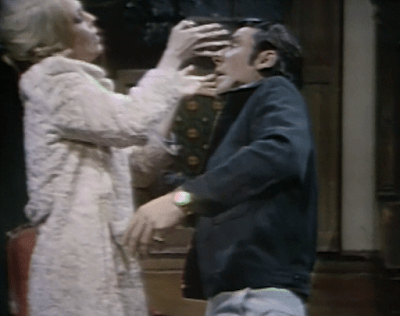
Wicked witch Angelique has returned from the dead, murdered her twin sister Alexis, and assumed Alexis’ identity. Angelique’s widower Quentin had already welcomed Alexis as a more or less permanent guest at the great house of Collinwood. Quentin’s new wife, the former Maggie Evans, has left him. Angelique wants Quentin back, but has decided that she cannot overcome his obsession with Maggie unless Maggie returns to Collinwood, where she will be able to fight her directly. So she has cast a spell on Quentin to inflame his feelings for Maggie. Angelique expects this will cause him to bring Maggie home. Once she is there, Angelique will be able to complete her evil plan, which the writers don’t seem to have come up with yet.
Angelique’s spell goes awry. At the beginning of the episode, Quentin slashes a portrait of Maggie; at the end, he believes he has killed her, and is getting ready to hang himself so that he can join her in death. In between, he goes off and tells his friend, mad scientist Cyrus Longworth, how miserable he is. Angelique and Cyrus have a conversation about how sad Quentin is.
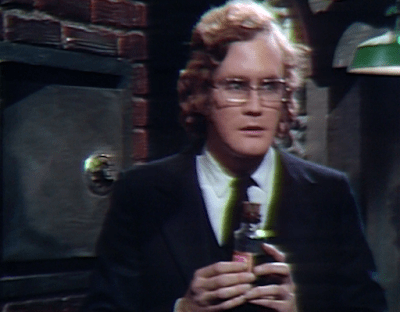
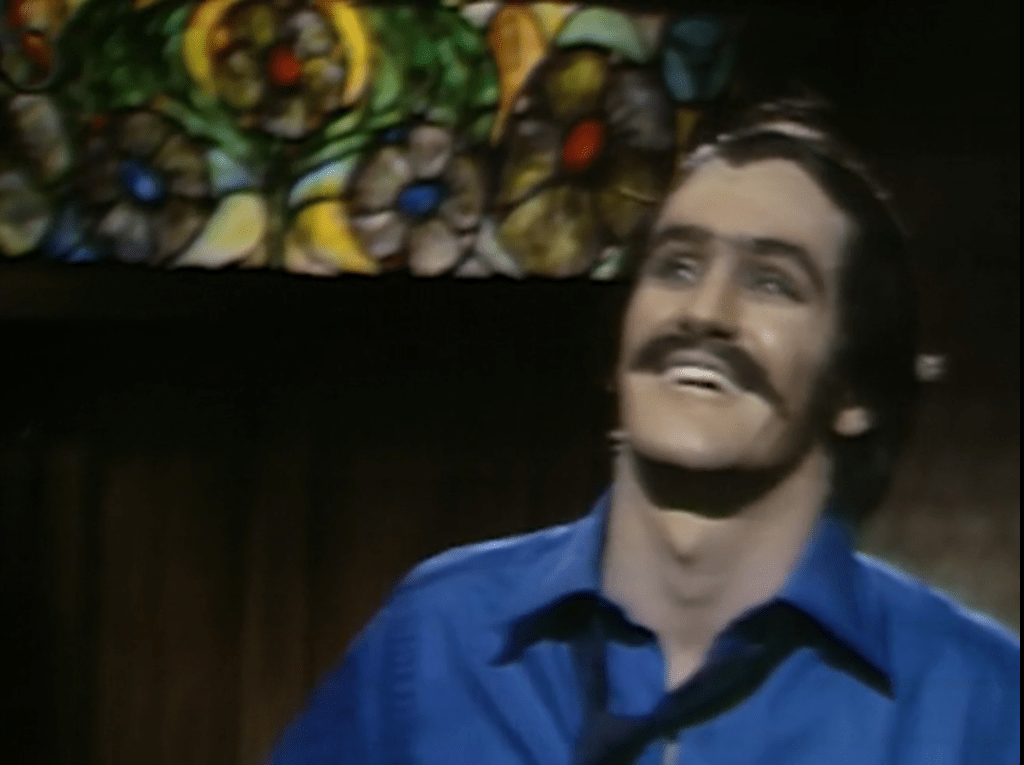
The performances are all good, but the only one that serves a purpose in the story is Christopher Pennock’s as Cyrus. Cyrus has devised a potion that changes his appearance so drastically that even the people who know him best do not recognize him when he is under its influence. This is supposed to be a Jekyll and Hyde story in which the innocent Cyrus is being consumed by his evil alter ego, “John Yaeger.” But it is all too obvious that Yaeger is just a disguise Cyrus puts on when he has decided to commit acts of rapine and slaughter. Today, Pennock really makes Cyrus seem like a well-intentioned nerd. When he puts the potion back in his safe and resolves never to become Yaeger again, we can believe that he is a better person when his hair is red than he is when it is dark.
Cyrus resolves to break his addiction to “Do Not Touch” juice. Screenshot by Dark Shadows Before I Die.
Also, he and Lara Parker have a fun moment when Cyrus and Angelique are talking about Quentin’s feelings. He gets carried away with a mad scientist rant about the horrible evil that dwells at the base of every human heart, prompting her to give him a puzzled look. It’s an effective comic take.
This episode marks the last appearance of Paula Laurence as Angelique’s aunt, Hannah Stokes. As Hannah, Laurence imitated some of the most recognizable mannerisms Parker incorporated in her portrayal of Angelique. This helped longtime viewers believe she was related to Angelique, and when she had scenes with Alexis the contrast showed us that Parker really was playing a different character. But the show isn’t big enough for two Angeliques, so Hannah’s days have been numbered for a while.
Vampire Barnabas Collins has escaped from the continuity in which Dark Shadows took place until late March 1970 and found himself in an alternate universe, which the show insists on calling “Parallel Time.” This universe is largely populated by people who remind Barnabas of their counterparts in his own world, but their personalities and relationships are very different from those he knew. His own counterpart is a case in point. That other Barnabas Collins never became a vampire, but lived a quiet life and died a natural death in 1830.
Barnabas’ first few weeks in Parallel Time were spent trapped in a coffin. Alcoholic novelist Will Loomis found out about Barnabas after he saw fang marks on the neck of his wife, the former Carolyn Collins Stoddard, and decided he could force Barnabas to give him a complete history of his career as a vampire. Will was under the impression this would make a good book. Will’s irresponsibility in keeping a vampire as a pet, his cruelty in exploiting a fellow creature for his own gain, and his lack of literary judgment in imagining that a recounting of the plot of weeks 43 through 196 of Dark Shadows would be both a bestseller and a critical favorite come back to bite him. More precisely, Barnabas comes to bite him when Will lets him out of his coffin and turns his back on him for a moment during their interview, taking the cross out of his sight and freeing Barnabas to attack.
Barnabas forces Will to burn all the pages he has already written. The idea of a book detailing Barnabas’ crimes featured in #326, #510, and #756, and may have planted the seed for the whole conception of Will Loomis.
Will and Carolyn live in the Old House on the grounds of the estate of Collinwood, which in the original continuity belongs to Barnabas. The pages are still in the fireplace when drunken sourpuss Quentin Collins, master of the great house of Collinwood and proprietor of the family businesses, bangs on the door and demands admittance.
Quentin interrogates Will. The name “Barnabas Collins” has been cropping up in the oddest connections lately, and Quentin is convinced Will knows why. Their exchange is getting quite warm when Barnabas enters and introduces himself.
Quentin is bewildered to see Barnabas. Through a time warp that occasionally manifests in the east wing of his house, he has caught a few glimpses of the original continuity, mostly in the form of people standing around talking about how Barnabas is missing and is under a terrible curse. So he is inclined to be leery of this fellow claiming to be a descendant of the Barnabas who died in 1830. Barnabas specifies that his great-grandfather was the son of that Barnabas, the son who went to Peru in the nineteenth century. Quentin had read that that son of Barnabas died while still in Peru. Barnabas says that he did not die in that country. He does not specify where his ancestor went after leaving Peru, but says he spent the rest of his life in poverty. He was so ashamed of this circumstance that neither he nor any member of his family could bear to reconnect with the rich Collinses in Maine. Barnabas claims that he has now made a fortune of his own, leading him to conclude that the time is right for a reunion. Barnabas invites himself to the great house in an hour. Quentin says that the morning would be better, to which Barnabas replies that he will not be free then. Quentin acquiesces.
Quentin exits, and Barnabas orders Will to accompany him to the grave of his counterpart. Longtime viewers will remember #660, when Barnabas managed to travel back in time by going to a grave and yelling at its occupant. Now he hopes to travel sideways in time, returning to his own universe, by the same technique.
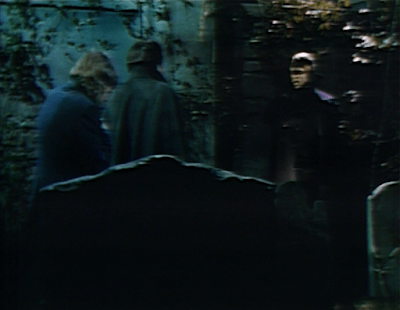
Barnabas and Will enter a graveyard we have seen several times in the last seven weeks. It differs from the cemeteries we have seen in the original continuity in that none of the grave markers is in the form of a cross. Most of the graves in the cemetery from which Barnabas emerged were marked with crosses, and he strolled by them with perfect equanimity. The cemetery set was built for Barnabas, so evidently it was not the original plan that the cross would be formidable to him. It wasn’t until #450, 48 weeks after Barnabas debuted, that he was first held at bay with a cross. Even after that, he still strolled placidly through the field of crosses in Eagle Hill Cemetery. Now the apotropaic power of the cross is a major point, and they have designed the cemetery in this universe to accommodate Barnabas’ special needs.
Barnabas calls on his counterpart. He conjures up a spirit, but it is not that of Barnabas Collins (d. 1830.) It is Joshua Collins, father of that Barnabas. The sight prompts Barnabas to gasp “Father!” Joshua denies that Barnabas is any kin to him. Barnabas tries to explain that, while that is true, he is nonetheless Barnabas Collins, son of Joshua, eliciting an angry command “Do not profane those names!” Joshua tells Barnabas to take his vileness back where it came from. Before Barnabas can explain that is what he is trying to do, Joshua vanishes.
Joshua appeared to Quentin and Angelique in #1009. That turn was not particularly effective. The visual composition made it too clear that Louis Edmonds was standing in the same space as David Selby and Lara Parker for the actors to create any sense of the uncanny. And Joshua hung around too long and had too many lines for it to make sense that he couldn’t give any useful information. But this time Joshua is off to the side, lit by his own light, and he disappears after just a few seconds. It is a powerful scene, especially for longtime viewers who remember the relationship between Barnabas and Joshua we saw when the show was set in the 1790s from November 1967 to March 1968.
Will is terrified. The apparition leaves him trembling and speechless. So far Will has cut an arrogant, self-assured figure. He handled his encounter with the vampire with aplomb. Even after Barnabas bit him, his resistance to the command to burn the pages showed that self-assured personality is still partly functional. But the ghost of Joshua has blasted away the last of it.
Barnabas tells Will that he now has only one way back to his own universe, the way he came. There is a room in the east wing of the great house that is bare and vacant in Barnabas’ universe, but that is fully furnished, richly decorated, and brightly lit here. When Quentin’s wife Angelique Stokes Collins was alive, it was her bedroom. Now Quentin has given it to Angelique’s identical twin sister Alexis to occupy while she is his guest. The barrier between the universes is at its thinnest there. Barnabas could occasionally see into Angelique and Alexis’ room from the main continuity, and it was when he was looking through the doors to the room that Quentin has seen that other Collinwood. Barnabas was in the room when it changed, and found himself here. Now he wants to go back to the room, and make the opposite journey.
What neither Barnabas nor Quentin knows is that Angelique has returned from the dead and murdered Alexis. Angelique is now impersonating Alexis. In her life, Angelique had built a little cult of people who expected her to transcend death. The only one she has so far told that she has actually done so is her aunt, Hannah Stokes. Everyone else believes she is Alexis.
Barnabas enters the drawing room of the great house, where Quentin introduces him to “Alexis” and to housekeeper Julia Hoffman, the most devoted member of Angelique’s cult. Hoffman and “Alexis” had been talking about Barnabas before he arrived. Hoffman expressed certainty that Barnabas is a fraud. But after he and Quentin leave to examine the room where the Parallel Time phenomenon can sometimes be seen, she admits that his resemblance to the portrait of Barnabas is too strong to disregard. “Alexis” remembers what Quentin heard while he was watching the people in the room, and asks Hoffman if Barnabas looks like a man under a curse. She does not appear to have expected this question.
Quentin takes Barnabas to the room. Sure enough, the other continuity is visible. Barnabas’ best friend is there, talking to herself about how much she hopes to see him again. She is mad scientist Julia Hoffman, MD, counterpart of Hoffman. Julia is as devoted to Barnabas as Hoffman is to Angelique. Seeing her, we wonder how long Angelique can keep it a secret from her Julia Hoffman that she has returned.
The name “Barnabas Collins” has been coming up in the oddest circumstances around the estate of Collinwood. The only person of that name known to drunken sourpuss Quentin Collins, the master of the great house, was an ancestor of his who lived a long dull life and died a natural death in 1830. Quentin has decided that it is time to ask Barnabas’ spirit what’s going on. He wants housekeeper Julia Hoffman to join him and his late wife Angelique’s identical twin sister, Alexis Stokes, in a séance.
Hoffman is reluctant to participate, and when the invocation prompts theremin music to start playing in the background she breaks the circle of fingers and runs out of the drawing room. But Hoffman is not the most problematic participant. Alexis is not in fact present. Angelique returned from the dead, murdered her, and took her place. Unknown to Hoffman or to Quentin, it is the undead Angelique who is at the table with them.
“Alexis” tells Quentin that she felt a presence before Hoffman broke the circle, but that it is gone now. Suddenly a figure appears in the corner of the room. He identifies himself as the ghost of Joshua Collins, father of Barnabas. Joshua addresses his remarks to Quentin, ignoring “Alexis.” He says that Quentin knows all he needs to know about his son Barnabas, but that there is another entity at Collinwood, an evil that is at once living and dead. “Alexis” looks shocked and says “Living and dead? How can that be possible?” I suppose we should praise Lara Parker for resisting the temptation to pad her part by visibly squirming and playing up the fact that this describes her character precisely. She is giving the audience credit for the brains needed to make that connection. But if I wanted a show that gave me credit for brains, I wouldn’t watch Dark Shadows every evening, so I’m disappointed. I wish she were tugging on her collar and fidgeting like a Hank Azaria character on The Simpsons.
Joshua can’t be any more specific. This might have been OK had he just flickered into view for a few seconds, uttered his vague warning, and flickered out. We would then be left thinking of the awe-inspiring improbability of even the most fleeting communication between the living and the dead. But as Joshua, Louis Edmonds stands there for several minutes, in the same light as the other actors. They’ve had trouble with one of the microphones lately, occasionally making one actor sound like they are far away from the person standing next to them, but that microphone isn’t used in this scene. Both the audio and the video make it clear Joshua is occupying the same space as Quentin and “Alexis.” The result is an embarrassment for which writer Gordon Russell and director Henry Kaplan must share the blame.
This embarrassment is particularly disappointing under the circumstances. The scene is Edmonds’ first appearance since going off to play his part in the feature House of Dark Shadows after #990, and the first appearance of this Joshua Collins. Edmonds played another version of Joshua from November 1967 to March 1968, when Dark Shadows was set in a different universe. That Joshua figured in a costume drama segment set in the 1790s. He emerged as the central figure in a tragedy in the course of which his son Barnabas became a vampire and he had to decide what to do about him.
This Joshua never dealt with such a curse. The audience knows, if only because the opening voiceover told us, that the vampire Barnabas has crossed over into this universe, into this year 1970, and that he is at present trapped in a chained coffin in the basement of the home where the Joshua we meet today raised that other, luckier Barnabas. We last saw the other Joshua in #623, and longtime viewers will be excited at the idea of seeing Edmonds reprise the character who was perhaps his greatest triumph. To see him in such a debacle lets us down hard.
After Joshua leaves, Quentin and “Alexis” talk for a moment. Then Quentin’s brother Roger enters. Roger is also played by Louis Edmonds, but neither Quentin nor “Alexis” notices that he looks like Joshua. This works well enough, since Edmonds takes a very different posture and tone as Roger than he had as Joshua. Joshua was erect and stentorian, Roger curls to his left as he sits on the couch and purrs about how tedious it is to read about the life of the late Barnabas.
Quentin exits, and Roger talks with “Alexis.” He says that despite her resemblance to her sister, he never for a moment thought she was Angelique. In fact, when he first met the real Alexis he was utterly shocked, certain she was Angelique, and she had to work hard to bring him around. But Angelique doesn’t know about that, and Roger doesn’t want to remember it, so she just looks at him placidly while he goes on and on about how unlike anyone else Angelique was and how he knew her more intimately than anyone else could, even though she was married to Quentin.
I suppose Russell may have been trying to make a point by juxtaposing Joshua’s long pointless speech in which he keeps referring to Quentin’s responsibilities as the master of Collinwood with Roger’s long pointless speech in which he keeps referring to his mystical connection with his brother’s late wife. We saw in the 1790s segment that the Joshua of the other continuity was the victim of his own virtues. A forceful, dynamic man devoted to his family and its honor, he became a tyrant in pursuit of his worthy goals, and saw everyone he loved destroyed in part because of his haughtiness. As generation followed generation, Joshua’s misguided strength and brittle courage would yield to ever weaker, ever-softer descendants. Perhaps in the contrast between this Joshua’s attempt to help his successor use the authority he once held when he cannot impart any useful information and Roger’s fatuous pretense to have known Angelique uniquely well when he cannot recognize that he is talking to her we can see the same decline in this iteration of the Collins family.
The Legal Eagle
Meanwhile, mad scientist Cyrus Longworth has a problem of his own. Cyrus has developed a potion which, when he drinks it, transforms his appearance so drastically that even those closest to him cannot recognize him. When thus disguised, he calls himself “John Yaeger,” spends a lot of money, and beats people up. This makes him very happy, but now chemist Horace Gladstone, his connection for one of the potion’s vital ingredients, has learned his secret. Gladstone will not supply him with more of the ingredient or keep his mouth shut about Cyrus’ crimes unless he gets $10,000 in cash.
Cyrus’ lawyer, Larry Chase, comes to his laboratory. On Cyrus’ instructions, Larry has drawn up a will naming “Yaeger” as the sole beneficiary of Cyrus’ estate. Larry has met “Yaeger” and been appalled by him. He urges Cyrus to reconsider. Cyrus signs the papers and invites Larry to a late supper. Larry declines, saying that Horace Gladstone called him earlier and wants to meet him outside the Eagle tavern at 10 PM.
Larry was in the drawing room at Collinwood going over some papers with Quentin when he got Gladstone’s call. Cyrus’ newly drafted will fell out of Larry’s briefcase, and Quentin read through it while Larry was looking for another document. Quentin asked some questions about the will. Larry responded to the first by saying that he couldn’t talk about it, but thereafter blabbed away, revealing everything Quentin could want to know. With that level of regard for a client’s confidential communications, we aren’t surprised when Larry tells Cyrus who he is going to meet at what time in what place.
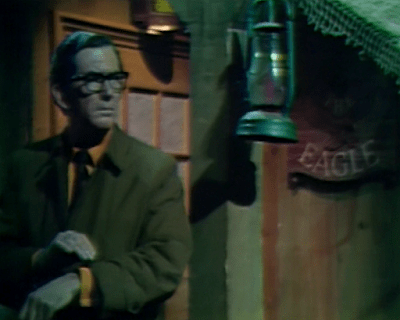
After Larry goes, Cyrus takes the potion, that is, puts on his disguise. He goes to the alley next to the Eagle, in which the sign for the Greenfield Inn hangs. He corners Gladstone there. He beats Gladstone to the pavement with his heavy cane. Gladstone begs for mercy, and Cyrus sneers at him. He releases the bayonet from inside the cane, stabbing Gladstone with it. The first time Cyrus took the potion, he had amnesia after he resumed his normal appearance, and we could believe that he was less than fully responsible for what he did while under its influence. But he has had his full memories on each subsequent occasion, and has shown pleasure when told of the harm “Yaeger” has done and the fear he inspires. By this point, we can classify Cyrus’ killing of Gladstone as nothing other than premeditated murder.
Cyrus doesn’t really surprise us by this act. It is Larry who does something we would not have expected. While Gladstone is in the alley, Larry is already in front of the tavern. We see enough of the set that we cannot believe he is more than 30 or 40 feet away from Gladstone, just around the corner. Gladstone cries out when “Yaeger” attacks him. We cut to Larry, and see him react to that cry and start towards the alley. “Yaeger” stands over Gladstone and pontificates for a minute or two before stabbing him. Even after that, “Yaeger” still has time to get most of the way out of the alley before Larry finally arrives. It took Joshua Collins less time to get from the abode of the dead to the drawing room at Collinwood than it takes Larry to walk the few steps from the sidewalk to the alley. Maybe he had to stop somewhere along the way to make some more announcements about a client’s business.
From the time he joined the cast of characters in April 1967, vampire Barnabas Collins has been the most famous thing about Dark Shadows. We haven’t seen him in over a month. He passed through a cosmic rift in #980, leaving his native universe behind and arriving in another “time-band” populated largely by counterparts of people he knew. In the original continuity, Barnabas was freed from his coffin when dangerously unstable ruffian Willie Loomis unchained it, believing he would extract from it a treasure in jewels that would make him rich. Here, Barnabas is trapped in his coffin when Willie’s counterpart, author William H. Loomis, chains it, believing he will extract a story from Barnabas that will make him rich.
We haven’t seen any of Will Loomis’ oral history sessions with Barnabas, since John Karlen and Jonathan Frid have both been in Tarrytown, New York. Along with many other key members of the cast, they have been filming their parts in the feature House of Dark Shadows. That production is nearing a wrap, and several other cast members have already come back. Today’s story is all about Barnabas’ impending return.
When Barnabas found himself in “Parallel Time,” the first person he met was Will’s wife, the counterpart of Barnabas’ distant cousin Carolyn Collins Stoddard. He told Carolyn that he was a descendant of the eighteenth century Barnabas Collins, of whom a portrait hangs in the foyer of the great house of Collinwood. In his own universe, that portrait does hang there, and it has been Barnabas’ letter of introduction to the Collinses more than once. But Carolyn told him there was no such portrait there or, so far as she knows, anywhere else. So he bit her and made her his blood thrall.
Indeed, the other day we saw the spot on the wall where Barnabas’ portrait hangs in the main continuity, and it was not there. Instead, there was a metallic decoration reminiscent of a coat of arms. That decoration hung there before Barnabas’ portrait first appeared in #204. So few of the people watching at this point in 1970 had been in the audience in early 1967, and so few of those would have made note of what was hanging on the walls, that I can’t imagine one viewer in ten thousand would have caught the reference during the first broadcast. None of the writers currently with the show was on staff then, nor was line producer Peter Miner. It’s one of those moments when I suspect director Lela Swift and art director Sy Tomashoff were decorating the set for their own amusement.
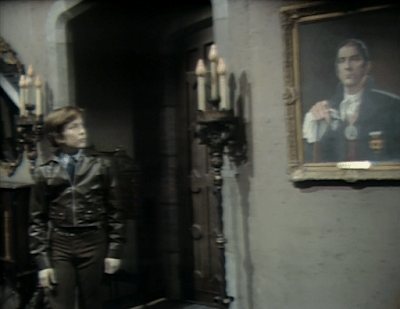
Today, a portrait of Barnabas has taken the place of the coat of arms. Children Daniel and Amy Collins found it in the attic of Will and Carolyn’s house, and for some reason housekeeper Julia Hoffman and butler Mr Trask decided to hang it up by the front door. It is a copy of the one we have seen over the last three years. It depicts Barnabas’ counterpart in this universe, a man who lived a quiet life and died a natural death in 1830.
The master of Collinwood, drunken sourpuss Quentin Collins, is shocked to see the portrait, and orders it to be removed immediately. Daniel’s counterpart, strange and troubled boy David Collins, had been the first to speak Barnabas’ name when he called Willie’s attention to the portrait in #205. Shortly after, Willie heard a heartbeat coming from the portrait, which led him to make his fateful trip to open the coffin. In this continuity, it is Daniel who hears the heartbeat, and he will today try to find and open the coffin.
Quentin has caught two glimpses of the other universe in the room in the east wing that was his late wife Angelique’s bedroom. Unknown to Quentin, Angelique has returned from the dead and murdered her identical twin sister Alexis. Quentin thinks that it is Alexis who is his guest in the great house, staying in her sister’s old room. When he tells her today what he saw, “Alexis” thinks he is losing his mind. But she then sees the phenomenon herself. She sees Hoffman’s counterpart calling for Barnabas, as Quentin had seen her talking about Barnabas’ “terrible curse.” “Alexis” and Quentin decide that they and Hoffman should have a séance to contact the spirit of the Barnabas Collins who died in their universe in 1830, the only Barnabas Collins they know of.
In the main continuity, séances are a frequent occurrence; we have seen fourteen of them there, and heard a detailed account of a fifteenth. In the early days, there was always one participant who tried to break the circle, only to be sternly reproved by the leader. The characters stopped doing that as they got to be familiar with the procedure, but séances are rarer in this universe. As things start to get interesting, Hoffman can’t take it anymore. She breaks the circle and runs out. “Alexis” says that the presence she felt is gone. But then a ghost materializes in the corner of the room.
Chemist Horace Gladstone has been selling a strange and powerful synthesis of his own invention to Cyrus Longworth, an independent medical researcher. Cyrus refuses to tell Gladstone what he is using the synthesis for. Gladstone has now figured it out for himself. Cyrus has concocted a potion which he drinks to change his appearance, disguising him so effectively that even the people who know him best do not recognize him. In that disguise, Cyrus calls himself “John Yaeger,” spends a lot of money, and indulges his sadistic impulses.
Gladstone comes to Cyrus’ lab and tells him what he knows. Cyrus tries to deny that he is Yaeger, and Gladstone lists the evidence he has collected proving that he is. Gladstone tells Cyrus that he doesn’t believe he can do without the thrills he gets from his activities as Yaeger. The story has been crafted as an account of addiction, so returning viewers are sure Gladstone is right. He says he will go on serving as Cyrus’ connection for the drug he craves, but the price has gone up. He demands $10,000.
Cyrus first learned Gladstone’s name from his late friend Angelique Stokes Collins. Angelique was a woman of vast learning in a variety of fields, much like the title character in Edgar Allan Poe’s story “Ligeia.” Also like Ligeia, Angelique has returned from the dead. She is now back in the great house of Collinwood, impersonating the identical twin sister whom she murdered on the night of her resurrection, and occupying her old room as the guest of her widower, drunken sourpuss Quentin Collins.
Cyrus calls Gladstone a blackmailer. In reply, Gladstone makes a cryptic remark: “Why do you think my number was in Angelique Collins’ phone book? She’s led many lives. Each person only gets one. Good night.” We have indeed been wondering how Angelique came to know Gladstone, and now we wonder if he is aware of just how literally true it is that “She’s led many lives.” It doesn’t make any sense to follow “She’s led many lives” with “Each person only gets one,” but actor John Harkins was so precise in his delivery that I’m sure that was the scripted line. If there was a slip, it came from Sam Hall’s typewriter, not from Harkins’ tongue.
If it isn’t a slip, I think we would have to go out on a limb to explain what Gladstone could mean. Angelique built up a cult around herself, including several people who were firmly convinced that she was going to rise from the dead. When her sister Alexis came to Collinwood, housekeeper Julia Hoffman, sleazy musician Bruno Hess, and Angelique and Quentin’s son Daniel were certain that the prophecy had been fulfilled and they were seeing Angelique redivivus. This was also the first thought that came to Cyrus, to Quentin’s brother Roger, and to Angelique’s Aunt Hannah, though they were more easily persuaded that Alexis was a separate person. The cultists are impressive enough in their certainty that even people outside their ranks were sure Alexis was Angelique returned from the grave. Daniel’s cousin and playmate Amy Collins was horrified to see her for that reason, and Quentin’s second wife, the former Maggie Evans, fled the house in part because she could not shake her belief that Alexis was Angelique.
If Gladstone is familiar with Angelique’s cult and has been involved with it, he might be saying that each person gets to participate in only one of Angelique’s lives. We’ve already seen that is not the case, but that doesn’t mean he doesn’t think it is. Angelique may at some point have taught her followers a doctrine like that. While Hoffman, Bruno, and Daniel expected Angelique to come back and rejoin them, Cyrus, Roger, and Hannah were unsure they would see her again, even though they were certain that she was not simply dead. Indeed, Angelique is still telling her most of her devotees that she is Alexis. The only one to whom she has fully revealed herself is Hannah. Perhaps she had a plan to transcend death, but did not know just how it would work. Or perhaps she has decided the rest are not yet ready to be initiated into the esoteric truth of her return.
Sam Hall was a serious Lutheran, so much so that he insisted Shirley Grossman convert from Judaism before she married him and became Grayson Hall. Christian studies in twentieth century academic institutions were largely taken up with speculation about differences of opinion in the church before the codification of the New Testament and the formulation of the creeds. This sort of thing is still prominent in divinity schools today, and is often heard from pulpits in mainline Protestant denominations. Hall must have been familiar with it, so he probably gave it some thought when he spent Easter season 1970 writing scripts about a figure whose followers sort of expected her to rise from the dead and who surprised them by the way in which she actually did so. I doubt he was making any particular point about the various schools of thought that seminary professors postulate in the primitive church, but when he presents Angelique’s cult as divided into several strains of opinion from the start he is developing an idea that he did not have to invent himself.
We cut from the scene between Cyrus and Gladstone to the basement of Collinwood. Angelique leads Quentin to a little chamber hidden behind an alcove. A human skeleton stands in the chamber. You may wonder how a skeleton can stand, but Quentin doesn’t. He is too busy being surprised that he didn’t realize this chamber was in his basement.
The skeleton is that of Dameon Edwards, a friend of Angelique’s who went missing about a year before. Dameon’s ghost has been haunting the place for a couple of weeks. Angelique tells Quentin that Hannah found the skeleton and exorcised the ghost. Yesterday, we saw Angelique exorcise the ghost. Returning viewers know that she is giving credit to Hannah because she is masquerading as Alexis, who did not share her sister’s interest in the occult or her aunt’s. Quentin thinks that Bruno probably killed Dameon. Indeed, the ghost confirmed this yesterday. Quentin very much wants to get rid of Bruno, so you might think he would be interested in bringing a murder charge against him. But he decides that would be too much trouble, and it hurts his feelings when “Alexis” snaps at him that he shouldn’t be wasting his time reporting Dameon’s murder when he isn’t doing anything to investigate Angelique’s. So he calls Cyrus, and the two of them bury the bones on the grounds of the estate.
Meanwhile, two long-absent characters have returned from trips out of town. Quentin sent Hoffman to visit friends of hers in Boston because she kept antagonizing Maggie. Quentin’s sister Elizabeth Collins Stoddard also went away for a long stay in New York, where she visited Maggie. In off-screen reality, Grayson Hall and Joan Bennett were both in Tarrytown, New York with several other cast members, working on the feature film House of Dark Shadows. Liz complains that Hoffman didn’t meet her at the train station with a car, and Hoffman explains that she just got back herself.
Hoffman says she missed Collinwood terribly while she was in Boston; Liz says she can’t understand that. If she were in Quentin’s place, she would sell the house and move to the city. That will interest longtime viewers. For its first 196 weeks, Dark Shadows was set in a parallel universe, where Liz’ counterpart owned Collinwood. When the show started, she was a recluse who hadn’t left the house for eighteen years. Her brother Roger often urged her to sell the place so that they could live someplace less gloomy, but even after she stopped being a recluse Liz wouldn’t hear of that. She was a symbol of the family’s commitment to the house. We have already seen that this Liz is the opposite of her counterpart in other ways, and now we wonder how far they will take that mirror image motif.
Angelique is in the foyer, talking on the telephone to Hannah. Villains on Dark Shadows have remarkably little sense of OpSec, and this is a case in point. Quentin, Liz, and Hoffman are a few feet away from her in the drawing room, and each of them knows that Alexis and Hannah couldn’t stand each other. All Angelique has to do is call Hannah by name and she will raise their suspicions. Yet not only does she use Hannah’s name several times, she uses one incriminating expression after another about how no one will suspect what they are up to. If any of them listens in, or of anyone else in the house happens by on their way to the front door, Angelique will have tipped her hand.
It is Hoffman who eavesdrops on the call. After Angelique catches her, they have an awkward exchange and Hoffman goes upstairs. Angelique then stands at the door to the drawing room and eavesdrops on a conversation between Liz and Quentin. Liz wants Quentin to go to New York and ask Maggie to come home, he throws a tantrum and says that Maggie is too childish for him to do such a thing.
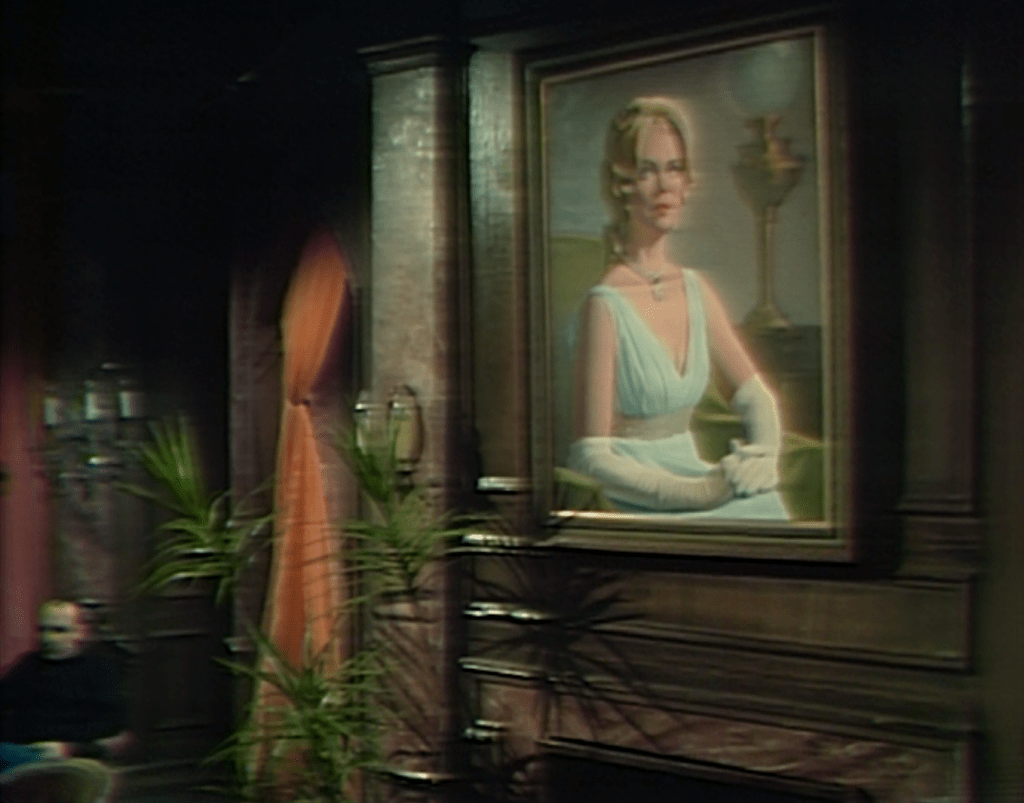
Hoffman is in Angelique’s old room, talking to the portrait of her that hangs there. The members of Angelique’s cult make a practice of coming to the room and carrying on conversations with the portrait; when Alexis was staying in the room, she sometimes walked in on them while they were confiding their thoughts to it. Angelique eavesdrops on the last part of Hoffman’s account that when she was in Boston, she felt a mystic assurance that when she returned to Collinwood she would find Angelique come back to life. When Hoffman says that everything seems to be the same as it was when she left, she is close to tears.
The resurrected Angelique eavesdrops on Hoffman’s conversation with the dead Angelique. Screenshot by Dark Shadows Before I Die.
Angelique takes a step forward, and Hoffman realizes she is not alone with the portrait. She apologizes to “Alexis,” and Angelique says she needs a friend she can trust. Hoffman claims to be such a friend. “Alexis” then launches into her reasons for believing that Angelique was murdered. After the first couple of sentences, returning viewers know what she is going to say, so we dissolve to Quentin and Cyrus in the drawing room.
Quentin and Cyrus have just buried the skeleton, prompting Quentin to feel sorry for himself. He then tries to explain to Cyrus something extremely weird he saw the other evening. He went to Angelique’s old room to see Alexis. He opened the door, and saw a space that lacked the room’s furniture, lights, and decor. He saw two children whom he took to be Daniel and Amy, and they said something about Barnabas Collins. The only person of that name of whom Quentin or Cyrus is aware died in 1830, but the children were talking about someone they knew. An invisible barrier kept Quentin from entering the room, and he could not attract the children’s attention. Regular viewers know that Quentin was catching a glimpse of the other continuity, and that the children were not Daniel and Amy Collins, but their counterparts David Collins and Amy Jennings. Cyrus hasn’t been watching the show, so all he can do is suggest Quentin take a vacation.
They’ve been experimenting with videotape editing, and they make a jump cut from the drawing room scene with Quentin and Cyrus to Quentin walking up to the doors of Angelique’s room. The effect is startling, I suspect intentionally so. Quentin opens the doors, and again sees the other universe.
This time Quentin sees the counterparts of Liz and Hoffman. As David and Amy had been, they are talking about Barnabas, who was last seen in this room. Hoffman, whom Liz addresses as Julia, says that they must keep the room open so that Barnabas will have a chance to return to them. She says she wants to stay there, because it makes her feel close to Barnabas. Liz excuses herself, and Julia calls out to Barnabas. As Hoffman had grown emotional talking to the Angelique whom she believed to be absent, Julia grows emotional when she talks to the missing Barnabas. She looks at the hallway, seeing not Quentin but the dark, empty space that is there in her universe. She asks if Barnabas is there, watching her. Grayson Hall plays these two scenes so similarly that we can have no doubt that whatever the one Julia Hoffman feels for Barnabas, the other feels for Angelique.
Quentin calls out to Hoffman’s counterpart, as he had called to Daniel and Amy’s counterparts. As the children had been unaware of his presence, so this other Julia Hoffman is unaware of him. And as Daniel and Amy had come to the hallway and asked why he was shouting for them, Hoffman comes to the hallway and asks why he is shouting for her.
We are in the fifth week of a segment set in a different universe than the one where Dark Shadows spent its first 196 weeks. There are enough stories to keep everyone busy all day every day, and almost all of those stories are working quite well right now.
The only exception is the one that dominates the action today. In #994, we learned that a man named Dameon Edwards used to be a frequent visitor to the great estate of Collinwood. Dameon hasn’t been seen or heard from in about a year. He’s dead, as it happens, and his ghost has been popping up and making various people uncomfortable.
Since the first thing we had ever heard about Dameon was that he was dead, we were off to a rocky start with him. The main continuity had a great success with Quentin Collins, who was introduced the same way. But Quentin was not only a member of the Collins family that is central to the show, he figured first as a series of weird and frightening events in the lives of children David Collins and Amy Jennings, characters we know and care about. Dameon’s only background is that he was one of many ex-boyfriends of Angelique Collins, the late and recently reanimated wife of Quentin’s counterpart. His actions are just a bunch of not-particularly scary special effects that are witnessed by people who have either been brought on so that they can worry about them, such as sleazy musician Bruno Hess and uptight butler Mr Trask, or who have bigger problems, such as Quentin and Angelique.
I’ve speculated in previous posts that this was not the original plan for Dameon. Maybe they planned to develop more of a connection between him and the action, and just couldn’t fit the necessary material into the first 13 scripts of the “Parallel Time” segment. Or maybe they did not intend to introduce a new character, but the counterpart of someone we know from the other continuity. Whatever they may have hoped to do, what they actually did falls absolutely flat.
To the extent that Dameon is the counterpart to anyone in the other continuity, it would be Quentin’s ghost. Indeed, today he leads Parallel Quentin to a room that reminds us of the one from which Quentin’s ghost began his reign of terror in late 1968 and early 1969. As 1969 went on, the living Quentin became an important character. Due to a trip back in time and some magic, he was prevented from dying and immunized against aging. The people he had haunted remembered the ghost, but the living Quentin was also around. Eventually they started to treat the ghost as a separate being from the Quentin who was a regular fixture of the cast of characters. So I suppose they might have intended to have Quentin’s ghost cross over into the current continuity, confusing David Selby when he saw himself wearing mutton chop sideburns, a Victorian-era suit, and a sardonic grin while he refused to speak. But that kind of thing was still a stretch for viewers when they did it on Twin Peaks twenty years later, and would have been a big ask for a daytime audience to follow in 1970.
There are a number of buildings on the estate of Collinwood. There is the Old House, a big mansion where the Collinses lived until the 1790s, and the great house, an even bigger mansion where they have lived since. These days, the Old House is home to hard-drinking writer William H. Loomis and his wife, the former Carolyn Collins Stoddard. Sometimes the place is called “Loomis House” in recognition of its inhabitants. We learn today that the Loomises have a servant. His name is Wilfred Block, but everyone knows him as Fred.
Fred hears some noise coming from the attic. He goes up there and finds two kids who belong at the great house. They are Amy Collins and her cousin, Daniel Collins. Amy is out cold, and Fred asks Daniel what he did to her. Daniel claims to be innocent. He says that Amy just looked at a portrait and fainted. That’s the sort of thing the Collinses do all the time, so Fred accepts it. He carries Amy back to the great house. Daniel follows.
There, Daniel tells his father, Quentin Collins, the same story he told Fred. Fred tells Quentin that he couldn’t get any answers out of Amy. She just kept repeating the words “chained” and “trapped.” Quentin thanks Fred.
On his way out, Fred sees a woman whom he greets as “Miss Alexis.” He tells Alexis that he misses her visits to the Loomis House. She walks up very close to him and says she is feeling cold. He says he knows what to do about that, and hugs her. She holds the embrace for quite a while. He says he’s wanted to do that ever since he first saw her. She tells him to kiss her. Before he can comply, they hear Quentin coming. They separate and look nonchalant. Quentin is surprised Fred is still there. Fred hastens out.
Later, Alexis’ aunt, Hannah Stokes, would go to Fred at the Loomis House and ask him to come to her place, telling him Alexis wanted to see him there. That scene took place out of our view. The next time we do see Fred, Hannah is leading him into her parlor. Fred tells Alexis that he’d been planning to see her at Collinwood, but she says it is better at Hannah’s. Hannah leaves them alone together. They embrace, and Fred kisses Alexis. He feels cold. She tells him he will go on feeling cold, but bids him embrace her again. He does. He collapses.
Hannah was close to one of her nieces, Quentin’s late wife Angelique Stokes Collins. But she never got along with Angelique’s identical twin sister Alexis. Angelique had shared Hannah’s interest in the occult, and had been her pupil in that area, while Alexis scorned such matters. Alexis came to stay at Collinwood four and a half weeks ago, and spoke to Hannah only once during that time, when Hannah invited herself to the great house. That was a tense meeting which ended with Alexis all but ordering Hannah to go.
Hannah is taken aback today when she answers her door. She sees Alexis. She makes sarcastic remarks about Alexis, which do not deter her visitor from entering. The visitor asks Hannah to tell her fortune. Hannah resists, but the visitor keeps telling her it is something she wants very much. Hannah starts laying out the Tarot, but the first two cards disturb her so deeply she stops and cannot be persuaded to resume. She tells her visitor that they mean that she has no future. The visitor responds with a placid look and an insistence that Hannah read her palm. Hannah does not want to see the same message there, but the visitor will not be denied. When she looks at her palm, Hannah has a realization. “You are not Alexis! You are Angelique!”
Hannah is horrified that Angelique has returned from the dead. She does not want to know how it was done. Angelique seems eager to tell her everything; if Hannah were willing to listen, she might even volunteer that she murdered Alexis by draining the warmth from her body to heat her own undead frame. Angelique asks Hannah to bring her up to date on some things that happened while Alexis was at Collinwood and she was in the tomb. She then explains that her own death was also a murder, and that she wants to avenge it, though she does not yet know who the murderer was. She also has plans for Quentin, though she does not make it clear at this time what those are. She tells Hannah to bring Fred to her so that she can drain the warmth from him. Hannah protests, but Angelique tells her she has no choice. If she does not deliver Fred to her, she will haunt Hannah as long as Hannah lives.
After Fred collapses, Angelique calls her aunt back to the parlor. She tells her that she is all right now. Hannah finds that Fred is dead. Angelique agrees that he is, and repeats that she is warm again. She goes on: “That’s the way it must be now. This is the way I will live now. And when Quentin comes to join me, he will live this way, too. For eternity.” Evidently she is now a vampire, only instead of blood she drains heat from her victims. Also, she will be killing someone every 24 hours. Collinsport has been established as a very small town, so if she and Quentin are both going to be keeping up that pace it’s hard to see how it can last even for a year, let alone for eternity.
Quentin Collins
Quentin does not suspect that Angelique has risen from the dead, killed her sister, and taken her place. He has problems of his own. At the beginning of today’s episode, he is standing at the door to Angelique’s old bedroom in the east wing of Collinwood, where Alexis stayed during her visit and which Angelique now occupies again under Alexis’ name. He is looking into the room, but does not see it. Instead, he sees an entirely different space. Unlike Angelique’s richly decorated room, it is bare and dark.
Quentin sees two children in the room. They look and sound exactly like Daniel and Amy, though they are wearing clothing he does not recognize. He calls the names Daniel and Amy, but even though they are just a few feet away from him they do not seem to hear him or to be aware of his presence. An invisible barrier of some kind keeps him from entering the room.
Though the children cannot hear Quentin, he can hear what they are saying. The boy says that according to his father, “Dr Hoffman” said that “Barnabas got caught” in the room. The girl is alarmed and says that she does not want to get caught. She does not want to be in the room at all, but would rather be asleep in bed.
Quentin keeps calling the names Daniel and Amy. After a moment, he hears Daniel’s voice coming from somewhere other than the room. He turns, and sees Daniel and Amy standing behind him in the hallway. They don’t know what he is talking about when he asks them if they have been in the room, and he doesn’t know how to explain what he saw.
The Hoffman likeliest to come to Quentin’s mind is Julia Hoffman, Angelique’s fanatically devoted servant, who is the housekeeper at the great house of Collinwood and is certainly not a doctor. The only Barnabas he can think of is Barnabas Collins, an ancestor who died in 1830 and who was the subject of a biography Will Loomis wrote five years ago. Amy has told him that Will has started another book about that Barnabas. Quentin read Will’s original book, and was puzzled as to what could possibly be left to be said about its subject. So the conversation he has overheard makes no more sense to him than does the setting in which it took place.
Quentin shoos the children away and goes into the room. It is furnished as it always is. Angelique, whom he believes to be Alexis, is lounging in the middle of it. He tries to explain the phenomenon to her, and she does not take him at all seriously. He tells her enough that she should know that if it was an hallucination, it was a remarkably involved one, the sort that occurs only to people with grave mental illnesses. Even so, she could not be less interested in it. She wants to know what Quentin is doing to investigate her murder. He says that he doesn’t believe Angelique was murdered, to which she replies that he is a fool. This conversation does not have an obvious track forward, and Quentin quickly excuses himself.
Barnabas Collins
Barnabas Collins went to the island of Martinique in the 1790s on a business trip for his father’s shipping concern. While there, he met two lovely young women. One was Josette DuPrés, daughter of the richest sugar planter on the island. He was captivated by Josette, but did not believe she could love him. Josette’s aunt, the exiled Countess DuPrés, had brought a lady’s maid with her when she escaped from the French Revolution. This maid, named Angelique, was quite as beautiful as Josette, and made it clear that she was available to Barnabas. He consoled the sadness that he felt when he supposed Josette to be unreachable in a light-hearted love affair with Angelique. When it turned out that Josette was not unreachable at all, he forgot about Angelique and turned to her. Soon, he and Josette were engaged to be married.
When Josette and her father came to Collinwood for the wedding in 1795, the countess and Angelique came along. Angelique was sure that Barnabas was marrying Josette only to conceal his true intention, which was to keep her as his real partner. When she discovered that this was not the case, Angelique vowed to do something about it. She had learned black magic, and was ready to wreak a terrible vengeance.
Angelique managed to end Barnabas’ engagement to Josette, and had caused many disasters by the time Barnabas agreed to marry her. Before long, he discovered that she was a witch. He made several farcically inept attempts to kill her. When he shot her with a gun, she thought he had succeeded. As she lay bleeding, Angelique cursed Barnabas to become a vampire. It turned out her wounds were only superficial, but the curse was not. Barnabas was eventually trapped and chained in his coffin until 1967, when he was accidentally freed once more to prey upon the living.
That Barnabas Collins was not the one Will wrote his 1965 book about, and that Angelique is not the one who has returned from her coffin to stay in Quentin’s house. They were residents of a parallel universe. It was in their universe that the first 196 weeks of Dark Shadows took place. There, the east wing of Collinwood has long been vacant and disused. Barnabas happened to be there when the bare dark room Quentin sees today was replaced by Angelique’s room from this universe. He and several other residents of the original continuity saw the phenomenon a number of times over the next few days.
Barnabas became preoccupied with the forlorn hope that if he could enter the other “time-band,” he might be freed of the vampire curse and become human again. His closest friend, mad scientist Julia Hoffman, MD, tried to dissuade him from this plan, but he was nothing daunted. Barnabas finally did manage to find a way through the barrier.
Once in “Parallel Time,” Barnabas’ hopes were instantly disappointed. He was still a vampire. The first person he met was Carolyn Stoddard Loomis. He bit her and made her his thrall. Will found out about this very shortly after, and trapped Barnabas in a chained coffin. He is using him as a source of material for a new book.
The children Quentin saw talking about Barnabas were not Daniel and Amy Collins, but David Collins and Amy Jennings from the main continuity. They don’t know that Barnabas is a vampire; so far as they are concerned, he is their kindly cousin from England, an old world gentleman with some eccentric habits.
Amy Collins
Amy had stayed with the Loomises for a few days recently when there was some trouble in the great house. She took Daniel to their attic because she wanted him to join her in her favorite pastime while she was there, going through the trunks. Daniel declares that only girls would be interested in an activity like that. Amy doesn’t refute his claim when she says that the trunks have all sorts of interesting old stuff in them, such as dolls.
Daniel asks Amy about the basement of the Loomis House. She tells him that Will has the only key, and that he refuses to let even Carolyn go down there. We know that the basement is where Will keeps Barnabas’ coffin. Daniel says that there is a tunnel that leads from the beach right into the basement, and that he likes to play there. He says that it has been sealed up lately, but suggests Amy come with him to unseal it and explore. She says “Not at night,” and turns away. He calls her a scared-y-cat. Longtime viewers know that the same tunnel exists in the main continuity and that it has been a hugely important part of the story more than once, and will wonder if they can again match the excitement associated with it in those past episodes.
Amy tells Daniel that there is a sword somewhere in the attic, a real one. This does not exactly thrill Daniel, but at least he asks if it is a saber or a fencing foil, which is more than he had to offer in response to the prospect of digging up some antique dolls. He goes to look for the sword behind some paintings. When he turns up the portrait of Barnabas Collins, he hears a heartbeat. Longtime viewers will remember that characters have several times heard a heartbeat when looking at the portrait of Barnabas in the main continuity, and that this means that Barnabas is going to be on the show before much longer. Amy can’t hear the heartbeat, but she does have a strong reaction. It is at this point that she faints and the ill-fated Fred enters.
Regular viewers know that Amy’s muttering of the words “chained” and “trapped” mean that she has a mystical perception of Barnabas’ situation. But Quentin doesn’t have the slightest idea what to make of it. Amy comes to in the drawing room and tells Quentin that when she saw the eyes in the portrait of Barnabas, she realized he needed help. Quentin says that Barnabas has been dead for a very long time.* Amy says she knows, and leaves it at that.
Ben Stokes
In the 1790s, the Barnabas of the main continuity befriended much-put-upon indentured servant Ben Stokes. Barnabas’ father, haughty overlord Joshua Collins, made Ben’s life miserable. Barnabas took pity on Ben, teaching him to read and write and standing up for him when he was wrongly accused of misconduct. In return, Ben gave Barnabas his absolute loyalty.
When Angelique came to Collinwood in 1795 and hatched her evil schemes, she decided she needed a henchman. She chose Ben. She pretended to find Ben attractive. He matter-of-factly walked up to her and took hold of her, as if women who look like movie stars come on to indentured servants every day. She soon used his excitement to cast her spell on him. He found himself helping Angelique to do great harm to Barnabas and everyone he cared about, grieving him very deeply.
Eventually, Ben broke free of Angelique. He went on to be freed from his indenture and to have children. One of his descendants is Professor Timothy Eliot Stokes, an expert on the occult and a frequent ally of Barnabas and Dr Hoffman.
Fred’s response to Angelique today reminds us of Ben so long ago. Once Ben gathered that Angelique was propositioning him, he didn’t see any need to talk at all. They both had work to get back to, so he was ready to get down to business straightaway. But Fred keeps telling Angelique how beautiful she is and how he always hoped something would develop between them. His dialogue and Edmund Hashim’s delivery of it are as realistic and unadorned as Angelique’s lines and Lara Parker’s style are florid and over the top. The contrast is deliberate, as the contrast between the monosyllabic working-class “Fred” and the ornate and ethereal “Angelique” is deliberate. Just as Ben did not know what kind of world he had stumbled into when he reached for the original Angelique, Fred has no idea that he lives in a place where beings such as this Angelique can exist.
When Barnabas first came to this universe, Carolyn Loomis told him that Angelique and Alexis were the daughters of “Tim Stokes,” the counterpart of his old acquaintance Timothy Eliot Stokes. We have yet to see Tim Stokes, but we can be sure he will played by Thayer David. We know what Thayer David looks like. Alexandra Moltke Isles, who was in 333 episodes as well-meaning governess Victoria Winters, dated critic John Simon in the 1970s. Simon was a college classmate of Thayer David, and told her that in their day David was “the handsomest man at Harvard.” When I mention that to my wife, Mrs Acilius, she says that those must have been rough days for Harvard. David may have been better looking before he put on weight, but he never bore anything that could be mistaken for a family resemblance to the dazzling Lara Parker.
Longtime viewers, thinking back to what we saw when the show was set in 1795, might have an idea. Will’s book proves that the timelines diverged in the 1790s, when the Barnabas of the current timeline left Angelique alone and had a happy marriage with Josette. Perhaps in that continuity Ben really did pair off with Angelique. If so, Angelique and Alexis might be their descendants. They were lucky to inherit all of the genes governing their appearance from her.
The thought of the counterparts of Ben and Angelique as the forebears of the Stokes family in the current continuity might shed some light on its members. We’ve heard not only that Hannah and Alexis had no use for each other, but that Alexis and her father have not spoken for a long time. Like Hannah, Tim shared Angelique’s interest in the occult and doted on Angelique, while scorning Alexis. The new Angelique certainly qualifies as the Evil Twin, and is very much a continuation of the Angelique we already know from the main continuity. From what we know about them, Hannah and Tim seem to be the sort of people Angelique would naturally turn to for help in her deadly doings.
As for Alexis, she seems to have set her cap for Quentin, and succeeded in driving Quentin’s current wife Maggie out of Collinwood when she caught Alexis and Quentin in rather a compromising position. Alexis kept saying it would be easier for the new Mrs Collins to come home if she were to leave, but she never did leave. On a conventional soap, Alexis would have the makings of a Vixen, but it takes more than husband-stealing to join the ranks of the villains on Dark Shadows. Alexis would seem to take more after Ben, who had been indentured because he was a thief and was bewitched by Angelique because he disregarded sexual morality. She may have those sorts of flaws, but compared to the evils around her they seem like minor foibles indeed.
Edmund Hashim
Fred is played by character actor Edmund Hashim, making his only appearance on Dark Shadows. Hashim does a fine job. Fred had to be played with strict naturalism, so that the only resource Hashim could draw on to hold anyone’s attention against the flamboyant Parker was skilled and truthful acting. He pulls it off. It’s a shame we won’t see him again. He died in 1974 at the age of 41, one of the first cast members to pass away. The only ones who predeceased him were Fred Stewart (1970, aged 64,) House Jameson (1971, aged 68) George Mitchell (1972, aged 66) and Patrick McVey (1973, aged 63.)
*In fact, he says that Barnabas has been dead for “over 200 years.” It’s 1970, as the wardrobe makes unmistakably clear, and they have explicitly said that the Barnabas Quentin has heard of died in 1830. So he’s bad at math.
Medical researcher Cyrus Longworth has invented a potion which, when he drinks it, darkens his hair, causes him to grow more of it, and adds to his muscle mass. When he is in this state, Cyrus calls himself “John Yaeger.” Yaeger serves Cyrus as a very effective disguise. The other day, he ran into his old friend Quentin Collins while he was presenting himself as Yaeger. Quentin did not suspect that the man he was talking to was Cyrus.
Cyrus uses Yaeger to escape responsibility for violent crimes. He has started a couple of bar fights in the Eagle tavern. Barmaid Buffie Harrington has drawn Cyrus’ special attention; he hit her, twisted her arm, choked her, and threatened worse when he was alone in the tavern with her, and he has since taken an apartment in her boarding house. Cyrus has also beaten Buffie’s sometime boyfriend Steve so severely that he put him in the hospital. Cyrus was choking Steve when he heard a police whistle and ran away. It looked like he would probably have murdered him if the police had been a minute later. When Buffie saw Cyrus in his undisguised form and told him of the cruelty she and Steve had suffered at Yaeger’s hands, Cyrus barely bothered to conceal his pleasure. When Buffie asked Cyrus if Yaeger worked for him, Cyrus was delighted to say that he did.
We open in the drawing room of the great house of Collinwood, where Cyrus is waiting for Quentin. All of a sudden Cyrus starts to transform into Yaeger. This is the first time the transformation has taken place spontaneously, without a fresh dose of the potion. Cyrus leaves a note, then jumps out the window and runs away.
In his laboratory, Cyrus is about to drink the antidote to restore his usual appearance. He decides he would rather have some more fun as Yaeger first and puts the antidote back. His fiancée and lab assistant Sabrina Stuart comes downstairs. She has not seen Cyrus as Yaeger before, and is completely fooled by the disguise. She has heard the name John Yaeger in connection with recent strange behavior on Cyrus’ part, and is stern with him. Regular viewers know how brutal Cyrus is with Buffie, and we fear that he will mete the same treatment out to Sabrina. But he does not do so, not this time. He insists that Cyrus wants him to wait in the laboratory, and Sabrina leaves him alone there. After Sabrina exits, he takes a painting from the wall and goes.
Cyrus takes the painting to the apartment he has rented in the name of Yaeger. Buffie comes to him there. He harries her about her visit to him when he looked like his usual self and she knew him as Cyrus. He says she told Cyrus she likes a quiet man. He walks up to her, talking all the while about how quiet he can be. He gets quieter and quieter until he brings his hand across her face with full force. The next we see, she is bruised and cut, her clothing badly torn. Christopher Pennock and Elizabeth Eis play these moments very well. They are really hard to watch.
Cyrus gives Buffie the painting from his laboratory. He asks her if she wants him to take her someplace nice, with good food and a sophisticated atmosphere. She perks up and is enthusiastic. He then points out that she is covered in bruises and abrasions and wearing damaged clothing. He ridicules the idea that she could be seen anywhere looking like that, and taunts her with imprecations to take better care of herself. She leaves, hanging her head and carrying the painting. Cyrus laughs, relishing the misery he has inflicted on Buffie.
Cyrus rejoices to have battered and humiliated Buffie.
As Cyrus, whether he has red hair, a white coat, and a diffident manner, or black hair, a mustache, and a sadistic swagger, Pennock has a relatively straightforward job to do. He is to embody a total rat bastard, one who pretends to be nice when he might be held accountable for his actions and who exults in hurting people when he thinks he can get away with it.
Eis has a trickier assignment. When we first saw Buffie, she was cheerfully fending off Steve’s clumsy advances. Even after she had seen Cyrus, as Yaeger, outfight many strong men, she still stood up to him and spoke her mind. But now he has harmed her again and again, and she just keeps coming back for more. It would be depressing to see anyone fall into that pattern, but it strips us of all hope when we know the person to be so lively and dynamic. That’s the point, I think, and Eis doesn’t let us off the hook. Buffie still holds her head up, she still looks Cyrus in the face, she still speaks in a mature tone of voice when she protests against his abuse. But even so, whatever masochistic fascination is at work has such a grip on Buffie that she will not walk away from a situation that is already intolerably bad and can only get worse.
A Window Into This World From That
We are currently several weeks into a segment set in a different continuity than the one where Dark Shadows spent its first 196 weeks. Vampire Barnabas Collins brought us here. Barnabas discovered that a room in the long-disused east wing of the great house of Collinwood was the site of an inexplicable phenomenon. When he opened the doors to the room, he usually saw it as it was in his universe, a dark space with bare floors and undecorated walls. But once in a while, it appears to be brilliantly lit, fully furnished, and the setting of frequent meetings among people who look and sound just like his acquaintances, but who are living different lives. Through an invisible barrier, Barnabas could see and hear those people, but he could neither pass through the barrier nor attract the people’s notice.
Barnabas became obsessed with the forlorn hope that if he could pass into the other universe, he might be free of his curse and become a living man once more. Other characters from the main continuity joined him in watching their counterparts in the other world; few of these knew that Barnabas was a vampire, but all of them could see that the phenomenon had some obscure significance special to him, and were concerned that he was going to do something dangerous. In #980, Barnabas managed to make his way through the barrier, only to find that he was still a vampire. He bit the first person he met, and shortly after was chained in a coffin by her husband. He has been trapped there ever since.
The room on which Barnabas and others in the main continuity had been spying in the days before he crossed over has been a major set in the “Parallel Time” segment, and every time we see it we wonder if those others are still watching. Today, we intercut with the original “time-band.” Quentin goes to the room, and finds the bare dark space it represents in the main continuity. He sees two children there, whom he takes to be his son Daniel Collins and Daniel’s cousin Amy Collins. The boy is telling the girl that “Dr Hoffman” told his father that Barnabas got caught in that room. The girl responds that she certainly does not want to get caught, and she wants to leave at once. Quentin calls Daniel and Amy’s names, and is puzzled that the children do not react. He hears Daniel’s voice coming from behind him. He turns and sees Daniel and Amy standing in the hallway, asking why he is calling their names.
This is the first indication we have had that the main continuity is ever visible from this one. We are left wondering if the traffic between the universes can go both ways, and if so whether this continuity and the original one will in some way merge together. Cyrus’ attack on Buffie and her response to it were so difficult to watch that, done as well as the scenes were done today, they left us reluctant to tune back in tomorrow. The story of Buffie’s degradation at Cyrus’ hands can only become more depressing as it goes. But this new information about how “Parallel Time” works suggests such a wide variety of possible next steps that it sets our imaginations into overdrive, and we can’t wait to see which way we will turn next.
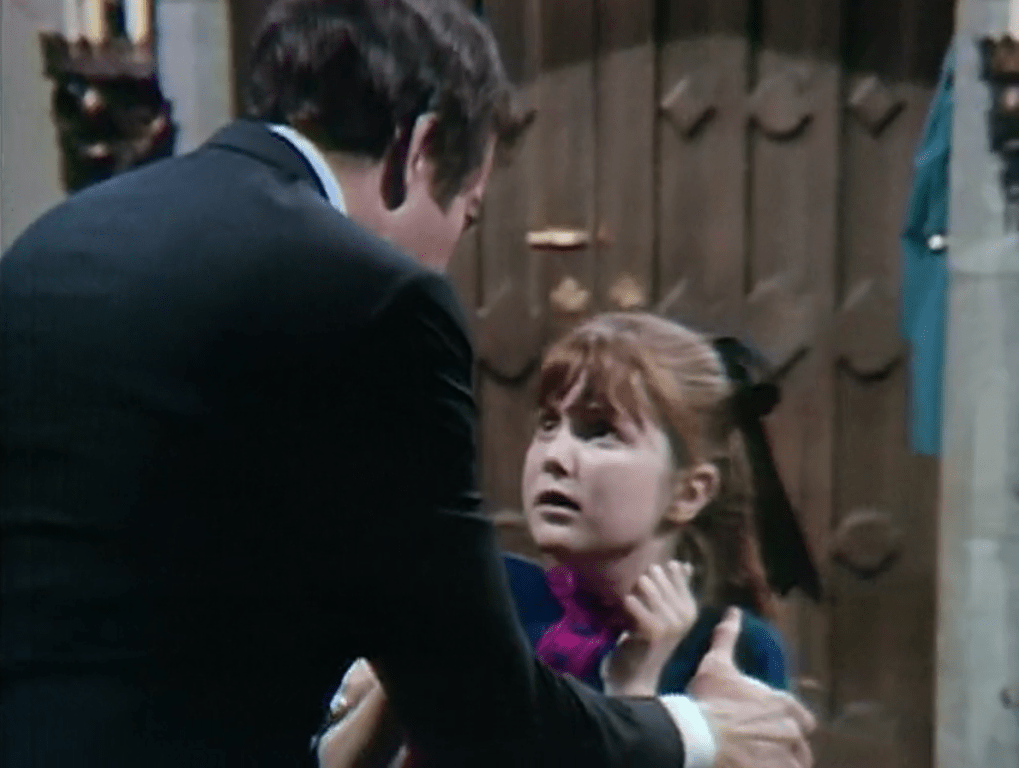
Trask the butler is surprised to see young Amy Collins in the great house of Collinwood. Amy’s cousin Quentin, the master of Collinwood, sent her to stay in the Old House on the estate, home to Will and Carolyn Loomis. The visibly uncomfortable Trask tells Amy she is not supposed to come back until Quentin sends for her. Amy says that she can’t stand it at the Loomises. Trask snaps at her for making life more complicated “at a time like this.” Amy asks what’s so unusual about this time, and Trask claims that he just means that he has been working hard. After an awkward silence, Amy asks if there has been any news about someone called Dameon Edwards. At Edwards’ name, Trask flies out of control. He grabs Amy by the shoulders, leans down so that his nose is in her face, and shouts that she has seen Edwards again. Terrified, she says she hasn’t. He shakes her and shouts louder, she freezes tighter and tighter. It’s getting pretty disturbing when the front door opens. Quentin enters, with two other adults, and demands to know what Trask thinks he’s doing.
Trask goes berserk.
Jerry Lacy and Denise Nickerson do a great job in this scene, which comes as no surprise to longtime viewers. For much of 1969, Dark Shadows was a costume drama set in 1897. In that segment, Nickerson and Mr Lacy played Nora Collins and the evil Gregory Trask. They were terrific together then, as they are today.
Gregory was cruel to children, including Nora. Gregory’s goal was to take control of Collinwood and all its residents, and for a time he seemed to be succeeding. As such, Gregory’s abuse of Nora left us feeling helpless. This Trask is not in control of anything, least of all himself. We don’t know exactly what secret he is frantically trying to keep in connection with Edwards, but we know he believes that it might be exposed at any moment and that when it is he will be ruined. He is acting from panic. Outrageous as Trask’s attack on Amy is, we can see that it is not likely to be repeated and it does not fill us with despair.
Quentin takes Amy to the drawing room and talks with her privately. She is absorbed in her dislike of the Loomises’ house. She says she has a feeling that something terrible is happening there, but she can’t give any reason why she should feel that way. She says that Will spends all of his time writing a new book. This surprises Quentin, who says that Will hasn’t written a word in five years. Amy says that he is busy now, and mentions that she stole a couple of pages from his wastebasket. Quentin asks if she still has them. She hands them over, and he reads them avidly.
Quentin is so enthusiastic about joining Amy in spying on Will’s new project that he forgets all about Trask. Amy seems to have forgotten him as well. When Quentin walked in and found Trask getting rough with her, it looked like he was going to dismiss him on the spot, but now it seems Trask will keep his job for a while longer.
The two who entered with Quentin were Cyrus Longworth and Alexis Stokes. Alexis is the identical twin sister of Quentin’s late wife, Angelique. Cyrus was a friend of Angelique’s, and is a fool. He is a scientist by occupation, and unknown to any of the other characters in today’s episode has been taking a potion of his own devising to turn himself into a hairier and more openly sadistic version of himself. That Jekyll and Hyde potion was the end product of an idea he got from Angelique. Cyrus tells Alexis today that Angelique was his teacher in matters of the occult, with which he is fascinated.
Quentin, Cyrus, and Alexis have returned from Angelique’s tomb. Alexis went there to try to prevent the men from unsealing the tomb and opening the coffin. They were so caught up in the idea that she was really Angelique come back to life that there was no point in her trying to talk sense to them. When they had done their work, they were astounded to find, not only that Angelique’s body was where it was supposed to be, but that it was perfectly preserved six months after her death. Quentin twice asked Cyrus how that could be, first appealing to his expertise as a scientist, then to his studies in occult lore, and each time Cyrus responded with a declaration that what they were seeing could not possibly exist.
The men are now convinced that Alexis is not Angelique, and they tell Trask this. He never thought she was, and is entirely absorbed in his fears about Dameon Edwards. All he says in reply is that he believes there is an evil presence in the house.
Quentin and Cyrus want to cremate Angelique’s body. They announced this plan while they were still in the tomb, prompting Alexis to remind them that her sister’s will specified that she be buried and to threaten to take them to court if they go against Angelique’s wishes.
Cyrus talks with Alexis in Angelique’s old bedroom, telling her that the body’s extraordinarily uncorrupted state has persuaded him that Angelique survives in some uncanny way. He urges her to let the body be destroyed. She continues to demur.
Cyrus says that when she was alive, Angelique had a “rapport with the unnatural” that inclines him to believe she might come “back from the death.” These awkward phrases were probably just line bobbles by Christopher Pennock, but they suit Cyrus well. He’s supposed to be an intellectual who spends little time talking to anyone, and such people do indeed tend to stumble over their words.
Later, Alexis summons Trask. She asks him to drive her to the cemetery and to keep their trip there a secret from Quentin. He acquiesces.
At the mausoleum, Trask is worried about an impending storm. He says he will go back to the car to get an umbrella, but Alexis tells him to forget about that. He is simply to wait for her in the car. She plans to spend only ten minutes with her sister’s remains.
Alexis looks in the coffin and talks to Angelique. She has bad news for her:
I don’t know what your secret was, Angelique, or why you still look as you did in life. I only know that it is wrong. It goes against the natural order of things. I don’t want to do what I have to do now. Quentin and Cyrus are right. Your body must be destroyed.
Distraught, Alexis puts her hand on Angelique’s shoulder, touching her sister one last time. We cut to a closeup of Angelique lying in her coffin. Her eyes pop open, and her lips curl into a smile. For a half a second, these motions look like they might be mechanical reflexes taking place within a dead body as it begins to decompose. But then she speaks: “My dear Alexis, you were always so right. Someone must be destroyed, but it won’t be me. It will be you.”
The show has kept us in suspense for three weeks as to whether Alexis was Angelique. Now, they’ve settled that question, and we know who Alexis is. Unfortunately for her, it seems we just have time to say goodbye.
In our world, bodies do sometimes turn up long after death showing no visible signs of decay. There were several vampire panics in Europe in the early modern era when exhumed corpses were found still looking fresh after months in the grave. Cyrus does not know of any such events in his world’s history, so he and Quentin have to come up with the idea of a panicked response on their own.
It has also been traditional in many branches of Christianity to regard a long-uncorrupted corpse as a count in favor of putting the person on the calendar of saints. Dostoevsky was hugely fashionable in the USA in the Cold War years of the 1950s and 1960s, and it is probable that the writing staff had at least a nodding acquaintance with The Brothers Karamazov. One of the central episodes of that novel comes when the admirers of the godly Father Zosima insist on leaving his body unburied for a long period, certain that it will remain uncorrupt and prove that the anniversary of his passing should be kept as a feast day. To their horror, his remains rot in the usual way. We’ve only been in this particular universe for four weeks, and the only indication we have so far had that Christianity even exists here came early on, when Will used the sign of the cross to immobilize and trap a vampire. So it is no surprise that Quentin, Cyrus, and Alexis never consider that the perfect preservation of Angelique’s body might suggest that she has taken a place among the saints.
Quentin Collins walks into the bedroom once occupied by his late wife Angelique, where Angelique’s identical twin sister Alexis is staying. Quentin arrives just in time to see sleazy musician Bruno Hess strangling Alexis. He interrupts this process. Bruno is convinced that Alexis is Angelique returned from the grave, and that she is responsible for many strange and unhappy occurrences that have taken place on the estate of Collinwood since her arrival.
Bruno holds the deed to a cottage on the grounds of the estate and lives there, to Quentin’s intense annoyance. He hates Bruno, who had an affair with Angelique, a fact he likes to throw in Quentin’s face. You might think Quentin would call the police and report Bruno’s assault on Alexis. Not only would that result in a felony charge, but if Bruno bursts out with his suspicions it should be easy to get a civil commitment order that will earn him a a long stay in a home for the very nervous. But Quentin leaves Alexis and Angelique’s room without calling the sheriff. What’s more, when he goes to the drawing room and finds Bruno still in his house he has a lengthy conversation with him and waits for him to go. He never does telephone the police.
By the end of the episode, Quentin has convinced himself to take Bruno’s theory seriously. Alexis overhears him talking about it with his friend Cyrus Longworth. Quentin tells Cyrus that they must open Angelique’s tomb and look in her coffin.
Alexis finds them there, the coffin already out of its niche. She objects to the desecration of her sister’s resting place. She promises to leave Collinwood immediately if they will let Angelique rest in peace. Quentin refuses. He opens the box. Whatever he finds inside prompts a reaction of shock on his face and on Alexis’ as they look inside.
Between these scenes, we spend time in Cyrus’ laboratory. He is a mad scientist who has devised a Jekyll and Hyde potion. His alter ego goes by the name John Yaeger. Cyrus’ fiancée Sabrina Stuart is a sweet, trusting young woman who is determined to believe the best of Cyrus, but she has heard so much about Cyrus’ involvement with the brutal Yaeger that she is certain something is terribly wrong. We know that Cyrus was close to Angelique, and that she put him up to the Jekyll and Hyde experiment. Sabrina doesn’t know what Cyrus’ project is, but his withdrawn and irritable manner reminds her of the influence Angelique had on him. She says “It’s the same as it was when Angelique was alive- you were different then, and you’re different now.” I’m sure that was the scripted line, too.
Sabrina demands Cyrus stop lying to her and tell the truth about who Yaeger is and what hold he has over him. We saw yesterday that Cyrus’ attitude towards the potion and towards his time as Yaeger is already that of an addict towards his drug, and he sullenly refuses to answer any of Sabrina’s questions, even with more lies. She grows more and more exasperated.
Sabrina’s time with Cyrus is cut short when barmaid Buffie Harrington enters and insists on talking with Cyrus alone. Yaeger gave Buffie a check signed by Cyrus to cover the damages he did to her place of employment in a bar fight the other night; she wants to know if the check is authentic. Cyrus confirms that it is, much to Buffie’s delight. She mentions that her sometime boyfriend Steve is in the hospital because of a beating Yaeger gave him; Cyrus hands her a pile of cash to cover Steve’s hospital expenses. Buffie tells Cyrus that Yaeger has taken rooms in the boarding house where she stays, and that he frightens her. She does not tell him that Yaeger has hit her, choked her, and threatened her every time they have met. We know that he knows that- he has met her only when he was in the form of Yaeger, and he recognizes her on sight, showing that he remembers their encounters. Buffie asks if Yaeger works for Cyrus. He smiles with great satisfaction and says that he does.
That smile is a key moment. Yesterday’s episode gave the Jekyll and Hyde story a new lease on life by confirming that it will indeed be about addiction. That’s the usual thing with that material, but Dark Shadows has taken familiar tales in such weird directions that we could by no means take it for granted that its version would follow the typical pattern. Cyrus’ response to the thought that he controls Yaeger, who has put Steve in the hospital and is terrorizing Buffie, confirms something else. Cyrus’ diffident manner and scientific preoccupations help Sabrina hold onto the idea that he is a sweet man whose only flaw is naïveté, but Christopher Pennock’s rendering of that smile leaves no doubt that Yaeger is Cyrus’ means of indulging his own sadistic impulses.
As Buffie is leaving, Cyrus asks her if she likes Yaeger. Holding her head high, she says that sometimes she does. She sounds like she means it. Buffie was a commanding presence when first we saw her, and she is forceful throughout this scene. But she has given up on fighting back against Yaeger or even trying to run away from him. Her line suggests that she is not simply giving in to fear, but is drawn to a masochistic fantasy. Yaeger has been so vicious and Cyrus is so sinister that there is no prospect this fantasy is going to be channeled into any kind of consensual game- Buffie is drifting into a situation that can lead only to her destruction.
This episode includes one of the all-time great bloopers. The closing credits run over a shot of Angelique and Alexis’s room. For the first minute or so, we see a man sitting in a chair, chewing on something. Whoever he was, apparently he decided he’d found a good spot for lunch. Eventually the camera zooms in on the portrait of Angelique that dominates the room. This is so obviously an attempt to get the lunch-eater out of the frame that it only adds to the hilarity.